Whole Numbers
Whole Numbers
Key Concepts
-
Whole numbers are numbers used for counting and ordering.
- They include 0, 1, 2, 3, 4, …
- They do not include fractions, decimals, or negative numbers.
- Note: Negative numbers are a separate set of numbers introduced at P6 level — see the Negative Numbers section below.
-
In this topic, you need to know how to:
- read and write whole numbers correctly
- understand the place value of each digit
- compare and order numbers
- round numbers
- estimate answers
- solve calculations correctly using BODMAS
- solve word problems involving whole numbers
Place Value
-
Place value tells us the value of a digit based on its position in a number.
-
The same digit can have different values in different places.
- Example:
- In 4,582, the digit 4 means 4 thousands
- In 54,820, the digit 4 means 4 thousands
- In 845, the digit 4 means 4 tens
- Example:
-
Common place values in whole numbers:
| Place | Value |
|---|---|
| Ones | 1 |
| Tens | 10 |
| Hundreds | 100 |
| Thousands | 1,000 |
| Ten thousands | 10,000 |
| Hundred thousands | 100,000 |
| Millions | 1,000,000 |
- Example:
- In 376,245
- 3 is in the hundred thousands place = 300,000
- 7 is in the ten thousands place = 70,000
- 6 is in the thousands place = 6,000
- 2 is in the hundreds place = 200
- 4 is in the tens place = 40
- 5 is in the ones place = 5
- In 376,245
Number Notation
- Number notation means writing numbers in different forms.
1. Standard form
- Writing the number using digits.
- Example: 48,305
2. Number names
- Writing the number in words.
- Example: forty-eight thousand three hundred and five
3. Expanded form
-
Writing the number as the sum of the values of its digits.
-
Example:
- 48,305 = 40,000 + 8,000 + 300 + 5
-
Be careful:
- If a place has 0, it does not add value.
- Example:
- 60,402 = 60,000 + 400 + 2
Comparing and Ordering Whole Numbers
-
To compare whole numbers:
- Look at the number of digits.
- The number with more digits is greater.
- If they have the same number of digits, compare from the leftmost digit.
- Move one digit at a time to the right until you find a difference.
- Look at the number of digits.
-
Symbols used:
- > means greater than
- < means less than
- = means equal to
-
Example:
- Compare 56,789 and 56,198
- Ten-thousands digit: both 5
- Thousands digit: both 6
- Hundreds digit: 7 and 1
- Since 7 > 1, 56,789 > 56,198
-
Ascending order means arranging from smallest to largest.
-
Descending order means arranging from largest to smallest.
Rounding Whole Numbers
- Rounding means changing a number to a nearby value to make it simpler.
- You may round to the nearest:
- 10
- 100
- 1,000
- 10,000
- and so on
Steps for rounding
- Identify the place value you are rounding to.
- Look at the digit to the right of that place.
- If the digit is:
- 0, 1, 2, 3, or 4 → round down
- 5, 6, 7, 8, or 9 → round up
- Change all digits to the right into 0.
-
Example:
- Round 47,362 to the nearest 1,000
- Thousands digit = 7
- Look at the hundreds digit = 3
- Since 3 < 5, round down
- Answer: 47,000
-
Another example:
- Round 47,862 to the nearest 1,000
- Hundreds digit = 8
- Since 8 ≥ 5, round up
- Answer: 48,000
Estimation
-
Estimation means finding an answer that is close to the exact answer.
-
It is useful for:
- checking whether your final answer is reasonable
- solving problems quickly
- comparing quantities
-
Common ways to estimate:
- round each number first, then calculate
- use compatible numbers that are easy to work with
-
Example:
- Estimate 398 + 201
- Round:
- 398 ≈ 400
- 201 ≈ 200
- Estimated sum = 600
-
Example:
- Estimate 1,982 - 497
- Round:
- 1,982 ≈ 2,000
- 497 ≈ 500
- Estimated difference = 1,500
-
Remember:
- Estimation gives a close answer, not the exact answer.
- In some exam questions, you may need to write words like:
- about
- approximately
- estimated
Order of Operations: BODMAS
-
BODMAS helps you know the correct order to do calculations.
-
BODMAS stands for:
- B – Brackets
- O – Orders
- D – Division
- M – Multiplication
- A – Addition
- S – Subtraction
-
Rules:
- Do calculations inside brackets first.
- Then do orders if any.
- At Primary 6, this may be less common, but know it means powers such as
.
- At Primary 6, this may be less common, but know it means powers such as
- Then do division and multiplication from left to right.
- Then do addition and subtraction from left to right.
-
Note: The ‘O’ in BODMAS stands for Orders (powers and square roots). At PSLE level, you mainly need to handle B (Brackets), D/M (Division/Multiplication left to right), A/S (Addition/Subtraction left to right). You will see “Orders” in action when calculating areas (side²) and volumes (side³) — e.g. in Area and Perimeter, the area of a square = side × side = side².
-
Important:
- Division and multiplication have the same priority.
- Addition and subtraction have the same priority.
- So when they appear together, work from left to right.
-
Example:
- 24 ÷ 3 × 2
- Do left to right:
- 24 ÷ 3 = 8
- 8 × 2 = 16
- Answer: 16
-
Example:
- 18 - 4 + 7
- Left to right:
- 18 - 4 = 14
- 14 + 7 = 21
- Answer: 21
Word Problems Involving Whole Numbers
-
Word problems test whether you can:
- understand the situation
- choose the correct operation
- calculate carefully
- state the answer clearly with the correct unit if needed
-
Common operations:
- Addition: total, altogether, in all, sum
- Subtraction: left, difference, fewer, remain
- Multiplication: groups of, each, every, times
- Division: shared equally, each gets, how many groups
-
Steps to solve word problems:
- Read the question carefully.
- Underline important numbers and keywords.
- Decide what is being asked.
- Choose the correct operation or operations.
- Work step by step.
- Check whether your answer makes sense.
- Write the answer clearly, including units if needed.
-
For multi-step problems:
- find one quantity first before finding the final answer
- do not rush into using all the numbers immediately
Important Definitions
- Whole numbers: numbers used for counting, including 0 and all positive integers.
- Digit: a symbol used to write numbers, such as 0, 1, 2, 3, 4, 5, 6, 7, 8, and 9.
- Place value: the value of a digit based on its position in a number.
- Ones: the first place from the right in a whole number.
- Tens: the second place from the right; each ten is 10 ones.
- Hundreds: the third place from the right; each hundred is 10 tens.
- Thousands: the fourth place from the right; each thousand is 10 hundreds.
- Expanded form: writing a number as the sum of the values of its digits.
- Standard form: writing a number using digits.
- Number name: writing a number in words.
- Ascending order: arranging numbers from smallest to largest.
- Descending order: arranging numbers from largest to smallest.
- Rounding: replacing a number with a nearby number to make it simpler.
- Estimate / estimation: an answer that is close to the exact answer.
- Nearest: the closest value or place value asked for in rounding.
- BODMAS: a rule for the order of operations in calculations: Brackets, Orders, Division, Multiplication, Addition, Subtraction.
- Operation: a mathematical process such as addition, subtraction, multiplication, or division.
- Exact answer: the precise answer.
- Approximate answer: an answer that is close to the exact answer but not exact.
Worked Examples
Example 1: Place Value and Expanded Form
Write 508,364 in expanded form and state the value of the digit 8.
Step 1: Identify each digit and its place
- 5 is in the hundred thousands place = 500,000
- 0 is in the ten thousands place = 0
- 8 is in the thousands place = 8,000
- 3 is in the hundreds place = 300
- 6 is in the tens place = 60
- 4 is in the ones place = 4
Step 2: Write in expanded form
- 508,364 = 500,000 + 8,000 + 300 + 60 + 4
Step 3: State the value of 8
- The digit 8 has a value of 8,000
Answer:
- Expanded form: 500,000 + 8,000 + 300 + 60 + 4
- Value of 8: 8,000
Example 2: Rounding and Estimation
Round 76,482 to the nearest:
- 1,000
- 10,000
Then estimate 76,482 + 12,519 by rounding each number to the nearest thousand.
Part A: Round to the nearest 1,000
Step 1: Look at the hundreds digit.
- In 76,482, the thousands digit is 6 and the hundreds digit is 4
Step 2: Since 4 is less than 5, round down.
- 76,482 ≈ 76,000
Part B: Round to the nearest 10,000
Step 1: Look at the thousands digit.
- The ten thousands digit is 7 and the thousands digit is 6
Step 2: Since 6 is 5 or more, round up.
- 76,482 ≈ 80,000
Part C: Estimate 76,482 + 12,519
Step 1: Round each number to the nearest 1,000.
- 76,482 ≈ 76,000
- 12,519 ≈ 13,000
Step 2: Add the rounded numbers.
- 76,000 + 13,000 = 89,000
Answer:
- Nearest 1,000: 76,000
- Nearest 10,000: 80,000
- Estimated sum: 89,000
Example 3: BODMAS and Word Problem
A shop had 3,250 balloons. It sold 425 balloons in the morning and 378 balloons in the afternoon. The remaining balloons were packed equally into 7 boxes. How many balloons were in each box?
Step 1: Find the total number sold
- 425 + 378 = 803
Step 2: Find the number remaining
- 3,250 - 803 = 2,447
Step 3: Divide equally into 7 boxes
- 2,447 ÷ 7 = 349 remainder 4
Now think carefully:
- If the question asks how many balloons were in each box, and the balloons were packed equally, then 2,447 cannot be shared equally into 7 boxes without 4 balloons left over.
So:
- each box has 349 balloons
- 4 balloons remain unpacked
Answer:
- 349 balloons in each box, with 4 balloons left over
Important note:
- Always check whether the division gives an exact answer or a remainder.
- Use the wording in the question to decide whether to write:
- quotient only
- quotient and remainder
- or continue if another step is needed
Common Mistakes to Avoid
-
Mixing up place and value.
- Example:
- saying 6 in 6,245 is in the thousands place is correct
- saying its value is 6 is wrong
- its value is 6,000
- Example:
-
Forgetting zeros in large numbers.
- Example:
- writing 5,040 as 540
- Zeros can hold place values.
- Example:
-
Reading numbers wrongly in words.
- Check every place value carefully.
-
Comparing numbers by looking only at one digit without starting from the left.
- Always compare from the greatest place value first.
-
Rounding using the wrong digit.
- Always look at the digit to the right of the place you are rounding to.
-
Forgetting to change the digits on the right to 0 after rounding.
-
Treating estimation as exact calculation.
- Estimated answers should be written as about or approximately when needed.
-
Ignoring BODMAS.
- Example:
- Wrong:
- Correct:
- Example:
-
Doing multiplication before division automatically.
- For multiplication and division together, work from left to right.
-
Doing addition before subtraction automatically.
- For addition and subtraction together, work from left to right.
-
Using the wrong operation in word problems.
- Read the meaning carefully, not just the numbers.
-
Forgetting units or final statement in word problems.
- Example: 349 balloons instead of just 349
-
Not checking whether a remainder makes sense.
- In real-life problems, the remainder may need to be interpreted carefully.
Negative Numbers (Introduction)
- Negative numbers are numbers that are less than zero.
- They are written with a minus sign in front, such as −1, −2, −3.
- Negative numbers appear on a number line to the left of zero.
- Positive numbers are to the right of zero.
- Zero is neither positive nor negative.
Number Line with Negative Numbers
... −5  −4  −3  −2  −1   0   1   2   3   4   5 ...
          ←  smaller              larger  →
- Numbers decrease as you move left.
- Numbers increase as you move right.
Comparing Negative Numbers
- A number closer to 0 on the left side is greater than one farther from 0.
- Example: −2 > −5 because −2 is closer to 0
- Example: −10 < −3 because −10 is farther to the left
Real-life Examples of Negative Numbers
- Temperature: A temperature of −3°C means 3 degrees below zero.
- Floors below ground: Basement level −1 is one floor below ground level.
- Debt: Owing $5 can be represented as −$5.
Introduction to Ordering Negative Numbers
To order a set of numbers that includes negative numbers:
- Place all numbers on a number line (or imagine one).
- Numbers on the left are smaller; numbers on the right are larger.
Example: Arrange −4, 2, −1, 0, 3 in ascending order.
- On the number line: −4 is furthest left, then −1, then 0, then 2, then 3.
- Ascending order (smallest to largest): −4, −1, 0, 2, 3
PSLE Note: At P6 level, you are expected to understand what negative numbers are, where they sit on a number line, and how to order and compare them. Operations (adding/subtracting negative numbers) are introduced at Secondary level.
Factors, Multiples, HCF and LCM
Factors and Multiples
-
A factor is a number that divides exactly into another number with no remainder.
- Example: Factors of 12 = 1, 2, 3, 4, 6, 12
- Tip: Always list factors in pairs — (1 × 12), (2 × 6), (3 × 4). This helps you find all factors without missing any.
-
A multiple is the result of multiplying a number by a positive integer.
- Example: Multiples of 4 = 4, 8, 12, 16, 20, …
- Multiples go on forever; factors do not.
Prime Numbers and Prime Factorisation
-
A prime number has exactly 2 factors — 1 and itself.
- First 10 prime numbers: 2, 3, 5, 7, 11, 13, 17, 19, 23, 29
- Note: 1 is NOT a prime number — it has only one factor (itself).
-
Prime factorisation means expressing a number as a product of its prime factors.
-
Use the factor tree method.
-
Worked example with 60:
60 = 2 × 30
   = 2 × 2 × 15
   = 2 × 2 × 3 × 5
So: 60 = 2² × 3 × 5
-
HCF (Highest Common Factor)
- The HCF is the largest factor that two or more numbers share.
- Method 1 — List all factors:
- Factors of 12: 1, 2, 3, 4, 6, 12
- Factors of 18: 1, 2, 3, 6, 9, 18
- Common factors: 1, 2, 3, 6
- HCF of 12 and 18 = 6
- Method 2 — Prime factorisation:
- Take the lowest power of each common prime factor.
- 12 = 2² × 3 and 18 = 2 × 3²
- Common primes: 2 and 3
- HCF = 2¹ × 3¹ = 6
LCM (Lowest Common Multiple)
- The LCM is the smallest multiple that two or more numbers share.
- Method 1 — List multiples:
- Multiples of 4: 4, 8, 12, 16, 20, …
- Multiples of 6: 6, 12, 18, 24, …
- LCM of 4 and 6 = 12
- Method 2 — Prime factorisation:
- Take the highest power of all prime factors involved.
- 4 = 2² and 6 = 2 × 3
- LCM = 2² × 3 = 12
- PSLE word problem tip: LCM is used when things happen in cycles — buses arriving, lights blinking, items being packed in groups.
Worked Example — LCM Word Problem
Bus A arrives every 6 minutes. Bus B arrives every 9 minutes. They both arrive together at 8:00 am. When is the next time they arrive together?
Step 1: Find the LCM of 6 and 9
- Multiples of 6: 6, 12, 18, …
- Multiples of 9: 9, 18, …
- LCM = 18
Step 2: Add 18 minutes to the starting time
- 8:00 am + 18 minutes = 8:18 am
Answer: The next time both buses arrive together is 8:18 am.
Exam Tips
-
When a question asks for the value of a digit, give the full value, not just the digit.
- Example: in 42,781, the value of 2 is 2,000
-
Underline words such as:
- total
- remaining
- each
- shared equally
- nearest
- estimate
- altogether
-
For rounding questions:
- write down the digit you are checking
- this helps avoid careless mistakes
-
For estimation questions:
- show the rounded numbers first
- then show the calculation
-
In BODMAS questions:
- rewrite the expression step by step
- do not squeeze too many steps into one line
-
In word problems:
- write a number sentence for each step
- this helps you earn method marks
-
If the answer is not exact in a division problem:
- think about whether to give:
- a remainder
- a whole-number answer only
- or round up/down depending on the situation
- think about whether to give:
-
Always check:
- Is the answer too big or too small?
- Does it match the question?
- Did you copy the numbers correctly?
-
Useful answer phrases:
- The value of the digit ___ is…
- Rounded to the nearest…
- Estimated answer = …
- Therefore, …
- So, there are …
Quick Summary
- Whole numbers are 0 and positive counting numbers.
- Each digit has a place value based on its position.
- Be able to write numbers in standard form, number names, and expanded form.
- To compare numbers, first look at the number of digits, then compare from the left.
- Ascending order means smallest to largest; descending order means largest to smallest.
- To round, look at the digit to the right of the required place value.
- Digits 0 to 4 round down; digits 5 to 9 round up.
- Estimation gives an answer that is close to, not exactly, the real answer.
- Use BODMAS: Brackets, Orders, Division, Multiplication, Addition, Subtraction.
- For multiplication/division together, and addition/subtraction together, work from left to right.
- In word problems, identify keywords, choose the correct operations, and solve step by step.
- Always write the final answer clearly, with units and remainder if needed.
Round 51 872 to the nearest thousand.
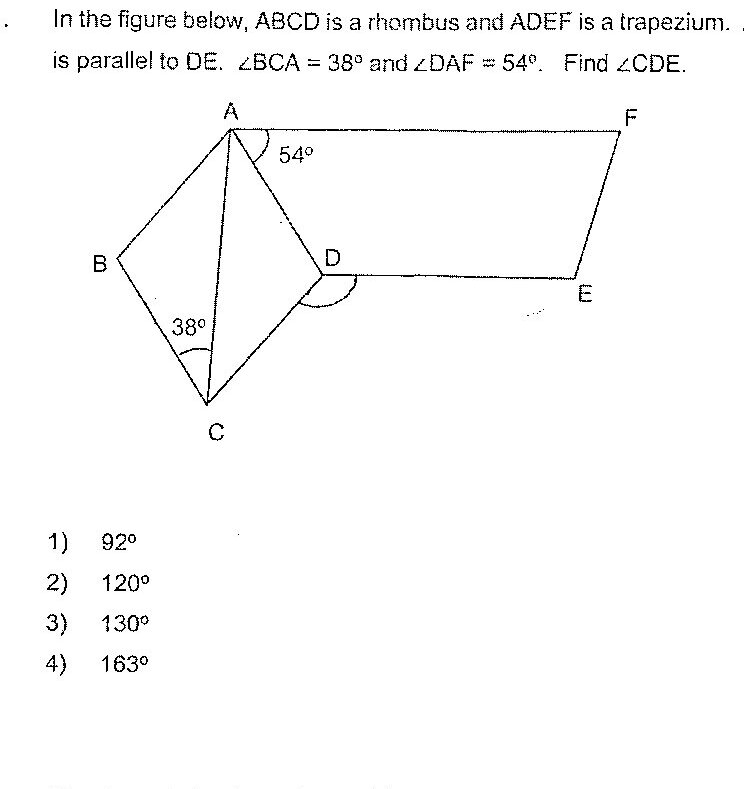
In the figure below, ABCD is a rhombus and ADEF is a trapezium. AF is parallel to DE. ∠BCA = 38° and ∠DAF = 54°. Find ∠CDE.
Joshua used a calculator to multiply a 4-digit number by a 1-digit number. For the 1-digit number, he mistakenly pressed 2 instead of 3. He got the incorrect answer of 4296. What should the correct answer be?
Find the value of 98 − 3 x (17 − 3).
How many workers were there altogether?
James bought a packet of flour to make cakes. He used an equal amount of flour for each cake. After he had used the flour to make 3 cakes, 3/4 of the packet of flour was left. He went on to bake another 5 cakes and had 1400 g of the flour left. How much flour was used for each cake?
Find the value of 2 - 1/4 - 1/3. Leave your answer as a mixed number.
Charlie needs 100 pieces of string, each of length 90 cm. The string is sold in rolls of 500 cm each. What is the least number of rolls of string that Charlie needs to buy?
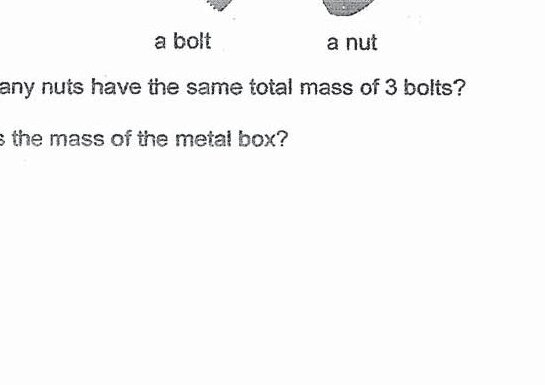
What is the mass of the metal box?
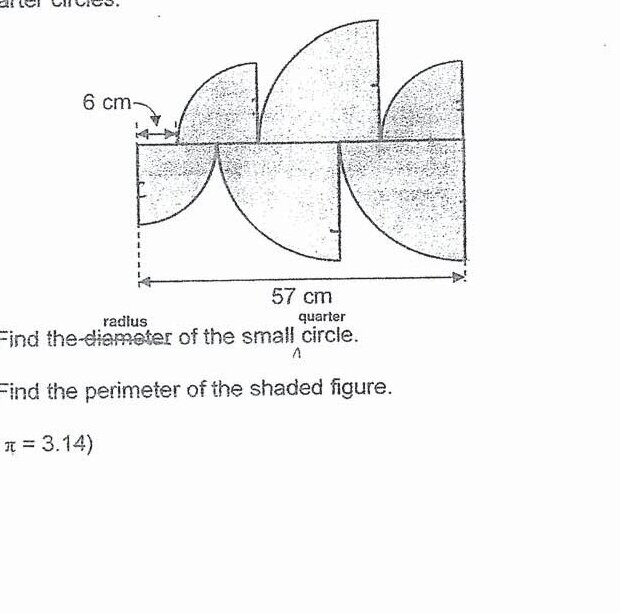
Find the diameter of the small circle.
The height of Mount Kraig is 350 000 m when rounded to the nearest thousand metres. Which of the following could be the actual height of Mount Kraig?
Express 4080 g in kg.
Mrs Ling was in school at 6.40 a.m. yesterday. She stayed in school for 9 hours and 40 minutes. What time did she leave the school yesterday?
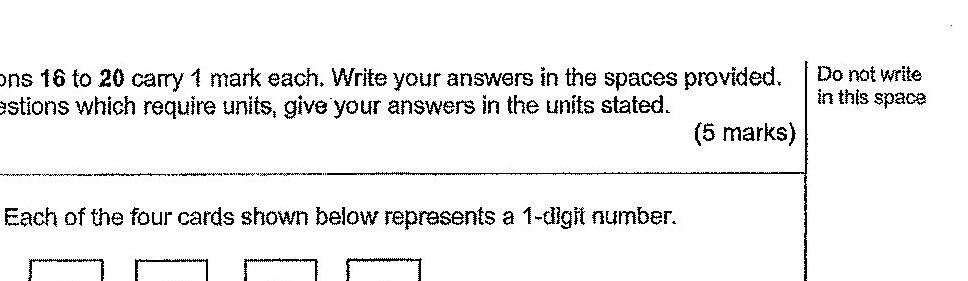
Each of the four cards shown below represents a 1-digit number. The sum of all the digits of the four cards is a multiple of 8. What is the missing digit in the card shown above?
Every student in the group donated some money.
The group consisted of 252 students.
The number of students who donated $10 was the greatest.
The total number of plastic bottles collected by the four classes is 209. Given m = 13, find the number of plastic bottles collected by 6D.
What is the total number of triangles and circles in Figure 100?
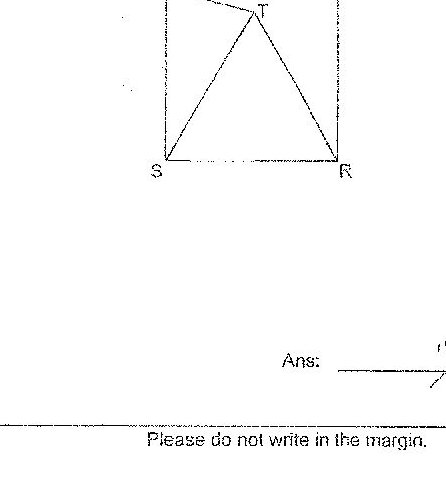
ABCD is a rhombus and CDEF is a square. ∠BAD is 124°. Find ∠BFC.

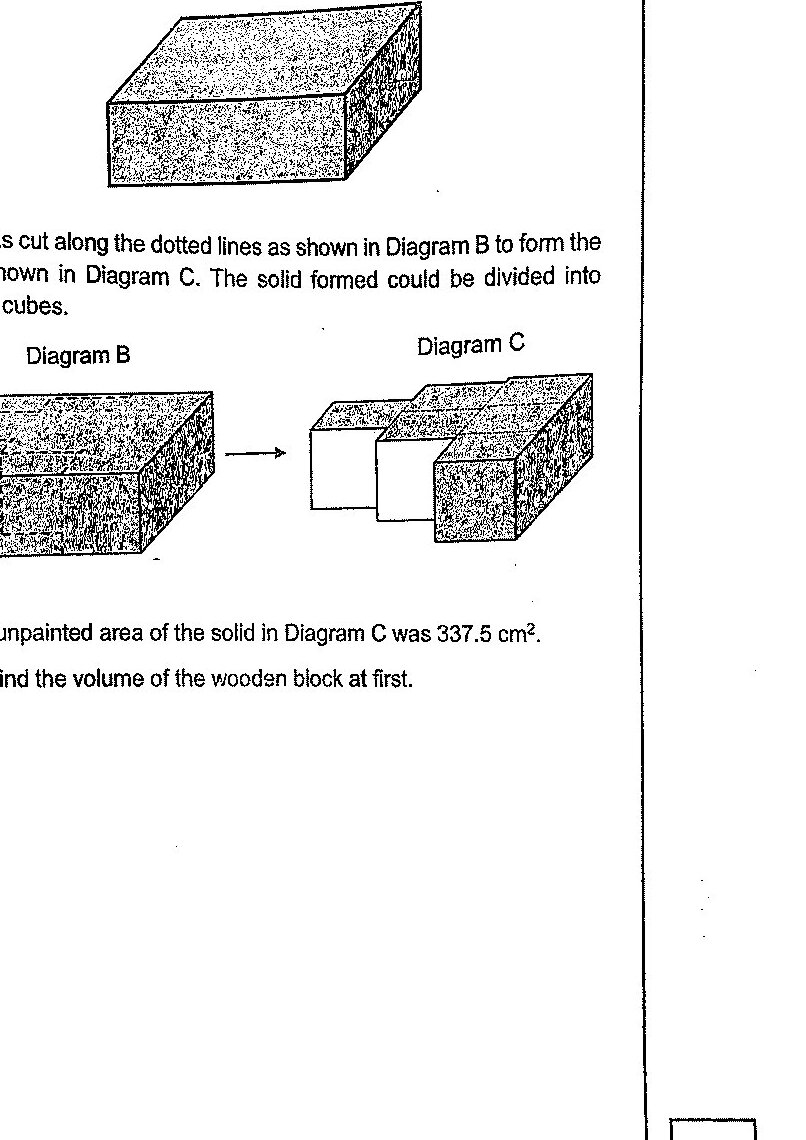
The wooden block as shown in Diagram A was dipped completely into a pail of paint. Then, it was cut along the dotted lines as shown in Diagram B to form the solid as shown in Diagram C. The solid formed could be divided into 6 identical cubes. The total unpainted area of the solid in Diagram C was 337.5 cm². (a) Find the volume of the wooden block at first.
The table shows the charges for bicycle rental. Jane rented a bicycle from 5.30 p.m. to 7.45 p.m. How much did she pay?

An entrance fee was charged to those who took part in swimming. A total of $528.75 was collected in March and April. How much was the entrance fee?

How many tarts did she sell altogether?
What is the value of the digit 9 in 485 093?
Find the sum of 305 and 139. Round the answer to the nearest hundred.
A school concert started at 3.40 p.m. and ended at 5.25 p.m. How long was the concert?
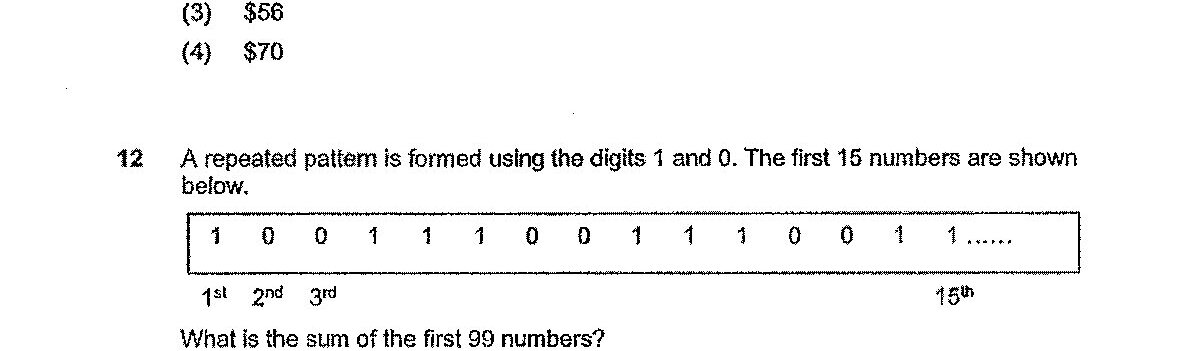
A repeated pattern is formed using the digits 1 and 0. The first 15 numbers are shown below. What is the sum of the first 99 numbers?
Past year papers cover the full exam — browse by subject below.