Cycles in Plants and Animals
Cycles in Plants and Animals - PSLE Science Study Notes
Key Concepts
Life Cycles of Plants
Flowering Plants (Complete Life Cycle):
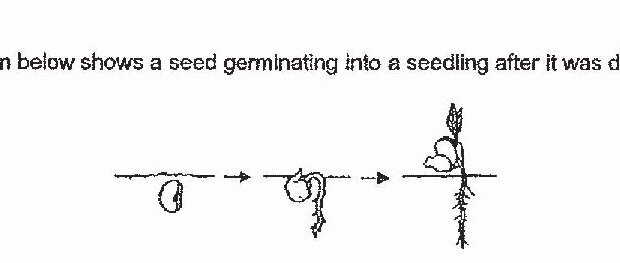
- All flowering plants go through four main stages: seed → germination → mature plant → reproduction (flowers, fruits, seeds)
- Germination is the process where a seed begins to grow into a new plant when conditions are suitable (water, air, warmth)
- The seed contains:
- Embryo (baby plant)
- Food store (provides energy for growth until the plant can make its own food)
- Seed coat (protective outer covering)
- After germination, the seedling grows into a mature plant that can produce flowers
- Flowers produce fruits which contain seeds, completing the cycle
Non-Flowering Plants:
- Examples: ferns, mosses
- Reproduce using spores instead of seeds
- Spores are tiny reproductive structures that can grow into new plants
- Life cycle: spore → young plant → mature plant → spores
Life Cycles of Animals
Complete Metamorphosis (4 stages):
- Occurs in butterflies, moths, beetles, flies, mosquitoes, bees
- Four distinct stages: egg → larva → pupa → adult
- Each stage looks completely different from the others
- Larva (e.g., caterpillar, maggot) - eating and growing stage
- Pupa (e.g., chrysalis, cocoon) - transformation stage where body is reorganized
- Adult - mature form capable of reproduction
Incomplete Metamorphosis (3 stages):
- Occurs in grasshoppers, cockroaches, dragonflies
- Three stages: egg → nymph → adult
- Nymph looks like a small adult but without fully developed wings or reproductive organs
- Nymph grows through several moults (shedding of outer skin)
- No pupa stage - gradual change from nymph to adult
Direct Development (2 stages):
- Occurs in most mammals (humans, dogs, cats) and birds
- Two stages: young → adult
- Young animals look similar to adults but are smaller and cannot reproduce
- Examples: baby → adult (humans), puppy → dog, kitten → cat
Special Life Cycles:
- Frogs and toads (amphibians): egg → tadpole → young frog → adult frog
- Tadpoles live in water, have gills and tails
- Young frogs develop lungs and legs, lose tails (this change is called metamorphosis)
Reproduction in Plants
Sexual Reproduction in Flowering Plants:
- Requires two parent parts: male (pollen) and female (ovule)
- Pollination is the transfer of pollen from the anther to the stigma
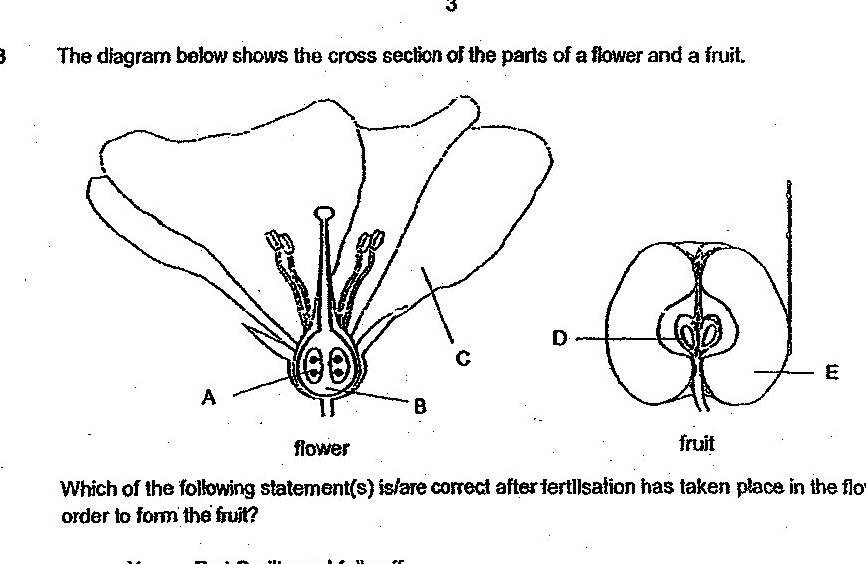
- Parts of a flower (male): anther (produces pollen) and filament (stalk that holds the anther up outside the flower). Parts of a flower (female): stigma (receives pollen), style (tube connecting stigma to ovary), ovary (contains the ovule), ovule (contains the female reproductive cell).
- Types of pollination:
- Self-pollination: pollen lands on stigma of same flower or another flower on same plant
- Cross-pollination: pollen transfers from one plant to another plant of the same species
Agents of Pollination:
-
Insect-pollinated flowers have:
- Brightly colored petals to attract insects
- Scent/nectar to attract insects
- Sticky/spiky pollen that clings to insect bodies
- Sticky stigma to catch pollen from insects
- Anthers and stigmas are positioned inside the flower so that insects brush against them when entering to collect nectar, picking up or depositing pollen.
- Examples: hibiscus, bougainvillea
-
Wind-pollinated flowers have:
- Small, dull-colored petals (or no petals)
- No scent or nectar
- Light, smooth pollen produced in large quantities
- Long filaments that hold anthers outside the flower and allow them to sway in the wind, releasing pollen into the air.
- Feathery stigma to catch wind-blown pollen
- Examples: grasses, corn
After Pollination:
- After pollen lands on the stigma, a pollen tube grows from the pollen grain down through the style and into the ovary. The male reproductive cell travels through the pollen tube and enters the ovule, where it fuses with the female reproductive cell. This fusion is fertilisation.
- Fertilization occurs: male cell from pollen joins with female cell (ovule)
- Ovule develops into a seed
- Ovary develops into a fruit
- Fruits help in seed dispersal (spreading seeds away from parent plant)
Seed Dispersal Methods:
- Wind: seeds are light with wing-like structures or hairy parachutes (e.g., lalang, dandelion). Wing-like structures increase the seed’s surface area and air resistance, slowing descent so wind can carry seeds further from the parent plant (e.g. Shorea).
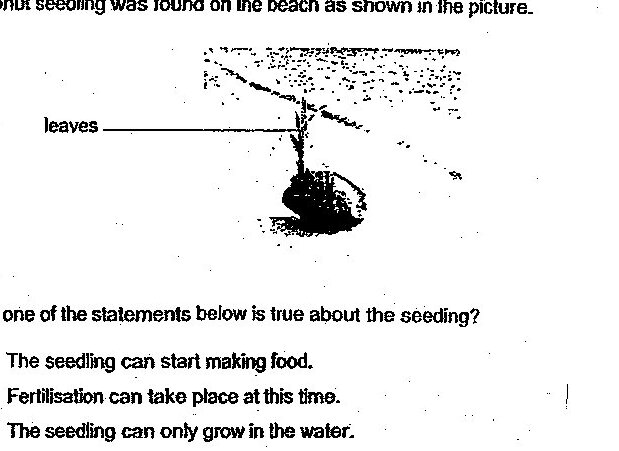
- Water: fruits/seeds have air spaces or fibrous husks to float (e.g., coconut). The fibrous husk of the coconut traps air, allowing the fruit to float and travel on water currents.
- Animals:
- Eaten fruits with seeds that pass through digestive system (e.g., papaya, guava)
- Hooks or spines that stick to animal fur (e.g., cocklebur, Bidens)
- Explosive action: pods burst open forcefully when ripe (e.g., balsam pods). Seed pods split along lines of weakness when ripe, flinging seeds out with force.
- Diagram questions: identify the seed distribution pattern shown, name the dispersal method, then link the plant structure to its function and connect back to the pattern.
Asexual Reproduction (Vegetative Reproduction):
- Reproduction using only one parent
- No flowers, pollination, or seeds involved
- New plants are identical to parent plant
- Methods:
- Stem cuttings: new plants grow from cut stems (e.g., roses, bougainvillea)
- Runners: horizontal stems along ground produce new plants (e.g., strawberry, grass)
- Bulbs: underground storage organs (e.g., onion)
- Tubers: swollen underground stems (e.g., potato)
Reproduction in Animals
Sexual Reproduction:
- Requires two parents (male and female)
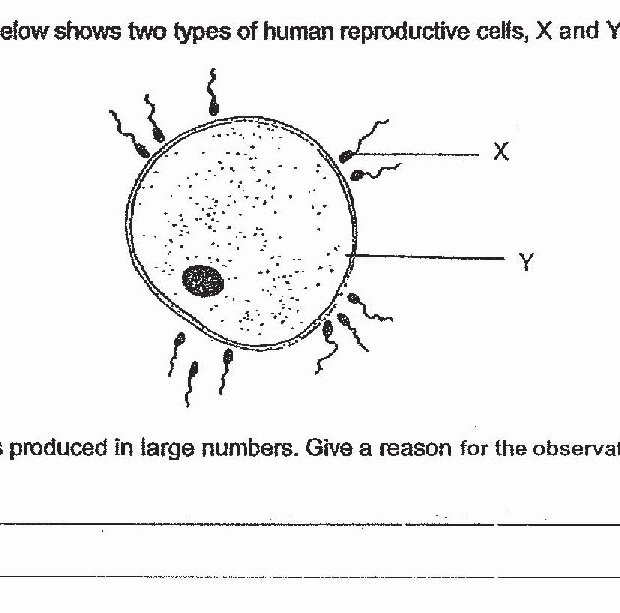
- Fertilization: male sex cell (sperm) joins with female sex cell (egg/ovum)
- Offspring show characteristics from both parents
- Creates variation in offspring
External Fertilization:
- Occurs outside the body
- Common in animals living in water
- Female releases eggs into water, male releases sperm over eggs
- Large numbers of eggs produced (many don’t survive)
- Examples: fish, frogs, toads
Internal Fertilization:
- Occurs inside the female’s body
- Common in land animals
- Male deposits sperm inside female’s body
- Fewer eggs produced but better protected
- Examples: mammals, birds, reptiles, insects
Development After Fertilization:
Egg-laying animals (Oviparous):
- Fertilized egg develops outside mother’s body
- Examples: birds, most reptiles, fish, amphibians, insects
- Birds and some reptiles care for eggs until hatching
Live birth (Viviparous):
- Fertilized egg develops inside mother’s body
- Young born alive after development period
- Examples: most mammals (humans, dogs, cats, whales)
Parental Care:
- High parental care: fewer young produced, parents protect and feed young (e.g., humans, birds, elephants)
- Low/no parental care: many eggs/young produced, little or no care (e.g., fish, insects, frogs)
Important Definitions
Germination: The process by which a seed begins to grow into a new plant under suitable conditions (presence of water, air, and warmth).
Metamorphosis: A series of changes in body form during the life cycle of certain animals (e.g., butterflies, frogs).
Complete Metamorphosis: A type of life cycle with four distinct stages (egg → larva → pupa → adult) where each stage looks completely different.
Incomplete Metamorphosis: A type of life cycle with three stages (egg → nymph → adult) where the nymph looks similar to the adult.
Pollination: The transfer of pollen grains from the anther (male part) to the stigma (female part) of a flower.
Fertilization: The fusion (joining) of male and female sex cells to form a new individual.
Seed Dispersal: The spreading of seeds away from the parent plant to reduce competition for light, water, and nutrients.
Sexual Reproduction: Reproduction involving two parents where male and female sex cells join together (offspring show variation).
Asexual Reproduction: Reproduction involving only one parent without the joining of sex cells (offspring are identical to parent).
External Fertilization: Fertilization that occurs outside the body, usually in water.
Internal Fertilization: Fertilization that occurs inside the female’s body.
Oviparous: Animals that lay eggs where the young develop and hatch outside the mother’s body.
Viviparous: Animals that give birth to live young after development inside the mother’s body.
Larva: The immature feeding stage in complete metamorphosis (e.g., caterpillar, maggot).
Pupa: The transformation stage in complete metamorphosis where the larva changes into an adult.
Nymph: The immature stage in incomplete metamorphosis that looks like a small adult.
Worked Examples
Example 1: Identifying Type of Metamorphosis
Question: A mosquito goes through the following stages in its life cycle: egg → larva (wriggler) → pupa (tumbler) → adult mosquito. What type of life cycle does the mosquito have? Explain your answer.
Step-by-step solution:
-
Count the number of stages: egg → larva → pupa → adult = 4 stages
-
Check if there is a pupa stage: Yes, there is a pupa stage (tumbler)
-
Check if each stage looks different:
- Larva (wriggler) lives in water, looks like a worm
- Pupa (tumbler) is a transformation stage in water
- Adult mosquito has wings and lives on land
- All stages look completely different
-
Conclusion: The mosquito has complete metamorphosis because:
- It has 4 distinct stages (egg → larva → pupa → adult)
- Each stage looks completely different from the others
- It has a pupa stage where transformation occurs
Answer: The mosquito undergoes complete metamorphosis because it has four distinct stages (egg, larva, pupa, adult) and each stage looks completely different from the others. The presence of a pupa stage is a key characteristic of complete metamorphosis.
Example 2: Comparing Insect-Pollinated and Wind-Pollinated Flowers
Question: Compare the characteristics of insect-pollinated flowers and wind-pollinated flowers. Give two differences.
Step-by-step solution:
- Make a comparison table:
| Feature | Insect-Pollinated | Wind-Pollinated |
|---|---|---|
| Petals | Brightly colored, large | Small, dull-colored or no petals |
| Scent | Present (to attract insects) | Absent |
| Nectar | Present (to attract insects) | Absent |
| Pollen | Sticky/spiky, smaller amounts | Light/smooth, large amounts |
| Stigma | Sticky (to catch pollen from insects) | Feathery (to catch wind-blown pollen) |
- Select two clear differences that contrast with each other
Answer:
Difference 1:
- Insect-pollinated flowers have brightly colored petals to attract insects
- Wind-pollinated flowers have small, dull-colored petals or no petals as they do not need to attract insects
Difference 2:
- Insect-pollinated flowers have sticky or spiky pollen that can cling to insect bodies
- Wind-pollinated flowers have light, smooth pollen that can be carried by wind easily
Example 3: Identifying Method of Seed Dispersal
Question: Rambutan fruits are red and hairy on the outside. Inside the fruit is a sweet, juicy flesh that monkeys and birds like to eat. The seed inside is hard and cannot be digested.
(a) What is the method of seed dispersal for rambutan? (b) Explain how the characteristics of the rambutan fruit help in this method of dispersal.
Step-by-step solution:
(a) Identify the method:
-
Look for clues in the description:
- Fruit is eaten by animals (monkeys, birds)
- Seed is hard and cannot be digested
- This suggests seeds pass through the animal
-
Conclusion: Method is dispersal by animals (eaten)
(b) Explain the characteristics:
-
Identify relevant characteristics mentioned:
- Red and hairy exterior
- Sweet, juicy flesh
- Hard seed
-
Link each characteristic to its function:
| Characteristic | Function in dispersal |
|---|---|
| Red exterior | Attracts animals to the fruit |
| Sweet, juicy flesh | Encourages animals to eat the fruit |
| Hard seed | Protects seed from digestion, so it passes through animal’s body intact |
Answer:
(a) The method of seed dispersal is dispersal by animals (specifically, animals that eat the fruit).
(b) The rambutan fruit has characteristics that help in this dispersal method:
- The red exterior attracts animals (like monkeys and birds) to the fruit
- The sweet, juicy flesh encourages animals to eat the fruit
- The hard seed cannot be digested, so it passes through the animal’s digestive system and is deposited in the animal’s droppings, often far from the parent plant
Common Mistakes to Avoid
Life Cycles
❌ Mistake 1: Confusing complete and incomplete metamorphosis
- Students often forget that complete metamorphosis has 4 stages (including pupa) while incomplete metamorphosis has 3 stages (no pupa)
- Remember: “Complete” means completely different stages, “incomplete” means the nymph looks similar to adult
❌ Mistake 2: Not naming the stages correctly
- Using general terms like “baby” instead of specific terms
- Correct terms: larva (not baby caterpillar), nymph (not baby grasshopper), tadpole (not baby frog)
❌ Mistake 3: Forgetting that tadpoles live in water and breathe with gills
- Students often forget to mention that tadpoles have gills and tails, while adult frogs have lungs and legs
- Always mention the key differences: tadpole = gills + tail + lives in water; adult frog = lungs + legs + lives on land and water
❌ Mistake 4: Missing stages in life cycles
- Students sometimes skip the “young/mature plant” stage in flowering plant cycle
- Always include all stages: seed → germination → mature plant → reproduction
Reproduction in Plants
❌ Mistake 5: Confusing pollination with fertilization
- Pollination = transfer of pollen to stigma
- Fertilization = joining of male and female sex cells
- These are TWO DIFFERENT processes! Pollination happens BEFORE fertilization
❌ Mistake 6: Mixing up characteristics of insect-pollinated and wind-pollinated flowers
- Read the question carefully - don’t write insect flower characteristics for wind flowers
- Make a clear comparison showing opposite characteristics
❌ Mistake 7: Not explaining HOW characteristics help in seed dispersal
- Don’t just list characteristics - explain their function
- Wrong: “The seed has hooks”
- Correct: “The seed has hooks that catch onto animal fur, so the animal carries the seed away from the parent plant”
❌ Mistake 8: Confusing seed dispersal methods
- Coconut is dispersed by water, not wind (despite being light - it floats!)
- Lalang is dispersed by wind, not animals
❌ Mistake 9: Thinking asexual reproduction needs two parents
- Asexual = ONE parent only
- Sexual = TWO parents needed
- Offspring from asexual reproduction are identical to parent
❌ Mistake: Saying pollen grains fuse with ovules
- Pollen grains and ovules are structures, not cells
- It is the cells inside them that fuse
- Wrong: “pollen grain fuses with ovule”
- Correct: “the male reproductive cell fuses with the female reproductive cell”
❌ Mistake: Incomplete chains in consequence questions
- When asked what happens if a part is removed (e.g., stigma), trace every step to the final outcome
- Wrong: “pollen cannot land on the stigma, so fertilisation cannot occur”
- Correct: “pollen cannot land on stigma → pollen tube cannot grow down style → male reproductive cell cannot reach ovule → fertilisation cannot occur → ovule cannot develop into seed → ovary cannot develop into fruit”
❌ Mistake (Seed Dispersal - Animal Ingestion): Forgetting the word “undigestible” — this is the key term that proves seeds survive the animal’s digestive system and must appear in the answer.
❌ Mistake (Seed Dispersal - Animal Ingestion): Not stating that the animal moves away from the parent plant before depositing the seeds — without this, you have not explained that dispersal actually occurs.
❌ Mistake (Seed Dispersal - Animal Ingestion): Using informal language such as “pooped out” — use scientific terms: “deposited in the animal’s droppings” or “passes out of the digestive system”.
❌ Mistake (Diagram questions): Not referencing the diagram — answers must explicitly state what the diagram shows (e.g. “As seen in the diagram, seeds are scattered randomly around the parent plant”) before explaining the dispersal method.
Reproduction in Animals
❌ Mistake 10: Confusing external and internal fertilization
- External = outside body, usually in water (fish, frogs)
- Internal = inside female’s body (mammals, birds, insects)
❌ Mistake 11: Thinking all animals that lay eggs have external fertilization
- Birds lay eggs BUT have internal fertilization
- Reptiles lay eggs BUT have internal fertilization
- Location of fertilization ≠ location of development
❌ Mistake 12: Not connecting number of offspring to parental care
- Many offspring → low/no parental care (e.g., fish lay thousands of eggs)
- Few offspring → high parental care (e.g., humans usually have one baby at a time)
❌ Mistake 13: Wrong examples for animals
- Whale gives live birth (it’s a mammal!), doesn’t lay eggs
- Penguin lays eggs (it’s a bird!), doesn’t give live birth
Exam Tips
Keywords to Use for Full Marks
For Life Cycles:
- Use proper stage names: embryo, germination, mature plant, reproduction (plants)
- Use proper stage names: egg, larva, pupa, adult (complete metamorphosis)
- Use proper stage names: egg, nymph, adult (incomplete metamorphosis)
- When describing butterfly life cycle, mention: “Each stage looks completely different”
- When describing grasshopper life cycle, mention: “Nymph looks similar to adult but smaller with undeveloped wings”
For Pollination:
- Use the phrase: “Pollen is transferred from anther to stigma”
- For insect pollination: “brightly colored petals attract insects”
- For wind pollination: “large amounts of light pollen are carried by wind”
- Always mention BOTH parts when comparing (don’t just describe one type)
For Fertilization:
- Use the phrase: “Male sex cell joins with female sex cell”
- Mention location: “Fertilization occurs outside/inside the body”
For Seed Dispersal:
- Always explain HOW the characteristic helps:
- “Wings allow seeds to be carried by wind”
- “Hooks catch onto animal fur to be carried away”
- “Sweet flesh attracts animals to eat the fruit”
- Use the phrase: “Seeds are dispersed away from parent plant to reduce competition for…”
- Complete the sentence with: “light, water, and nutrients/space”
For Reproduction Methods:
- Sexual reproduction: “requires two parents” and “offspring show variation”
- Asexual reproduction: “requires only one parent” and “offspring are identical to parent”
Answering Different Question Types
“State the type of…” questions (1 mark):
- Give a direct answer: “Complete metamorphosis” or “Wind pollination”
- No need for explanation unless asked
“Explain…” questions (2-3 marks):
- Give reason(s) with linking words
- Use “because”, “so that”, “in order to”
- Example: “The flower has brightly colored petals to attract insects so that insects will carry pollen from one flower to another.”
“Compare…” questions:
- Present both similarities AND differences if asked for comparison
- Use comparison words: “while”, “whereas”, “but”, “however”
- Structure: “A has X whereas B has Y”
“What would happen if [flower part] is removed?” questions (2-3 marks):
- Trace the full chain of events, step by step:
- State what that part does normally
- State what fails first without it
- Continue the chain: no pollen tube → no fertilisation → no seed/fruit
- Example: “If the stigma is removed, pollen cannot land on the stigma. Therefore, the pollen tube cannot grow. The male reproductive cell cannot reach the ovule, so fertilisation cannot occur. The ovule will not develop into a seed and the ovary will not develop into a fruit.”
Three-step method for flower characteristic questions:
- Identify the characteristic from the diagram (e.g., feathery stigma)
- Link it to its function (e.g., increases surface area to catch airborne pollen)
- Connect to the outcome (e.g., this is an adaptation for wind pollination) Incomplete answers that only name the characteristic without explaining its function will lose marks.
Diagram questions:
- Label all parts with straight lines (use ruler if possible)
- Don’t cross label lines
- Write labels horizontally (easier to read)
- Use scientific names (stigma, anther) not “top part”, “pollen holder”
Seed Dispersal Diagram Questions
Three-step framework:
- Identify the seed distribution pattern from the diagram (e.g. seeds scattered randomly in all directions)
- Name the dispersal method based on the pattern
- Link specific plant structures to their functions and connect back to the observed pattern
A complete answer must include all four elements:
- The dispersal method
- Explicit evidence from the diagram
- The relevant plant part and its function
- A clear cause-and-effect link
Scoring keywords by dispersal method:
| Method | Must-use keywords |
|---|---|
| Wind | wing-like structures, surface area, air resistance |
| Water | fibrous husk, traps air, float |
| Explosive | lines of weakness, flung out, force |
| Animal (ingestion) | fleshy fruit, undigestible seeds, droppings, moves away from parent plant |
| Animal (attachment) | hooks, fur, carried away |
Describing distribution patterns in diagrams:
- Use “scattered randomly” for wind or explosive dispersal
- Use “directional pattern” where seeds spread in one direction (e.g. downstream for water)
Mark-Earning Phrases
Use these complete phrases in your answers:
-
“The seed contains an embryo (baby plant), food store, and seed coat”
-
“For germination, the seed needs water, air, and warmth”
-
“Pollination is the transfer of pollen from the anther to the stigma”
-
“After fertilization, the ovule develops into a seed and the ovary develops into a fruit”
-
“Seeds need to be dispersed away from the parent plant to reduce competition for light, water, and nutrients/space”
-
“In complete metamorphosis, there are four stages (egg, larva, pupa, adult) and each stage looks completely different”
-
“In incomplete metamorphosis, there are three stages (egg, nymph, adult) and the nymph looks similar to the adult”
-
“External fertilization occurs outside the body and is common in animals that live in water”
-
“Internal fertilization occurs inside the female’s body and is common in land animals”
-
“Sexual reproduction involves two parents and produces offspring with variation”
-
“Asexual reproduction involves only one parent and produces offspring that are identical to the parent”
Quick Summary
✓ Life Cycles - Plants:
- Flowering plant cycle: seed → germination → mature plant → reproduction (flowers → fruits → seeds)
- Seeds need water, air, and warmth for germination
- Non-flowering plants reproduce using spores instead of seeds
✓ Life Cycles - Animals:
- Complete metamorphosis = 4 stages (egg → larva → pupa → adult); each stage looks completely different; examples: butterfly, mosquito, beetle
- Incomplete metamorphosis = 3 stages (egg → nymph → adult); nymph looks similar to adult; examples: grasshopper, cockroach
- Direct development = 2 stages (young → adult); young looks like small adult; examples: humans, dogs, chickens
- Frog life cycle: egg → tadpole (gills, tail, lives in water) → young frog → adult frog (lungs, legs, lives on land and water)
✓ Pollination:
- Pollination = transfer of pollen from anther to stigma (happens BEFORE fertilization)
- Insect-pollinated: brightly colored petals, scent, nectar, sticky pollen, sticky stigma
- Wind-pollinated: small/dull petals, no scent/nectar, light pollen (large amounts), feathery stigma
✓ Fertilization & Fruit Formation:
- Fertilization = joining of male cell (from pollen) with female cell (ovule)
- After fertilization: ovule → seed; ovary → fruit
✓ Seed Dispersal:
- Purpose: spread seeds away from parent plant to reduce competition for light, water, nutrients, space
- Wind: light seeds with wings or parachutes (lalang, dandelion)
- Water: floating seeds/fruits with air spaces (coconut)
- Animals: eaten fruits with hard seeds (papaya, guava) OR hooks that catch on fur (cocklebur)
- Explosive: pods burst open when ripe (balsam)
✓ Reproduction in Plants:
- Sexual: needs two parts (pollen + ovule), produces variation
- Asexual (vegetative): needs only one parent, offspring identical to parent, methods include stem cuttings, runners, bulbs, tubers
✓ Reproduction in Animals:
- Sexual reproduction: needs male + female, produces variation
- External fertilization: outside body, in water, many eggs, low parental care (fish, frogs)
- Internal fertilization: inside female’s body, fewer eggs, higher parental care (mammals, birds, reptiles)
- Oviparous = lay eggs (birds, reptiles, fish, amphibians, insects)
- Viviparous = give live birth (most mammals including whales and dolphins)
✓ Key Comparisons to Remember:
- Pollination ≠ fertilization (two different processes)
- External fertilization ≠ laying eggs (birds have internal fertilization but lay eggs)
- Complete metamorphosis (4 stages, has pupa) ≠ incomplete metamorphosis (3 stages, no pupa)
- Sexual (2 parents, variation) ≠ asexual (1 parent, identical offspring)
End of Study Notes - Review diagrams and practice drawing life cycles regularly for best exam preparation!
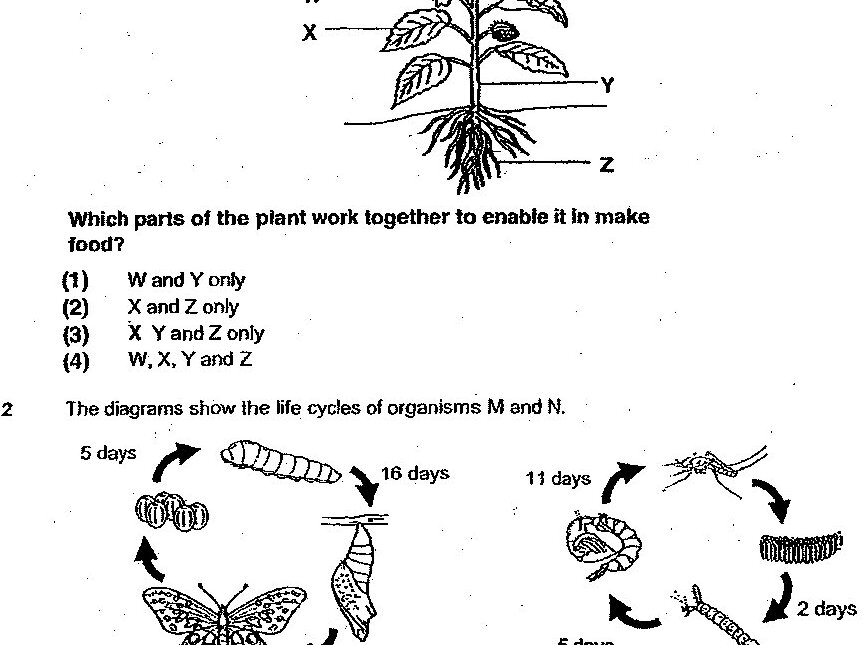
The diagrams show the life cycles of organisms M and N. Based on the information above only, which of the following statement(s) about organisms M and N is/are true? A: The young of N resembles its adult but the young of M does not. B: The pupa of N takes a longer time to develop into an adult than M. C: The larva of N takes a longer time to develop into an adult than M. D: The young of N feeds on leaves only but the young of M does not.
Which of the following statement(s) is/are correct after fertilisation has taken place in the flower in order to form the fruit? X - Part C wilts and falls off. Y - Part A develops into part D. Z - Part B develops into part E.
A coconut seedling was found on the beach as shown in the picture. Which one of the statements below is true about the seedling?
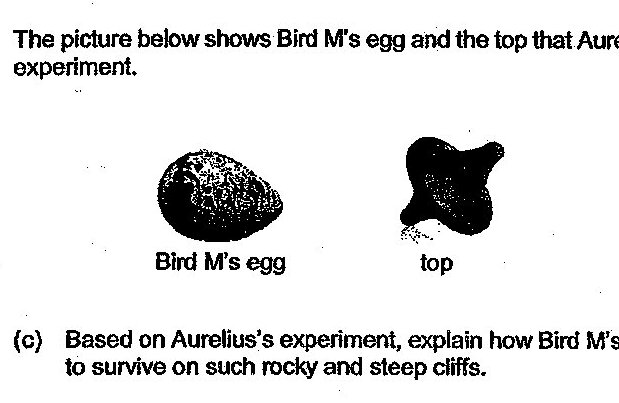
Based on Aurelius's experiment, explain how Bird M's egg is adapted to survive on such rocky and steep cliffs.
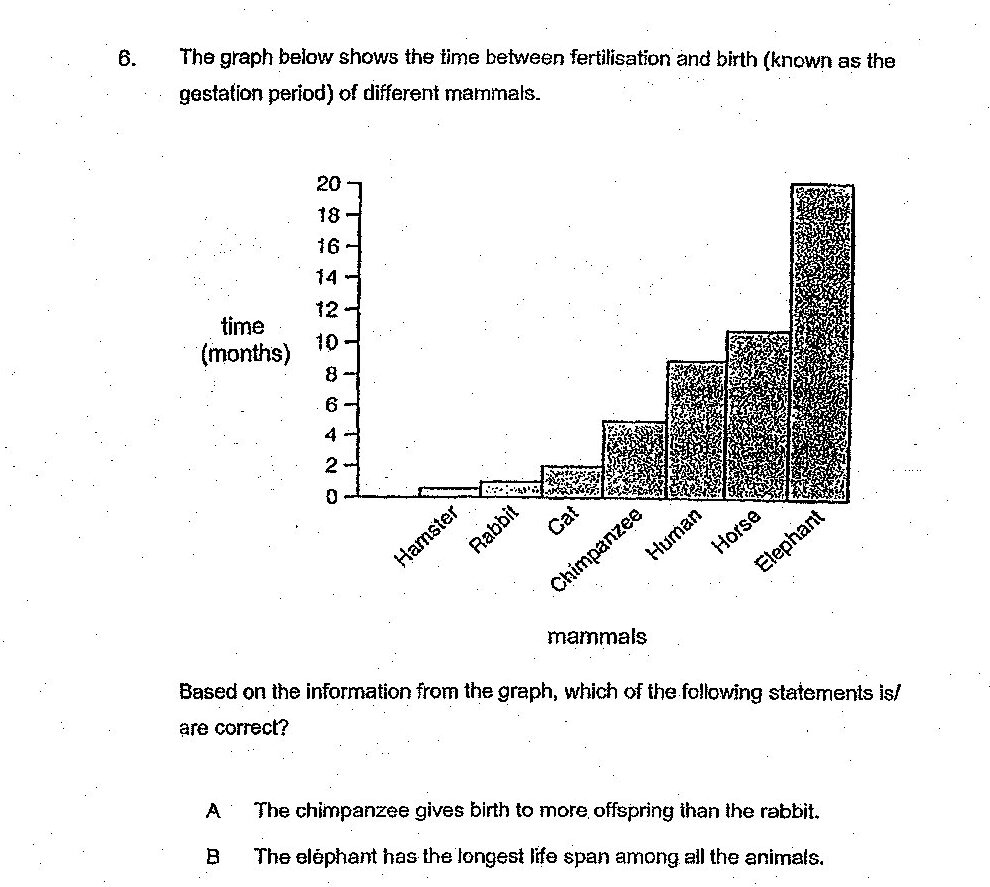
The graph below shows the time between fertilisation and birth (known as the gestation period) of different mammals. Based on the information from the graph, which of the following statements is/are correct?
Explain how by laying many eggs each time can help insect X in their survival.
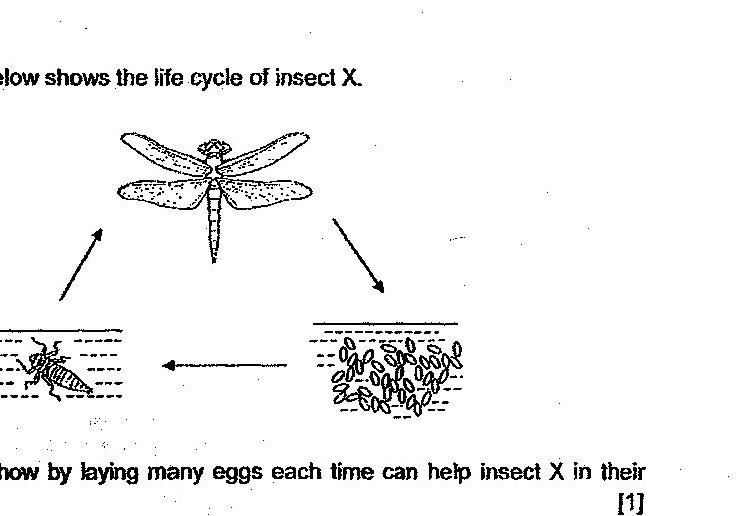
The nymphs of insect X live in water while the adult insect X lives out of water. This helps insect X to survive better. Suggest two advantages for the young and the adult to live in different surroundings.
Study the diagrams of the two life cycles as shown below. Which of the following describe the characteristics at stages A, B and C, respectively?
![Two life cycle diagrams shown. Left cycle labeled A: mosquito → larva → [stage A] → [stage B] → back to mosquito. Right cycle: egg → grasshopper → [stage C] → back to egg. Stages A, B, and C are marked in boxes.](/assets/question-images/p6_P6_Science_SA2_2018_-_Methodist_Girls_p3_q2.jpg)
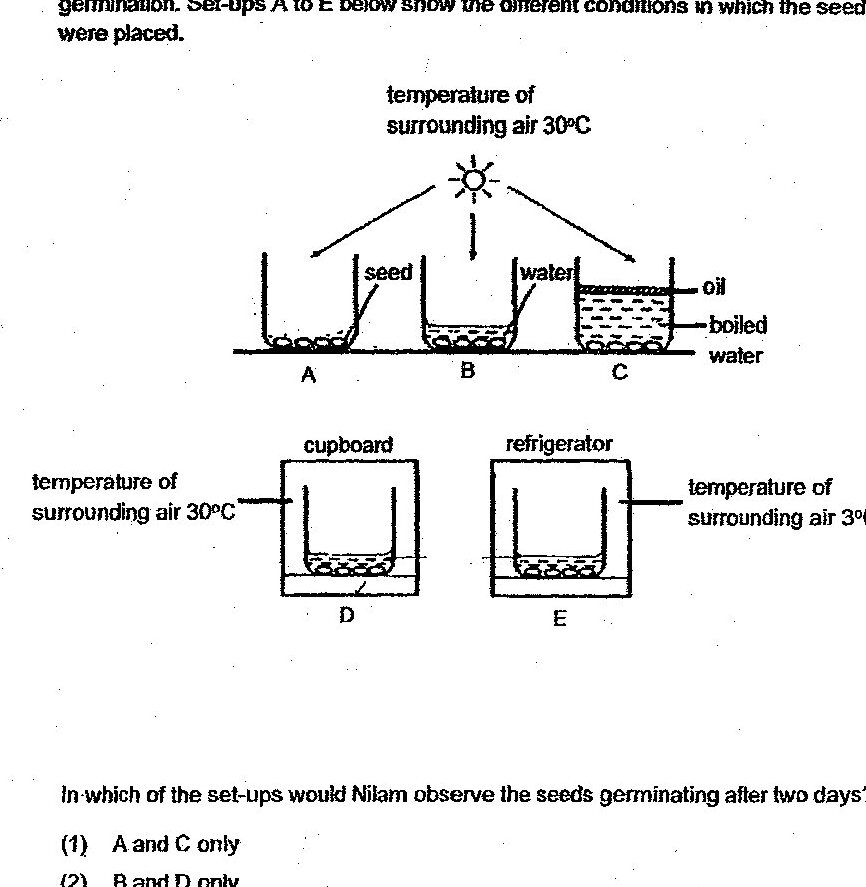
In which of the set-ups would Nilam observe the seeds germinating after two days?
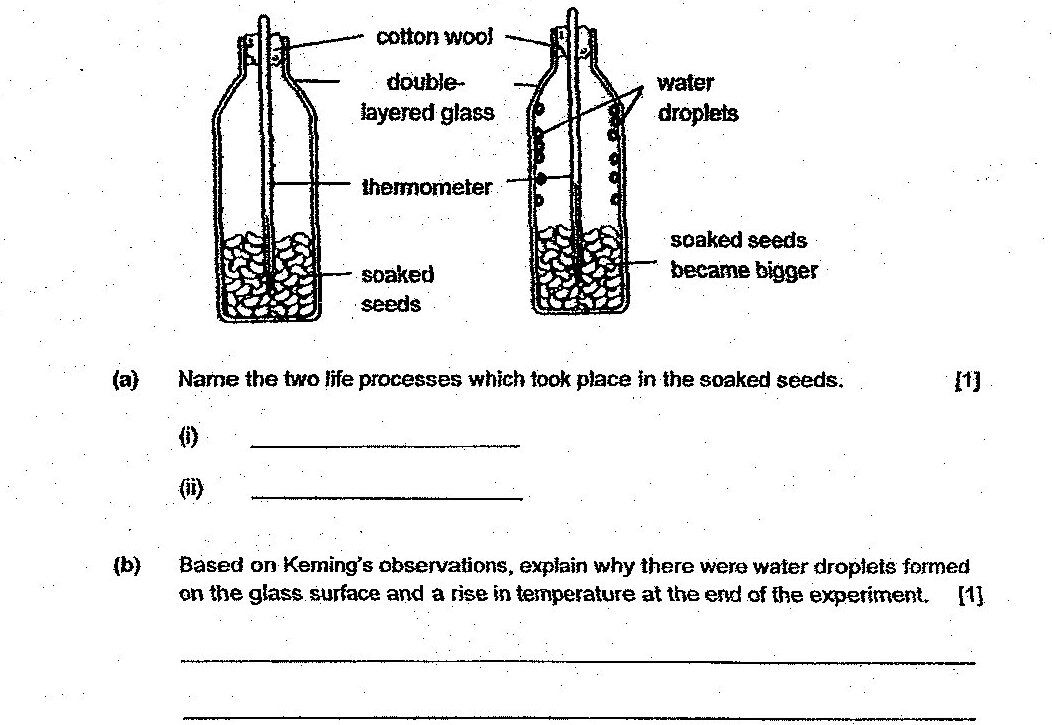
Name the two life processes which took place in the soaked seeds.
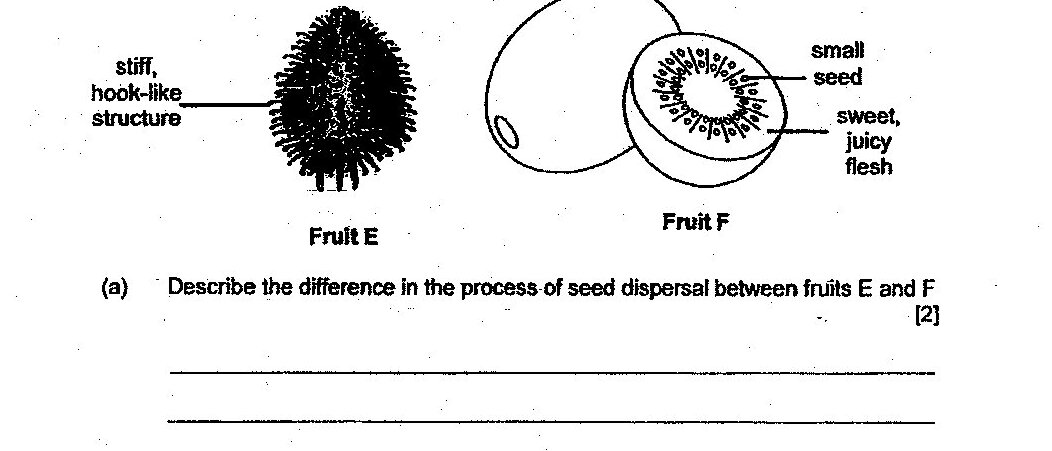
Describe the difference in the process of seed dispersal between fruits E and F
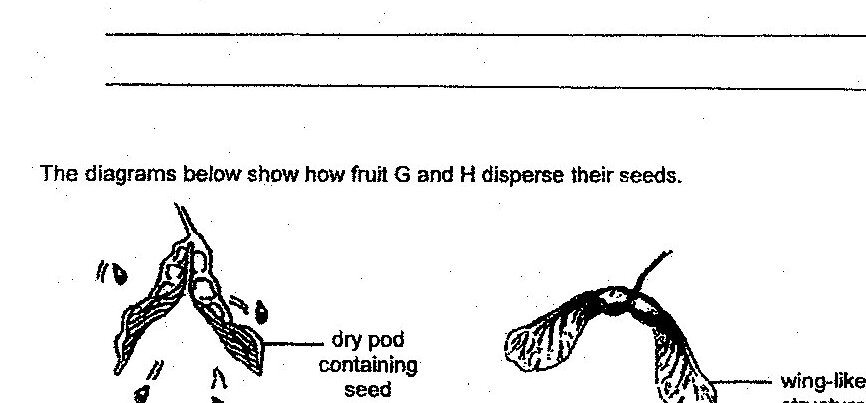
State one disadvantage of fruit G's method of seed dispersal compared to fruit H's method of seed dispersal in the presence of wind.
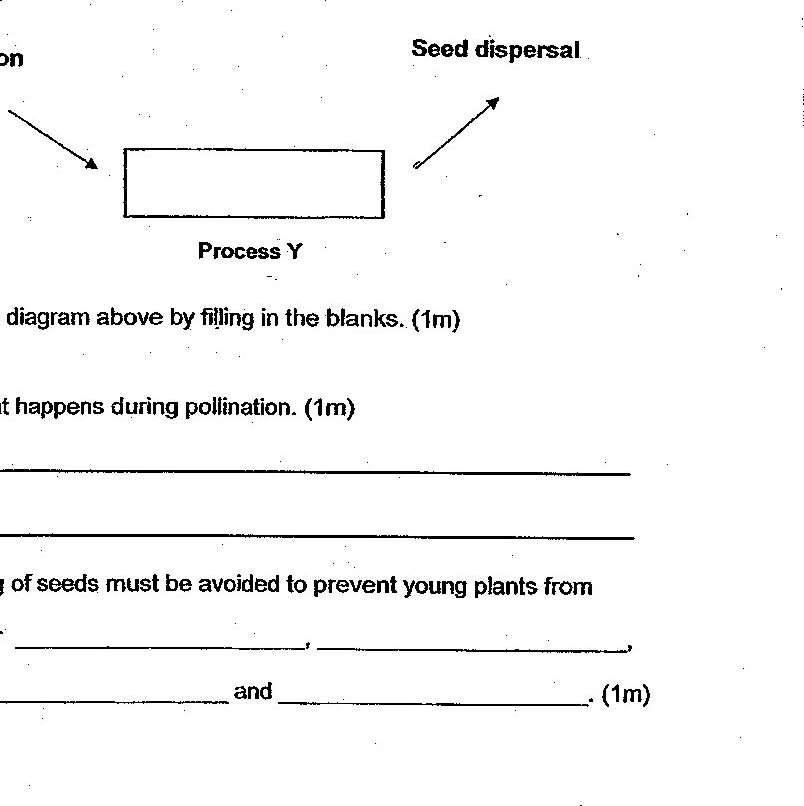
Describe what happens during pollination.
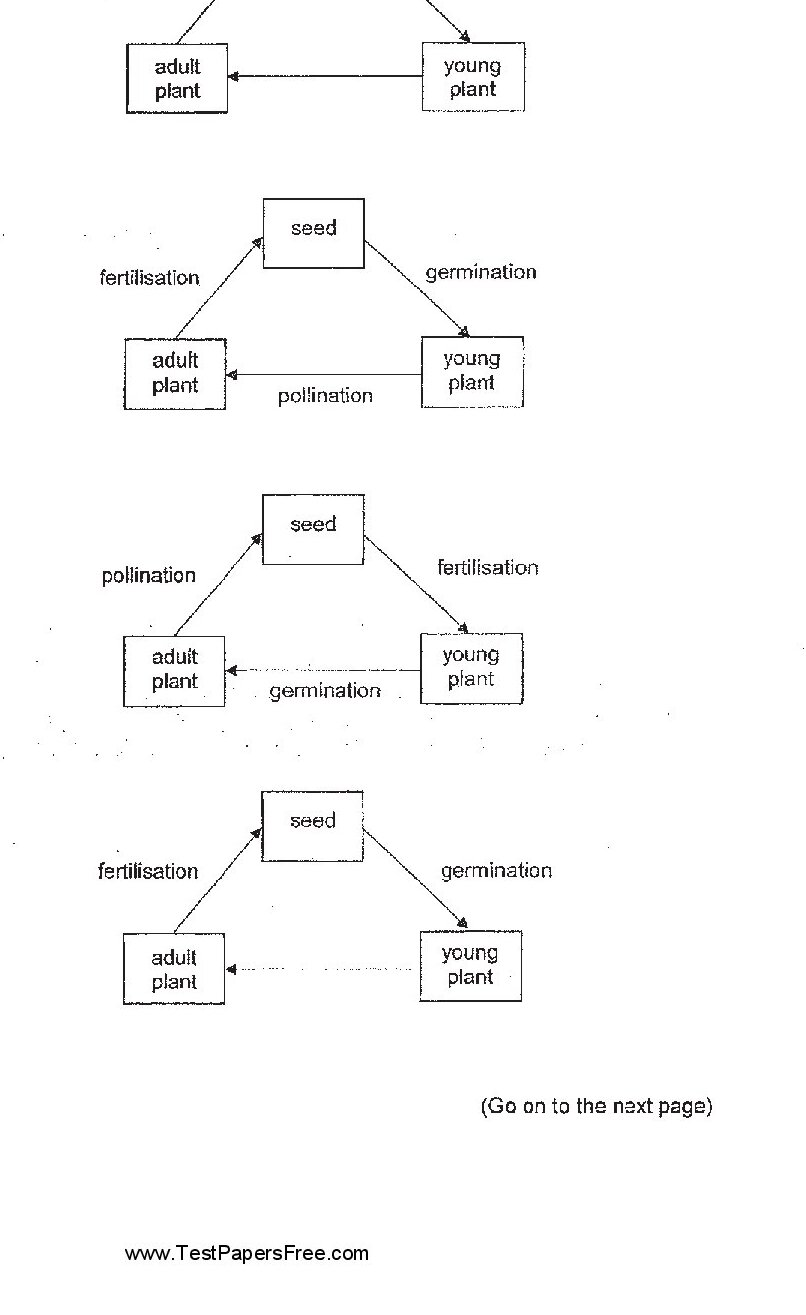
Which of the following diagrams shows the correct order of stages and processes in the life cycle of a flowering plant?
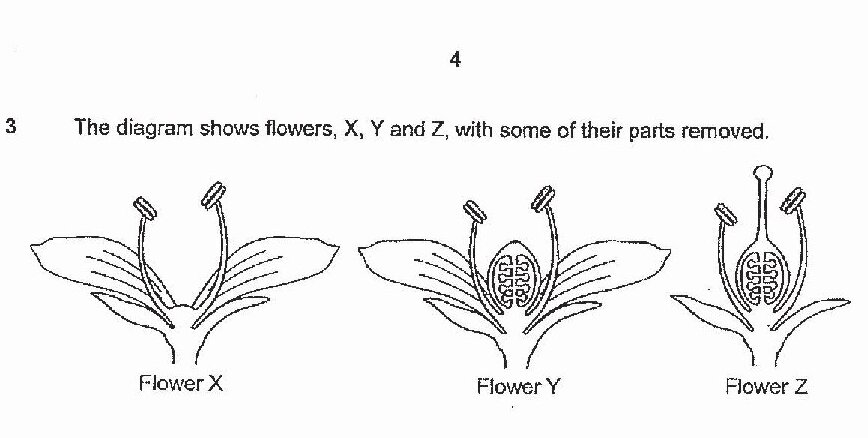
The diagram shows flowers, X, Y and Z, with some of their parts removed. Charlie sprinkled some pollen grains from a similar flower over flowers X, Y and Z. The flowers were observed for the formation of fruits. Which flower(s) would most likely develop into a fruit?
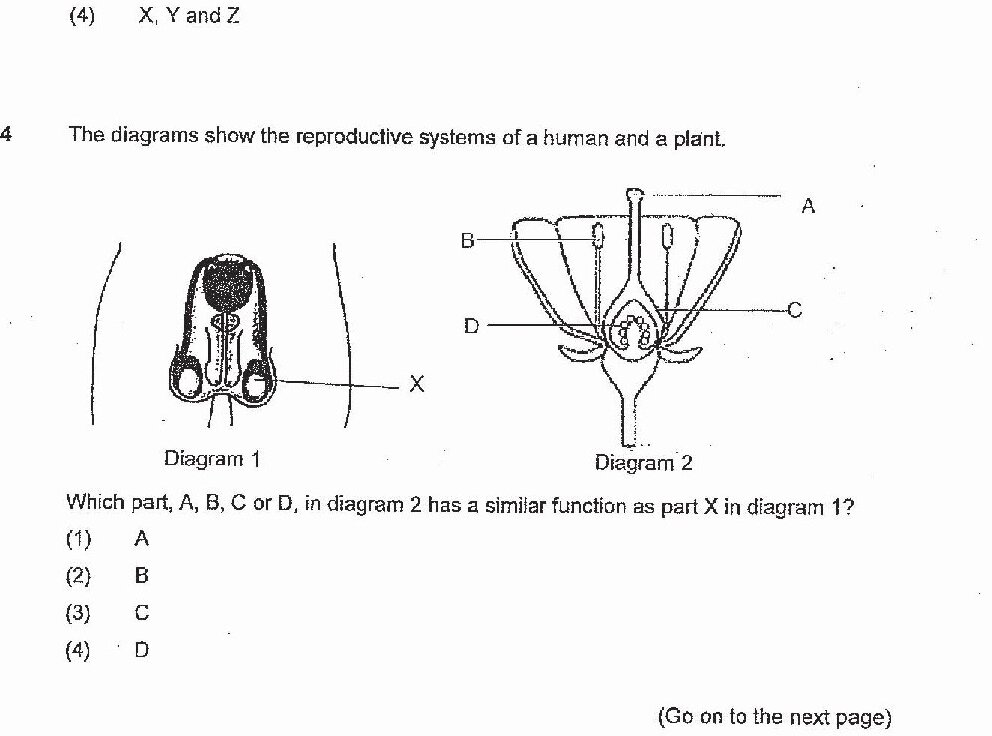
The diagrams show the reproductive systems of a human and a plant. Which part, A, B, C or D, in diagram 2 has a similar function as part X in diagram 1?
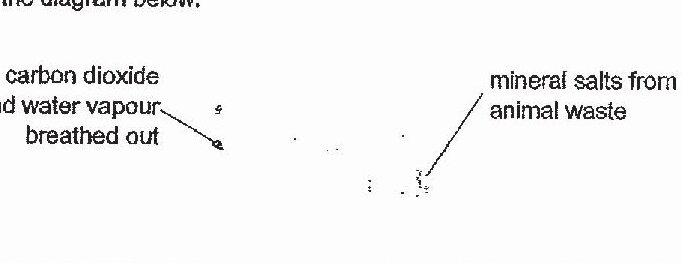
Study the diagram below. Which of the following substances will be returned to the environment and be recycled?
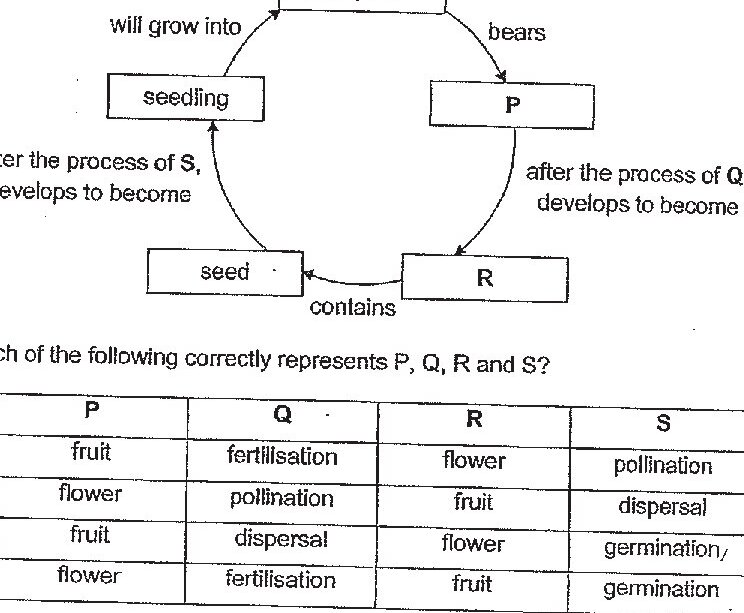
The diagram below shows the development of plant Y. Which of the following correctly represents P, Q, R and S?
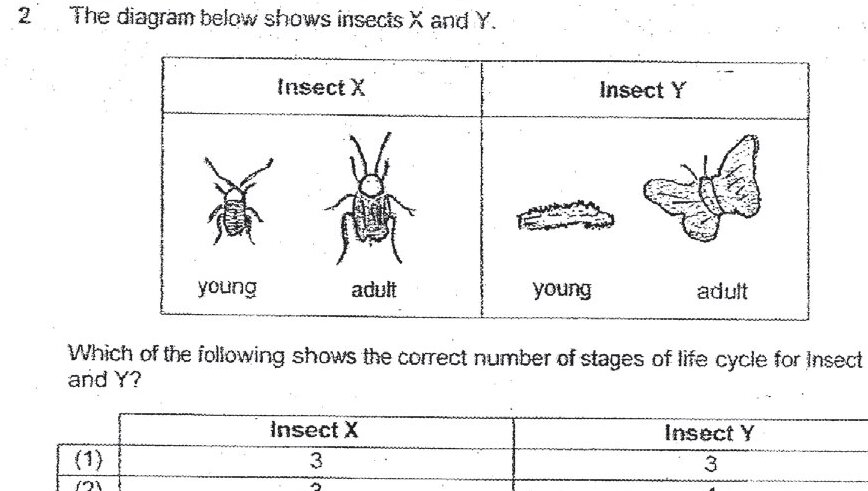
Which of the following shows the correct number of stages of life cycle for Insect X and Y?
How does temperature affect the number of days mosquitoes take to develop into adult stage?
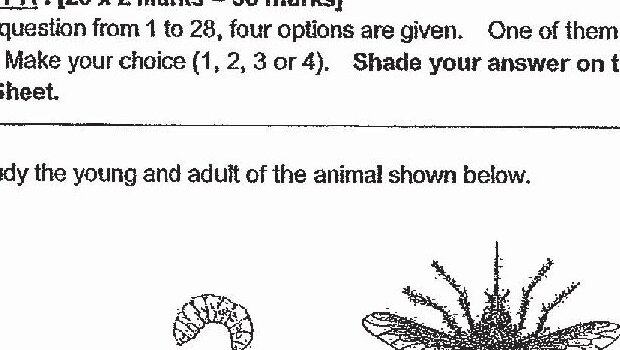
Study the young and adult of the animal shown below. Which of the following statements is not true?
How are the flowers of Plant F pollinated? Give a reason for your answer.
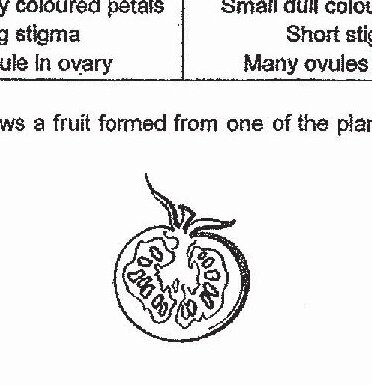
Which plant, F or G, is the fruit most likely taken from? Explain your answer.
What are the conditions necessary for it to take place?
Cell X is produced in large numbers. Give a reason for the observation.
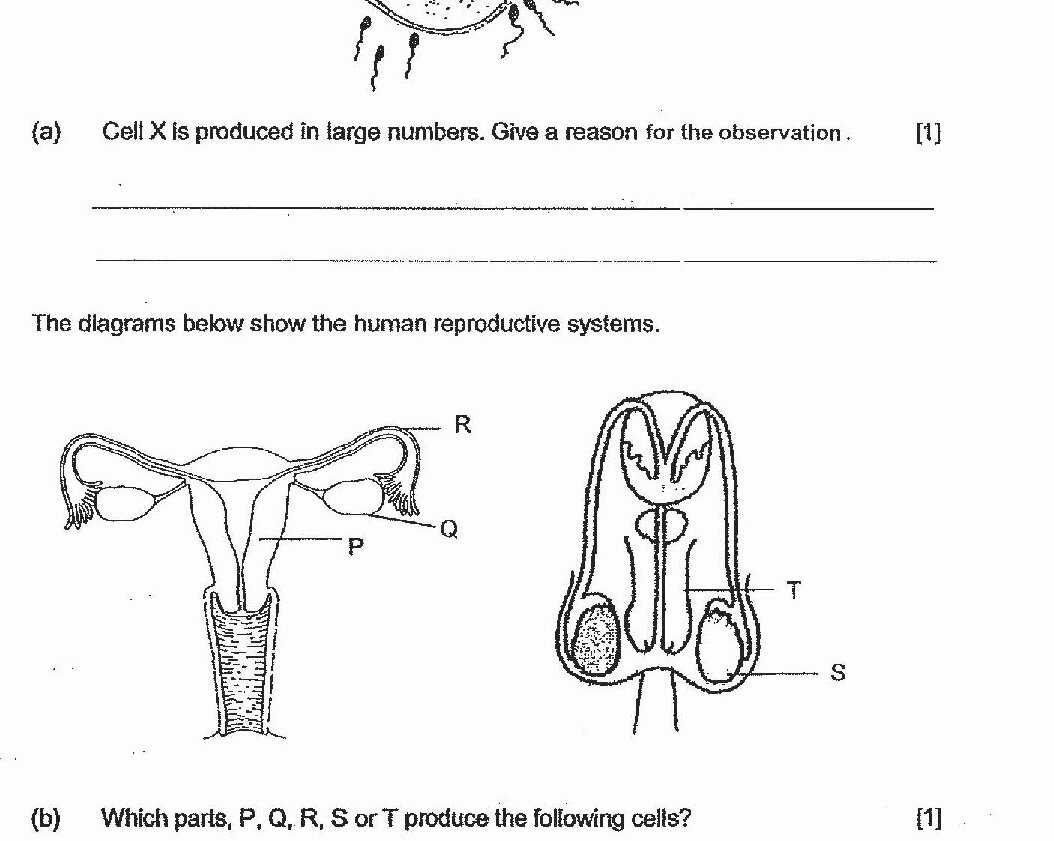
Which parts, P, Q, R, S or T produce the following cells? Cell Y:
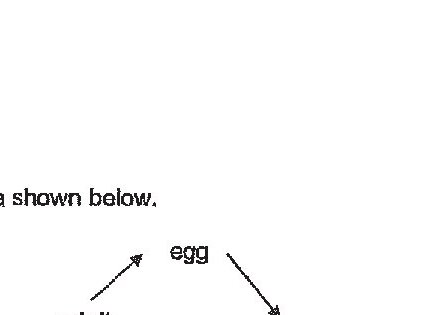
Study the life cycle shown below. Which one of the following animals has a life cycle similar to the one shown above?
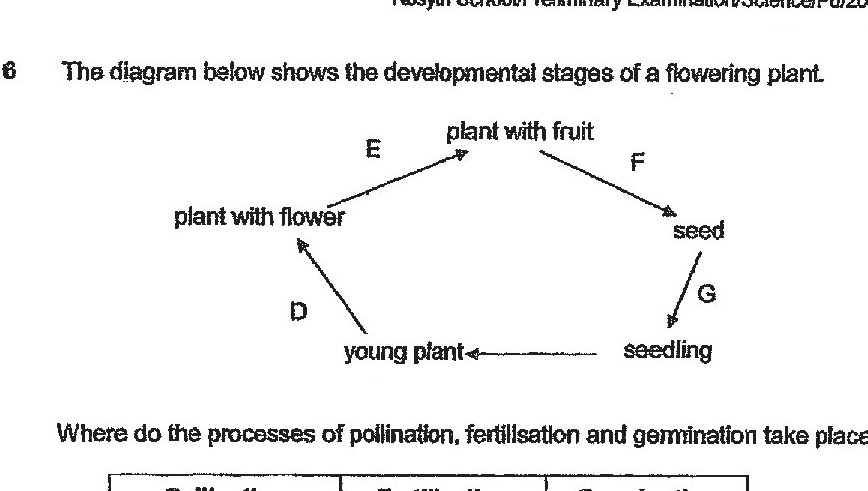
Where do the processes of pollination, fertilisation and germination take place?
Past year papers cover the full exam — browse by subject below.
View All Papers ›