Matter
Study Notes: Cycles - Matter
Key Concepts
What is Matter?
- Matter is anything that has mass and takes up space (volume). Examples: wood, water, air.
- Non-matter has no mass and does not occupy space. Examples: light, sound.
Mass and Volume
- Mass is the amount of matter in a body or object. Units: kilograms (kg) and grams (g).
- Volume is the amount of space that a body or object occupies. Units: litres (L), millilitres (mL), cubic metres (m³), cubic centimetres (cm³).
- Mass and volume are independent — knowing the volume of an object does not tell you its mass, and vice versa.
- An object with a large volume can have a small mass (e.g. a balloon), and an object with a small volume can have a large mass (e.g. a metal ball).
- Three objects with identical mass may look very different in size (different volumes).
- Removing air from spaces between objects reduces the overall volume without changing the total mass.
Three States of Matter
- Matter exists in three main states: solid, liquid, and gas
- All matter is made up of tiny particles that are too small to see with our eyes
Solids:
- Particles are very closely packed together in a fixed arrangement
- Particles vibrate in fixed positions but cannot move freely
- Solids have a fixed shape and volume
- Solids cannot be compressed (squashed)
- Examples: ice, wood, metal, rock
Liquids:
- Particles are close together but can slide past one another
- Particles can move around more freely than in solids
- Liquids have a fixed volume but no fixed shape (they take the shape of their container)
- Liquids cannot be compressed
- Examples: water, oil, milk, juice
Gases:
- Particles are very far apart and move freely in all directions at high speed
- Particles have weak forces of attraction between them
- Gases have no fixed shape and no fixed volume (they spread out to fill any container)
- Gases can be compressed
- Examples: air, oxygen, carbon dioxide, water vapour
Changes of State
Matter can change from one state to another when heated or cooled:
- Melting: solid → liquid (gain heat energy)
- Freezing: liquid → solid (lose heat energy)
- Boiling/Evaporation: liquid → gas (gain heat energy)
- Condensation: gas → liquid (lose heat energy)
- Sublimation: solid → gas directly (gain heat energy), bypassing the liquid state (e.g., dry ice / solid carbon dioxide)
Important principle: During a change of state, the mass of the substance remains the same (no particles are lost or gained)
Pure Substances and Mixtures
Pure substance:
- Made up of only one type of particle (one type of matter)
- Has a fixed composition and definite properties (e.g., fixed melting point, fixed boiling point)
- Examples: pure water (H₂O), pure iron, pure gold, oxygen gas
Mixture:
- Made up of two or more different types of particles (two or more substances) combined together
- The substances are NOT chemically joined — they can be separated by physical methods
- The properties of a mixture depend on what substances are in it and in what amounts
- Examples: salt water (salt + water), air (nitrogen + oxygen + other gases), soil (sand + clay + minerals + organic matter), granite (quartz + feldspar + mica)
Key differences:
| Feature | Pure Substance | Mixture |
|---|---|---|
| Composition | One type only | Two or more types |
| Melting/boiling point | Fixed (sharp) | Range of temperatures |
| Can be separated? | No (by physical methods) | Yes (by physical methods) |
| Example | Pure water (boils at exactly 100°C) | Salt water (boils above 100°C) |
Separating Mixtures
Different methods are used to separate mixtures depending on the properties of the substances involved:
1. Filtration
- Used to separate an insoluble solid from a liquid
- The mixture is poured through filter paper in a funnel
- The liquid (filtrate) passes through; the solid (residue) remains on the filter paper
- Example: separating sand from water (sand + water mixture)
2. Evaporation
- Used to separate a dissolved solid (solute) from a liquid (solvent)
- The mixture is heated so the liquid evaporates away, leaving the dissolved solid behind
- Example: separating salt from salt water — the water evaporates and dry salt crystals remain
3. Magnetic Attraction
- Used to separate a magnetic material from non-magnetic materials
- A magnet is used to attract and remove the magnetic substance
- Example: separating iron filings from sand — a magnet picks up the iron filings
4. Sieving
- Used to separate solid particles of different sizes
- The mixture is passed through a sieve with a specific mesh size
- Smaller particles fall through; larger particles are retained
- Example: separating large gravel from fine sand
5. Decanting
- Used to separate a solid that has settled at the bottom from a liquid
- The liquid is carefully poured off (decanted) while the solid remains
- Example: sand that has settled in water can be separated by careful pouring
The Water Cycle
- The water cycle is the continuous movement of water on, above, and below the Earth’s surface
- Water constantly changes state as it moves through the cycle
- The sun is the main source of energy that drives the water cycle
Stages of the Water Cycle:
- Evaporation: Heat from the sun causes water from oceans, seas, rivers, lakes, and puddles to change into water vapour (gas)
- Transpiration: Plants release water vapour into the air through their leaves
- Condensation: Water vapour rises and cools in the atmosphere, changing back into tiny water droplets that form clouds
- Precipitation: Water droplets in clouds join together to form larger, heavier drops that fall as rain, hail, or snow
- Collection: Water flows into rivers, lakes, and back into oceans, and the cycle continues
Evaporation
- Evaporation is the process where a liquid changes into a gas
- Evaporation can occur at temperatures below the boiling point
- Evaporation happens only at the surface of the liquid
- Water vapour is invisible (you cannot see it)
Factors that affect the rate of evaporation:
- Temperature: Higher temperature → faster evaporation (particles gain more energy and move faster)
- Exposed surface area: Larger surface area → faster evaporation (more particles at the surface can escape)
- Wind/Moving air: Stronger wind → faster evaporation (water vapour is blown away, allowing more particles to escape)
- Humidity: Lower humidity (drier air) → faster evaporation (more space for water vapour in the air)
Condensation
- Condensation is the process where a gas changes into a liquid
- Condensation occurs when water vapour cools down and loses heat energy
- Condensation happens when warm, moist air comes into contact with a cool surface
Common examples of condensation:
- Water droplets forming on the outside of a cold drink can
- Mist forming on a bathroom mirror during a hot shower
- Dew forming on grass in the early morning
- Clouds forming in the sky
Melting and Boiling
Melting:
- Melting is the process where a solid changes into a liquid
- The temperature at which a substance melts is called its melting point
- Ice melts at 0°C to form water
- During melting, particles gain heat energy and start to move more freely
Boiling:
- Boiling is the process where a liquid changes into a gas rapidly throughout the entire liquid
- The temperature at which a substance boils is called its boiling point
- Water boils at 100°C to form water vapour
- During boiling, bubbles of gas form throughout the liquid and rise to the surface
- Boiling occurs throughout the liquid, while evaporation only occurs at the surface
Key difference: Evaporation can happen at any temperature and only at the surface, while boiling happens at a specific temperature (boiling point) throughout the entire liquid
Important Definitions
Matter: Anything that has mass and occupies space
Solid: A state of matter with particles closely packed in fixed positions, having a fixed shape and volume
Liquid: A state of matter with particles that can slide past one another, having a fixed volume but no fixed shape
Gas: A state of matter with particles far apart and moving freely, having no fixed shape or volume
Melting: The change of state from solid to liquid when heat is gained
Freezing: The change of state from liquid to solid when heat is lost
Melting point: The temperature at which a solid changes to a liquid (0°C for ice)
Boiling: The rapid change of state from liquid to gas throughout the entire liquid when heated to its boiling point
Boiling point: The temperature at which a liquid changes to a gas throughout the entire liquid (100°C for water)
Evaporation: The change of state from liquid to gas that occurs at the surface of a liquid at temperatures below boiling point
Condensation: The change of state from gas to liquid when heat is lost
Sublimation: The change of state from solid directly to gas (bypassing the liquid state) when heat is gained (e.g., dry ice / solid carbon dioxide)
Pure substance: Matter made up of only one type of particle, with fixed and definite properties
Mixture: Two or more different substances combined together but NOT chemically joined; can be separated by physical methods
Filtration: A method of separating an insoluble solid from a liquid using filter paper
Evaporation (as separation method): A method of separating a dissolved solid from a liquid by heating the solution so the liquid evaporates away, leaving the solid
Water vapour: Water in its gaseous state (invisible)
The Water Cycle: The continuous movement of water between the Earth’s surface and the atmosphere through evaporation, condensation, and precipitation
Transpiration: The process by which plants release water vapour into the air through their leaves
Precipitation: Water falling from clouds as rain, hail, or snow
Humidity: The amount of water vapour present in the air
Non-matter: Anything that has no mass and does not take up space (e.g. light, sound)
Mass: The amount of matter in a body or object, measured in kg or g
Volume: The amount of space a body or object occupies, measured in L, mL, m³, or cm³
Worked Examples
Example 1: Explaining Evaporation Rate
Question: Mary hung two identical wet towels outside on a sunny day. Towel A was hung in an open area with strong wind, while Towel B was hung in a sheltered corner with no wind. Which towel will dry faster? Explain your answer.
Step-by-step solution:
Step 1: Identify what the question is asking
- We need to compare the rate of evaporation of water from two towels
- We need to explain which dries faster and why
Step 2: Identify the key difference between the two setups
- Both towels: same wetness, same sunny day (same temperature and surface area)
- Difference: Towel A has strong wind, Towel B has no wind
Step 3: Apply knowledge about factors affecting evaporation
- Wind/moving air affects the rate of evaporation
- Stronger wind → faster evaporation
Step 4: Explain the process
- When there is wind, water vapour that evaporates from the towel is blown away
- This allows more water particles to escape from the towel’s surface
- Without wind, water vapour accumulates near the towel, slowing down further evaporation
Complete answer: “Towel A will dry faster. This is because Towel A is exposed to strong wind, which blows away the water vapour that evaporates from the towel. This allows more water particles to escape from the towel’s surface into the air. Towel B has no wind, so water vapour remains near the towel’s surface, which slows down the rate of evaporation. Therefore, Towel A dries faster due to the presence of moving air/wind.”
Example 2: Condensation on Cold Surface
Question: John took a can of cold drink from the refrigerator. After a few minutes, he noticed water droplets forming on the outside of the can. Where did the water come from? Explain how it was formed.
Step-by-step solution:
Step 1: Identify what happened
- Water droplets appeared on the outside of a cold can
- This is an example of condensation
Step 2: Identify where the water came from
- The water did NOT come from inside the can
- The water came from water vapour in the air around the can
Step 3: Explain the process of condensation
- The air around us contains water vapour (invisible gas)
- When this warm, moist air touches the cold can surface, it cools down
- As water vapour cools, it loses heat energy and changes into liquid water
- These tiny water droplets collect on the outside of the can
Complete answer: “The water came from water vapour in the air. The air around us contains water vapour. When the warm, moist air comes into contact with the cold surface of the can, the water vapour cools down and loses heat energy. The water vapour then condenses (changes from gas to liquid) and forms water droplets on the outside of the can. This process is called condensation.”
Example 3: Mass During Change of State
Question: A student has 50g of ice in a beaker. She heats the ice until it completely melts into water and then continues heating until all the water evaporates. What is the mass of water vapour formed? Explain your answer.
Step-by-step solution:
Step 1: Identify what changes occurred
- Ice (solid) → Water (liquid) through melting
- Water (liquid) → Water vapour (gas) through evaporation
- Two changes of state occurred
Step 2: Apply the key principle about mass during state changes
- During a change of state, the mass remains the same
- No particles are lost or gained
- The number of particles stays constant
Step 3: Calculate the mass
- Starting mass of ice = 50g
- After melting: mass of water = 50g (same)
- After evaporation: mass of water vapour = 50g (same)
Complete answer: “The mass of water vapour formed is 50g. This is because during a change of state, the mass of the substance remains the same. When ice melts into water or water evaporates into water vapour, no particles are lost or gained. Only the arrangement and movement of particles change. Therefore, the 50g of ice becomes 50g of water, which then becomes 50g of water vapour.”
Common Mistakes to Avoid
-
Confusing evaporation and boiling:
- ✗ Wrong: “Evaporation and boiling are the same thing”
- ✓ Correct: Evaporation occurs at the surface at any temperature; boiling occurs throughout the liquid at boiling point (100°C for water)
-
Thinking water vapour is visible:
- ✗ Wrong: “The steam/white mist coming from boiling water is water vapour”
- ✓ Correct: Water vapour is invisible. The white mist is tiny water droplets formed when water vapour condenses in cool air
-
Wrong source of condensation water:
- ✗ Wrong: “Water droplets on a cold can come from inside the can leaking out”
- ✓ Correct: Water droplets come from water vapour in the air that condenses on the cold surface
-
Thinking mass changes during state changes:
- ✗ Wrong: “When water evaporates, it disappears so the mass decreases”
- ✓ Correct: Mass remains the same during state changes; water vapour still has mass even though we cannot see it
-
Confusing melting and dissolving:
- ✗ Wrong: “Sugar melts in water”
- ✓ Correct: Sugar dissolves in water (forms a solution). Melting is changing from solid to liquid due to heat, like ice melting
-
Incomplete explanations for evaporation factors:
- ✗ Wrong: “Evaporation is faster because there is more heat” (not specific enough)
- ✓ Correct: “Higher temperature causes water particles to gain more heat energy and move faster, so more particles can escape from the surface into the air, increasing the rate of evaporation”
-
Wrong direction of heat transfer:
- ✗ Wrong: “Heat is lost during melting”
- ✓ Correct: Heat is gained during melting; heat is lost during freezing
-
Confusing humidity with temperature:
- ✗ Wrong: “Evaporation is faster on humid days”
- ✓ Correct: Evaporation is slower on humid days because the air already contains a lot of water vapour, so there is less space for more water vapour
-
Not mentioning particle movement/energy in explanations:
- ✗ Wrong: “Ice melts at 0°C” (incomplete)
- ✓ Correct: “Ice melts at 0°C because particles gain heat energy and start to move more freely, breaking away from fixed positions”
-
Forgetting transpiration in the water cycle:
- ✗ Wrong: Only mentioning evaporation from water bodies
- ✓ Correct: Include both evaporation from water bodies AND transpiration from plants as sources of water vapour in the atmosphere
-
Assuming bigger means heavier (confusing volume with mass):
- ✗ Wrong: ‘The larger object must be heavier’
- ✓ Correct: Volume and mass are independent. A large object can have a small mass; always refer to measured mass, not size.
-
Making visual assumptions about mass based on appearance:
- ✗ Wrong: Judging which object is heavier by looking at its size
- ✓ Correct: Two objects that look very different in size may have the same mass; always rely on measurement, not visual estimation.
Exam Tips
Keywords to Include in Your Answers
For evaporation questions:
- “Water vapour” (not just “gas” or “steam”)
- “Surface of the liquid”
- “Heat energy gained”
- “Particles move faster / gain more energy”
- Name specific factors: “temperature”, “exposed surface area”, “wind/moving air”, “humidity”
- “Rate of evaporation increases/decreases”
For condensation questions:
- “Water vapour in the air”
- “Cool/cold surface”
- “Heat energy lost”
- “Changes from gas to liquid”
- “Water droplets form”
For water cycle questions:
- Name all stages: “evaporation”, “transpiration”, “condensation”, “precipitation”, “collection”
- “The sun provides heat energy”
- “Continuous cycle”
- “Water changes state”
For melting/freezing questions:
- “0°C” (melting/freezing point of ice)
- “Heat energy gained” (melting) or “Heat energy lost” (freezing)
- “Solid changes to liquid” or “Liquid changes to solid”
- “Particles move more freely” (melting) or “Particles move into fixed positions” (freezing)
For boiling questions:
- “100°C” (boiling point of water)
- “Throughout the liquid” (not just surface)
- “Bubbles form”
- “Rapid change from liquid to gas”
Mark-Earning Phrases
When comparing rates of evaporation:
- State which setup will have faster/slower evaporation
- Identify the specific factor causing the difference
- Explain how that factor affects particle movement/escape
- Use “Therefore” or “Thus” to conclude
Example: “Setup A will have faster evaporation because it has a larger exposed surface area. This means more water particles at the surface can escape into the air. Therefore, the rate of evaporation increases.”
When explaining state changes:
- Name the process (melting, freezing, evaporation, boiling, condensation)
- State heat is gained or lost
- Describe what happens to particles (energy, movement, arrangement)
- State the change in state
Example: “This is condensation. Water vapour in the air loses heat energy when it touches the cold surface. The water vapour changes from gas to liquid, forming water droplets.”
For “explain” questions:
- Use scientific terms correctly
- Link cause and effect using words like “because”, “therefore”, “thus”, “as a result”
- Describe particle behavior when relevant
- Be specific (not vague)
For “describe” questions:
- Use sequential steps if describing a process
- Include all relevant observations
- Use words like “first”, “then”, “next”, “finally”
Mass vs Volume Questions
- Read the question carefully to determine whether it is asking about mass (amount of matter, units: kg/g) or volume (space occupied, units: L/mL/cm³/m³) — these are different properties.
- Never assume a larger object has greater mass; mass and volume are independent.
- Use the correct unit in your answer: kg or g for mass; L, mL, cm³, or m³ for volume.
- Compare properties systematically — do not rely on visual intuition about size and heaviness.
General Exam Strategies
- Read the question carefully - Look for keywords like “explain”, “describe”, “compare”, “state”
- Look at the marks allocated - 2 marks usually need 2 distinct points
- Use diagrams when given - Extract information from diagrams in the question
- Always mention energy changes - State whether heat is gained or lost during state changes
- Be specific about particle behavior - Don’t just say “particles move”; say “particles move faster” or “particles vibrate in fixed positions”
- Check your spelling of key terms: evaporation, condensation, precipitation, transpiration
- Write in complete sentences unless the question asks for a list
- Refer to specific parts of the setup when comparing (e.g., “Setup A has…, while Setup B has…”)
Quick Summary
Essential points for revision:
✓ Three states of matter: Solids have fixed shape and volume (particles tightly packed); liquids have fixed volume but no fixed shape (particles can slide); gases have no fixed shape or volume (particles far apart)
✓ Mass stays the same during state changes - only the arrangement and movement of particles change
✓ Melting: solid → liquid at 0°C (for ice), heat gained, particles move more freely
✓ Freezing: liquid → solid at 0°C (for water), heat lost, particles move into fixed positions
✓ Evaporation: liquid → gas at surface, any temperature, heat gained. Affected by temperature, surface area, wind, and humidity
✓ Boiling: liquid → gas throughout the liquid at 100°C (for water), heat gained, bubbles form
✓ Condensation: gas → liquid, heat lost, occurs when water vapour touches cool surface or cools in atmosphere
✓ Sublimation: solid → gas directly (no liquid stage), heat gained (e.g., dry ice)
✓ Pure substances are made of one type of particle with fixed properties; mixtures contain two or more substances that can be separated by physical methods
✓ Separating mixtures: filtration (insoluble solid from liquid), evaporation (dissolved solid from liquid), magnetic attraction (magnetic material from non-magnetic), sieving (particles of different sizes), decanting (settled solid from liquid)
✓ Water vapour is invisible - white mist/steam is tiny water droplets, not water vapour
✓ Water cycle stages: Evaporation (from water bodies) + Transpiration (from plants) → Condensation (forms clouds) → Precipitation (rain/hail/snow) → Collection (back to water bodies)
✓ The sun drives the water cycle by providing heat energy for evaporation
✓ Four factors affecting evaporation rate: Higher temperature, larger surface area, stronger wind, lower humidity → faster evaporation
✓ In explanations, always mention: the process name, whether heat is gained/lost, what happens to particles, and the resulting change in state
✓ Matter has mass and occupies space; non-matter (e.g. light, sound) has neither.
✓ Mass (kg/g) and volume (L/mL/cm³/m³) are independent — a large volume does not mean large mass, and vice versa.
✓ Removing air from between objects reduces volume but does NOT change mass.
Remember: Understanding particle movement and energy changes is key to answering all questions on this topic correctly!
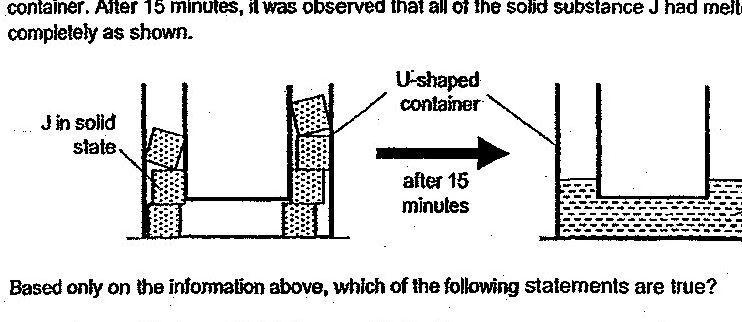
Some solid pieces of substance J were taken out of a freezer and placed in a U-shaped container. After 15 minutes, it was observed that all of the solid substance J had melted completely as shown. Based only on the information above, which of the following statements are true? A: J in the solid state has no definite shape. B: J in the liquid state has a definite volume. C: J in the liquid state has no definite shape. D: J in the solid state has no definite volume.
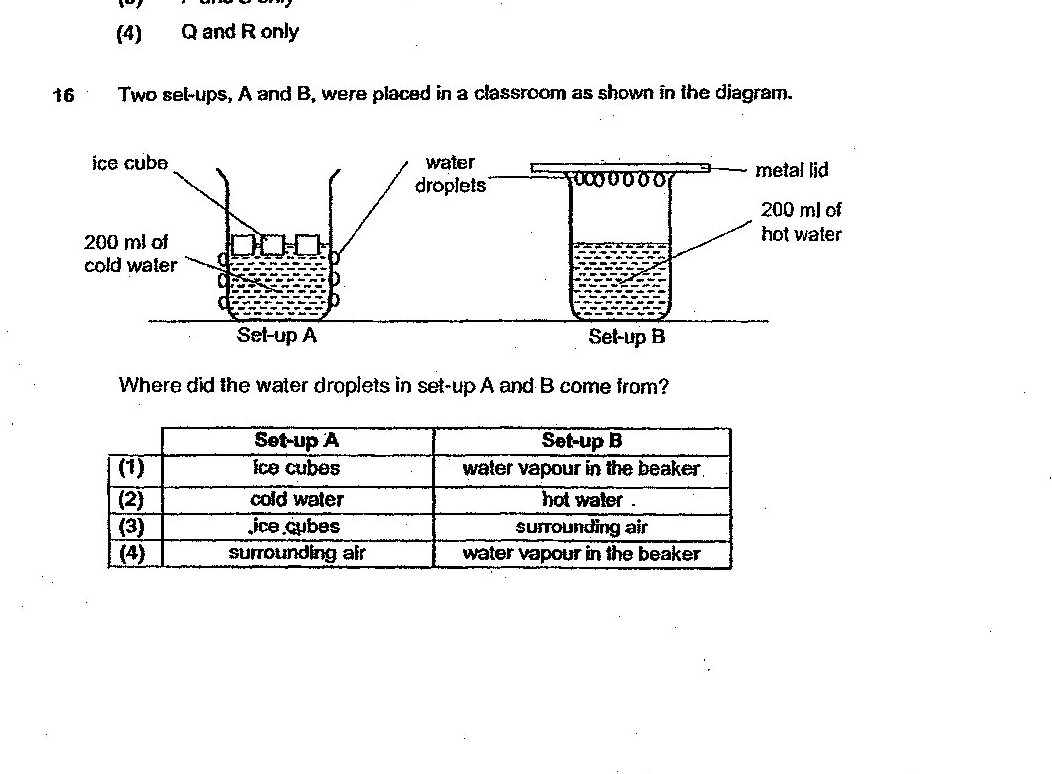
Where did the water droplets in set-up A and B come from?
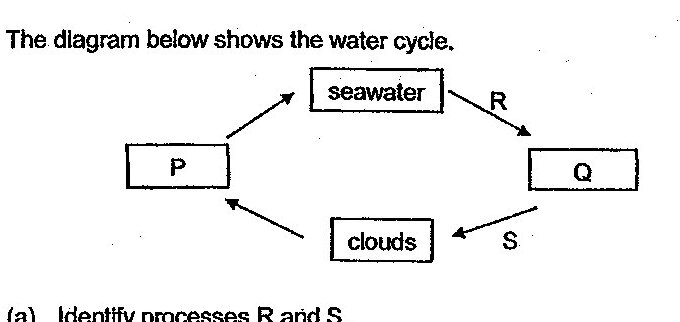
Identify processes R and S.
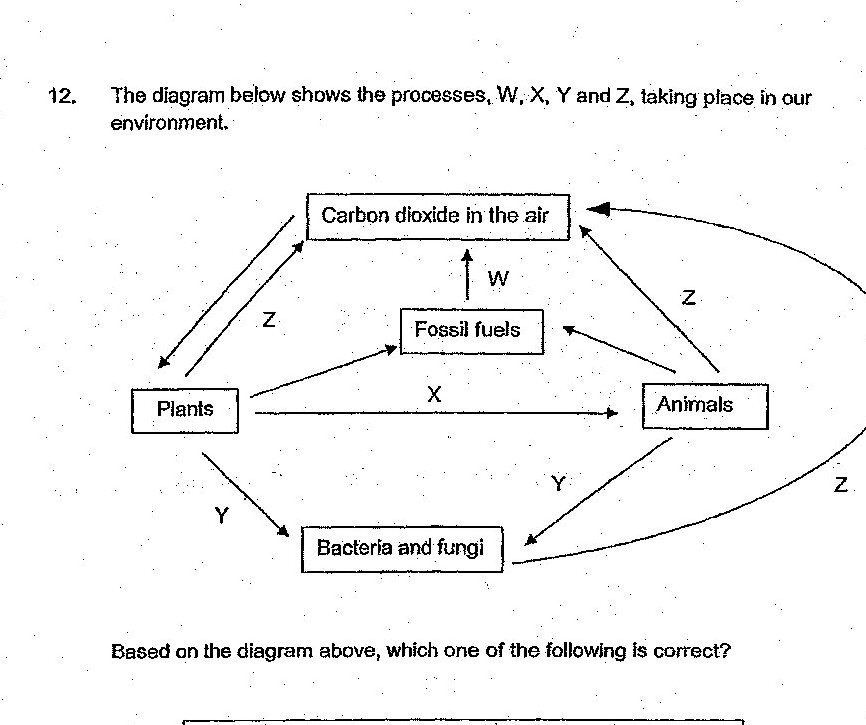
The diagram below shows the processes, W, X, Y and Z, taking place in our environment. Based on the diagram above, which one of the following is correct?
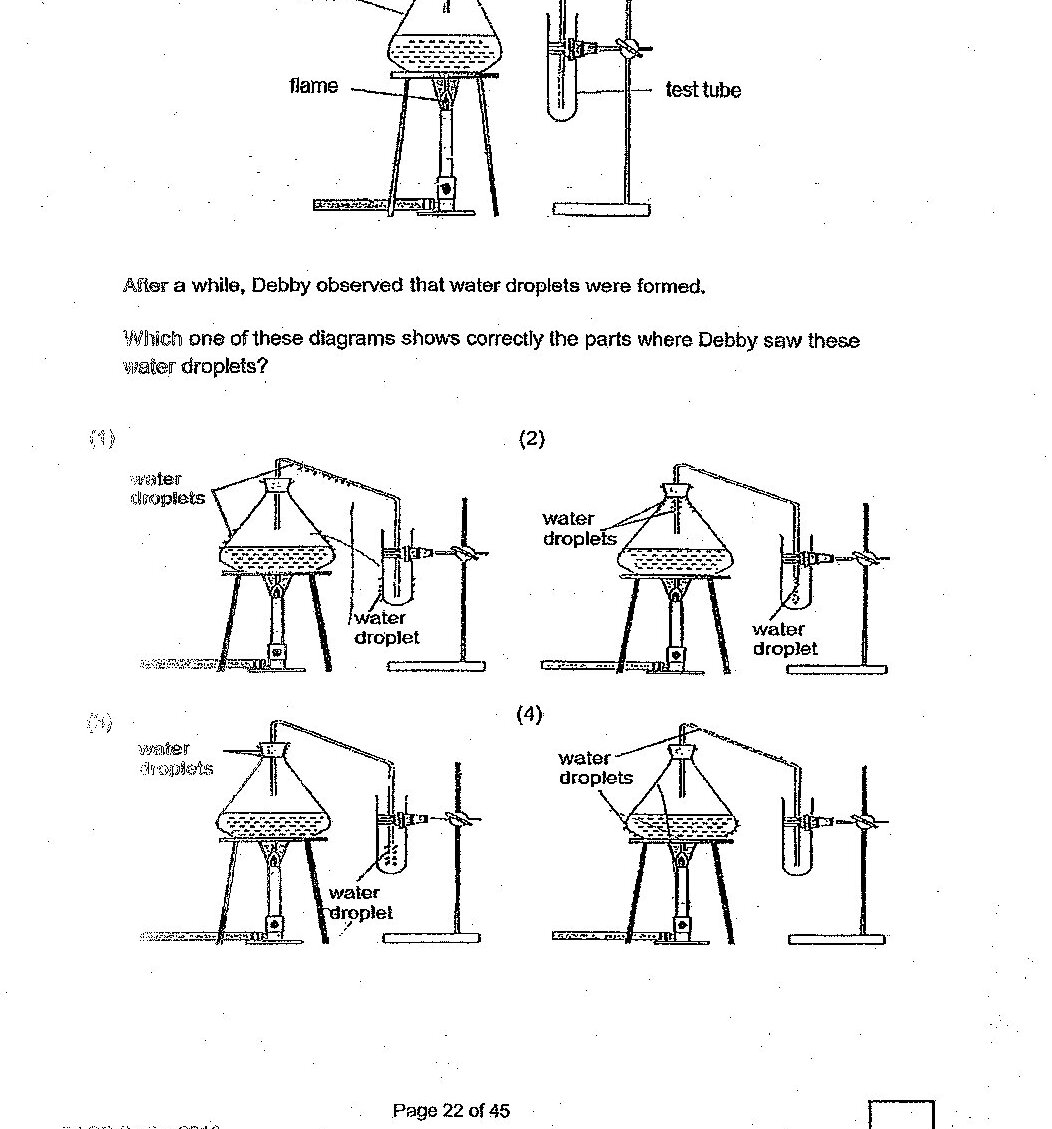
Debby heated a flask of water over a flame as shown below. After a while, Debby observed that water droplets were formed. Which one of these diagrams shows correctly the parts where Debby saw these water droplets?
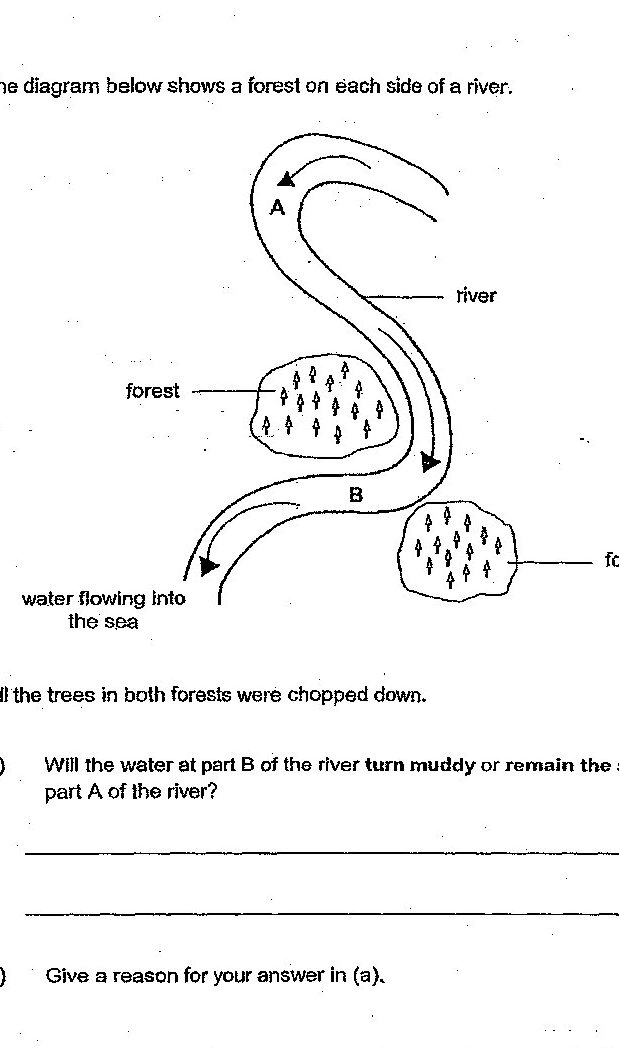
Will the water at part B of the river turn muddy or remain the same as that at part A of the river?
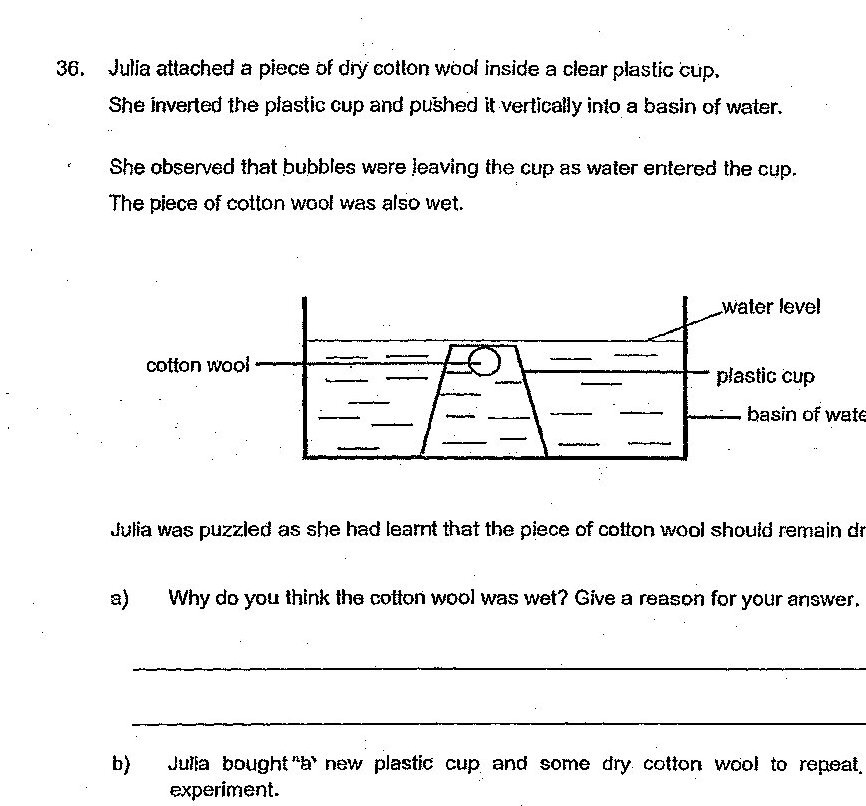
Why do you think the cotton wool was wet? Give a reason for your answer.
Based on Keming's observations, explain why there were water droplets formed on the glass surface and a rise in temperature at the end of the experiment.
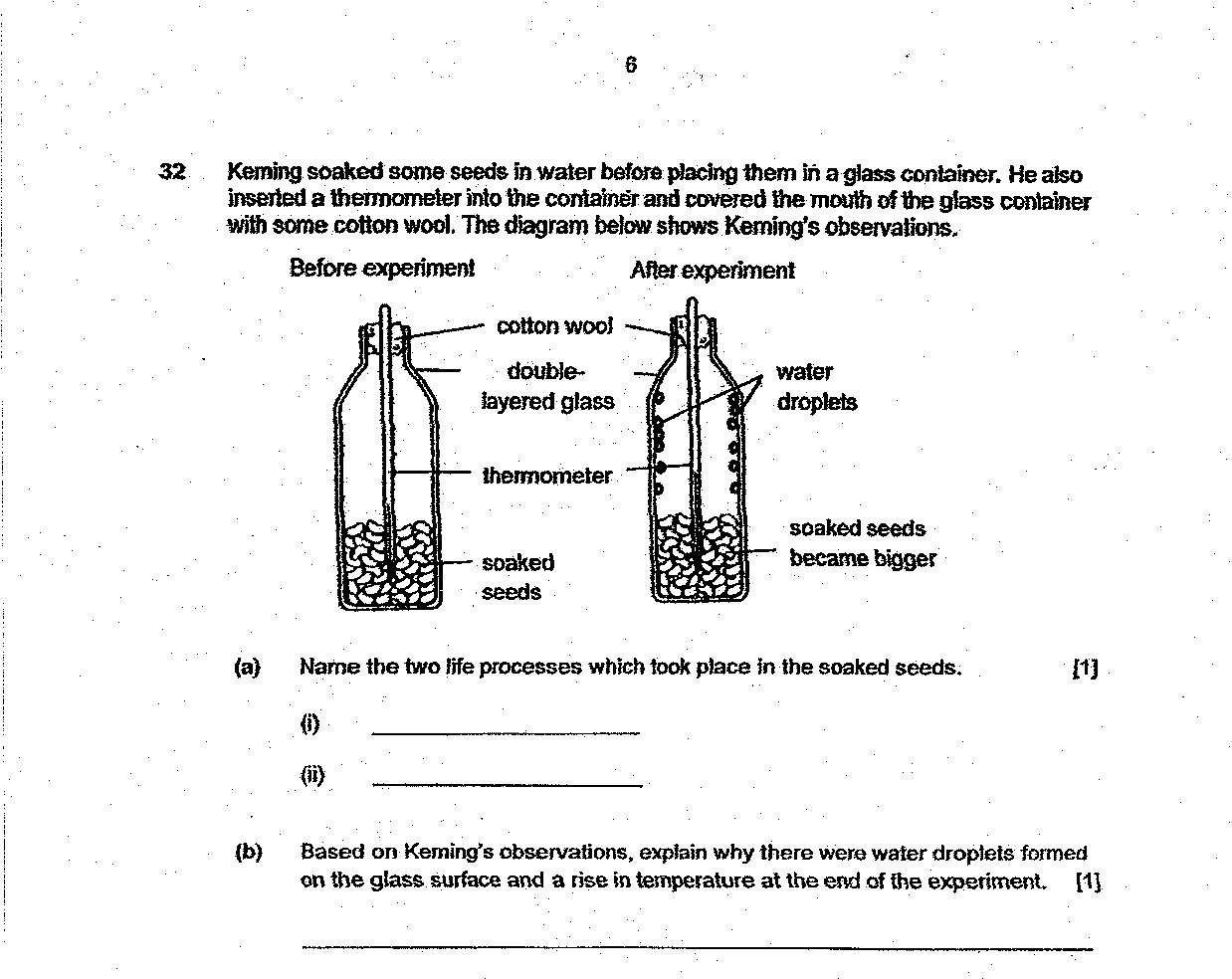
How does using the double-layered glass containers and cotton wool ensure Keming gets a more accurate results?

Based on his observations, which is the best material for making a container to keep food warm for as long as possible?
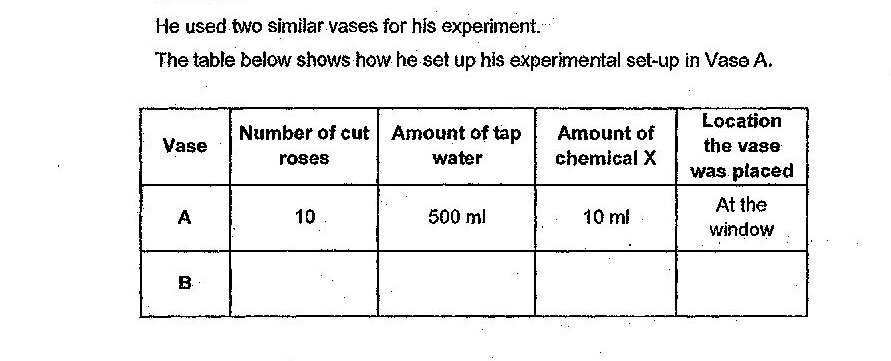
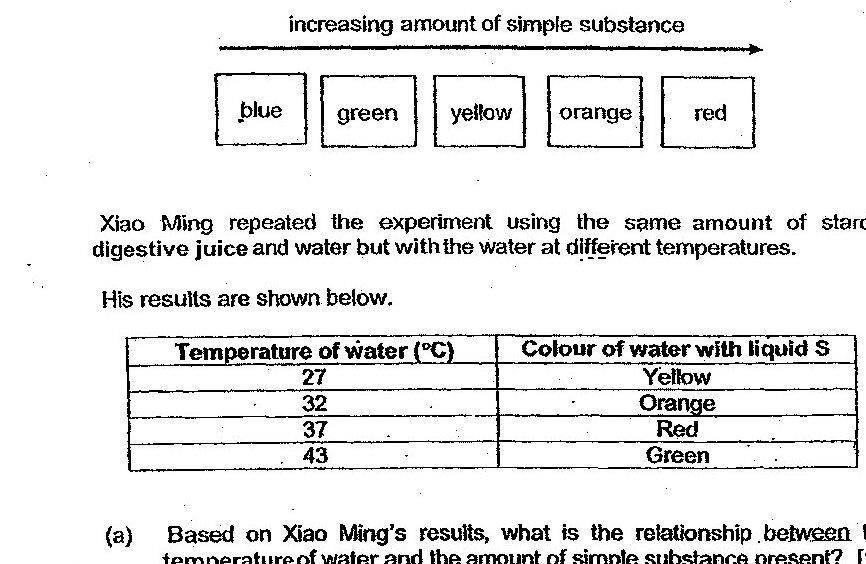
Based on Xiao Ming's results, what is the relationship between the temperature of water and the amount of simple substance present?
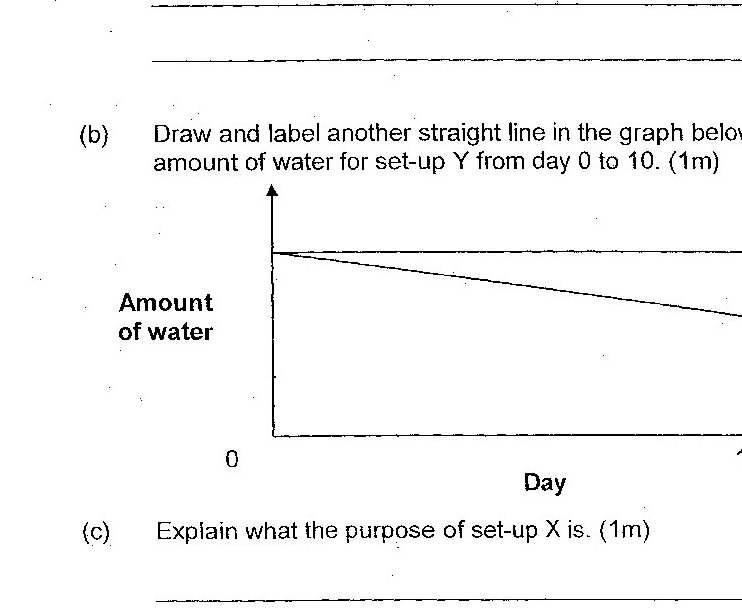
Draw and label another straight line in the graph below to show the change in the amount of water for set-up Y from day 0 to 10.
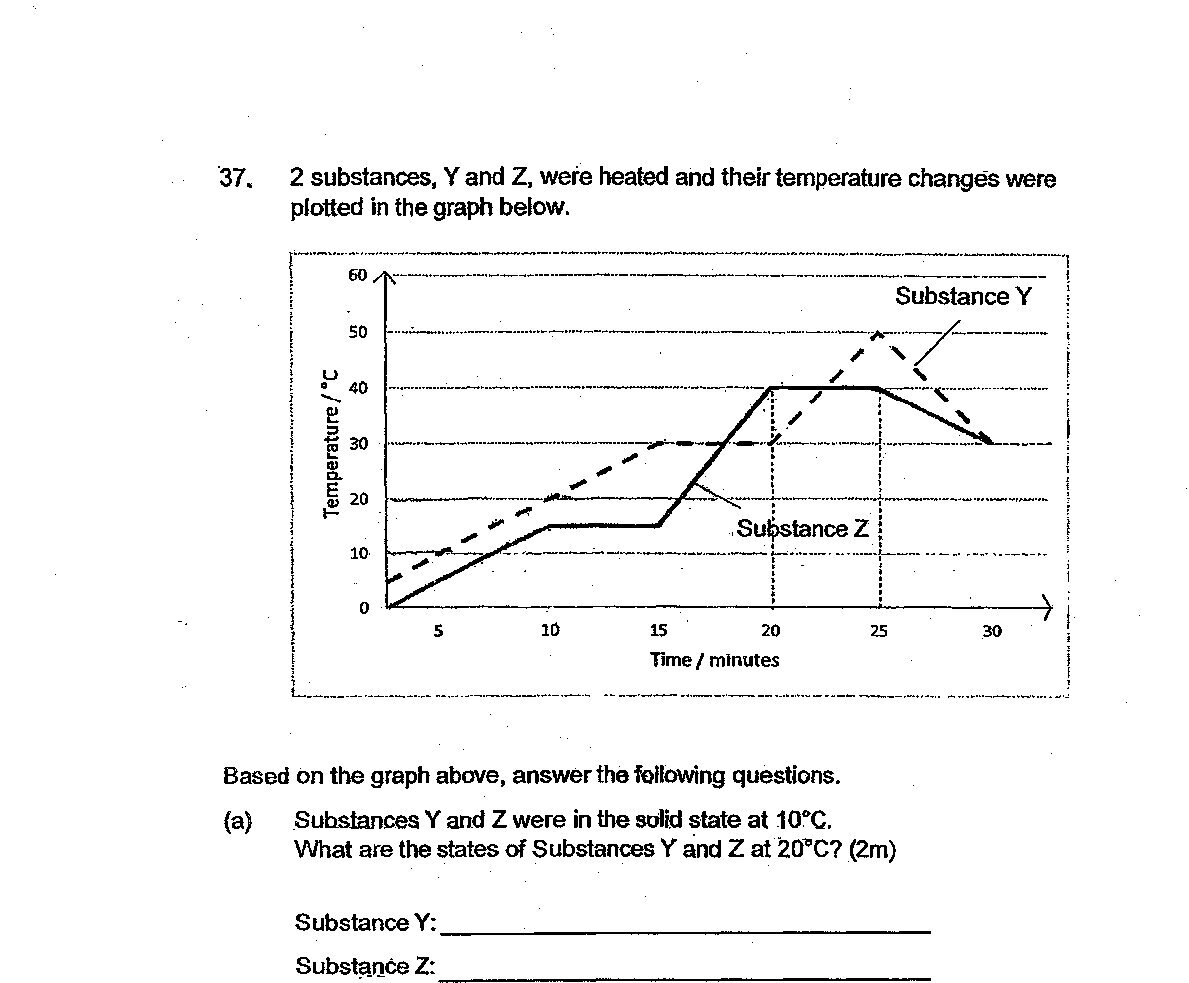
2 substances, Y and Z, were heated and their temperature changes were plotted in the graph below.
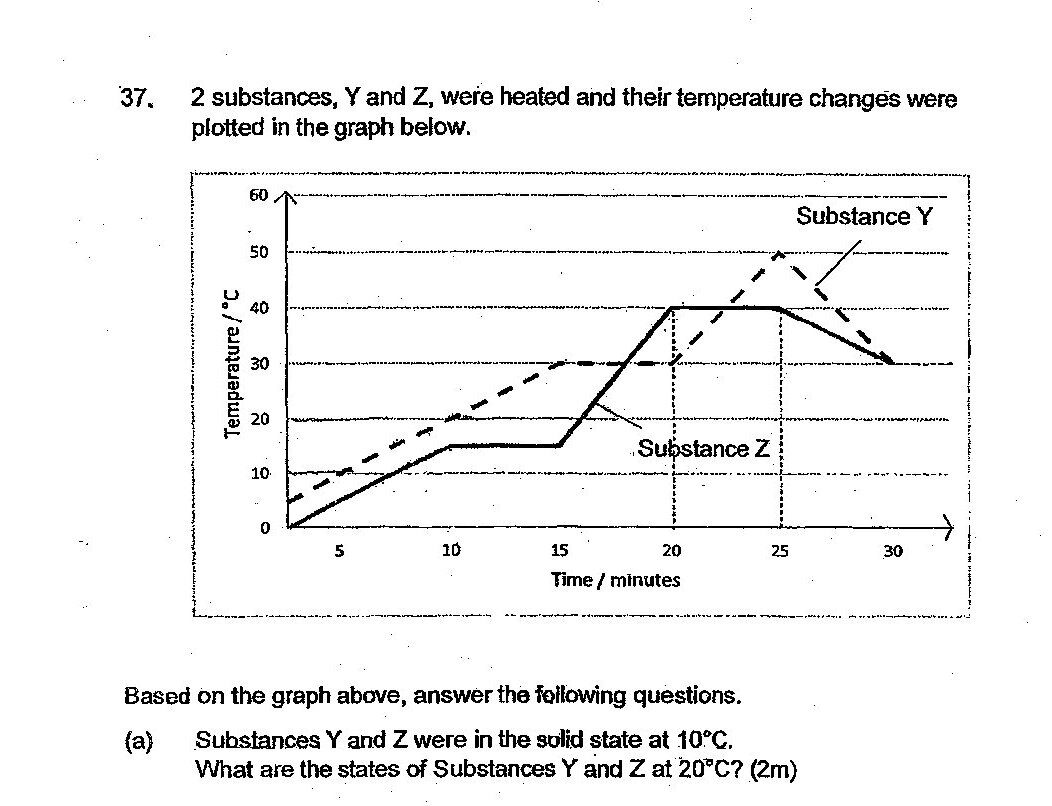
Substances Y and Z were in the solid state at 10°C. What are the states of Substances Y and Z at 20°C?
Describe what is happening to Substance Z between the 20th and 25th minute.
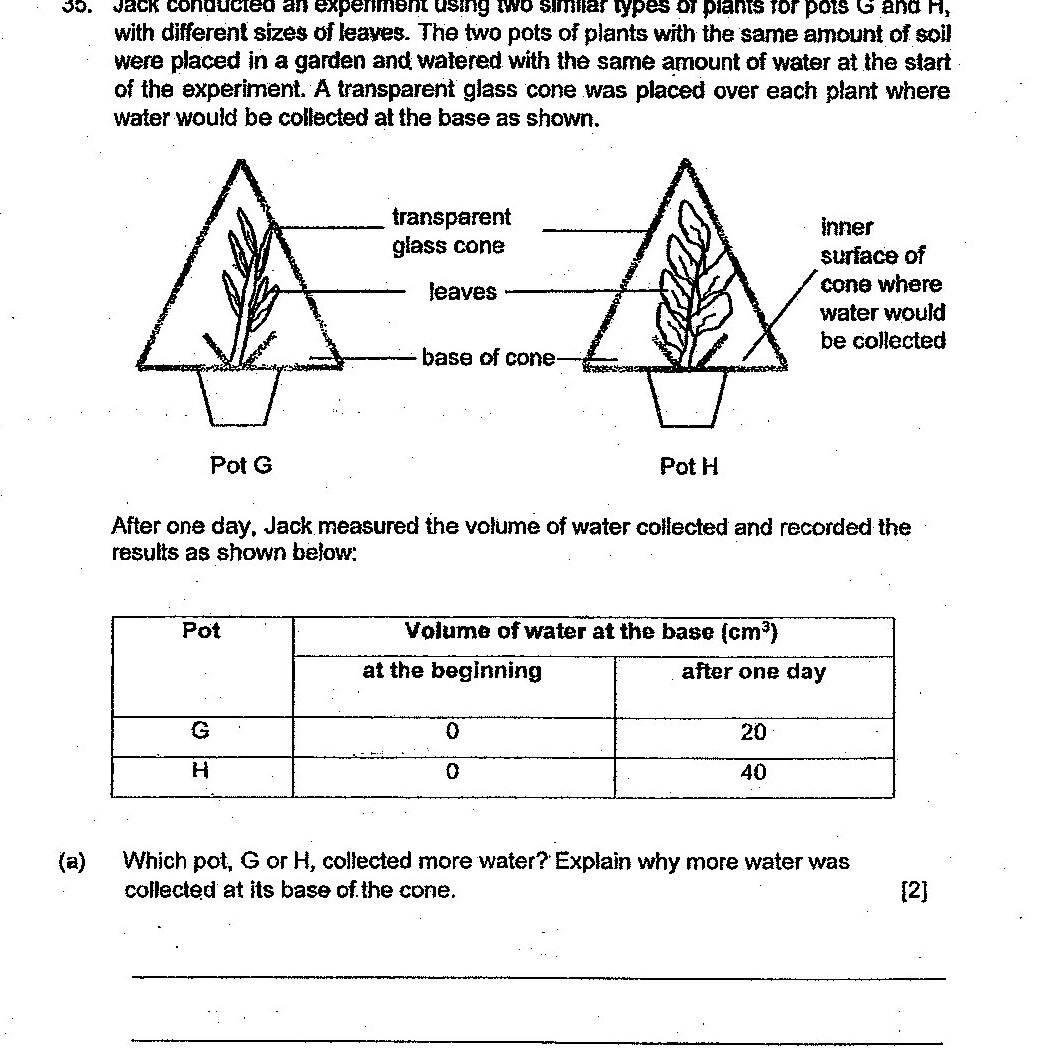
Which pot, G or H, collected more water? Explain why more water was collected at its base of the cone.
Explain how the water droplets are formed on the underside of the plastic sheet.
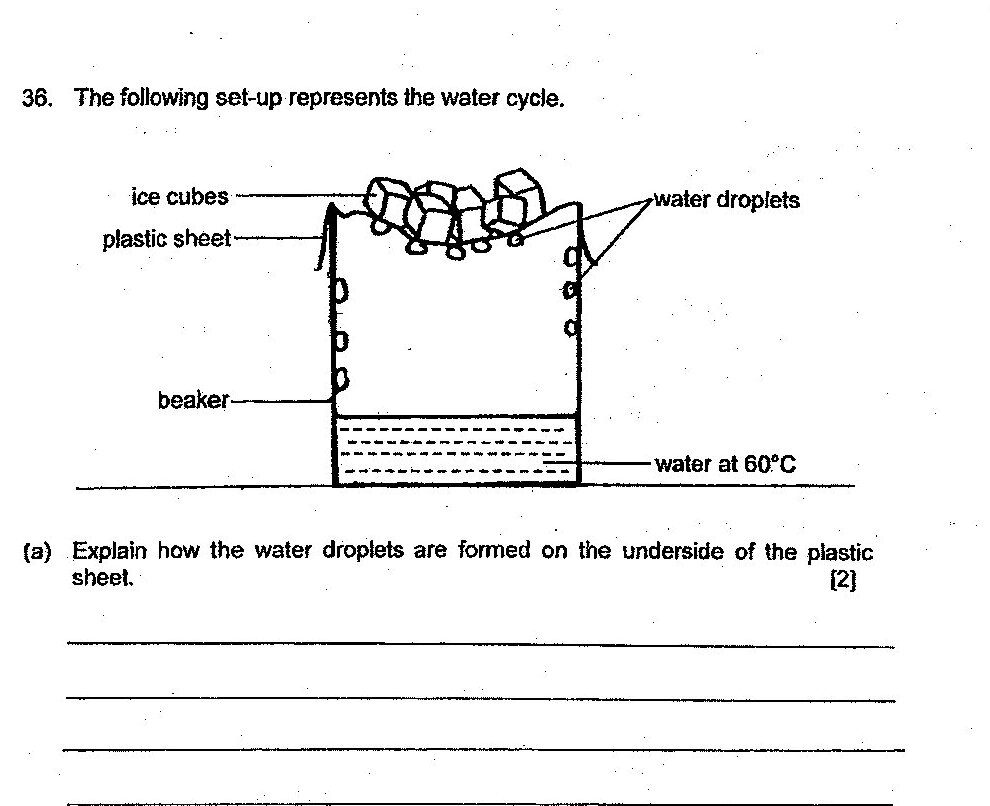
What would happen to the rate at which the water droplets are formed if the temperature of the water placed in the beaker was increased to 95°C? Explain your answer.
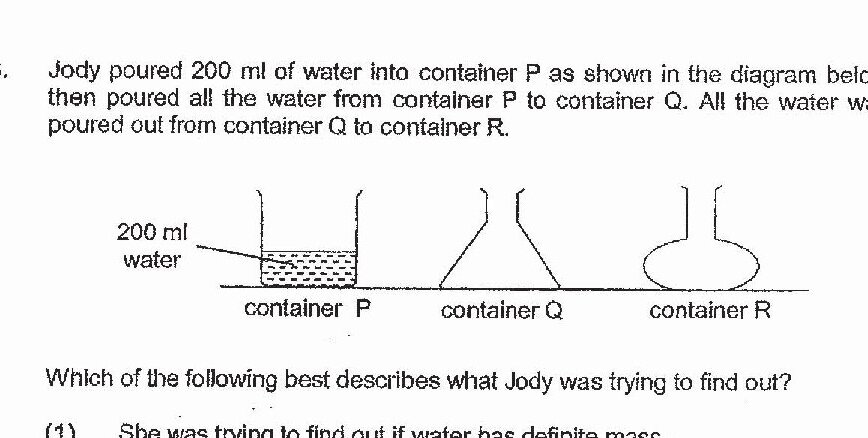
Jody poured 200 ml of water into container P as shown in the diagram below. She then poured all the water from container P to container Q. All the water was then poured out from container Q to container R. Which of the following best describes what Jody was trying to find out?
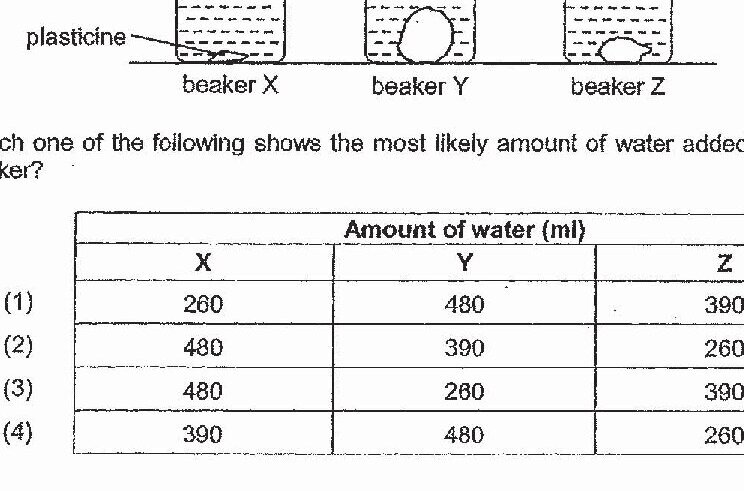
The diagram below shows three identical beakers X, Y and Z. Three pieces of plasticine of different sizes were placed into the beakers. The beakers were then filled to the brim with water. Which one of the following shows the most likely amount of water added into each beaker?
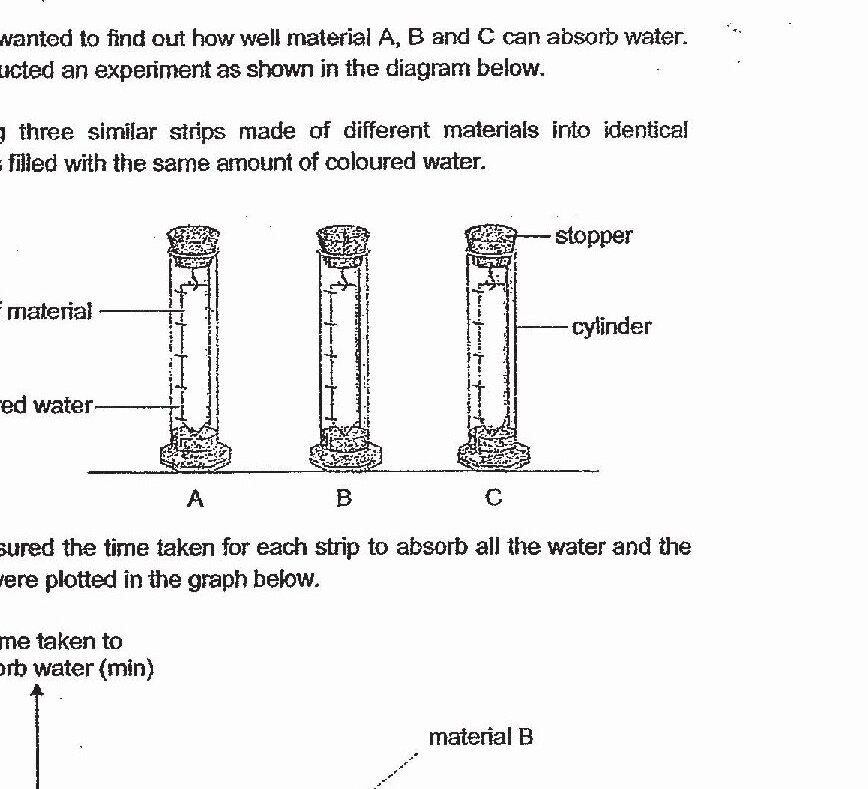
Why was a stopper placed at the opening of the cylinder?
In an experiment, Yue Ling filled a glass container with marbles until she could not put any more marbles into it. She concluded that there was no more space in the container for her to put anything into it. However, her friend, Sally said that she was wrong. How could Sally prove that Yue Ling was wrong?

In an experiment, Yue Ling filled a glass container with marbles until she could not put any more marbles into it. She concluded that there was no more space in the container for her to put anything into it. However, her friend, Sally said that she was wrong. How could Sally prove that Yue Ling was wrong?
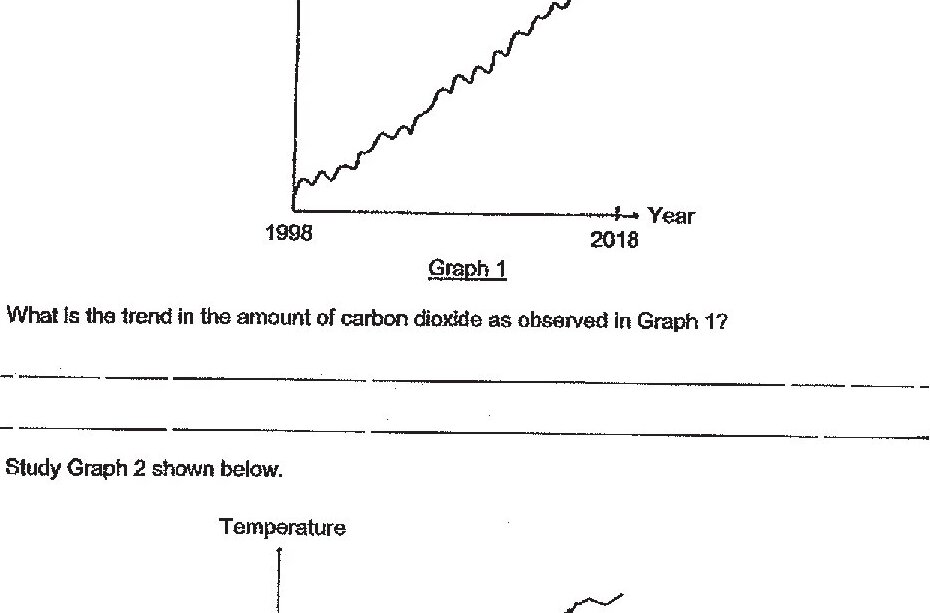
What is the trend in the amount of carbon dioxide as observed in Graph 1?
As global temperatures rises, the ice in the Antarctic melts. Explain how this may affect small islands around the world in future.
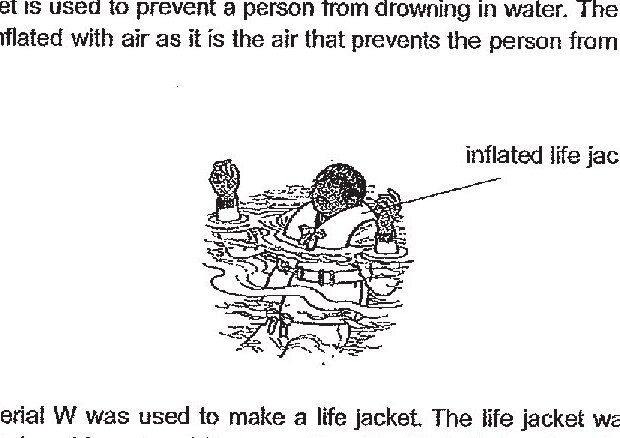
A life jacket is used to prevent a person from drowning in water. The life jacket must be inflated with air as it is the air that prevents the person from sinking in water.
Explain how water droplets are formed on the windscreen.
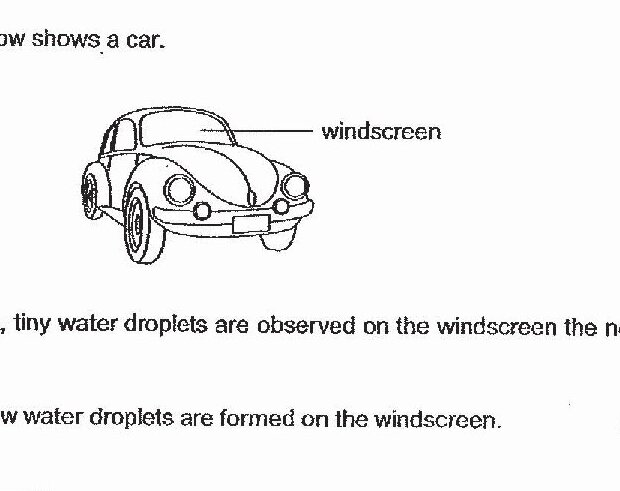
Give a reason why water droplets are less likely to form when the windscreen becomes warm after some time.
Explain how the water droplets disappear when the windscreen continues to remain warm for a long time.
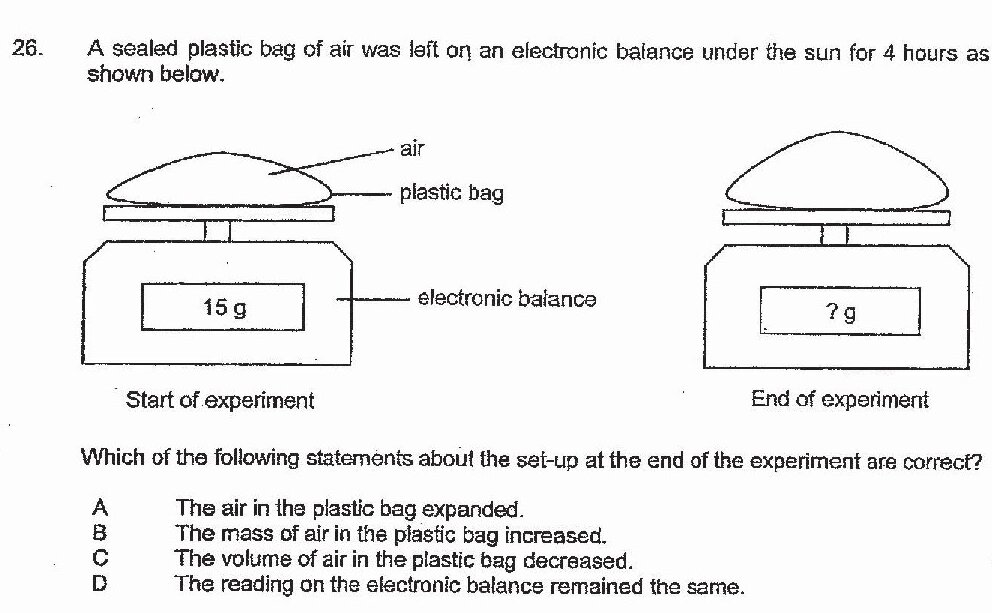
A sealed plastic bag of air was left on an electronic balance under the sun for 4 hours as shown below. Which of the following statements about the set-up at the end of the experiment are correct?
Past year papers cover the full exam — browse by subject below.
View All Papers ›