Diversity of Living Things
Diversity of Living Things - PSLE Science Study Notes
Key Concepts
What Makes Something “Living”?
All living things share seven characteristics (remember: MRS GREN):
- Movement - ability to move parts of the body or the whole body
- Respiration - process of releasing energy from food (happens in all living things)
- Sensitivity - ability to respond to changes in the environment (light, sound, temperature, touch)
- Growth - increase in size and mass
- Reproduction - ability to produce offspring (young ones)
- Excretion - removal of waste products from the body
- Nutrition - taking in food or making food for energy and growth
Classification of Living Things
- Scientists group living things based on their similarities and differences
- This grouping system is called classification
- Classification helps us:
- Organize information about millions of living things
- Identify and study living things more easily
- Understand relationships between different organisms
The Five Main Groups of Living Things
Living things are classified into five kingdoms:
-
Animals
- Cannot make their own food (need to eat other organisms)
- Can move from place to place
- Examples: humans, dogs, fish, birds, insects, worms
-
Plants
- Can make their own food through photosynthesis
- Usually stay in one place (fixed to the ground)
- Have parts like roots, stems, leaves
- Examples: trees, grass, ferns, mosses
-
Fungi (singular: fungus)
- Cannot make their own food
- Feed on dead or decaying matter
- Grow thread-like structures
- Examples: mushrooms, moulds, yeast
-
Bacteria (singular: bacterium)
- Very tiny single-celled organisms
- Can only be seen under a microscope
- Some are helpful, some cause diseases
- Examples: bacteria in yogurt, bacteria that cause food poisoning
-
Protists (not tested in PSLE — you do not need to memorise this)
- Mostly single-celled organisms
- Live in water
- Examples: amoeba, algae
Classifying Animals
Animals can be further divided into two main groups:
Vertebrates (animals WITH backbones):
- Mammals: have fur/hair, give birth to live young, feed young with milk
- Examples: humans, dogs, whales, bats
- Birds: have feathers, wings, lay eggs with hard shells
- Examples: chicken, eagle, penguin
- Fish: have scales, fins, gills for breathing in water, lay eggs in water
- Examples: goldfish, shark, stingray
- Reptiles: have dry scaly skin, lay eggs with soft leathery shells
- Examples: snake, lizard, crocodile, turtle
- Amphibians: have moist skin, live partly on land and partly in water, lay eggs in water
- Examples: frog, toad, salamander
Invertebrates (animals WITHOUT backbones):
- Make up about 95% of all animal species
- Examples: insects (ant, butterfly), snails, jellyfish, worms, spiders, crabs
Classifying Plants
Plants can be classified into two main groups:
Flowering Plants:
- Produce flowers for reproduction
- Flowers produce fruits with seeds
- Examples: rose, sunflower, mango tree, grass
Non-flowering Plants:
- Do not produce flowers
- Reproduce using spores (tiny reproductive units)
- Examples: ferns, mosses
Fungi in Detail
- Fungi are NOT plants even though they don’t move
- Cannot make their own food (no photosynthesis)
- Feed by breaking down dead organisms or waste matter
- This makes them decomposers - very important for recycling nutrients
- Grow thread-like structures called hyphae (singular: hypha)
- Reproduce using spores
- Some fungi are useful:
- Yeast helps bread rise and makes alcoholic drinks
- Some mushrooms can be eaten
- Some fungi produce antibiotics (medicine like penicillin)
- Some fungi are harmful:
- Cause food to rot and spoil
- Cause diseases in plants and animals (e.g., athlete’s foot, ringworm)
- Some mushrooms are poisonous
- Fungi grow best in warm, moist, and dark environments. These three conditions together support fungal growth — this is why mould often appears on food left in warm, damp places.
- White spots or patches visible on food (e.g. bread, fruit) are fungi (mould), NOT bacteria. Bacteria are microscopic and cannot be seen with the naked eye, so any visible growth on food is fungal.
Conditions for Mould Growth
Mould is a type of fungi. For mould to grow, three conditions must all be present:
- Moisture — mould needs water/moisture to survive and grow
- Warmth — mould needs a warm environment
- Air (oxygen) — mould needs oxygen to survive
If ANY one of these conditions is missing, mould cannot grow.
Moisture is the most critical condition — it is the one most commonly tested in PSLE questions.
Bread in Sunlight vs Bread in Shade (Classic Exam Scenario)
| Setup | Moisture | Warmth | Air | Mould Grows? |
|---|---|---|---|---|
| Bread in sunlight | Low (water evaporates fast) | Yes | Yes | No |
| Bread in shade/enclosed area | High (water retained) | Yes | Yes | Yes |
Why does bread in sunlight NOT grow mould?
- The bread is exposed to sunlight, so the water in the bread gains heat from the surroundings
- This causes the water to evaporate faster
- The bread loses moisture quickly and becomes dry
- Without moisture, mould cannot grow even though warmth and air are present
The key variable between the two setups is moisture — not warmth or air (both setups have warmth and air). The sunlight causes faster evaporation, reducing moisture below what mould needs.
Bacteria in Detail
- Microscopic organisms - so tiny you need a microscope to see them
- Single-celled organisms
- Found everywhere: in air, water, soil, inside our bodies
- Different shapes: round (cocci), rod-shaped (bacilli), spiral (spirilla)
- Reproduce by binary fission (splitting into two)
- Can reproduce very quickly (some divide every 20 minutes!)
Useful bacteria:
- Help make food: yogurt, cheese, pickles
- Help digestion in our intestines
- Decompose dead matter and recycle nutrients
- Used to make medicines and vaccines
- Used in sewage treatment to break down waste
Harmful bacteria:
- Cause diseases: food poisoning, cholera, tuberculosis, tooth decay
- Cause food to spoil
- Some produce toxins (poisons)
How to control harmful bacteria:
- Cooking food thoroughly (heat kills bacteria)
- Refrigeration (cold slows bacterial growth)
- Freezing (stops bacterial growth)
- Keeping food covered (prevents bacteria from landing on food)
- Washing hands before handling food
- Sterilization (using very high heat or chemicals)
- Preserving food (salting, drying, adding vinegar, adding sugar)
Viruses in Detail
- NOT considered fully “living” because they cannot carry out all life processes on their own
- Much smaller than bacteria (need electron microscope to see)
- Cannot reproduce on their own - need to invade living cells
- Cause many diseases: flu, common cold, COVID-19, chickenpox, measles, dengue fever
- Cannot be killed by antibiotics (only bacteria can be killed by antibiotics)
- Some diseases caused by viruses can be prevented by vaccines
Differences between viruses and bacteria:
| Feature | Bacteria | Viruses |
|---|---|---|
| Size | Tiny (can see with microscope) | Much tinier (need electron microscope) |
| Living? | Yes (can reproduce on their own) | Not fully (need host cells to reproduce) |
| Cell structure | Single-celled | Not made of cells |
| Treatment | Can be killed by antibiotics | Cannot be killed by antibiotics |
| Examples | Food poisoning, tuberculosis | Flu, COVID-19, chickenpox |
Ecology
Ecology is the study of how living things interact with each other and with their environment.
Key Ecological Terms
-
Population: All organisms of the same species living in the same area at the same time
- Example: All the sparrows living in a park
- Note: A population is made up of ONE type of organism only
-
Community: All the different populations living together in the same area
- Example: All the sparrows, earthworms, grass, oak trees, and mushrooms in a park together
- Note: A community includes MANY different species
-
Habitat: The place or environment where an organism lives
- Example: A pond is the habitat of a frog; a forest floor is the habitat of earthworms
- The habitat provides the organism with food, shelter, water, and space
-
Ecosystem: A community of organisms interacting with each other AND with their physical (non-living) environment
- Includes living factors (biotic): plants, animals, fungi, bacteria
- Includes non-living factors (abiotic): temperature, light, water, soil, air
- Example: A pond ecosystem includes fish, frogs, water plants, bacteria, as well as the water, sunlight, and mud
Summary of Ecological Levels
| Term | Definition | What it includes |
|---|---|---|
| Population | Same species, same area | One species only |
| Community | All populations in one area | Many different species |
| Habitat | The place where an organism lives | The physical location |
| Ecosystem | Community + physical environment | Living + non-living things |
2026 PSLE Syllabus note: The Cells topic (cell structure, cell parts, plant vs animal cell) has been removed from the PSLE syllabus from 2026 onwards. Jamie does not need to study cell structure, nucleus, cytoplasm, chloroplast, vacuole, or cell wall for her PSLE.
Important Definitions
Living things: Organisms that show all seven life processes (MRS GREN)
Classification: The grouping of living things based on their similarities and differences
Vertebrates: Animals that have a backbone (spine)
Invertebrates: Animals that do not have a backbone
Mammals: Vertebrates that have fur or hair, give birth to live young, and feed their young with milk
Birds: Vertebrates that have feathers, wings, and lay eggs with hard shells
Fish: Vertebrates that have scales, fins, and gills to breathe in water
Reptiles: Vertebrates that have dry scaly skin and lay eggs with soft leathery shells on land
Amphibians: Vertebrates that have moist skin, live partly on land and partly in water, and lay eggs in water
Flowering plants: Plants that reproduce by producing flowers, which develop into fruits containing seeds
Non-flowering plants: Plants that do not produce flowers and reproduce using spores
Spores: Tiny reproductive structures produced by fungi and non-flowering plants
Fungi: Living things that cannot make their own food and feed on dead or decaying matter
Decomposers: Organisms (like fungi and bacteria) that break down dead organisms and waste, returning nutrients to the soil
Bacteria: Microscopic single-celled organisms found everywhere
Viruses: Extremely small particles that can only reproduce inside living cells and cause diseases
Microscopic: Too small to be seen with the naked eye; requires a microscope
Antibiotics: Medicines that can kill bacteria but do not work against viruses
Vaccines: Substances given to help the body build immunity against specific viral diseases
Binary fission: The way bacteria reproduce by splitting into two identical cells
Hyphae: Thread-like structures that make up the body of fungi
Desert Adaptations
How Animals Adapt to Desert Heat
Desert animals face two major heat challenges: extreme heat from the sun and heat absorbed from the hot sand underfoot.
The Core Principle — Surface Area in Contact with the Heat Source
The rate at which an animal gains heat from the sand depends on how much of its body is in contact with the sand, NOT on the animal’s overall body size.
- The lower the surface area in contact with the hot sand → the slower the rate of heat gain.
- The higher the surface area in contact with the hot sand → the faster the rate of heat gain.
Snake vs Lizard — A Worked Comparison
| Animal | How it moves | Surface area in contact with sand | Rate of heat gain | Result |
|---|---|---|---|---|
| Snake | Slithers using entire body | HIGH (whole body touches sand) | Faster | Must seek shelter sooner |
| Lizard | Runs on two legs at a time | LOW (only two feet touch sand) | Slower | Can travel farther before overheating |
- Snake: slithering means the whole body is in contact with the hot sand at all times, maximising surface area contact and therefore heat gain.
- Lizard: running on two legs at a time minimises the body surface touching the sand, so heat is absorbed more slowly, allowing it to stay active longer.
Worked Examples
Example 1: Identifying Living vs Non-Living Things
Question: A student observes four things in the garden: a rock, a mushroom, a robot toy, and an ant. Which of these are living things? Explain your answer using MRS GREN.
Step-by-step solution:
-
List MRS GREN characteristics: Movement, Respiration, Sensitivity, Growth, Reproduction, Excretion, Nutrition
-
Examine the rock:
- ✗ Cannot move by itself
- ✗ Does not respire
- ✗ Cannot sense environment
- ✗ Does not grow
- ✗ Cannot reproduce
- ✗ Does not excrete
- ✗ Does not need nutrition
- Conclusion: NON-LIVING (shows no MRS GREN characteristics)
-
Examine the mushroom (fungus):
- ✓ Parts can move slightly (though not locomotion)
- ✓ Respires to get energy
- ✓ Responds to light and moisture
- ✓ Grows in size
- ✓ Reproduces using spores
- ✓ Excretes waste products
- ✓ Gets nutrition by feeding on dead matter
- Conclusion: LIVING (shows all MRS GREN characteristics)
-
Examine the robot toy:
- ✗ Can move BUT needs batteries (not its own energy)
- ✗ Does not respire
- ✗ May have sensors BUT does not respond naturally
- ✗ Does not grow
- ✗ Cannot reproduce
- ✗ Does not excrete
- ✗ Does not need food for nutrition
- Conclusion: NON-LIVING (may seem to move but doesn’t show true MRS GREN)
-
Examine the ant:
- ✓ Moves from place to place
- ✓ Respires to release energy
- ✓ Senses food, danger, light
- ✓ Grows from egg to adult
- ✓ Queen ant reproduces
- ✓ Excretes waste
- ✓ Needs food for nutrition
- Conclusion: LIVING (shows all MRS GREN characteristics)
Final Answer: The mushroom and ant are living things. The rock and robot are non-living.
Example 2: Classifying Animals
Question: Sarah found these animals: dolphin, penguin, snake, frog, and goldfish. Help her classify them into the correct vertebrate groups and give one characteristic that helped you decide.
Step-by-step solution:
-
Dolphin:
- Has backbone → Vertebrate
- Lives in water but breathes air using lungs
- Gives birth to live young
- Feeds baby with milk
- Has smooth skin (no scales)
- Classification: MAMMAL
- Key characteristic: Feeds young with milk / gives birth to live young
-
Penguin:
- Has backbone → Vertebrate
- Has feathers covering body
- Has wings (though cannot fly, it can swim)
- Lays eggs with hard shells
- Classification: BIRD
- Key characteristic: Has feathers
-
Snake:
- Has backbone → Vertebrate
- Has dry scaly skin
- Lays eggs with soft leathery shells on land
- Breathes using lungs
- Classification: REPTILE
- Key characteristic: Has dry scaly skin
-
Frog:
- Has backbone → Vertebrate
- Has moist, smooth skin (no scales)
- Lives both in water and on land
- Lays eggs in water
- Young (tadpoles) look different from adults
- Classification: AMPHIBIAN
- Key characteristic: Has moist skin / lays eggs in water
-
Goldfish:
- Has backbone → Vertebrate
- Lives in water
- Has scales and fins
- Breathes using gills
- Lays eggs in water
- Classification: FISH
- Key characteristic: Has gills and scales
Summary Table:
| Animal | Group | Key Feature |
|---|---|---|
| Dolphin | Mammal | Feeds young with milk |
| Penguin | Bird | Has feathers |
| Snake | Reptile | Dry scaly skin |
| Frog | Amphibian | Moist skin, lays eggs in water |
| Goldfish | Fish | Has gills and scales |
Example 3: Fungi vs Bacteria vs Viruses
Question: Explain the differences between fungi, bacteria, and viruses. Include: (a) whether they are living things, (b) how they can affect humans, and © one way to control harmful ones.
Step-by-step solution:
Part (a): Are they living things?
-
Fungi: YES, fully living
- Show all MRS GREN characteristics
- Can grow, reproduce (using spores), respire, etc.
- Can survive on their own by feeding on dead matter
-
Bacteria: YES, fully living
- Show all MRS GREN characteristics
- Can grow, reproduce (by binary fission), respire, etc.
- Can survive and reproduce on their own
-
Viruses: NOT considered fully living
- Cannot reproduce on their own
- Must invade living cells to make copies of themselves
- Cannot carry out most life processes independently
Part (b): How they affect humans
-
Fungi:
- Helpful: Yeast makes bread rise; mushrooms for food; produce medicines like penicillin
- Harmful: Cause athlete’s foot, ringworm; some mushrooms are poisonous; spoil food
-
Bacteria:
- Helpful: Make yogurt, cheese; help digest food in intestines; decompose waste
- Harmful: Cause food poisoning, tooth decay, tuberculosis; spoil food
-
Viruses:
- Mostly harmful: Cause flu, common cold, COVID-19, chickenpox, measles, dengue fever
- Note: Very few viruses are helpful to humans
Part ©: How to control harmful ones
-
Fungi:
- Keep areas clean and dry (fungi grow in damp places)
- Store food properly
- Use anti-fungal creams for skin infections
-
Bacteria:
- Cooking food thoroughly (heat kills bacteria)
- Refrigeration (cold slows bacterial growth)
- Washing hands before eating
- Use antibiotics (medicines that kill bacteria)
- Keep wounds clean and covered
-
Viruses:
- Vaccines to prevent viral diseases
- Rest and drink fluids to help body fight infection
- Good hygiene (wash hands, cover mouth when coughing)
- Note: Antibiotics do NOT work on viruses!
Complete Answer Summary: Fungi and bacteria are fully living things that can be helpful or harmful. Viruses are not considered fully living and are mostly harmful. We control harmful fungi by keeping clean and dry, harmful bacteria by cooking food and using antibiotics, and viruses by using vaccines and good hygiene. Remember: antibiotics work on bacteria but NOT on viruses.
Common Mistakes to Avoid
Mistake 1: Confusing viruses with bacteria
- Wrong: “Viruses are tiny bacteria”
- Wrong: “We can kill viruses with antibiotics”
- Correct: Viruses are NOT bacteria; they are much smaller and cannot be killed by antibiotics
- Remember: Antibiotics work ONLY on bacteria, NOT on viruses
Mistake 2: Thinking fungi are plants
- Wrong: “Mushrooms are plants because they don’t move”
- Wrong: “Fungi can make their own food like plants”
- Correct: Fungi are NOT plants; they cannot make their own food and must feed on dead or decaying matter
- Remember: Plants can photosynthesize; fungi cannot
Mistake 3: Forgetting that ALL living things respire
- Wrong: “Only animals respire, plants don’t”
- Wrong: “Plants only photosynthesize, they don’t respire”
- Correct: ALL living things respire (release energy from food) - animals, plants, fungi, bacteria
- Remember: Respiration happens 24/7; photosynthesis only happens in plants during daytime
Mistake 4: Confusing vertebrate groups
- Wrong: “Dolphins are fish because they live in water”
- Wrong: “Penguins are not birds because they can’t fly”
- Wrong: “Turtles are amphibians because they live in water and on land”
- Correct:
- Dolphins are mammals (give birth, feed milk, breathe air with lungs)
- Penguins are birds (have feathers)
- Turtles are reptiles (dry scaly skin, lay eggs on land)
- Remember: Where an animal lives doesn’t determine its group; its characteristics do
Mistake 5: Thinking movement means locomotion only
- Wrong: “Plants don’t show movement, so they’re not living”
- Correct: Movement includes any change in position of body parts (leaves turning toward light, roots growing downward, flowers opening)
- Remember: Movement doesn’t always mean moving from place to place
Mistake 6: Saying bacteria and viruses are not living at all
- Wrong: “Bacteria and viruses are both non-living”
- Correct: Bacteria ARE fully living; viruses are NOT considered fully living
- Remember: Bacteria can reproduce on their own; viruses need host cells
Mistake 7: Forgetting that invertebrates have no backbone
- Wrong: “Crabs are vertebrates because they have a hard shell”
- Wrong: “Insects have backbones”
- Correct: Invertebrates have NO backbone (spine); they may have other hard parts (shells, exoskeletons) but no backbone
- Remember: VERTEBRATE = BACKBONE; no backbone = invertebrate (even if hard outside)
Mistake 8: Thinking refrigeration kills bacteria
- Wrong: “Freezing kills all bacteria”
- Correct: Cold temperatures SLOW DOWN or STOP bacterial growth; they don’t always kill bacteria. Cooking (heat) kills bacteria.
- Remember:
- Hot = kills bacteria
- Cold = slows/stops bacterial growth
Mistake 9: Listing only 6 characteristics instead of 7 (MRS GREN)
- Wrong: Forgetting one characteristic when asked to list all
- Correct: Always remember all seven: Movement, Respiration, Sensitivity, Growth, Reproduction, Excretion, Nutrition
- Tip: Use the acronym MRS GREN and practice writing all seven
Mistake 10: Not giving specific examples when asked
- Wrong: “Some animals are vertebrates” (too vague)
- Correct: “Examples of vertebrates include humans, fish, and birds”
- Remember: Always give specific, concrete examples to earn marks
Mistake 11: Identifying white spots on food as bacteria
- Wrong: “The white spots on the bread are bacteria”
- Correct: White spots on food are fungi (mould). Bacteria are microscopic — they cannot be seen with the naked eye.
- Remember: If you can SEE it on food, it is fungi, not bacteria.
Mistake 12: Not comparing setups in experimental questions
- Wrong: “The mushroom grew because it had air, food and water”
- Correct: Compare each setup — state which conditions are present or absent in EACH option and explain which setup provides the conditions fungi or bacteria need
- Remember: Exam questions ask you to compare, not just list. Say WHY one setup works better than another by linking it to specific setup details.
Mistake (Desert Adaptations): Saying the lizard gains heat more slowly because it is smaller
- Wrong: ‘The lizard is smaller, so it gains heat more slowly than the snake.’
- Why it is wrong: The question gives no information about size; you cannot assume size without evidence. More importantly, size is not the key factor — the surface area in contact with the sand is.
- Correct: ‘The lizard runs on two legs at a time, so less of its body is in contact with the hot sand. This reduces the surface area in contact, so heat is gained more slowly.’
Mistake (Desert Adaptations): Giving a vague comparison without explaining the mechanism
- Wrong: ‘The lizard loses less heat’ or ‘The lizard has less contact with the sand’ (no explanation of why this matters).
- Correct: Always link reduced surface area in contact → slower rate of heat gain → the animal can travel farther / stay active longer before needing shelter.
Mistake (Desert Adaptations): Confusing overall body size with surface area in contact
- Wrong: ‘Because the lizard’s body is smaller, it absorbs less heat.’
- Correct: Surface area in contact with the heat source is the critical variable, not total body size. A large lizard that runs on two legs still gains heat more slowly than a small snake that slithers.
Mistake (Mould Growth): Thinking warmth or air is the key factor when comparing bread in sunlight vs bread in shade
- Wrong: ‘The bread in sunlight does not grow mould because it is too warm’ or ‘because there is more air’
- Correct: Both setups have warmth and air. The difference is moisture — sunlight causes the water in bread to gain heat and evaporate faster, so the bread in sunlight lacks moisture for mould to grow
- Remember: Identify the ONE condition that differs between the two setups — that is the key variable
Mistake (Mould Growth): Thinking mould needs ALL three conditions to be absent before it stops growing
- Wrong: ‘Mould cannot grow because there is no warmth AND no moisture’
- Correct: Mould stops growing if even ONE of the three conditions (moisture, warmth, air) is missing. In the sunlight scenario, only moisture is absent — and that is enough to stop mould growth.
- Remember: You only need ONE missing condition to prevent mould growth
Mistake (Mould Growth): Giving only one concept in a 2-mark answer about mould not growing
- Wrong (1-mark answer): ‘The bread dried out so mould could not grow’
- Correct (2-mark answer): State TWO distinct concepts — (1) the water in bread gains heat from sunlight and evaporates faster, AND (2) without moisture, mould does not have the conditions necessary to grow
- Remember: Count the marks — a 2-mark question needs 2 separate scientific points
Exam Tips
General Answering Strategies
-
When asked about characteristics of living things:
- Use the acronym MRS GREN to remember all seven
- Write the full words, not just the letters (Movement, Respiration, Sensitivity, Growth, Reproduction, Excretion, Nutrition)
- If asked for examples, give specific ones (e.g., “A plant grows taller and develops more leaves”)
-
When classifying animals:
- First identify: vertebrate or invertebrate?
- If vertebrate, identify the group using key features:
- Mammals: fur/hair, live birth, milk
- Birds: feathers, hard-shelled eggs
- Fish: scales, fins, gills
- Reptiles: dry scales, soft-shelled eggs on land
- Amphibians: moist skin, eggs in water
- Always give at least one characteristic to support your answer
-
When asked about fungi, bacteria, or viruses:
- State whether they are living or not
- Mention size (bacteria = microscopic; viruses = much smaller)
- Give specific examples of helpful or harmful ones
- For control methods, be specific (e.g., “Cook food at high temperature to kill bacteria”)
Answering desert-adaptation comparison questions (e.g., snake vs lizard)
Follow this four-step structure:
- Identify the environmental challenge: ‘Desert sand is very hot.’
- State which factor differs: ‘The surface area of the body in contact with the sand differs between the two animals.’
- Explain the effect on heat gain: ‘The lizard runs on two legs at a time, so less of its body touches the sand → lower surface area in contact → heat is gained more slowly.’
- Link back to the question: ‘Therefore the lizard can travel farther before it needs to seek shelter to cool down.’
Key phrase to use: ‘surface area in contact with the sand’ — not ‘smaller body’, ‘less contact’, or ‘thinner legs’.
Direction of effect to state explicitly: lower surface area in contact → slower rate of heat gain → animal stays active longer.
Keywords That Earn Marks
For MRS GREN:
- “All living things show these seven characteristics…”
- “Movement includes movement of body parts, not just locomotion”
- “Respiration releases energy from food”
- “Sensitivity means responding to changes in the environment”
For vertebrates:
- “Has a backbone/spine”
- “Gives birth to live young” (mammals)
- “Feeds young with milk” (mammals)
- “Has feathers” (birds)
- “Has gills” (fish)
- “Has dry scaly skin” (reptiles)
- “Has moist skin” (amphibians)
For invertebrates:
- “Does not have a backbone”
- “Has an exoskeleton” (insects)
- “Has a soft body” (worms)
For plants:
- “Flowering plants produce flowers and fruits with seeds”
- “Non-flowering plants reproduce using spores”
- “Can make their own food through photosynthesis”
For fungi:
- “Feeds on dead or decaying matter”
- “Cannot make its own food”
- “Decomposes dead organisms”
- “Reproduces using spores”
- “NOT a plant” (if comparing)
For bacteria:
- “Microscopic” or “Can only be seen under microscope”
- “Single-celled organisms”
- “Reproduces by binary fission”
- “Can be killed by antibiotics”
- “Can be controlled by cooking/heating”
For viruses:
- “Not considered fully living”
- “Much smaller than bacteria”
- “Needs to invade living cells to reproduce”
- “Cannot be killed by antibiotics”
- “Can be prevented by vaccines”
For mould growth questions:
- Three conditions for mould: moisture, warmth, air (oxygen) — all three must be present
- ‘The water gains heat from surroundings and evaporates faster’ — use this to explain sunlight effect
- ‘Evaporate faster’ / ‘evaporate slower’ — use to describe rate of moisture loss
- Use ‘moisture’ not just ‘water’ as the scientific keyword for what mould needs
- ‘Conditions necessary to grow’ — use this phrase to link conditions to outcome
- For 2-mark questions: always give BOTH the evaporation reason AND the moisture requirement as two separate points
- When comparing two setups: identify which condition DIFFERS first, then explain how that difference affects mould growth
How to Answer Common Question Types
Type 1: “State the characteristics of living things”
- List all seven MRS GREN characteristics
- Write in full sentences or bullet points
- Don’t just write the acronym letters
Type 2: “Classify the following animals…”
- Create a table with columns: Animal | Group | Key Characteristic
- Be specific about the group (don’t just write “vertebrate”)
- Give at least one observable feature
Type 3: “Explain the difference between [X] and [Y]”
- Use a comparison format
- Include at least 2-3 differences
- Give specific examples for each
- Example structure:
- “[X] is…, while [Y] is…”
- “[X] has…, but [Y] has…”
- “Example of [X] includes…, whereas [Y] includes…”
Type 4: “How can we prevent/control [harmful organisms]?”
- Be specific about the method
- Explain why it works (e.g., “Cooking at high temperature kills bacteria”)
- Give 2-3 different methods if possible
Type 5: “Is [organism] living or non-living? Explain.”
- State your answer clearly first
- Give at least 2-3 MRS GREN characteristics as evidence
- Use “because” or “as” to link answer to evidence
- Example: “The mushroom is a living thing because it grows in size, reproduces using spores, and respires to release energy.”
Type 6: “Which setup would best support the growth of fungi/bacteria? Explain.”
- Identify the conditions fungi or bacteria need: warmth, moisture, darkness, food source (for fungi); warmth, moisture, food source (for bacteria)
- For EACH setup option, state which of these conditions are present or absent
- Conclude by stating which setup provides ALL the necessary conditions
- Example: “Setup A would best support fungal growth because it is warm (left near a heater), moist (bread is damp), and dark (kept in a closed box). Setup B would not support fungal growth as well because it is kept in the refrigerator, which is too cold for fungi to grow.”
Mark-Earning Phrases
When describing living things:
- “Shows all seven characteristics of living things”
- “Can reproduce to produce offspring”
- “Responds to changes in its environment”
When describing classification:
- “Based on similarities and differences”
- “Helps scientists organize and identify living things”
When describing control methods:
- “High temperature kills bacteria”
- “Low temperature slows down bacterial growth”
- “Antibiotics kill bacteria but do not work on viruses”
- “Vaccines help the body build immunity against viruses”
When comparing:
- “Unlike [X], [Y] is…”
- “Both [X] and [Y] can…, but only [X] can…”
- “[X] is similar to [Y] in that they both…, but [X] differs because…”
Watch Out For These Question Tricks
-
“Give an example of a mammal that lives in water”
- Answer: Dolphin or whale (NOT fish!)
- Trick: They want you to know that habitat doesn’t determine classification
-
“Can antibiotics cure the flu?”
- Answer: No, because flu is caused by a virus, and antibiotics only work on bacteria
- Trick: Testing whether you know viruses ≠ bacteria
-
“Why is a mushroom not a plant?”
- Answer: It cannot make its own food / cannot photosynthesize / feeds on dead matter
- Trick: Testing whether you know fungi are a separate group
-
“All living things need food. True or false?”
- Careful! Plants don’t “eat” food; they make their own food
- Better to say: “All living things need nutrition”
-
“White spots appear on a piece of bread after a few days. What are these white spots?”
- Answer: Fungi (mould) — NOT bacteria
- Explanation: Bacteria are microscopic and cannot be seen with the naked eye. Any visible growth on food is fungi.
- Trick: Testing whether you know bacteria are invisible to the naked eye
Quick Summary
Essential Points to Remember for PSLE:
✓ MRS GREN: All living things show 7 characteristics - Movement, Respiration, Sensitivity, Growth, Reproduction, Excretion, Nutrition
✓ Five kingdoms: Animals, Plants, Fungi, Bacteria, Protists (focus on first four)
✓ Vertebrates (with backbone): Mammals, Birds, Fish, Reptiles, Amphibians
- Mammals: fur/hair, live birth, milk
- Birds: feathers, hard-shelled eggs
- Fish: scales, fins, gills
- Reptiles: dry scales, soft-shelled eggs on land
- Amphibians: moist skin, eggs in water
✓ Invertebrates: No backbone (insects, worms, snails, jellyfish, spiders)
✓ Plants: Flowering (seeds in fruits) vs Non-flowering (reproduce using spores)
✓ Fungi:
- NOT plants; cannot make own food
- Feed on dead/decaying matter (decomposers)
- Reproduce using spores
- Can be helpful (yeast, edible mushrooms) or harmful (cause diseases, spoil food)
✓ Bacteria:
- Microscopic, single-celled, fully living
- Reproduce by binary fission
- Can be helpful (yogurt, digestion) or harmful (diseases, food poisoning)
- Killed by cooking/heating
- Killed by antibiotics
✓ Viruses:
- NOT fully living; much smaller than bacteria
- Need host cells to reproduce
- Cause diseases (flu, COVID-19, chickenpox)
- NOT killed by antibiotics
- Prevented by vaccines
✓ Key differences: Antibiotics work on bacteria but NOT viruses
✓ Control methods:
- Bacteria: cooking (heat), refrigeration (cold), antibiotics, hygiene
- Viruses: vaccines, good hygiene, rest
- Fungi: keep clean and dry, anti-fungal treatments
✓ Common mistakes to avoid:
- Dolphins are mammals, NOT fish
- Fungi are NOT plants
- Cold slows bacteria but doesn’t kill them
- All living things respire (not just animals)
Final Exam Tip: When in doubt, go back to MRS GREN and use specific examples. Always read the question carefully to see how many marks are given - this tells you how many points to write!
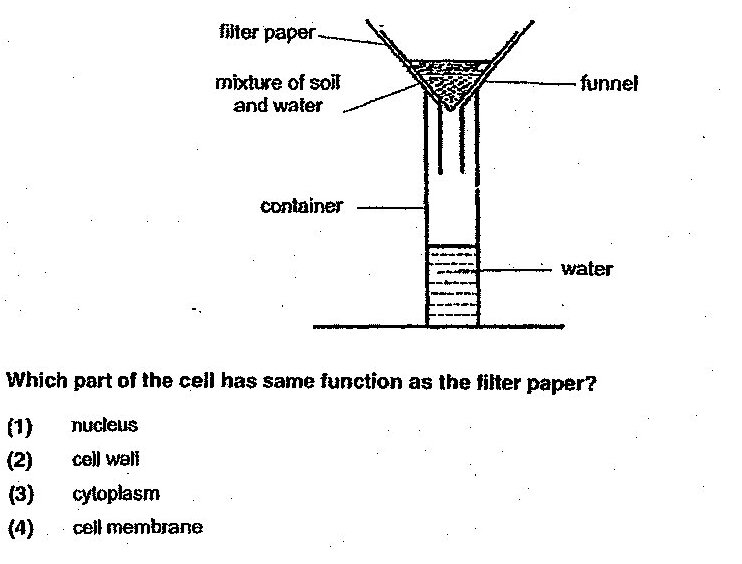
Which part of the cell has same function as the filter paper?
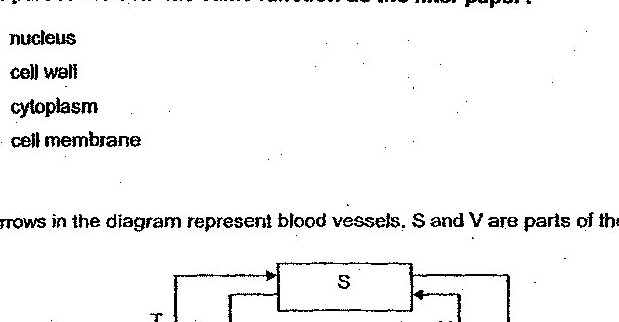
What do S, T, U and V represent?
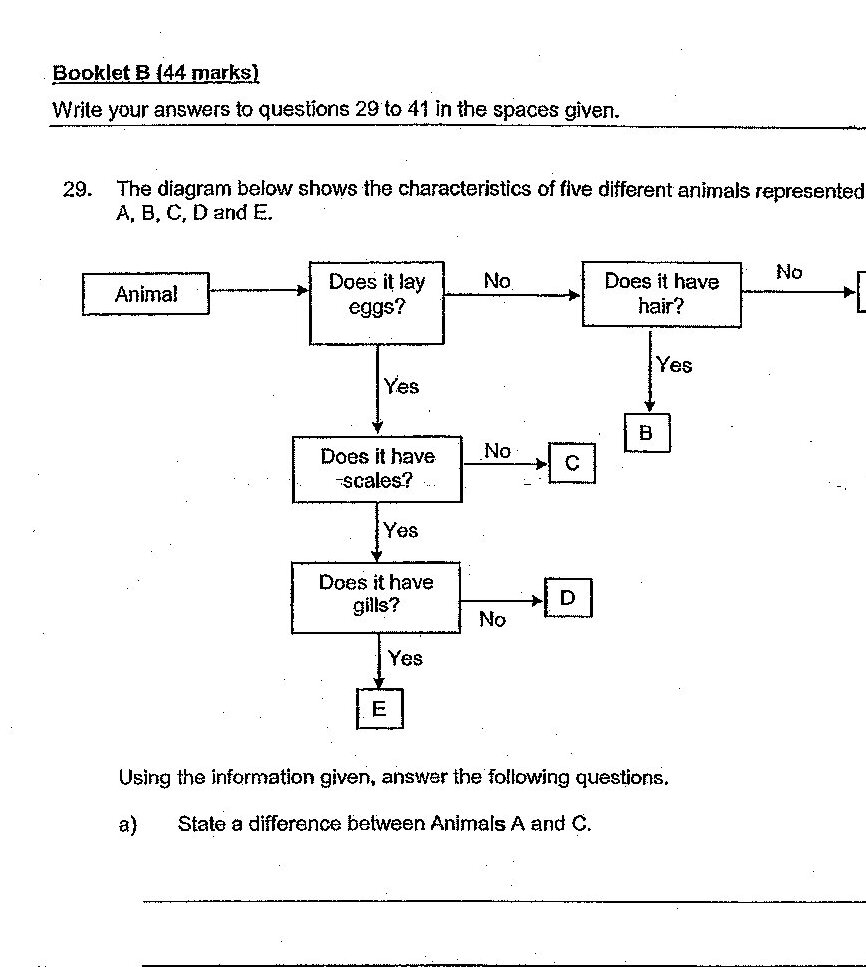
State a difference between Animals A and C.
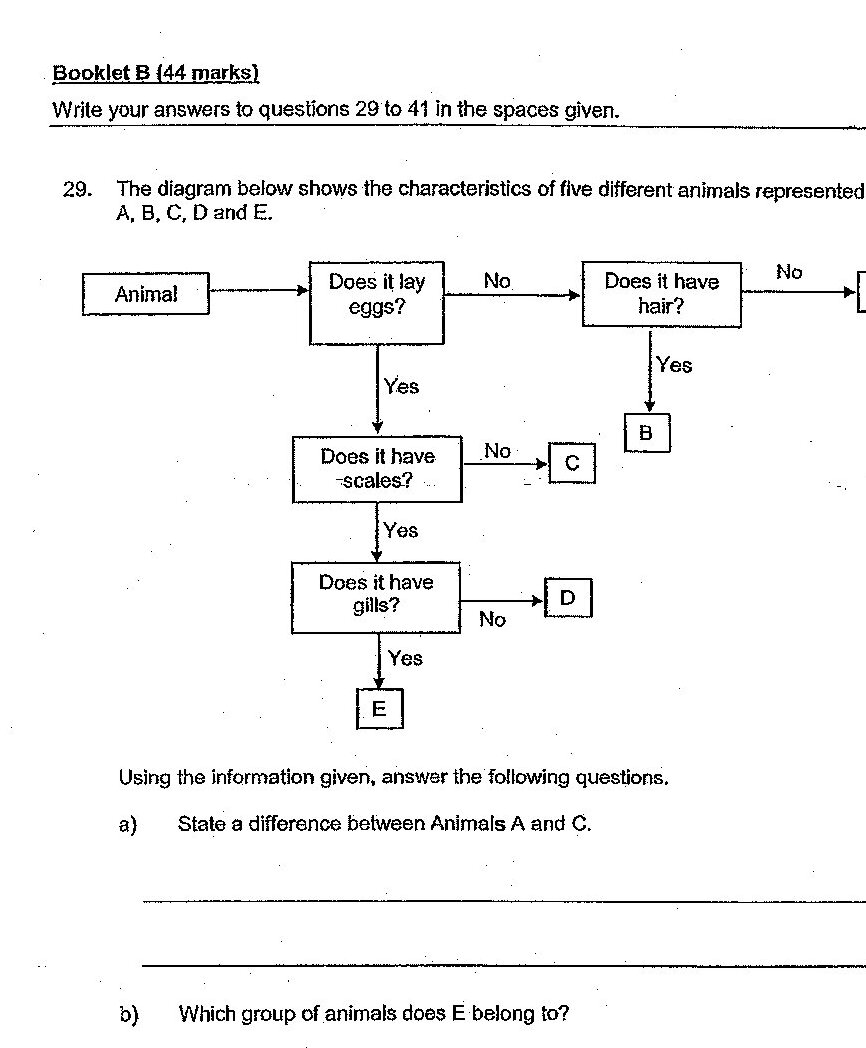
Which group of animals does E belong to?
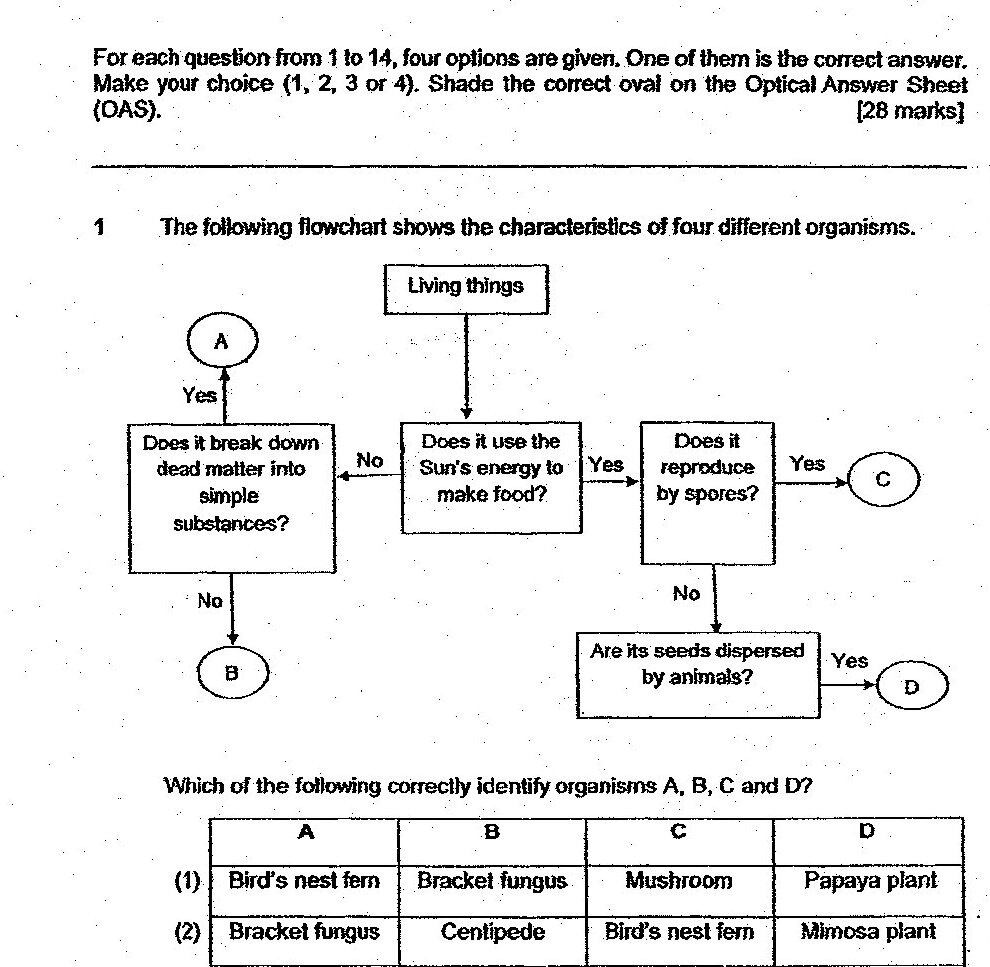
The following flowchart shows the characteristics of four different organisms. Which of the following correctly identify organisms A, B, C and D?
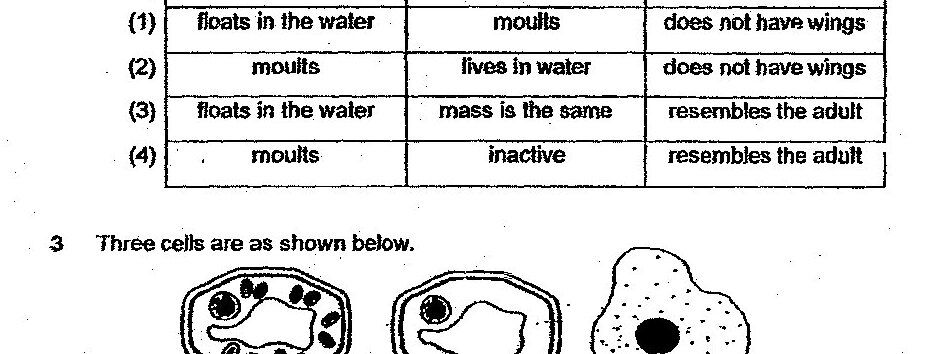
Which one of the following shows the correct classification and common parts found in all cells?
Which animal group does animal Y belong to? State a characteristic that is unique to this animal group.
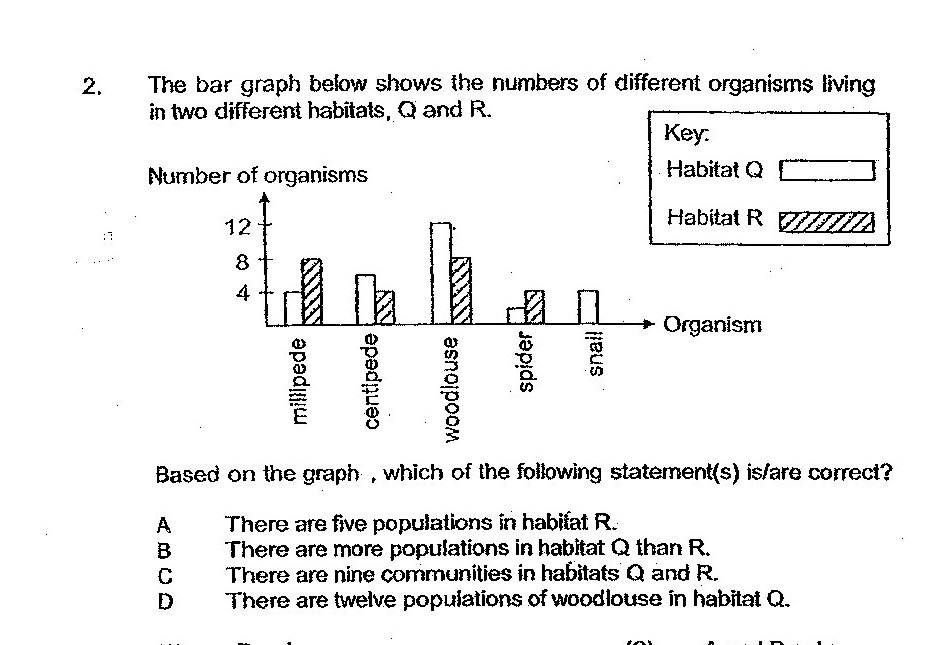
The bar graph below shows the numbers of different organisms living in two different habitats, Q and R. Based on the graph, which of the following statement(s) is/are correct?
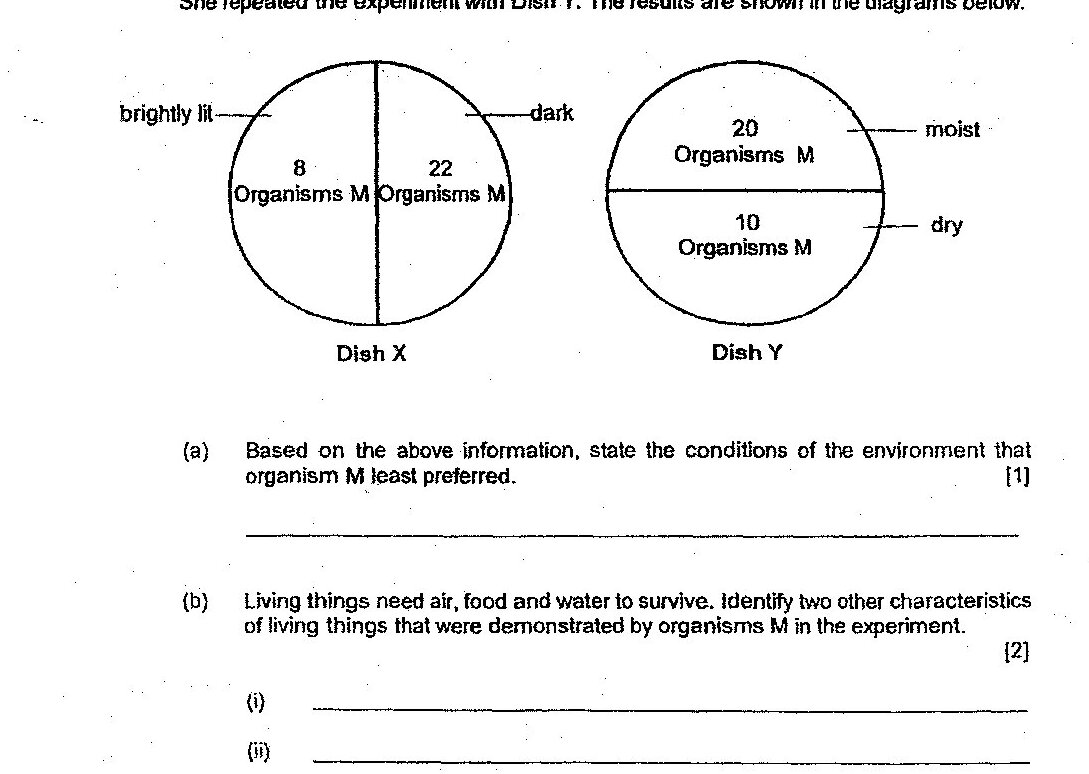
Living things need air, food and water to survive. Identify two other characteristics of living things that were demonstrated by organisms M in the experiment.
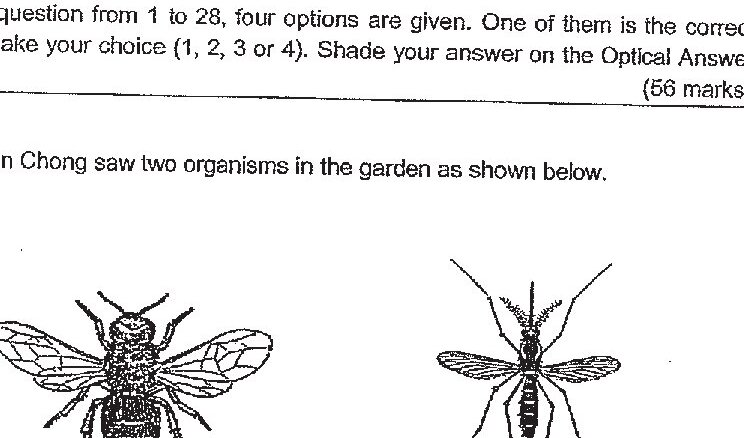
Boon Chong saw two organisms in the garden as shown below. He made the following observations. A Both have six legs. B Both have two wings. C Both have two feelers. D Both have a hard body covering. Which of the above characteristics conclude(s) that both organisms is/are insects?
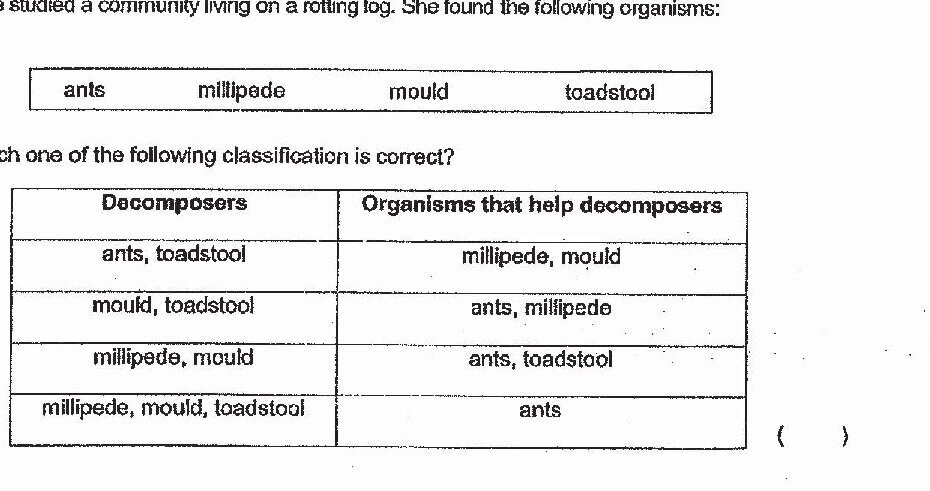
Alice studied a community living on a rotting log. She found the following organisms: ants, millipede, mould, toadstool Which one of the following classification is correct?
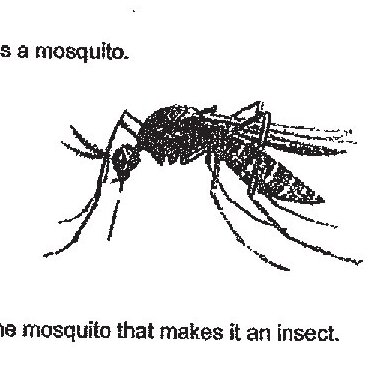
State a characteristic of the mosquito that makes it an insect.
Which of the following could be used to tell the difference between a plant cell and an animal cell?
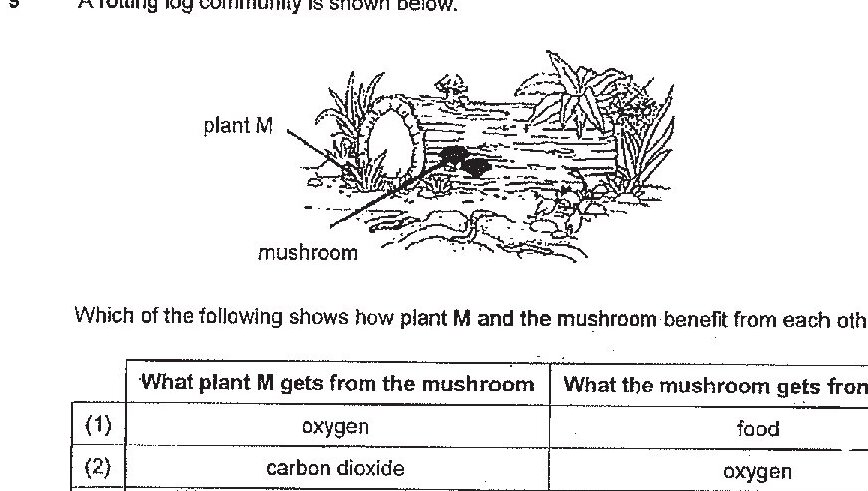
A rotting log community is shown below. Which of the following shows how plant M and the mushroom benefit from each other?
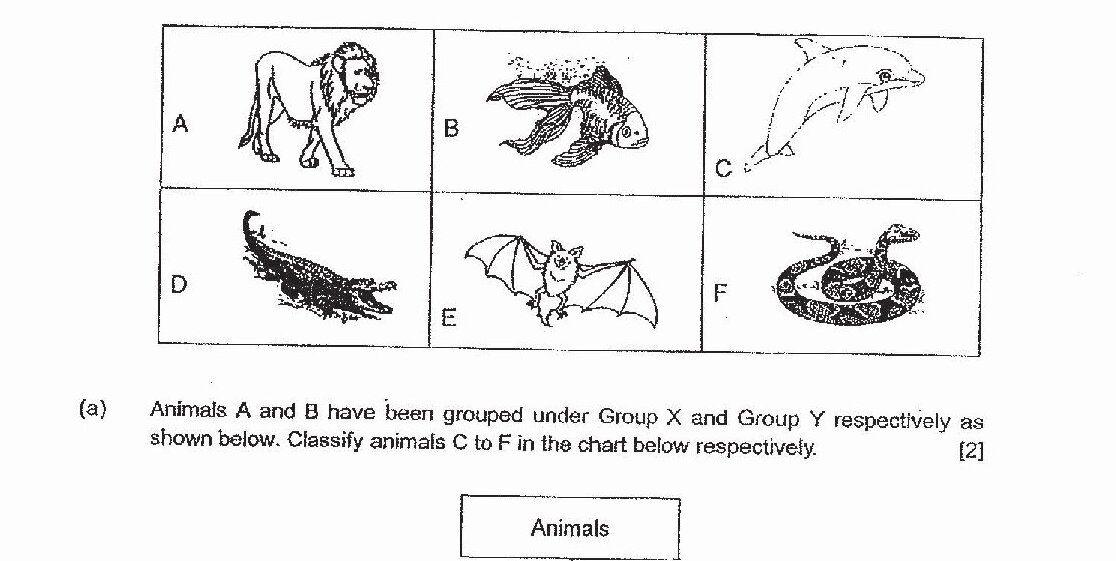
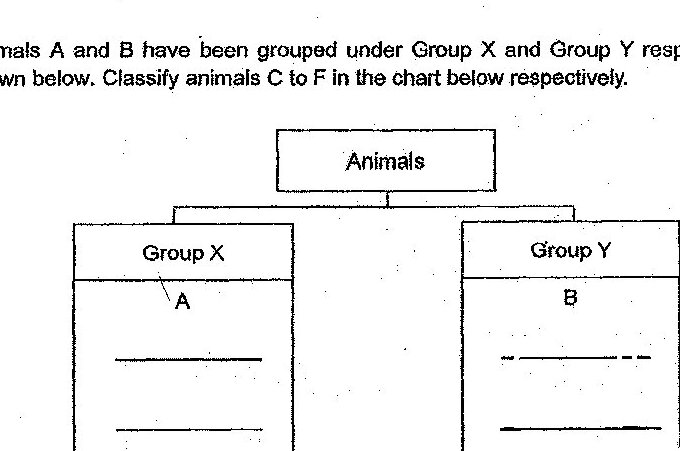
Animals A and B have been grouped under Group X and Group Y respectively as shown below. Classify animals C to F in the chart below respectively.
Suggest suitable headings based on your answer in (a)
Name Gas P. How was it produced?

State what Joel can use to test if the soba noodles is made from a plant.
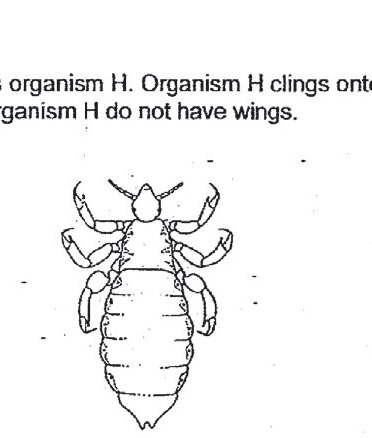
Dinesh classified organism H as an insect. Give a reason why.
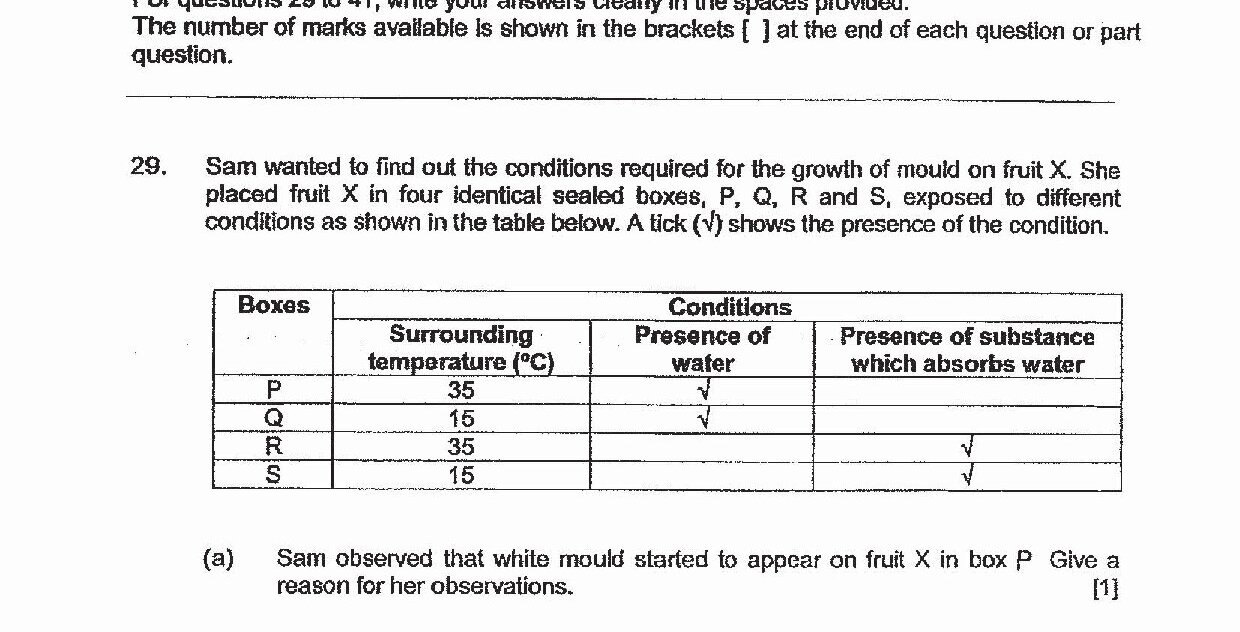
Sam observed that white mould started to appear on fruit X in box P. Give a reason for her observations.
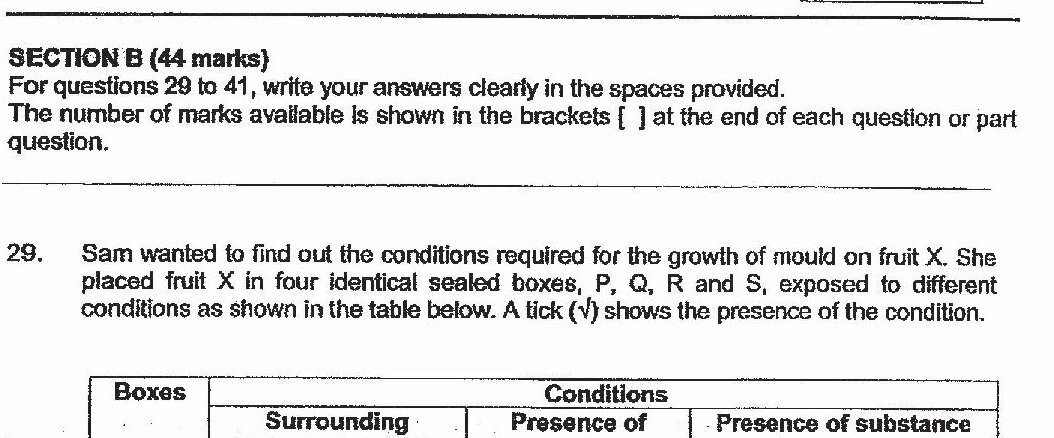
How did the mould appear since all boxes were sealed?
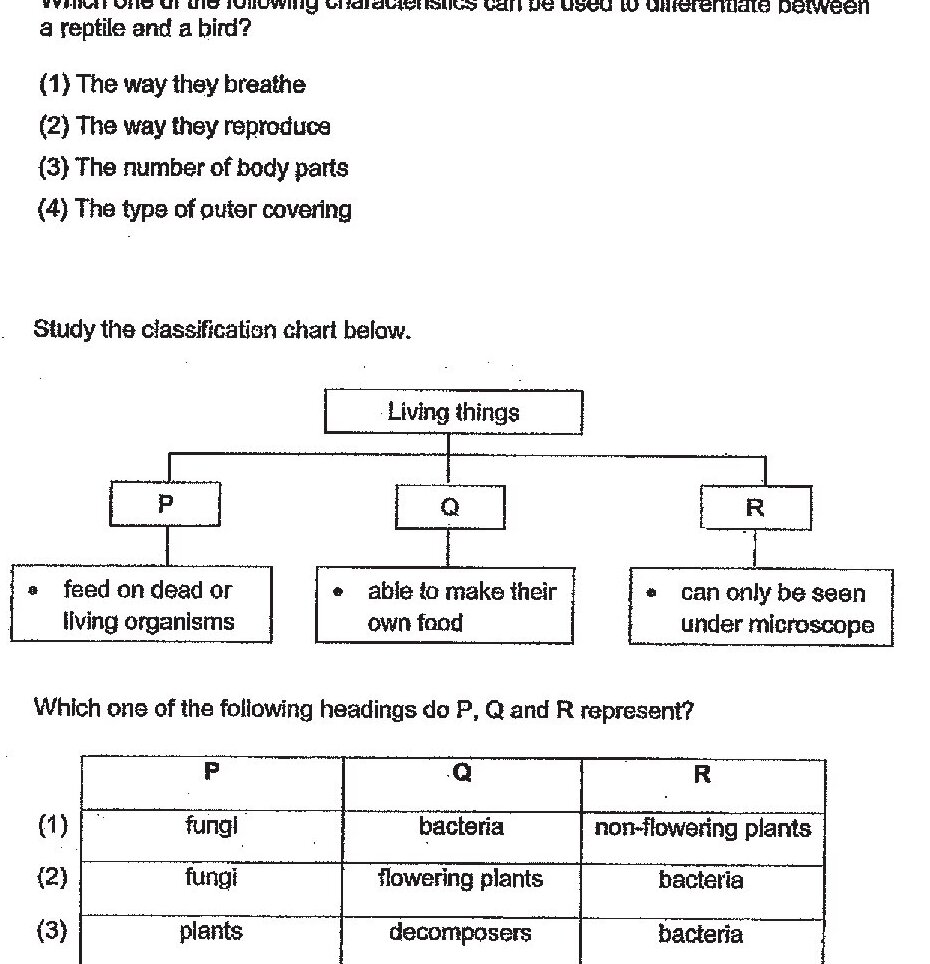
Which one of the following characteristics can be used to differentiate between a reptile and a bird?
Study the classification chart below. Which one of the following headings do P, Q and R represent?
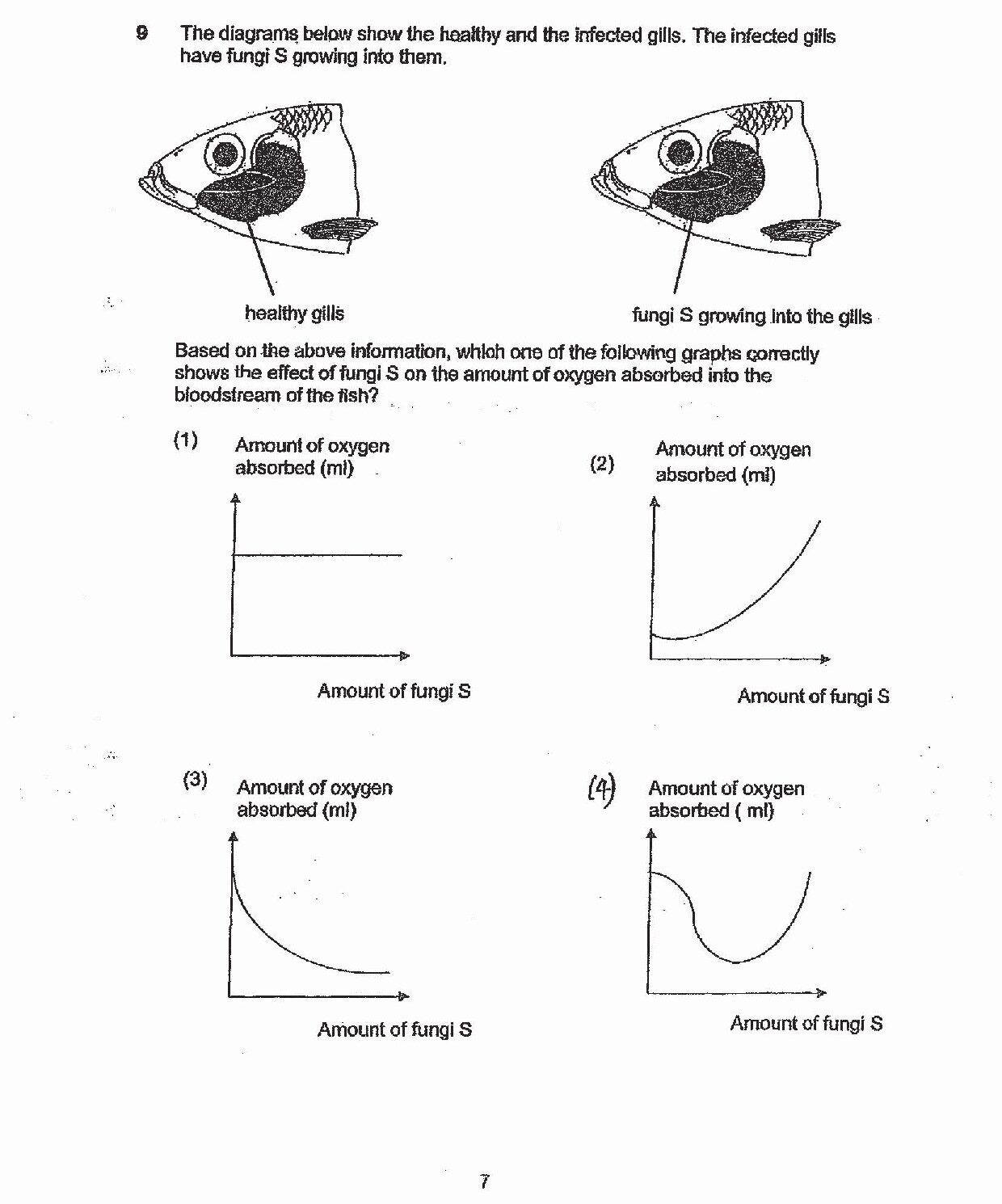
The diagrams below show the healthy and the infected gills. The infected gills have fungi S growing into them. Based on the above information, which one of the following graphs correctly shows the effect of fungi S on the amount of oxygen absorbed into the bloodstream of the fish?
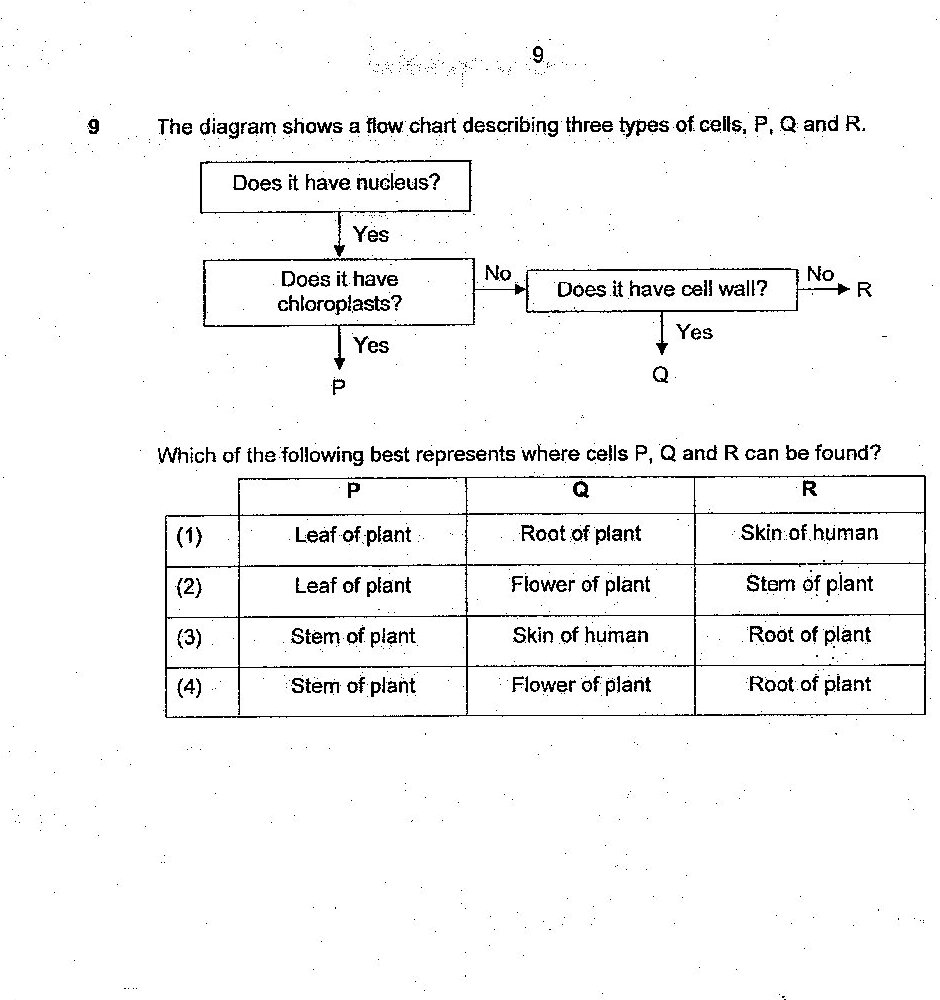
The diagram shows a flow chart describing three types of cells, P, Q and R. Which of the following best represents where cells P, Q and R can be found?
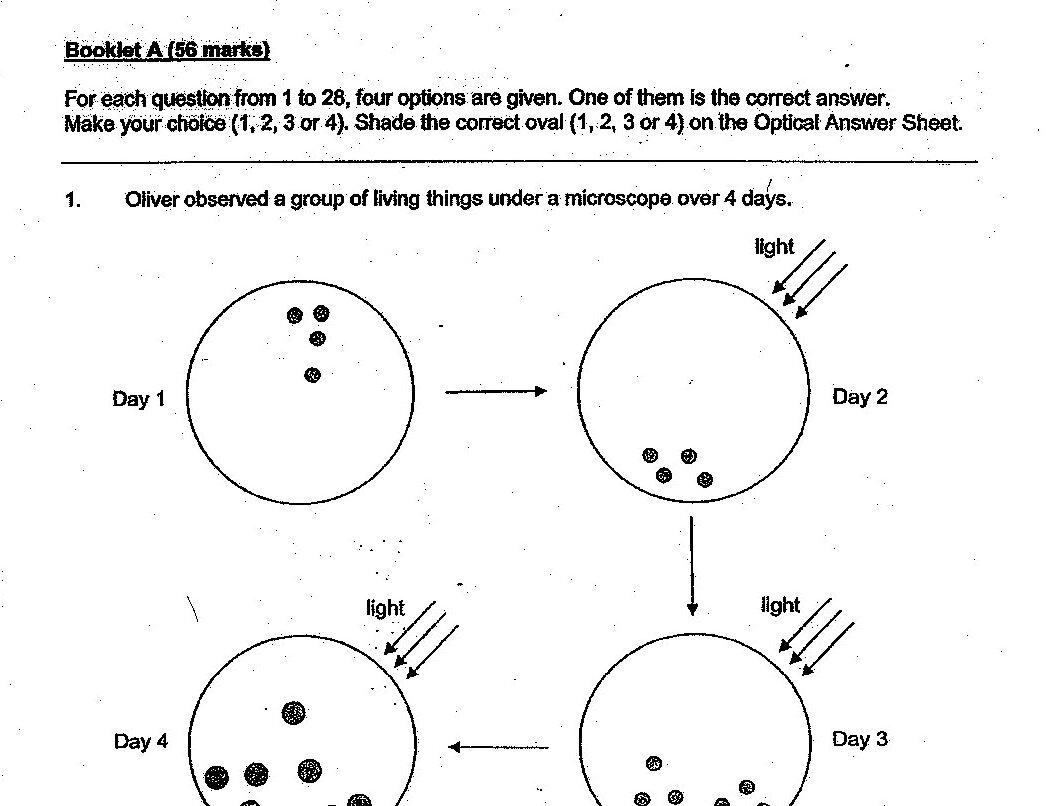
Oliver observed a group of living things under a microscope over 4 days. Which of the following characteristics of living things did he observe over the 4 days?
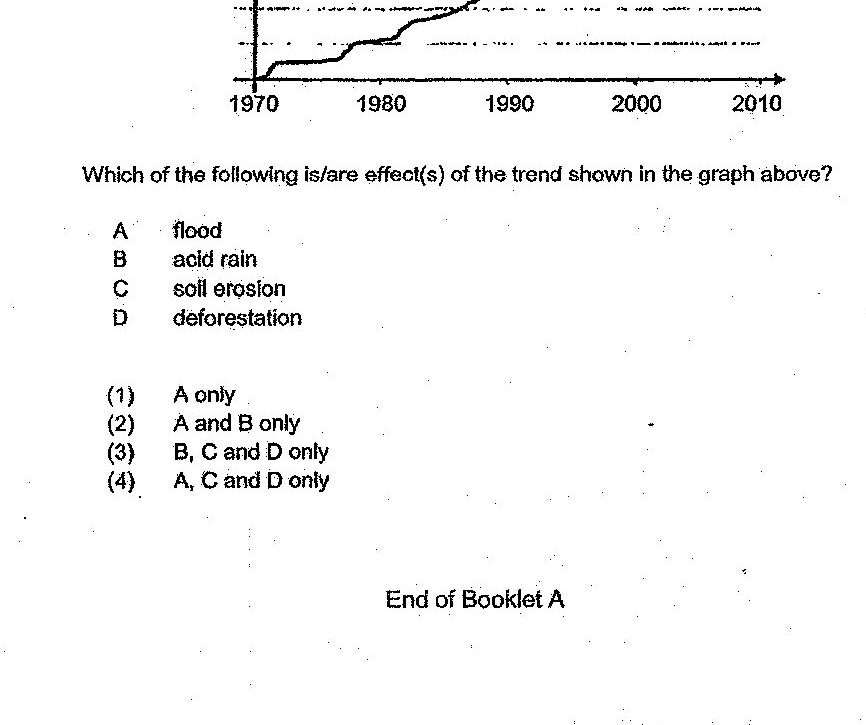
Which option correctly identifies the effect(s)?
Study the animals as shown below.
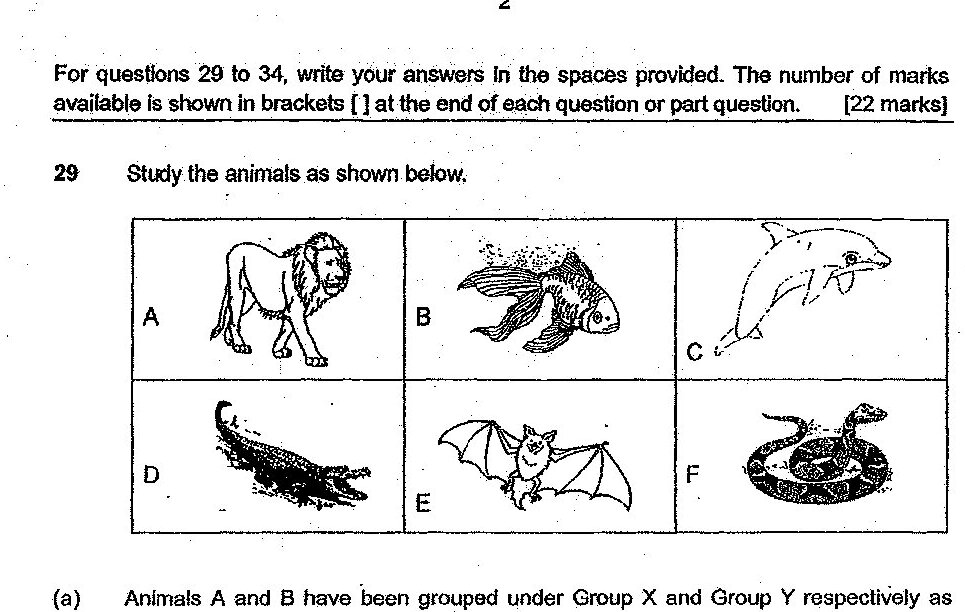
Animals A and B have been grouped under Group X and Group Y respectively as shown below. Classify animals C to F in the chart below respectively.
Suggest suitable headings based on your answer in (a)
Past year papers cover the full exam — browse by subject below.
View All Papers ›