Diversity of Materials
Study Notes: Diversity of Materials
Key Concepts
Properties of Materials
Materials have different properties that make them suitable for different purposes. Understanding these properties helps us choose the right material for the right job.
Physical Properties:
-
Hardness: How difficult it is to scratch or dent a material
- Hard materials: diamond, steel, glass
- Soft materials: rubber, sponge, clay
-
Flexibility: The ability of a material to bend without breaking
- Flexible materials: rubber, plastic sheets, fabric
- Rigid materials: glass, ceramic, metal rods
-
Strength: The ability to withstand force without breaking
- Strong materials: steel, concrete, hardwood
- Weak materials: paper, thin plastic, balsa wood
-
Transparency: How much light can pass through a material
- Transparent: clear glass, clear plastic (can see through clearly)
- Translucent: frosted glass, wax paper (allows some light, cannot see clearly)
- Opaque: wood, metal, brick (no light passes through)
-
Density: How heavy a material is for its size (mass per unit volume)
- Dense materials sink in water: metal, stone, glass
- Less dense materials float: wood, cork, expanded polystyrene
-
Texture: How a material feels to touch
- Smooth: glass, polished metal, plastic
- Rough: sandpaper, concrete, bark
-
Waterproof/Water-resistant: Whether water can pass through or soak into the material
- Waterproof: plastic, rubber, metal, glass
- Water-absorbent: sponge, cloth, paper, wood
Thermal Properties:
-
Thermal Conductivity: How well a material allows heat to pass through it
- Good thermal conductors: metals (copper, aluminum, iron, steel)
- Poor thermal conductors (insulators): wood, plastic, rubber, air, fabric
-
Heat Resistance: How well a material withstands high temperatures without melting or burning
- Heat-resistant: ceramic, glass, metal
- Not heat-resistant: plastic, wax, paper
Electrical Properties:
- Electrical Conductivity: How well a material allows electricity to pass through it
- Good electrical conductors: metals (copper, aluminum, iron, steel, silver, gold)
- Poor electrical conductors (insulators): plastic, rubber, wood, glass, ceramic
Magnetic Properties:
- Magnetic Materials: Materials that are attracted to magnets
- Magnetic: iron, steel, nickel, cobalt
- Non-magnetic: aluminum, copper, plastic, wood, glass, paper
Uses of Materials
Different materials are chosen for different purposes based on their properties.
Common Materials and Their Uses:
Metals (Steel, Aluminum, Copper, Iron):
- Steel: building frames, bridges, car bodies, tools (strong, hard, durable)
- Aluminum: drink cans, aircraft parts, window frames (light, strong, does not rust easily)
- Copper: electrical wires, water pipes (good electrical conductor, malleable)
- Iron: gates, railings, machinery (strong, magnetic, cheaper than steel)
Wood:
- Furniture, floors, building frames, paper
- Chosen because: strong, can be shaped easily, natural, insulating, relatively light
Plastic:
- Bottles, containers, bags, toys, electrical wire coating
- Chosen because: waterproof, light, flexible or rigid depending on type, cheap to produce, electrical insulator
Glass:
- Windows, drinking containers, lenses, light bulbs
- Chosen because: transparent, hard, waterproof, does not react with most substances
Rubber:
- Tyres, erasers, gloves, shoe soles, hoses
- Chosen because: flexible, waterproof, elastic (returns to original shape), electrical insulator, good grip
Ceramics:
- Plates, cups, tiles, toilet bowls, insulators in electrical equipment
- Chosen because: hard, heat-resistant, waterproof, electrical insulator, does not react with most substances
Fabric/Cloth:
- Clothing, curtains, bags, upholstery
- Chosen because: flexible, can be woven into different textures, comfortable, some fabrics are absorbent
Concrete:
- Building foundations, roads, pavements, bridges
- Chosen because: very strong when set, durable, fire-resistant, cheap
Comparing Materials
When comparing materials, we need to consider multiple properties to decide which is most suitable for a specific use.
Framework for Comparison:
- Identify the purpose: What will the object be used for?
- List required properties: What properties does the material need?
- Compare materials: Which materials have these properties?
- Consider additional factors: Cost, availability, environmental impact, aesthetics
Important Comparisons:
Metals vs Plastics:
- Metals: stronger, heat-resistant, electrical conductors, heavier, more expensive
- Plastics: lighter, cheaper, electrical insulators, less strong, can melt at lower temperatures
Glass vs Plastic (for containers):
- Glass: more transparent, harder, more scratch-resistant, heavier, breaks easily
- Plastic: lighter, flexible, does not shatter, less transparent over time, scratches easily
Natural vs Synthetic Materials:
- Natural: wood, cotton, wool, leather, rubber (from rubber trees)
- Synthetic: most plastics, nylon, polyester, synthetic rubber
- Natural materials are renewable but may be less durable
- Synthetic materials can be designed for specific properties but may not decompose easily
Important Definitions
Property: A characteristic or quality of a material that describes how it looks, feels, or behaves.
Hardness: The resistance of a material to being scratched, dented, or deformed.
Flexibility: The ability of a material to bend without breaking and sometimes return to its original shape.
Strength: The ability of a material to support weight or withstand force without breaking or deforming.
Transparent: Allows light to pass through completely so objects can be seen clearly through the material.
Translucent: Allows some light to pass through but objects cannot be seen clearly through the material.
Opaque: Does not allow light to pass through at all.
Density: How much matter (mass) is packed into a certain volume; dense materials feel heavy for their size.
Waterproof: Does not allow water to pass through or soak in.
Thermal Conductor: A material that allows heat to pass through it easily.
Thermal Insulator: A material that does not allow heat to pass through it easily; it slows down heat transfer.
Electrical Conductor: A material that allows electricity to pass through it easily.
Electrical Insulator: A material that does not allow electricity to pass through it easily; it prevents the flow of electricity.
Magnetic Material: A material that is attracted to a magnet (mainly iron, steel, nickel, and cobalt).
Malleable: Can be hammered or pressed into different shapes without breaking (property of some metals).
Ductile: Can be drawn out into wires (property of some metals).
Synthetic: Made by humans through chemical processes; not found naturally.
Worked Examples
Example 1: Choosing Material for a Cooking Pot
Question: A cooking pot needs to heat up quickly and evenly, but the handle should not get too hot to touch. Explain which materials should be used for:
- (a) The body of the pot
- (b) The handle of the pot
Solution:
(a) Body of the pot:
- Material needed: Metal (such as steel or aluminum)
- Reasoning:
- The pot body needs to be a good thermal conductor to allow heat from the stove to pass through to the food quickly
- It needs to be heat-resistant so it won’t melt when heated
- It needs to be strong to hold the weight of food and water
- It needs to be waterproof to contain liquids
- Metals have all these properties
(b) Handle of the pot:
- Material needed: Wood or plastic (heat-resistant plastic)
- Reasoning:
- The handle needs to be a poor thermal conductor (insulator) so heat does not pass through easily from the hot pot
- This keeps the handle cool enough to touch safely
- It needs to be strong enough to support the weight of the pot
- Wood and plastic are both good thermal insulators
Key point: Different parts of the same object may need different materials based on their specific functions.
Example 2: Comparing Materials for Window Panes
Question: A school wants to install window panes in classrooms. They are considering three materials: clear glass, clear plastic, and frosted glass. Compare these materials and suggest which would be most suitable, giving reasons.
Solution:
Comparison of properties:
Clear Glass:
- Transparent (students can see outside clearly)
- Hard and scratch-resistant
- Waterproof
- Heavy
- Breaks easily into sharp pieces (safety concern)
Clear Plastic:
- Transparent (students can see outside)
- Lighter than glass
- Does not shatter (safer)
- Scratches more easily
- Becomes less clear over time
- Cheaper than glass
Frosted Glass:
- Translucent (allows light in but cannot see through clearly)
- Hard and scratch-resistant
- Waterproof
- Heavy
- Breaks easily (safety concern)
- Provides privacy
Most suitable choice: Clear glass
Reasons:
- Classrooms need maximum light for studying, and clear glass is most transparent
- Students benefit from being able to see outside clearly (reduces feeling of being closed in, can see weather)
- Although glass can break, it is more durable and scratch-resistant than plastic for long-term use
- Glass remains clear over many years, while plastic becomes cloudy
- Safety concerns can be addressed by using toughened glass that breaks into small, less dangerous pieces
Alternative consideration: Clear plastic could be chosen if cost and safety are the main priorities, especially in areas where balls might hit windows (near sports areas).
Example 3: Explaining Material Properties for Electrical Wiring
Question: Electrical wires in homes have a metal core (usually copper) surrounded by a plastic coating. Explain why each material is chosen for its specific part.
Solution:
Copper core (inside):
Material chosen: Copper (metal)
Reasons:
- Good electrical conductor: Copper allows electricity to flow through easily, carrying electrical current to appliances
- Ductile: Copper can be drawn out into thin wires without breaking
- Flexible: The wire can bend around corners in walls without snapping
- Does not corrode easily: Copper lasts a long time without rusting
Plastic coating (outside):
Material chosen: Plastic (PVC - polyvinyl chloride)
Reasons:
- Electrical insulator: Plastic prevents electricity from escaping the wire, which would cause short circuits or electric shocks
- Waterproof: Protects the copper from moisture which could cause corrosion or dangerous situations
- Flexible: Allows the wire to bend without the coating cracking
- Durable: Resistant to wear and tear
- Safety: Prevents people from touching the electrical conductor directly
Conclusion: The combination of copper and plastic uses the best property of each material - copper’s electrical conductivity and plastic’s electrical insulation - to make wires that are both effective and safe.
Common Mistakes to Avoid
Mistake 1: Confusing Hardness with Strength
- Wrong thinking: “This material is hard, so it’s strong.”
- Why it’s wrong: Hardness means resistance to scratching; strength means resistance to breaking. Glass is hard (difficult to scratch) but not very strong (breaks easily when force is applied).
- Correct approach: Always specify whether you’re talking about hardness or strength. A material can be hard but brittle (breaks easily).
Mistake 2: Saying “Metal” or “Plastic” Without Being Specific
- Wrong: “Metal is a good conductor.”
- Better: “Metals such as copper, iron, and steel are good electrical conductors.”
- Why: There are many types of metals and plastics with different properties. Be specific when you can.
Mistake 3: Forgetting That Some Properties Can Overlap
- Wrong: “This material must be either transparent or opaque.”
- Correct: Remember there are three categories: transparent, translucent, and opaque. Don’t forget translucent!
Mistake 4: Confusing Thermal and Electrical Conductivity
- Wrong thinking: Assuming all good thermal conductors are also good electrical conductors
- Why it’s partly wrong: While all good electrical conductors (metals) are also good thermal conductors, not all good thermal conductors are good electrical conductors (e.g., graphite)
- For PSLE level: Metals are both good thermal AND electrical conductors; non-metals are generally poor at conducting both heat and electricity
Mistake 5: Not Giving Complete Explanations
- Wrong: “Plastic is used for water bottles because it is waterproof.”
- Incomplete because: This is only one reason.
- Better answer: “Plastic is used for water bottles because it is waterproof (keeps water in), lightweight (easy to carry), transparent or translucent (can see how much water is left), and does not break easily like glass (safer).”
Mistake 6: Writing About Irrelevant Properties
- Example scenario: Question asks why metal is used for pot but plastic for handle
- Wrong: Including that “metal is shiny” or “plastic comes in many colors”
- Correct approach: Focus only on properties that are relevant to the function (thermal conductivity in this case)
Mistake 7: Confusing “Does Not Conduct” with “Prevents/Stops/Blocks”
- Wrong: “Plastic prevents electricity.”
- Correct: “Plastic is a poor conductor of electricity” or “Plastic is an electrical insulator” or “Plastic does not allow electricity to pass through easily.”
Mistake 8: Not Linking Properties to Uses
- Wrong approach: Just listing properties without explaining why they matter
- Example of wrong answer: “Glass is transparent, hard, and waterproof.”
- Correct approach: “Glass is used for windows because it is transparent (allows people to see outside), hard (not easily scratched), and waterproof (keeps rain out).”
Reactions of Materials
Rust and Corrosion
What is Rust?
Rust is what forms when iron or steel reacts with both oxygen and water. The key rule for PSLE:
- Rust forms only when iron or steel is exposed to BOTH oxygen AND water at the same time
- Oxygen alone is NOT enough — water must also be present
- Water alone is NOT enough — oxygen must also be present
- Both conditions must be present together for rusting to occur
The chemical reaction: Iron + Oxygen + Water → Iron oxide (rust)
Rust appears as a reddish-brown, flaky coating on the surface of iron or steel.
Rust is a Chemical Change
Rusting is a chemical change, not a physical change:
- A new substance (iron oxide / rust) is formed that is different from the original iron
- The change cannot be reversed — you cannot turn rust back into iron by simple physical means
- This is a key distinction: physical changes (e.g. bending, cutting) can often be reversed; chemical changes cannot
Which Metals Rust?
- Only iron and steel rust — not all metals rust
- Other metals undergo corrosion (a similar process) but do not produce rust
- Example: Copper corrodes and turns green — this green coating is called verdigris
- Example: Aluminium forms a thin oxide layer on its surface, which actually protects it from further corrosion (this is why aluminium “does not rust easily”)
- Silver, gold, and platinum are very resistant to corrosion
What is Corrosion?
Corrosion is the broader process where metals react with substances in the environment (such as oxygen, water, or acids) and are gradually worn away or changed. Rusting is a specific type of corrosion that affects only iron and steel.
| Metal | What happens | Appearance |
|---|---|---|
| Iron / Steel | Rusts (reacts with oxygen + water) | Reddish-brown flaky coating |
| Copper | Corrodes (reacts with oxygen + moisture in air) | Green coating (verdigris) |
| Aluminium | Forms thin oxide layer (self-protecting) | Stays silver/grey; surface dulls slightly |
How to Prevent Rust
Rust prevention works by keeping oxygen and/or water away from the iron or steel surface:
| Method | How it works |
|---|---|
| Painting | A layer of paint covers the metal surface, blocking contact with oxygen and water |
| Oiling / Greasing | A layer of oil or grease coats the surface, preventing oxygen and water from reaching the metal |
| Galvanising | A layer of zinc is applied to the iron or steel; zinc acts as a protective barrier and also corrodes preferentially (sacrificial protection) |
| Electroplating | A thin layer of another metal (e.g. chromium, gold) is deposited onto the surface using electricity, forming a protective barrier |
| Using stainless steel | An alloy of iron with chromium (and other metals) that resists rusting |
Key principle: All rust-prevention methods work by creating a barrier that stops oxygen and/or water from reaching the iron or steel.
PSLE Exam Tips for Rust Questions
- Always state BOTH conditions: “Iron needs both oxygen AND water to rust” — never say just “air” or just “water”
- Rust = chemical change: It cannot be reversed; a new substance (iron oxide) is formed
- Only iron and steel rust: If the question asks about copper turning green, that is corrosion (verdigris), not rust
- Prevention = blocking oxygen or water (or both): Link the method to which condition it removes
- Classic experiment: Three test tubes — (1) iron nail + dry air only → no rust; (2) iron nail + boiled water (no oxygen) only → no rust; (3) iron nail + water + air → rusts. This shows BOTH are needed.
Exam Tips
Keywords That Earn Marks:
When describing why a material is chosen, use these connecting phrases:
- “because it is…”
- “so that it can…”
- “which allows…”
- “enabling it to…”
- “to prevent…”
Essential Keywords for Different Properties:
Thermal properties:
- Good/poor conductor of heat
- Thermal conductor/insulator
- Allows heat to pass through easily/does not allow heat to pass through easily
- “Keeps/prevents heat from passing through”
Electrical properties:
- Good/poor conductor of electricity
- Electrical conductor/insulator
- Allows electricity to flow through/does not allow electricity to flow through
- “Prevents electric shock”
Structural properties:
- Strong/weak
- Hard/soft
- Flexible/rigid
- Can withstand force/weight without breaking
Light properties:
- Transparent/translucent/opaque
- Allows light to pass through completely/partially/not at all
- Can see through clearly/cannot see clearly through
Answer Structure for “Why is [material] used for [object]?” Questions:
Use this 3-part structure:
- State the property (what characteristic the material has)
- Use a linking word (because, so that, which allows)
- Explain the benefit (how this property makes it suitable for the use)
Example: “Copper is used for electrical wires because it is a good conductor of electricity (property + link), which allows electrical current to flow through easily (benefit).”
For Comparison Questions:
- Use comparison words: “more…than”, “less…than”, “while”, “whereas”, “on the other hand”
- Compare the same properties for both materials
- Make sure you address the specific context given in the question
Example structure: “Material A is more suitable than Material B because Material A is [property 1] while Material B is [opposite property 1]. Material A is also [property 2], which is important for [specific function in question].”
For “Suggest a Suitable Material” Questions:
- First, think about what the object needs to do (its function)
- List the properties needed for that function
- Choose a material that has those properties
- Write your answer linking the properties to the function
Mark-earning phrases:
- “A suitable material would be…”
- “…has the properties of…”
- “These properties make it suitable because…”
- “This allows it to…”
Common Question Types and How to Answer:
Type 1: “Why is material X chosen for object Y?”
- Must link at least 2-3 properties to the function
- More properties correctly linked = more marks
Type 2: “Compare material A and material B for use as [object]”
- State at least 2 properties where they differ
- Explain which is more suitable for the specific use
- Conclude with a recommendation
Type 3: “Material X has properties P1, P2, P3. What can it be used for?”
- Think of objects that need those specific properties
- Explain how each property makes it suitable
- Give specific examples, not vague ones (e.g., “cooking pot” not just “kitchen item”)
Specific Numbers/Facts That May Be Tested:
- Metals are both good thermal AND electrical conductors
- Magnetic materials: iron, steel, nickel, cobalt (most commonly iron and steel)
- Copper is commonly used for electrical wires and water pipes
- Glass, ceramic, plastic, rubber, and wood are electrical insulators
- Air is a poor conductor (good insulator) of heat and electricity
Watch Out For These Words in Questions:
- “Suggest”: You need to give a material and explain why
- “Compare”: You must discuss both materials
- “Explain”: Don’t just state - you must give reasons
- “Which property”: Identify the specific property, don’t just name the material
- “Most suitable”: You must justify why it’s better than alternatives
Quick Summary
Properties to Remember:
✓ Hardness: Resistance to scratching (hard: glass, metal, ceramic; soft: rubber, sponge)
✓ Strength: Resistance to breaking under force (strong: steel, concrete; weak: paper, thin plastic)
✓ Flexibility: Ability to bend without breaking (flexible: rubber, fabric; rigid: glass, ceramic)
✓ Transparency: How light passes through (transparent: clear glass; translucent: frosted glass; opaque: wood, metal)
✓ Thermal conductivity: Metals are good conductors (copper, aluminum, steel); non-metals are poor conductors/insulators (wood, plastic, rubber, air)
✓ Electrical conductivity: Metals are good conductors (copper, iron, steel); non-metals are insulators (plastic, rubber, glass, wood, ceramic)
✓ Magnetic materials: Only iron, steel, nickel, and cobalt are magnetic (most common: iron and steel)
✓ Waterproof materials: Plastic, rubber, metal, glass are waterproof; wood, paper, fabric absorb water
Key Material Uses:
✓ Metals: Building structures, wires, pots and pans, tools (because: strong, good conductors, heat-resistant)
✓ Plastics: Bottles, containers, wire coating, bags (because: waterproof, light, cheap, electrical insulator)
✓ Glass: Windows, drinking containers, lenses (because: transparent, hard, waterproof, does not react with substances)
✓ Wood: Furniture, pot handles, building material (because: strong, insulator, can be shaped easily)
✓ Rubber: Tyres, gloves, erasers (because: flexible, waterproof, electrical insulator, good grip)
Exam Success Checklist:
✓ Always link properties to functions - explain WHY a material is suitable
✓ Give specific examples of materials (name the actual metal/plastic type when possible)
✓ Remember both thermal AND electrical properties of metals (good conductors of both)
✓ Don’t confuse hardness with strength - they are different properties
✓ For comparison questions, discuss both materials and state which is more suitable
✓ Include at least 2-3 relevant properties in your answer for full marks
✓ Use correct scientific terms: conductor/insulator, transparent/translucent/opaque, flexible/rigid
✓ When answering “why” questions, always explain the benefit (what the property allows the object to do)
Remember: The key to doing well in Diversity of Materials questions is to link properties to functions. Don’t just list properties - always explain how each property makes the material suitable for its specific use!
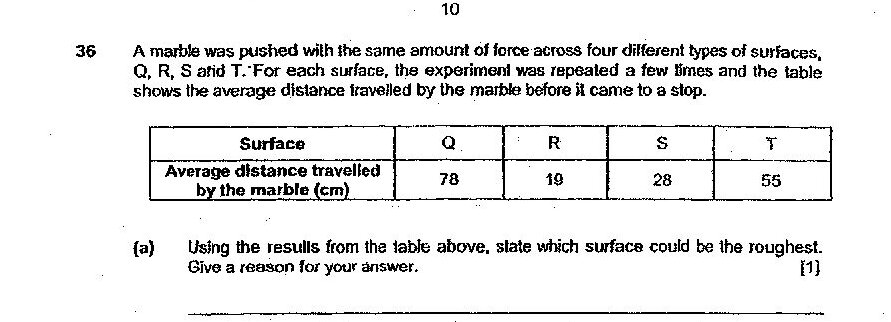
Using the results from the table above, state which surface could be the roughest. Give a reason for your answer.
Which piece of fabric is most suitable to make a bath towel? Explain your choice.
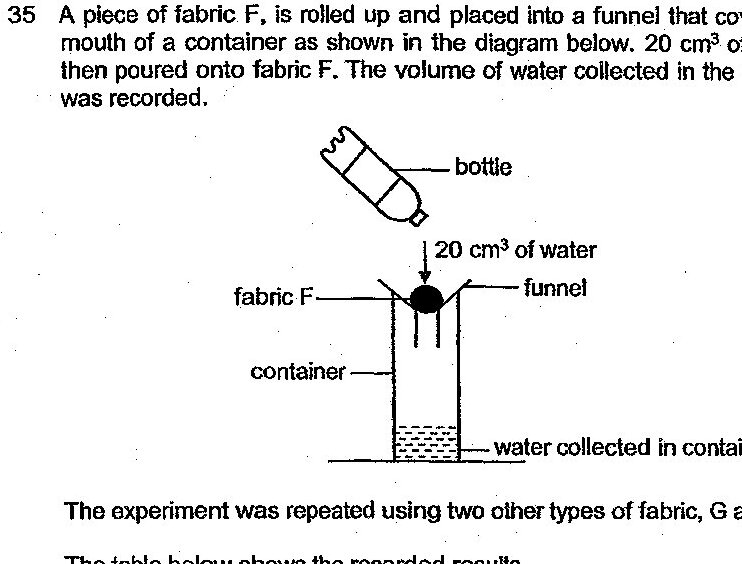
State a factor about the fabrics used that needs to be kept constant to ensure a fair test.
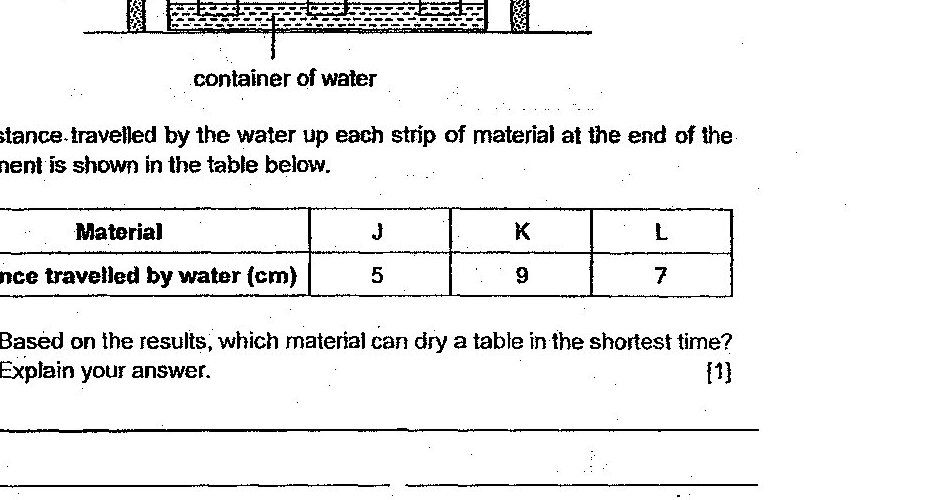
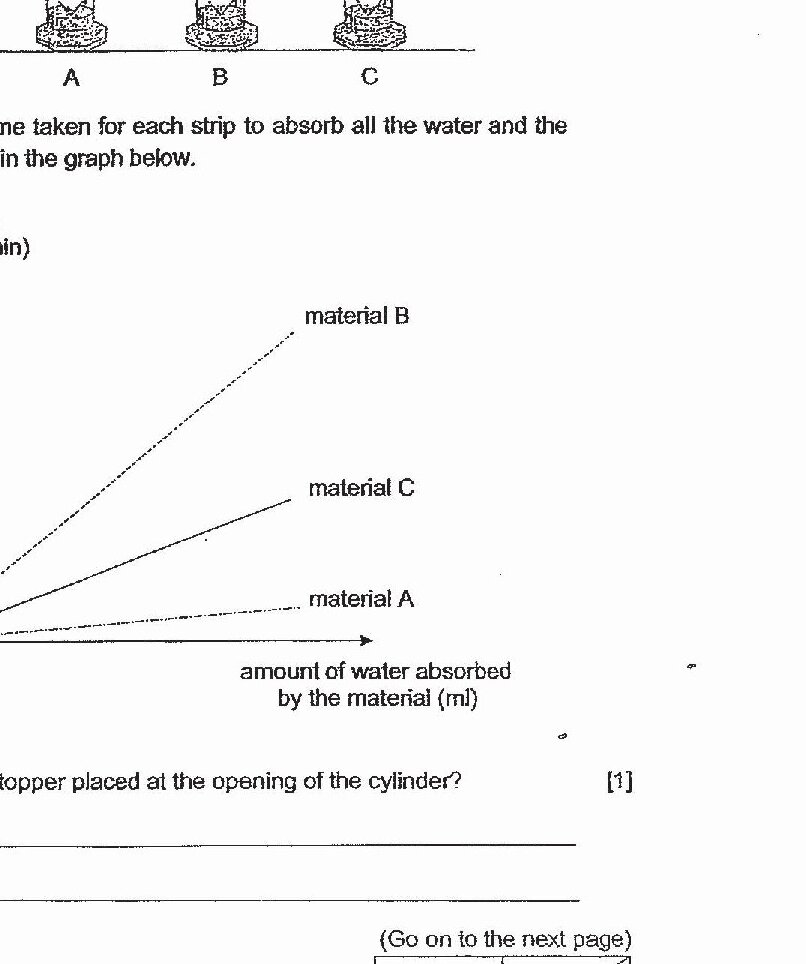
Calvin set up an experiment as shown below to find out how fast materials, J, K and L, would absorb water. One end of each strip of material was hung on a rod while the other end was soaked in water.
Based on the results, which material can dry a table in the shortest time? Explain your answer.
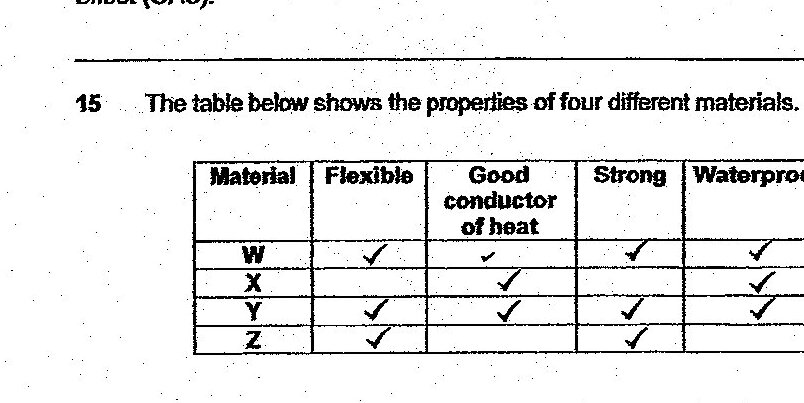
The table below shows the properties of four different materials. Ashraf wanted to bring some cold water to school. He needed a bottle which he could squeeze into his small bag together with his books without the bottle breaking. Which one of the materials is most suitable for making Ashraf's bottle?
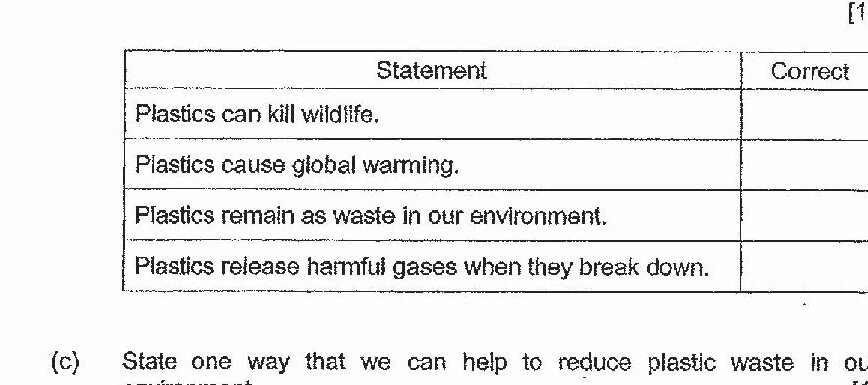
The results of Halim's experiment showed that the plastic box remained the same condition while the paper box had broken down into smaller pieces. Which of the following statements is supported by the results of Halim's experiment? Put a tick in the box next to the correct statement.
Based on the graph, which material should Sammy choose to make the children's bath mat if he wants to keep their feet dry? Explain why.
When making the children's bath mat, Sammy then decided to attach a layer of rubber below the material. Give a reason why Sammi added the layer of rubber.
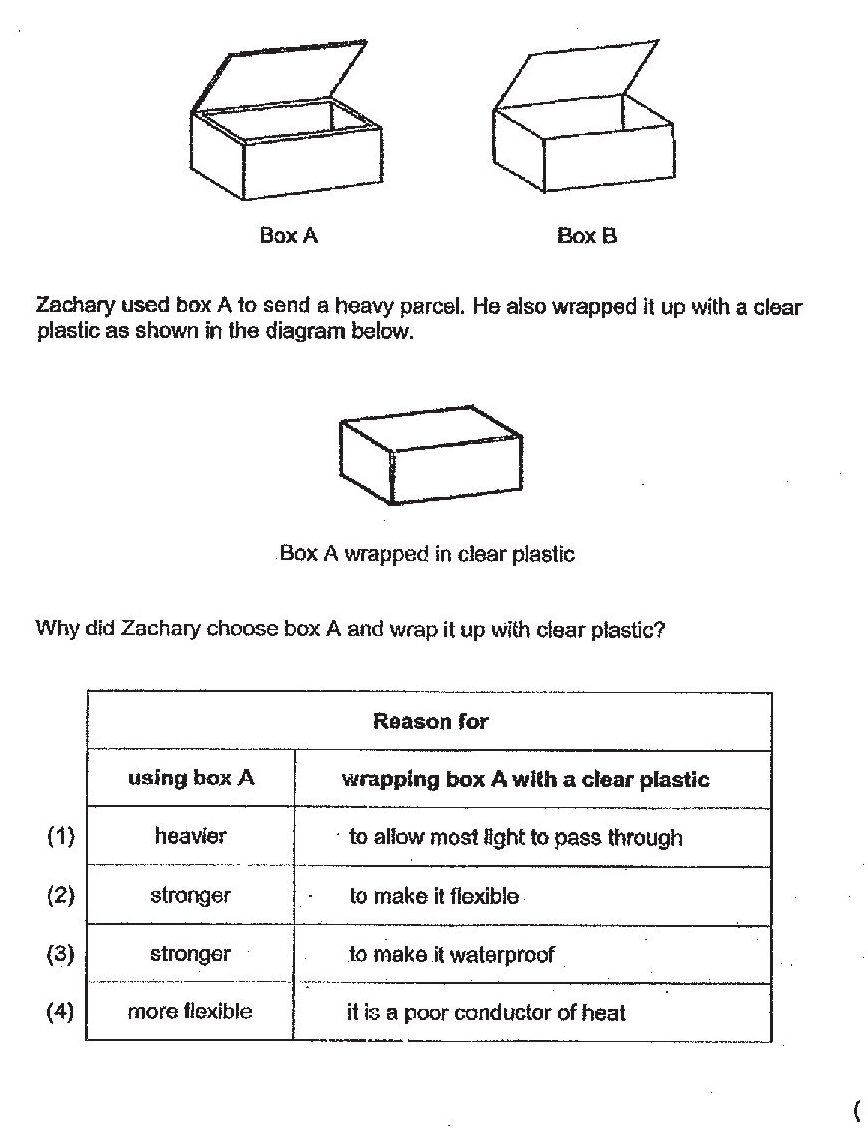
The diagram below shows two cardboard boxes, A and B, of the same size but of different thickness. Zachary used box A to send a heavy parcel. He also wrapped it up with a clear plastic as shown in the diagram below. Why did Zachary choose box A and wrap it up with clear plastic?
Material W was used to make a life jacket. The life jacket was inflated and placed in water. After some time, the life jacket sank and the inside was filled with water. There were no holes in the life jacket. Suggest a property that was missing in Material W that did not allow the life jacket to stay afloat.
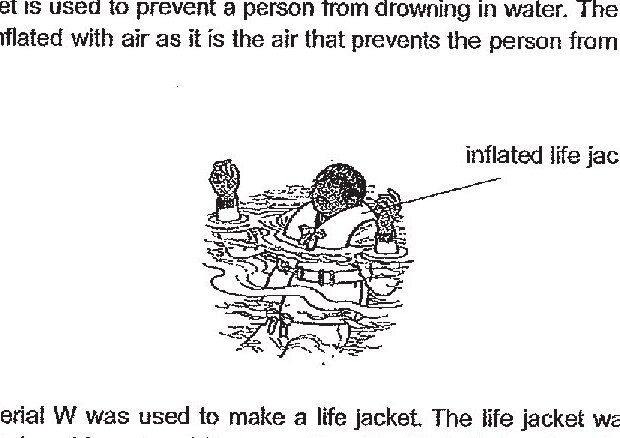
Life jackets are usually kept under the seats of airplanes. It is deflated in order for it to take up less space. State the property of the material that allows life jackets to be deflated. Explain how this property allows the life jacket to fit neatly under the seat.
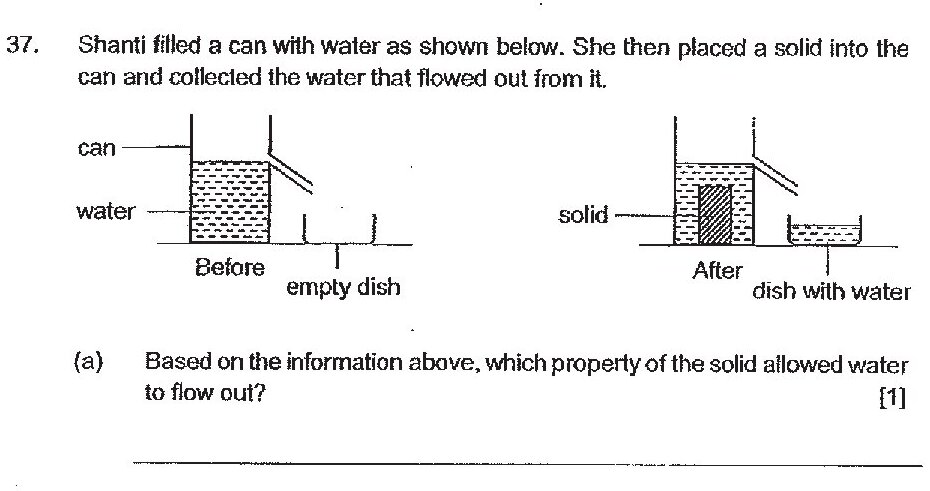
Based on the information above, which property of the solid allowed water to flow out?
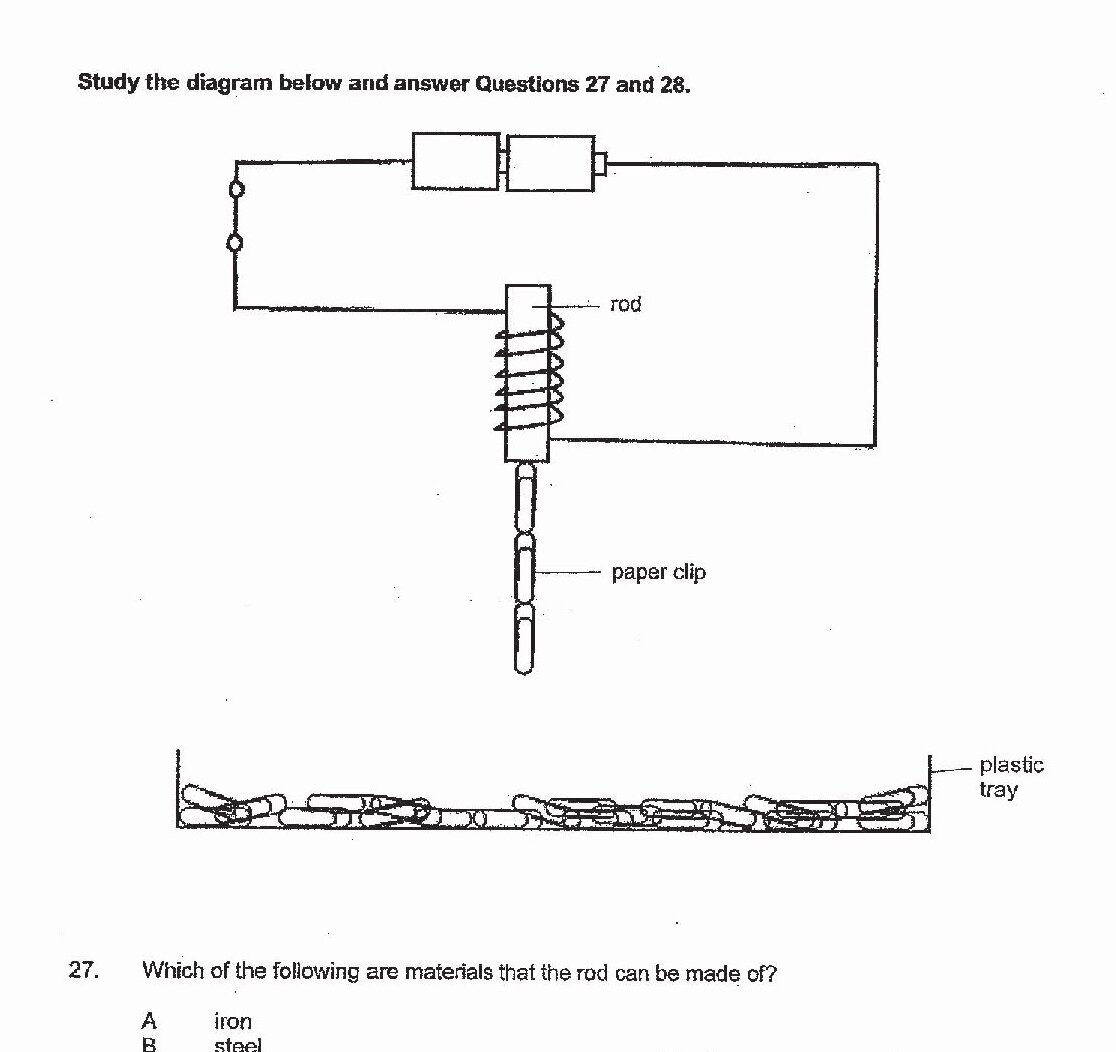
Which of the following are materials that the rod can be made of?
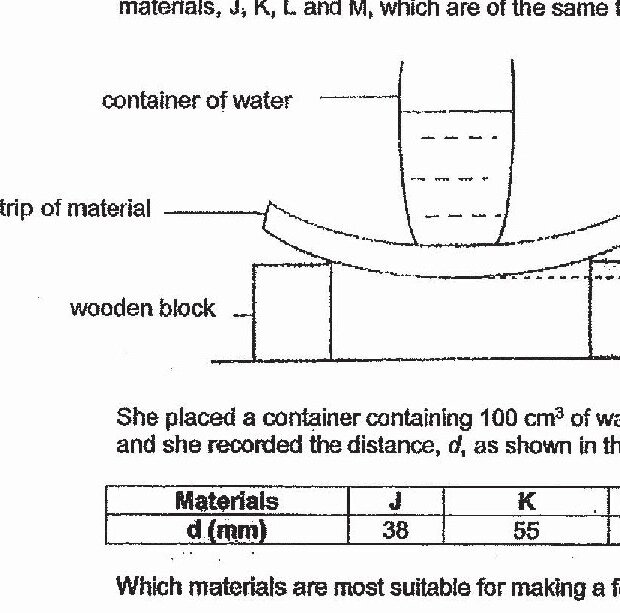
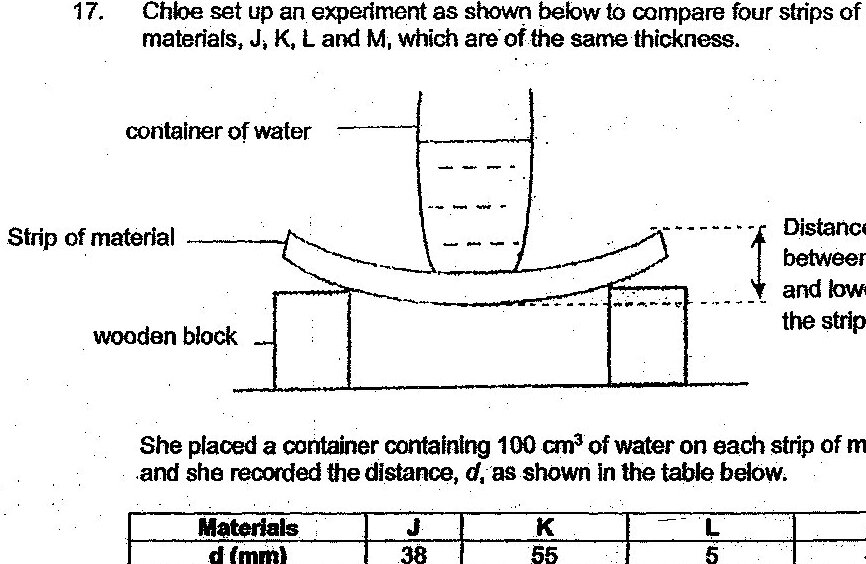
Chloe set up an experiment as shown below to compare four strips of different materials, J, K, L and M, which are of the same thickness. She placed a container containing 100 cm³ of water on each strip of material and she recorded the distance, d, as shown in the table below. Which materials are most suitable for making a food tray and a belt?
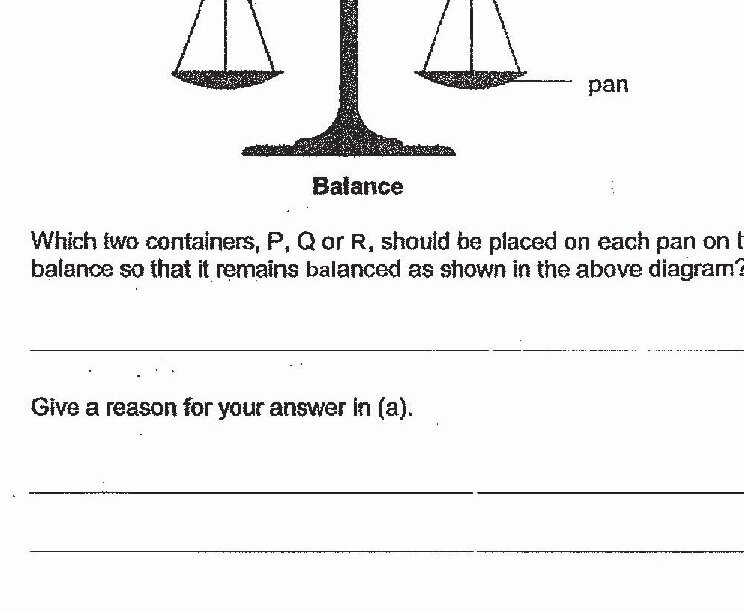
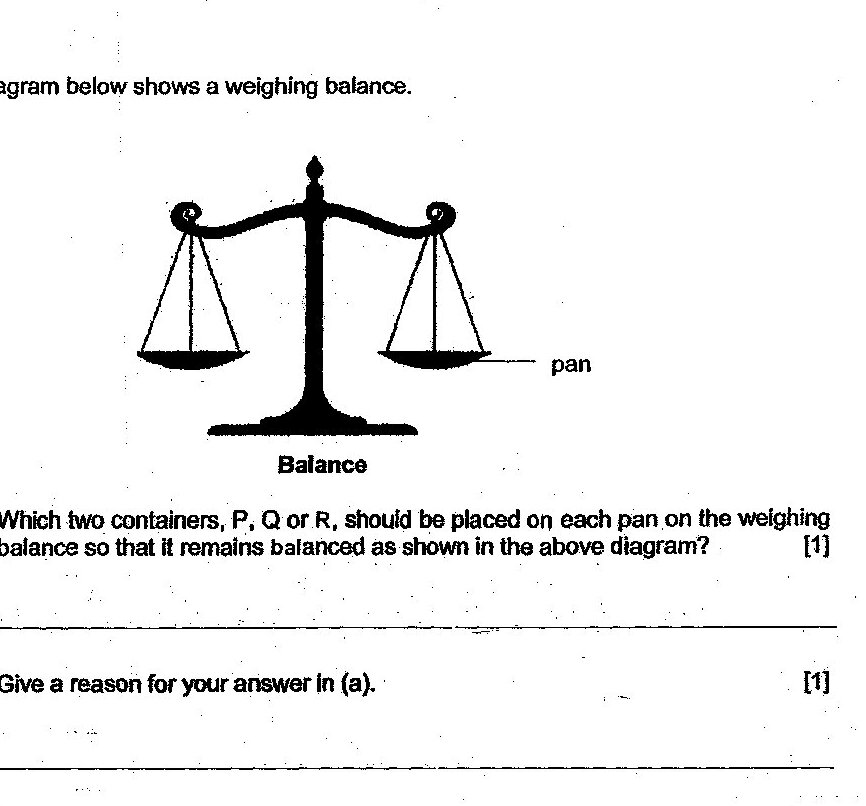
Which two containers, P, Q or R, should be placed on each pan on the weighing balance so that it remains balanced as shown in the above diagram?
Zul set up an experiment as shown below to compare a property of three strips of different materials, X, Y and Z. He measured the distance d, when a container of 200 cm³ of water is placed on it. For each strip, he placed a container of 200 cm³ of water on it and measured the distance d. His results are shown below. (a) Based on the results, what property of the materials was Zul trying to find out?
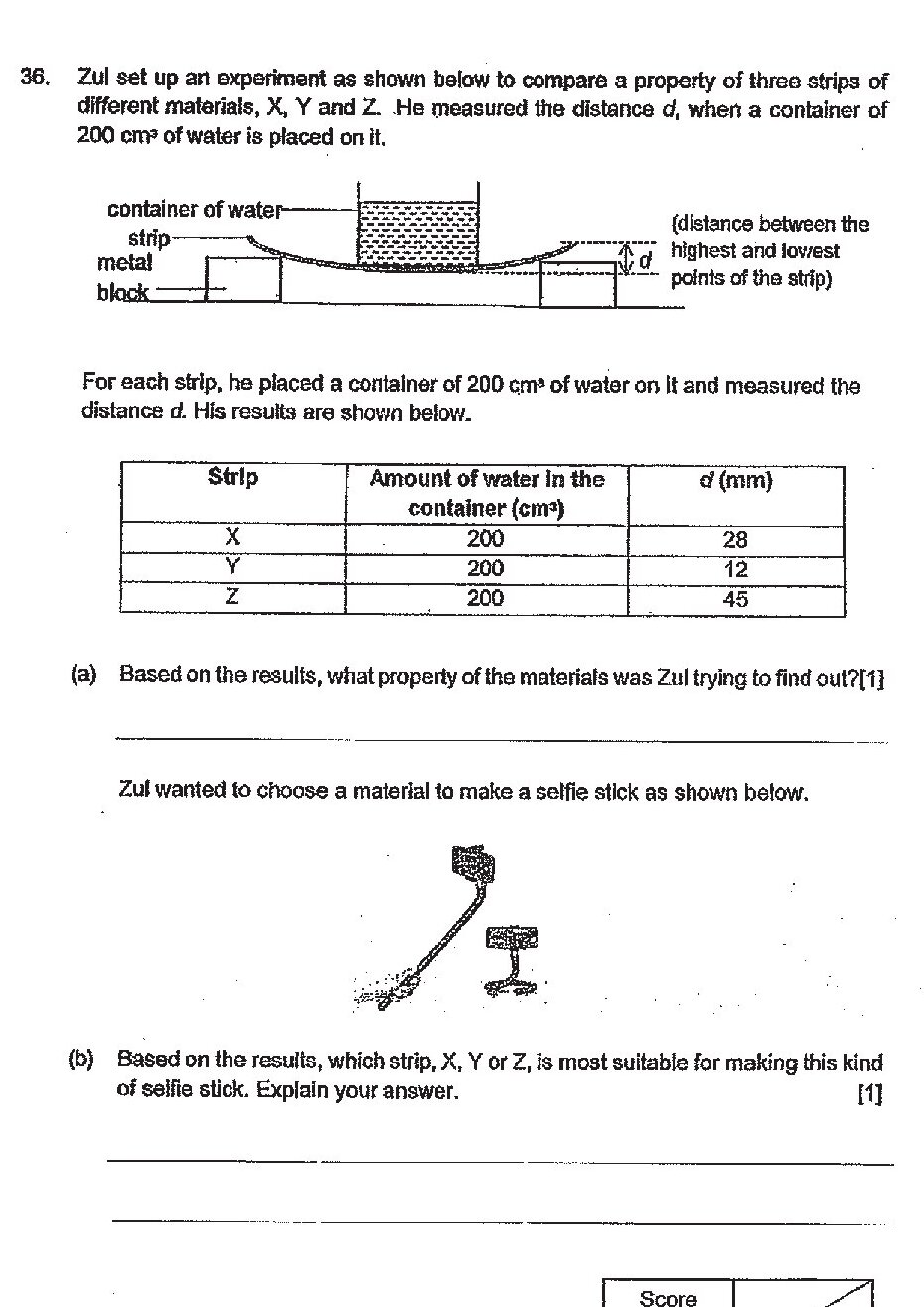
Zul wanted to choose a material to make a selfie stick as shown below. Based on the results, which strip, X, Y or Z, is most suitable for making this kind of selfie stick. Explain your answer.
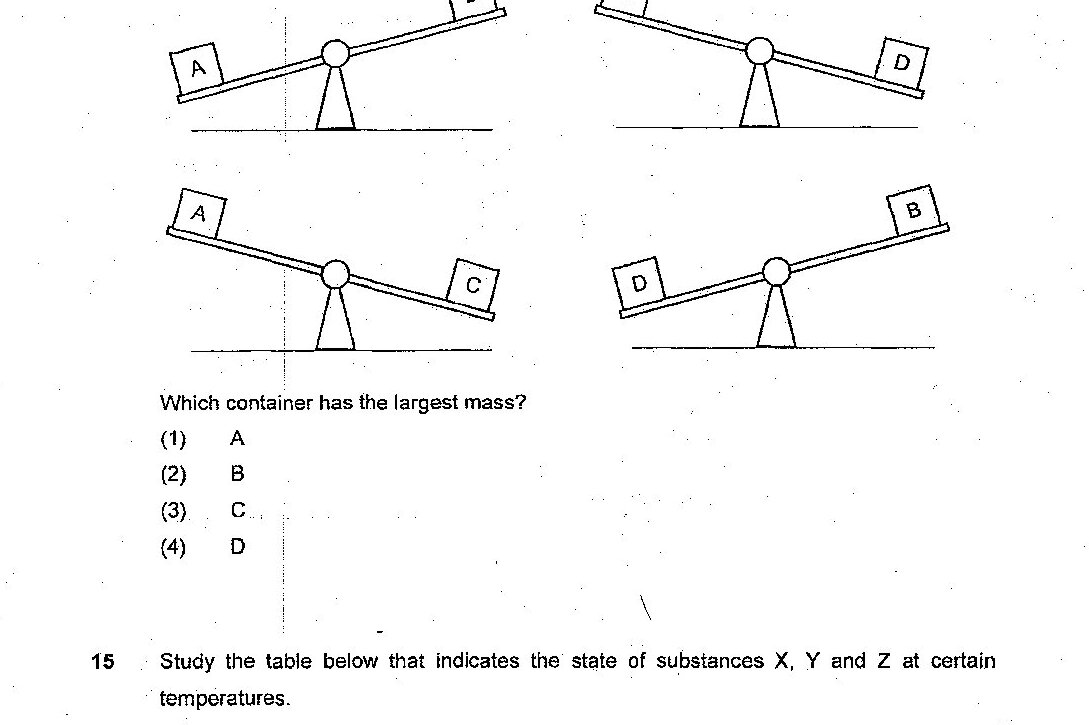
Study the containers, A, B, C and D, in the diagrams. Which container has the largest mass?
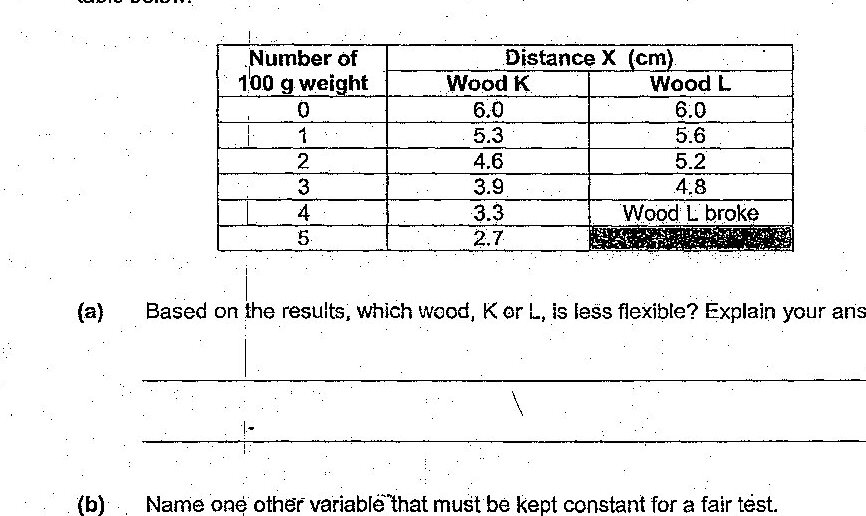
Based on the results, which wood, K or L, is less flexible? Explain your answer.
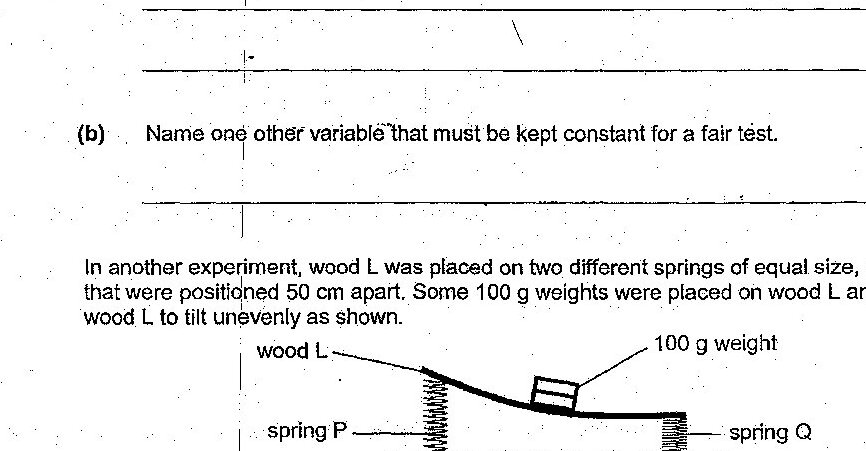
Based on the above observation only, why did wood L tilt unevenly?
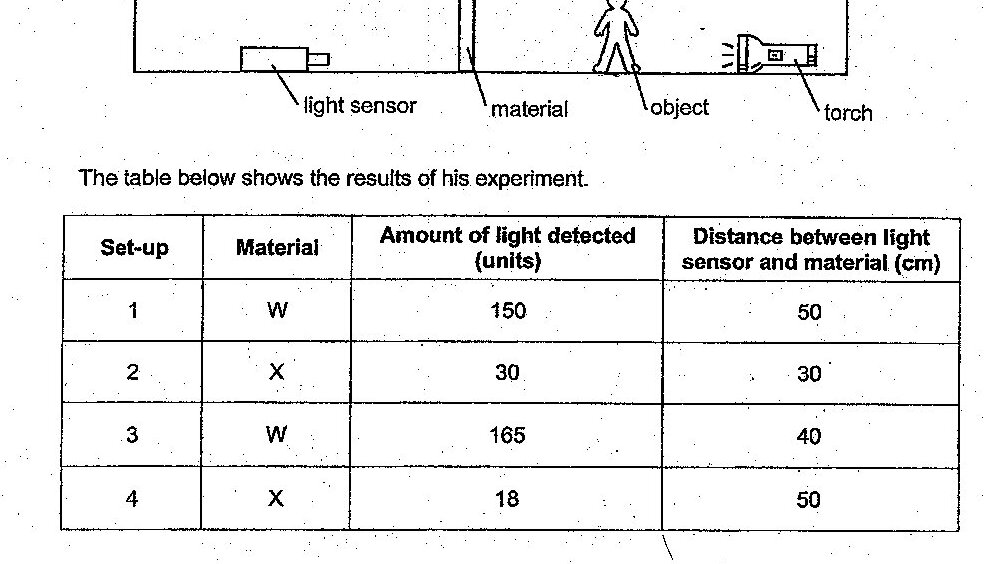
Based on the results, which location, P, Q, R or S, would be most suitable to display a statue made from stone X? Explain why.

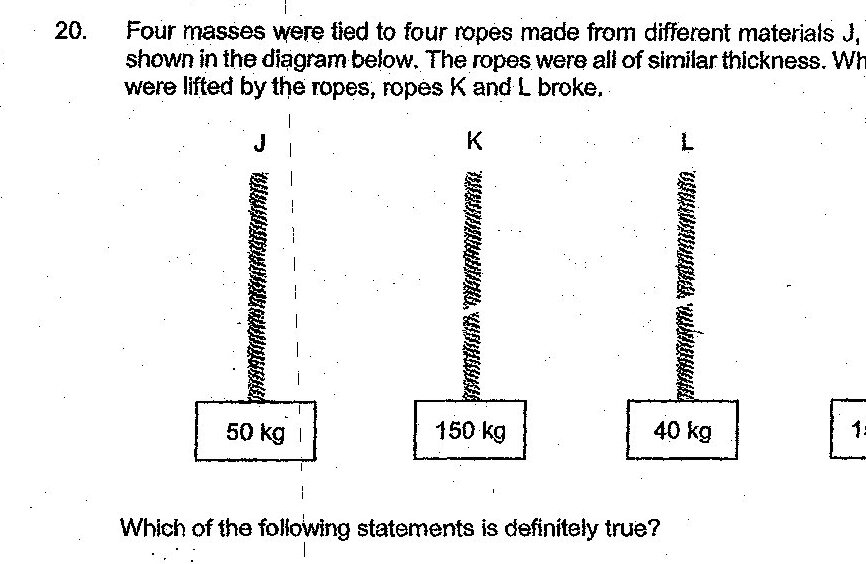
Four masses were tied to four ropes made from different materials J, K, L and M as shown in the diagram below. The ropes were all of similar thickness. When the masses were lifted by the ropes, ropes K and L broke. Which of the following statements is definitely true? A: Material L is the weakest. B: Material M is the strongest. C: Material J is stronger than material L. D: Material K is weaker than material M.
Explain why metal is used to make the top part of the water collector.

Explain why there are folds in the metal top.

State the property of the material that would be more suitable to be pasted over the bathroom window.
Chloe set up an experiment as shown below to compare four strips of different materials, J, K, L and M, which are of the same thickness. She placed a container containing 100 cm³ of water on each strip of material and she recorded the distance, d, as shown in the table below. Which materials are most suitable for making a food tray and a belt?
Which two containers, P, Q or R, should be placed on each pan on the weighing balance so that it remains balanced as shown in the above diagram?
Which container would the company choose to meet its objective? Explain your option
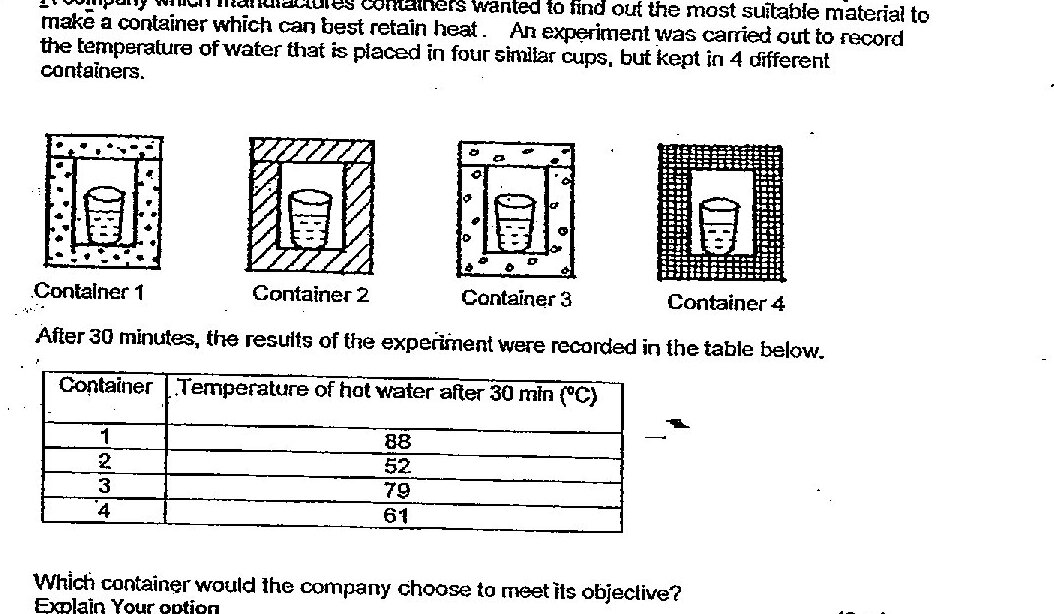
What property should the container mentioned in (a) have? Name 1 material that has such a property.
Past year papers cover the full exam — browse by subject below.
View All Papers ›