Chemical Composition of Matter
Chemical Composition of Matter - Study Notes
Key Concepts
Elements, Compounds, and Mixtures
Elements:
- The simplest form of matter that cannot be broken down into simpler substances by chemical methods
- Made up of only one type of atom
- Examples: oxygen (O), carbon ©, iron (Fe), gold (Au), hydrogen (H)
- There are 118 known elements, organized in the Periodic Table
- Each element has a unique chemical symbol (1 or 2 letters)
- Elements can be metals (e.g., copper, aluminium), non-metals (e.g., oxygen, sulfur), or metalloids (e.g., silicon)
- Example reaction: sodium reacts vigorously with water, producing sodium hydroxide (NaOH) and hydrogen gas (H₂) — this illustrates how elements have distinct, sometimes dramatic, chemical properties
Compounds:
- Pure substances formed when two or more different elements chemically combine in a fixed ratio
- Have completely different properties from the elements that form them
- Can only be separated into elements by chemical methods (not physical methods)
- Represented by chemical formulae showing the elements and their ratios
- Examples:
- Water (H₂O) - 2 hydrogen atoms + 1 oxygen atom
- Carbon dioxide (CO₂) - 1 carbon atom + 2 oxygen atoms
- Sodium chloride (NaCl) - 1 sodium atom + 1 chlorine atom
- Glucose (C₆H₁₂O₆) - 6 carbon + 12 hydrogen + 6 oxygen atoms
Mixtures:
- Two or more substances (elements or compounds) mixed together but not chemically combined
- Components retain their individual properties
- No fixed composition - can be mixed in any proportion
- Can be separated by physical methods (filtration, evaporation, distillation, chromatography, use of magnets)
- Types of mixtures:
- Homogeneous mixtures (uniform composition throughout): salt solution, air, brass
- Heterogeneous mixtures (non-uniform composition): sand and water, oil and water, salad
- Example of a mixture that is often mistaken for a compound: steel (iron + carbon) — the components are physically combined, not chemically bonded, so it is a mixture
Classifying by Electrical Behaviour
- Elements: cannot be broken down into simpler substances by chemical means, including electrolysis — they consist of only one type of atom and cannot be further separated by chemical methods
- Compounds: may break down chemically when an electrical current is passed through them (electrolysis), e.g. molten sodium chloride → sodium metal + chlorine gas (Note: detailed electrolysis procedures and calculations are a Sec 3/4 Chemistry topic; at Sec 2, it is sufficient to know that compounds can be broken down by chemical methods such as using an electric current)
- Mixtures: cannot be broken down by electrical current but can be separated by physical methods
- Note: always examine BOTH electrical behaviour AND separability before classifying
Atoms and Molecules
Atoms:
- The smallest particle of an element that can exist
- Cannot be divided into smaller particles by chemical means
- All matter is made up of atoms
- Atoms of the same element are identical
- Atoms of different elements have different properties
- Structure: Contains a nucleus (protons + neutrons) surrounded by electrons
- Represented by element symbols: H (hydrogen atom), O (oxygen atom), Fe (iron atom)
Molecules:
- Two or more atoms chemically bonded together
- Can be atoms of the same element or different elements
- The smallest particle of a substance that can exist independently and retain its chemical properties
- Types:
- Element molecules: Atoms of the same element bonded together
- O₂ (oxygen molecule - 2 oxygen atoms)
- H₂ (hydrogen molecule - 2 hydrogen atoms)
- N₂ (nitrogen molecule - 2 nitrogen atoms)
- O₃ (ozone - 3 oxygen atoms)
- Compound molecules: Atoms of different elements bonded together
- H₂O (water molecule)
- CO₂ (carbon dioxide molecule)
- CH₄ (methane molecule)
- Element molecules: Atoms of the same element bonded together
Particle Theory:
- All matter is made up of tiny particles (atoms, molecules, or ions)
- These particles are in constant motion
- Particles in solids vibrate in fixed positions
- Particles in liquids move freely but stay close together
- Particles in gases move rapidly and are far apart
Physical vs Chemical Changes
Physical Changes:
- Changes in the physical properties of a substance (size, shape, state)
- No new substance is formed
- The chemical composition remains the same
- Usually easily reversible
- Examples:
- Changes of state: melting, freezing, boiling, condensation, sublimation
- Dissolving sugar in water
- Breaking glass
- Cutting paper
- Mixing sand and salt
- Magnetizing iron
- Energy changes are usually small
Chemical Changes:
- One or more new substances with different properties are formed
- The chemical composition changes
- Usually difficult or impossible to reverse
- Also called chemical reactions
- Examples:
- Burning wood or paper
- Rusting of iron
- Cooking an egg
- Digestion of food
- Photosynthesis in plants
- Fermentation of sugar to alcohol
- Energy changes are usually large (heat, light released or absorbed)
Evidence of Chemical Changes:
- Formation of a new substance with different properties
- Colour change
- Gas produced (bubbles, fizzing)
- Energy change (heat or light given out or absorbed)
- Formation of a precipitate (solid forming in a liquid)
- Permanent change that is difficult to reverse
Important Definitions
Element: A pure substance that contains only one type of atom and cannot be broken down into simpler substances by chemical methods.
Compound: A pure substance formed when two or more different elements are chemically combined in a fixed ratio.
Mixture: Two or more substances mixed together but not chemically combined, where each substance retains its own properties.
Atom: The smallest particle of an element that can exist and still retain the properties of that element.
Molecule: Two or more atoms chemically bonded together, which is the smallest particle of a substance that can exist independently.
Physical change: A change in which no new substance is formed; only the physical properties (such as size, shape, or state) change.
Chemical change: A change in which one or more new substances with different properties are formed; also called a chemical reaction.
Homogeneous mixture: A mixture that has uniform composition throughout, where the components cannot be easily distinguished.
Heterogeneous mixture: A mixture that has non-uniform composition, where the different components can be seen or easily distinguished.
Chemical formula: A representation of a compound using chemical symbols and numbers to show which elements are present and in what ratio.
Pure substance: A substance that contains only one type of element or compound, with no other substances mixed in.
Precipitate: A solid substance that forms in a liquid during a chemical reaction.
Worked Examples
Example 1: Classifying Substances
Question: Classify the following as element, compound, or mixture: a) Sodium chloride (NaCl) b) Iron (Fe) c) Salt water d) Carbon dioxide (CO₂) e) Air
Solution:
a) Sodium chloride (NaCl) = Compound
- Contains two different elements: sodium (Na) and chlorine (Cl)
- Chemically combined in fixed ratio (1:1)
- Has chemical formula
b) Iron (Fe) = Element
- Contains only one type of atom
- Cannot be broken down into simpler substances
- Has chemical symbol only (not formula)
c) Salt water = Mixture
- Contains salt (compound) and water (compound) mixed together
- Not chemically combined
- No fixed ratio - can have more or less salt
- Can be separated by physical method (evaporation)
d) Carbon dioxide (CO₂) = Compound
- Contains two different elements: carbon © and oxygen (O)
- Chemically combined in fixed ratio (1:2)
- Has chemical formula
e) Air = Mixture
- Contains several gases (nitrogen, oxygen, carbon dioxide, argon, etc.)
- Not chemically combined
- Variable composition
- Can be separated by physical methods (fractional distillation)
Example 2: Atoms vs Molecules
Question: State whether each of the following represents an atom or molecule, and identify if it’s an element or compound: a) O b) O₂ c) H₂O d) Cu e) CO₂
Solution:
a) O = Atom of an element
- Single oxygen atom
- Element because it contains only one type of atom
b) O₂ = Molecule of an element
- Two oxygen atoms bonded together
- Element because all atoms are the same type
c) H₂O = Molecule of a compound
- Three atoms bonded together (2 hydrogen + 1 oxygen)
- Compound because it contains different types of atoms
d) Cu = Atom of an element
- Single copper atom
- Element because it contains only one type of atom
e) CO₂ = Molecule of a compound
- Three atoms bonded together (1 carbon + 2 oxygen)
- Compound because it contains different types of atoms
Example 3: Physical vs Chemical Change
Question: Identify whether each change is physical or chemical, and give a reason:
a) Ice melting to water b) Burning magnesium in air c) Iron rusting d) Sugar dissolving in tea e) Frying an egg
Solution:
a) Physical change
- Reason: Ice (H₂O) changes to water (H₂O) - same substance, only state changes
- No new substance formed
- Reversible by freezing
b) Chemical change
- Reason: Magnesium reacts with oxygen to form magnesium oxide (new substance)
- Magnesium + oxygen → magnesium oxide
- Properties change (shiny metal → white powder)
- Heat and light produced
- Irreversible
c) Chemical change
- Reason: Iron reacts with oxygen and water to form rust (iron oxide)
- New substance with different properties formed
- Colour changes (grey → reddish-brown)
- Irreversible
d) Physical change
- Reason: Sugar molecules remain unchanged
- No new substance formed
- Can get sugar back by evaporating water
- Reversible
e) Chemical change
- Reason: Proteins in egg undergo permanent change
- New substances formed
- Colour and texture change permanently
- Cannot be changed back to raw egg
- Irreversible
Common Mistakes to Avoid
-
Confusing elements with compounds
- Mistake: Thinking O₂ is a compound because it has a subscript
- Correction: O₂ is still an element because it contains only oxygen atoms; compounds must have different types of atoms
-
Mixing up atoms and molecules
- Mistake: Calling O₂ an atom
- Correction: O₂ is a molecule (two atoms bonded together); O is an atom
-
Thinking mixtures have fixed compositions
- Mistake: Saying mixtures always have the same ratio of components
- Correction: Mixtures can have any proportion of components; compounds have fixed ratios
-
Confusing physical and chemical changes
- Mistake: Saying dissolving salt is a chemical change
- Correction: Dissolving is physical - you can get the salt back by evaporation; no new substance forms
-
Using incorrect chemical formulae
- Mistake: Writing water as HO or H2O2
- Correction: Water is H₂O (subscripts must be correct)
-
Thinking all mixtures are homogeneous
- Mistake: Not recognizing heterogeneous mixtures
- Correction: Mixtures can be homogeneous (uniform) or heterogeneous (non-uniform)
-
Forgetting that energy changes indicate chemical reactions
- Mistake: Not recognizing burning or cooking as chemical changes
- Correction: Large energy changes (heat, light) usually indicate chemical changes
-
Confusing separation methods
- Mistake: Saying you can separate compounds by filtration
- Correction: Compounds need chemical methods; mixtures use physical methods
-
Focusing only on electrical behaviour to distinguish compounds from mixtures
- Mistake: Concluding a substance is a compound purely because it conducts electricity or breaks down under electrical current, without checking whether it can also be separated by physical methods
- Correction: A compound breaks down chemically under electrical current AND cannot be separated by physical methods; a mixture cannot be broken down by electrical current but CAN be separated by physical methods — both criteria must be checked
-
Assuming any combination of two substances is a compound
- Mistake: Classifying steel (iron + carbon) as a compound because it contains two elements
- Correction: Steel is a mixture — iron and carbon are physically combined, not chemically bonded; the components retain their individual properties and the ratio is not fixed
- Not understanding the difference between pure substances and mixtures
- Mistake: Thinking air is a pure substance
- Correction: Air is a mixture of gases; pure substances are elements or compounds only
- Misidentifying changes of state
- Mistake: Thinking boiling water is a chemical change because bubbles form
- Correction: Boiling is physical - water vapour is still H₂O
Exam Tips
Keywords to Use in Answers
For Elements:
- “Contains only one type of atom”
- “Cannot be broken down by chemical methods”
- “Pure substance”
- “Found in the Periodic Table”
For Compounds:
- “Two or more different elements”
- “Chemically combined”
- “Chemical bond”
- “Fixed ratio”
- “Different properties from the elements”
- “Separated by chemical methods only”
For Mixtures:
- “Not chemically combined”
- “Components retain their properties”
- “No fixed composition/ratio”
- “Separated by physical methods”
- “Electrical behaviour” (key scoring term: use when classifying substances by their response to electrical current)
For Physical Changes:
- “No new substance formed”
- “Only physical properties change”
- “Reversible”
- “Small energy changes”
- “Same chemical composition”
For Chemical Changes:
- “New substance(s) formed”
- “Different properties”
- “Irreversible” or “difficult to reverse”
- “Chemical composition changes”
- “Large energy changes”
Mark-Earning Phrases
- When explaining why something is an element: “It contains only one type of atom”
- When explaining why something is a compound: “It contains two or more different elements chemically combined in a fixed ratio”
- When explaining separation: “Physical methods for mixtures, chemical methods for compounds”
- When identifying chemical changes: “Evidence: colour change/gas produced/heat released/precipitate formed/new substance formed”
- When comparing atoms and molecules: “An atom is the smallest particle of an element, while a molecule is two or more atoms bonded together”
Answering Strategies
-
Classification Questions:
- Always give a reason with your classification
- Check if it’s pure (element/compound) or mixed (mixture)
- Look for chemical formulae to identify compounds
-
Physical vs Chemical Change Questions:
- Look for evidence of new substances
- Check if it’s reversible
- Mention specific observations (colour change, gas, heat, etc.)
-
Separation Methods:
- Identify if it’s a mixture or compound first
- For mixtures: suggest physical methods with reasons
- For compounds: state that chemical methods are needed
-
Formula Interpretation:
- Count the total number of atoms
- Identify how many different elements
- State the ratio of elements
-
Drawing Diagrams:
- Use different sizes or colours for different atoms
- Show bonding clearly for molecules
- Label all parts properly
- Include a key if needed
-
Three-Step Classification Method (for element / compound / mixture questions):
- Recall properties: elements resist electrical breakdown; compounds may break down chemically under electrical current; mixtures separate by physical methods
- Analyse: examine both the electrical behaviour AND the separability of the substance
- Synthesise: combine both observations to reach your final classification and always explicitly state whether any change involved is chemical or physical
Quick Summary
Elements, Compounds, and Mixtures:
- ✓ Elements contain one type of atom only; cannot be broken down chemically
- ✓ Compounds contain two or more different elements chemically combined in fixed ratios
- ✓ Mixtures contain substances mixed but not chemically combined; variable composition
- ✓ Compounds can only be separated by chemical methods; mixtures by physical methods
Atoms and Molecules:
- ✓ Atoms are the smallest particles of elements
- ✓ Molecules are two or more atoms bonded together
- ✓ Element molecules contain same type of atoms (O₂, H₂, N₂)
- ✓ Compound molecules contain different types of atoms (H₂O, CO₂)
Physical Changes:
- ✓ No new substance formed; same chemical composition
- ✓ Usually reversible; small energy changes
- ✓ Examples: changes of state, dissolving, cutting, breaking
Chemical Changes:
- ✓ New substance(s) formed with different properties
- ✓ Usually irreversible; large energy changes
- ✓ Evidence: colour change, gas produced, heat/light released, precipitate formed
- ✓ Examples: burning, rusting, cooking, digestion, reactions
Key Skills:
- ✓ Classify substances as element, compound, or mixture with reasons
- ✓ Distinguish between atoms and molecules from chemical formulae
- ✓ Identify physical and chemical changes from observations
- ✓ Suggest appropriate separation methods for mixtures vs compounds
Which substance is a reactive metal?
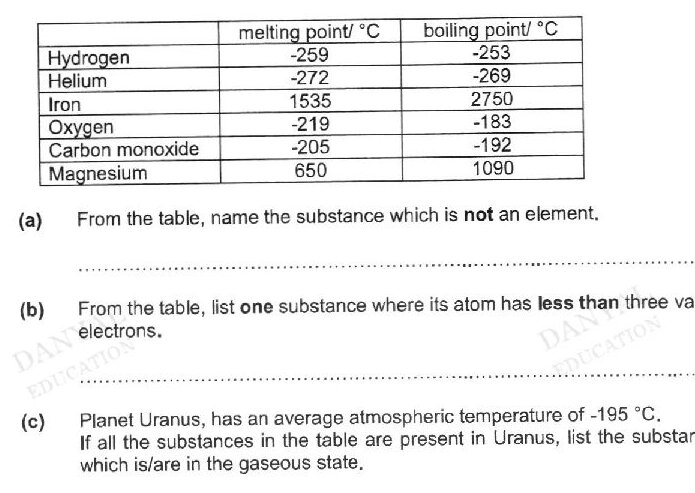
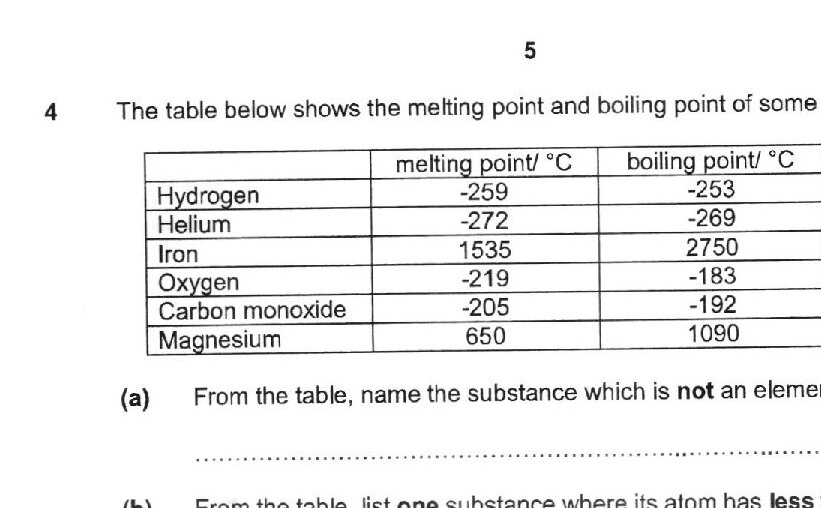
From the table, name the substance which is not an element.
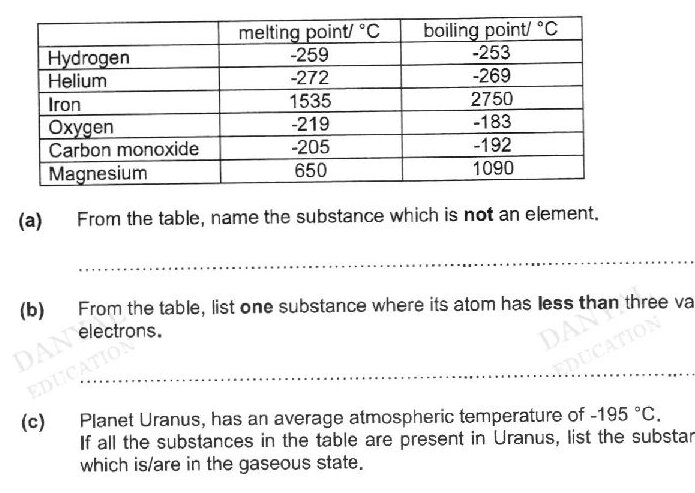
From the table, list one substance where its atom has less than three valence electrons.
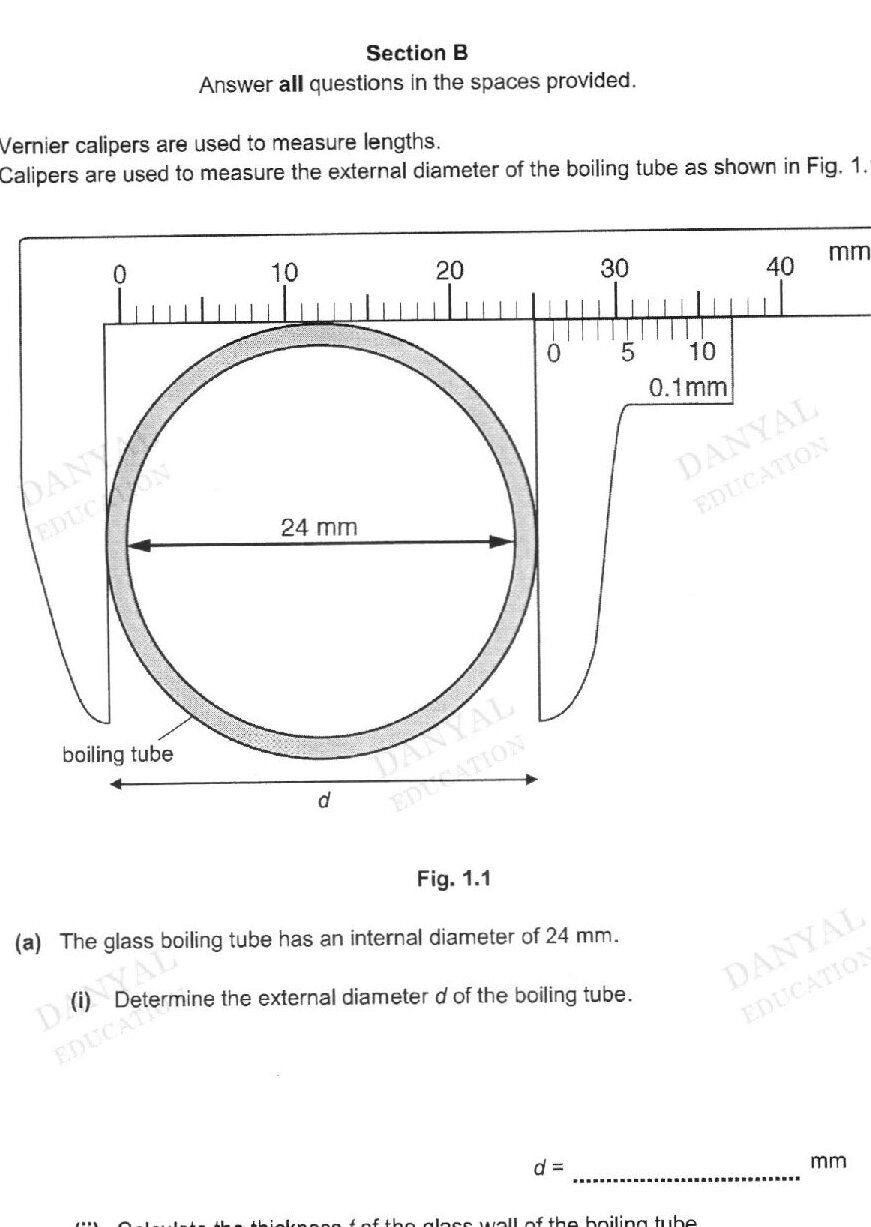
Compound X is formed when elements S and T are mixed and heated in a test tube. Which statement about compound X is incorrect?
Which are the examples of matter?
Which statement best shows that blue copper (II) sulfate solution is a mixture?
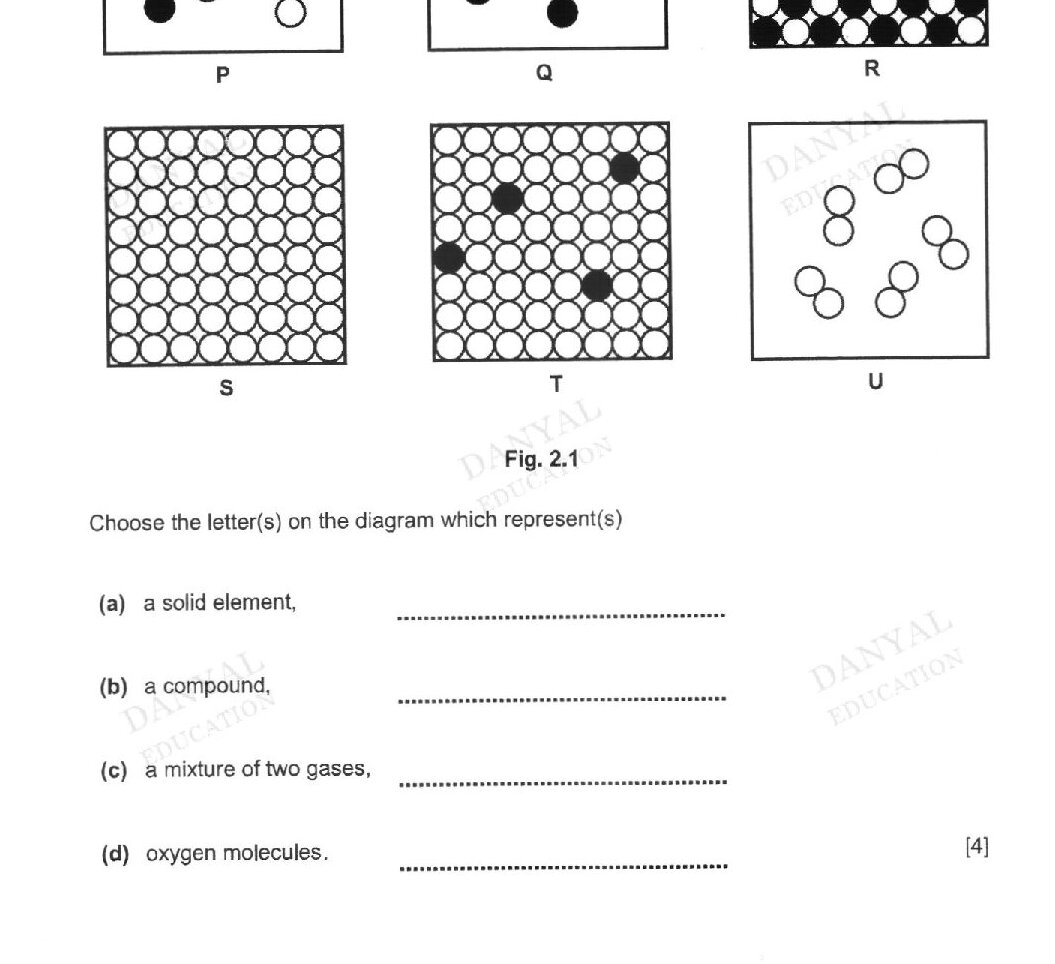
a mixture of two gases,
When ice melts, it forms liquid water. Describe how the arrangement and movement of water particles change during melting.
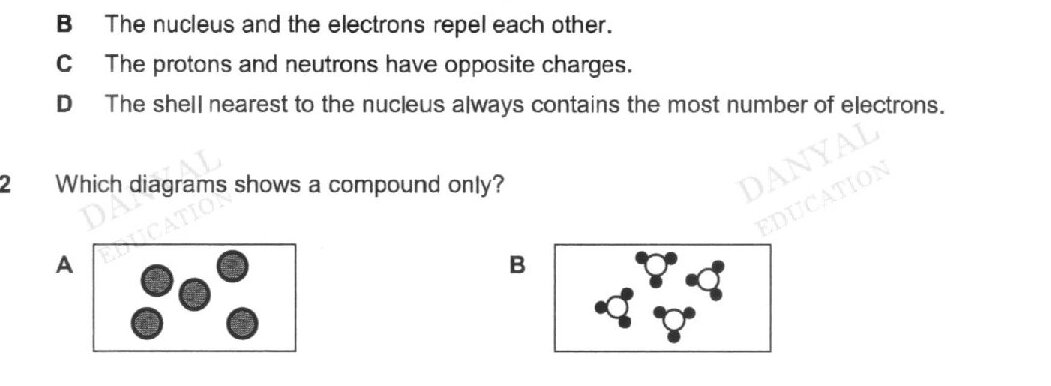
Which diagrams shows a compound only?
From the table, name the substance which is not an element.
Past year papers cover the full exam — browse by subject below.
View All Papers ›