Physical Properties of Matter
Physical Properties of Matter - Study Notes
Key Concepts
Density
- What is density? Density is the mass per unit volume of a substance. It tells us how tightly packed the particles are in a material.
- Formula: Density = Mass ÷ Volume or ρ = m/V
- SI unit: kilograms per cubic metre (kg/m³) or grams per cubic centimetre (g/cm³)
- 1 g/cm³ = 1000 kg/m³
- Key principle: Different substances have different densities because their particles have different masses and are arranged differently
- Denser substances sink in less dense substances (e.g., iron sinks in water)
- Density is an intensive property - it doesn’t depend on the amount of substance present
- The density of a substance generally decreases when heated (particles spread out) and increases when cooled (particles move closer)
- Exception: Water is most dense at 4°C, not at 0°C (ice is less dense than liquid water, which is why ice floats)
Thermal Conductivity
- What is thermal conductivity? The ability of a material to conduct heat energy from a hotter region to a cooler region
- Heat energy is transferred through materials by conduction - the vibration of particles passing energy to neighboring particles
- Good thermal conductors (high thermal conductivity):
- Metals like copper, aluminum, silver, iron
- Particles are closely packed and can vibrate efficiently
- Metals also have free-moving electrons that transfer energy quickly
- Poor thermal conductors/Thermal insulators (low thermal conductivity):
- Non-metals like wood, plastic, rubber, glass
- Air and gases (particles are far apart)
- Materials with trapped air pockets (wool, styrofoam, bubble wrap)
- Applications:
- Cooking pots made of metal (good conductors) with plastic handles (insulators)
- Building insulation uses materials with low thermal conductivity
- Clothing traps air to keep warm in cold weather
Electrical Conductivity
- What is electrical conductivity? The ability of a material to allow electric current (flow of electrons or ions) to pass through it
- Good electrical conductors:
- All metals (copper, silver, gold, aluminum, iron)
- Graphite (a form of carbon with free-moving electrons)
- Ionic solutions (dissolved salts in water conduct because ions can move)
- Molten ionic compounds (ions are free to move)
- Poor electrical conductors/Electrical insulators:
- Non-metals (except graphite)
- Plastics, rubber, wood, glass, ceramics
- Pure water (distilled water doesn’t conduct well)
- Air and gases
- Why metals conduct electricity:
- Metals have free-moving electrons that can flow through the structure
- These electrons carry electrical charge from one place to another
- Why ionic compounds conduct when dissolved or molten:
- Ions become free to move and carry charge
- Solid ionic compounds don’t conduct because ions are fixed in position
- Applications:
- Electrical wires made of copper (excellent conductor)
- Wires coated with plastic insulation (prevents electric shocks)
- Circuit boards use both conductors and insulators
Melting and Boiling Points
- Melting point: The temperature at which a solid changes to a liquid (fixed temperature for pure substances)
- Boiling point: The temperature at which a liquid changes to a gas/vapor throughout the bulk of the liquid (fixed temperature for pure substances)
- These are state changes or changes of state - the physical form changes but the chemical composition stays the same
- During melting or boiling, temperature remains constant even though heat is being added (energy is used to overcome forces between particles, not to increase temperature)
- Pure substances have sharp, fixed melting and boiling points
- Mixtures melt and boil over a range of temperatures
- Different substances have different melting and boiling points because of:
- Strength of forces between particles (stronger forces = higher melting/boiling points)
- Size and arrangement of particles
Examples of melting and boiling points:
- Water: melting point = 0°C, boiling point = 100°C (at standard atmospheric pressure)
- Iron: melting point = 1538°C, boiling point = 2862°C
- Oxygen: melting point = -218°C, boiling point = -183°C
- Ethanol: melting point = -114°C, boiling point = 78°C
Factors affecting melting/boiling points:
- Atmospheric pressure: Higher pressure increases boiling point; lower pressure decreases boiling point (this is why water boils at lower temperatures on mountains)
- Impurities: Adding substances (like salt to water) generally increases boiling point and decreases melting point
Important Definitions
Density: The mass per unit volume of a substance. Formula: Density = Mass ÷ Volume (ρ = m/V). Unit: kg/m³ or g/cm³.
Thermal conductivity: The ability of a material to conduct heat energy through it from a hotter region to a cooler region.
Thermal conductor: A material that allows heat energy to pass through it easily (e.g., metals).
Thermal insulator: A material that does not allow heat energy to pass through it easily (e.g., plastic, wood, air).
Electrical conductivity: The ability of a material to allow electric current (flow of electric charge) to pass through it.
Electrical conductor: A material that allows electric current to flow through it easily (e.g., metals, graphite, ionic solutions).
Electrical insulator: A material that does not allow electric current to flow through it easily (e.g., plastic, rubber, glass).
Melting point: The fixed temperature at which a pure substance changes from solid state to liquid state.
Boiling point: The fixed temperature at which a pure substance changes from liquid state to gas state throughout the bulk of the liquid.
Physical property: A characteristic of a substance that can be observed or measured without changing the chemical identity of the substance.
Intensive property: A property that does not depend on the amount of substance present (e.g., density, melting point, boiling point).
Worked Examples
Example 1: Calculating Density
Question: A metal cube has a mass of 540 g and dimensions 6 cm × 6 cm × 6 cm. Calculate the density of the metal in: (a) g/cm³ (b) kg/m³
Solution:
Step 1: Identify what is given
- Mass (m) = 540 g
- Dimensions = 6 cm × 6 cm × 6 cm
Step 2: Calculate volume
- Volume = length × width × height
- Volume = 6 cm × 6 cm × 6 cm = 216 cm³
Step 3: Apply density formula for part (a)
- Density = Mass ÷ Volume
- Density = 540 g ÷ 216 cm³
- Density = 2.5 g/cm³
Step 4: Convert to kg/m³ for part (b)
-
Method 1: Use conversion factor
- 1 g/cm³ = 1000 kg/m³
- 2.5 g/cm³ = 2.5 × 1000 = 2500 kg/m³
-
Method 2: Convert mass and volume separately
- Mass = 540 g = 0.540 kg
- Volume = 216 cm³ = 216 ÷ 1,000,000 m³ = 0.000216 m³
- Density = 0.540 kg ÷ 0.000216 m³ = 2500 kg/m³
Answer: (a) 2.5 g/cm³ (b) 2500 kg/m³
Example 2: Predicting Floating or Sinking
Question: The table shows the densities of different substances:
| Substance | Density (g/cm³) |
|---|---|
| Water | 1.0 |
| Ice | 0.92 |
| Cooking oil | 0.90 |
| Aluminum | 2.7 |
| Cork | 0.25 |
Predict what will happen when each substance is placed in water. Explain your answers.
Solution:
Principle: An object will float in a liquid if its density is less than the liquid’s density. It will sink if its density is greater than the liquid’s density.
Water density = 1.0 g/cm³
-
Ice (0.92 g/cm³):
- Density of ice < density of water
- Ice will float on water
- This is why icebergs float in the ocean
-
Cooking oil (0.90 g/cm³):
- Density of oil < density of water
- Oil will float on water
- This is why oil forms a layer on top of water
-
Aluminum (2.7 g/cm³):
- Density of aluminum > density of water
- Aluminum will sink in water
- The metal is much denser than water
-
Cork (0.25 g/cm³):
- Density of cork < density of water
- Cork will float on water
- Cork floats easily because it’s much less dense than water (about ¼ the density)
Example 3: Comparing Physical Properties
Question: Explain why: (a) Cooking pots are made of metal but have plastic handles (b) Electrical wires are made of copper covered with plastic coating
Solution:
(a) Cooking pots with plastic handles
Part 1 - Metal pot:
- Metals have high thermal conductivity (good thermal conductors)
- Heat from the stove is quickly conducted through the metal to the food
- This allows food to cook efficiently and evenly
- Therefore, metals are ideal for the pot body
Part 2 - Plastic handle:
- Plastic has low thermal conductivity (thermal insulator)
- Heat does not easily pass through the plastic
- The handle stays cool enough to touch safely while cooking
- This prevents burns when holding the pot
- Therefore, plastic is ideal for the handle
(b) Copper wires with plastic coating
Part 1 - Copper wire:
- Copper has high electrical conductivity (excellent electrical conductor)
- Copper has many free-moving electrons that can carry electric current
- Electricity flows easily through copper with minimal energy loss
- Therefore, copper is ideal for conducting electricity in wires
Part 2 - Plastic coating:
- Plastic has low electrical conductivity (electrical insulator)
- Electric current cannot flow through plastic
- The plastic coating prevents:
- Electric shocks when touching the wire
- Short circuits when wires touch each other
- Accidental contact between live wires and other conductors
- Therefore, plastic coating makes wires safe to use
Common Mistakes to Avoid
-
Confusing mass and density
- ✗ Saying “lead is heavier than wood” when comparing equal volumes
- ✓ Say “lead is denser than wood” or “lead has a higher density than wood”
- Remember: density compares mass per unit volume, not total mass
-
Wrong units in density calculations
- ✗ Mixing units: mass in kg with volume in cm³
- ✓ Keep units consistent: g with cm³, or kg with m³
- ✓ Always write the unit in your final answer (g/cm³ or kg/m³)
-
Forgetting to convert units
- ✗ Leaving answer as 0.0025 kg/cm³ instead of converting to standard units
- ✓ Convert to g/cm³ or kg/m³ as required
- Remember: 1 g/cm³ = 1000 kg/m³
-
Incorrect density formula
- ✗ Writing Density = Volume ÷ Mass
- ✓ Density = Mass ÷ Volume (ρ = m/V)
- Tip: Remember “DVM” - Density equals Volume under Mass (division)
-
Confusing thermal and electrical conductivity
- ✗ Saying all thermal conductors are electrical conductors
- ✓ Most metals conduct both heat and electricity, BUT water conducts heat but not electricity well
- ✓ Graphite conducts electricity but is a relatively poor thermal conductor compared to metals
-
Thinking solid ionic compounds conduct electricity
- ✗ “Salt conducts electricity” (when referring to solid salt)
- ✓ “Salt solution conducts electricity” or “Molten salt conducts electricity”
- Remember: Ions must be free to move to conduct electricity
-
Confusing melting and boiling
- ✗ “Ice boils at 0°C”
- ✓ “Ice melts at 0°C” (solid → liquid)
- ✓ “Water boils at 100°C” (liquid → gas)
-
Thinking temperature increases during melting/boiling
- ✗ “Temperature keeps rising when ice is melting”
- ✓ “Temperature stays at 0°C while ice is melting into water”
- Remember: Energy is used to break bonds between particles, not to increase temperature
-
Incomplete explanations about conductivity
- ✗ “Metals conduct electricity because they are metals”
- ✓ “Metals conduct electricity because they have free-moving electrons that can carry electric charge”
- Always explain WHY in terms of particle structure
-
Forgetting atmospheric pressure affects boiling point
- ✗ “Water always boils at 100°C”
- ✓ “Water boils at 100°C at standard atmospheric pressure” or “at sea level”
- Higher altitude (lower pressure) → lower boiling point
Exam Tips
For Density Questions:
- Always write the formula first: Density = Mass ÷ Volume
- Show your working clearly: Write each step of the calculation
- Include units in your answer: g/cm³ or kg/m³ (1 mark often given for correct units)
- Key phrases to use:
- “The object will float because its density is less than that of water”
- “The object will sink because its density is greater than that of water”
- “Density is mass per unit volume”
For Thermal Conductivity Questions:
- Use particle explanation: Mention how closely packed particles are and how they transfer energy through vibration
- For metals: State “free-moving electrons transfer energy quickly”
- Key phrases to use:
- “Metal is a good thermal conductor because…”
- “Plastic is a poor thermal conductor / thermal insulator because…”
- “Heat energy is transferred from particle to particle through vibration”
- “Materials with trapped air are good insulators because air particles are far apart”
For Electrical Conductivity Questions:
- Always mention charge carriers: electrons in metals, ions in solutions
- Key phrases to use:
- “Metals conduct electricity because they have free-moving electrons that carry electric charge”
- “Ionic solutions conduct because ions are free to move and carry charge”
- “Solid ionic compounds do not conduct because ions are held in fixed positions”
- “Insulators do not conduct because they have no free-moving charged particles”
For Melting/Boiling Point Questions:
- State the definition clearly: “The melting point is the fixed temperature at which…”
- Mention purity: “Pure substances have sharp/fixed melting and boiling points”
- Explain state changes: “During melting, temperature remains constant because energy is used to overcome forces between particles”
- Key phrases to use:
- “The temperature remains constant during state change”
- “Energy is used to overcome forces between particles, not to increase temperature”
- “Pure substances melt/boil at a fixed temperature; mixtures melt/boil over a range of temperatures”
General Exam Tips:
- Compare and contrast questions: Use comparative language (“higher than”, “lower than”, “more than”, “less than”)
- “Explain” questions: Give reasons using particle theory - describe what particles are doing
- “State” questions: Brief answer without explanation needed
- Diagrams: Always label clearly and use a ruler for straight lines
- Calculations: Show formula, substitution, and final answer with units
- Read questions carefully: Check if they ask for g/cm³ or kg/m³, or specific substances
Quick Summary
✓ Density = Mass ÷ Volume (ρ = m/V); units: g/cm³ or kg/m³; 1 g/cm³ = 1000 kg/m³
✓ Density determines floating/sinking: Object floats if its density < liquid’s density; sinks if density > liquid’s density
✓ Thermal conductivity is the ability to conduct heat; metals are good thermal conductors due to free-moving electrons and closely packed particles
✓ Thermal insulators (poor conductors) include plastics, wood, air, and materials with trapped air pockets
✓ Electrical conductivity is the ability to conduct electricity; metals conduct due to free-moving electrons
✓ Ionic solutions and molten ionic compounds conduct electricity because ions are free to move; solid ionic compounds don’t conduct
✓ Graphite is a non-metal that conducts electricity; plastics, rubber, and glass are electrical insulators
✓ Melting point is the fixed temperature where solid → liquid; boiling point is the fixed temperature where liquid → gas
✓ Temperature stays constant during melting and boiling as energy breaks bonds between particles
✓ Pure substances have sharp melting/boiling points; mixtures melt/boil over a range of temperatures
✓ Atmospheric pressure affects boiling point: higher pressure = higher boiling point; lower pressure = lower boiling point
✓ Physical properties (density, melting point, boiling point, conductivity) can identify substances without changing their chemical identity
How will the pressure on the ground change if the block is made from styrofoam instead of concrete?

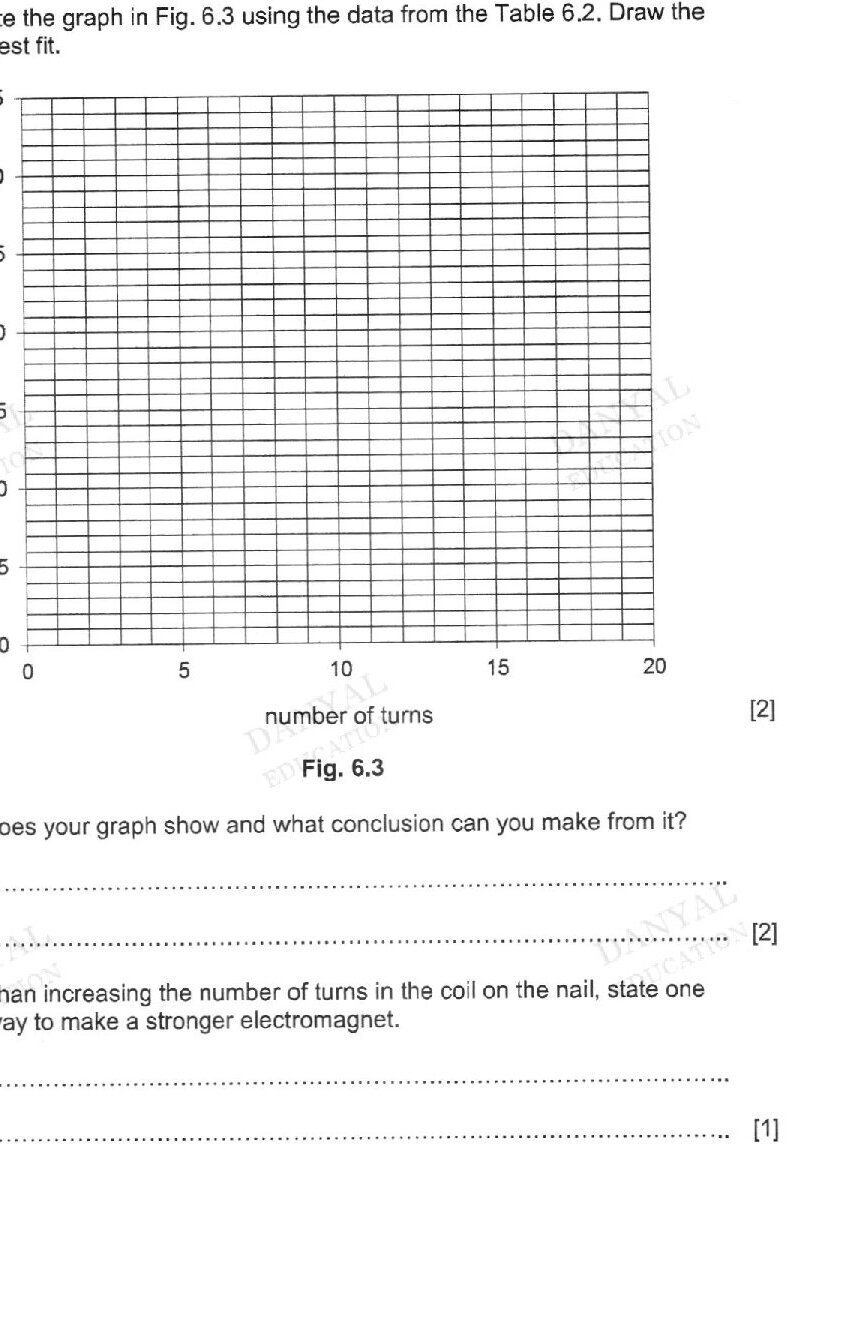
Complete the graph in Fig. 6.3 using the data from the Table 6.2. Draw the line of best fit.
Which measure does not counter expansion of materials during hot weather?
Which shows the temperature in S.I. units of boiling water?
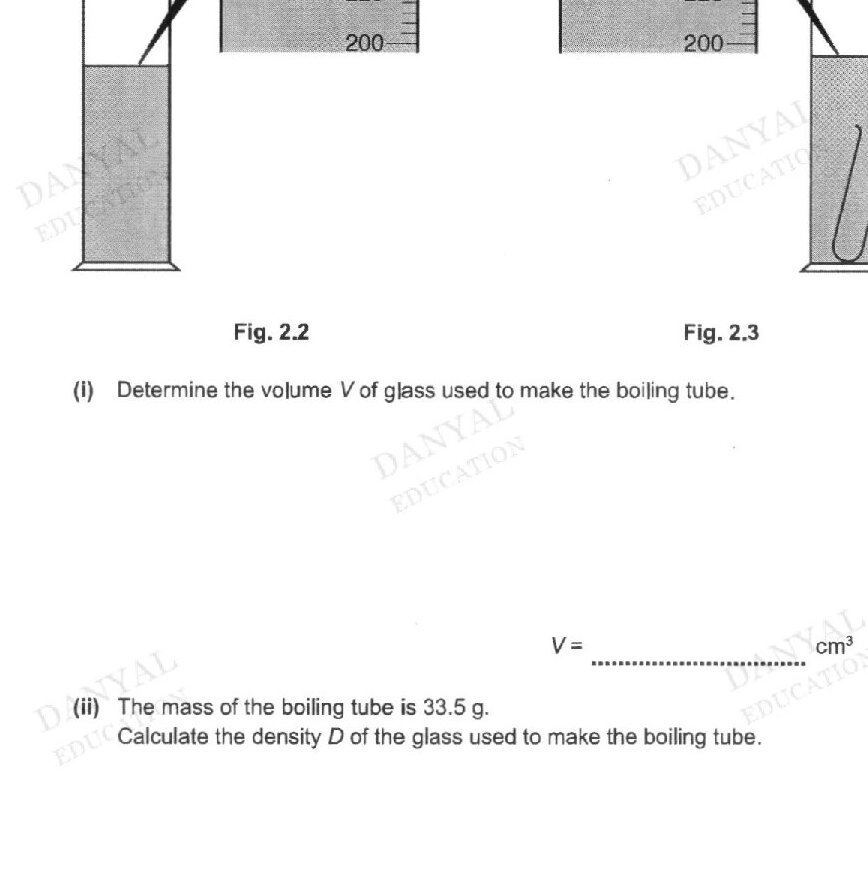
The mass of the boiling tube is 33.5 g. Calculate the density D of the glass used to make the boiling tube.
Complete the main energy conversion which takes place when the man climbs from the valley to the top of the mountain.
![Energy conversion diagram with three boxes connected by arrows. First box labeled 'chemical energy', followed by two empty boxes to be completed, with a marking of [1] at the end.](/assets/question-images/sec2_Fuchun-Secondary-SA2-2021-Sec-2-Science_p2_q4.jpg)
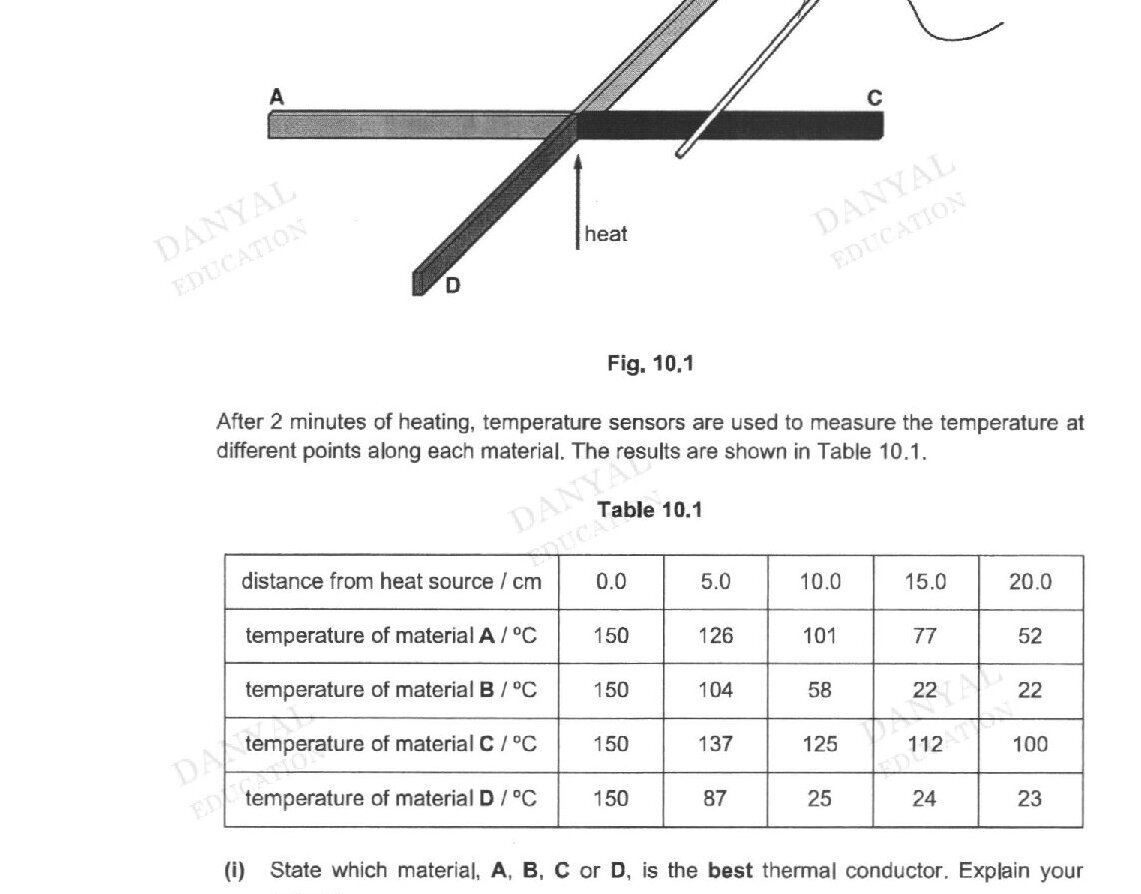
Describe one physical change to the materials as they are heated.
Describe one physical property of hydrochloric acid.
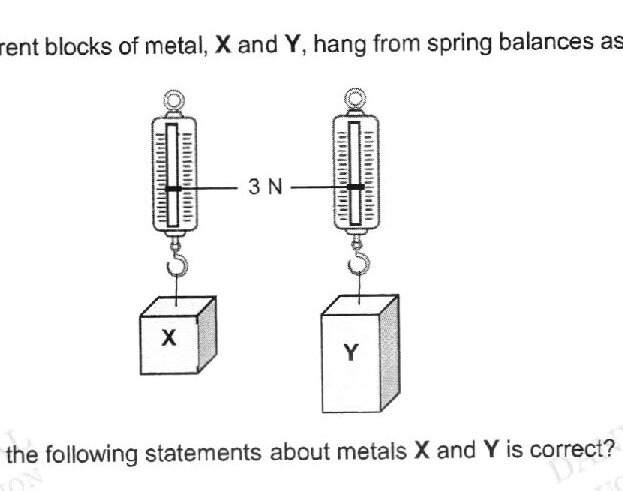
Two different blocks of metal, X and Y, hang from spring balances as shown below. Which of the following statements about metals X and Y is correct?
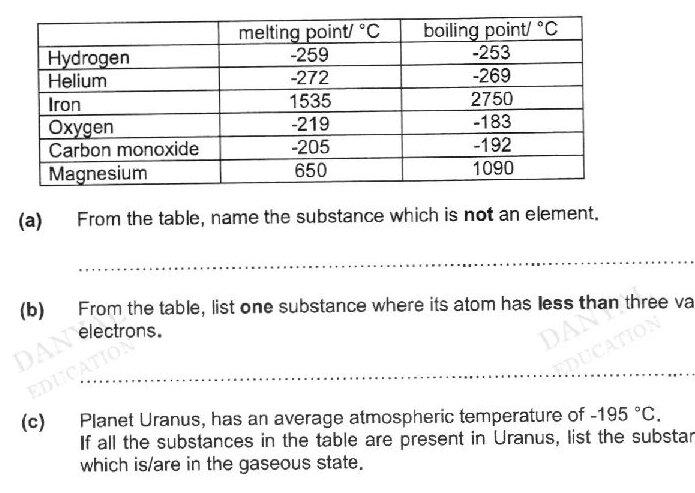
Planet Uranus has an average atmospheric temperature of -195 °C. If all the substances in the table are present in Uranus, list the substance(s) which is/are in the gaseous state.
Suggest and explain a suitable material for the handle.
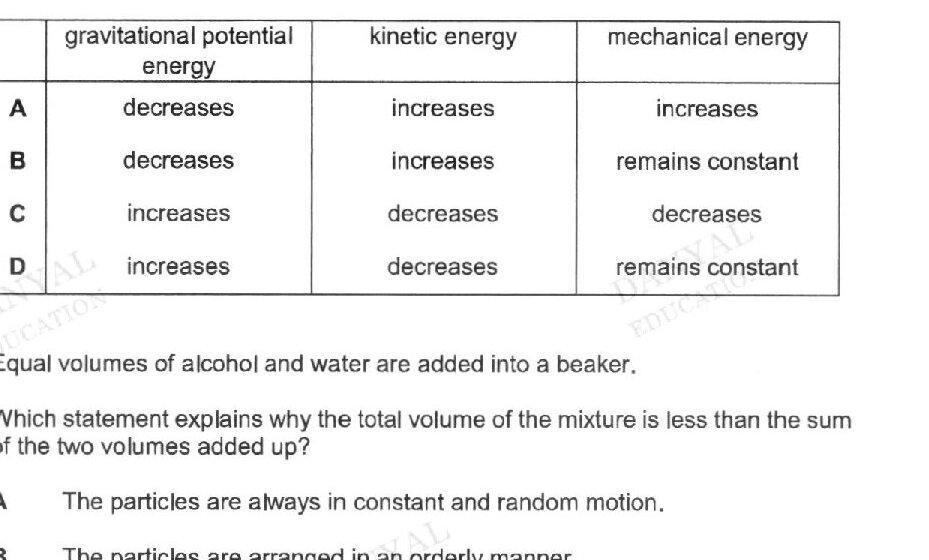
Two different blocks of metal, X and Y, hang from spring balances as shown below. Which of the following statements about metals X and Y is correct?
Past year papers cover the full exam — browse by subject below.
View All Papers ›