Separation Techniques
Separation Techniques - Comprehensive Study Notes
Key Concepts
Why We Need Separation Techniques
- Mixtures contain two or more substances that are not chemically combined
- We often need to separate mixtures to obtain pure substances or remove unwanted materials
- Different techniques work based on the different physical properties of the substances in the mixture
- The choice of technique depends on whether the mixture is solid-solid, solid-liquid, or liquid-liquid
Filtration
- Purpose: Separates insoluble solids from liquids
- Principle: Uses a barrier (filter paper) with tiny pores that allow liquid and dissolved substances to pass through, but trap solid particles that are too large
- The liquid that passes through is called the filtrate
- The solid left behind on the filter paper is called the residue
- Used in everyday life: coffee filters, water purification, tea strainers
- Works only when the solid does NOT dissolve in the liquid
Evaporation
- Purpose: Separates a dissolved solid (solute) from a liquid (solvent) by removing the liquid
- Principle: The liquid is heated and changes to vapour (gas), leaving the solid behind
- The solid obtained is often in crystalline form
- Best used when:
- You only want to keep the solid
- The solid does not decompose (break down) when heated
- The liquid is lost to the atmosphere as vapour
- Used to obtain salt from seawater in salt pans
Crystallisation
Not in Sec 2 2026: Crystallisation as a separate named separation technique, the concept of saturated/unsaturated solutions, and solubility curves are not in the 2026 Sec 2 syllabus. They are covered in Sec 3/4 Chemistry. The five separation techniques required for Sec 2 are: filtration, evaporation, distillation, chromatography, and magnetic separation. The evaporation notes below (and the worked example) include a note about sugar decomposing — this cross-reference to crystallisation is retained as useful context for understanding when not to use evaporation.
- Purpose: Separates a dissolved solid from a solution when the solid would decompose if heated strongly
- Principle: The solution is heated gently to produce a concentrated (saturated) solution, then cooled. As temperature drops, the solubility of the solid decreases, and solid crystals form out of solution
- Used when: (1) you want to keep the solid, (2) the solid is heat-sensitive and would decompose if evaporated to dryness
- Example: obtaining sugar crystals from sugar solution (sugar decomposes above ~180°C)
Saturated and Unsaturated Solutions
Not in Sec 2 2026: Saturated solutions, unsaturated solutions, and solubility are Sec 3/4 Chemistry topics and are not assessed at Sec 2.
- A saturated solution contains the maximum amount of dissolved solute for a given temperature — no more solute can dissolve
- An unsaturated solution contains less than the maximum amount of solute — more solute can still dissolve
- Solubility increases with temperature for most solids, so a solution that is saturated at a low temperature may become unsaturated when heated
- When a saturated solution is cooled, the excess solute that can no longer stay dissolved forms solid crystals
Solubility Curves
Not in Sec 2 2026: Solubility curves and interpreting solubility graphs are Sec 3/4 Chemistry topics and are not assessed at Sec 2.
- A solubility curve is a graph showing how the solubility of a substance (in g per 100 g of water) changes with temperature
- Key points:
- Most solids become MORE soluble as temperature increases — the curve slopes upward
- The value on the curve at a given temperature is the maximum mass that can dissolve in 100 g of water at that temperature
- Any point below the curve represents an unsaturated solution; any point on the curve represents a saturated solution
Distillation
- Purpose: Separates a liquid from a solution, or separates liquids with different boiling points
- Principle: The liquid is heated to its boiling point, turns to vapour, then is cooled back to liquid in a separate container
- Simple distillation: Used to separate a pure liquid from a solution (e.g., pure water from salt solution)
- Fractional distillation: Used to separate two or more liquids with different boiling points (e.g., crude oil into petrol, diesel, etc.)
- The liquid collected is called the distillate
- Used when you want to keep the liquid (not just the solid)
Chromatography
- Purpose: Separates different coloured substances or substances that dissolve differently in a solvent
- Principle: Different substances travel at different speeds through a medium (usually filter paper) when carried by a solvent
- Substances that are more soluble in the solvent travel further up the paper
- Creates a chromatogram - the pattern of separated substances
- Used to:
- Identify components in mixtures (e.g., food colourings, inks)
- Test for purity of substances
- Separate and identify chemicals in forensics and medical testing
Magnetic Separation
- Purpose: Separates magnetic materials from non-magnetic materials
- Principle: A magnet attracts magnetic substances (like iron, nickel, cobalt) but not non-magnetic substances
- Simple, quick, and effective when one component is magnetic
- Used in:
- Recycling plants to separate iron and steel from other materials
- Mining to separate magnetic ores from rocks
- Removing iron filings from mixtures in the laboratory
Choosing the Right Technique
The correct separation technique depends on the physical properties of the substances:
- Is one substance magnetic? → Use magnetic separation
- Is it a solid-liquid mixture where the solid doesn’t dissolve? → Use filtration
- Do you want to recover a solid from a solution? → Use evaporation (if you don’t need the liquid)
- Do you want to recover a liquid from a solution? → Use distillation
- Are there coloured substances or substances with different solubilities? → Use chromatography
- Are there liquids with different boiling points? → Use fractional distillation
Important Definitions
Filtration: The process of separating insoluble solids from liquids using a filter with tiny pores.
Filtrate: The liquid that passes through the filter paper during filtration.
Residue: The insoluble solid that remains on the filter paper after filtration.
Evaporation: The process of turning a liquid into vapour by heating, used to separate a dissolved solid from a solution.
Distillation: The process of boiling a liquid to form vapour, then cooling the vapour to form a pure liquid in a separate container.
Distillate: The pure liquid collected after distillation.
Simple distillation: A technique used to separate a pure liquid from a solution.
Fractional distillation: A technique used to separate two or more liquids with different boiling points.
Chromatography: A technique used to separate and identify different substances in a mixture based on their different movement rates through a medium.
Chromatogram: The pattern produced on the chromatography paper showing the separated components.
Solvent: The liquid used in chromatography to carry the substances up the paper; also the liquid part of a solution that dissolves the solute.
Solute: The substance that dissolves in a solvent to form a solution.
Magnetic separation: The process of using a magnet to separate magnetic substances from non-magnetic substances.
Mixture: Two or more substances mixed together but not chemically combined, so they can be separated by physical methods.
Worked Examples
Example 1: Choosing Separation Techniques
Question: You have the following mixtures. State which separation technique you would use for each and explain why.
a) Sand and water b) Salt dissolved in water (you want to obtain salt crystals) c) Pure water from ink solution d) Iron filings and sulfur powder
Solution:
a) Sand and water → Filtration
- Reasoning: Sand is insoluble in water (does not dissolve). Filtration works for insoluble solid-liquid mixtures.
- Sand particles are too large to pass through the pores in the filter paper
- Sand will remain on the filter paper as residue
- Water will pass through as filtrate
b) Salt dissolved in water → Evaporation
- Reasoning: Salt is dissolved (soluble) in water, so filtration won’t work
- We want to obtain the solid (salt), not the liquid
- Heat the solution in an evaporating dish
- Water evaporates as vapour and escapes to the atmosphere
- Salt crystals remain in the dish
- Salt does not decompose when heated, so evaporation is safe
c) Pure water from ink solution → Distillation
- Reasoning: We want to recover the liquid (water), not the solid (ink)
- Cannot use evaporation because that would lose the water
- Distillation allows us to collect pure water as the distillate
- Water boils at 100°C, turns to vapour, travels to the condenser
- Vapour cools and condenses back to pure liquid water
- Ink remains in the flask as it doesn’t evaporate
d) Iron filings and sulfur powder → Magnetic separation
- Reasoning: Iron is magnetic, sulfur is not
- This is the quickest and easiest method
- Pass a magnet over the mixture or through the mixture
- Iron filings are attracted to the magnet and can be removed
- Sulfur powder remains behind
- No heating or liquids needed
Example 2: Paper Chromatography Analysis
Question: A student performed paper chromatography on a sample of black ink and three reference inks (red, blue, and green). The diagram shows the results:
- Black ink spot traveled and separated into: a red component at 8.0 cm and a blue component at 6.0 cm from the baseline
- Red reference ink: one spot at 8.0 cm
- Blue reference ink: one spot at 6.0 cm
- Green reference ink: one spot at 4.0 cm
- The solvent front reached 10.0 cm
a) What can you conclude about the composition of the black ink? b) Explain why different colours travel different distances. c) Why must the baseline be drawn in pencil and not pen?
Solution:
a) Conclusion about black ink composition:
- The black ink is a mixture of at least two coloured substances
- It contains red dye (matches the red reference at 8.0 cm)
- It contains blue dye (matches the blue reference at 6.0 cm)
- It does NOT contain green dye (no spot at 4.0 cm)
- Black ink is not a single substance but a mixture of red and blue dyes
b) Why different colours travel different distances:
- Different dyes have different solubilities in the solvent
- More soluble dyes dissolve better in the solvent and are carried further up the paper
- Less soluble dyes move more slowly and don’t travel as far
- The red dye (8.0 cm) is more soluble than the blue dye (6.0 cm)
- The blue dye is more soluble than the green dye (4.0 cm)
- Different dyes also have different attractions to the paper fibers, affecting their movement
c) Why use pencil for the baseline:
- Pencil is made of graphite/carbon, which is insoluble in the solvent
- If you used pen, the ink would dissolve in the solvent
- The pen ink would travel up the paper with the solvent
- This would contaminate the results and make it impossible to identify the components
- The baseline would disappear or smudge, making measurements impossible
Example 3: Distillation Temperature Analysis
Question: A student set up a simple distillation apparatus to separate pure water from a salt solution. She recorded the temperature shown on the thermometer every minute:
- At 0 min: 25°C (room temperature)
- At 2 min: 60°C
- At 4 min: 85°C
- At 6 min: 98°C
- At 8 min: 100°C
- At 10 min: 100°C
- At 12 min: 100°C
a) At what temperature did pure water start to be collected? b) Why did the temperature remain constant at 100°C? c) What would happen to the temperature if the student continued heating after all the water had distilled?
Solution:
a) Temperature when pure water started to be collected: 100°C
- Pure water boils at 100°C (at normal atmospheric pressure)
- Once the temperature reached 100°C, water vapour started forming
- The vapour traveled through the delivery tube to the condenser
- In the condenser, the vapour cooled and condensed to liquid water
- Collection of distillate began at 8 minutes when temperature reached 100°C
b) Why temperature remained constant at 100°C:
- During boiling, temperature remains constant at the boiling point
- All the heat energy is used to change water from liquid to vapour (change of state)
- This energy is used to overcome forces between particles and change the state of water (the term “latent heat of vaporization” is Sec 3/4 content; at Sec 2, it is sufficient to say “energy is used to change water from liquid to vapour at constant temperature”)
- The temperature cannot increase until all the water has evaporated
- As long as there is liquid water boiling in the flask, temperature stays at 100°C
- This constant temperature is a characteristic property of a pure substance
c) What would happen if heating continued after all water had distilled:
- Once all the water has evaporated, only salt remains in the flask
- The temperature would start to rise above 100°C
- Salt has a much higher boiling point than water (over 1400°C)
- You would stop collecting any more distillate (no more water vapor)
- Risk: The flask could crack from overheating
- Risk: The salt could decompose or burn
- Practical advice: Stop heating once the distillate stops being collected
Common Mistakes to Avoid
Filtration Mistakes
-
Mistake: Saying filtration can separate dissolved solids from liquids
- Correction: Filtration only works for INSOLUBLE solids. Dissolved substances pass through the filter paper with the liquid
-
Mistake: Confusing filtrate and residue
- Correction: Filtrate is the liquid that passes THROUGH; residue is the solid LEFT BEHIND on the paper
-
Mistake: Drawing filter paper flat across the funnel instead of folded into a cone
- Correction: Filter paper must be folded into a cone shape to fit properly in the funnel
Evaporation Mistakes
-
Mistake: Saying you can recover both the solid and liquid using evaporation
- Correction: Evaporation only recovers the solid. The liquid is lost as vapour to the atmosphere
-
Mistake: Using evaporation for substances that decompose when heated
- Correction: Some substances break down when heated strongly. Use distillation instead if you need gentler heating or if the liquid is valuable
-
Mistake: Using evaporation to obtain sugar from sugar solution
- Correction: Sugar decomposes at high temperatures, turning black (forming carbon and water). Never use evaporation for sugar solutions. (Note: crystallisation — heating gently then cooling to form crystals — is the correct technique for heat-sensitive solids, but crystallisation itself is Not in Sec 2 2026. For Sec 2, it is sufficient to state that evaporation cannot be used for sugar because sugar decomposes when heated strongly.)
Distillation Mistakes
-
Mistake: Drawing the thermometer bulb in the liquid or at the top of the flask
- Correction: The thermometer bulb must be at the opening of the side arm to measure the vapor temperature accurately
-
Mistake: Drawing water entering the condenser at the top
- Correction: Cold water must enter at the BOTTOM and exit at the TOP (opposite direction to the vapour) for efficient cooling
-
Mistake: Saying distillation separates a solid from a liquid
- Correction: Distillation separates a LIQUID from a solution, or separates liquids with different boiling points. Use evaporation to obtain solids
Chromatography Mistakes
-
Mistake: Drawing the baseline in pen or below the solvent level
- Correction: Always use PENCIL (insoluble) and place baseline ABOVE the solvent level
-
Mistake: Saying substances that travel further are less soluble
- Correction: Substances that travel FURTHER are MORE soluble in the solvent
-
Mistake: Forgetting to explain that pure substances produce one spot, mixtures produce multiple spots
- Correction: Always state this when identifying whether something is pure or a mixture
General Mistakes in Choosing Techniques
-
Mistake: Not reading the question carefully about what you want to recover (solid or liquid)
- Correction: If you want the solid → evaporation; if you want the liquid → distillation
-
Mistake: Forgetting to check if one substance is magnetic before suggesting complicated techniques
- Correction: Always check for magnetic properties first—it’s the quickest method
-
Mistake: Not considering whether a solid is soluble or insoluble before choosing a technique
- Correction: Insoluble solid + liquid = filtration; Soluble solid + liquid = evaporation or distillation
Exam Tips
Keywords to Include for Full Marks
For Filtration:
- “Insoluble solid”
- “Passes through filter paper” (for filtrate)
- “Remains on filter paper” (for residue)
- “Pores in filter paper are too small for solid particles”
For Evaporation:
- “Heat the solution”
- “Liquid turns to vapour”
- “Solid remains/is left behind”
- “Liquid is lost to the atmosphere”
- State you want to obtain/keep the solid
For Distillation:
- “Boiling point”
- “Vapour/gas is formed”
- “Vapour is cooled/condensed”
- “Pure liquid is collected”
- “Different boiling points” (for fractional distillation)
- State you want to obtain/keep the liquid
For Chromatography:
- “Different solubilities in the solvent”
- “Travel at different speeds/distances”
- “More soluble substances travel further”
- “Baseline drawn in pencil”
- “Baseline above the solvent level”
For Magnetic Separation:
- “Magnetic substance/material”
- “Non-magnetic substance/material”
- “Attracted to magnet”
How to Answer “Choose the Correct Technique” Questions
Use this structure for full marks:
- State the technique clearly
- Identify the key property being used to separate (e.g., magnetic/non-magnetic, soluble/insoluble, different boiling points)
- Explain the process briefly (what happens during the separation)
- State what you obtain (what ends up where)
Example answer format: “Use distillation. Water and ink have different boiling points. Water boils at 100°C and turns to vapour. The vapour is cooled in the condenser and condenses back to pure liquid water, which is collected as the distillate. The ink remains in the flask.”
Comparison Question Tips
When asked to compare two techniques:
- Make paired statements (not separate paragraphs for each)
- Use comparative words: “whereas,” “while,” “but,” “in contrast”
- State what each technique recovers
- State what each technique is used for
Example: “Evaporation is used to obtain the solid from a solution, whereas distillation is used to obtain the liquid. In evaporation, the liquid is lost as vapour, but in distillation, the liquid is collected as distillate.”
Reading Solubility Graph Questions
Not in Sec 2 2026: Solubility graph questions are not assessed at Sec 2. This section is retained for reference only and applies to Sec 3/4 Chemistry.
- Read VERTICALLY from the temperature value on the x-axis up to the curve
- Read HORIZONTALLY from that point on the curve to the y-axis to get the solubility
- The solubility value from the graph is always per 100 g of water. If the question uses a different mass of water (e.g. 200 g), scale the answer proportionally (multiply by 2 for 200 g, divide by 2 for 50 g)
- To find mass of crystals formed on cooling: calculate solubility at starting temperature, calculate solubility at final temperature, subtract — the difference is the mass that crystallises out (per 100 g water)
Diagram Drawing Tips
- Always use a ruler for straight lines
- Label clearly with arrow pointing to the exact part
- Don’t shade unless specifically asked to show liquids
- For distillation: show water direction arrows on condenser
- For chromatography: use pencil for baseline (and state this if asked)
- For filtration: show folded filter paper, not flat
Common Command Words
- “State”: Give a brief answer, usually one word or short phrase (1 mark)
- “Describe”: Give more detail about what happens in the process (2-3 marks)
- “Explain”: Give reasons WHY something happens (2-3 marks - must include reasoning)
- “Compare”: Give similarities AND differences (paired statements)
- “Suggest”: Apply knowledge to a new situation (read carefully, think about properties)
Safety and Practical Points Worth Mentioning
If the question is about practical work, mention:
- Wear safety goggles (when heating)
- Point test tube away from people (when heating)
- Don’t heat evaporating dish too strongly (salt might spit)
- Use a water bath for flammable liquids (not direct flame)
- Allow apparatus to cool before handling
- Ensure condenser water is flowing before heating (in distillation)
Quick Summary
Essential Points for Revision:
✓ Filtration separates insoluble solids from liquids; solid remains on filter paper (residue), liquid passes through (filtrate)
✓ Evaporation separates dissolved solid from solution by heating; liquid turns to vapour and escapes, solid remains—use when you want to keep the solid only
✓ Distillation separates pure liquid from solution by boiling then condensing; liquid is collected as distillate—use when you want to keep the liquid
✓ Simple distillation separates pure liquid from solution; fractional distillation separates mixtures of liquids with different boiling points
✓ Chromatography separates substances with different solubilities; more soluble substances travel further up the paper; baseline MUST be in pencil and above solvent level
✓ Magnetic separation uses a magnet to separate magnetic materials (iron, nickel, cobalt) from non-magnetic materials—quickest method when applicable
✓ Key diagrams: Know how to draw and label filtration setup, distillation apparatus (with thermometer position and water flow direction), and chromatography setup
✓ Choosing techniques: Consider what properties differ (solubility, boiling point, magnetism), whether solid is soluble/insoluble, and whether you want to keep solid or liquid
✓ Thermometer in distillation must have bulb at side arm opening to measure vapour temperature accurately; condenser water enters at bottom, exits at top
✓ Common exam tricks: Don’t confuse filtrate/residue; remember filtration only works for insoluble solids; distillation is for liquids, evaporation is for solids
✓ Exam technique: Always state the property being used to separate, describe what happens during the process, and state what is obtained/recovered
✓ Definitions to memorize: Filtrate, residue, distillate, solvent front, chromatogram, soluble/insoluble—use correct terminology for full marks
Remember: The key to separation techniques is matching the physical property differences to the correct method. Always think: What’s different about these substances? Do I want the solid or the liquid? Is the solid soluble or insoluble?
Which method is not used for separating substances physically?
The table shows the colours of four solids (W, X, Y and Z) and their solubilities in water. A mixture containing two of the solids is added to excess water, stirred and filtered. A colourless filtrate and a green residue are obtained. Which two solids are present in the mixture?
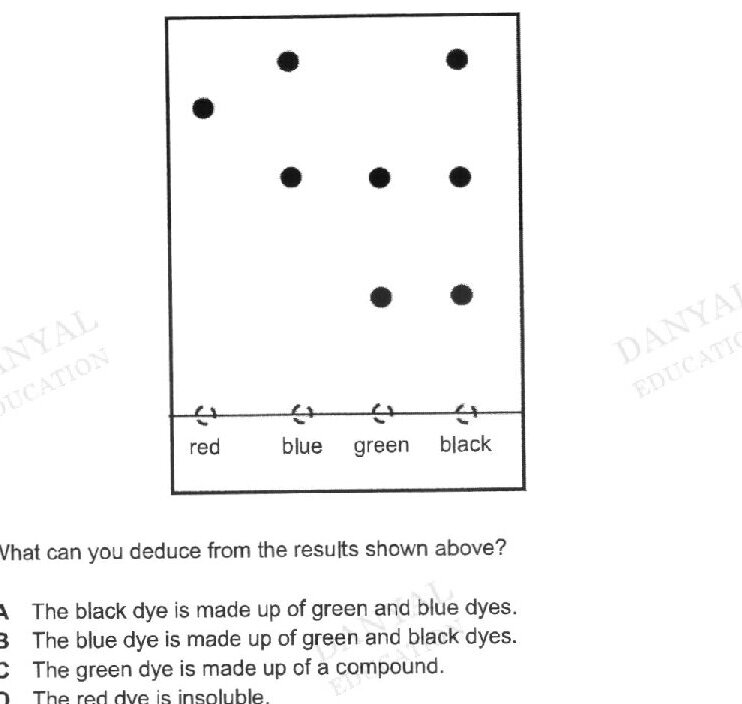
The diagram below shows the results of a chromatography experiment carried out using four different coloured dyes in water. What can you deduce from the results shown above?
Past year papers cover the full exam — browse by subject below.
View All Papers ›