Congruence and Similarity
Key Concepts
- Congruence and similarity are ways to compare shapes.
- These ideas are very useful in geometry, measurement, map reading, scale drawings, and solving problems involving lengths, areas, and volumes.
Congruent figures
- Two figures are congruent if they have:
- the same shape, and
- the same size.
- If one figure can be moved by:
- translation (sliding),
- rotation (turning), or
- reflection (flipping), so that it fits exactly onto the other, then the figures are congruent.
- For congruent figures:
- all corresponding sides are equal,
- all corresponding angles are equal.
Congruent triangles
- For triangles, you do not need to check all 6 parts every time.
- There are special conditions that prove two triangles are congruent.
1. SSS Congruence
- SSS means Side-Side-Side.
- If the three sides of one triangle are equal to the three corresponding sides of another triangle, then the triangles are congruent.
2. SAS Congruence
- SAS means Side-Angle-Side.
- If two sides and the included angle between them in one triangle are equal to the corresponding two sides and included angle in another triangle, then the triangles are congruent.
- The angle must be the angle between the two known sides.
3. AAS Congruence
- AAS means Angle-Angle-Side.
- If two angles and one corresponding side of one triangle are equal to those of another triangle, then the triangles are congruent.
- Since the angles in a triangle add up to 180°, knowing two angles also fixes the third angle.
4. RHS Congruence
- RHS means Right angle-Hypotenuse-Side.
- This condition applies only to right-angled triangles.
- If two right-angled triangles have:
- one right angle,
- equal hypotenuse,
- and one corresponding side equal, then the triangles are congruent.
Similar figures
- Two figures are similar if they have:
- the same shape,
- but not necessarily the same size.
- For similar figures:
- all corresponding angles are equal,
- all corresponding lengths are in the same ratio.
Similar triangles
- Two triangles are similar if:
- their corresponding angles are equal, and
- their corresponding sides are proportional.
- Similar triangles may be:
- enlarged,
- reduced,
- or turned/flipped.
AA Similarity Test
The AA (Angle-Angle) Similarity Test is the most commonly used test in Sec 2 exams:
If two pairs of corresponding angles in two triangles are equal, the triangles are similar.
Why only two angles? Because if two angles are equal, the third must also be equal (angles in a triangle sum to 180°).
Worked example — full similarity proof (write exactly this in exams):
Given: Triangle ABC and Triangle PQR, where ∠BAC = ∠QPR and ∠ABC = ∠PQR. Prove that the triangles are similar.
| Statement | Reason |
|---|---|
| ∠BAC = ∠QPR | Given |
| ∠ABC = ∠PQR | Given |
| ∴ Triangle ABC is similar to Triangle PQR | AA Similarity Test |
Consequence: Once similarity is established, corresponding sides are proportional: [\frac{AB}{PQ} = \frac{BC}{QR} = \frac{AC}{PR}]
Exam tip: Always write “AA Similarity Test” (not just “AA”) and list the two angle pairs with their reasons before stating the conclusion. One mark is typically awarded for each correct angle pair and one for the conclusion.
Scale factor
- The scale factor compares corresponding lengths in similar figures.
- If a figure is enlarged by scale factor
: - every length is multiplied by
.
- every length is multiplied by
Length scale factor
-
If corresponding lengths are in the ratio
, then the length scale factor is:
Area scale factor
-
If the length scale factor is
, then the area scale factor is: -
So if lengths double, area becomes:
times as large.
Volume scale factor
Not in Sec 2 2026: The volume scale factor for similar solids (k³) is a Sec 3/4 topic. The 2026 Sec 2 syllabus only requires the area scale factor (k²) for similar figures. The notes below are kept for completeness and future reference.
-
If the length scale factor is
, then the volume scale factor is: -
So if lengths triple, volume becomes:
times as large.
Proportional relationships in similar triangles
-
In similar triangles, corresponding sides are in equal ratios.
-
Example:
- if triangle
is similar to triangle , - and
, , , then
- if triangle
-
You can use these equal ratios to:
- find unknown lengths,
- compare heights and distances,
- solve scale drawing problems.
Writing corresponding vertices correctly
-
The order of letters matters.
-
If
then:
-
Therefore:
, etc.
Exterior Angle of a Triangle
Note: This theorem belongs to the Angles topic but is often tested alongside similarity questions, so it is included here for reference.
- An exterior angle of a triangle is formed by extending one side of the triangle.
- Exterior angle theorem: An exterior angle of a triangle is equal to the sum of the two non-adjacent interior angles (also called remote interior angles).
-
Example: In triangle
, side is extended to point . - The exterior angle
- If
and , then - Check: the three interior angles must add to
, so , and . ✓
- The exterior angle
-
This theorem is useful when you know two angles of a triangle and need to find an exterior angle — or when you know an exterior angle and one interior angle.
Problem solving with congruent and similar figures
- In geometry questions, you may need to:
- identify equal sides or angles,
- state the correct test for congruence,
- state that triangles are similar,
- use corresponding side ratios,
- use scale factors to compare area or volume.
- Always:
- identify corresponding parts carefully,
- write the correct ratio,
- substitute values,
- solve clearly.
Important Definitions
- Congruent figures: figures that have the same shape and the same size.
- Similar figures: figures that have the same shape but not necessarily the same size.
- Corresponding parts: matching sides or angles in two figures that are in the same relative positions.
- Triangle congruence: when two triangles are exactly equal in shape and size.
- SSS congruence: a test for congruence where all three corresponding sides are equal.
- SAS congruence: a test for congruence where two corresponding sides and the included angle are equal.
- AAS congruence: a test for congruence where two corresponding angles and one corresponding side are equal.
- RHS congruence: a test for congruence for right-angled triangles, using a right angle, hypotenuse, and one side.
- Included angle: the angle between two given sides.
- Right-angled triangle: a triangle with one angle equal to
. - Hypotenuse: the longest side in a right-angled triangle, opposite the right angle.
- Scale factor: the ratio of corresponding lengths in two similar figures.
- Proportional: having the same ratio.
- Length scale factor: the ratio of corresponding lengths of similar figures.
- Area scale factor: the ratio of corresponding areas of similar figures.
- Volume scale factor: the ratio of corresponding volumes of similar solids.
- Enlargement: a transformation that increases the size of a figure by a scale factor greater than 1.
- Reduction: a transformation that decreases the size of a figure by a scale factor between 0 and 1.
Worked Examples
Example 1: Proving triangles are congruent
Two triangles have:
Show that
Step 1: Identify the given equal parts
Step 2: Check the position of the angle
is between sides and is between sides and
So the equal angle is the included angle.
Step 3: Apply the congruence condition
- Two sides and the included angle are equal.
Therefore,
Final answer
by SAS.
Example 2: Finding an unknown length in similar triangles
Given:
- Find
Step 1: Write corresponding sides
Since
So,
Step 2: Substitute values
Step 3: Simplify ratio
Step 4: Cross multiply
Final answer
Example 3: Using scale factors for area and volume
Two similar solids have length scale factor
The smaller solid has:
- surface area
- volume
Find the surface area and volume of the larger solid.
Step 1: Find the area scale factor
Length scale factor:
Area scale factor:
Step 2: Find the larger surface area
So,
Step 3: Find the volume scale factor
Volume scale factor:
Step 4: Find the larger volume
So,
Final answers
- Larger surface area
- Larger volume
Common Mistakes to Avoid
- Mixing up congruent and similar.
- Congruent = same shape and same size.
- Similar = same shape only.
- Using the wrong order of vertices.
- If
, do not match with unless the order shows that.
- If
- Using SAS when the angle given is not the included angle.
- Forgetting that RHS works only for right-angled triangles.
- Assuming triangles are congruent just because two angles are equal.
- Equal angles alone show same shape, not necessarily same size.
- Using length scale factor directly for area or volume.
- Area uses
- Volume uses
- Area uses
- Writing side ratios upside down halfway through the solution.
- Stay consistent from start to end.
- Forgetting units:
- length in cm,
- area in cm²,
- volume in cm³.
- Not marking corresponding sides and angles clearly in a diagram.
- Cross-multiplying wrongly when solving proportions.
- Assuming figures are similar without checking corresponding angles or side ratios.
Exam Tips
-
When proving triangles congruent, write the full statement clearly:
- “
by SSS” - “
by RHS”
- “
-
Use the correct symbol:
- congruent:
- similar:
- congruent:
-
Always state the reason:
- “since
, , and ” - “therefore the triangles are congruent by SSS”
- “since
-
For similarity questions, write the ratio in matching order:
-
In scale factor questions:
- identify whether the question is about length, area, or volume
- then use
, , or correctly
-
If there are parallel lines, look for equal angles:
- alternate angles,
- corresponding angles,
- common angles.
-
In written explanations, useful mark-earning phrases include:
- “corresponding sides are equal”
- “included angle”
- “right angle”
- “hypotenuse”
- “corresponding angles are equal”
- “corresponding sides are proportional”
-
If the answer is a scale factor, state the direction clearly:
- “scale factor from small to large is 3”
- or “from large to small is
”
-
Draw or annotate your own marks on the diagram if allowed. This helps avoid matching the wrong sides.
Quick Summary
- Congruent figures have the same shape and same size.
- Similar figures have the same shape but may have different sizes.
- For congruent triangles, use:
- SSS
- SAS
- AAS
- RHS
- SAS needs the included angle between the two known sides.
- RHS applies only to right-angled triangles.
- In similar figures, corresponding angles are equal and corresponding sides are proportional.
- If
, keep the vertex order correct when matching sides. - If the length scale factor is
, then: - area scale factor
- volume scale factor
- area scale factor
- Use proportions to find unknown lengths in similar triangles.
- Always check whether the question is about length, area, or volume before calculating.
- Write complete mathematical statements such as:
by SSS
- Include correct units: cm, cm², cm³.
Construct the triangle PQR where PQ = QR = 7 cm and PR = 5 cm.
Measure and write down the size of angle QPR.
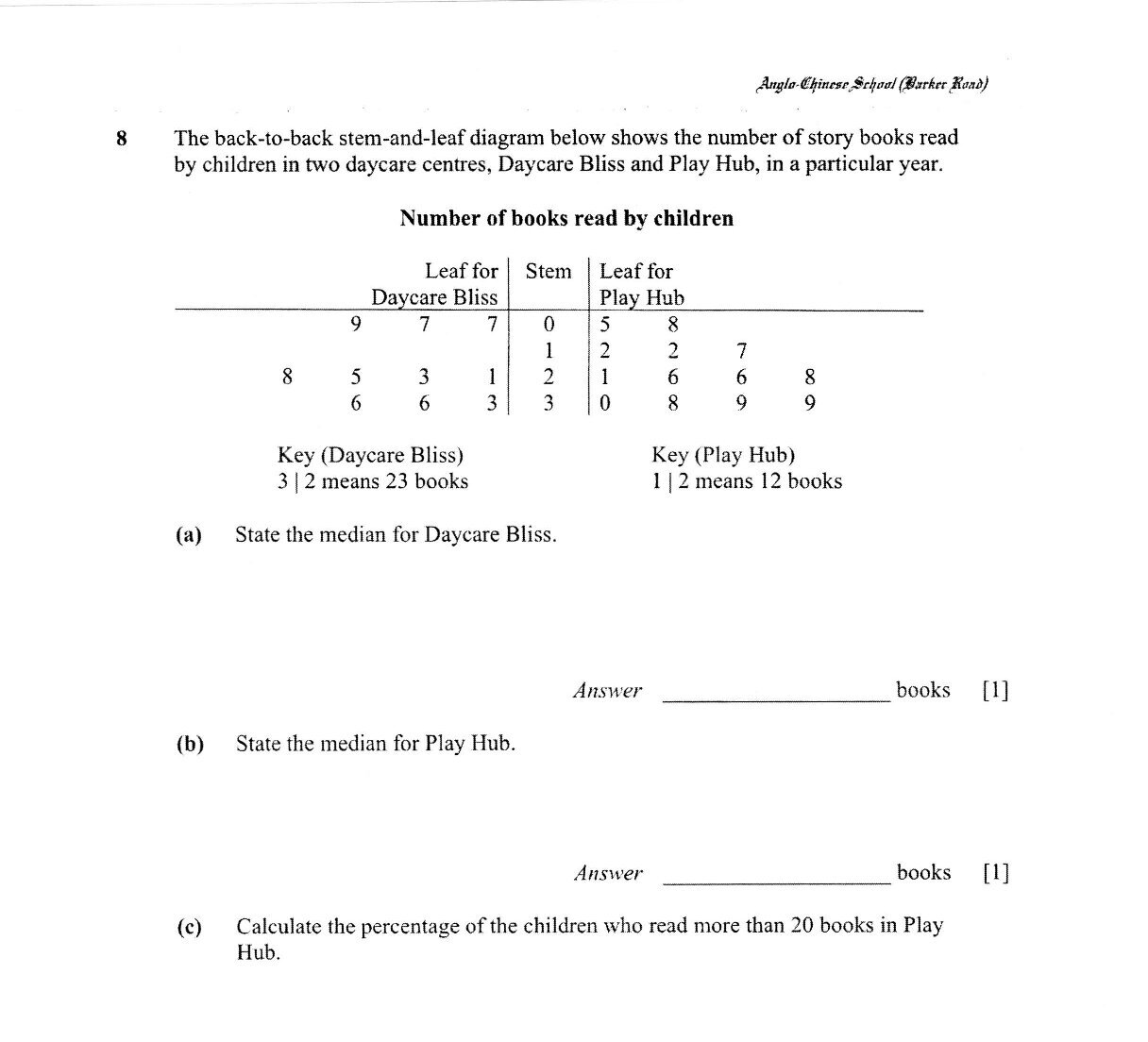
Calculate the percentage of the children who read more than 20 books in Play Hub.
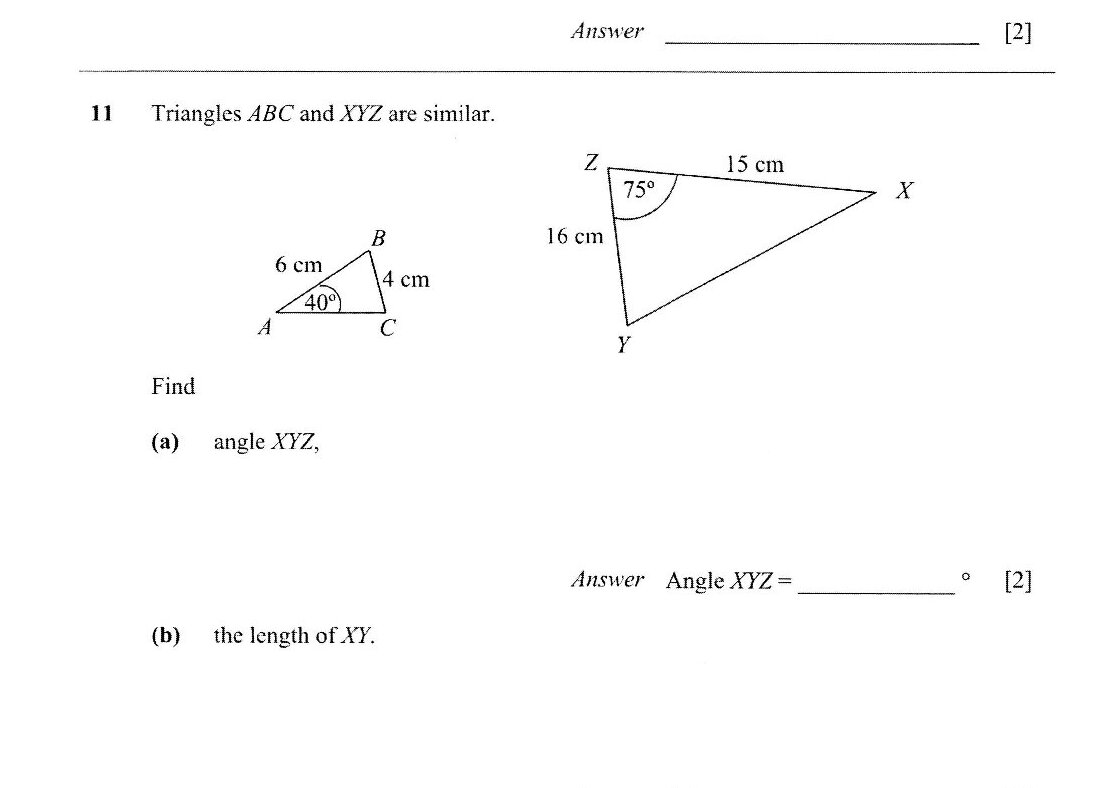
Triangles ABC and XYZ are similar. Find angle XYZ.
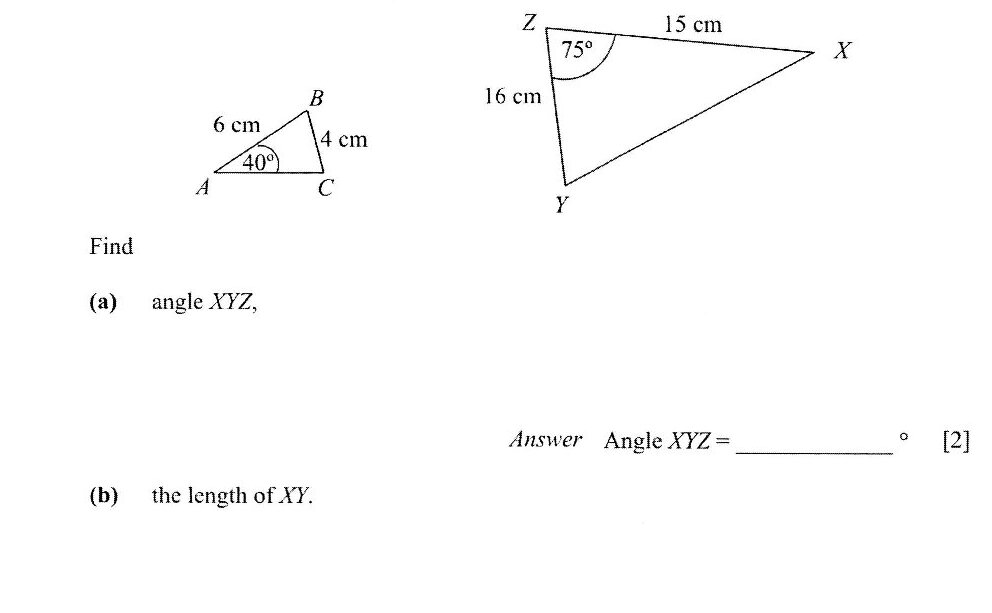
Triangles ABC and XYZ are similar. Find the length of XY.
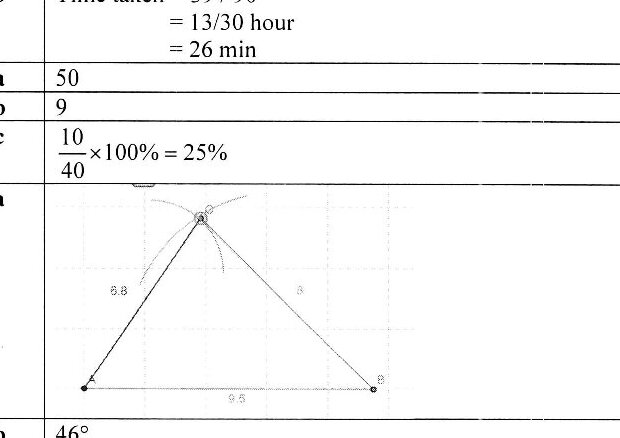
Construct a triangle ABC such that BC = 8 cm and AC = 6.8 cm. AB has been drawn for you.
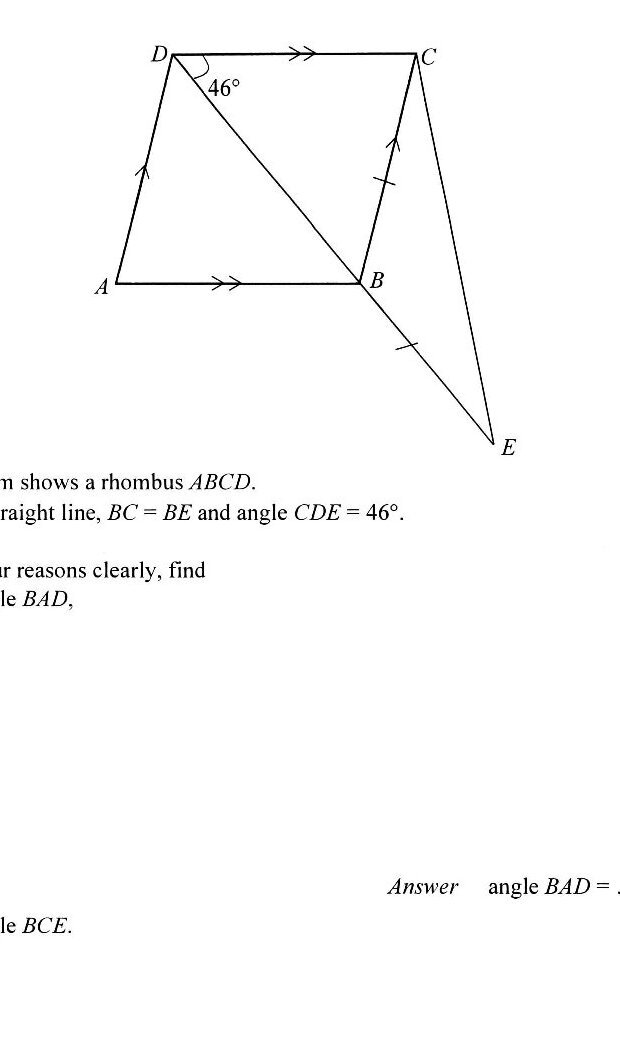
The diagram shows a rhombus ABCD. DBE is a straight line, BC = BE and angle CDE = 46°. Stating your reasons clearly, find angle BAD.
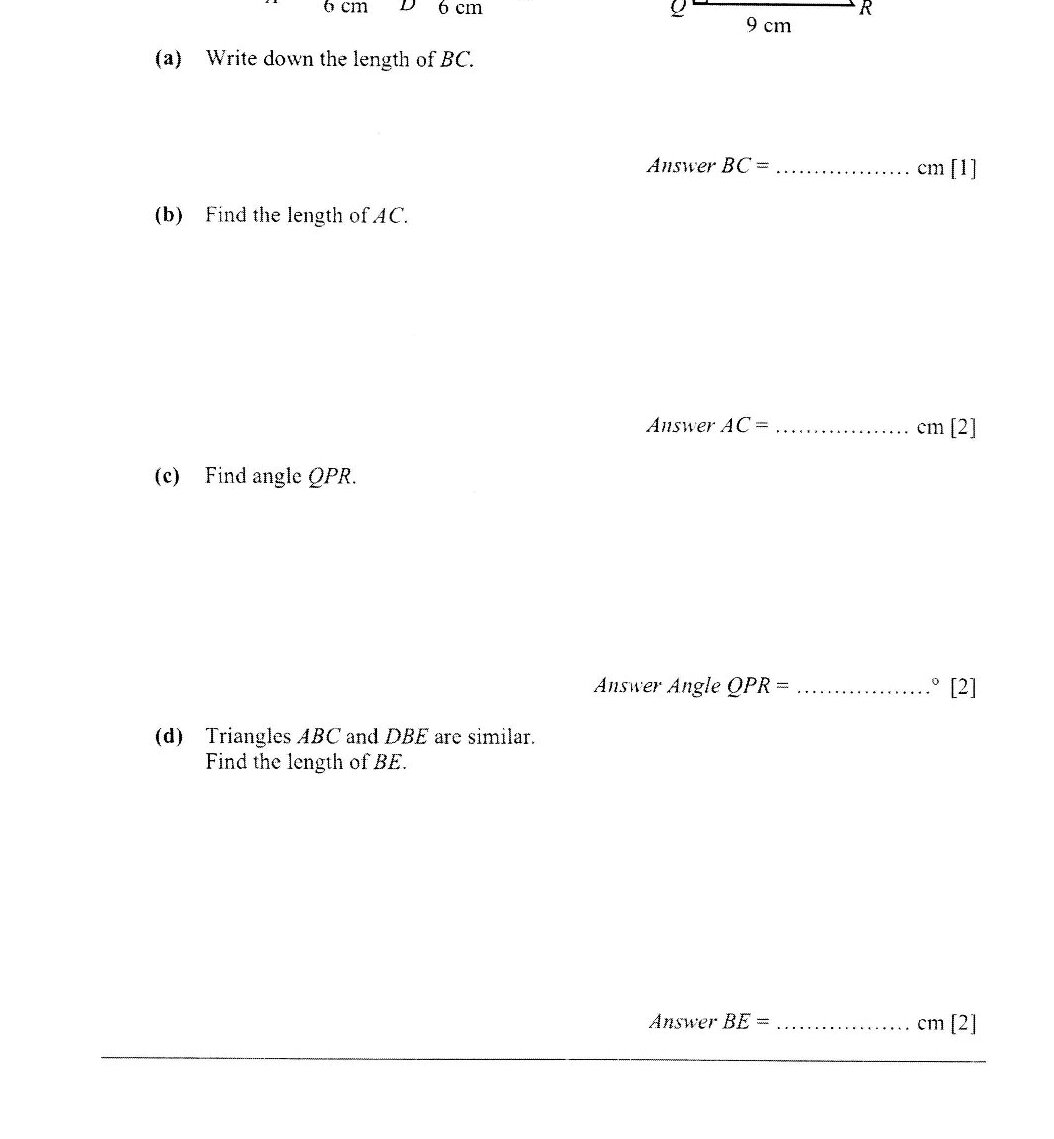
Triangles ABC and DBE are similar. Find the length of BE.
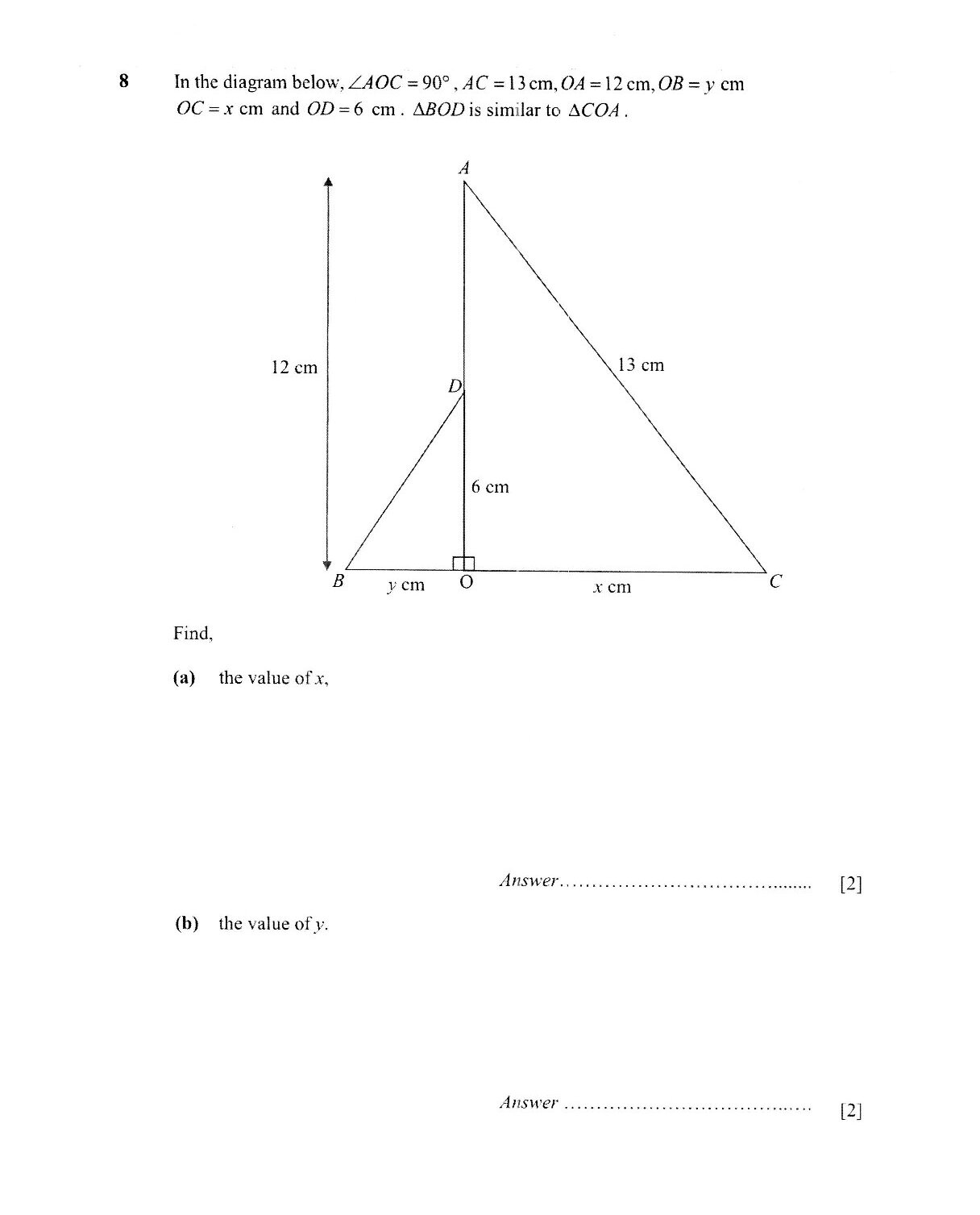
In the diagram below, ∠AOC = 90°, AC = 13 cm, OA = 12 cm, OB = y cm, OC = x cm and OD = 6 cm. △BOD is similar to △COA. Find the value of x.
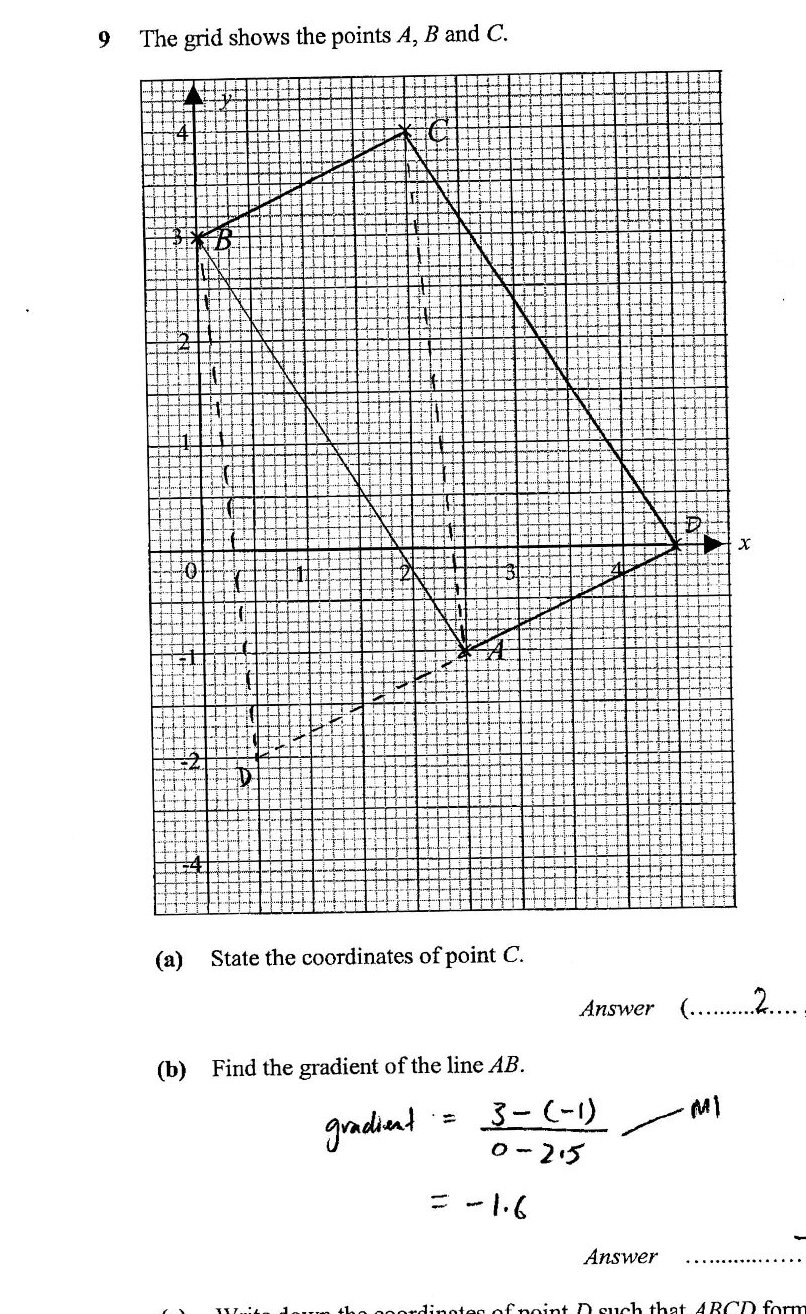
Write down the coordinates of point D such that ABCD forms a parallelogram.
Explain why triangle ABC is similar to triangle APQ.
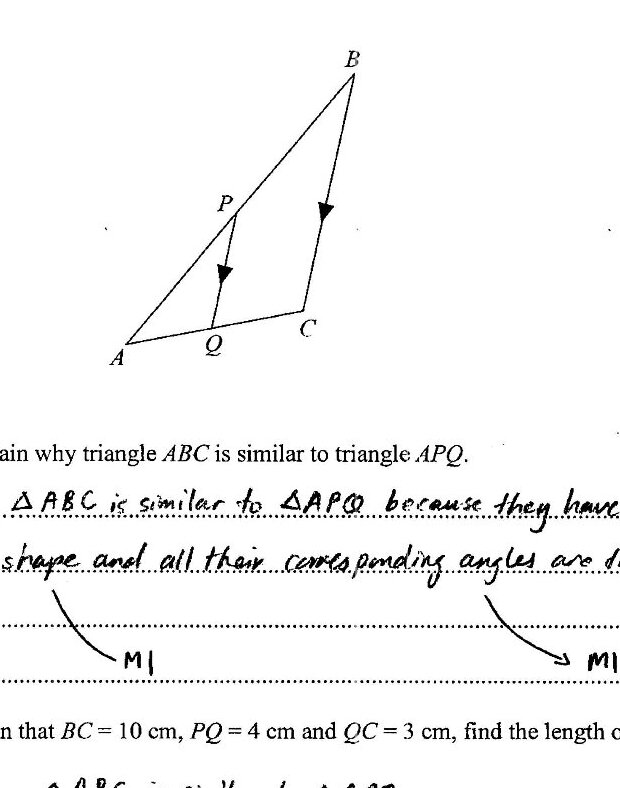
Given that BC = 10 cm, PQ = 4 cm and QC = 3 cm, find the length of AC.
Write down the coordinates of point D such that ABCD forms a parallelogram.
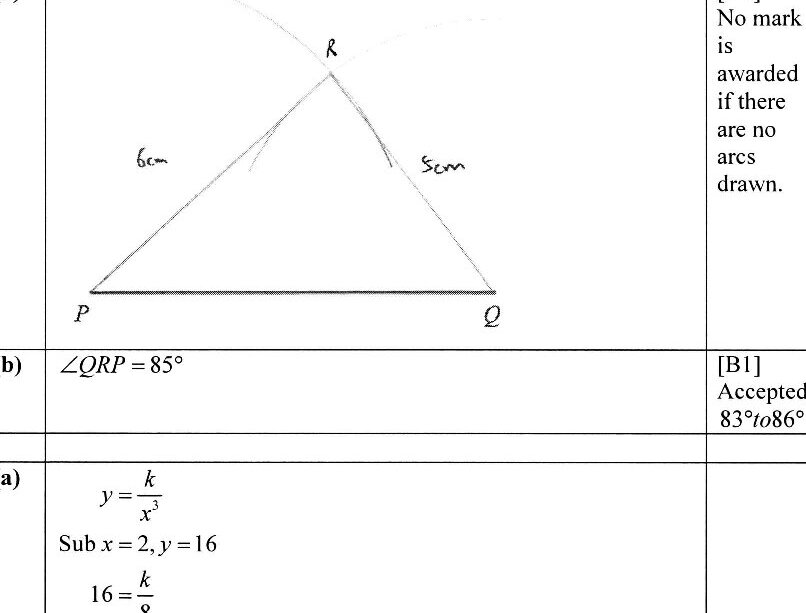
Construct triangle PQR such that QR = 5 cm and PR = 6 cm. Line PQ has been provided for you.
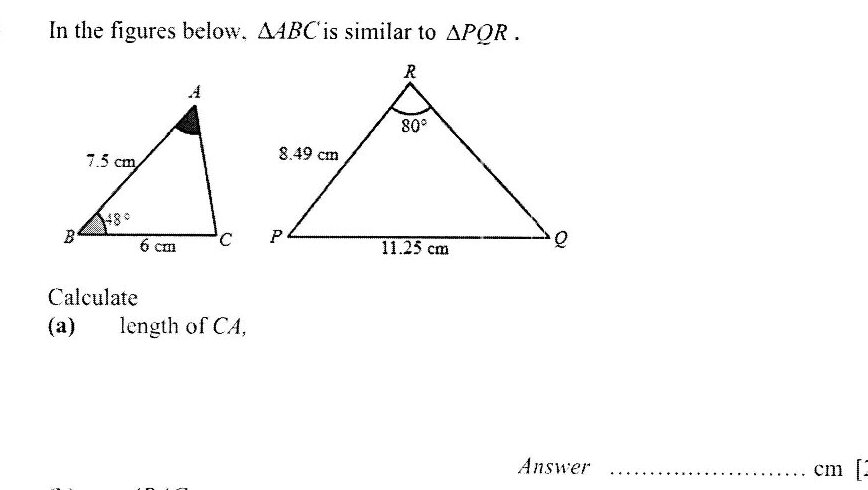
In the figures below, △ABC is similar to △PQR. (a) Calculate length of CA.
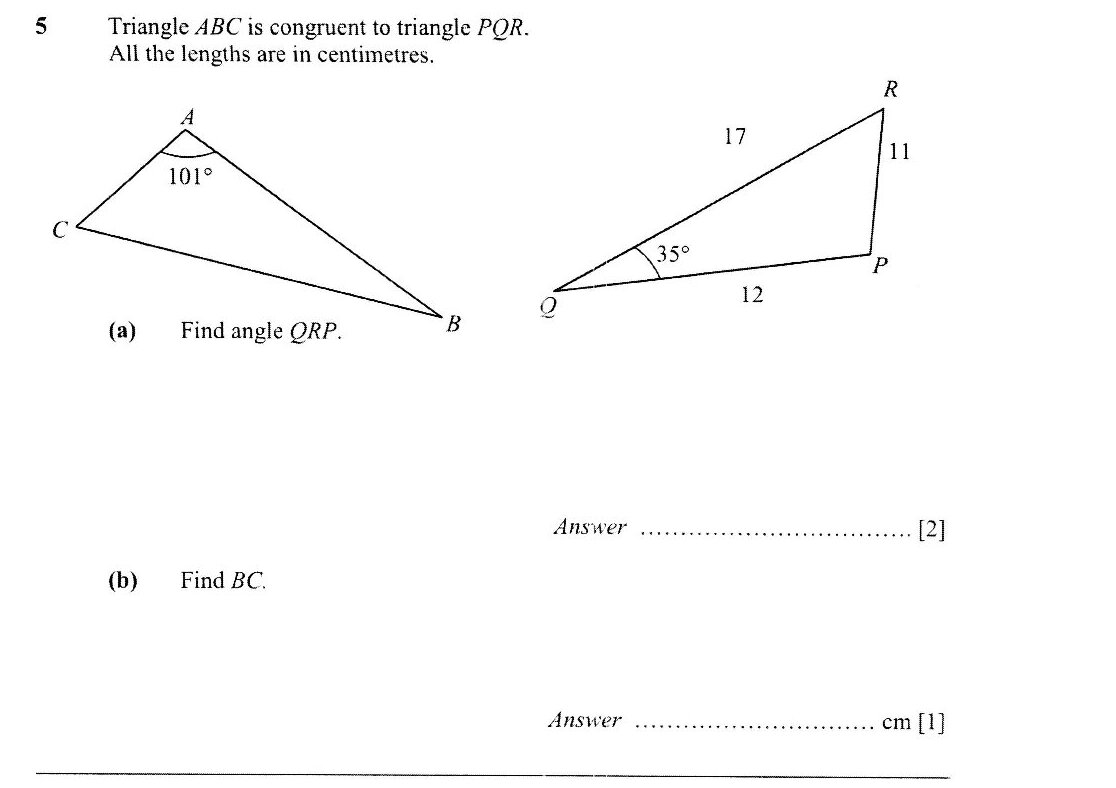
Triangle ABC is congruent to triangle PQR. All the lengths are in centimetres.
The diagram below shows two congruent quadrilaterals. It is given that angle SRU = 118°, angle STU = 78°, angle RST = 42°, angle ABC = 42°, AB = 10 cm, BC = 13 cm and RU = 3 cm.
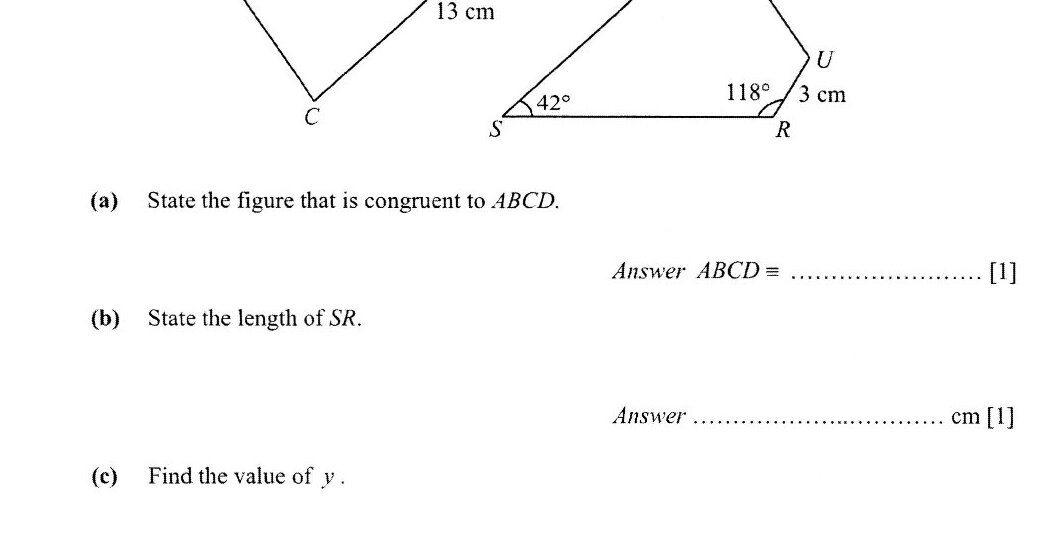
State the figure that is congruent to ABCD.
State the length of SR.
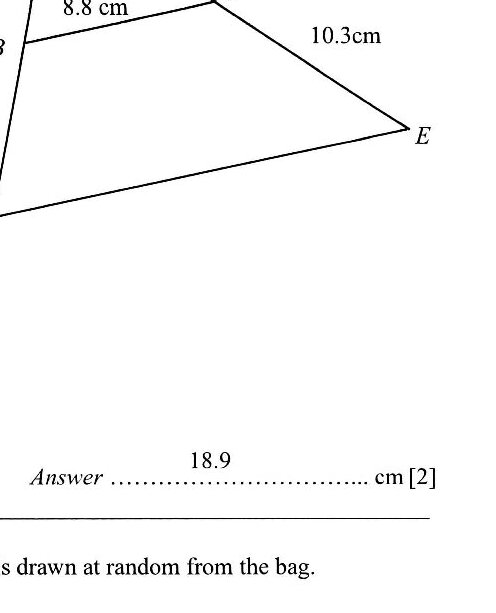
In the diagram, triangle ABC is similar to triangle ADE. AC = 9 cm, CE = 10.3 cm and BC = 8.8 cm. Find the length of DE.
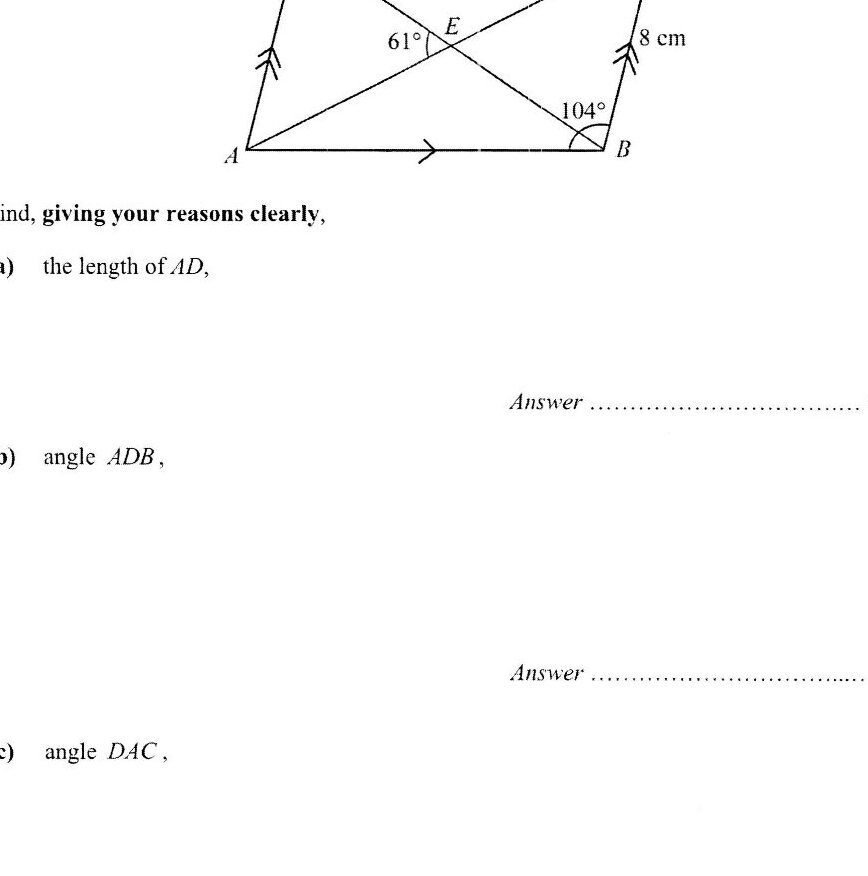
Find, giving your reasons clearly, the length of AD.
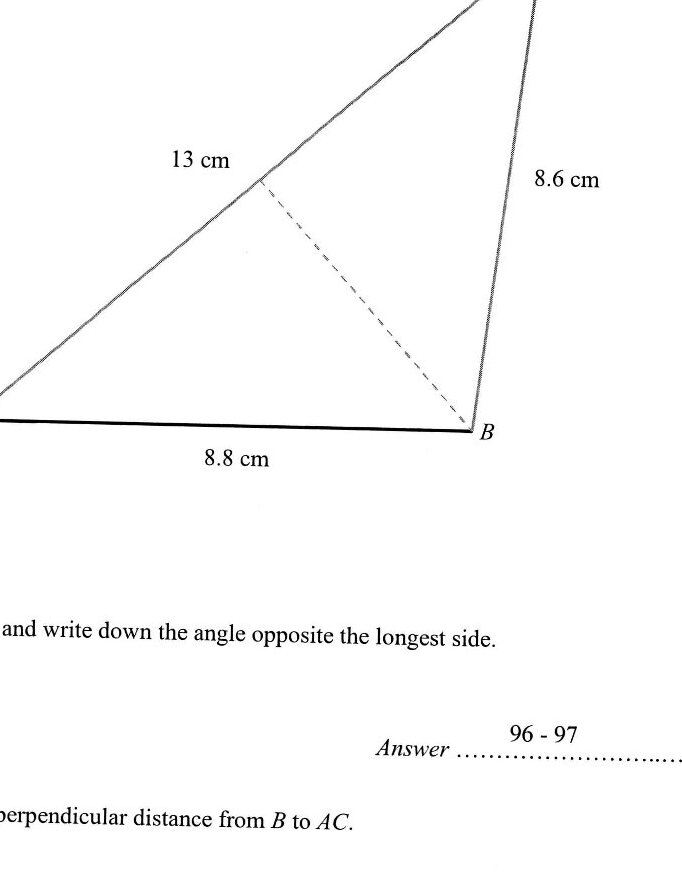
Construct a triangle such that AB = 8.8 cm, BC = 8.6 cm and CA = 13 cm. The line AB is shown below.
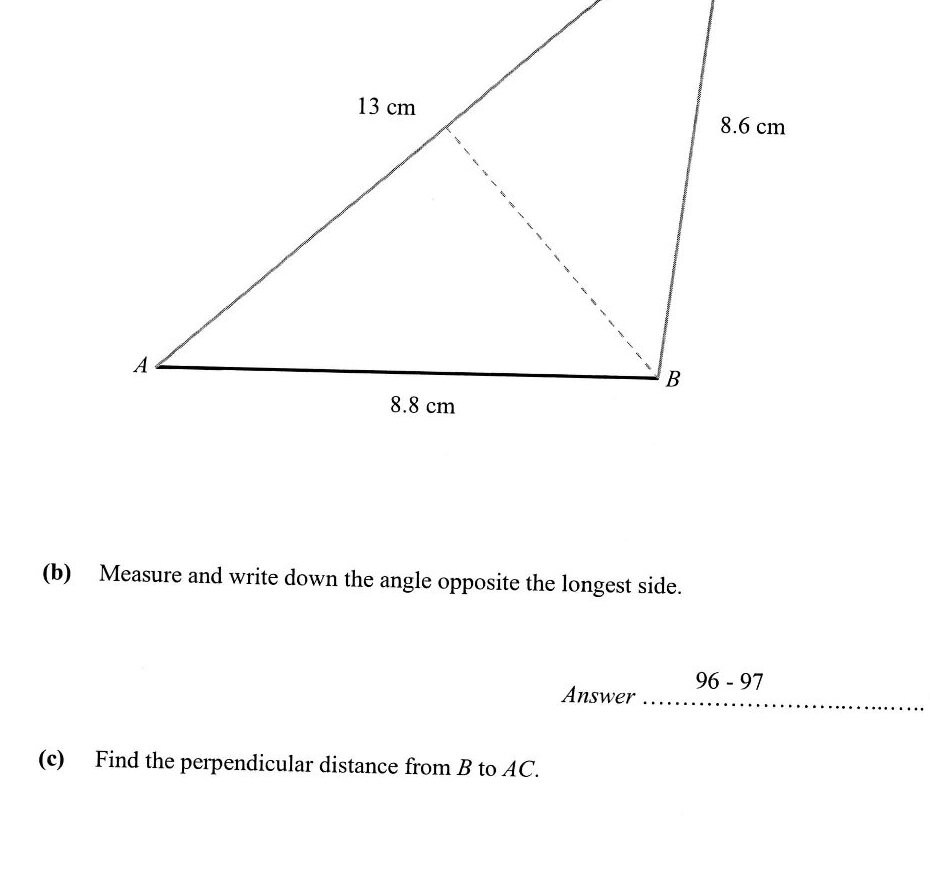
Construct a triangle such that AB = 8.8 cm, BC = 8.6 cm and CA = 13 cm. The line AB is shown below.
Measure and write down the angle opposite the longest side of the triangle.
The triangle EFG has FG = 8 cm and angle GEF = 116°. The line EF has been drawn for you below.
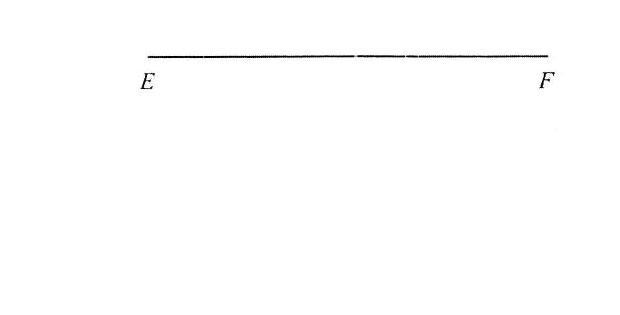
Construct and label the triangle EFG.
The diagram shows a rhombus ABCD. Angle DAB is 36°.
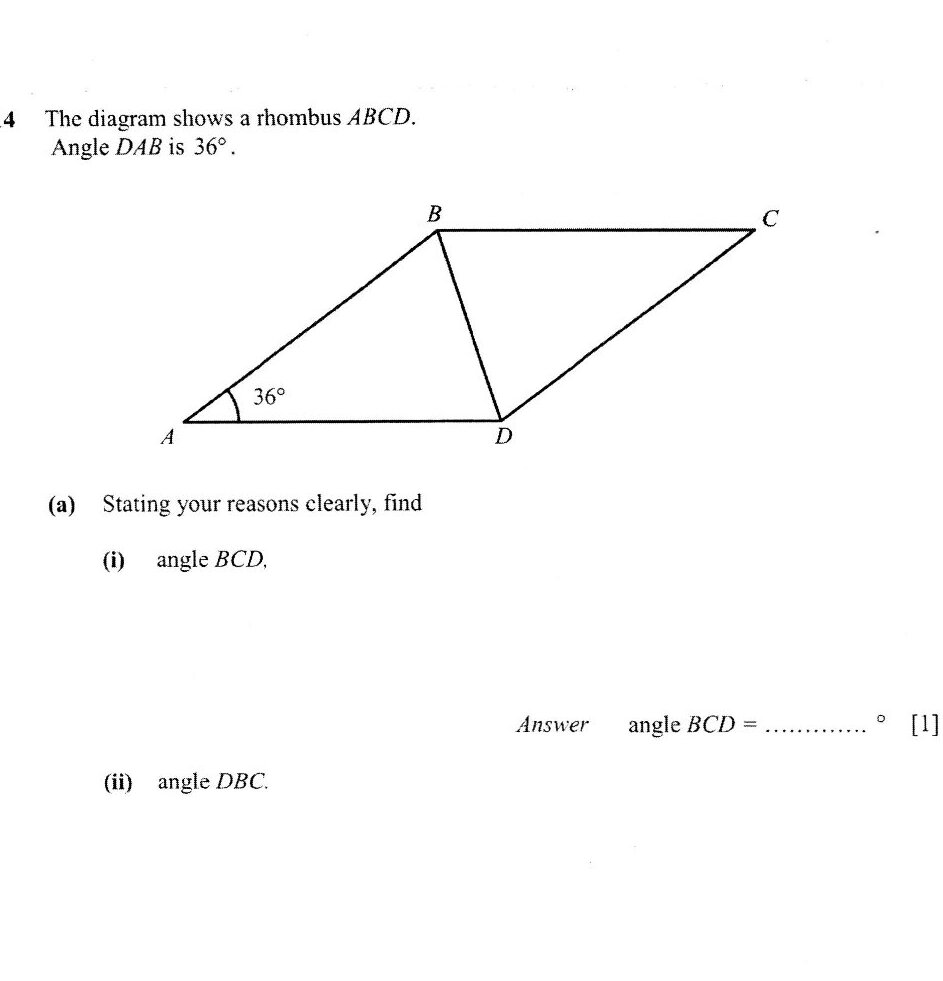
Stating your reasons clearly, find angle BCD.
Past year papers cover the full exam — browse by subject below.
View All Papers ›