Mensuration
Key Concepts
- Mensuration is the part of mathematics and science that deals with measurement of shapes and solids.
- In this topic, you need to know how to find:
- Volume of solids
- Surface area of solids
- Units of volume and how to convert between them
- Measurements of composite solids made from two or more simple solids joined together
1. Volume
- Volume is the amount of space occupied by a 3-dimensional object.
- Volume is measured in cubic units because it involves length × width × height.
- Common units:
- cm³
- m³
- mm³
- For liquids, volume may also be measured in:
- mL
- L
2. Surface Area
- Surface area is the total area of all the outer surfaces of a solid.
- It is measured in square units such as:
- cm²
- m²
- mm²
3. Pyramid
- A pyramid is a solid with:
- one base that is a polygon
- triangular faces that meet at a single point called the apex
- The most common type is a square-based pyramid.
Volume of a pyramid
-
Formula:
-
Important:
- Use the area of the base
- Use the vertical height, not the slant height
Surface area of a pyramid
- Surface area = base area + area of all triangular faces
- For a square-based pyramid:
- find area of square base
- find area of each triangular face
- add them together
4. Cone
- A cone is a solid with:
- one circular base
- one curved surface
- one vertex called the apex
- It can be thought of as a pyramid with a circular base.
Volume of a cone
-
Formula:
where:
= radius of base = vertical height
Surface area of a cone
-
A cone has:
- one circular base
- one curved surface
-
Total surface area:
where:
= radius = slant height
-
Curved surface area only:
-
If the cone’s slant height is not given, use Pythagoras’ theorem:
5. Sphere
- A sphere is a perfectly round 3D solid in which every point on the surface is the same distance from the centre.
- Examples: basketball, marble, planet Earth (approximately).
Volume of a sphere
-
Formula:
Surface area of a sphere
-
Formula:
6. Composite Solids
- A composite solid is a solid made by joining two or more simple solids together.
- Examples:
- hemisphere on top of a cylinder
- cone attached to a cylinder
- two cuboids joined together
Finding volume of composite solids
- Split the solid into simpler known shapes
- Find the volume of each part
- Add them together
If there is a hollow or cut-out section:
- find the total volume first
- subtract the missing part
Finding surface area of composite solids
- Find the area of all exposed surfaces only
- Do not include surfaces that are joined inside and cannot be seen from outside
7. Converting Between Units of Volume
- Volume units are cubic, so conversion involves cubing the linear conversion.
Length conversions
Volume conversions
Because volume is cubic:
Liquid volume conversions
8. Choosing the Correct Formula
-
For pyramids and cones, volume always has a factor of:
-
For surface area, check whether the question asks for:
- total surface area
- curved surface area only
- exposed surface area
-
Always identify:
- radius or diameter
- vertical height or slant height
- whether a base is included
Important Definitions
- Mensuration: the branch of mathematics dealing with measurement of lengths, areas and volumes.
- Volume: the amount of space taken up by a 3D object.
- Surface area: the total area of all the outside surfaces of a solid.
- Base: the surface on which a solid stands, or the main face used in a formula.
- Apex: the pointed top of a pyramid or cone.
- Radius: the distance from the centre of a circle or sphere to its edge or surface.
- Diameter: a straight line passing through the centre of a circle or sphere, equal to twice the radius.
- Vertical height: the perpendicular distance from the base to the top or apex.
- Slant height: the length measured along the sloping face of a cone or pyramid.
- Curved surface area: the area of the curved outer surface of a solid, not including the base.
- Sphere: a round 3D solid with all points on the surface equidistant from its centre.
- Composite solid: a solid formed by combining two or more simple solids.
- Exposed surface: a surface that can be seen from the outside.
- Cubic unit: a unit used for volume, such as cm³ or m³.
- Square unit: a unit used for area, such as cm² or m².
- Hemisphere: half of a sphere.
Worked Examples
Example 1: Volume and surface area of a cone
A cone has radius
- its volume
- its total surface area
Step 1: Write down the given information
To find surface area, we need slant height
Step 2: Find the slant height
Step 3: Find the volume
Using the π key on your calculator:
Step 4: Find the total surface area
Using the π key on your calculator:
Final answers
- Volume =
or - Total surface area =
or
Example 2: Volume and surface area of a sphere
A sphere has diameter
- its radius
- its volume
- its surface area
Step 1: Find the radius
Step 2: Find the volume
Using the π key on your calculator:
Step 3: Find the surface area
Using the π key on your calculator:
Final answers
- Radius =
- Volume =
or - Surface area =
or
Example 3: Composite solid
A solid is made of a cylinder with a hemisphere on top.
- Radius of both parts
- Height of cylinder
Find:
- total volume
- total exposed surface area
Step 1: Identify the parts
The solid consists of:
- one cylinder
- one hemisphere
Step 2: Find the volume of the cylinder
Step 3: Find the volume of the hemisphere
Volume of sphere:
Volume of hemisphere:
Step 4: Add the volumes
Using the π key on your calculator:
Step 5: Find exposed surface area
Exposed surfaces are:
- curved surface of hemisphere
- curved surface of cylinder
- bottom circular base of cylinder
Do not include:
- the circular face between hemisphere and cylinder, because it is internal
Curved surface area of hemisphere:
Curved surface area of cylinder:
Bottom base of cylinder:
Step 6: Add exposed areas
Using the π key on your calculator:
Final answers
- Total volume =
or - Exposed surface area =
or
Common Mistakes to Avoid
- Using diameter instead of radius in formulas for cones and spheres
- Using slant height instead of vertical height when finding volume
- Forgetting the
in the volume formula for pyramids and cones - Using surface area units for volume, or volume units for area
- volume must be in cm³, m³
- surface area must be in cm², m²
- Including hidden internal surfaces when finding surface area of composite solids
- Forgetting to include the base area when the question asks for total surface area of a cone
- Including the base when the question asks for curved surface area only
- Not converting units before substituting into formulas
- for example, radius in cm and height in m
- Converting volume units wrongly by multiplying by 10 or 100 instead of cubing the conversion factor
- Rounding too early in the working, leading to inaccurate final answers
- Forgetting that:
Exam Tips
-
Start by writing the correct formula clearly. This often earns method marks.
-
Define the symbols you use:
= radius = vertical height = slant height
-
If the diameter is given, immediately write:
-
For composite solids, write:
- “Total volume = volume of part A + volume of part B”
- “Exposed surface area excludes internal faces”
-
If you need slant height of a cone, mention:
- “Using Pythagoras’ theorem”
-
Always write units in the final answer:
- cm³ for volume
- cm² for surface area
-
If exact answers are acceptable, leave answers in terms of
first. -
If a decimal answer is needed, use the π key on your calculator — this gives accurate results for exams. Leave answers in exact form (in terms of π) where possible.
-
Read the question carefully to check whether it asks for:
- total surface area
- curved surface area
- volume
- capacity
-
For unit conversion questions:
- convert before calculation if easier
- or calculate first, then convert carefully using the correct cubic relationship
-
Useful mark-earning phrases:
- “Area of base = …”
- “Vertical height = …”
- “Curved surface area = …”
- “Internal surface not included”
- “Hence, total volume is …”
Quick Summary
-
Volume measures the space inside a solid; surface area measures the outside area.
-
Volume units are cubic units like cm³; surface area units are square units like cm².
-
Volume of a pyramid:
-
Surface area of a pyramid = base area + area of triangular faces.
-
Volume of a cone:
-
Total surface area of a cone:
-
Volume of a sphere:
-
Surface area of a sphere:
-
For a cone, slant height is found by:
-
For composite solids, split into simple solids, then add or subtract volumes and count only exposed surfaces.
-
Key conversions:
-
Always check whether the question gives radius or diameter, and whether it wants exact form or decimal form.
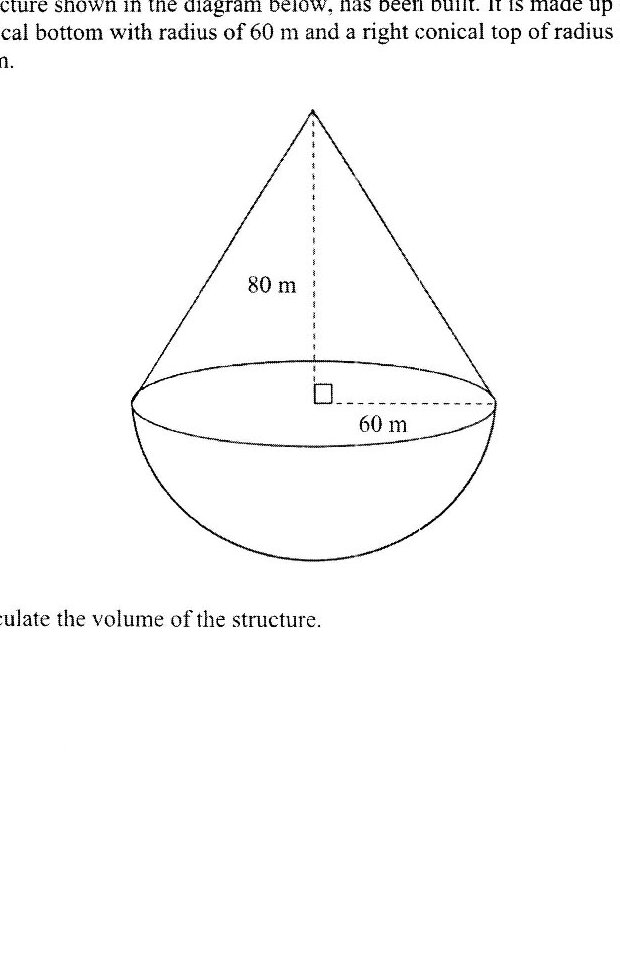
A new structure shown in the diagram below, has been built. It is made up of hemispherical bottom with radius of 60 m and a right conical top of radius 60 m and height 80 m. Calculate the volume of the structure.
The diagram shows a solid wooden toy made up of a circular cone and a hemisphere. The toy is 6 cm wide and the height of the cone is 4 cm tall. Calculate the volume of the wooden toy.
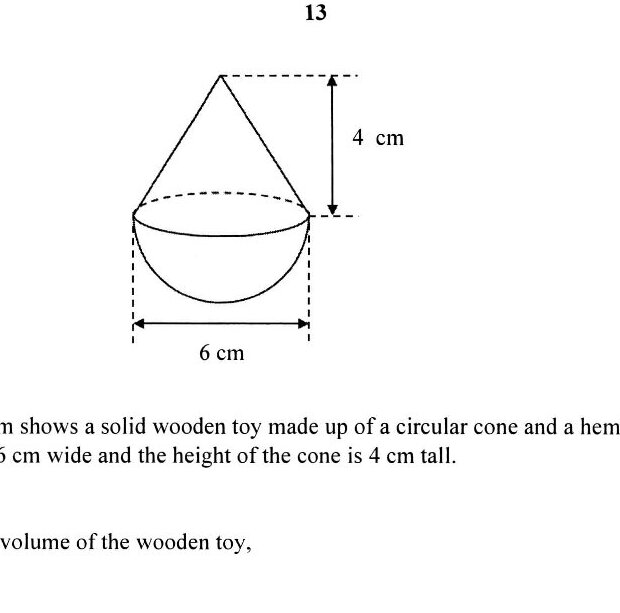
Calculate the total surface area of the wooden toy.
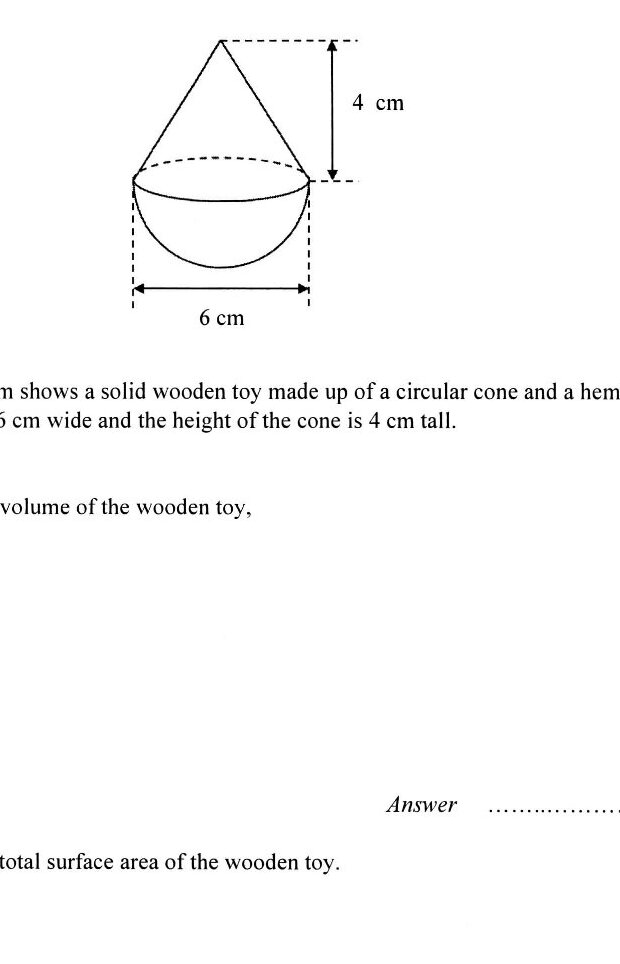
The diagram shows a solid wooden toy made up of a circular cone and a hemisphere. The toy is 6 cm wide and the height of the cone is 4 cm tall. Calculate the volume of the wooden toy.
Calculate the total surface area of the wooden toy.
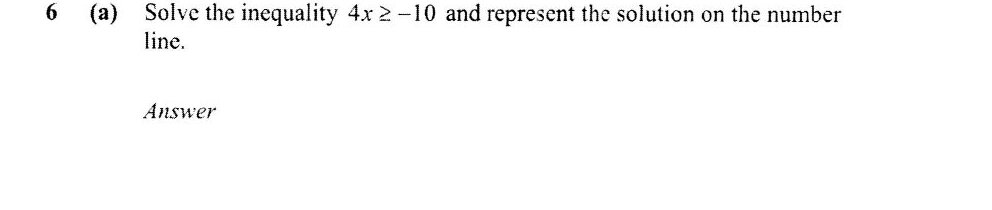
Solve the inequality 4x ≥ −10 and represent the solution on the number line.

Hence, write down the smallest integer x that satisfies 4x ≥ −10.
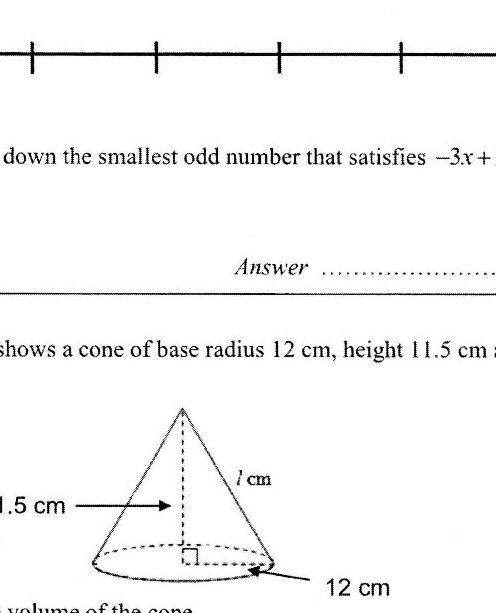
Calculate the volume of the cone.
A rectangular pyramid has a base of 9 cm by 12 cm and a height of 15 cm.
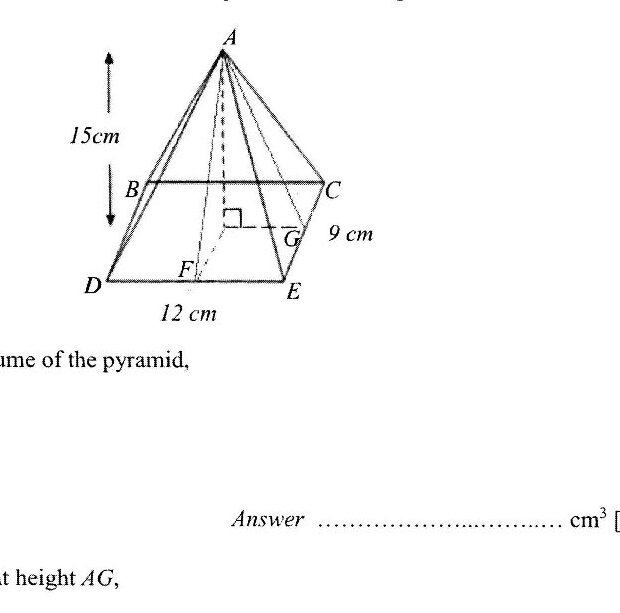
Find the volume of the pyramid.
Find the slant height AG.
Given AF = 17 cm, calculate the total surface area of the pyramid.
Show that the volume of the chocolate, correct to one decimal place is 14.1 cm³.
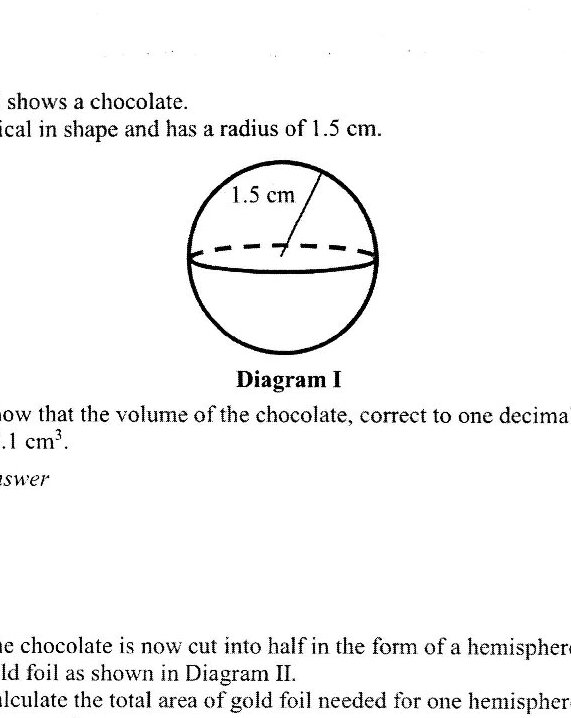
The chocolate is now cut into half in the form of a hemisphere and wrapped in gold foil as shown in Diagram II. Calculate the total area of gold foil needed for one hemisphere, assuming there is no overlap.
Given that the cost of chocolate is $0.10 per cm³ and the cost of gold foil is $0.20 per cm², determine the selling price of one hemispherical chocolate so that a profit can be made.
A solid hemisphere has a volume of 144π cm³. (a) Find the radius of the hemisphere.
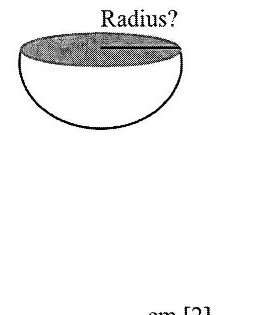
Find the total surface area of the hemisphere, correct your answer to 3 significant figures.
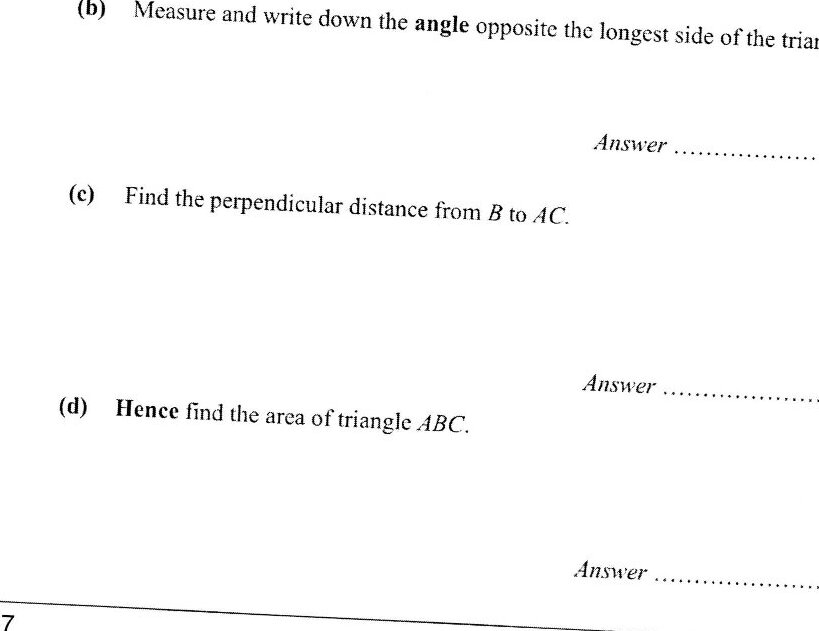
Hence find the area of triangle ABC.
The diagram shows a candle in the shape of a pyramid with a vertical height of 10 cm. The base of the pyramid is a square CDEF and the volume of the pyramid is 235.2 cm³. Show that the length of CD is 8.4 cm.
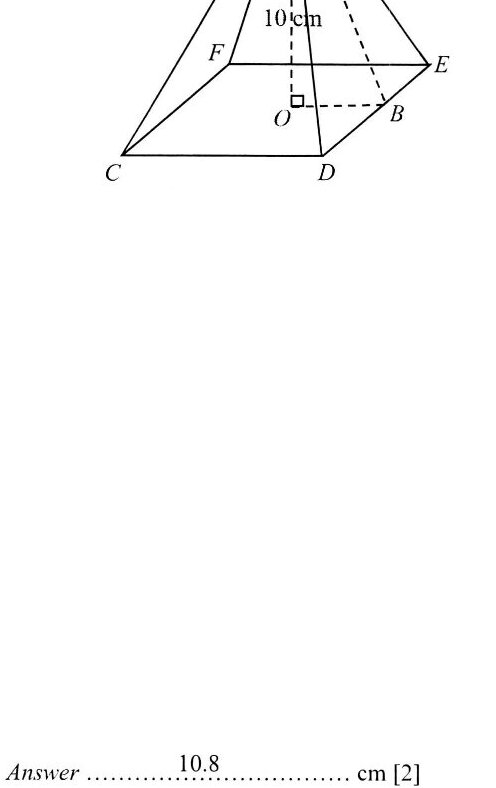
Find the total surface area of the candle.
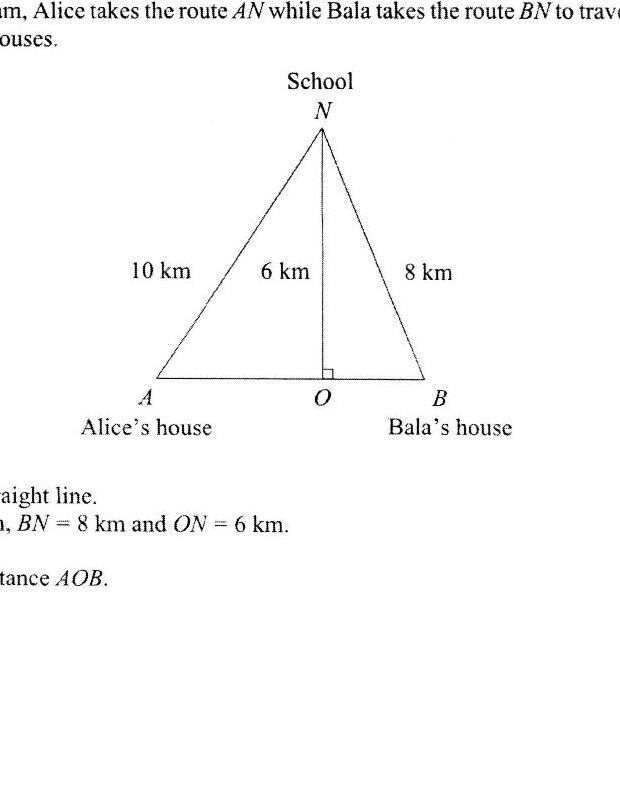
A ladder BC is leaning against the wall AB and touching the top of the wall at B. The height of the wall is 6 m and the distance from the foot of the ladder to the foot of the wall, AC, is 9.6 m. Find the length of the ladder BC.
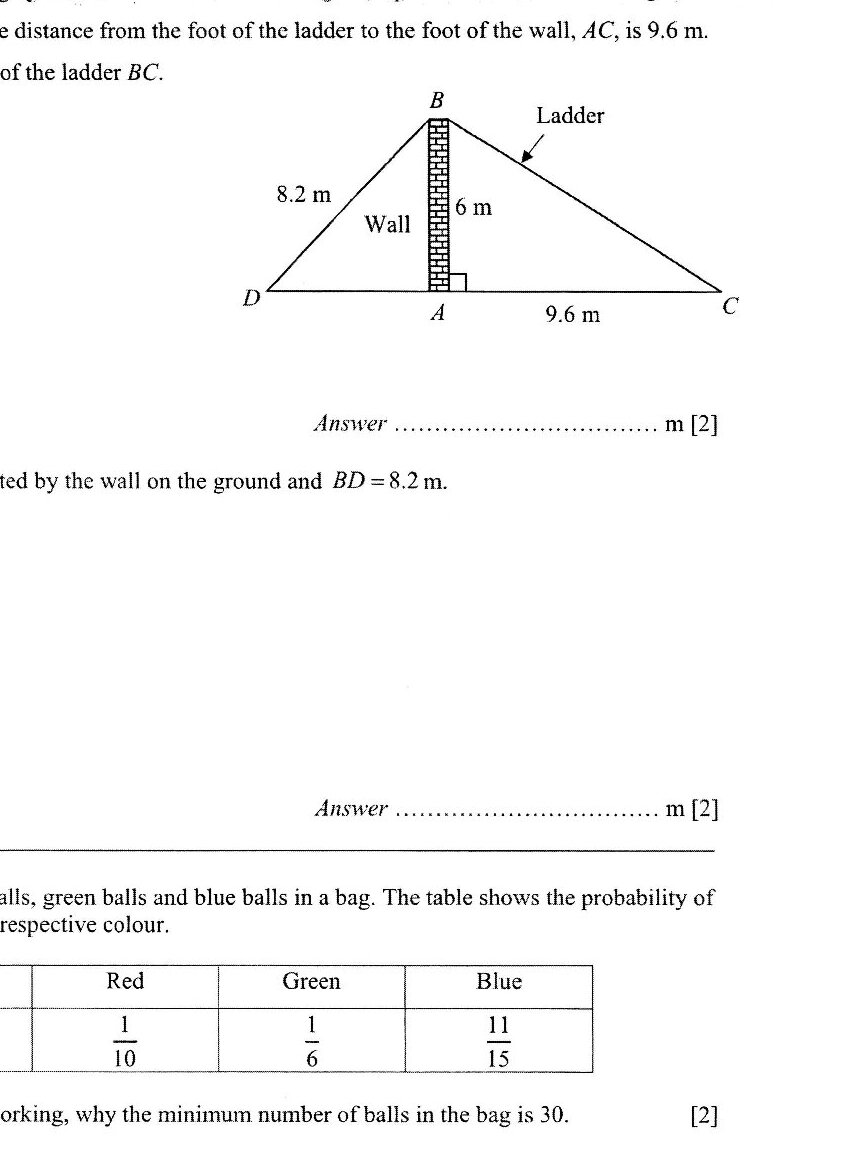
Hence find the area of triangle ABC.
The area of triangle ABC is 71.5 cm². Find BC.
The baked bean cans are packed vertically as shown in Fig. 1. By considering the dimensions of the medium box, show that x = 6.
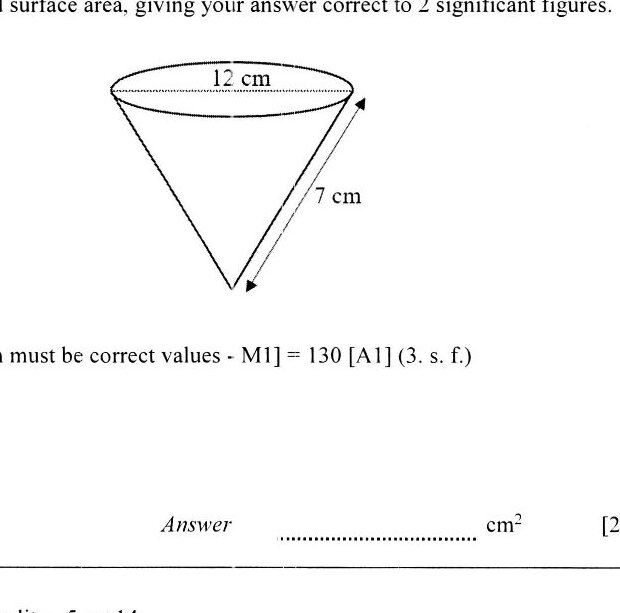
An open cone has a circular top of diameter 12 cm and a slant height of 7 cm. Calculate its curved surface area, giving your answer correct to 2 significant figures.
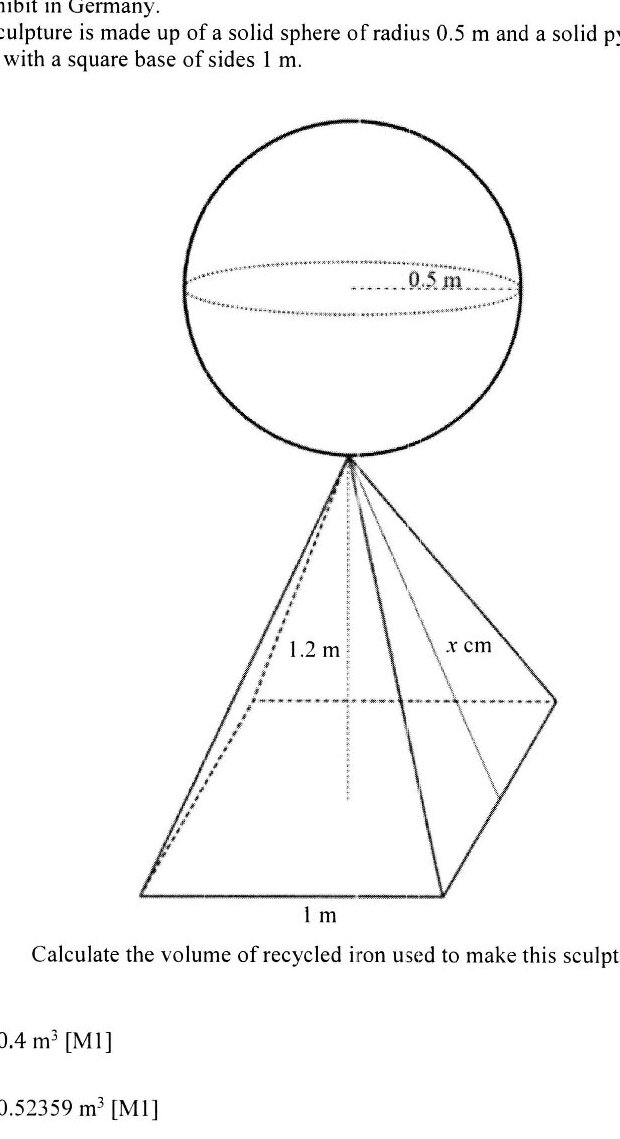
Ryan is a local sculptor and his latest sculpture made from recycled iron was selected for an exhibit in Germany. The sculpture is made up of a solid sphere of radius 0.5 m and a solid pyramid of a height 1.2 m with a square base of sides 1 m. Calculate the volume of recycled iron used to make this sculpture.
An open cone has a circular top of diameter 12 cm and a slant height of 7 cm. Calculate its curved surface area, giving your answer correct to 2 significant figures.
Ryan is a local sculptor and his latest sculpture made from recycled iron was selected for an exhibit in Germany. The sculpture is made up of a solid sphere of radius 0.5 m and a solid pyramid of a height 1.2 m with a square base of sides 1 m. Calculate the volume of recycled iron used to make this sculpture.
The diagram shows a smaller cone removed from a larger cone of the same height of 12 cm. The smaller cone has a radius of 5 cm and slant height of 13 cm. The larger cone has a radius of 9 cm and slant height of 15 cm. Find an expression, in terms of π, for the volume of the remaining solid.

Past year papers cover the full exam — browse by subject below.
View All Papers ›