Ray Model of Light
Ray Model of Light
Key Concepts
What is the ray model of light?
- The ray model of light represents light as straight lines called rays.
- A ray shows the direction in which light travels.
- This model helps us explain how light behaves when it:
- bounces off surfaces (reflection)
- passes from one medium to another (refraction)
- forms images in mirrors and lenses
Light travels in straight lines
- In a uniform medium, light travels in straight lines.
- A medium is a substance through which light travels, such as:
- air
- water
- glass
- This is why shadows are formed and why we can draw light paths using straight lines.
Reflection
- Reflection is the bouncing back of light when it hits a surface.
- Reflection happens on shiny, polished surfaces such as mirrors and calm water.
Terms used in reflection
- Incident ray: the ray of light that strikes the surface.
- Reflected ray: the ray of light that bounces off the surface.
- Normal: an imaginary line drawn at right angles to the surface at the point where the light ray strikes.
- Angle of incidence,
: the angle between the incident ray and the normal. - Angle of reflection,
: the angle between the reflected ray and the normal.
Laws of reflection
- The incident ray, reflected ray and the normal all lie in the same plane.
- The angle of incidence is equal to the angle of reflection.
- In symbols:
[ i = r ]
- In symbols:
Smooth and rough surfaces
- On a smooth surface, reflected rays remain orderly. This gives regular reflection and forms a clear image.
- On a rough surface, reflected rays scatter in many directions. This gives diffuse reflection and no clear image is formed.
Refraction
- Refraction is the bending of light when it passes from one medium to another because its speed changes.
- Light changes direction when it moves between media of different optical densities.
Optical density
- Optical density describes how much a medium slows down light.
- A more optically dense medium slows light more.
- Example:
- air is less optically dense
- glass is more optically dense than air
How light bends
- When light travels from a less optically dense medium to a more optically dense medium:
- it slows down
- it bends towards the normal
- When light travels from a more optically dense medium to a less optically dense medium:
- it speeds up
- it bends away from the normal
- If light hits the boundary along the normal:
- it does not bend
- but its speed still changes
Terms used in refraction
- Refracted ray: the ray in the second medium after bending.
- Angle of refraction,
: the angle between the refracted ray and the normal.
Snell’s law
Not in Sec 2 2026: Snell’s law (n₁ sin i = n₂ sin r), refractive index calculations, and all uses of the sine function belong to the Sec 3/4 Physics syllabus. These topics require trigonometry which is not assessed at Sec 2. You are expected to know the qualitative rules for refraction (light bends towards/away from the normal) but not to calculate angles using Snell’s law or refractive indices.
- Snell’s law relates the angle of incidence and angle of refraction when light passes between two media.
- Formula:
[
n_1 \sin i = n_2 \sin r
]
where:
= refractive index of the first medium = refractive index of the second medium = angle of incidence = angle of refraction
Refractive index
- The refractive index of a medium tells us how much light slows down in that medium.
- It is given by: [ n = \frac{\text{speed of light in vacuum}}{\text{speed of light in the medium}} ]
- A larger refractive index means the medium is more optically dense.
Useful refractive index values
- Vacuum:
- Air: about
- Water: about
- Glass: about
Total internal reflection
- Total internal reflection is the complete reflection of light back into a medium when it tries to pass from a more optically dense medium to a less optically dense medium.
Conditions for total internal reflection
Two conditions must be met:
- Light must travel from a more optically dense medium to a less optically dense medium.
- The angle of incidence must be greater than the critical angle.
Critical angle
- The critical angle is the angle of incidence in the more optically dense medium for which the angle of refraction is
. - At this angle, the refracted ray travels along the boundary.
What happens as the angle of incidence increases
- If angle of incidence is less than critical angle:
- light is refracted out
- If angle of incidence is equal to critical angle:
- refracted ray travels along the surface
- If angle of incidence is greater than critical angle:
- total internal reflection occurs
Applications of total internal reflection
- optical fibres
- periscopes using prisms
- sparkle of diamonds
Plane mirrors
- A plane mirror is a flat mirror.
- It forms an image by reflection.
Properties of the image formed by a plane mirror
The image is:
- virtual
- upright
- same size as the object
- laterally inverted
- same distance behind the mirror as the object is in front of the mirror
What each property means
- Virtual image: an image that cannot be formed on a screen because light rays do not actually meet there.
- Upright: the image is not upside down.
- Laterally inverted: left and right are reversed.
- The image appears behind the mirror because the reflected rays seem to come from there.
Curved mirrors introduction
Curved mirrors are mirrors with curved reflecting surfaces.
Types of curved mirrors
- Concave mirror:
- curves inward
- also called a converging mirror
- can make light rays come together
- Convex mirror:
- curves outward
- also called a diverging mirror
- makes light rays spread out
Concave mirrors
- Parallel rays striking a concave mirror are reflected to meet at the principal focus.
- It can form different kinds of images depending on where the object is placed.
- At this level, focus on the basic idea that concave mirrors can:
- magnify images when the object is close
- produce real images when the object is farther away
Convex mirrors
- Parallel rays striking a convex mirror are reflected outwards.
- The reflected rays appear to come from a point behind the mirror.
- Convex mirrors always produce:
- virtual images
- upright images
- diminished images
- They give a wider field of view, so they are used as security mirrors and vehicle side mirrors.
Terms for curved mirrors
- Principal axis: the straight line through the centre of the mirror.
- Principal focus,
: the point where parallel rays meet, or appear to come from, after reflection. - Pole,
: the centre point of the mirror surface.
Lenses
- A lens is a transparent optical object that refracts light.
- Most lenses are made of glass or plastic.
Types of lenses
- Converging lens:
- thicker in the middle than at the edges
- also called a convex lens
- brings parallel rays together
- Diverging lens:
- thinner in the middle than at the edges
- also called a concave lens
- causes parallel rays to spread out
Parts of a lens
- Optical centre: the middle point of the lens where a ray passes through without changing direction significantly.
- Principal axis: straight line through the optical centre.
- Principal focus,
: point where parallel rays converge to, or appear to diverge from, after passing through the lens. - Focal length: distance from the optical centre to the principal focus.
Converging lenses
- A converging lens refracts parallel rays so that they meet at the principal focus.
- It can form:
- real, inverted images when the object is beyond the focal length
- virtual, upright, magnified images when the object is within the focal length
Uses of converging lenses
- magnifying glasses
- cameras
- projectors
- human eye
Diverging lenses
- A diverging lens refracts parallel rays so that they spread out.
- The refracted rays appear to come from the principal focus on the same side as the incident rays.
- A diverging lens always forms an image that is:
- virtual
- upright
- diminished
Uses of diverging lenses
- spectacles for short-sightedness
- door viewers
Real and virtual images
- Real image:
- formed when light rays actually meet
- can be formed on a screen
- usually inverted
- Virtual image:
- formed when light rays only appear to meet
- cannot be formed on a screen
- usually upright
Important Definitions
- Ray model of light: a model that represents light as straight lines showing the direction of travel.
- Reflection: the bouncing back of light when it strikes a surface.
- Refraction: the bending of light when it passes from one medium to another due to a change in speed.
- Incident ray: the incoming light ray that strikes a surface.
- Reflected ray: the light ray that bounces off a surface.
- Refracted ray: the light ray that bends as it enters another medium.
- Normal: an imaginary line drawn perpendicular to a surface at the point where a ray strikes.
- Angle of incidence: the angle between the incident ray and the normal.
- Angle of reflection: the angle between the reflected ray and the normal.
- Angle of refraction: the angle between the refracted ray and the normal.
- Law of reflection: the angle of incidence equals the angle of reflection, and the incident ray, reflected ray and normal lie in the same plane.
- Optical density: a measure of how much a medium slows down light.
- Refractive index: a number that shows how much light slows down in a medium. (Not in Sec 2 2026 — calculations using refractive index are Sec 3/4 only)
- Snell’s law: the law that states
. (Not in Sec 2 2026 — Sec 3/4 topic only) - Critical angle: the angle of incidence in the more optically dense medium for which the angle of refraction is
. - Total internal reflection: complete reflection of light inside a more optically dense medium when the angle of incidence is greater than the critical angle.
- Plane mirror: a mirror with a flat reflecting surface.
- Virtual image: an image formed when light rays appear to meet but do not actually meet.
- Real image: an image formed when light rays actually meet.
- Lateral inversion: the sideways reversal of an image in a plane mirror.
- Concave mirror: a curved mirror that curves inward and can converge light rays.
- Convex mirror: a curved mirror that curves outward and causes light rays to diverge.
- Principal axis: the straight line through the centre of a mirror or lens.
- Principal focus: the point where parallel rays meet, or appear to come from, after reflection or refraction.
- Lens: a transparent object that refracts light to form images.
- Converging lens: a lens thicker at the centre that brings parallel rays together.
- Diverging lens: a lens thinner at the centre that causes parallel rays to spread out.
- Focal length: the distance between the optical centre and the principal focus.
- Optical centre: the centre of a lens where a ray passes through undeviated.
Diagrams and Structures
1. Reflection at a plane mirror
Draw this diagram:
- Draw a straight horizontal line to represent the mirror surface.
- Mark a point on the line where the light ray hits the mirror.
- Draw a dashed vertical line through that point at
to the mirror. Label it normal. - Draw an arrow coming down towards the mirror from the left side. Label it incident ray.
- Measure the angle between the incident ray and the normal. Label it angle of incidence,
. - Draw an arrow leaving the mirror on the right side, making the same angle with the normal. Label it reflected ray.
- Label the angle between the reflected ray and the normal as angle of reflection,
. - Show clearly that
.
Labels:
- mirror
- incident ray
- reflected ray
- normal
- angle of incidence
- angle of reflection
2. Refraction at an air-glass boundary
Draw this diagram:
- Draw a horizontal line to represent the boundary between air and glass.
- Label the upper region air and the lower region glass.
- Mark the point where the ray hits the boundary.
- Draw a dashed vertical line through that point. Label it normal.
- Draw an incident ray in air approaching the boundary at an angle.
- Draw the refracted ray inside the glass bending towards the normal.
- Label:
- incident ray
- refracted ray
- angle of incidence,
- angle of refraction,
Important feature:
- The angle in glass must be smaller than the angle in air because light bends towards the normal when entering a more optically dense medium.
3. Refraction at a glass-air boundary
Draw this diagram:
- Draw a horizontal boundary line.
- Label the upper region air and the lower region glass.
- Draw an incident ray inside the glass heading towards the boundary.
- Draw the normal at the point of incidence.
- Draw the refracted ray in air bending away from the normal.
- Label
in glass and in air.
Important feature:
- The angle in air must be larger than the angle in glass.
4. Critical angle and total internal reflection
Draw three separate diagrams side by side:
Diagram A: angle less than critical angle
- Draw a glass-air boundary.
- Draw a ray in glass striking the boundary.
- Draw a refracted ray emerging into air, bending away from the normal.
Diagram B: angle equal to critical angle
- Draw a ray in glass striking the boundary.
- Draw the refracted ray travelling exactly along the boundary.
- Label the angle of incidence as critical angle,
.
Diagram C: angle greater than critical angle
- Draw a ray in glass striking the boundary.
- Do not draw any refracted ray in air.
- Draw a reflected ray inside the glass.
- Label this total internal reflection.
5. Image in a plane mirror
Draw this diagram:
- Draw a vertical straight line for the mirror.
- Draw an upright arrow in front of the mirror. Label it object.
- Measure the distance from the object to the mirror.
- Draw a dotted upright arrow of the same size behind the mirror at the same distance. Label it image.
- Draw at least two rays from the top of the object to the mirror and then reflected to the observer’s eye.
- Extend the reflected rays backwards using dotted lines behind the mirror until they meet at the top of the image.
Labels:
- object
- mirror
- image
- reflected rays
- dotted backward extensions
- eye/observer
Important features:
- image same size as object
- image same distance behind mirror
- image is virtual and upright
6. Concave and convex mirrors
Concave mirror
- Draw a curved mirror like the inside of a spoon facing the object.
- Draw the principal axis as a horizontal line.
- Mark the pole
at the centre of the mirror. - Mark the principal focus
in front of the mirror. - Draw parallel rays coming in along the principal axis.
- After reflection, make them meet at
.
Convex mirror
- Draw a curved mirror bulging towards the object.
- Draw the principal axis.
- Mark pole
. - Mark principal focus
behind the mirror. - Draw parallel rays incident on the mirror.
- Reflect them outwards so they diverge.
- Extend the reflected rays backwards with dotted lines to meet at
.
7. Converging and diverging lenses
Converging lens
- Draw a lens thicker in the centre.
- Draw a horizontal principal axis through the centre.
- Mark the optical centre
. - Mark principal focus
on both sides. - Draw parallel rays entering the lens from the left.
- Show them meeting at the principal focus on the right.
Diverging lens
- Draw a lens thinner in the centre.
- Draw the principal axis and optical centre
. - Mark principal focus
on both sides. - Draw parallel rays entering from the left.
- Show them spreading out after leaving the lens.
- Extend the refracted rays backwards with dotted lines to meet at
on the left.
Worked Examples
Example 1: Reflection angle
A light ray strikes a plane mirror. The angle between the incident ray and the normal is
Solution
-
Identify the given value:
- Angle of incidence,
- Angle of incidence,
-
Use the law of reflection: [ i = r ]
-
Substitute: [ r = 35^\circ ]
Answer
The angle of reflection is
Example 2: Refraction using Snell’s law
Not in Sec 2 2026: This worked example uses Snell’s law and the sine function (trigonometry). It is kept here for reference only. Sec 2 students are not required to perform these calculations; this topic is assessed in Sec 3/4 Physics.
A ray of light passes from air into glass. The angle of incidence is
Solution
-
Write down the formula: [ n_1 \sin i = n_2 \sin r ]
-
Substitute the values: [ 1.00 \sin 30^\circ = 1.5 \sin r ]
-
Calculate
: [ \sin 30^\circ = 0.5 ] -
So: [ 1.00(0.5) = 1.5 \sin r ] [ 0.5 = 1.5 \sin r ]
-
Solve for
: [ \sin r = \frac{0.5}{1.5} = 0.333 ] -
Find
: [ r = \sin^{-1}(0.333) \approx 19.5^\circ ]
Answer
The angle of refraction is about
Check
- Light is going from air to glass.
- It should bend towards the normal.
- So the refracted angle should be smaller than
. is reasonable.
Example 3: Total internal reflection
A ray in glass strikes a glass-air boundary. The critical angle for glass is about
Solution
8. When angle of incidence is
- The angle is less than the critical angle.
- Light is refracted out into the air.
9. When angle of incidence is
- The angle is equal to the critical angle.
- The refracted ray travels along the boundary.
10. When angle of incidence is
- The angle is greater than the critical angle.
- Total internal reflection occurs.
Answer
: refraction occurs : refracted ray travels along the surface : total internal reflection occurs
Common Mistakes to Avoid
- Measuring angles from the surface instead of from the normal.
- Forgetting to draw the normal in reflection and refraction diagrams.
- Writing the law of reflection wrongly as angle of incidence equals angle with the mirror surface.
- Saying light bends because it “hits the surface” without mentioning the change in speed.
- Mixing up optical density and mass density. They are not the same.
- Saying light bends towards the normal when it goes from glass to air. It actually bends away from the normal.
- Forgetting that for total internal reflection, light must travel from a more optically dense medium to a less optically dense medium.
- Thinking total internal reflection happens whenever light reflects inside a material. The angle of incidence must also be greater than the critical angle.
- Drawing a plane mirror image at the wrong distance behind the mirror.
- Forgetting that a plane mirror image is virtual, not real.
- Confusing lateral inversion with upside-down inversion.
- Mixing up concave and convex mirrors.
- Mixing up converging and diverging lenses.
- Saying a diverging lens forms a real image. It forms a virtual, upright, diminished image.
- Forgetting to use dotted lines for backward extensions of rays when showing virtual images.
Exam Tips
-
Always draw a normal first when doing ray diagrams for reflection or refraction.
-
State the law of reflection exactly:
- angle of incidence equals angle of reflection
-
For refraction explanations, include:
- light changes speed when it enters a different medium
- therefore it changes direction
-
When describing bending:
- towards the normal when entering a more optically dense medium
- away from the normal when entering a less optically dense medium
-
For total internal reflection, write both conditions:
- light travels from a more optically dense medium to a less optically dense medium
- angle of incidence is greater than the critical angle
-
For plane mirror image questions, use the full set of properties if asked:
- virtual, upright, same size, laterally inverted, same distance behind the mirror
-
In ray diagrams:
- use a ruler
- use arrowheads to show direction of light
- label all parts clearly
- use dotted lines for virtual rays
-
If a question asks why an image cannot be formed on a screen, use the phrase:
- the image is virtual because the light rays do not actually meet
-
If using Snell’s law, show:
- formula
- substitution
- calculation
- final answer with unit
Not in Sec 2 2026: Snell’s law calculations using sin are not assessed at Sec 2. Focus instead on qualitative descriptions of refraction direction.
-
Check whether your final refracted angle makes sense:
- smaller angle in denser medium
- larger angle in less dense medium
Quick Summary
- Light can be represented by straight lines called rays.
- Reflection is the bouncing back of light from a surface.
- In reflection, angle of incidence = angle of reflection.
- Angles are always measured from the normal, not from the surface.
- Refraction is the bending of light due to a change in speed when it enters another medium.
- Light bends towards the normal when entering a more optically dense medium.
- Light bends away from the normal when entering a less optically dense medium.
- Snell’s law is
. (Not in Sec 2 2026 — Sec 3/4 topic only) - Total internal reflection happens only when light goes from a more optically dense medium to a less optically dense medium and the angle of incidence is greater than the critical angle.
- A plane mirror forms a virtual, upright, same-sized, laterally inverted image at the same distance behind the mirror.
- A concave mirror converges light; a convex mirror diverges light.
- A converging lens brings rays together; a diverging lens spreads rays apart.
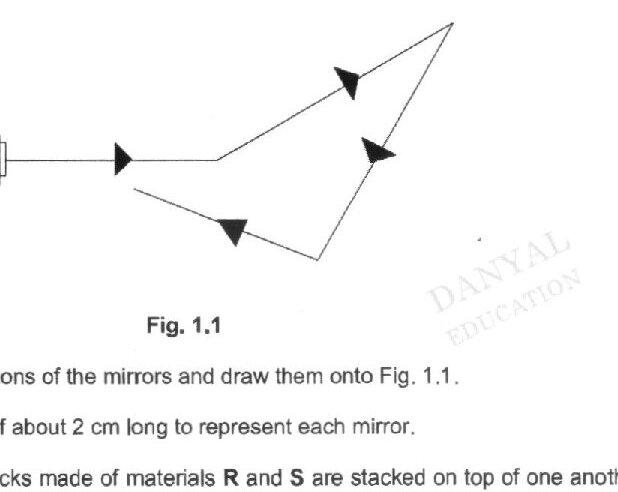
Michael is conducting an experiment about light and reflection in the laboratory. He is using mirrors to reflect a light ray from a ray box several times. Fig. 1.1 is a sketch of his experiment which shows the positions of the ray box and path of the light ray. Determine the positions of the mirrors and draw them onto Fig. 1.1. Use a straight line of about 2 cm long to represent each mirror.
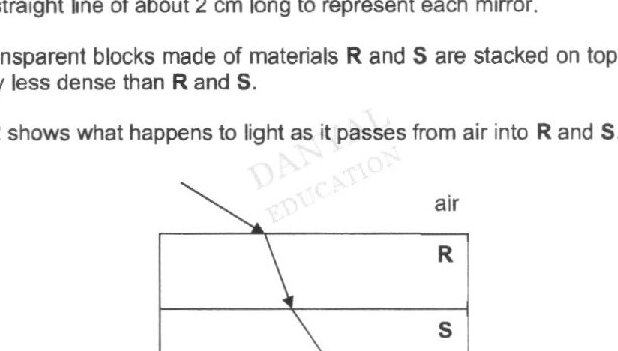
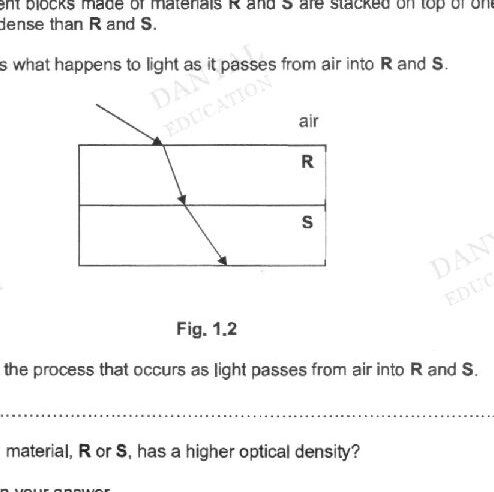
Name the process that occurs as light passes from air into R and S.
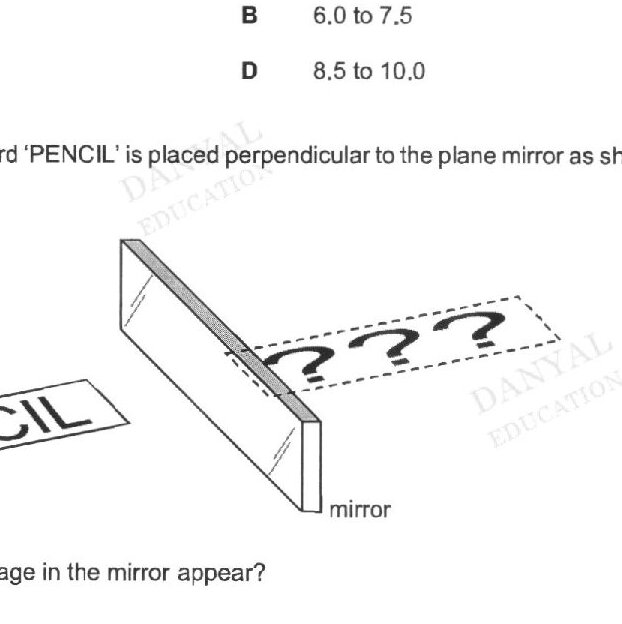
A card with the word 'PENCIL' is placed perpendicular to the plane mirror as shown in the diagram. How would the image in the mirror appear?
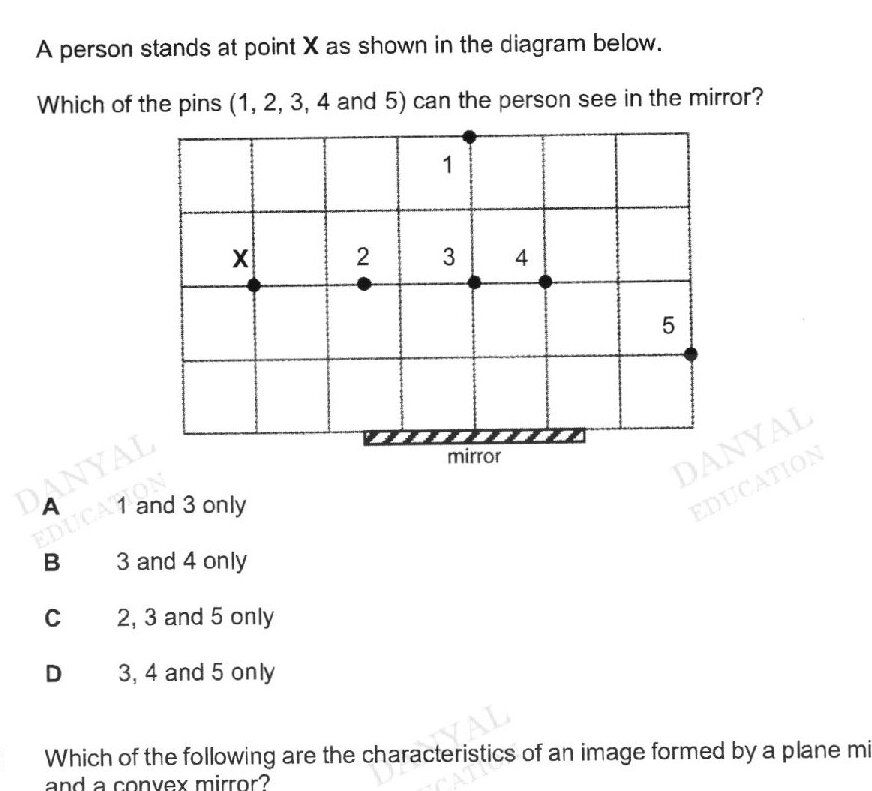
A person stands at point X as shown in the diagram below. Which of the pins (1, 2, 3, 4 and 5) can the person see in the mirror?
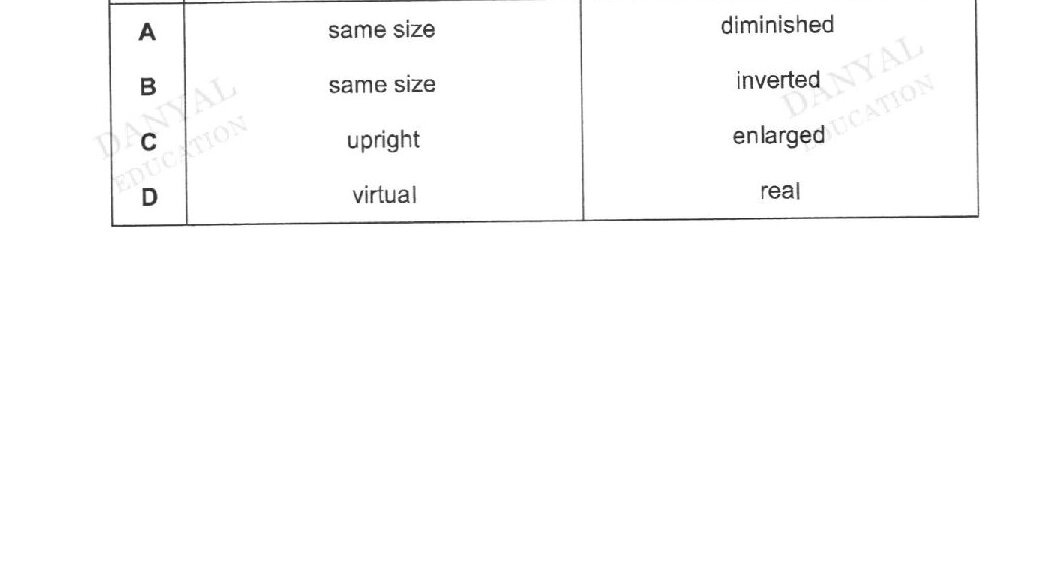
Which of the following are the characteristics of an image formed by a plane mirror and a convex mirror?
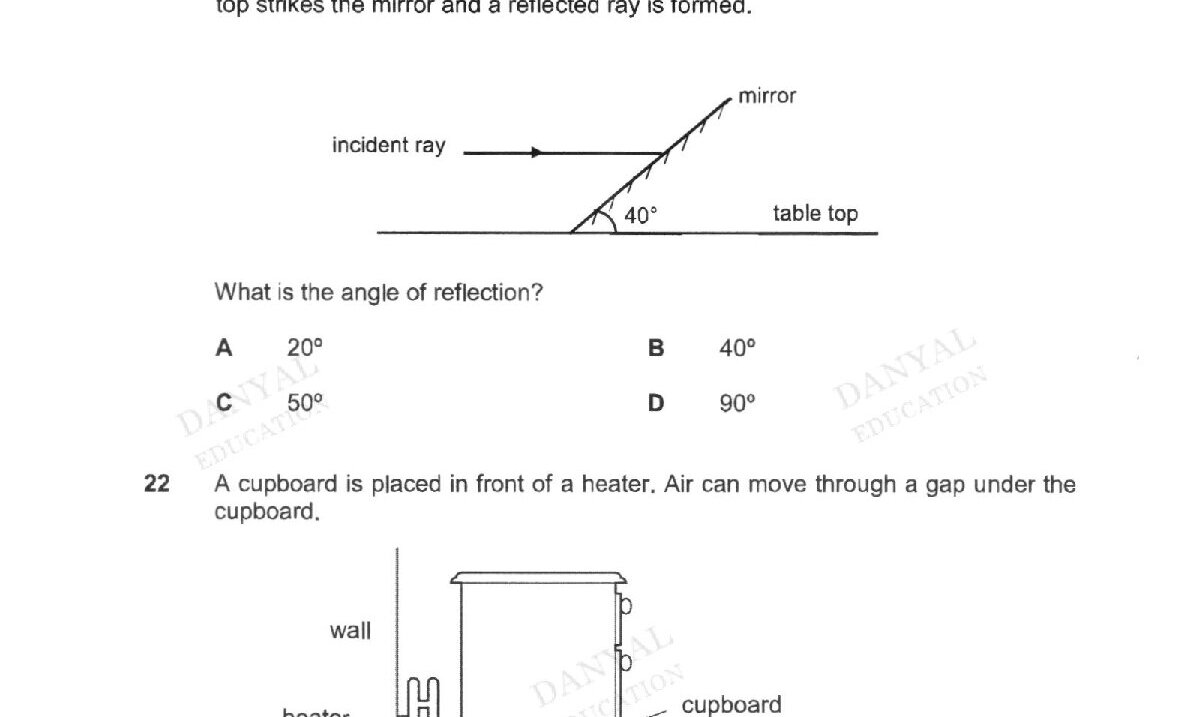
A plane mirror is inclined at 40° to the table top. An incident ray parallel to the table top strikes the mirror and a reflected ray is formed. What is the angle of reflection?
A boy is standing 2.0 m in front of a mirror. His cat is sitting 3.0 m behind him. If the cat walks 1.5 m towards the mirror, how far is the boy away from the cat's image in the mirror?
The diagram shows a ray of light entering a glass prism. What is the colour observed at X and Y respectively?
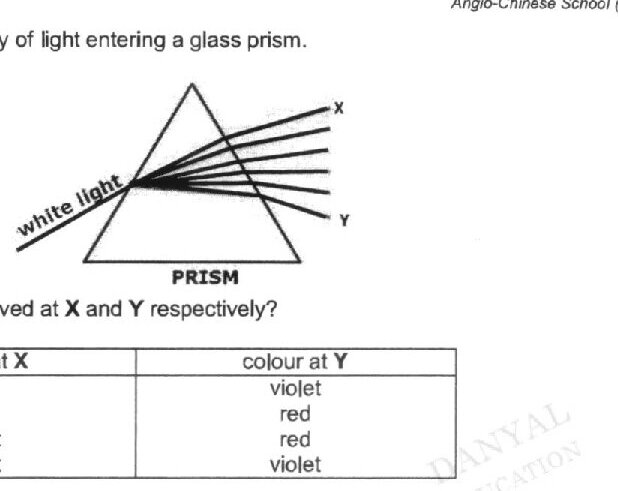
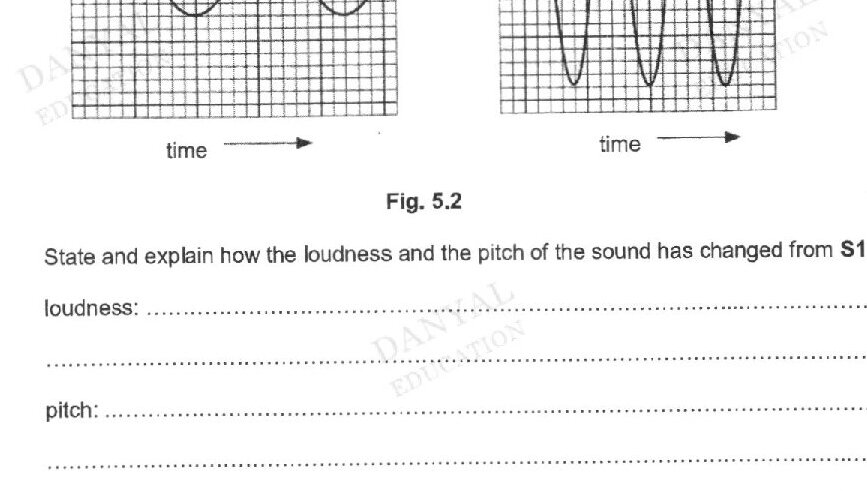
Fig. 5.2 shows traces of two different sound waves, S1 and S2, drawn to the same scale. State and explain how the loudness and the pitch of the sound has changed from S1 to S2.
On the diagram, draw the path of the light ray after it leaves medium S.
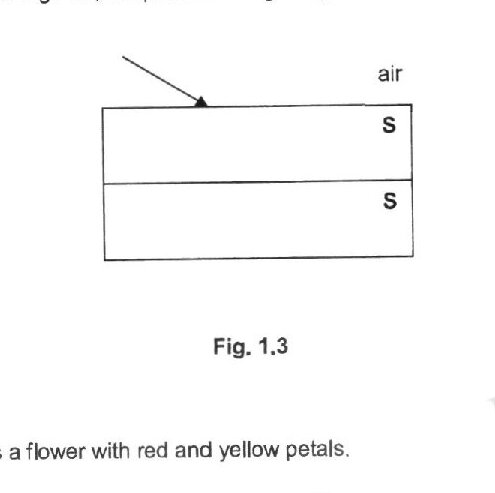
Two blocks of material S are stacked on top of each other. Draw, on Fig. 1.3, the path of the light ray as it enters the two blocks.
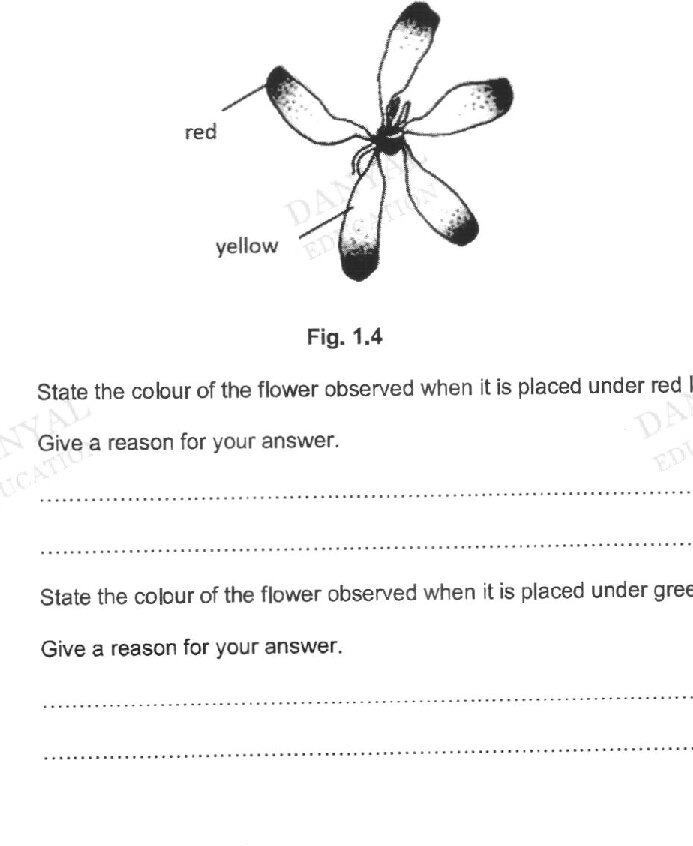
State the colour of the flower observed when it is placed under red light. Give a reason for your answer.
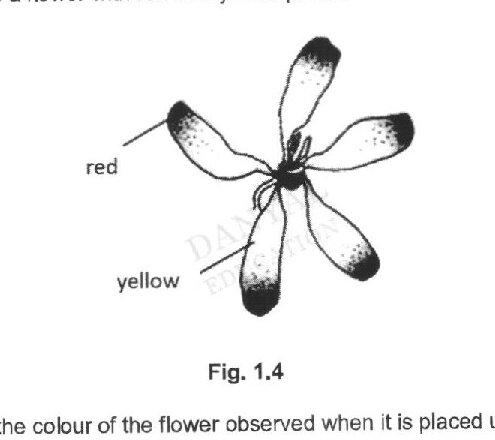
State the colour of the flower observed when it is placed under green light. Give a reason for your answer.
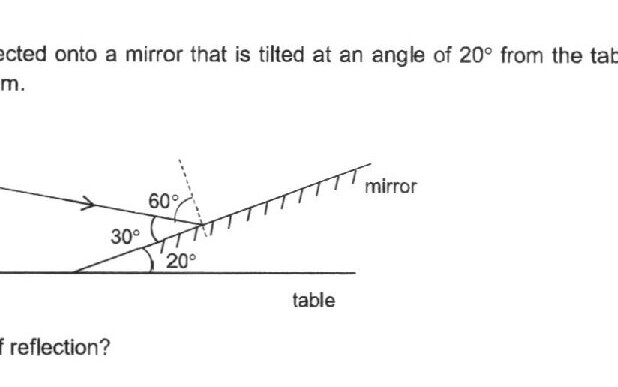
A ray of light is directed onto a mirror that is tilted at an angle of 20° from the table as shown in the diagram. What is the angle of reflection?
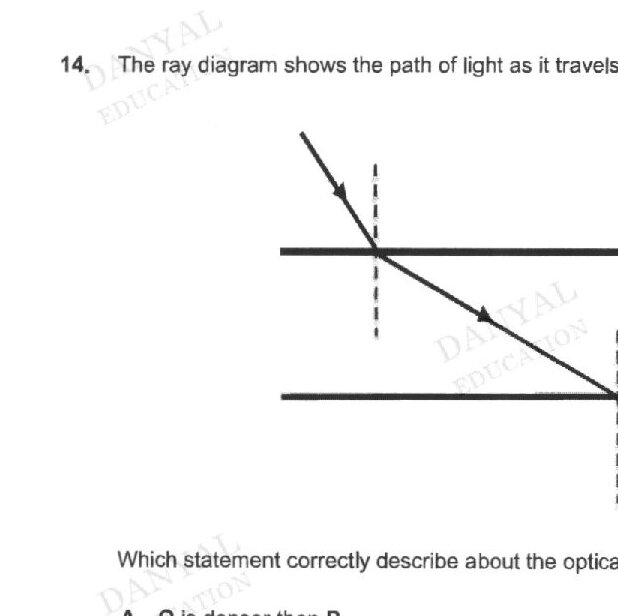
The ray diagram shows the path of light as it travels through three media P, Q and R. Which statement correctly describe about the optical densities of the three media?
A boy is standing 2.0 m in front of a plane mirror. His cat is sitting 3.0 m behind him. If the cat walks 1.5 m towards the mirror, how far is the boy away from the cat's image in the mirror?
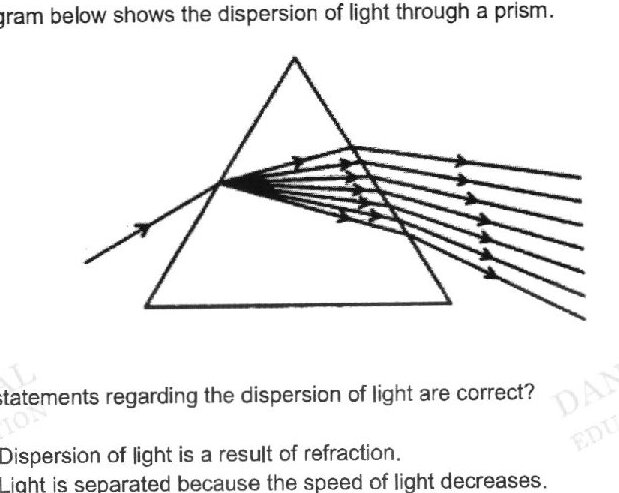
The diagram below shows the dispersion of light through a prism. Which statements regarding the dispersion of light are correct? I Dispersion of light is a result of refraction. II Light is separated because the speed of light decreases. III Only triangular prism can separate the light. IV When the light is separated, they cannot be recombined.
Aluminium foils are often used to wrap food to be cooked in barbecue fire. The aluminium has a shiny side and a dull side. How should the aluminium foil be wrapped around the food and why?
Which changes describe interaction of matter with light?
A card with the word 'PENCIL' is placed perpendicular to the plane mirror as shown in the diagram. How would the image in the mirror appear?
A person stands at point X as shown in the diagram below. Which of the pins (1, 2, 3, 4 and 5) can the person see in the mirror?
Which of the following are the characteristics of an image formed by a plane mirror and a convex mirror?
A plane mirror is inclined at 40° to the table top. An incident ray parallel to the table top strikes the mirror and a reflected ray is formed. What is the angle of reflection?
Locate and label 'P', the image of the object, in the plane mirror AB.
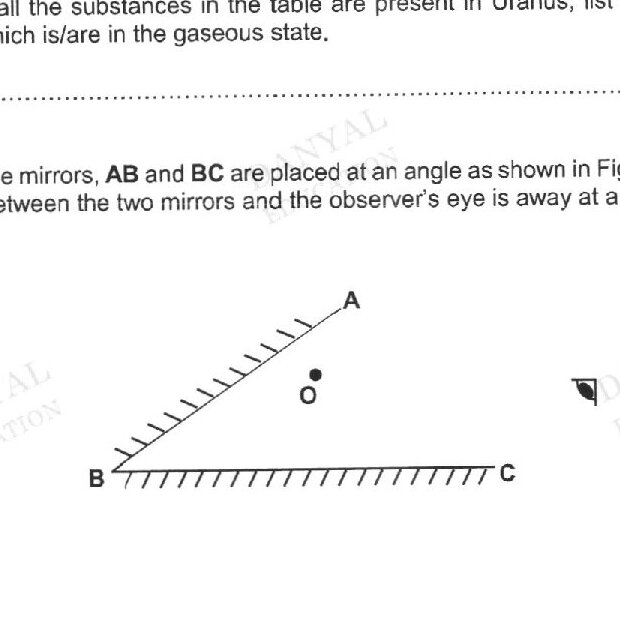
Locate and label 'Q', the image of the object, in the plane mirror BC.
Draw a complete single ray diagram to show how the eye is able to see Q and its corresponding incident ray on the diagram in the plane mirror BC.
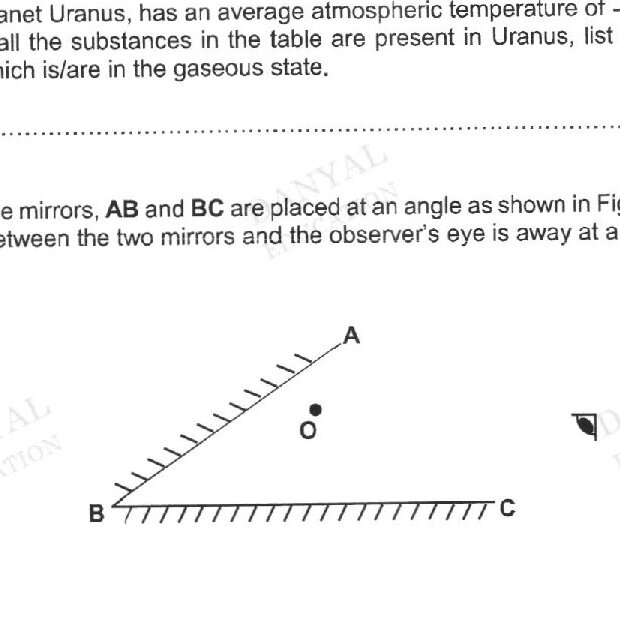
Locate and label 'P', the image of the object, in the plane mirror AB.
Locate and label 'Q', the image of the object, in the plane mirror BC.
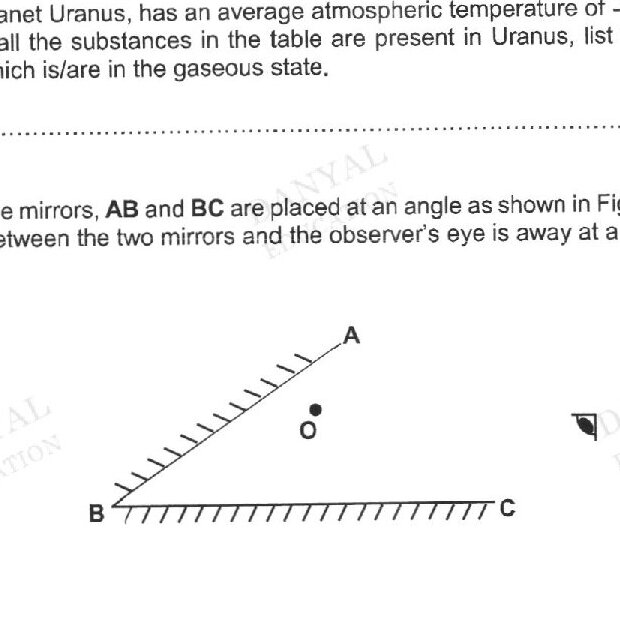
Draw a complete single ray diagram to show how the eye is able to see Q and its corresponding incident ray on the diagram in the plane mirror BC.
Past year papers cover the full exam — browse by subject below.
View All Papers ›