Particulate Nature of Matter
Particulate Nature of Matter - Study Notes
Key Concepts
The Particle Model of Matter
- All matter is made up of tiny, discrete (separate) particles that are too small to be seen with the naked eye
- These particles can be atoms, molecules, or ions
- The particles are in constant, random motion
- There are spaces between particles
- There are forces of attraction between particles
- The arrangement, movement, and energy of particles determine whether a substance is a solid, liquid, or gas
Particle Model of Solids
- Arrangement: Particles are very closely packed together in a regular, orderly pattern (usually in rows)
- Movement: Particles vibrate about fixed positions - they cannot move from place to place
- Energy: Particles have the least kinetic energy compared to liquids and gases
- Forces of attraction: Very strong forces hold particles in fixed positions
- Properties explained:
- Fixed shape - particles cannot move around
- Fixed volume - particles are already very close together and cannot be compressed
- High density - particles are tightly packed
- Cannot flow - particles are held in fixed positions
Particle Model of Liquids
- Arrangement: Particles are close together but not in a regular pattern (randomly arranged)
- Movement: Particles can slide past and move around each other throughout the liquid
- Energy: Particles have more kinetic energy than in solids
- Forces of attraction: Weaker forces than in solids, but still strong enough to keep particles close
- Properties explained:
- No fixed shape - takes the shape of its container as particles can move around
- Fixed volume - particles are still close together and cannot be compressed much
- Can flow - particles can slide past each other
- Moderate density - particles are fairly close together
Particle Model of Gases
- Arrangement: Particles are very far apart with large spaces between them, randomly arranged
- Movement: Particles move rapidly in all directions, in straight lines until they collide with each other or container walls
- Energy: Particles have the most kinetic energy compared to solids and liquids
- Forces of attraction: Very weak or negligible forces between particles
- Properties explained:
- No fixed shape or volume - fills entire container as particles move freely
- Can be compressed - large spaces between particles can be reduced
- Low density - particles are far apart
- Can flow easily - particles move freely
Brownian Motion
- Discovery: First observed by scientist Robert Brown in 1827 when he looked at pollen grains in water under a microscope
- The random, zig-zag movement of small particles suspended in a fluid (liquid or gas)
- Cause: The visible particles are constantly being bombarded by tiny, invisible particles (molecules) of the fluid moving randomly in all directions
- The bombardment is uneven and random, causing the visible particle to move in an irregular, unpredictable path
- Evidence for particle model: Brownian motion provides evidence that:
- Particles are constantly moving randomly
- Particles are too small to be seen
- Particles collide with each other and with larger particles
- Examples in daily life:
- Dust particles dancing in a beam of sunlight (hit by air molecules)
- Smoke particles moving randomly when viewed under a microscope
- Pollen grains jiggling in water
Diffusion
- The net (overall) movement of particles from a region of higher concentration to a region of lower concentration
- Movement continues until the particles are evenly distributed (equilibrium reached)
- Does NOT require any external energy source - happens spontaneously
- Occurs in both liquids and gases (but NOT in solids as particles cannot move from place to place)
- Rate of diffusion: Diffusion is faster when:
- Temperature is higher (particles have more kinetic energy and move faster)
- Particles are smaller/lighter (they move faster)
- The medium is a gas rather than a liquid (gas particles are further apart)
- Examples:
- Smell of perfume spreading across a room
- Food coloring spreading in water
- Air freshener scent dispersing
- Tea flavor diffusing from a tea bag into hot water
- Ammonia and hydrogen chloride gases meeting to form a white ring of ammonium chloride
- Explanation using particle model:
- Particles are in constant random motion
- Particles spread out from where they are concentrated
- Random collisions between particles help spread them out
- No stirring or external force needed - motion of particles causes mixing
Changes of State
All changes of state are physical changes that can be reversed.
Melting (Solid → Liquid)
- Heat energy is absorbed by the solid
- Particles gain kinetic energy and vibrate more vigorously
- Forces of attraction between particles weaken
- Particles break away from fixed positions and can move around
- Regular arrangement becomes irregular
- Occurs at a fixed temperature called the melting point
Freezing (Liquid → Solid)
- Heat energy is released by the liquid to surroundings
- Particles lose kinetic energy and move slower
- Forces of attraction between particles become stronger
- Particles settle into fixed positions in a regular pattern
- Can no longer slide past each other
- Occurs at the freezing point (same temperature as melting point)
Boiling/Evaporation (Liquid → Gas)
- Heat energy is absorbed by the liquid
- Particles gain kinetic energy and move faster
- Forces of attraction between particles break completely
- Particles move far apart and move freely in all directions
- Boiling: occurs throughout the liquid at a fixed temperature (boiling point) with rapid bubble formation
- Evaporation: occurs only at the surface of the liquid, at any temperature below boiling point, particles with enough energy escape from the surface
Condensation (Gas → Liquid)
- Heat energy is released by the gas to surroundings
- Particles lose kinetic energy and slow down
- Forces of attraction between particles form
- Particles come closer together
- Particles can now slide past each other but cannot move freely
Sublimation (Solid → Gas directly)
- Substance changes from solid directly to gas without passing through liquid state
- Particles gain enough energy to break free from solid structure
- Examples: dry ice (solid carbon dioxide), iodine crystals, naphthalene (mothballs)
Temperature and Particle Motion
- Temperature is a measure of the average kinetic energy of particles
- Higher temperature = particles move faster on average
- During a change of state, temperature remains constant even though heating continues
- Energy absorbed during change of state is used to overcome forces of attraction, not to increase kinetic energy
Important Definitions
Particle model: A scientific model that represents matter as being made up of tiny, discrete particles that are in constant motion.
Solid: A state of matter where particles are very closely packed in a regular arrangement, vibrating about fixed positions with strong forces of attraction between them.
Liquid: A state of matter where particles are close together in an irregular arrangement, able to move around each other with moderate forces of attraction between them.
Gas: A state of matter where particles are far apart in a random arrangement, moving rapidly in all directions with very weak or negligible forces of attraction between them.
Brownian motion: The random, zig-zag movement of small visible particles suspended in a fluid, caused by collisions with invisible, randomly moving particles of the fluid.
Diffusion: The net movement of particles from a region of higher concentration to a region of lower concentration until evenly distributed, as a result of their random motion.
Melting: The change of state from solid to liquid when heat energy is absorbed, causing particles to break away from fixed positions.
Freezing: The change of state from liquid to solid when heat energy is released, causing particles to settle into fixed positions.
Boiling: The change of state from liquid to gas that occurs throughout the liquid at a fixed temperature (boiling point) when heat energy is absorbed.
Evaporation: The change of state from liquid to gas that occurs at the surface of a liquid at any temperature below boiling point, when particles with sufficient energy escape.
Condensation: The change of state from gas to liquid when heat energy is released, causing particles to come closer together.
Sublimation: The change of state from solid directly to gas without passing through the liquid state.
Kinetic energy: The energy that particles have due to their motion.
Forces of attraction: Forces between particles that hold them together; strongest in solids, weaker in liquids, and very weak or negligible in gases.
Worked Examples
Example 1: Explaining Properties Using Particle Model
Question: Explain why liquids have a fixed volume but no fixed shape, using the particle model.
Step-by-step solution:
Step 1: Identify the relevant particle characteristics for liquids.
- In liquids, particles are close together (almost touching)
- Particles are arranged randomly (no regular pattern)
- Particles can slide past and move around each other
- There are forces of attraction between particles, but weaker than in solids
Step 2: Explain fixed volume using particle arrangement.
- Liquids have a fixed volume because the particles are already close together
- There are only very small spaces between particles
- When you try to compress a liquid, the particles cannot be pushed much closer together
- The volume therefore cannot be reduced significantly
Step 3: Explain no fixed shape using particle movement.
- Liquids have no fixed shape because particles can move around and slide past each other
- When a liquid is poured into a container, the particles flow and rearrange
- The particles move to fill the bottom and sides of the container
- The liquid takes the shape of whatever container it is in
Answer: Liquids have a fixed volume because their particles are close together with little space between them, so they cannot be compressed. Liquids have no fixed shape because their particles can move around and slide past each other, allowing the liquid to flow and take the shape of its container.
Example 2: Comparing Rates of Diffusion
Question: Two gas jars are set up. In Experiment A, ammonia gas diffuses through air at 25°C. In Experiment B, ammonia gas diffuses through air at 50°C. In which experiment will the ammonia diffuse faster? Explain your answer using the particle model.
Step-by-step solution:
Step 1: Identify what affects the rate of diffusion.
- Temperature affects how fast particles move
- Higher temperature = more kinetic energy
- More kinetic energy = faster particle movement
Step 2: Compare the two experiments.
- Experiment A: Temperature = 25°C (lower temperature)
- Experiment B: Temperature = 50°C (higher temperature)
- Same gas (ammonia) in both experiments
- Same medium (air) in both experiments
Step 3: Apply particle model reasoning.
- At 50°C (Experiment B), the ammonia particles have more kinetic energy
- They move faster and collide more frequently
- This causes them to spread out more quickly
- Therefore, diffusion happens at a faster rate
Step 4: State conclusion clearly. Experiment B will show faster diffusion.
Answer: Ammonia will diffuse faster in Experiment B (at 50°C). This is because at higher temperatures, particles have more kinetic energy and move faster. The faster-moving ammonia particles spread out more quickly from high concentration to low concentration, increasing the rate of diffusion.
Example 3: Changes of State
Question: A student heats a beaker of ice at -10°C. Describe what happens to the particles as the ice changes to water and then to steam. Include in your answer what happens to:
- The arrangement of particles
- The movement of particles
- The forces between particles
Step-by-step solution:
Step 1: Describe the ice (solid) being heated from -10°C to 0°C.
- Particles are in a regular, fixed arrangement
- Particles vibrate about fixed positions
- As temperature increases, particles vibrate more vigorously
- Strong forces of attraction keep particles in place
- At 0°C, ice reaches its melting point
Step 2: Describe melting (ice → water at 0°C).
- Heat energy is absorbed
- Energy is used to overcome forces of attraction, not to increase temperature
- Temperature stays at 0°C during melting
- Particles gain enough energy to break away from fixed positions
- Regular arrangement becomes irregular/random
- Particles can now slide past each other
- Forces of attraction become weaker but still present
Step 3: Describe the water (liquid) being heated from 0°C to 100°C.
- Particles continue moving around each other
- As temperature increases, particles move faster
- Forces of attraction remain moderate
- At 100°C, water reaches its boiling point
Step 4: Describe boiling (water → steam at 100°C).
- Heat energy is absorbed
- Energy is used to completely overcome forces of attraction
- Temperature stays at 100°C during boiling
- Particles break completely free from each other
- Particles move far apart
- Particles move rapidly in all directions
- Forces of attraction become negligible
Answer: Ice to water: The regularly arranged particles in ice vibrate more vigorously as heat is absorbed. At 0°C, particles break away from fixed positions, the arrangement becomes irregular, and particles can slide past each other. Forces of attraction weaken.
Water to steam: As water is heated to 100°C, particles move faster. During boiling at 100°C, particles gain enough energy to completely overcome forces of attraction. Particles separate far apart and move rapidly in all directions. Forces of attraction become negligible.
Common Mistakes to Avoid
-
Confusing particle size with spacing
- ❌ Mistake: Saying “particles get bigger when heated”
- ✅ Correct: Particles stay the same size; they move faster and get further apart when heated
-
Thinking particles stop moving
- ❌ Mistake: Stating “particles in solids don’t move at all”
- ✅ Correct: Particles in solids vibrate about fixed positions; all particles are always moving
-
Forgetting that temperature stays constant during state changes
- ❌ Mistake: Saying “temperature increases as ice melts”
- ✅ Correct: Temperature remains constant (at melting point) during melting; energy is used to overcome forces of attraction
-
Saying diffusion requires stirring or mixing
- ❌ Mistake: “Diffusion happens when you stir the liquid”
- ✅ Correct: Diffusion occurs naturally due to random particle motion without any external force
-
Confusing evaporation and boiling
- ❌ Mistake: Using these terms interchangeably
- ✅ Correct: Evaporation occurs at the surface at any temperature; boiling occurs throughout the liquid at a fixed temperature
-
Incorrect explanation of Brownian motion
- ❌ Mistake: “The particle moves randomly because it wants to”
- ✅ Correct: The particle moves randomly because it is being bombarded unevenly by many tiny, invisible, randomly moving particles
-
Drawing particles touching in gases
- ❌ Mistake: Drawing gas particles close together or touching
- ✅ Correct: Gas particles should be far apart with large spaces between them
-
Saying forces disappear in liquids
- ❌ Mistake: “There are no forces of attraction in liquids”
- ✅ Correct: Forces of attraction exist in liquids but are weaker than in solids; they become negligible in gases
-
Wrong direction for diffusion
- ❌ Mistake: “Particles diffuse from low to high concentration”
- ✅ Correct: Net movement is from high to low concentration
-
Forgetting that only kinetic energy changes with temperature
- ❌ Mistake: “Heating makes particles bigger” or “cooling makes particles smaller”
- ✅ Correct: Temperature changes the kinetic energy (speed) of particles, not their size
Exam Tips
Keywords to Include in Your Answers
When explaining particle arrangement:
- “closely packed” / “far apart”
- “regular arrangement” / “irregular/random arrangement”
- “fixed positions” / “can move around”
When explaining particle motion:
- “vibrate about fixed positions” (solids)
- “slide past each other” (liquids)
- “move rapidly in all directions” / “move freely” (gases)
- “random motion”
- “kinetic energy”
When explaining forces:
- “strong forces of attraction” (solids)
- “weaker forces of attraction” (liquids)
- “very weak/negligible forces of attraction” (gases)
When explaining changes of state:
- “heat energy is absorbed” (melting, boiling, evaporation, sublimation)
- “heat energy is released” (freezing, condensation)
- “temperature remains constant during change of state”
- “energy is used to overcome forces of attraction”
When explaining diffusion:
- “net movement from high concentration to low concentration”
- “random motion of particles”
- “until evenly distributed”
- “no external energy needed” / “occurs spontaneously”
When explaining Brownian motion:
- “random/zig-zag movement”
- “bombarded by invisible particles”
- “uneven collisions”
- “evidence for particle model”
Mark-Earning Phrases
For 2-3 mark questions:
- Link particle behavior to observable properties
- Example: “Gas can be compressed because there are large spaces between the particles that can be reduced”
For comparison questions:
- Always make comparisons explicit using “more than” / “less than” / “faster than” / “slower than”
- Example: “Particles in liquids move faster than in solids but slower than in gases”
For explanation questions:
- Start with the particle behavior, then explain the consequence
- Use “because” or “therefore” to link cause and effect
- Example: “Temperature remains constant during melting because the heat energy absorbed is used to overcome forces of attraction between particles, not to increase their kinetic energy”
Specific Exam Strategies
-
Always refer to particles - Don’t just describe what you observe; explain using the particle model
-
For diagrams - Make clear differences visible:
- Solids: particles touching, neat rows
- Liquids: particles close but random
- Gases: particles far apart with lots of space
-
When asked to compare - Create a clear structure with three aspects: arrangement, movement, and forces
-
For diffusion questions - Remember to mention:
- Direction (high to low concentration)
- Cause (random motion)
- Endpoint (even distribution)
-
For Brownian motion - Must mention:
- What moves (the visible particle)
- What causes it (bombardment by invisible particles)
- Nature of movement (random/zig-zag)
-
State change questions - Include:
- Whether energy is absorbed or released
- What happens to temperature
- What happens to forces of attraction
- What changes in particle arrangement and movement
Quick Summary
The Particle Model - Core Ideas:
- ✓ All matter is made of tiny particles in constant random motion with spaces between them
- ✓ Particles are held together by forces of attraction of varying strength
- ✓ Temperature measures the average kinetic energy of particles
Three States of Matter:
- ✓ Solids: closely packed regular arrangement, vibrate about fixed positions, strong forces
- ✓ Liquids: close together random arrangement, slide past each other, weaker forces
- ✓ Gases: far apart random arrangement, move rapidly in all directions, negligible forces
Brownian Motion:
- ✓ Random zig-zag movement of visible particles in a fluid
- ✓ Caused by uneven bombardment by invisible, randomly moving particles
- ✓ Provides evidence that particles exist, are in constant motion, and are too small to see
Diffusion:
- ✓ Net movement of particles from high to low concentration due to random motion
- ✓ Occurs in liquids and gases (not solids)
- ✓ Faster at higher temperatures, with smaller particles, and in gases rather than liquids
- ✓ Continues until particles are evenly distributed
Changes of State:
- ✓ Melting/Boiling/Evaporation: energy absorbed, forces weaken, particles move faster and further apart
- ✓ Freezing/Condensation: energy released, forces strengthen, particles move slower and closer together
- ✓ Temperature stays constant during state changes (energy breaks/forms forces, not increasing kinetic energy)
- ✓ Sublimation: solid to gas directly without liquid stage
Key Relationships:
- ✓ Higher temperature → particles move faster → faster diffusion
- ✓ Stronger forces of attraction → particles held closer and more firmly
- ✓ More kinetic energy → particles move more vigorously → can overcome stronger forces
Remember: Always explain observations using what happens to particles (their arrangement, movement, and forces between them). This is the foundation of the particle model!
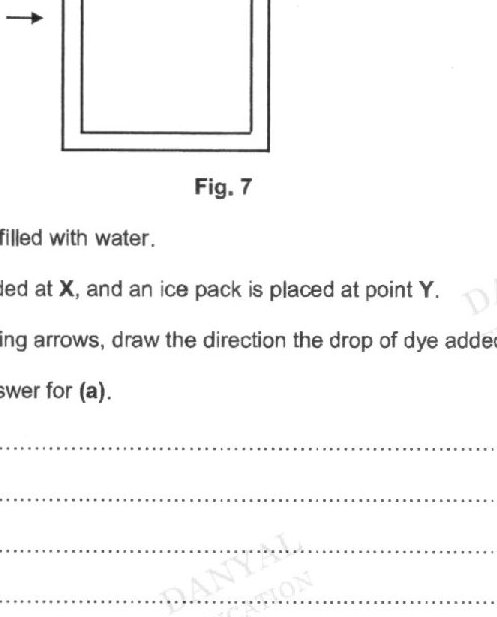
On Fig. 7, by using arrows, draw the direction the drop of dye added at X will move.
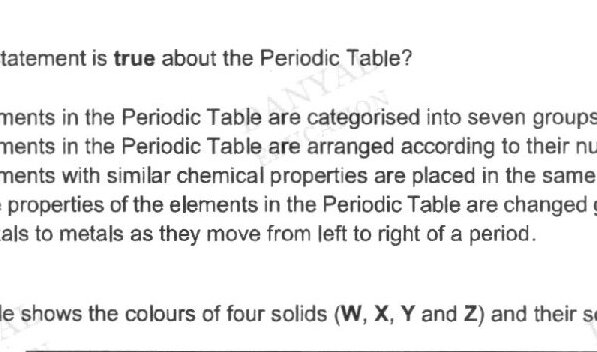
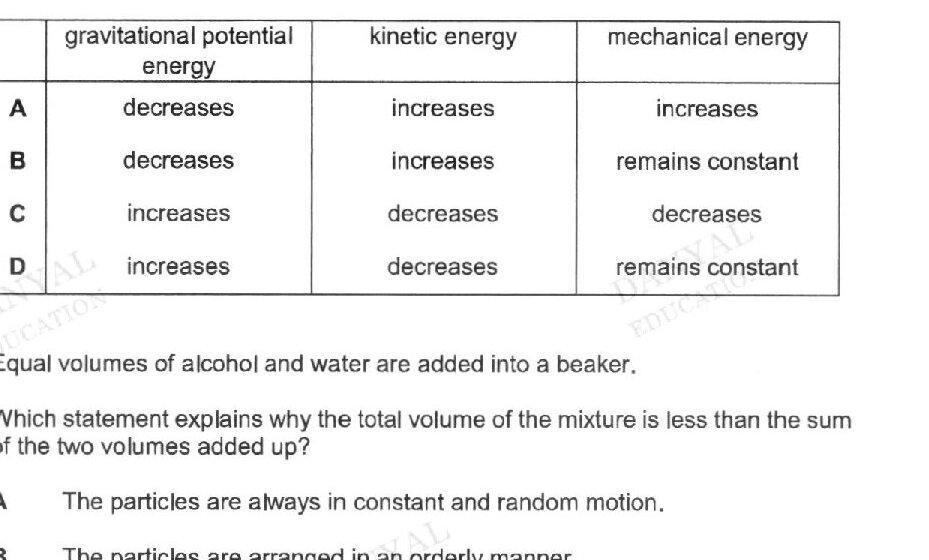
Equal volumes of alcohol and water are added into a beaker. Which statement explains why the total volume of the mixture is less than the sum of the two volumes added up?
Which of the following processes involves the weakening of forces of attraction between the particles?
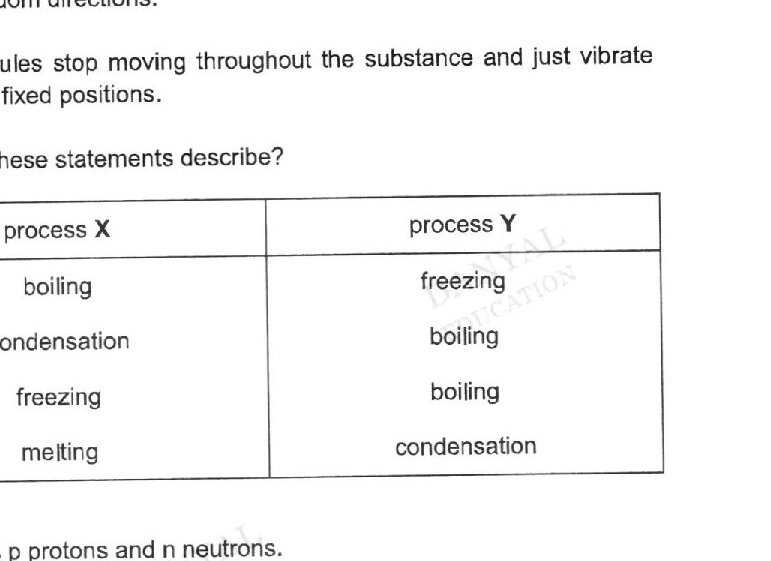
A substance can exist in three different states: solid, liquid or gas. Each statement below describes a process which involves a change of state. process X: Molecules start to move further away from each other at high speeds in random directions. process Y: Molecules stop moving throughout the substance and just vibrate about fixed positions. Which process do these statements describe?
Equal volumes of alcohol and water are added into a beaker. Which statement explains why the total volume of the mixture is less than the sum of the two volumes added up?
Which of the following processes involves the weakening of forces of attraction between the particles?
A substance can exist in three different states: solid, liquid or gas. Each statement below describes a process which involves a change of state. process X: Molecules start to move further away from each other at high speeds in random directions. process Y: Molecules stop moving throughout the substance and just vibrate about fixed positions. Which process do these statements describe?
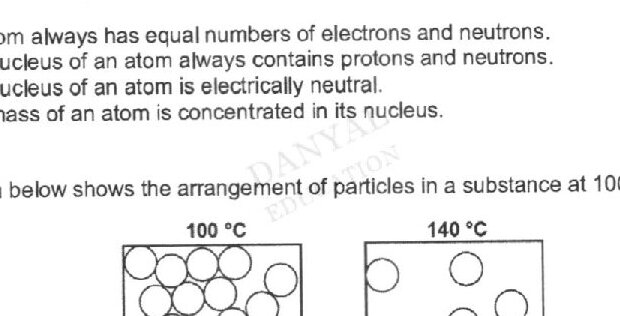
The diagram below shows the arrangement of particles in a substance at 100 °C and 140 °C. What could be the melting point and boiling point of the substance shown?
A container of liquid nitrogen has a temperature of –196 °C. A fully inflated balloon is placed in liquid nitrogen for 5 s. The balloon appears deflated when taken out from liquid nitrogen, but begins to expand after a few seconds. After about 2 min, the balloon becomes fully inflated. Which statement provides an explanation for the observation?
State the meaning of the term melting point.
Explain the movement of water in 7b(i).
After heating for some time, the water remains at a constant temperature of 100 °C. John noticed that the volume of water in the pan decreases. He concludes that water is lost from the pan by evaporation only. State and explain whether his conclusion is correct.
Planet Uranus has an average atmospheric temperature of -195 °C. If all the substances in the table are present in Uranus, list the substance(s) which is/are in the gaseous state.
After heating for some time, the water remains at a constant temperature of 100 °C. John noticed that the volume of water in the pan decreases. He concludes that water is lost from the pan by evaporation only. State and explain whether his conclusion is correct.
Past year papers cover the full exam — browse by subject below.
View All Papers ›