Algebraic Expressions and Formulae
Algebraic Expressions and Formulae
Key Concepts
-
Algebra uses letters and numbers to represent values and relationships.
- Letters such as
, , and are called variables. - A variable can stand for an unknown value or a value that can change.
- Letters such as
-
An algebraic expression is a mathematical phrase made up of numbers, variables, and operations such as
, , , and . - Examples:
, ,
- Examples:
-
A term is one part of an expression, separated by
or . - In
, the terms are , , and .
- In
-
A coefficient is the numerical part of a term.
- In
, the coefficient is . - In
, the coefficient is .
- In
-
A constant is a fixed number without a variable.
- In
, is the constant.
- In
-
Like terms are terms with the same variable part.
and are like terms. and are like terms. and are not like terms.
1. Expansion of Products of Algebraic Expressions
-
Expansion means removing brackets by multiplying each term inside the bracket.
-
Use the distributive law:
Expanding a single bracket
-
Multiply the term outside the bracket by every term inside.
-
Example:
Expanding two brackets
-
Multiply every term in the first bracket by every term in the second bracket.
-
Example:
-
After expanding, always collect like terms.
2. Standard Algebraic Identities
An identity is an equation that is true for all values of the variables.
You must know these standard identities:
Square of a sum
Square of a difference
Product of a sum and a difference
Important notes
does not mean - The middle term comes from multiplying the two terms twice:
3. Factorisation of Algebraic Expressions
- Factorisation is the reverse of expansion.
- It means writing an expression as a product of factors.
Common factor
-
Find the highest common factor of all the terms and take it out.
-
Example:
Factorising by grouping
-
Sometimes terms can be grouped to form common factors.
-
Example:
Using identities
- Recognise patterns:
4. Factorising Quadratic Expressions
-
A quadratic expression has highest power
. -
General form:
where
When
- Factorise
by finding two numbers: - whose product is
- whose sum is
- whose product is
Example:
because
When
- Find two numbers:
- whose product is
- whose sum is
- whose product is
- Then split the middle term and factorise by grouping.
Example:
- Need two numbers that multiply to
and add to : and
So,
5. Changing the Subject of a Formula
-
A formula is an equation that shows a relationship between quantities.
-
Example:
-
-
The subject of a formula is the variable that is written alone on one side.
- In
, the subject is
- In
-
Changing the subject means rearranging the formula so that a different variable is the subject.
Steps
- Identify the variable to make the subject.
- Remove addition or subtraction first.
- Remove multiplication or division next.
- Keep the equation balanced by doing the same operation to both sides.
Example:
Make
-
Multiply both sides by
: -
Divide both sides by
:
6. Operations with Algebraic Fractions
An algebraic fraction is a fraction that contains variables.
Example:
Simplifying algebraic fractions
- Factorise the numerator and denominator first.
- Cancel only common factors, not terms.
Example:
Multiplication
- Multiply numerators together and denominators together.
- Factorise first if possible.
Example:
Division
- Change division into multiplication by the reciprocal.
- Reciprocal means flipping the fraction.
Example:
Addition and subtraction
- Find a common denominator first.
- Then combine the numerators.
Example:
Example with different denominators:
Common denominator is
So,
Restriction
- The denominator of a fraction cannot be zero.
- If
is in the denominator, then
Important Definitions
- Variable: a letter that represents an unknown value or a value that can change.
- Algebraic expression: a combination of numbers, variables, and operations.
- Term: a part of an algebraic expression separated by
or . - Coefficient: the numerical factor of a term.
- Constant: a number without a variable.
- Like terms: terms with the same variable part.
- Expansion: removing brackets by multiplication.
- Distributive law: the rule
. - Identity: an equation that is true for all values of the variables.
- Factorisation: writing an expression as a product of factors.
- Common factor: a factor shared by two or more terms.
- Quadratic expression: an expression with highest power
, usually written as . - Formula: an equation showing the relationship between quantities.
- Subject of a formula: the variable that is alone on one side of the equation.
- Algebraic fraction: a fraction involving variables.
- Reciprocal: the multiplicative inverse of a number or fraction; for
, the reciprocal is .
Worked Examples
Example 1: Expand and simplify
Step 1: Multiply each term in the first bracket by each term in the second bracket
Step 2: Simplify each product
Step 3: Collect like terms
Answer:
Example 2: Change the subject of
We want
Step 1: Remove
Subtract
Step 2: Remove
Divide both sides by
Answer:
Example 3: Factorise
Step 1: Identify
Step 2: Find
Step 3: Find two numbers with product
These are
Step 4: Split the middle term
Step 5: Factorise by grouping
Step 6: Take out common bracket
Answer:
Common Mistakes to Avoid
-
Expanding
as - Correct form is
- Correct form is
-
Forgetting to multiply every term in a bracket.
- In
, you must get 4 products.
- In
-
Sign errors when multiplying negatives.
- Example:
,
- Example:
-
Collecting unlike terms.
cannot be simplified further.
-
Cancelling terms instead of factors in algebraic fractions.
cannot be simplified by cancelling the
-
Forgetting to factorise before simplifying fractions.
- Example:
must first become
- Example:
-
Rearranging a formula incorrectly by moving terms without using inverse operations.
- Always do the same operation to both sides.
-
Leaving the final answer unsimplified.
- Always collect like terms or cancel common factors where possible.
-
Forgetting restrictions for algebraic fractions.
- If the denominator is
, then
- If the denominator is
Exam Tips
- When expanding brackets, write out all products clearly before simplifying.
- Use identities only when the expression matches the pattern exactly.
- In factorisation, always check your answer by expanding the factors again.
- For
, look for two numbers with: - product = constant term
- sum = coefficient of
- For
, first calculate . - When changing the subject of a formula:
- state or show each operation on both sides
- keep the target variable positive if possible
- In algebraic fractions:
- factorise first
- state common denominator when adding or subtracting
- cancel only common factors
- Watch signs carefully, especially when the constant term is negative.
- If your factorised answer has brackets, make sure each bracket is as simple as possible.
Quick Summary
- An algebraic expression contains variables, numbers, and operations.
- Expansion means removing brackets by multiplication.
- Use the distributive law:
- Factorisation is the reverse of expansion.
- To factorise, first look for a common factor.
- For
, find two numbers whose product is and sum is . - For
, find two numbers whose product is and sum is , then group. - To change the subject of a formula, use inverse operations on both sides.
- For algebraic fractions, factorise first and cancel only common factors, not terms.
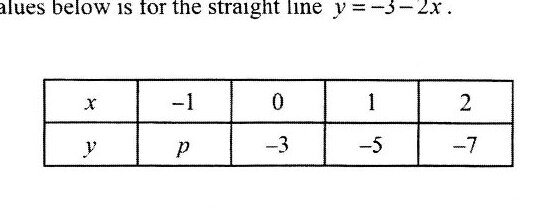
The table of values below is for the straight line y = -3 - 2x.
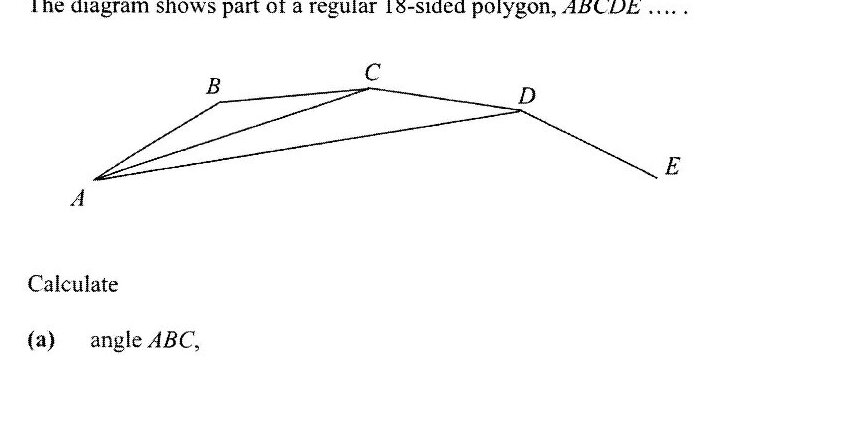
The diagram shows part of a regular 18-sided polygon, ABCDE .... Calculate (a) angle ABC,
Simplify: (4x²)/(5y) ÷ (15xy²)/(2z)
Simplify: (4a² - b²)/(6a - 3b)
Simplify (2p - 3)/(q - 4)² ÷ (8p² - 12p)/(q - 4)³, giving your answer as a single fraction.
Find the value of p.
Find an expression for m in terms of r.
Expand and simplify (4y − 3)(2y + 5).
Factorise completely: 4mn + 2n
Factorise completely: x² + 6x + 9
Factorise completely: 9x² - 4
Find an expression for m in terms of r.
Expand and simplify (2x+5)² - 3(4x-1).
Hence prove that (2x+5)² - 3(4x-1) is an even number for all integer values of x.
Factorise 4x³ - 4x - 3.
Hence simplify (4x - 2)/(4x³ + 4x - 3).
Expand and simplify the following: 3a(9a+1) + 2(10 - 2a²)
Expand and simplify the following: (6c + 7)²
Factorise the following completely: 3b² - 8b + 4
16d³ - 8d² - 12d
A rectangle has a length of x cm and a breadth which is 1/3 of the length. Given that the perimeter of the rectangle is 48 cm, write down an expression, in terms of x, to represent the perimeter of the rectangle.

Given that (a + b)² = 64 and ab = 15, find the value of a² + b².
Simplify the following. (3xz + 3yz)/(x² + xy)
Simplify the following. (5x - 15y)/(6x - 8y) + (4x - 12y)/(9x - 12y)
A bookshop sells pens at $x each and notebooks at $y for a pack of 6. Ali bought 9 pens and 3 packs of notebooks. He paid $36. Show that 3x + y = 12
Sarah bought 16 pens and 8 packs of notebooks. She paid $76. Show that 4x + 2y = 19
Past year papers cover the full exam — browse by subject below.
View All Papers ›