Equations and Inequalities
Equations and Inequalities
Key Concepts
1. Linear inequalities
- An inequality compares two expressions that may not be equal.
- Common inequality signs:
- > means greater than
- < means less than
- ≥ means greater than or equal to
- ≤ means less than or equal to
- A linear inequality contains a variable with power 1 only, such as:
How to solve a linear inequality
- Solve it in a similar way to a linear equation:
- add the same number to both sides
- subtract the same number from both sides
- multiply both sides by the same positive number
- divide both sides by the same positive number
- Important rule:
- when you multiply or divide both sides by a negative number, you must reverse the inequality sign
- Example:
- If
- divide both sides by
- then
- If
Why the sign reverses
- Multiplying or dividing by a negative changes the order of numbers on the number line.
- Example:
- multiply both sides by
, so the sign changes
2. Representing solutions on a number line
- A number line is a straight line used to show values in order.
- Solutions to inequalities can be shown clearly on a number line.
Symbols used on number lines
- Open circle:
- means the endpoint is not included
- used for < or >
- Closed/filled circle:
- means the endpoint is included
- used for ≤ or ≥
- Arrow:
- shows the solution continues forever in that direction
Examples
- open circle at 2
- shade or draw arrow to the right
- closed circle at -1
- shade or draw arrow to the left
3. Simultaneous linear equations
- Simultaneous equations are two equations with the same variables.
- The values of the variables must satisfy both equations at the same time.
- Example:
What is a solution?
- A solution is a pair of values, such as
, , that makes both equations true.
4. Solving simultaneous equations by substitution
- Substitution means replacing one variable with an equivalent expression.
- Best used when:
- one equation is already written as a variable in terms of the other
- for example,
Steps for substitution
- Make one variable the subject in one equation.
- Substitute that expression into the other equation.
- Solve the resulting single-variable equation.
- Substitute back to find the other variable.
- Check both values in the original equations.
Example idea
- If
and - replace
in the second equation with
5. Solving simultaneous equations by elimination
- Elimination means removing one variable by adding or subtracting the equations.
- Best used when:
- the coefficients of one variable are already the same
- or can be made the same easily
Steps for elimination
- Write the equations in aligned form:
- Multiply one or both equations if necessary so that one variable has equal coefficients.
- Add or subtract the equations to eliminate one variable.
- Solve for the remaining variable.
- Substitute back to find the other variable.
- Check in both original equations.
Example idea
- Add the equations:
6. Solving simultaneous equations graphically
- Each linear equation can be drawn as a straight line graph.
- The solution to the simultaneous equations is the point where the two lines intersect.
Important ideas
- Intersect means cross.
- The coordinates of the intersection point give the values of
and . - If the lines cross at
, then the solution is:
Possible graph situations
- One intersection point:
- one solution
- Parallel lines:
- no solution
- Same line:
- infinitely many solutions
Accuracy
- Graphical solutions are often approximate unless the intersection is exactly on grid points.
- Use a ruler and label axes clearly.
7. Quadratic equations
-
A quadratic equation is an equation in which the highest power of the variable is 2.
-
General form:
where:
, , are constants
Examples
Roots or solutions
- The values of
that make the equation true are called: - roots
- solutions
- sometimes zeros
8. Solving quadratic equations by factorisation
-
Factorisation means writing an expression as a product of simpler expressions.
-
Example:
Zero-product property
- If
, then: , or
- This is how factorised quadratics are solved.
Steps for factorisation
- Write the equation in the form
. - Factorise the quadratic expression.
- Set each factor equal to zero.
- Solve each simple equation.
Example
So:
9. Solving quadratic equations by quadratic formula
Not in Sec 2 2026: The quadratic formula and the discriminant are not in the 2026 Sec 2 E-Mathematics syllabus. These are Sec 3/4 topics. Solving quadratic equations by factorisation (Section 8) is the only quadratic-solving method required at Sec 2. The notes below are kept for reference and future preparation only.
- Some quadratic equations are difficult or impossible to factorise easily.
- In such cases, use the quadratic formula:
Meaning of symbols
-
, , are the coefficients in: -
The symbol ± means there are usually two possible answers:
- one using
- one using
- one using
Steps for using the quadratic formula
- Write the equation in the form
. - Identify
, , and . - Substitute carefully into the formula.
- Simplify step by step.
- Give both answers if there are two.
Discriminant
-
The expression under the square root is:
-
It is called the discriminant.
-
It tells you the number of real solutions:
- if
: two real solutions - if
: one repeated real solution - if
: no real solution
- if
Important Definitions
-
Inequality: a mathematical statement showing that two values or expressions are not necessarily equal.
-
Linear inequality: an inequality involving a variable of power 1 only.
-
Solution set: all values that satisfy an equation or inequality.
-
Number line: a straight line used to represent numbers in order.
-
Open circle: a symbol on a number line showing that a value is not included in the solution.
-
Closed circle: a symbol on a number line showing that a value is included in the solution.
-
Simultaneous equations: two or more equations involving the same variables, solved together.
-
Substitution: a method of solving equations by replacing one variable with an equivalent expression.
-
Elimination: a method of solving simultaneous equations by removing one variable.
-
Graphical solution: the solution obtained from the point where graphs intersect.
-
Quadratic equation: an equation with highest power of the variable equal to 2.
-
Factorisation: writing an expression as a product of factors.
-
Factor: a quantity that is multiplied by another quantity.
-
Root: a value of the variable that makes an equation equal to zero.
-
Quadratic formula: a formula used to solve quadratic equations:
-
Discriminant: the part
in the quadratic formula that shows the nature of the roots. -
Coefficient: the number multiplying a variable.
-
Constant: a fixed value without a variable.
Worked Examples
Example 1: Solving a linear inequality and representing it on a number line
Solve:
Step 1: Add 5 to both sides
Step 2: Divide both sides by 3
Final answer
Number line representation
- draw a closed circle at 4
- shade to the left
- add an arrow to the left
Example 2: Solving simultaneous equations by substitution
Solve:
Step 1: Substitute
Step 2: Simplify
Step 3: Solve for
Step 4: Substitute back to find
Final answer
Check
- First equation:
✔ - Second equation:
✔
Example 3: Solving simultaneous equations by elimination
Solve:
Step 1: Add the equations
Step 2: Solve for
Step 3: Substitute into one original equation
Using
Final answer
Example 4: Solving simultaneous equations graphically
Solve:
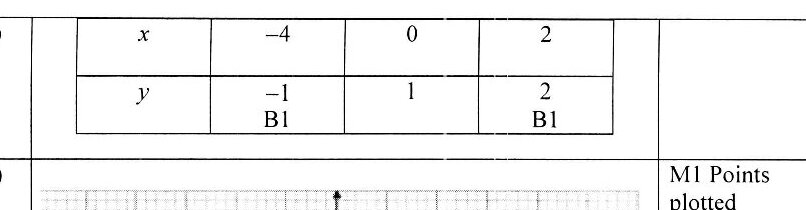
Step 1: Plot the first line
For
- if
, → - if
, →
Step 2: Plot the second line
For
- if
, → - if
, →
Step 3: Draw the lines
- use a ruler
- label each line
Step 4: Read the intersection point
The lines intersect at:
Final answer
Example 5: Solving a quadratic equation by factorisation
Solve:
Step 1: Factorise
Find two numbers that multiply to
and
So:
Step 2: Use the zero-product property
So:
Step 3: Solve
Final answer
Example 6: Solving a quadratic equation by quadratic formula (Extension — not required for NA)
Solve:
Step 1: Identify
Step 2: Write the quadratic formula
Step 3: Substitute values
Step 4: Simplify inside the square root
Step 5: Find both answers
Using
Using
Final answer
Common Mistakes to Avoid
-
Forgetting to reverse the inequality sign when dividing or multiplying by a negative number.
-
Using a closed circle instead of an open circle on a number line, or vice versa.
-
Shading the wrong direction on the number line.
-
Making sign errors when rearranging equations.
-
In substitution, forgetting to put substituted expressions in brackets.
- Example: writing
incorrectly from
- Example: writing
-
In elimination, not multiplying the whole equation correctly before adding or subtracting.
-
Mixing up which variable was eliminated.
-
Reading the graph inaccurately because of poor scale or untidy lines.
-
Not checking whether the intersection point is exact or approximate in graphical solutions.
-
Forgetting to write the quadratic equation in the form:
before factorising or using the formula.
-
Choosing factors that multiply correctly but do not add to the middle coefficient.
-
Forgetting the or when giving two roots of a quadratic.
-
Copying the quadratic formula wrongly.
-
Forgetting that if
is negative, then becomes positive. -
Not using brackets for negative values in the quadratic formula:
- write
, not
- write
Exam Tips
- For inequalities:
- write each algebra step clearly on a new line
- if you reverse the sign, do it neatly and clearly
- For number lines:
- show the correct endpoint symbol
- use arrows to show the solution extends infinitely
- For simultaneous equations:
- always label your final answer clearly as:
,
- substitute back to check if time allows
- always label your final answer clearly as:
- For substitution:
- choose the equation that already has one variable isolated if possible
- For elimination:
- line up equations carefully before adding or subtracting
- if multiplying an equation, show the new equation clearly
- For graphical solutions:
- use a sharp pencil and ruler
- label both lines
- state the coordinates of the intersection point
- For quadratics by factorisation:
- first make sure one side is 0
- write the factorised form completely before solving
- For quadratic formula:
- identify
, , first - substitute with brackets, especially for negative values
- identify
- Mark-earning phrases:
- “reverse the inequality sign”
- “substitute into”
- “eliminate
” or “eliminate ” - “point of intersection”
- “factorise”
- “using the quadratic formula”
- Always simplify final answers fully where possible.
Quick Summary
- An inequality compares values using
, , , or . - Solve linear inequalities like equations, but reverse the sign when multiplying or dividing by a negative number.
- On a number line:
- open circle for
or - closed circle for
or
- open circle for
- Simultaneous equations are solved to find values that satisfy both equations.
- In substitution, replace one variable using an equivalent expression.
- In elimination, add or subtract equations to remove one variable.
- In graphical solving, the solution is the intersection point of the two lines.
- A quadratic equation has highest power 2 and can be written as
. - Solve quadratics by factorisation using the zero-product property. This is the required method at Sec 2.
- (Not in Sec 2 2026) The quadratic formula
and the discriminant are Sec 3/4 topics. - Always check signs carefully and present final answers clearly.
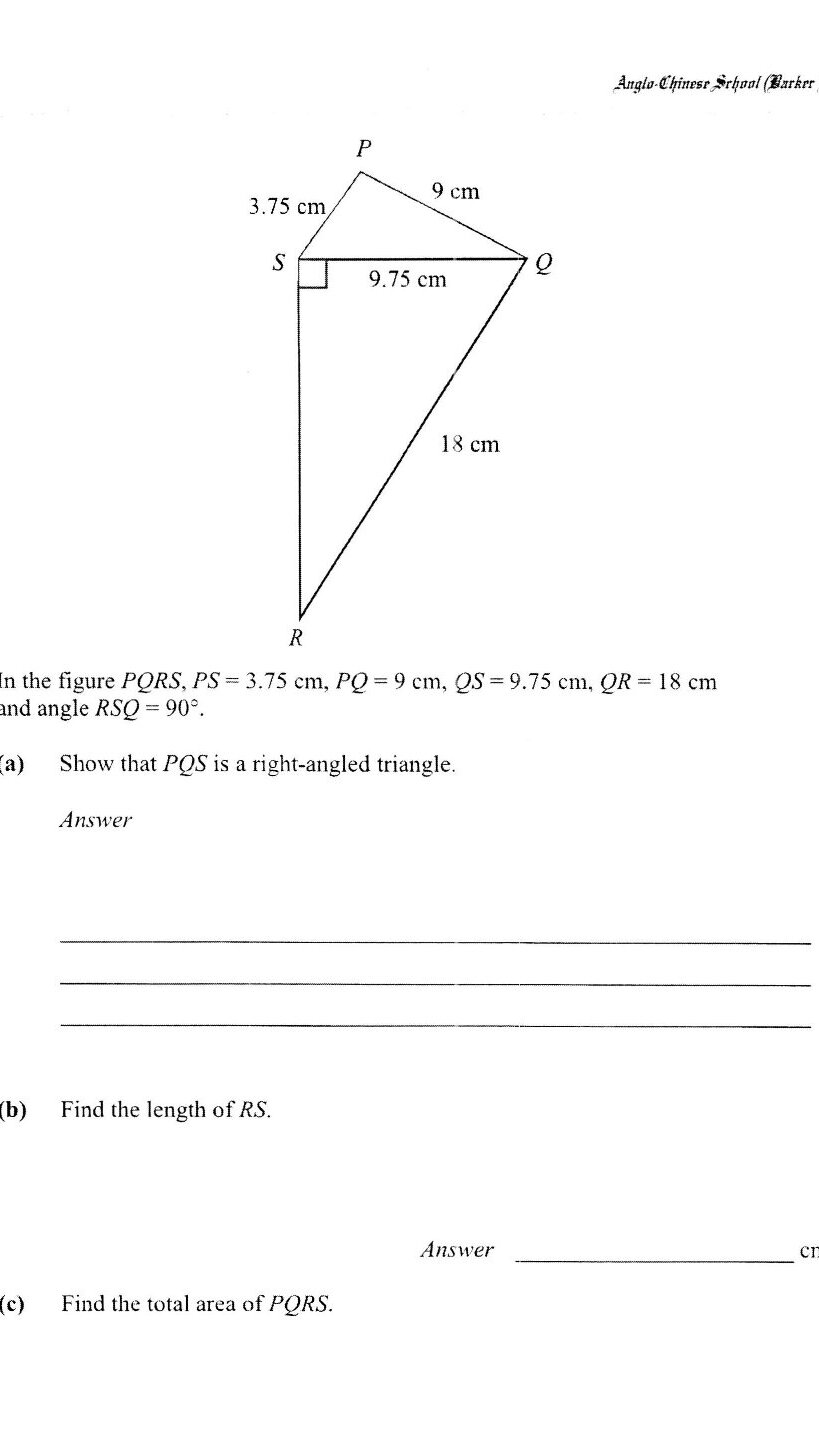
A lake of 2 km is represented on a map with a length of 10 cm. Find the scale of the map in the form 1 : n.

Find the length of an expressway on the map that represents an actual distance of 1480 m.
Find the actual area of a park, in m², that is represented by 0.35 cm² on the map.
Solve 5/(2y + 3) = 6/(1 - y)
Write the number 85.898 correct to 2 decimal places.
Solve the simultaneous equations. a + b = 17 a + 4b = 41
Solve 7a - 9 = 5
Solve x/4 - 2 = 5
Solve (y - 7)/(2y) = 3/4
Solve the inequality 2x ≥ -6.

Represent the solution on the number line given below.
Hence find the smallest integer satisfying 2x ≥ -6.
Solve these simultaneous equations. -5x + 4y = 13 3x + y = -1
Solve the simultaneous equations. 8p + q = 32 5p - 2q = -1
Hence, find the length and the breadth of the rectangle.

Given that 4x ≥ 24, solve this inequality, representing your answer on the number line below.
Hence, find the smallest perfect cube value of x which satisfies the inequality 4x > 24.
Hence solve the equation (x+4)/2 = -3/2 x + 6.
Solve the following equation. (3/5)x + 5 = 20
Solve the inequality 4x ≥ −10 and represent the solution on the number line.

Hence, write down the smallest integer x that satisfies 4x ≥ −10.
Solve the following equation: (2x + 5)/3 = (x − 1)/2
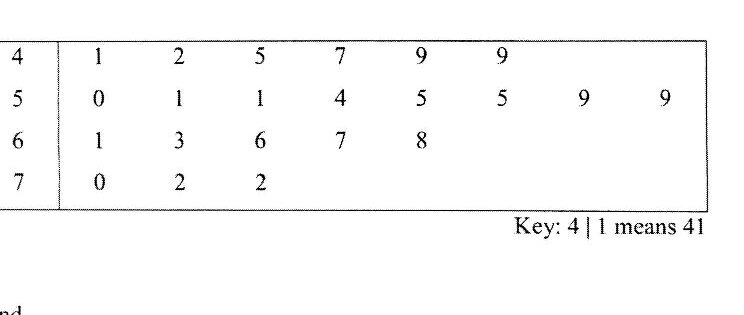
Find the number of students with weight more than 55kg.
Solve these simultaneous equations. 3x + y = 12 4x + 2y = 19
Find x and y in the given simultaneous equations below. 3x - y = 6 x + y = 1
Solve the inequality −3x+1≤−8.
Illustrate the solution on the number line given below.

Hence, write down the smallest odd number that satisfies −3x+1≤−8.
Solve the following equation: 1/2(y+1)-6=0
Solve the following equation: (x+1)/2 = (5x-2)/4
Past year papers cover the full exam — browse by subject below.
View All Papers ›