Transport Systems in Living Things
Transport Systems in Living Things - Study Notes
Key Concepts
Human Circulatory System
The Heart:
- A muscular organ about the size of your fist that pumps blood throughout the body
- Located in the chest cavity, slightly to the left of the centre
- Has four chambers: two atria (upper chambers) and two ventricles (lower chambers)
- Right atrium receives deoxygenated blood from the body via the vena cava
- Right ventricle pumps deoxygenated blood to the lungs via the pulmonary artery
- Left atrium receives oxygenated blood from the lungs via the pulmonary vein
- Left ventricle pumps oxygenated blood to the body via the aorta (has the thickest muscular wall because it needs to pump blood furthest)
- Valves prevent backflow of blood: tricuspid valve (between right atrium and ventricle), bicuspid/mitral valve (between left atrium and ventricle), semilunar valves (in arteries leaving the heart)
- Heart rate at rest: approximately 60-100 beats per minute in adults; faster in teenagers and children
Blood Vessels:
-
Arteries: carry blood AWAY from the heart
- Thick, muscular, elastic walls to withstand high pressure
- No valves needed (except where they leave the heart)
- Narrow lumen (central space)
- Carry oxygenated blood (except pulmonary artery)
- Pulse can be felt where arteries are close to the skin surface
-
Veins: carry blood TOWARDS the heart
- Thinner walls than arteries
- Contain valves to prevent backflow
- Wider lumen than arteries
- Carry deoxygenated blood (except pulmonary vein)
- Blood flows under lower pressure
-
Capillaries: microscopic vessels connecting arteries and veins
- Walls are one cell thick for efficient exchange of materials
- Form extensive networks in tissues and organs
- Very narrow lumen (red blood cells pass through in single file)
- Site where oxygen, nutrients, and waste materials are exchanged with body cells
Types of Circulation:
- Double circulation system: blood passes through the heart twice in one complete circuit
- Pulmonary circulation: right side of heart → lungs → left side of heart (picks up oxygen, releases carbon dioxide)
- Systemic circulation: left side of heart → body tissues → right side of heart (delivers oxygen and nutrients, collects waste)
Blood Components and Functions
Blood Components:
-
Red Blood Cells (Erythrocytes)
- Biconcave disc shape (doughnut shape without a hole) increases surface area for faster oxygen diffusion (loading and unloading)
- No nucleus (more space for haemoglobin)
- Contains haemoglobin: red protein that binds with oxygen
- Produced in bone marrow
- Lifespan: approximately 120 days
- Function: transport oxygen from lungs to body cells, and some carbon dioxide from cells back to lungs
-
White Blood Cells (Leukocytes)
- Larger than red blood cells
- Have a nucleus
- Can change shape and move independently
- Fewer in number than red blood cells
- Two main types:
- Phagocytes: engulf and digest pathogens (bacteria and viruses)
- Lymphocytes: produce antibodies to destroy specific pathogens
- Function: defend body against disease and infection
-
Platelets (Thrombocytes)
- Small cell fragments without a nucleus
- Produced in bone marrow
- Function: help blood clot at wounds to prevent excessive bleeding and pathogen entry
- Clotting process: platelets clump together and release chemicals that convert soluble fibrinogen into insoluble fibrin threads, forming a mesh that traps blood cells
-
Plasma
- Pale yellow liquid (about 55% of blood volume)
- Mainly water (90% of plasma)
- Contains dissolved substances:
- Nutrients (glucose, amino acids, vitamins, minerals)
- Waste products (urea, carbon dioxide)
- Hormones
- Antibodies and antitoxins
- Fibrinogen (for blood clotting)
- Function: transports all blood cells and dissolved substances around the body
Lymphatic System
Structure and Function:
- Network of vessels throughout the body that work alongside the circulatory system
- Lymph: clear/pale yellow fluid similar to plasma but contains less protein
- Lymph capillaries: tiny blind-ended vessels in tissues that collect excess tissue fluid
- Lymph vessels: contain valves to ensure one-way flow of lymph toward the heart
- Lymph eventually drains into veins near the heart
- Lymph nodes: small bean-shaped organs along lymph vessels
- Filter lymph and trap pathogens
- Contain many white blood cells (especially lymphocytes)
- Swell during infection as white blood cells multiply to fight pathogens
Functions of the Lymphatic System:
- Returns excess tissue fluid to the bloodstream
- Transports fats absorbed from the small intestine
- Produces lymphocytes (type of white blood cell)
- Filters out bacteria and foreign particles from lymph
Relationship between Blood, Tissue Fluid, and Lymph:
- Blood pressure forces plasma out of capillaries into spaces between cells (becomes tissue fluid)
- Tissue fluid bathes cells, delivering nutrients and oxygen while removing waste
- Most tissue fluid returns to capillaries, but some enters lymph capillaries (becomes lymph)
- Lymph eventually returns to the bloodstream
Transport in Plants
Xylem Vessels:
-
Structure:
- Dead cells arranged end-to-end forming continuous hollow tubes
- No end walls between cells (allows uninterrupted flow)
- Thick walls strengthened with lignin (waterproof substance)
- Lignin provides structural support to the plant
- Found closer to the centre of stems and roots
-
Function: transport water and dissolved mineral salts from roots to all parts of the plant
-
Process of water transport:
- Water enters root hair cells by osmosis (from soil where water concentration is higher)
- Water moves through root cells to xylem vessels
- Water travels up xylem due to:
- Transpiration pull: water evaporates from leaves, pulling more water up from roots
- Root pressure: continuous uptake of water by roots pushes water upward
- Cohesion: water molecules stick together forming continuous column
- Water reaches leaves and other parts of the plant
Phloem Vessels:
-
Structure:
- Made of living cells arranged end-to-end
- End walls present but perforated with pores (sieve plates)
- Companion cells beside each sieve tube cell provide energy
- Found closer to the outside of stems and roots
-
Function: transport manufactured food (mainly sucrose and amino acids) from leaves to other parts of the plant
-
Process of food transport (Translocation):
- Sugars produced during photosynthesis in leaves
- Sugars loaded into phloem vessels
- Transported to growing regions (roots, fruits, new leaves) or storage organs (tubers, bulbs)
- Can move both upward and downward depending on plant’s needs
- Requires energy from companion cells
Key Differences between Xylem and Phloem:
| Feature | Xylem | Phloem |
|---|---|---|
| Type of cells | Dead cells | Living cells |
| End walls | Absent | Present (with pores) |
| What is transported | Water and mineral salts | Manufactured food (sugars, amino acids) |
| Direction of transport | Upward only (roots to leaves) | Both upward and downward |
| Energy required | No | Yes |
Transpiration:
- Loss of water vapour from plant surfaces, mainly through stomata (tiny pores) in leaves
- Stomata are controlled by guard cells that open and close the pores
- Functions of transpiration:
- Cools the plant
- Maintains continuous flow of water and minerals from roots
- Keeps cells turgid (firm) for support
- Factors affecting transpiration rate:
- Temperature: higher temperature = faster transpiration
- Humidity: lower humidity = faster transpiration
- Wind speed: stronger wind = faster transpiration
- Light intensity: brighter light = faster transpiration (stomata open in light)
Important Definitions
Artery: Blood vessel that carries blood away from the heart; has thick muscular walls and narrow lumen.
Vein: Blood vessel that carries blood towards the heart; has thinner walls than arteries, valves to prevent backflow, and wider lumen.
Capillary: Microscopic blood vessel with walls one cell thick; site of exchange of materials between blood and body tissues.
Red Blood Cell: Blood cell that contains haemoglobin and transports oxygen from the lungs to body cells.
White Blood Cell: Blood cell that defends the body against pathogens through phagocytosis or antibody production.
Platelet: Cell fragment in blood that helps in blood clotting to prevent blood loss and entry of pathogens.
Plasma: Pale yellow liquid component of blood that transports blood cells and dissolved substances.
Haemoglobin: Red protein in red blood cells that binds reversibly with oxygen.
Phagocytosis: Process by which phagocytes engulf and digest pathogens.
Antibody: Protein produced by lymphocytes that destroys specific pathogens.
Lymph: Clear fluid similar to plasma that circulates in the lymphatic system; formed from excess tissue fluid.
Lymph Node: Small organ in the lymphatic system that filters lymph and contains white blood cells.
Xylem: Plant tissue consisting of dead cells that transports water and mineral salts from roots upward.
Phloem: Plant tissue consisting of living cells that transports manufactured food throughout the plant.
Translocation: Transport of manufactured food (sugars and amino acids) in phloem tissue.
Transpiration: Loss of water vapour from plant surfaces, mainly through stomata in leaves.
Stomata (singular: stoma): Tiny pores in leaves controlled by guard cells, through which water vapour and gases pass.
Lignin: Waterproof substance that strengthens and thickens xylem vessel walls.
Double Circulation: Circulation system where blood passes through the heart twice in one complete circuit of the body.
Pulmonary Circulation: Circulation of blood from the heart to the lungs and back to the heart.
Systemic Circulation: Circulation of blood from the heart to the body tissues and back to the heart.
Worked Examples
Example 1: Explaining the Path of Blood Through the Heart
Question: Describe the complete pathway of blood through the heart, starting from when deoxygenated blood returns from the body.
Solution (Step-by-step):
-
Deoxygenated blood returns from the body through the vena cava (large vein)
-
Blood enters the right atrium of the heart
-
Right atrium contracts, pushing blood through the tricuspid valve
-
Blood enters the right ventricle
-
Right ventricle contracts (more powerfully than the atrium), pushing blood through the semilunar valve
-
Blood leaves the heart via the pulmonary artery and travels to the lungs
-
In the lungs, blood picks up oxygen and releases carbon dioxide (blood becomes oxygenated)
-
Oxygenated blood returns to the heart via the pulmonary vein
-
Blood enters the left atrium
-
Left atrium contracts, pushing blood through the bicuspid (mitral) valve
-
Blood enters the left ventricle (which has the thickest muscular wall)
-
Left ventricle contracts powerfully, pushing blood through the semilunar valve
-
Blood leaves the heart via the aorta (largest artery) and travels to all body tissues
-
In body tissues, oxygen and nutrients are delivered, carbon dioxide and waste are collected (blood becomes deoxygenated again)
-
Cycle repeats as deoxygenated blood returns via the vena cava
Key point to remember: Blood passes through the heart TWICE in one complete circuit – this is called double circulation.
Example 2: Comparing Blood Vessels
Question: Complete a comparison table showing the differences between arteries, veins, and capillaries.
Solution:
| Feature | Artery | Vein | Capillary |
|---|---|---|---|
| Direction of blood flow | Away from heart | Towards heart | From arteries to veins through tissues |
| Wall thickness | Thick, muscular, elastic walls | Thin walls with less muscle | Wall one cell thick |
| Lumen size | Narrow lumen | Wide lumen | Very narrow (red blood cells in single file) |
| Valves present? | No (except at heart exit) | Yes (to prevent backflow) | No |
| Blood pressure | High pressure | Low pressure | Low pressure |
| Type of blood carried | Oxygenated (except pulmonary artery) | Deoxygenated (except pulmonary vein) | Both types depending on location |
| Can pulse be felt? | Yes | No | No |
| Function | Carry blood rapidly under high pressure to organs | Return blood to heart | Allow exchange of materials with tissues |
Key reasoning:
- Arteries need thick walls because the heart pumps blood into them under high pressure
- Veins need valves because blood returns to the heart under low pressure and might flow backward due to gravity
- Capillaries need thin walls (one cell thick) to allow efficient exchange of oxygen, nutrients, and waste materials with body cells
Example 3: Explaining How Water Moves Up a Tall Tree
Question: A coconut tree is 20 meters tall. Explain how water travels from the roots to the leaves at the top of the tree.
Solution (Step-by-step explanation):
-
Water enters root hair cells
- Soil water has higher water concentration than root hair cells
- Water moves into root hair cells by osmosis
- Root hair cells have large surface area to absorb water efficiently
-
Water crosses the root
- Water moves from cell to cell across the root cortex
- Water reaches the xylem vessels in the centre of the root
-
Water moves up xylem vessels
- Xylem vessels are dead, hollow tubes with no end walls
- This creates continuous pathways from roots to leaves
- Lignin in xylem walls prevents vessels from collapsing under pressure
-
Transpiration pull (main force)
- In the leaves, water evaporates from cell surfaces
- Water vapour escapes through stomata (transpiration)
- This creates a “pull” that draws water up from the roots
- Like sucking water up through a straw
-
Cohesion-tension theory
- Water molecules stick together strongly (cohesion)
- Forms continuous water column in xylem
- As water evaporates from top, the whole column is pulled upward
- No breaks in the water column even in tall trees
-
Root pressure (supporting force)
- Continuous uptake of water by roots creates pressure
- Pushes water upward
- Less important in tall trees but helps in short plants
Answer summary: Water travels up the 20-meter coconut tree through xylem vessels due to: (1) continuous water uptake by roots, (2) transpiration pull as water evaporates from leaves, (3) cohesion between water molecules forming an unbroken column, and (4) the structure of xylem vessels as continuous hollow tubes strengthened by lignin.
Common Mistakes to Avoid
Mistakes about the Circulatory System
-
Confusing which side of the heart pumps where
- ❌ WRONG: “The right side pumps oxygenated blood to the body”
- ✅ CORRECT: “The right side pumps deoxygenated blood to the lungs; the left side pumps oxygenated blood to the body”
- Memory tip: RIGHT = lungs (shorter distance), LEFT = body (longer distance, needs thicker muscle)
-
Getting the direction of arteries and veins confused
- ❌ WRONG: “Arteries carry oxygenated blood and veins carry deoxygenated blood”
- ✅ CORRECT: “Arteries carry blood AWAY from the heart; veins carry blood TOWARDS the heart”
- Exception to remember: Pulmonary artery carries deoxygenated blood; pulmonary vein carries oxygenated blood
-
Confusing valve locations
- ❌ WRONG: “Arteries have valves to prevent backflow”
- ✅ CORRECT: “Veins have valves to prevent backflow; arteries don’t need valves because blood is under high pressure”
-
Wrong reason for left ventricle having thicker walls
- ❌ WRONG: “The left ventricle is thicker because it holds more blood”
- ✅ CORRECT: “The left ventricle has thicker muscular walls because it needs to pump blood to the entire body (longer distance) at higher pressure”
Mistakes about Blood
-
Confusing blood cell functions
- ❌ WRONG: “White blood cells carry oxygen”
- ✅ CORRECT: “Red blood cells carry oxygen; white blood cells fight disease”
-
Incomplete explanations of red blood cell adaptations
- ❌ WRONG: “Red blood cells have no nucleus”
- ✅ CORRECT: “Red blood cells have no nucleus, which provides MORE SPACE for haemoglobin to carry MORE oxygen”
- Always explain HOW the feature helps the function
-
Forgetting plasma functions
- ❌ WRONG: Only mentioning blood cells
- ✅ CORRECT: Remember plasma transports: nutrients (glucose, amino acids), waste (urea, CO₂), hormones, antibodies, heat
Mistakes about Plant Transport
-
Confusing xylem and phloem
- ❌ WRONG: “Xylem transports food and phloem transports water”
- ✅ CORRECT: “Xylem transports water and mineral salts upward; phloem transports manufactured food in both directions”
-
Wrong description of xylem structure
- ❌ WRONG: “Xylem vessels are living cells”
- ✅ CORRECT: “Xylem vessels are made of DEAD cells arranged end-to-end with NO END WALLS, forming continuous hollow tubes”
-
Incomplete explanation of transpiration
- ❌ WRONG: “Transpiration is water loss from plants”
- ✅ CORRECT: “Transpiration is the loss of water vapour from plant surfaces, mainly through stomata in leaves”
- Must mention: water VAPOUR, stomata, leaves
-
Confusing direction of transport
- ❌ WRONG: “Phloem only transports food downward”
- ✅ CORRECT: “Phloem transports food BOTH upward and downward, depending on where the plant needs it”
Mistakes about the Lymphatic System
-
Forgetting the lymphatic system entirely
- Many students forget to mention the lymphatic system when asked about transport systems
- ✅ CORRECT: Remember it works ALONGSIDE the circulatory system
-
Unclear explanation of lymph formation
- ❌ WRONG: “Lymph is different from blood”
- ✅ CORRECT: “Lymph is formed from excess tissue fluid that doesn’t return to blood capillaries; it’s similar to plasma but with less protein”
General Mistakes
-
Not using proper scientific terminology
- ❌ WRONG: “Blood tube”
- ✅ CORRECT: “Blood vessel” (or specifically: artery, vein, capillary)
-
Forgetting to explain WHY a structure suits its function
- Always link structure to function
- Example: “Capillaries have walls one cell thick TO ALLOW efficient exchange of materials with body tissues”
Exam Tips
Keywords to Include for Maximum Marks
For the heart and circulation:
- Use proper names: “vena cava,” “aorta,” “pulmonary artery/vein” (not just “blood vessel”)
- Specify: “oxygenated” or “deoxygenated” blood (never just “blood”)
- State direction: “towards” or “away from” heart
- Mention pressure when comparing vessels: “high pressure,” “low pressure”
- For double circulation: “blood passes through the heart TWICE in one complete circuit”
For blood components:
- Link structure to function: “biconcave shape increases surface area for faster oxygen diffusion (loading and unloading)”
- “No nucleus provides more space for haemoglobin”
- Use specific terms: “phagocytosis,” “antibodies,” “antigens”
- For haemoglobin: “binds REVERSIBLY with oxygen” (shows you understand oxygen is released later)
For plant transport:
- “Continuous hollow tubes” for xylem
- “Living cells” for phloem vs “dead cells” for xylem
- “Transpiration pull” not just “pull”
- “Mineral salts” not just “minerals”
- “Manufactured food” or “sugars and amino acids” not just “food”
- “One-way” (xylem) vs “two-way” or “both directions” (phloem)
Mark-Earning Phrases
For comparison questions (arteries vs veins):
- “Arteries have thick, muscular, elastic walls to withstand high blood pressure”
- “Veins have valves to prevent backflow of blood because blood returns under low pressure”
- “Arteries have narrow lumen; veins have wide lumen”
- Always mention the consequence/reason for each feature
For explanation questions:
- Use “This allows…” or “This enables…” to link structure to function
- “As a result…” shows cause and effect
- “Therefore…” when drawing conclusions
For diagram labelling:
- Write in full: “right ventricle” not “RV”
- Add description if asked: “pulmonary artery (carries deoxygenated blood to lungs)”
- Use arrows to show direction of flow
- Use different colours for oxygenated (red) and deoxygenated (blue) blood if allowed
How to Score Full Marks
For “Explain” questions (worth 3-4 marks):
- State the structure/feature
- Explain how it works
- Link to the function/outcome
- Use proper terminology
Example: “Explain how red blood cells are adapted to carry oxygen.”
- “Red blood cells have a biconcave disc shape” (structure)
- “which increases surface area” (how it works)
- “for more efficient absorption of oxygen” (outcome)
- “They have no nucleus, providing more space for haemoglobin” (structure)
- “which binds reversibly with oxygen for transport” (function)
For “Compare” questions:
- Use a comparison word in every sentence: “whereas,” “while,” “however,” “in contrast”
- State both sides of the comparison
- Give reasons/consequences
For “Describe the pathway” questions:
- Use sequence words: “first,” “then,” “next,” “finally”
- Name every structure blood/water passes through
- Use arrows or flow diagrams if helpful
- Specify what type of blood (oxygenated/deoxygenated)
Common Question Types and How to Answer
“State the function of…” (1 mark):
- Keep it brief and specific
- Example: “Transport water and mineral salts from roots to leaves”
“Explain why…” (2-3 marks):
- Give reason AND consequence
- Use “because” or “so that”
- Example: “Left ventricle has thicker muscular walls because it needs to pump blood to the entire body, which requires greater force to overcome the longer distance”
“Compare…” (4-6 marks):
- Make at least 3-4 comparative points
- Structure as a table if not required to write in sentences
- Cover structure AND function
Drawing questions:
- Use a ruler for straight lines (blood vessels)
- Use a pencil so you can erase mistakes
- Label lines should not cross each other
- Label all parts asked for in the question
- Add annotations if asked to explain
Time Management
- Diagram questions: spend time drawing neatly – marks are given for accuracy
- Don’t spend too long on 1-mark questions
- If a question is worth 4 marks, aim to make 4 distinct points
- Leave space to add more information if you remember something later
Quick Summary
Must-Know Facts for Revision
Human Circulatory System:
- ✓ Four chambers of heart: right and left atria (top), right and left ventricles (bottom)
- ✓ Left ventricle has the thickest muscular wall (pumps blood to entire body at high pressure)
- ✓ Arteries: thick walls, narrow lumen, high pressure, carry blood AWAY from heart, no valves
- ✓ Veins: thin walls, wide lumen, low pressure, carry blood TOWARDS heart, have valves
- ✓ Capillaries: walls one cell thick for efficient material exchange, very narrow lumen
- ✓ Double circulation: pulmonary (heart→lungs→heart) and systemic (heart→body→heart)
- ✓ Pulmonary artery carries deoxygenated blood; pulmonary vein carries oxygenated blood (exceptions!)
Blood Components:
- ✓ Red blood cells: biconcave shape, no nucleus, contain haemoglobin, transport oxygen
- ✓ White blood cells: have nucleus, defend against disease via phagocytosis or antibody production
- ✓ Platelets: cell fragments, no nucleus, help blood clotting
- ✓ Plasma: liquid part (55% of blood), transports nutrients, waste, hormones, antibodies, heat
Lymphatic System:
- ✓ Lymph formed from excess tissue fluid; returns to bloodstream
- ✓ Lymph nodes filter lymph and contain white blood cells
- ✓ Functions: return tissue fluid, transport fats, produce lymphocytes, filter pathogens
Plant Transport - Xylem:
- ✓ Dead cells, no end walls, continuous hollow tubes, thick walls with lignin
- ✓ Transports water and mineral salts UPWARD only (roots to leaves)
- ✓ Water movement due to: transpiration pull, root pressure, cohesion between water molecules
Plant Transport - Phloem:
- ✓ Living cells, perforated end walls (sieve plates), companion cells provide energy
- ✓ Transports manufactured food (sugars, amino acids) in BOTH directions
- ✓ Process called translocation; requires energy
Transpiration:
- ✓ Loss of water vapour mainly through stomata in leaves
- ✓ Stomata controlled by guard cells
- ✓ Rate increases with: higher temperature, lower humidity, stronger wind, brighter light
- ✓ Functions: cooling, maintains water flow, keeps cells turgid
Final Exam Preparation Checklist:
- [ ] Can draw and label the heart with all four chambers and blood vessels
- [ ] Can explain the complete pathway of blood through the heart
- [ ] Can compare arteries, veins, and capillaries (structure and function)
- [ ] Can describe all four blood components and their functions
- [ ] Can explain how red blood cells are adapted for oxygen transport
- [ ] Understand the formation and function of lymph
- [ ] Can compare xylem and phloem (structure and function)
- [ ] Can explain how water travels from roots to leaves
- [ ] Can explain transpiration and factors affecting its rate
- [ ] Can use all technical terms correctly and spell them accurately
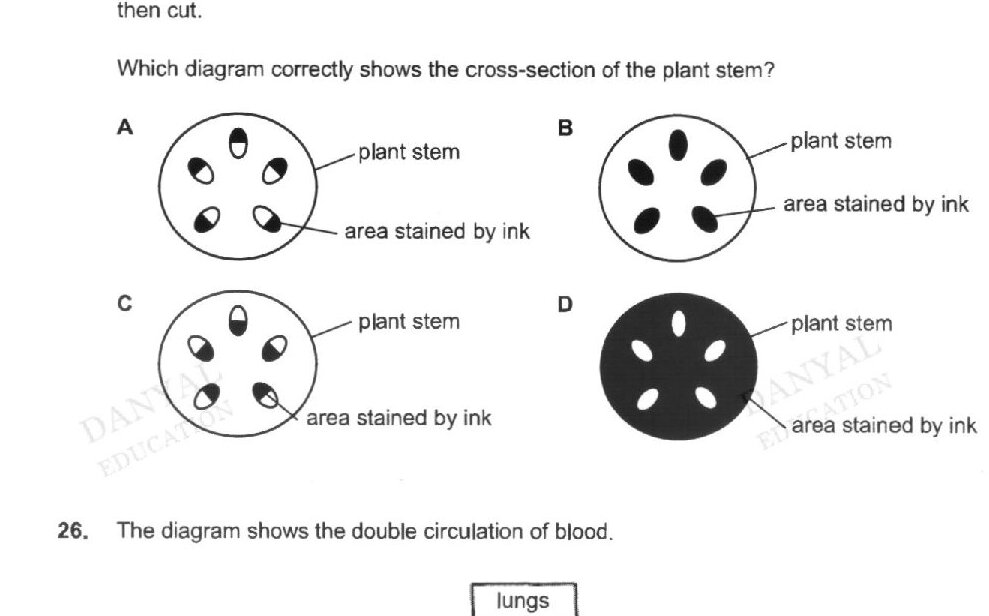
A plant shoot is left in a beaker of ink solution for several hours. A section of the stem was then cut. Which diagram correctly shows the cross-section of the plant stem?
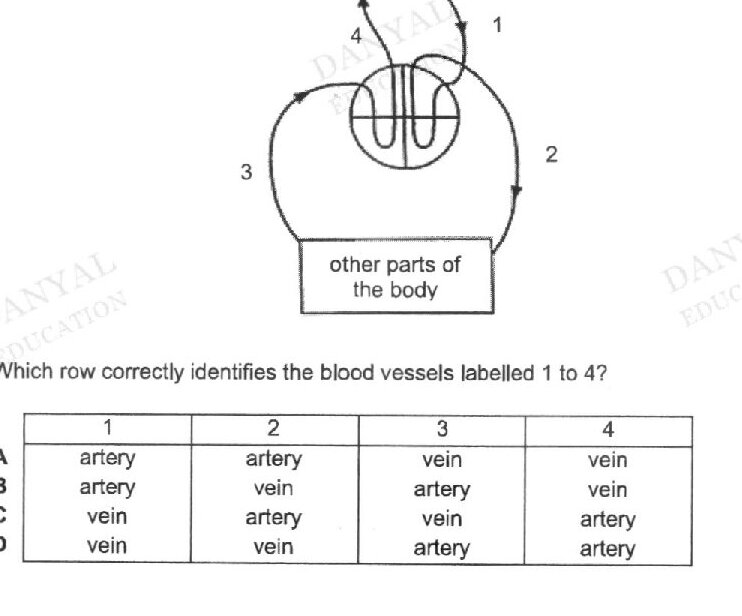
The diagram shows the double circulation of blood. Which row correctly identifies the blood vessels labelled 1 to 4?
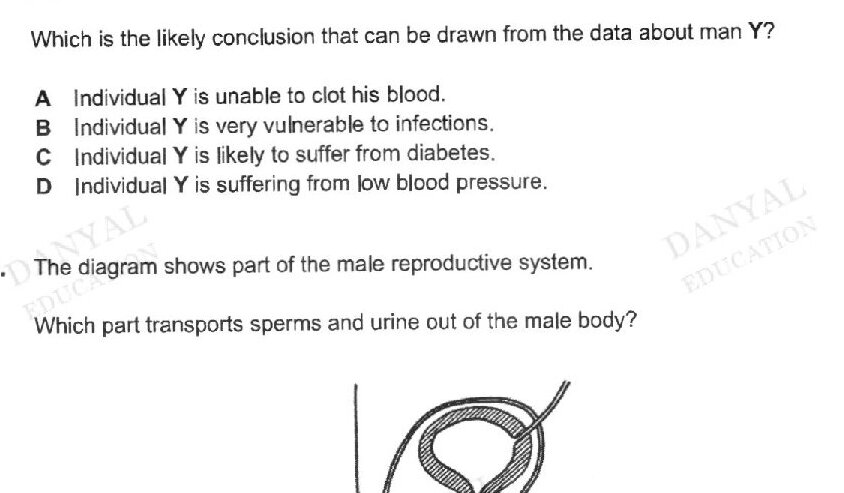
The blood counts of a healthy man (X) and one with a blood disorder (Y) are shown below. Which is the likely conclusion that can be drawn from the data about man Y?
Name the process by which oxygen and carbon dioxide molecules move between the air sac and the blood vessel.
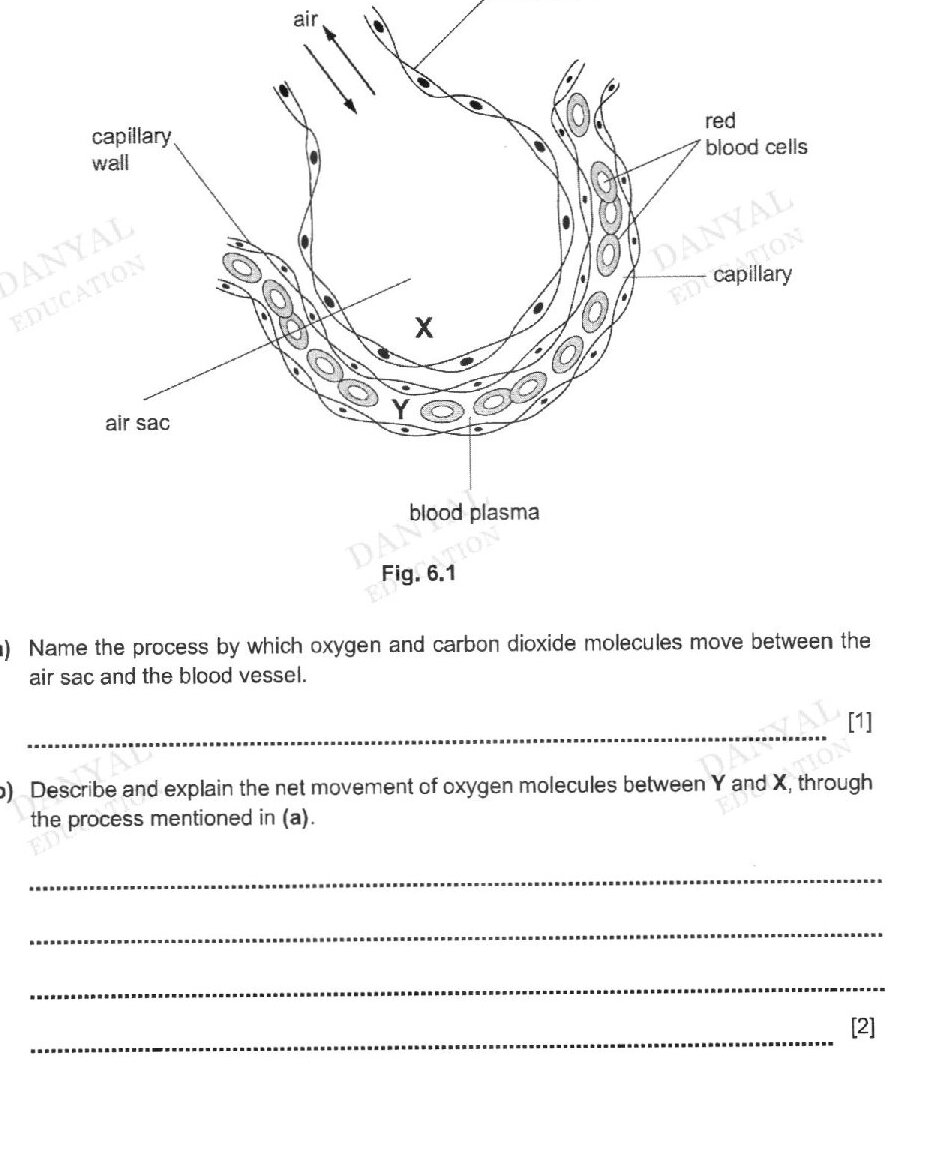
Describe and explain the net movement of oxygen molecules between Y and X, through the process mentioned in (a).
The diagram shows some body cells and a nearby blood capillary. The arrow shows the direction of movement of substance Z.
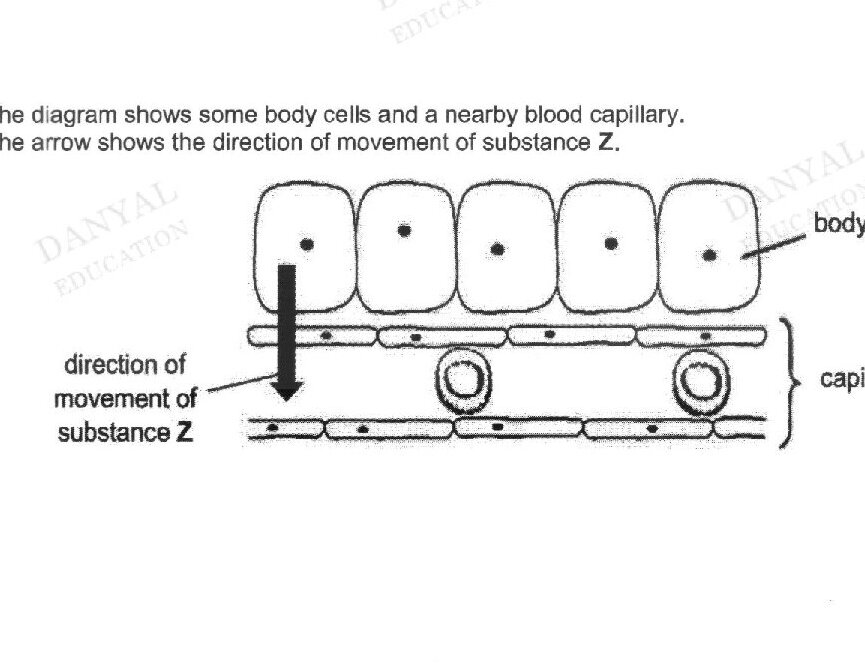
Which row correctly describes the identity and movement of substance Z as indicated by the arrow?
Which of the following is/are carried out by white blood cells?
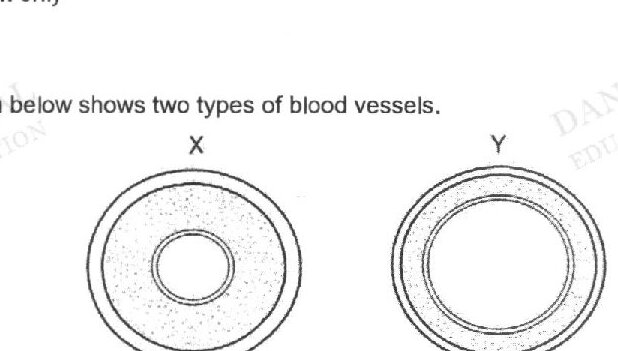
The diagram below shows two types of blood vessels. What are the functions of blood vessels X and Y?
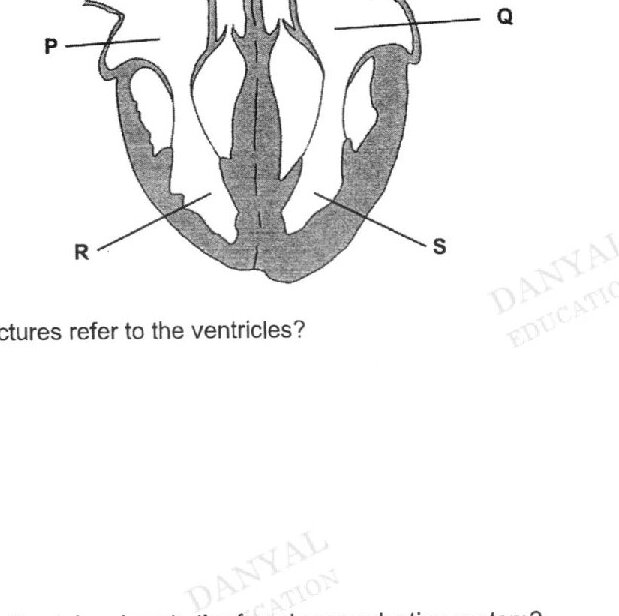
The diagram shows the cross-section of a human heart. Which labelled structures refer to the ventricles?
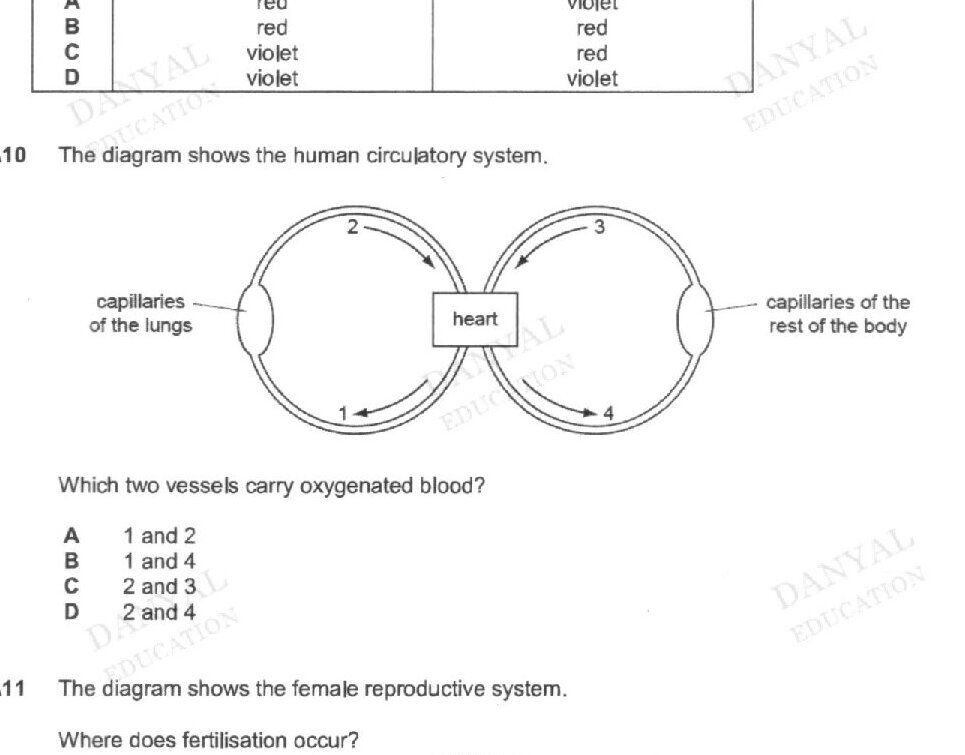
The diagram shows the human circulatory system. Which two vessels carry oxygenated blood?
Describe how water travels from the soil to the xylem in the roots.
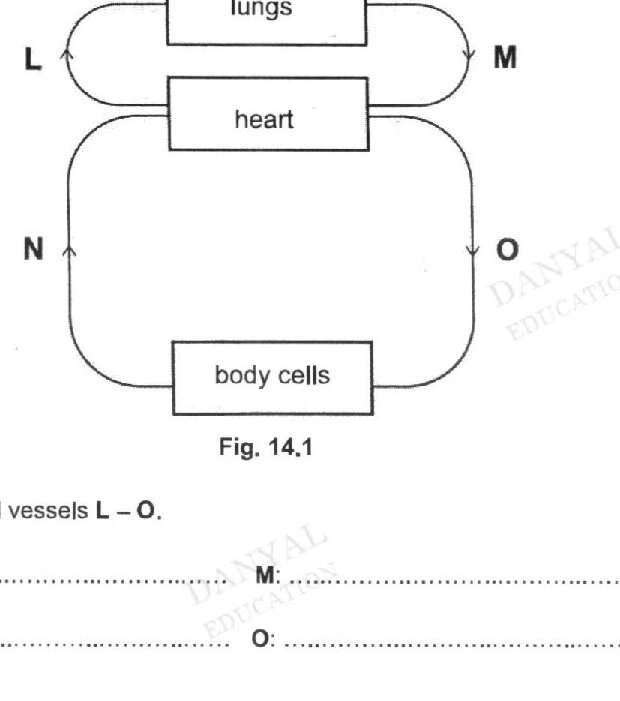
Identify blood vessels L – O.
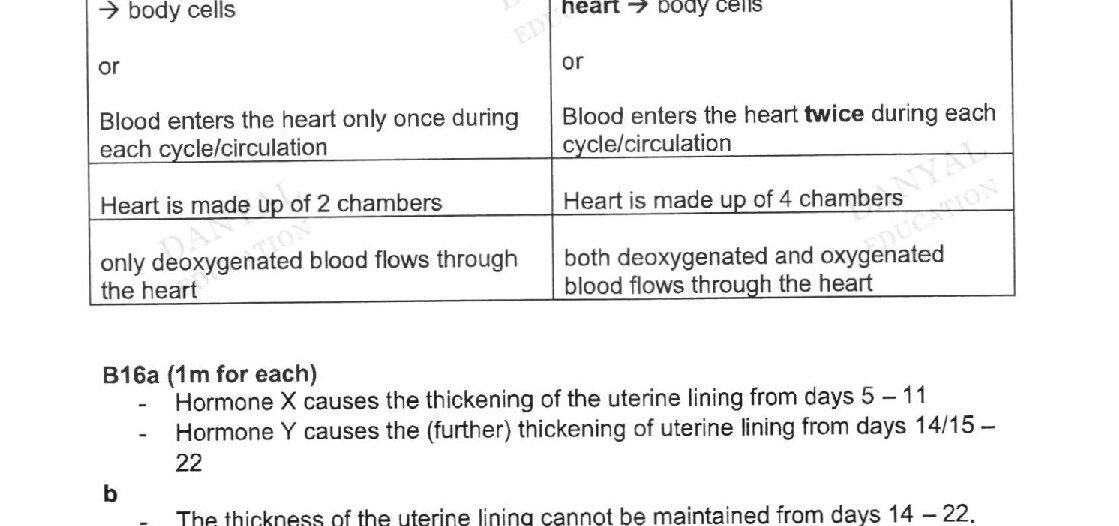
Humans have a bigger heart than fish. Describe two other differences in the circulatory systems in fish and humans.
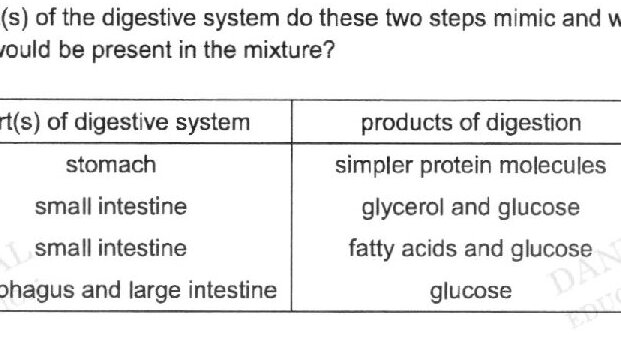
The following are steps in an experiment. Various foods with carbohydrates, proteins and fats were ground. Only protease and hydrochloric acid were added to the ground mixture. Which part(s) of the digestive system do these two steps mimic and what products of digestion would be present in the mixture?
The table shows the voltage and current ratings for four electric heaters, J, K, L and M. Which heater has the least resistance?

A construction worker wants to lay this piece of concrete block on a soft ground. On which surface, A, B or C, should he lay the concrete block on so that it is least likely to sink into the soft ground? Explain your answer.
Calculate the pressure exerted on the ground by the surface stated in 3(a) if the mass of the block is 500 kg. (take g to be 10 N / kg)
Past year papers cover the full exam — browse by subject below.
View All Papers ›