Human Sexual Reproductive System
Human Sexual Reproductive System - Study Notes
Key Concepts
Male Reproductive System
- Primary function: Produces male gametes (sperm cells) and delivers them to the female reproductive system
- Testes (singular: testis): Two oval-shaped organs that produce sperm and the hormone testosterone
- Located outside the body in the scrotum
- Kept at approximately 2-3°C below normal body temperature (optimal for sperm production)
- Contains seminiferous tubules where sperm are produced
- Scrotum: Sac of skin that holds and protects the testes
- Can contract when cold to bring testes closer to the body
- Can relax when warm to move testes away from the body
- Epididymis: Coiled tube on top of each testis where sperm mature and are temporarily stored
- Sperm duct (vas deferens): Muscular tube that transports mature sperm from the epididymis toward the urethra
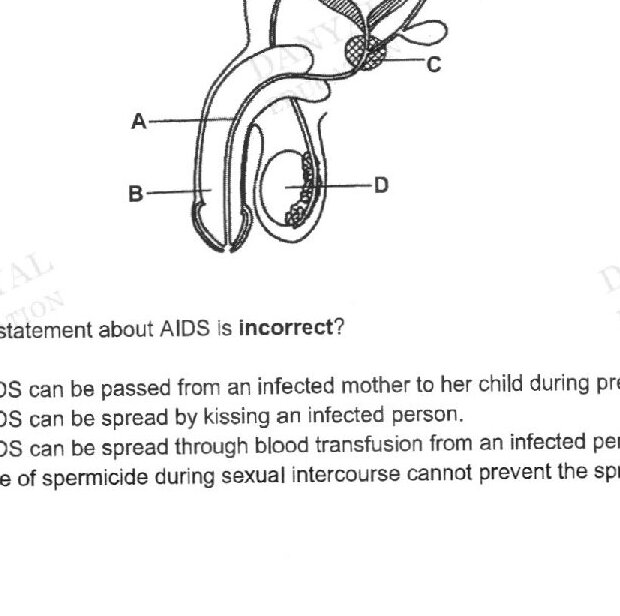
- Urethra: Tube that carries both urine (from the bladder) and semen out of the body through the penis
- Penis: External organ that delivers sperm into the female reproductive system during sexual intercourse
- Accessory glands (seminal vesicles, prostate gland, Cowper’s gland):
- Produce seminal fluid that nourishes and protects sperm
- Seminal fluid + sperm = semen
Female Reproductive System
- Primary function: Produces female gametes (egg cells/ova) and provides environment for fertilisation and foetal development
- Ovaries: Two almond-shaped organs that produce egg cells and the hormones oestrogen and progesterone
- Located in the lower abdomen
- Contain follicles (fluid-filled sacs) that hold immature egg cells
- At birth, females have a finite supply of immature egg cells (approximately 1-2 million); no new egg cells are produced after birth
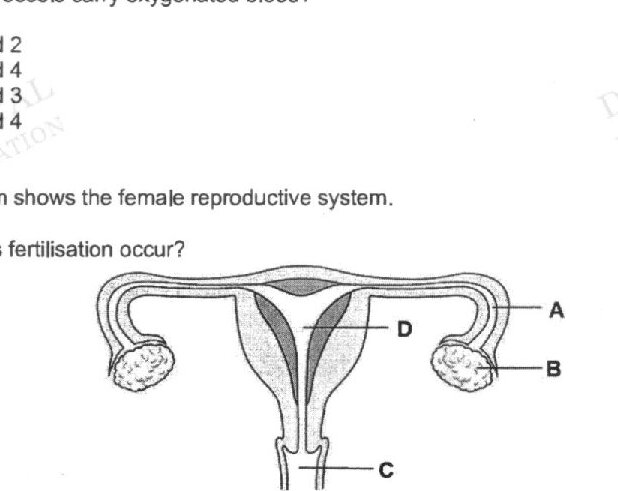
- Oviducts (Fallopian tubes): Two tubes that transport egg cells from the ovaries toward the uterus
- Lined with ciliated cells that help move the egg
- Site where fertilisation usually occurs (in the upper third of the oviduct)
- Have funnel-shaped openings near the ovaries to capture released eggs
- Uterus (womb): Muscular, pear-shaped organ where a fertilised egg implants and develops
- Inner lining called the endometrium, which thickens each month
- Can expand greatly during pregnancy
- Has thick muscular walls that contract during childbirth
- Cervix: Ring of muscle at the lower end of the uterus that opens into the vagina
- Normally produces mucus that acts as a barrier
- Dilates (opens) during childbirth
- Vagina: Muscular tube that connects the uterus to the outside of the body
- Receives the penis during sexual intercourse
- Acts as the birth canal during childbirth
- Pathway for menstrual flow
Gametogenesis
- Definition: The process of producing gametes (sex cells)
- Spermatogenesis (production of sperm):
- Begins at puberty and continues throughout adult life
- Occurs in the seminiferous tubules of the testes
- Takes approximately 64-72 days to produce mature sperm
- Millions of sperm are produced daily
- Each sperm cell has:
- A head containing the nucleus with 23 chromosomes (haploid)
- An acrosome (cap on the head) containing enzymes to penetrate the egg
- A middle piece packed with mitochondria for energy
- A tail (flagellum) for swimming
- Oogenesis (production of egg cells):
- Begins before birth but pauses until puberty
- After puberty, usually one egg matures and is released each month (ovulation)
- Occurs in the follicles of the ovaries
- Each egg cell is:
- Much larger than a sperm cell
- Contains 23 chromosomes (haploid)
- Has a cytoplasm rich in nutrients
- Surrounded by a protective jelly-like coating
- Key difference: Body cells have 46 chromosomes (diploid), but gametes have only 23 chromosomes (haploid)
- This ensures that when sperm and egg fuse, the resulting embryo has the correct 46 chromosomes
Fertilisation and Implantation
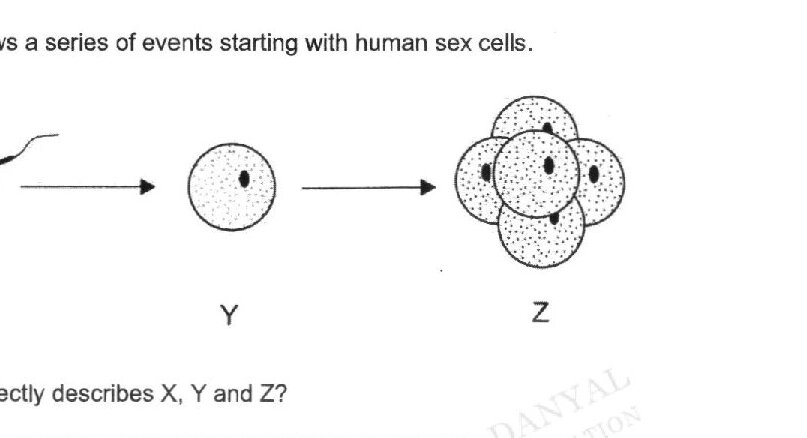
- Fertilisation: The fusion of a sperm nucleus with an egg nucleus
- Usually occurs in the upper third of the oviduct
- Process:
- Millions of sperm are deposited in the vagina during sexual intercourse
- Sperm swim through the cervix and uterus into the oviducts
- Only a few hundred reach the egg
- Enzymes from the acrosome help one sperm penetrate the egg’s outer layer
- The sperm nucleus fuses with the egg nucleus
- The fertilised egg (now called a zygote) has 46 chromosomes (23 from each parent)
- A membrane change prevents other sperm from entering
- After fertilisation:
- The zygote begins dividing by mitosis as it travels down the oviduct
- After 3-4 days, it becomes a ball of cells called an embryo
- After 5-7 days, it reaches the uterus
- Implantation: The embryo embeds itself into the thickened uterus lining (endometrium)
- Occurs approximately 6-10 days after fertilisation
- The embryo burrows into the endometrium
- Establishes connection with the mother’s blood supply
- Pregnancy officially begins after successful implantation
- After implantation, hormones (first from the corpus luteum, later from the placenta) maintain the uterus lining and prevent menstruation
Foetal Development
- Embryo stage (weeks 1-8):
- Rapid cell division and differentiation
- Major organs and body systems begin to form
- By week 4: heart begins to beat
- By week 8: all major organs present (though not fully developed)
- Most vulnerable to harmful substances during this period
- Foetus stage (week 9 until birth):
- The developing baby is now called a foetus
- Organs continue to grow and mature
- Movement can be felt by the mother (usually around week 16-20)
- Week 24: considered viable (could potentially survive outside the womb with medical care)
- Full term: approximately 40 weeks (9 months)
- Structures supporting foetal development:
- Placenta: Disc-shaped organ that forms in the uterus
- Connects the foetus to the mother’s uterus wall
- Mother’s blood and foetal blood DO NOT mix (separated by thin membranes)
- Functions:
- Allows oxygen and nutrients to pass from mother to foetus
- Allows waste products (carbon dioxide, urea) to pass from foetus to mother
- Produces hormones to maintain pregnancy
- Acts as a barrier to some (but not all) harmful substances
- Umbilical cord: Rope-like structure containing blood vessels
- Connects the foetus to the placenta
- Contains two arteries (carry deoxygenated blood and waste from foetus to placenta)
- Contains one vein (carries oxygenated blood and nutrients from placenta to foetus)
- Amniotic sac: Fluid-filled membrane surrounding the foetus
- Amniotic fluid protects the foetus by:
- Cushioning against bumps and injury
- Maintaining constant temperature
- Allowing movement for muscle development
- Preventing infection
- Amniotic fluid protects the foetus by:
- Placenta: Disc-shaped organ that forms in the uterus
Hormones in Reproduction
- Hormones: Chemical messengers produced by glands that travel in the bloodstream to target organs
- Main reproductive hormones in males:
- Testosterone: Produced by testes
- Stimulates sperm production
- Responsible for development of secondary sexual characteristics at puberty (deeper voice, facial hair, muscle development, broadening of shoulders)
- Testosterone: Produced by testes
- Main reproductive hormones in females:
- Oestrogen: Produced mainly by ovaries
- Stimulates development of secondary sexual characteristics at puberty (breast development, widening of hips, start of menstrual cycle)
- Causes repair and thickening of uterus lining after menstruation
- Stimulates release of egg (ovulation)
- Progesterone: Produced by ovaries after ovulation
- Maintains the thickened uterus lining
- Prepares the uterus for pregnancy
- If fertilisation doesn’t occur, progesterone levels drop and menstruation begins
- During pregnancy, maintains the uterus lining and prevents further ovulation
- Oestrogen: Produced mainly by ovaries
- The Menstrual Cycle:
- Average cycle: 28 days (can vary from 21-35 days)
- Day 1-5 (Menstruation): Uterus lining breaks down and is shed through the vagina
- Day 6-13: Oestrogen levels rise, causing uterus lining to thicken again
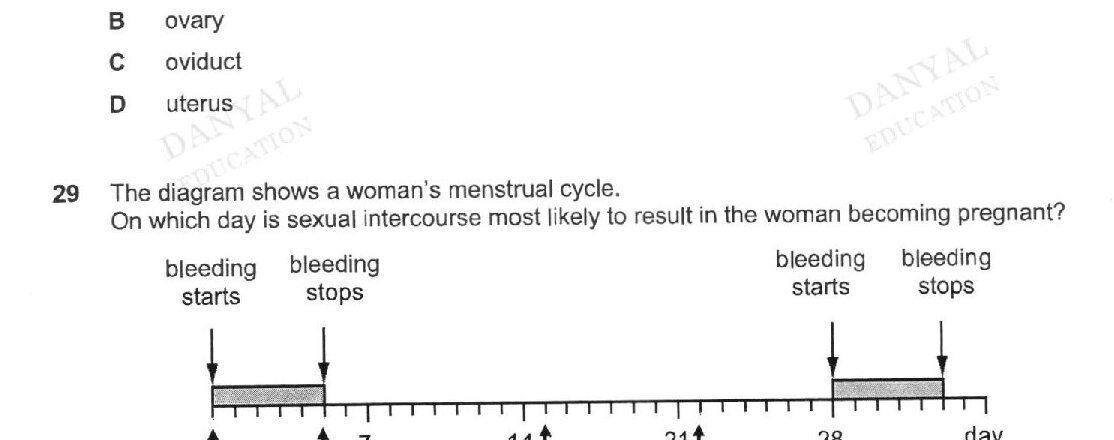
- Day 14 (Ovulation): An egg is released from an ovary (triggered by hormones)
- Day 15-28: Progesterone maintains the thick uterus lining
- If no fertilisation occurs, progesterone levels drop and the cycle begins again
- If fertilisation occurs, hormones maintain the uterus lining and no menstruation happens
Sexually Transmitted Infections (STIs)
- Definition: Infections passed from one person to another through sexual contact
- Common bacterial STIs:
- Gonorrhoea and Chlamydia:
- Caused by bacteria
- Symptoms: painful urination, unusual discharge, pelvic pain (some people have no symptoms)
- Can lead to infertility if untreated
- Can be cured with antibiotics
- Syphilis:
- Caused by bacteria
- Symptoms progress in stages: sores, rash, organ damage if untreated
- Can be cured with antibiotics if caught early
- Gonorrhoea and Chlamydia:
- Common viral STIs:
- HIV (Human Immunodeficiency Virus):
- Virus that attacks the immune system
- Can lead to AIDS (Acquired Immune Deficiency Syndrome)
- Transmitted through: sexual contact, sharing needles, mother to baby, infected blood
- Currently no cure, but can be managed with medication
- Weakened immune system makes person vulnerable to infections
- Genital herpes:
- Caused by herpes simplex virus
- Symptoms: painful blisters in genital area
- No cure, but medication can reduce outbreaks
- Human Papillomavirus (HPV):
- Some strains can cause genital warts
- Some strains can lead to cervical cancer
- Vaccine available for prevention
- HIV (Human Immunodeficiency Virus):
- Prevention of STIs:
- Abstinence (not engaging in sexual activity)
- Using barrier contraception (condoms) correctly
- Being in a mutually faithful relationship with an uninfected partner
- Regular health check-ups
- Vaccination (for HPV)
- Not sharing needles
- Importance of seeking help:
- Many STIs can be asymptomatic (no symptoms)
- Early detection and treatment prevent serious complications
- Untreated STIs can lead to infertility, organ damage, or death
- Testing and treatment are confidential
Important Definitions
Gamete: A sex cell containing half the normal number of chromosomes (23 in humans); sperm in males, egg cells in females
Fertilisation: The fusion of the nuclei of a male gamete (sperm) and a female gamete (egg) to form a zygote
Zygote: A fertilised egg cell containing the full number of chromosomes (46 in humans)
Embryo: The developing organism from fertilisation until approximately 8 weeks; also refers to the ball of cells that implants in the uterus
Foetus: The developing organism from week 9 after fertilisation until birth
Implantation: The process by which an embryo embeds itself into the thickened lining of the uterus
Ovulation: The release of a mature egg cell from an ovary, usually occurring around day 14 of the menstrual cycle
Menstruation: The monthly shedding of the uterus lining (endometrium) through the vagina when fertilisation has not occurred
Placenta: The organ that develops in the uterus during pregnancy, allowing exchange of substances between mother and foetus without their blood mixing
Amniotic fluid: The protective liquid surrounding the foetus in the amniotic sac
Hormone: A chemical messenger produced by glands that travels in the bloodstream to target organs to bring about specific effects
Testosterone: The main male sex hormone produced by the testes; responsible for sperm production and male secondary sexual characteristics
Oestrogen: A female sex hormone produced mainly by the ovaries; responsible for development of female secondary sexual characteristics and repair of uterus lining
Progesterone: A female sex hormone produced by the ovaries after ovulation; maintains the thickened uterus lining
Sexually Transmitted Infection (STI): An infection that is passed from one person to another through sexual contact
Haploid: A cell containing half the normal number of chromosomes (23 in humans); applies to gametes
Diploid: A cell containing the full number of chromosomes (46 in humans); applies to body cells
Secondary sexual characteristics: Physical features that develop during puberty but are not directly involved in reproduction (e.g., breast development, facial hair, voice changes)
Worked Examples
Example 1: Tracing the Path of Sperm
Question: Describe the journey of a sperm cell from where it is produced until it leaves the male body.
Step-by-step solution:
Step 1: Identify where sperm is produced
- Sperm is produced in the seminiferous tubules of the testis
Step 2: Identify where sperm matures
- Newly formed sperm moves to the epididymis where it matures and is temporarily stored
Step 3: Identify the transport pathway
- During ejaculation, mature sperm travels through the sperm duct (vas deferens)
Step 4: Identify where fluids are added
- As sperm passes the seminal vesicles and prostate gland, seminal fluid is added to form semen
Step 5: Identify the exit pathway
- The semen travels through the urethra and exits the body through the penis
Complete answer: “Sperm is produced in the seminiferous tubules of the testis. It then moves to the epididymis where it matures and is stored. During ejaculation, sperm travels up the sperm duct (vas deferens). Seminal fluid from the seminal vesicles and prostate gland is added to the sperm to form semen. The semen then travels through the urethra and exits the body through the penis.”
Example 2: Explaining Why Fertilisation Doesn’t Lead to Doubling of Chromosomes
Question: A human body cell contains 46 chromosomes. Explain why a zygote formed from fertilisation also has 46 chromosomes and not 92.
Step-by-step solution:
Step 1: State the chromosome number in body cells
- Normal human body cells are diploid and contain 46 chromosomes (23 pairs)
Step 2: Explain what happens during gamete formation
- During gametogenesis (sperm production and egg production), the chromosome number is halved
- This process produces haploid gametes
Step 3: State the chromosome number in gametes
- Each sperm cell contains 23 chromosomes
- Each egg cell contains 23 chromosomes
Step 4: Explain what happens during fertilisation
- During fertilisation, the sperm nucleus fuses with the egg nucleus
- 23 chromosomes from sperm + 23 chromosomes from egg = 46 chromosomes
Step 5: Conclude
- The zygote therefore has the normal diploid number of 46 chromosomes
Complete answer: “During gametogenesis, gametes are produced with only half the normal number of chromosomes. Each sperm cell and each egg cell contains 23 chromosomes (haploid). When fertilisation occurs, the nucleus of the sperm (23 chromosomes) fuses with the nucleus of the egg (23 chromosomes), resulting in a zygote with 46 chromosomes (diploid). This prevents the doubling of chromosome number in each generation.”
Example 3: Explaining the Role of the Placenta
Question: The placenta is essential for foetal development. Describe three ways the placenta helps the developing foetus, explaining what substances are involved.
Step-by-step solution:
Step 1: Identify the first function - providing nutrients
- The placenta allows glucose, amino acids, vitamins, and minerals to pass from the mother’s blood to the foetal blood
- These nutrients are essential for growth and energy
Step 2: Identify the second function - gas exchange
- Oxygen passes from mother’s blood to foetal blood through the placenta
- Carbon dioxide (waste gas) passes from foetal blood to mother’s blood
- This allows the foetus to carry out respiration
Step 3: Identify the third function - removing waste
- Urea and other waste products pass from foetal blood to mother’s blood
- These wastes are then removed by the mother’s kidneys
Step 4: Important note about blood separation
- Remember to mention that mother’s blood and foetal blood do not mix - they are separated by thin membranes
Complete answer: "The placenta helps the foetus in three main ways:
- Nutrient supply: Nutrients such as glucose, amino acids, vitamins, and minerals pass from the mother’s blood to the foetal blood to provide energy and materials for growth.
- Gas exchange: Oxygen passes from mother’s blood to foetal blood for respiration, while carbon dioxide passes from foetal blood to mother’s blood to be removed.
- Waste removal: Waste products like urea pass from foetal blood to mother’s blood, where they are removed by the mother’s excretory system.
It is important to note that the mother’s blood and foetal blood do not mix; substances pass through thin membranes in the placenta."
Common Mistakes to Avoid
-
Confusing the urethra in males and females
- ❌ Mistake: Saying that in females, the urethra carries both urine and reproductive cells
- ✓ Correct: In males, the urethra carries both urine and semen; in females, the urethra only carries urine and is separate from the reproductive system
-
Saying sperm is produced in the scrotum
- ❌ Mistake: “Sperm is produced in the scrotum”
- ✓ Correct: “Sperm is produced in the testes, which are held in the scrotum”
-
Confusing where fertilisation occurs
- ❌ Mistake: “Fertilisation occurs in the uterus” or “Fertilisation occurs in the ovary”
- ✓ Correct: “Fertilisation usually occurs in the upper third of the oviduct (Fallopian tube)”
-
Saying mother’s blood and foetal blood mix
- ❌ Mistake: “The mother’s blood flows directly to the foetus through the umbilical cord”
- ✓ Correct: “The mother’s blood and foetal blood do not mix. Substances pass between them through thin membranes in the placenta”
-
Confusing implantation with fertilisation
- ❌ Mistake: Using these terms interchangeably
- ✓ Correct: Fertilisation is when sperm and egg fuse (in oviduct); implantation is when the embryo embeds in the uterus lining (happens 6-10 days later)
-
Wrong chromosome numbers
- ❌ Mistake: “Gametes have 46 chromosomes” or “The zygote has 23 chromosomes”
- ✓ Correct: Gametes are haploid (23 chromosomes); body cells and zygotes are diploid (46 chromosomes)
-
Confusing oestrogen and progesterone functions
- ❌ Mistake: “Progesterone causes the uterus lining to thicken after menstruation”
- ✓ Correct: “Oestrogen causes the uterus lining to thicken; progesterone maintains it”
-
Not being specific about what passes through the placenta
- ❌ Mistake: Just saying “nutrients and waste” without examples
- ✓ Correct: Name specific substances - oxygen, glucose, amino acids, carbon dioxide, urea
-
Confusing the amniotic sac with the placenta
- ❌ Mistake: Mixing up their functions
- ✓ Correct: Amniotic sac/fluid protects and cushions; placenta exchanges substances
-
Wrong timing in the menstrual cycle
- ❌ Mistake: “Ovulation occurs on day 1” or “Menstruation occurs on day 14”
- ✓ Correct: Menstruation = days 1-5; Ovulation = approximately day 14 (in a 28-day cycle)
-
Saying STIs can be spread through casual contact
- ❌ Mistake: “You can get STIs from toilet seats or sharing food”
- ✓ Correct: STIs are spread through sexual contact, sharing needles, mother to baby, or infected blood - not through casual contact
-
Confusing cure vs. treatment
- ❌ Mistake: “HIV can be cured with antibiotics”
- ✓ Correct: “Bacterial STIs can be cured with antibiotics; viral STIs like HIV can be managed but not cured”
Exam Tips
Keywords and Phrases That Earn Marks
For fertilisation questions:
- “fusion of nuclei” (not just “joining of sperm and egg”)
- “in the oviduct” or “in the Fallopian tube” (be specific about location)
- “zygote has 46 chromosomes (23 from each parent)”
For placenta questions:
- “substances pass through thin membranes” or “by diffusion through membranes”
- “mother’s blood and foetal blood do not mix”
- Always name specific substances (oxygen, glucose, amino acids, carbon dioxide, urea)
For STI questions:
- “transmitted through sexual contact” (not just “transmitted sexually”)
- “can lead to infertility/organ damage if untreated”
- “bacterial STIs can be cured with antibiotics; viral STIs cannot be cured”
For hormone questions:
- Link each hormone to its specific function (don’t just list hormones)
- Use terms like “stimulates,” “maintains,” “causes”
- For menstrual cycle: mention both the hormone AND what it does to the uterus lining
For structure and function questions:
- Always link structure to function (e.g., “The oviduct has ciliated cells which help move the egg toward the uterus”)
- Use terms like “adapted for,” “allows,” “enables”
How to Structure Your Answers
For “Describe” questions:
- Make sure you provide details, not just labels
- Use connecting words (then, next, after, before)
- If describing a process, go step-by-step in order
For “Explain” questions:
- State what happens (the fact)
- Then explain WHY or HOW (the reasoning)
- Use linking words like “because,” “therefore,” “this allows,” “as a result”
For “Compare” questions:
- Make clear comparisons (use “whereas,” “while,” “in contrast”)
- Don’t just describe one then the other separately
- Use comparison table format if helpful
For diagram questions:
- Draw clear, large diagrams with space for labels
- Use a ruler for label lines
- Label lines should touch the part being labeled
- Don’t use arrows for labels (arrows show direction/movement)
Specific Mark-Earning Strategies
-
When asked about adaptations: Always mention BOTH the structure AND how it helps function
- Example: “Sperm has a tail which allows it to swim toward the egg”
-
When asked about multiple functions: Use numbering or bullet points to make distinct points clear
- This makes it easy for examiners to count your points
-
For questions about preventing pregnancy/STIs: Give practical methods, not just theoretical ones
- Mention specific methods like condoms, not just “protection”
-
When calculating/identifying timing: Show your working
- Example: If conception was on day 14, count forward to show when implantation occurs
-
Use correct scientific terminology:
- Say “oviduct” not just “tube”
- Say “uterus lining” or “endometrium” not “wall”
- Say “sperm duct” or “vas deferens” not “tube from testis”
-
For questions about the menstrual cycle:
- If asked about specific days, reference the day number
- If asked about hormones, mention what triggers changes, not just what changes
-
Read carefully whether question asks about male OR female OR both:
- Don’t waste time writing about the wrong system
- If it says “Compare male and female,” you must discuss both
Quick Summary
Essential points to remember for exams:
✓ Male system: Testes produce sperm and testosterone; sperm travels through epididymis → sperm duct → urethra; seminal fluid added by glands
✓ Female system: Ovaries produce eggs, oestrogen, and progesterone; eggs travel through oviduct to uterus; uterus is where foetus develops
✓ Gametes: Sperm (male) and eggs (female) each have 23 chromosomes (haploid); zygote formed at fertilisation has 46 chromosomes (diploid)
✓ Fertilisation: Sperm nucleus fuses with egg nucleus in the oviduct (Fallopian tube); forms a zygote
✓ Implantation: Embryo embeds in thickened uterus lining 6-10 days after fertilisation; pregnancy begins
✓ Foetal development: Embryo (weeks 1-8) → foetus (week 9 to birth); supported by placenta, umbilical cord, and amniotic fluid
✓ Placenta: Allows exchange of oxygen, nutrients, and waste between mother and foetus without blood mixing
✓ Menstrual cycle: ~28 days; menstruation (days 1-5); uterus lining thickens (days 6-13); ovulation (day ~14); progesterone maintains lining (days 15-28)
✓ STIs: Bacterial STIs (gonorrhoea, chlamydia, syphilis) can be treated with antibiotics; viral STIs (HIV, herpes, HPV) cannot be cured
Summary
- Puberty: Hormonal changes triggering development of secondary sexual characteristics
- Male reproductive system: Testes (produce sperm + testosterone), vas deferens, urethra
- Female reproductive system: Ovaries (produce eggs + oestrogen), fallopian tubes, uterus, vagina
- Menstrual cycle: ~28 days; ovulation on day ~14; if fertilisation occurs, embryo implants in uterine wall
- Fertilisation: Sperm fuses with egg in fallopian tube; forms zygote → embryo → foetus
- Gestation: ~40 weeks; foetus develops in uterus, nourished via placenta and umbilical cord
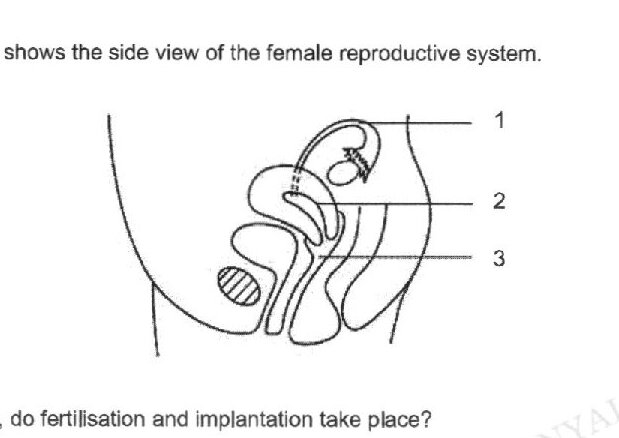
The diagram shows the female reproductive system. Where does fertilisation occur?
The diagram shows part of the male reproductive system. Which part transports sperms and urine out of the male body?
Where does fertilisation take place in the female reproductive system?
The diagram shows a woman's menstrual cycle. On which day is sexual intercourse most likely to result in the woman becoming pregnant?
The diagram shows a series of events starting with human sex cells. Which option correctly describes X, Y and Z?
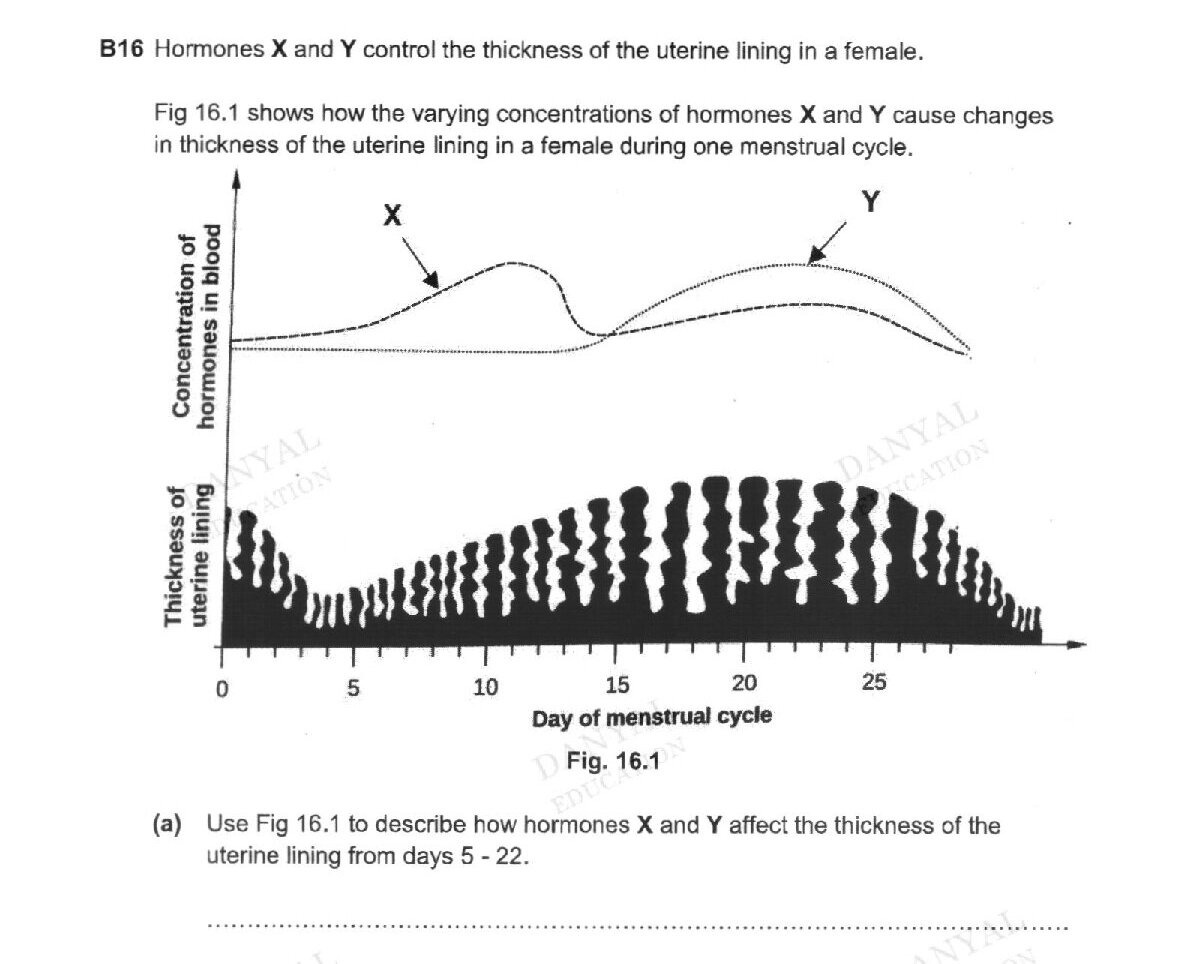
Use Fig 16.1 to describe how hormones X and Y affect the thickness of the uterine lining from days 5 - 22.
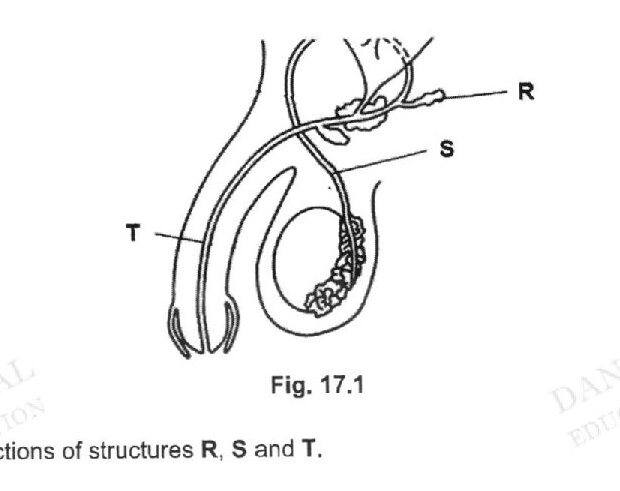
State the functions of structures R, S and T.
State the function of the parts labelled A and B in the male reproductive system.
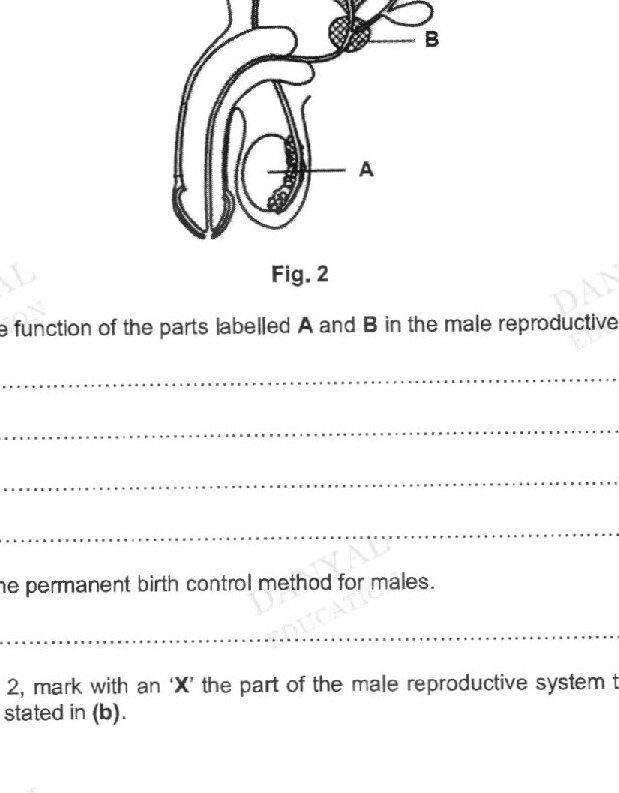
Name the permanent birth control method for males.
Cystic fibrosis is a genetic disorder that is passed down from one generation to the next. It causes persistent lung infections and limits a person's ability to breathe over time. Which structure is responsible for the inheritance of this disorder from the person's parents to the child?
The diagram shows the side view of the female reproductive system. In which part, do fertilisation and implantation take place?
Name the event that occurred from day 1 to 5 in the woman's uterus and describe how this event affects the thickness of uterus lining.
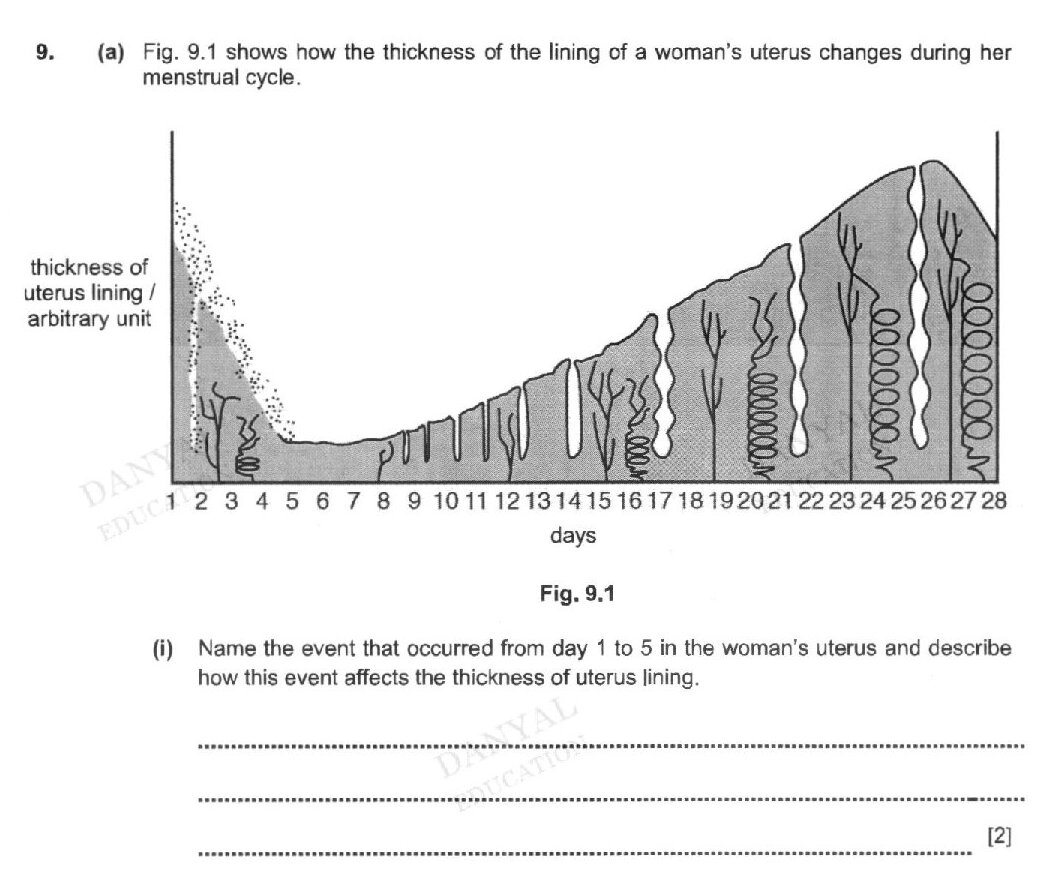
With reference to Fig. 9.1, describe what happens to the thickness of the uterus lining of the woman between day 14 to day 26. State the role of the uterus lining during this period.
Describe the difference you would expect after day 26 in Fig. 9.1 if an egg is fertilised during this cycle.
One method of birth control is to avoid sexual intercourse during a woman's fertile days. State two other temporary methods of birth control.
Fig. 9.2 is an electron micrograph showing a sperm cell trying to penetrate through the membrane of an egg cell. Describe what happens between the event shown in Fig. 9.2 and implantation in the uterus.
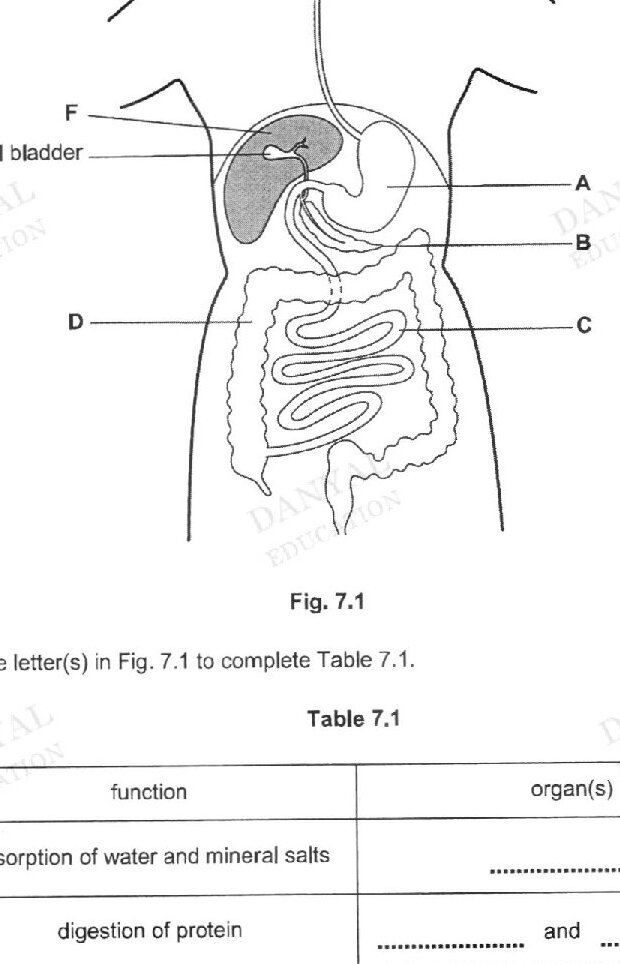
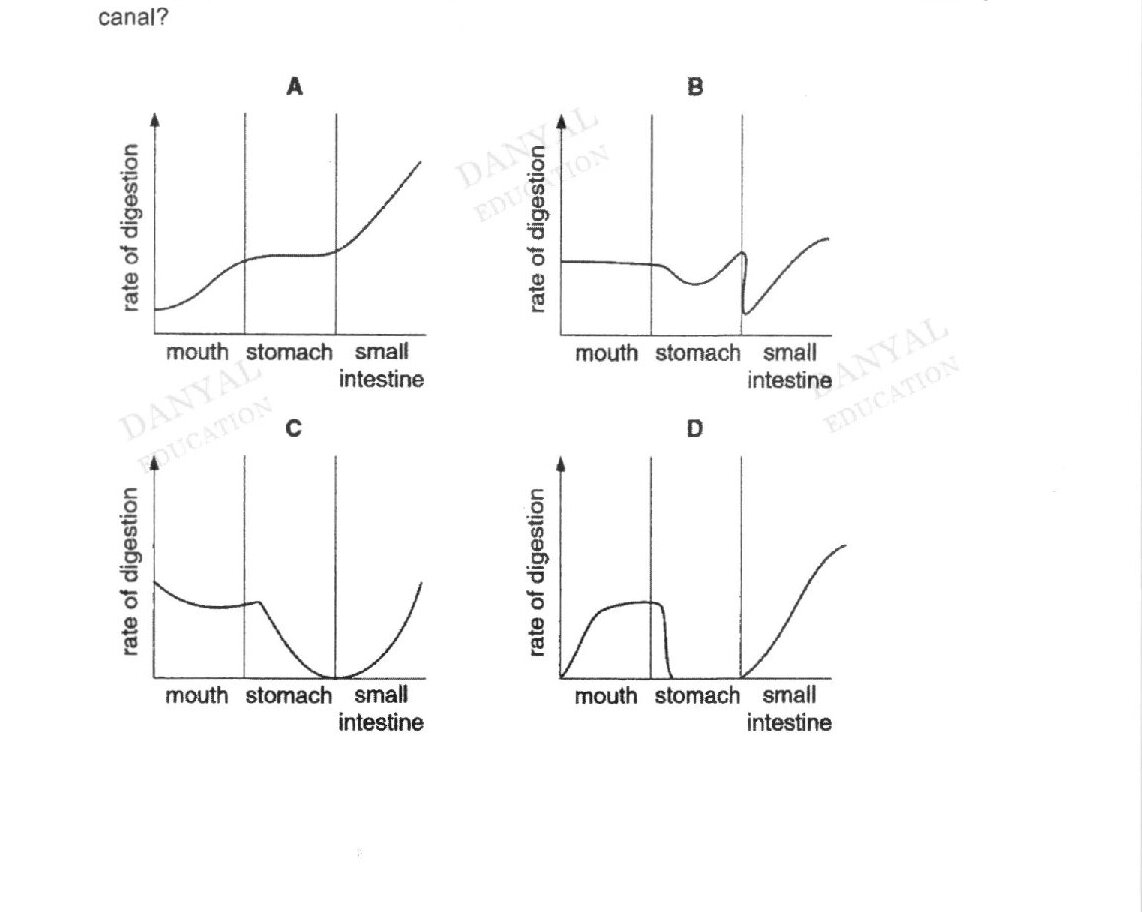
Which graph shows the rate of digestion of starch in the three parts of the alimentary canal?
Label and draw a line in both Fig. 5.1 and Fig. 5.2, to indicate the organ(s) responsible for the production of sex hormones in a man and woman.
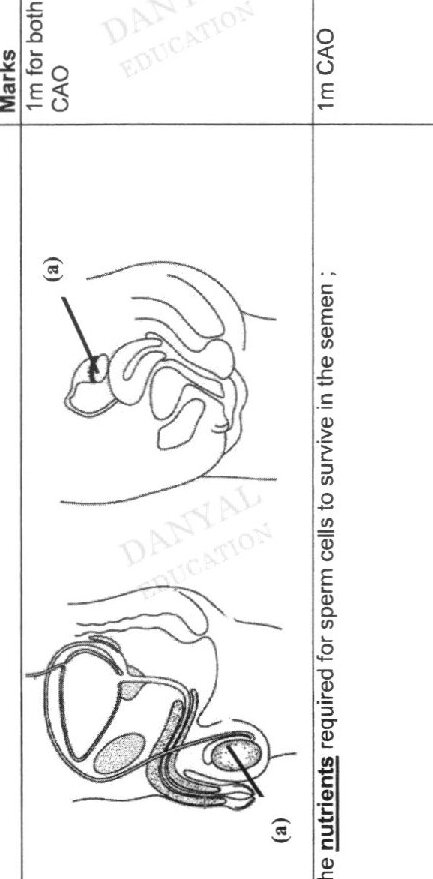
State the function of organ X in the male reproductive system.
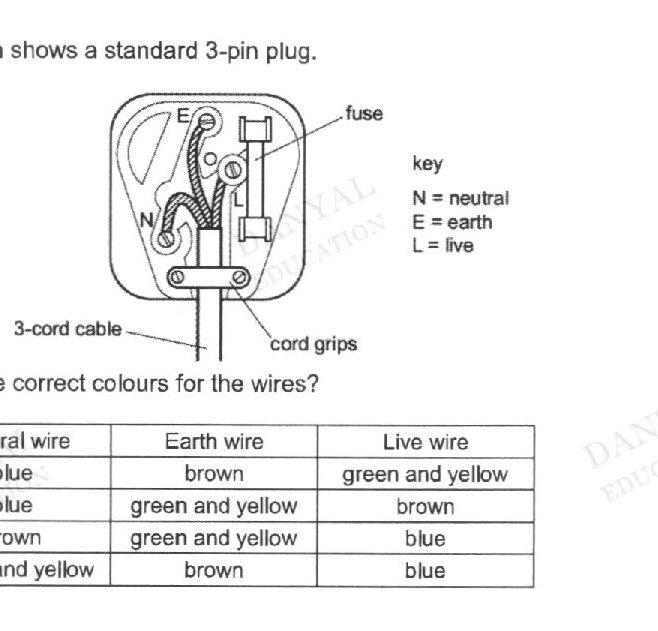
Patient S has a condition that causes abnormal growth in structure Y. This causes structure Y to be partially blocked. Explain how this condition can affect her ability to become pregnant.
Patient T is pregnant and is considering an abortion due to health risks of carrying a foetus to full term. However, her doctor informed her that abortion carries risks as well. Describe two risks that patient T might face in going through an abortion.
Past year papers cover the full exam — browse by subject below.
View All Papers ›