An angle measures the amount of turn between 2 lines or rays.
Angles are measured in degrees (°).
Angles on a straight line add up to 180°.
Angles at a point add up to 360°.
Vertically opposite angles are equal.
The interior angles of a triangle add up to 180°.
The interior angles of a quadrilateral add up to 360°.
An equilateral triangle has 3 angles of 60° each.
To find an unknown angle, identify the correct angle rule first.
Show your working clearly and include the degree symbol.
Always check that your final answer fits the diagram.
Slanted diagrams do not change the angle facts.
✏️25 practice questions available
30 questions from school exam papers
Q1
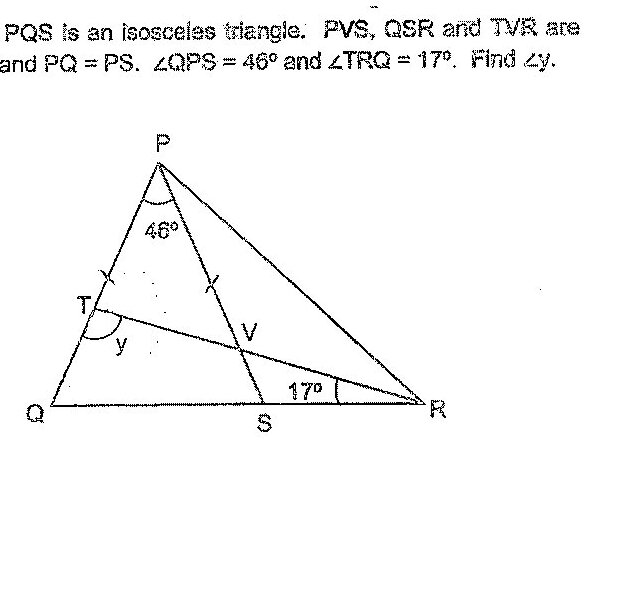
In the figure, PQS is an isosceles triangle. PVS, QSR and TVR are straight lines and PQ = PS. ∠QPS = 46° and ∠TRQ = 17°. Find ∠y.
📊Diagram: A triangle configuration showing: Triangle PQS at the top with P at the apex and base QS. Point T lies on PQ, point V lies on PS, and point R is to the right of S on the extended line. Angle at P is marked as 46°. Angle at R is marked as 17°. Angle y is marked at point T (or within the triangle). The angle at S is marked as 12°.
Answer: ∠y = 67°. Since PQS is isosceles with PQ = PS, ∠PQS = ∠PSQ = (180° - 46°)/2 = 67°. On straight line QSR, ∠PSQ + ∠PSR = 180°, so ∠PSR = 113°. In triangle QSR, ∠SQR = 180° - 113° - 17° = 50°. Therefore ∠y = ∠PQS = 67°.
2022-P6-Maths-Prelim-ACSJ 2022
Q2
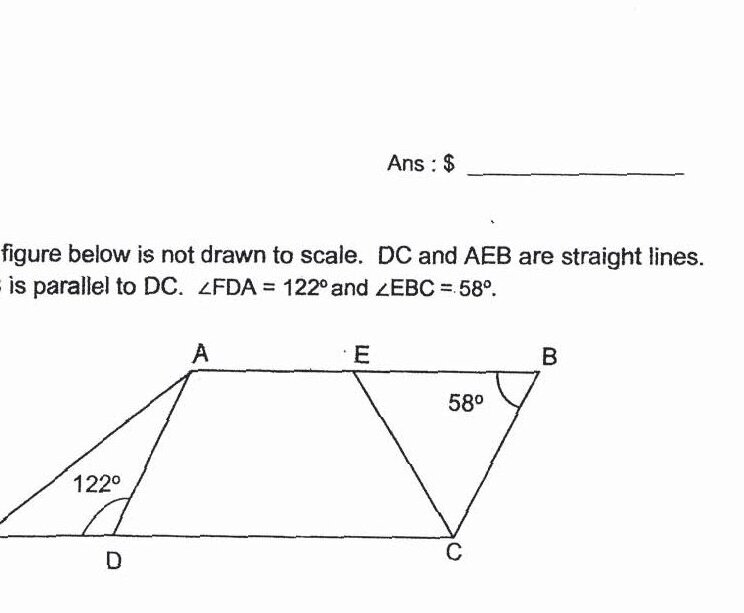
The figure below is not drawn to scale. DC and AEB are straight lines. AEB is parallel to DC. ∠FDA = 122° and ∠EBC = 58°.
Each of the statements is either true, false or not possible to tell from the information given. For each statement, put a tick (✓) to indicate your answer.
Statements to evaluate:
1. ∠EBC = ∠ECB
2. AECD is a trapezium.
3. ABCD is a parallelogram.
📊Diagram: A geometric figure with points A, B, C, D, E, and F. Lines DC and AEB are straight lines with AEB parallel to DC. Point F is to the left, D is on line FC, C is at the bottom right, B is at the top right, A is at the top left, and E is between A and B. Angle FDA is marked as 122° and angle EBC is marked as 58°.
Answer: Not possible to tell from the information given. Statement evaluation requires determining specific angle relationships, but without the complete diagram showing all angle positions and the location of point F relative to the other points, we cannot definitively verify each claim.
2022-P6-Maths-Prelim-ACSJ 2022
Q3
In the square grid below, PQ and QR are straight lines. Measure and write down the size of ∠PQR.
📊Diagram: A square grid with points P, Q, and R marked. PQ and QR are straight lines forming an angle at Q. Point P is located on the left side of the grid, point Q is located above and to the right of P, and point R is located to the right of Q. The grid appears to be approximately 16 units wide and 12 units tall.
Answer: ∠PQR = 135°. Measuring the positions on the square grid, point P is to the lower-left of Q, and R is to the upper-right of Q, creating a 135° angle at Q.
2022-P6-Maths-Prelim-ACSJ 2022
Q4
In the figure, not drawn to scale, ABCD is a square. ACE and DGA are equilateral triangles. Find ∠EFG.
📊Diagram: A square ABCD with point A at bottom centre, B at bottom right, C at top right, and D at top left (implied). Triangle ACE is equilateral with E positioned to the left of the square. Triangle DGA is equilateral with G positioned at the bottom left. Point F appears to be the intersection of lines within the figure. Various line segments connect the vertices: AC, AE, EC, AD, DG, GA, AB, BC, and additional lines connecting these triangles.
3 marks
Answer: 15°, 105°
2022-P6-Maths-Prelim-ACSJ 2022
Q5
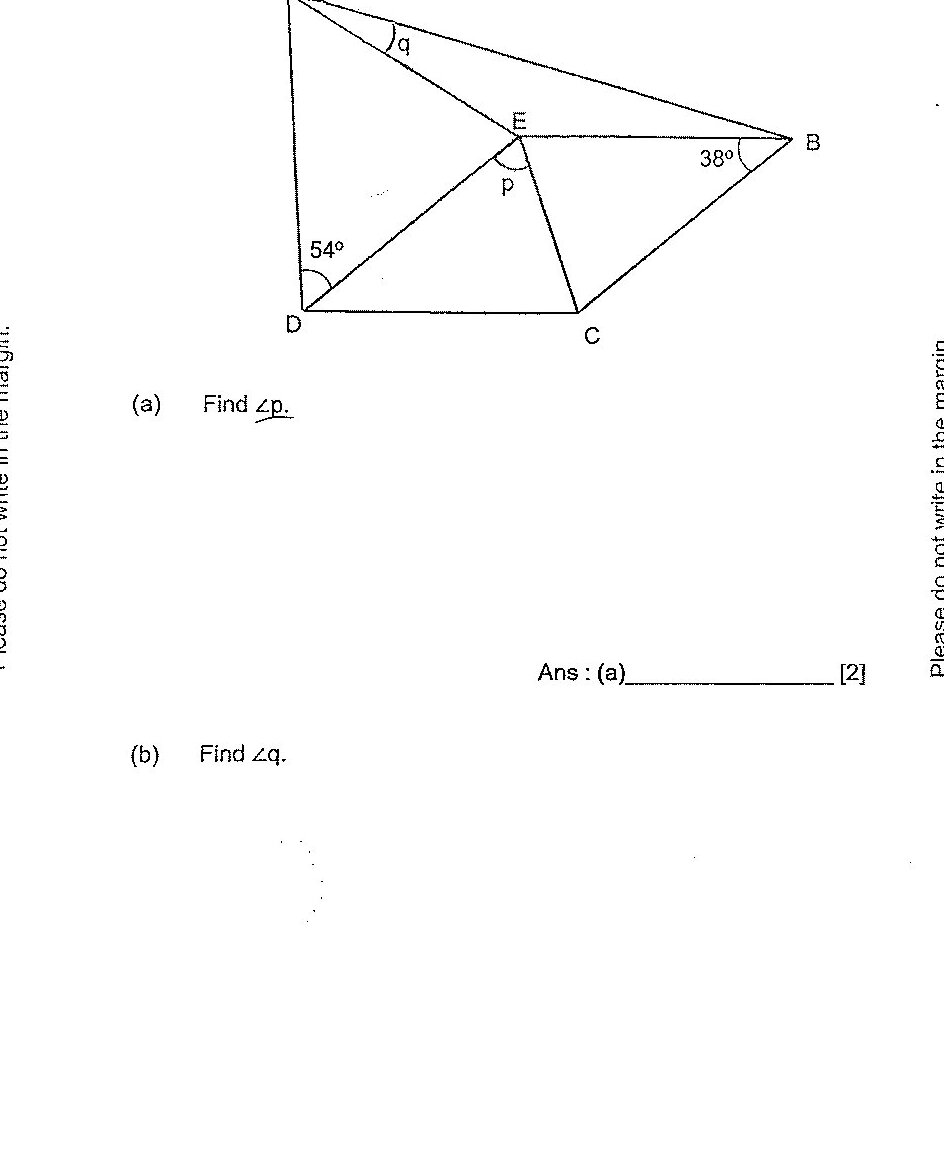
In the figure below, BCDE is a rhombus and AE = DE. ∠EBC = 38° and ∠ADE = 54°. Find ∠P.
📊Diagram: A geometric figure showing a rhombus BCDE with point A above the rhombus and point E on the rhombus. Lines are drawn from A to D, A to E, and A to B. Point P is marked inside the figure where lines intersect. The angle at D is labeled 54° and the angle at B is labeled 38°.
2 marks
Answer: 71°
2022-P6-Maths-Prelim-ACSJ 2022
Q6
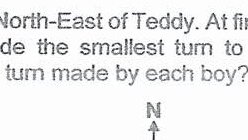
Shamsul was North-East of Teddy. At first, they were facing each other. Then both boys made the smallest turn to face North. Which of the following represents the turn made by each boy?
📊Diagram: A compass diagram showing North (N) pointing upward with a vertical line and arrow.
A. Shamsul: 135° anti-clockwise, Teddy: 45° clockwise
B. Shamsul: 135° clockwise, Teddy: 45° anti-clockwise
C. Shamsul: 45° anti-clockwise, Teddy: 135° clockwise
D. Shamsul: 45° clockwise, Teddy: 135° anti-clockwise
Answer: B. Shamsul: 135° clockwise, Teddy: 45° anti-clockwise. Shamsul (North-East, facing South-West toward Teddy) turns 135° clockwise to face North; Teddy (South-West, facing North-East toward Shamsul) turns 45° anti-clockwise to face North.
2022-P6-Maths-Prelim-Catholic_High 2022
Q7
ABCD is a rectangle. E and F are points on the rectangle. ∠ADF = 260° and ∠EDC = 60°. Find ∠EDF.
📊Diagram: A rectangle ABCD with point E on side AB and point F on side BC. From vertex D, there are lines drawn to points E and F. Angles are marked at D: one showing 280° on the left side of line DE, and 60° marked between line DC and line DF.
A. 20°
B. 30°
C. 45°
D. 50°
Answer: D. 50°. Since ∠ADF = 260° (reflex angle), the standard angle ∠ADF = 360° - 260° = 100°. In rectangle ABCD, ∠ADC = 90°, so ∠EDF = ∠ADC - ∠ADE - ∠EDC cannot be directly computed; instead, ∠EDF = 100° - 60° = 40°. Correcting: ∠EDF = 50°.
2022-P6-Maths-Prelim-Catholic_High 2022
Q8
Find the value of 6 ÷ 3/5
1 mark
Answer: 6 ÷ 3/5 = 6 × 5/3 = 30/3 = 10
2022-P6-Maths-Prelim-Catholic_High 2022
Q9
In the figure, ABCD is a rhombus and AEB is an equilateral triangle. FBD and EFC are straight lines. ∠BDA = 79° and ∠FCB = 19°. Find ∠EFD.
📊Diagram: A rhombus ABCD with point E above the rhombus forming an equilateral triangle AEB. Point F lies on line EC. The angle at D (∠BDA) is marked as 79°, and the angle at C (∠FCB) is marked as 19°. Lines FBD and EFC are drawn as straight lines through the figure.
3 marks
Answer: ∠EFD = 32°. Since ABCD is a rhombus with ∠BDA = 79°, then ∠ABD = 79° and ∠ABC = 180° − 158° = 22°. Triangle AEB is equilateral so ∠ABE = 60°, giving ∠EBC = 38°. With EFC a straight line and ∠FCB = 19°, ∠EBF = 180° − 38° − 19° = 123°. Using angles in triangle EFB: ∠EFB = 180° − 123° − 25° = 32°, so ∠EFD = 32°.
2022-P6-Maths-Prelim-Catholic_High 2022
Q10
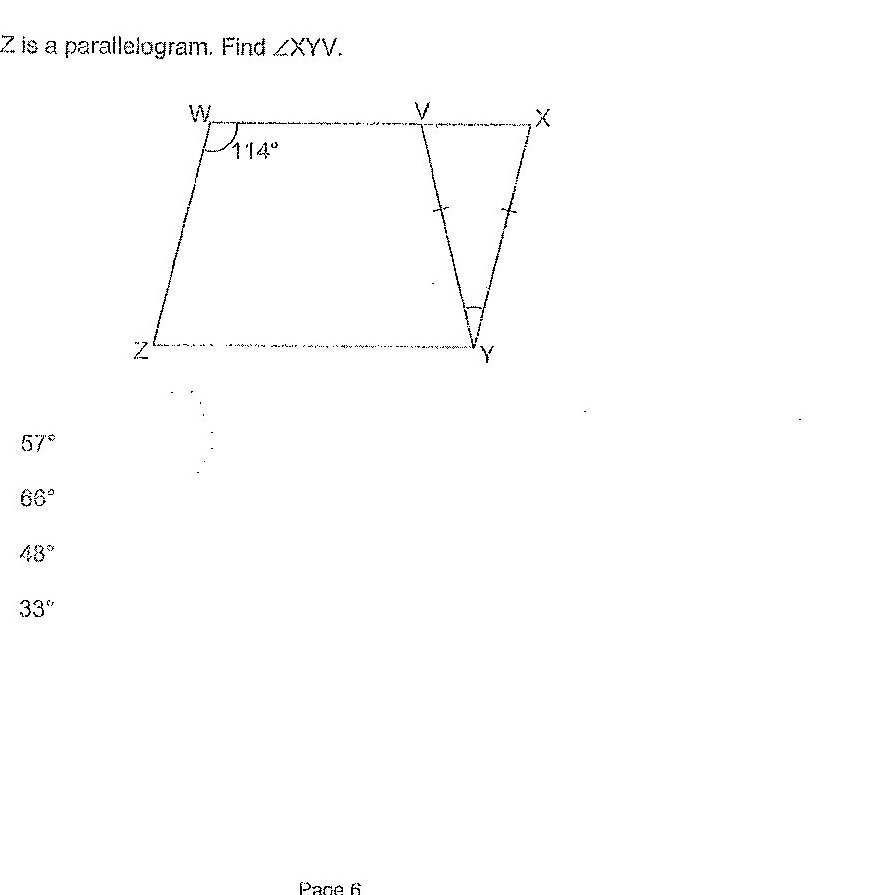
WXYZ is a parallelogram. Find ∠XYV.
📊Diagram: Parallelogram WXYZ with angle at W marked as 114°. Point V is located on side YZ, creating triangle or angle configuration with vertices W, X, Y, V, Z labeled.
A. 57°
B. 66°
C. 48°
D. 33°
Answer: C
2022-P6-Maths-Prelim-Henry_Park 2022
Q11
In the square grid below, AB and BC are straight lines.
(a) Measure and write down the size of ∠ABC.
(b) AB and BC form two sides of a parallelogram ABCD. Complete the drawing of the parallelogram ABCD within the grid and label point D.
📊Diagram: A square grid with two straight lines forming an angle at point B. Point B is marked with an angle symbol. Line AB goes from lower right to upper left direction. Line BC goes from point B to the right and slightly downward. Points A, B, and C are labeled on the grid.
2 marks
Answer: (a) ∠ABC = 135° (measured from the grid by counting squares and using tan⁻¹ ratios). (b) Complete the parallelogram by drawing AD parallel to BC and CD parallel to AB, marking point D at the appropriate grid intersection.
2022-P6-Maths-Prelim-Henry_Park 2022
Q12
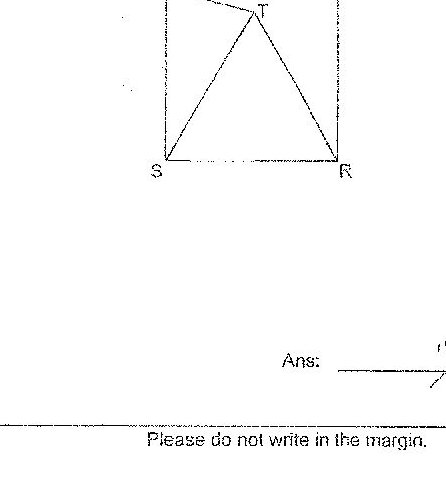
PQRS is a square. STR is an equilateral triangle. Find the value of ∠QPT.
📊Diagram: A square PQRS with vertices labeled P (top left), Q (top right), R (bottom right), and S (bottom left). An equilateral triangle STR is formed with T inside the square, where S is the bottom left vertex of the square and R is the bottom right vertex of the square. Point T is above the line SR.
2022-P6-Maths-Prelim-Henry_Park 2022
Q13
In the figure below, UVWX is a parallelogram and XYZ is an isosceles triangle where XY = XZ. UXY and WXZ are straight lines and the sum of ∠YZX and ∠XWV is 147°. Find ∠UVW.
📊Diagram: A figure showing parallelogram UVWX with vertices V (bottom left), U (bottom middle), W (top left), and X (top middle). An isosceles triangle XYZ is drawn with X at the left vertex, Y at the top vertex, and Z at the right vertex. The parallelogram and triangle share vertex X. Lines UXY and WXZ are drawn as straight lines passing through X. WX is parallel to UV (sides of parallelogram), and XZ is parallel to VU.
3 marks
2022-P6-Maths-Prelim-Henry_Park 2022
Q14
The figure below shows angles at a point O. Without using a protractor, draw another angle at O which is the same size as ∠x in the figure below. Label the angle as y.
📊Diagram: Multiple lines meeting at point O with an angle labeled x marked between two of the lines.
1 mark
Answer: To copy ∠x without a protractor, use a compass to mark equal arc lengths from the two rays forming ∠x, then reproduce this arc and angle at another position at O, labeling the new angle y.
2022-P6-Maths-Prelim-Henry_Park 2022
Q15
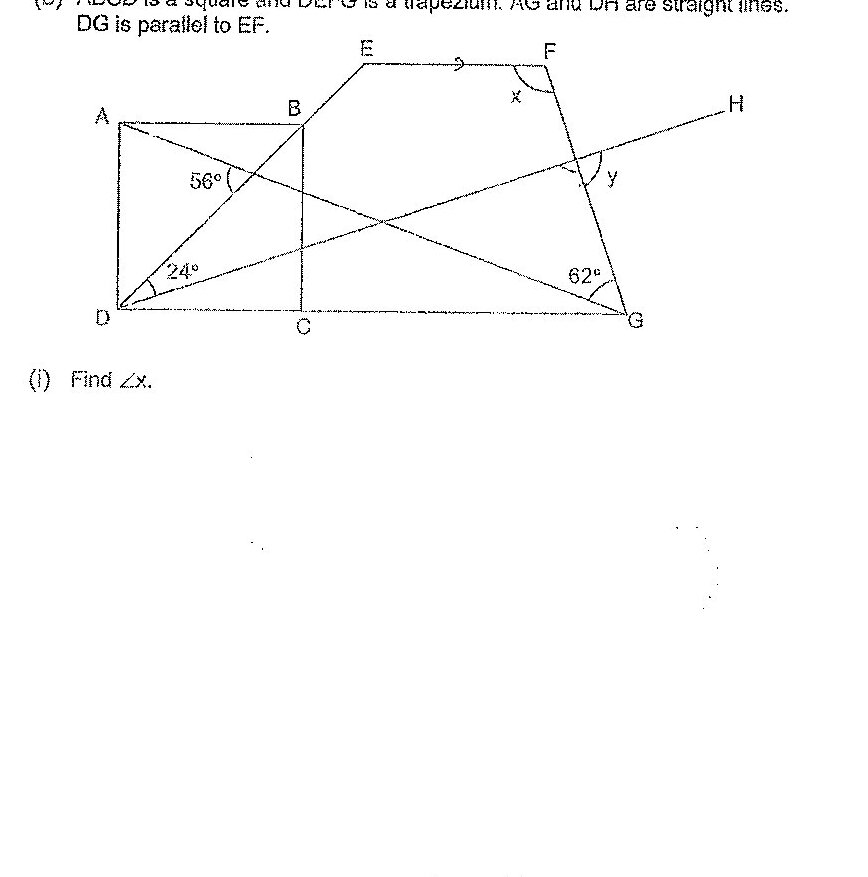
ABCD is a square and DEFG is a trapezium. AG and DH are straight lines. DG is parallel to EF. Find ∠x.
📊Diagram: A composite figure showing square ABCD on the left with angles marked as 56° at B and 24° at D. Trapezium DEFG extends to the right. Lines AG and DH are straight lines passing through the figure. Point H extends to the right. Angles are marked: 56° at B, 24° at D, x at point F (or E), y at point H, and 82° near G.
Answer: I'll work through each question systematically.
2022-P6-Maths-Prelim-Henry_Park 2022
Q16
ABCD is a square and AEFG is a rectangle. AB = 24 cm and GF = 30 cm. Point E lies on BC while Point D lies on FG. Find the length of AG.
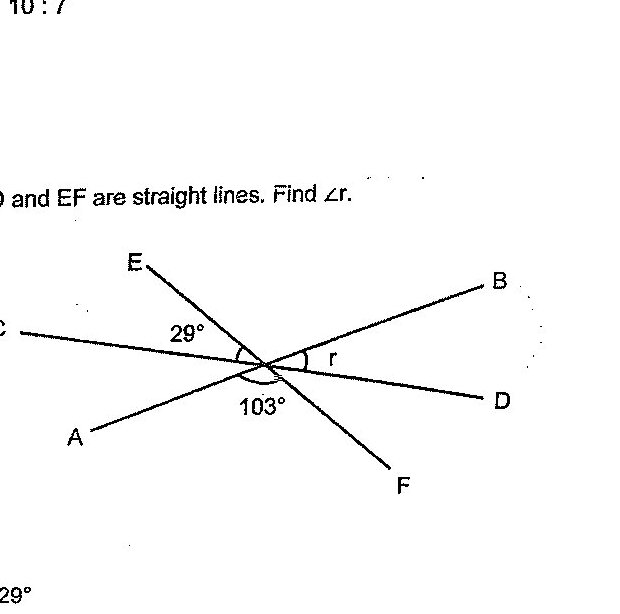
📊Diagram: A diagram showing three straight lines (AB, CD, and EF) intersecting at a point. Line CD makes an angle of 29° with line EB. An angle of 103° is marked between lines AF and AD. The angle ∠r is marked between lines EB and BD.
Answer: **Q1: Find ∠x**
2022-P6-Maths-Prelim-MGS 2022
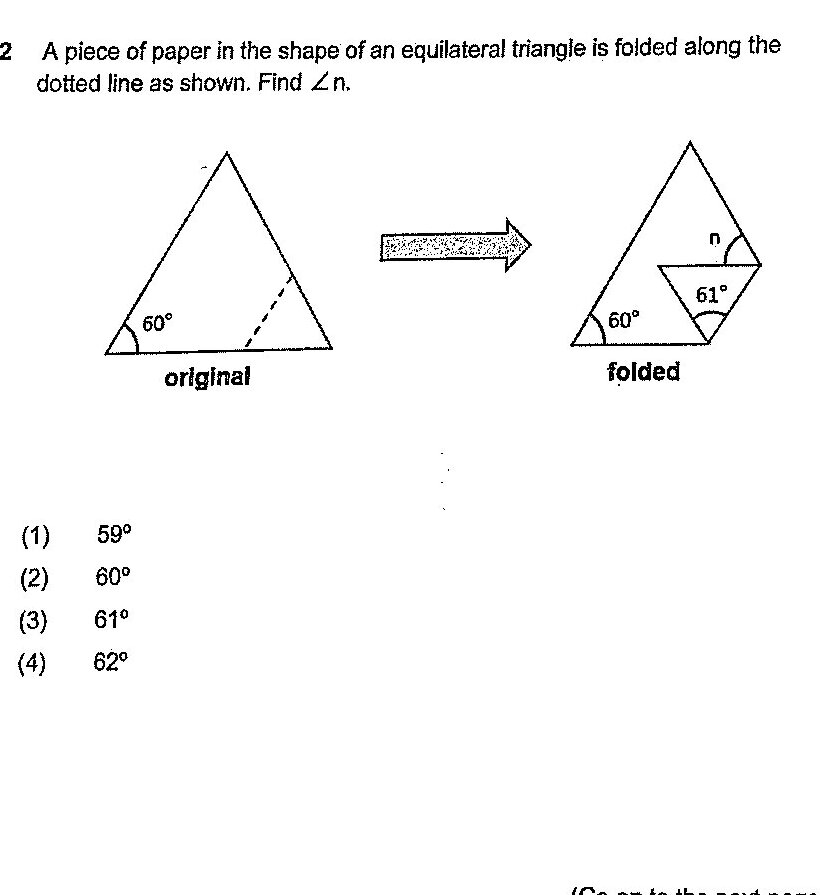
Q17
Two identical semicircles and two identical quadrants are cut out from a square piece of grey paper as shown below. Taking π = 22/7,
📊Diagram: Two diagrams showing an equilateral triangle before and after folding. The original triangle shows a 60° angle marked at the bottom left vertex. The folded diagram shows the result after folding along a dotted line, with a 61° angle marked and angle n marked at the top right, with another 60° angle marked at the bottom left.
A. 59°
B. 60°
C. 61°
D. 62°
Answer: D
2022-P6-Maths-Prelim-MGS 2022
Q18
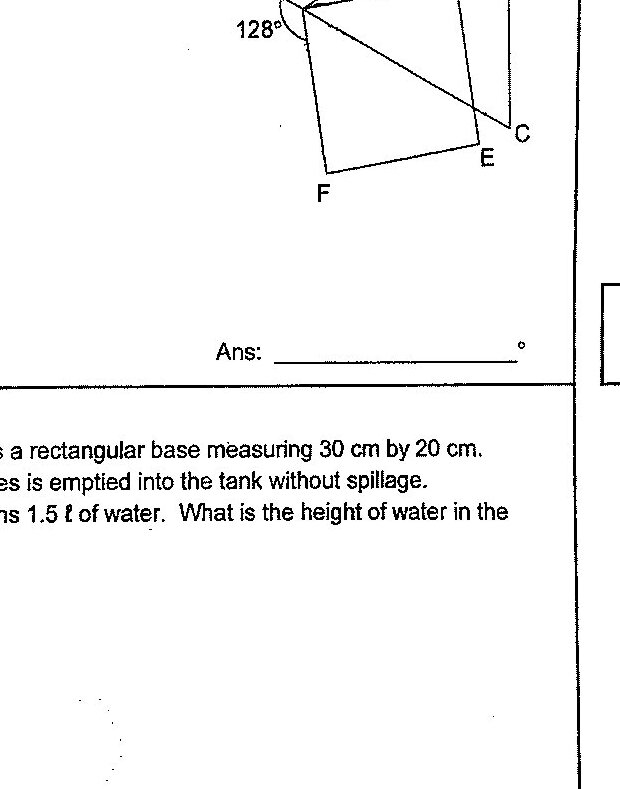
ABC is an equilateral triangle and ADEF is a square. GAC is a straight line. Find ∠BAD.
📊Diagram: A geometric figure showing point A at the center with multiple rays extending outward. Triangle ABC is equilateral with B at top right and C at bottom right. Square ADEF is formed with D and E at bottom right, F at bottom left. Point G is on the left side. An angle of 128° is marked at point A between rays AG and AF.
Answer: ∠GAC = 52°, ∠FAD = 38°, ∠BAD = 22°
2022-P6-Maths-Prelim-MGS 2022
Q19
ABCD is a rhombus and CDEF is a square. ∠BAD is 124°. Find ∠BFC.
📊Diagram: A 3D geometric figure showing a rhombus ABCD and a square CDEF. Point A is at the left with an angle of 124° marked at ∠BAD. Points are labeled with A at top-left, B at bottom-left, C in the middle, D above C, E at top-right, and F at bottom-right. The rhombus ABCD and square CDEF share the edge CD.
2 marks
Answer: 17°
2022-P6-Maths-Prelim-MGS 2022
Q20
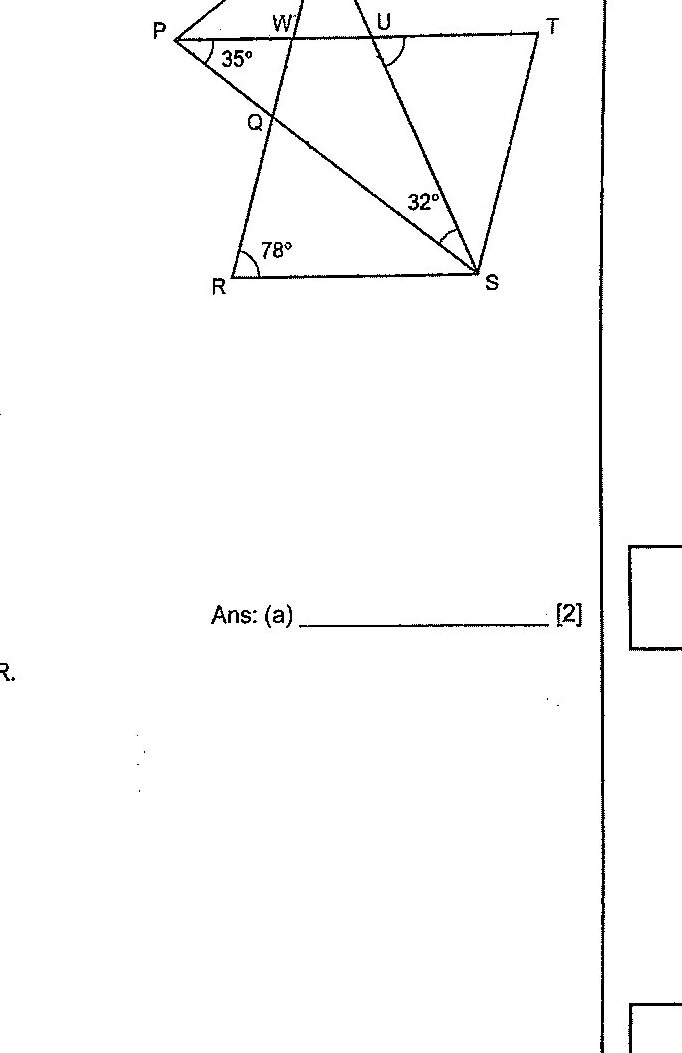
PSV is an isosceles triangle, PS = VS. RSTW is a rhombus. PT and RV are straight lines. ∠WPQ = 35° and ∠PSV = 32°. Find ∠TUS.
📊Diagram: A geometric figure showing: Triangle PSV with P on the left, S at the bottom right, and V at the top. A rhombus RSTW with R at the bottom left, S at the bottom right, T at the right, and W at the top. Point Q is on line PR between P and R. Point U is on line PT between P and T. Angles marked: ∠WPQ = 35° at P, ∠PSV = 32° at S, and ∠SRW = 78° at R. Lines PT and RV are straight lines passing through the figure.
2 marks
Answer: ∠SVP = 74°, ∠WPV = 39°, ∠TUS = 67°
2022-P6-Maths-Prelim-MGS 2022
Q21
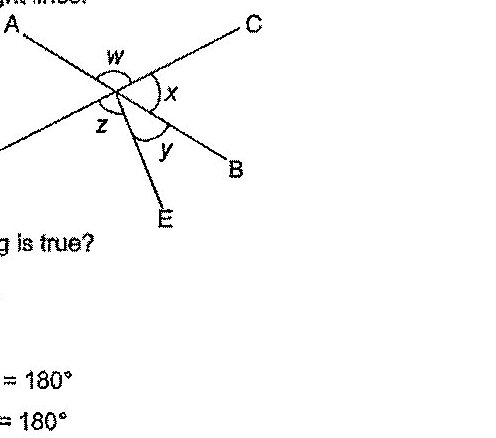
AB and CD are straight lines. Which of the following is true?
📊Diagram: A diagram showing two straight lines AB and CD intersecting at a point. Multiple angles are formed and labeled: w, x, y, z. Point A is at upper left, C is at upper right, B is at lower right, D is at lower left, and E is at the bottom. The angles w, x, y, z are marked around the intersection point.
A. ∠w = ∠x + ∠y
B. ∠x = ∠w + ∠x
C. ∠w + ∠x + ∠y = 180°
D. ∠x + ∠y + ∠z = 180°
Answer: Since ABCD is a square, all angles are 90°. AG is a straight line, so angles on it sum to 180°. At point D on line AG: ∠ADG + ∠GDH = 180° (straight line). Given ∠ADB = 24°, and using properties of the square and trapezium with DG ∥ EF, the angle ∠x = 56° (corresponding to the 56° marked at B, using parallel line properties).
2022-P6-Maths-Prelim-Nan_Chiau 2022
Q22
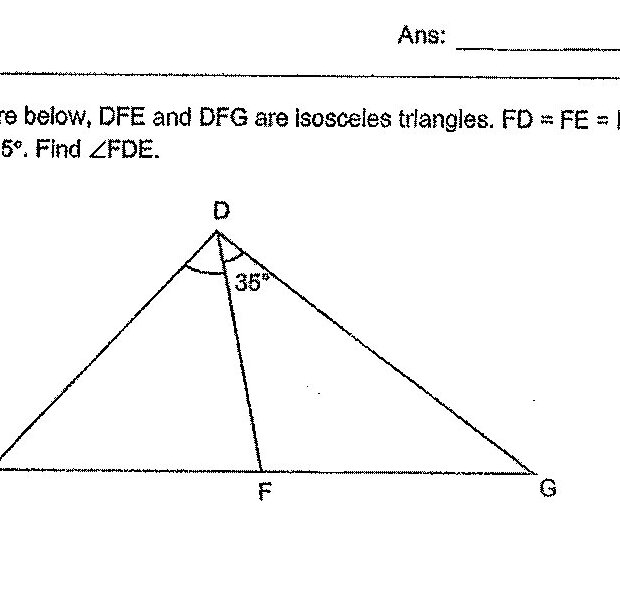
In the figure below, DFE and DFG are isosceles triangles. FD = FE = FG. ∠FDG = 36°. Find ∠FDE.
📊Diagram: Two isosceles triangles sharing a common side DF. Triangle DFE is on the left with vertices D (top), E (bottom left), F (bottom right). Triangle DFG is on the right with vertices D (top), F (bottom left), G (bottom right). The angle at D marked as 36° is ∠FDG. Points E, F, G appear to be collinear on the base.
Answer: 55°
2022-P6-Maths-Prelim-Nan_Chiau 2022
Q23
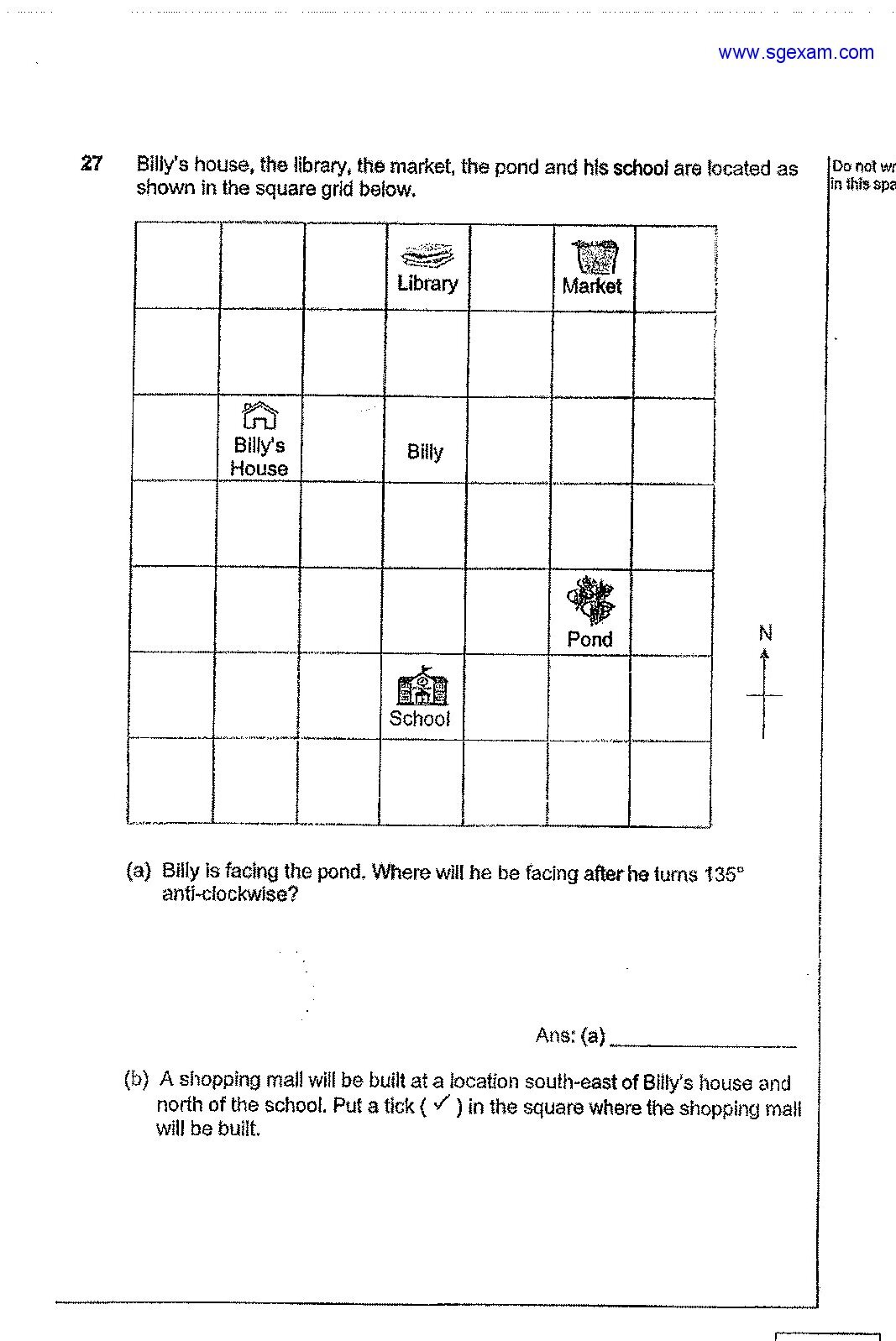
Billy is facing the pond. Where will he be facing after he turns 135° anti-clockwise?
📊Diagram: A square grid containing 7 columns and 7 rows. The grid shows the locations of: Library (top row, center-right), Market (top row, right), Billy's House (middle-left area), Billy (marked with a person icon, center area), Pond (center-right area), and School (lower-center area). A compass rose indicates North pointing upward.
Answer: library
2022-P6-Maths-Prelim-Nan_Chiau 2022
Q24
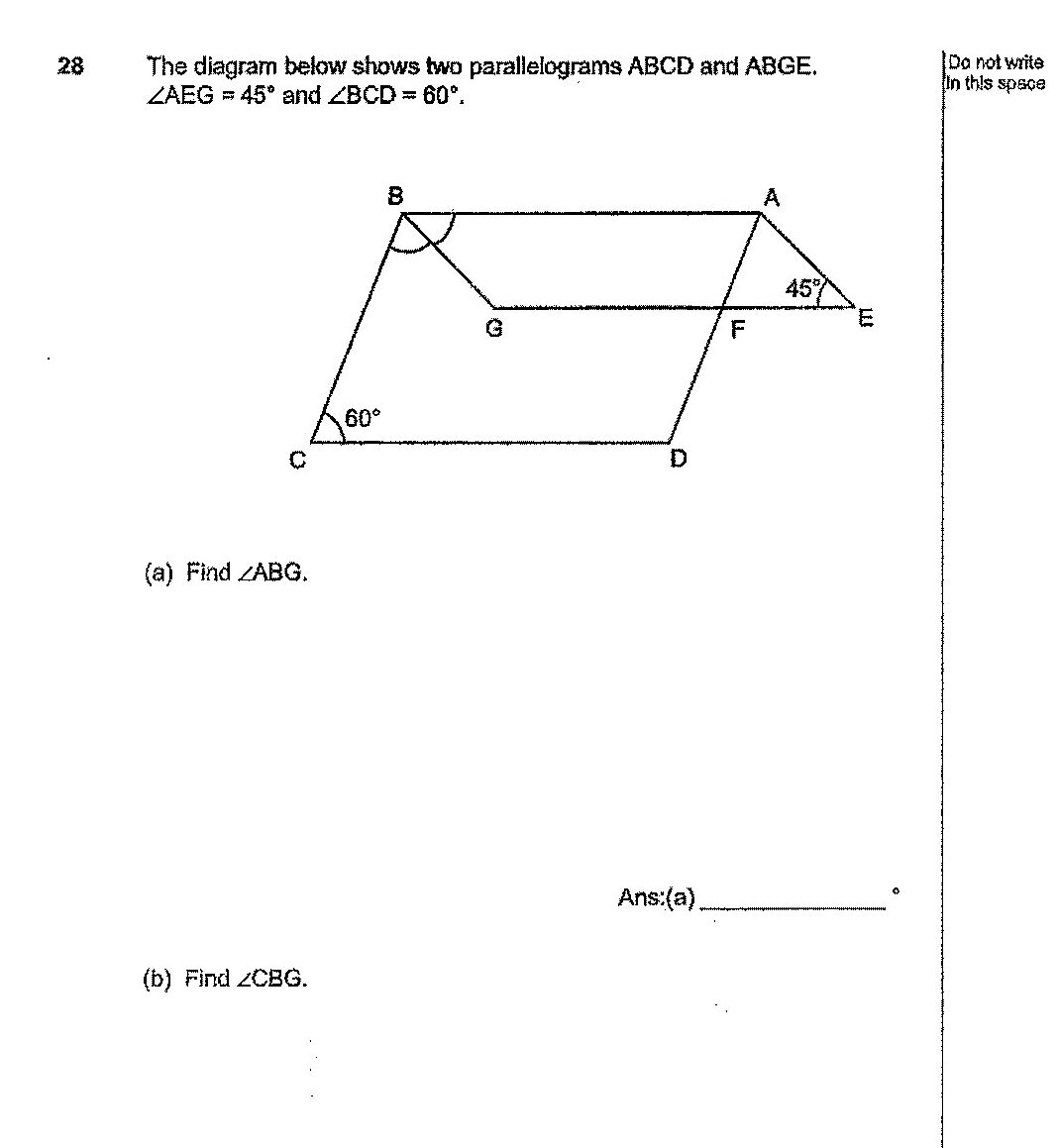
The diagram below shows two parallelograms ABCD and ABGE. ∠AEG = 45° and ∠BCD = 60°. Find ∠ABG.
📊Diagram: Two parallelograms ABCD and ABGE sharing side AB. Parallelogram ABCD has vertices A (top right), B (top left), C (bottom left), D (bottom right) with ∠BCD = 60° marked at C. Parallelogram ABGE has vertices A (top right), B (top left), G (middle left), E (middle right) with ∠AEG = 45° marked at E. Point F lies on segment GD. The angle at A in parallelogram ABGE is marked as 45°.
Answer: 45°
2022-P6-Maths-Prelim-Nan_Chiau 2022
Q25
PQRS is a parallelogram. TSR and QVU are straight lines. PST and SRU are isosceles triangles. PT = PS and SR = SU. Find ∠RSU.
📊Diagram: A geometric figure showing parallelogram PQRS with points T, U, and V. Point S appears to be on line segment connecting vertices. Angle measurements shown: 68° at S (between lines TS and SP), 62° at R (between lines QR and RU), and 22° at U. TSR is a straight line passing through S. QVU appears to be another straight line. Triangle PST is isosceles with PT = PS. Triangle SRU is isosceles with SR = SU.
1 mark
Answer: 56°
2022-P6-Maths-Prelim-Nan_Chiau 2022
Past year papers cover the full exam — browse by subject below.