Measurement and Geometry P6 PSLE Mathematics

Area and Perimeter

Area and Perimeter

Key Concepts

  • Perimeter is the total distance around the boundary of a closed shape.

    • It is measured in units of length, such as cm, m, or km.
    • To find perimeter, add up the lengths of all the sides.
  • Area is the amount of surface inside a flat 2-dimensional shape.

    • It is measured in square units, such as cm², m², or km².
    • The word “square” means the unit is multiplied by itself, for example:
      • 1 cm×1 cm=1 cm21 \text{ cm} \times 1 \text{ cm} = 1 \text{ cm}^2
  • A square is a shape with:

    • 4 equal sides
    • 4 right angles
  • A rectangle is a shape with:

    • opposite sides equal
    • 4 right angles
  • A triangle is a shape with 3 sides.

    • To find its area, we need its base and height.
    • The height must be perpendicular to the base.
  • A composite figure is a shape made by joining 2 or more simple shapes, such as rectangles, triangles, semicircles, or squares.

    • To find the area, split the figure into known shapes and add or subtract areas.
    • To find the perimeter, add only the outer boundary. Do not include internal lines.
  • A parallelogram is a 4-sided shape where:

    • opposite sides are parallel
    • opposite sides are equal in length
  • A trapezium is a 4-sided shape with one pair of parallel sides.

  • A circle is a round plane figure.

    • It has no corners and no straight sides.
    • Important parts:
      • Radius: distance from the centre to the circle
      • Diameter: distance across the circle through the centre
      • Circumference: distance around the circle
  • Relationship in circles:

    • Diameter = 2 × radius
    • Radius = diameter ÷ 2
  • Use π\pi for circle formulas.

    • In Primary 6, π\pi is often taken as:
      • 3.14, or
      • 227\frac{22}{7} when suitable
  • Formula for perimeter of a square:

    • P=4×sideP = 4 \times \text{side}
  • Formula for area of a square:

    • A=side×sideA = \text{side} \times \text{side}
  • Formula for perimeter of a rectangle:

    • P=2(length+width)P = 2(\text{length} + \text{width})
  • Formula for area of a rectangle:

    • A=length×widthA = \text{length} \times \text{width}
  • Formula for area of a triangle:

    • A=12×base×heightA = \frac{1}{2} \times \text{base} \times \text{height}
  • Formula for area of a parallelogram:

    • A=base×heightA = \text{base} \times \text{height}
  • Formula for area of a trapezium:

    • A=12×(sum of parallel sides)×heightA = \frac{1}{2} \times (\text{sum of parallel sides}) \times \text{height}
  • Formula for circumference of a circle:

    • C=πdC = \pi d
    • or C=2πrC = 2\pi r
  • Formula for area of a circle:

    • A=πr2A = \pi r^2
  • Semicircle formulas (half a circle):

    • Area of a semicircle: [ A = \frac{1}{2} \pi r^2 ]
    • Perimeter of a semicircle (curved arc + diameter): [ P = \pi r + 2r ]
    • Common mistake: forgetting to add the diameter (2r) when finding the perimeter of a semicircle — the perimeter includes both the curved part and the straight edge across the middle.

    Worked Example: Semicircle

    A semicircle has radius 7 cm. Find its area and perimeter. (Use π3.14\pi \approx 3.14)

    • Area: [ A = \frac{1}{2} \times \pi \times 7^2 = \frac{1}{2} \times \pi \times 49 = 24.5\pi \approx 76.97 \text{ cm}^2 ]
    • Perimeter: [ P = \pi \times 7 + 2 \times 7 = 7\pi + 14 \approx 35.98 \text{ cm} ]
  • Shaded region questions usually involve:

    • finding the area of a large shape
    • finding the area of the smaller unshaded shape(s)
    • subtracting:
      • Shaded area = Whole area − Unshaded area
  • Always check:

    • Are all units the same?
    • Is the question asking for area or perimeter?
    • Is the answer in the correct unit?

Important Definitions

  • Perimeter: the total length of the boundary of a closed figure.

  • Area: the amount of surface enclosed inside a 2-dimensional figure.

  • Square: a 4-sided figure with all sides equal and all angles 90°.

  • Rectangle: a 4-sided figure with opposite sides equal and all angles 90°.

  • Triangle: a 3-sided figure.

  • Base: the side chosen as the bottom of a figure, often used when finding area.

  • Height: the perpendicular distance from the base to the opposite side or vertex.

  • Perpendicular: meeting at a right angle of 90°.

  • Composite figure: a figure formed by combining two or more simple shapes.

  • Parallelogram: a 4-sided figure with both pairs of opposite sides parallel.

  • Trapezium: a 4-sided figure with one pair of parallel sides.

  • Circle: a plane figure where every point on the boundary is the same distance from the centre.

  • Centre: the fixed point in the middle of a circle.

  • Radius: a straight line from the centre of a circle to its boundary.

  • Diameter: a straight line passing through the centre of a circle and joining two points on the boundary.

  • Circumference: the distance around a circle.

  • Shaded region: the part of a figure that is coloured or marked, usually found by subtracting one area from another.

  • Square unit: a unit used to measure area, such as cm² or m².


Worked Examples

Example 1: Area and perimeter of a rectangle

A rectangle has length 12 cm and width 5 cm. Find:

  1. its perimeter
  2. its area

Step 1: Write the formulas

  • Perimeter of rectangle = 2(l+w)2(l+w)
  • Area of rectangle = l×wl \times w

Step 2: Substitute the values

  • l=12l = 12 cm
  • w=5w = 5 cm

Step 3: Find the perimeter

P=2(12+5) P = 2(12+5)
P=2(17) P = 2(17)
P=34 cm P = 34 \text{ cm}

Step 4: Find the area

A=12×5 A = 12 \times 5
A=60 cm2 A = 60 \text{ cm}^2

Answer

  • Perimeter = 34 cm
  • Area = 60 cm²

Example 2: Area of a trapezium

A trapezium has parallel sides of 8 m and 14 m. Its height is 6 m. Find its area.

Step 1: Write the formula

A=12(a+b)h A = \frac{1}{2}(a+b)h

Step 2: Substitute the values

A=12(8+14)×6 A = \frac{1}{2}(8+14)\times 6

Step 3: Calculate

8+14=22 8+14=22
A=12×22×6 A = \frac{1}{2}\times 22 \times 6
A=11×6 A = 11 \times 6
A=66 A = 66

Answer

Area = 66 m²


Example 3: Shaded region involving a circle

A circle of radius 7 cm is drawn inside a square of side 14 cm. Find the shaded area inside the square but outside the circle. Use π=227\pi = \frac{22}{7}.

Step 1: Find the area of the square

Asquare=14×14=196 cm2 A_{\text{square}} = 14 \times 14 = 196 \text{ cm}^2

Step 2: Find the area of the circle

Formula:

Acircle=πr2 A_{\text{circle}} = \pi r^2

Substitute:

Acircle=227×7×7 A_{\text{circle}} = \frac{22}{7}\times 7 \times 7
Acircle=22×7 A_{\text{circle}} = 22 \times 7
Acircle=154 cm2 A_{\text{circle}} = 154 \text{ cm}^2

Step 3: Find the shaded area

Shaded area=196154 \text{Shaded area} = 196 - 154
=42 cm2 = 42 \text{ cm}^2

Answer

Shaded area = 42 cm²


Example 4: Composite figure (L-shape)

An L-shaped figure has a total width of 10 cm and a total height of 8 cm. A rectangle of width 4 cm and height 5 cm is removed from the top-right corner. Find the area of the L-shape.

Method 1 — Subtract the missing piece:

Step 1: Find the area of the whole rectangle

Awhole=10×8=80 cm2 A_{\text{whole}} = 10 \times 8 = 80 \text{ cm}^2

Step 2: Find the area of the removed piece

Aremoved=4×5=20 cm2 A_{\text{removed}} = 4 \times 5 = 20 \text{ cm}^2

Step 3: Subtract

AL-shape=8020=60 cm2 A_{\text{L-shape}} = 80 - 20 = 60 \text{ cm}^2

Method 2 — Split into two rectangles:

Split the L-shape into a top rectangle and a bottom rectangle:

  • Bottom rectangle: 10×3=30 cm210 \times 3 = 30 \text{ cm}^2 (full width, height = 85=38 - 5 = 3 cm)
  • Top-left rectangle: 6×5=30 cm26 \times 5 = 30 \text{ cm}^2 (width = 104=610 - 4 = 6 cm, height = 5 cm)
AL-shape=30+30=60 cm2 A_{\text{L-shape}} = 30 + 30 = 60 \text{ cm}^2

Answer

Area of L-shape = 60 cm²

Key idea: For composite figures, you can either (a) subtract the missing piece from the whole, or (b) split the shape into smaller rectangles and add the parts. Both methods give the same answer.


Common Mistakes to Avoid

  • Mixing up area and perimeter.

    • Perimeter is around the shape.
    • Area is inside the shape.
  • Forgetting to write the correct units.

    • Perimeter uses units like cm, m.
    • Area uses square units like cm², m².
  • Using the wrong formula for triangles.

    • Correct formula: 12×base×height\frac{1}{2} \times \text{base} \times \text{height}
    • Do not use base × height without dividing by 2.
  • Using the slanted side as the height in triangles or parallelograms.

    • Height must be perpendicular to the base.
  • In trapeziums, adding all four sides in the area formula.

    • Only use the two parallel sides and the height.
  • In composite figures, including internal lines when finding perimeter.

    • Perimeter includes only the outer boundary.
  • Forgetting to find missing side lengths.

    • Some questions require subtraction before you can find area or perimeter.
  • Using diameter instead of radius for area of a circle.

    • Area formula needs radius: πr2\pi r^2
  • Using radius instead of diameter in C=πdC = \pi d without changing the formula.

    • If using radius, use C=2πrC = 2\pi r
  • Not using the correct value of π\pi stated in the question.

    • If not given, use the standard value expected by the question, usually 3.14 or 227\frac{22}{7}
  • Rounding too early.

    • Calculate carefully first, then round only if needed.
  • Not subtracting correctly in shaded region questions.

    • Decide clearly which part is the whole and which part must be removed.

Exam Tips

  • Underline the key information:

    • lengths
    • widths
    • radii
    • diameters
    • heights
    • units
  • Circle the command word:

    • find the area
    • find the perimeter
    • find the circumference
    • find the shaded region
  • Always write the formula before substituting values.

    • This helps you earn method marks.
  • Use labels in your working, such as:

    • “Area of rectangle = …”
    • “Area of circle = …”
    • “Shaded area = total area − inner area”
  • For composite figures:

    • split the shape clearly
    • label each smaller part
    • add or subtract the areas carefully
  • For perimeter:

    • trace the outside edge with your finger or pencil
    • check that no side is counted twice
    • make sure internal sides are not included
  • For circle questions:

    • first decide whether you need radius or diameter
    • write:
      • d=2rd = 2r, or
      • r=d2r = \frac{d}{2}, if needed
  • For shaded region questions, useful mark-earning phrases include:

    • “Find the area of the whole figure first.”
    • “Subtract the area of the unshaded part.”
    • “The shaded area is …”
  • Check units at the end:

    • cm, m for perimeter or circumference
    • cm², m² for area
  • Do a final check:

    • Is the answer reasonable?
    • Can the shaded area be bigger than the whole figure? No.
    • Can the perimeter be in square units? No.

Quick Summary

  • Perimeter is the total distance around a shape.
  • Area is the amount of space inside a shape.
  • Square:
    • perimeter = 4×side4 \times \text{side}
    • area = side2\text{side}^2
  • Rectangle:
    • perimeter = 2(l+w)2(l+w)
    • area = l×wl \times w
  • Triangle:
    • area = 12×base×height\frac{1}{2} \times \text{base} \times \text{height}
  • Parallelogram:
    • area = base×height\text{base} \times \text{height}
  • Trapezium:
    • area = 12×(sum of parallel sides)×height\frac{1}{2} \times (\text{sum of parallel sides}) \times \text{height}
  • Circle:
    • circumference = πd\pi d or 2πr2\pi r
    • area = πr2\pi r^2
  • Diameter = 2 × radius.
  • Composite figures can be split into simpler shapes to find area.
  • For perimeter of composite figures, count only the outside edges.
  • Shaded area usually = area of whole figure − area of unshaded part.
✏️ 30 practice questions available

30 questions from school exam papers

Q1

Find the area of triangle ABC shown below.
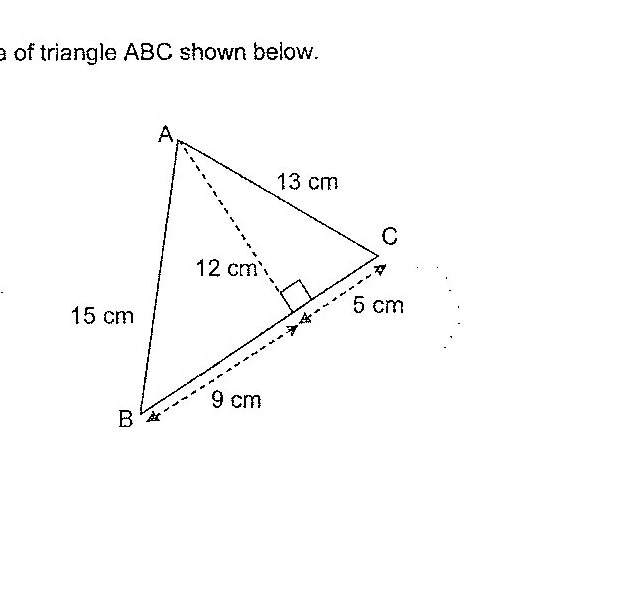
Triangle ABC with the following measurements: AB = 15 cm, AC = 13 cm, BC = 9 cm (with point B extended to show 9 cm). There is a perpendicular line from A to BC marked as 12 cm, meeting BC at a point. The point C is marked with a right angle symbol, and there is a 5 cm measurement shown from the right angle to point C.
📊 Diagram: Triangle ABC with the following measurements: AB = 15 cm, AC = 13 cm, BC = 9 cm (with point B extended to show 9 cm). There is a perpendicular line from A to BC marked as 12 cm, meeting BC at a point. The point C is marked with a right angle symbol, and there is a 5 cm measurement shown from the right angle to point C.
2022-P6-Maths-Prelim-ACSJ 2022
Q2

The figure below is made up of three quarter circles of radius 7 cm. Find the perimeter of the figure. Take π = 22/7.

A composite figure made up of three quarter circles. The radius is marked as 7 cm, with a distance of 3 cm also marked. The three quarter circles are arranged to form a shape that resembles a circular sector with additional curved sections.
📊 Diagram: A composite figure made up of three quarter circles. The radius is marked as 7 cm, with a distance of 3 cm also marked. The three quarter circles are arranged to form a shape that resembles a circular sector with additional curved sections.
A. 36 cm
B. 47 cm
C. 55 cm
D. 66 cm
2022-P6-Maths-Prelim-ACSJ 2022
Q3

There are 3 shapes A, B and C drawn in a grid. Which two shapes have the same area?
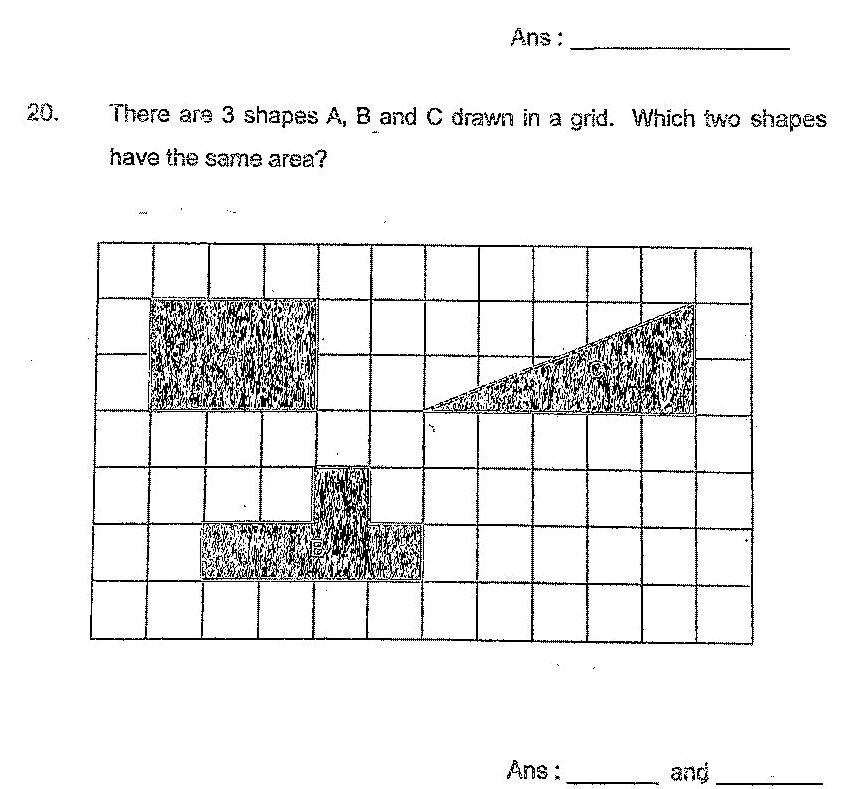
A grid showing three different shaded shapes labeled A, B, and C. Shape A appears to be an irregular quadrilateral in the upper-left portion. Shape B is an irregular shape in the lower-left portion. Shape C is an irregular quadrilateral in the upper-right portion. All shapes are drawn on a square grid where each square represents one unit.
📊 Diagram: A grid showing three different shaded shapes labeled A, B, and C. Shape A appears to be an irregular quadrilateral in the upper-left portion. Shape B is an irregular shape in the lower-left portion. Shape C is an irregular quadrilateral in the upper-right portion. All shapes are drawn on a square grid where each square represents one unit.
2022-P6-Maths-Prelim-ACSJ 2022
Q4

Figure P is a rectangular strip of paper. Xander cut out exactly 7 identical squares from the whole strip of paper and formed Figure Q as shown below. The perimeter of Figure Q is 210 cm. Find the perimeter of the strip of paper.
Two figures shown side by side. Figure P shows a rectangular strip with dashed lines indicating 7 identical squares cut from it. Figure Q shows the same 7 squares arranged in a cross or plus-sign pattern, with some squares at the top, middle, and bottom positions.
📊 Diagram: Two figures shown side by side. Figure P shows a rectangular strip with dashed lines indicating 7 identical squares cut from it. Figure Q shows the same 7 squares arranged in a cross or plus-sign pattern, with some squares at the top, middle, and bottom positions.
2 marks
2022-P6-Maths-Prelim-ACSJ 2022
Q5

Triangle ABC is folded along the line AD. The area of the new figure is 7/12 the area of Triangle ABC. The area of Triangle ADE is 65 cm². Find the area of Triangle ABC.
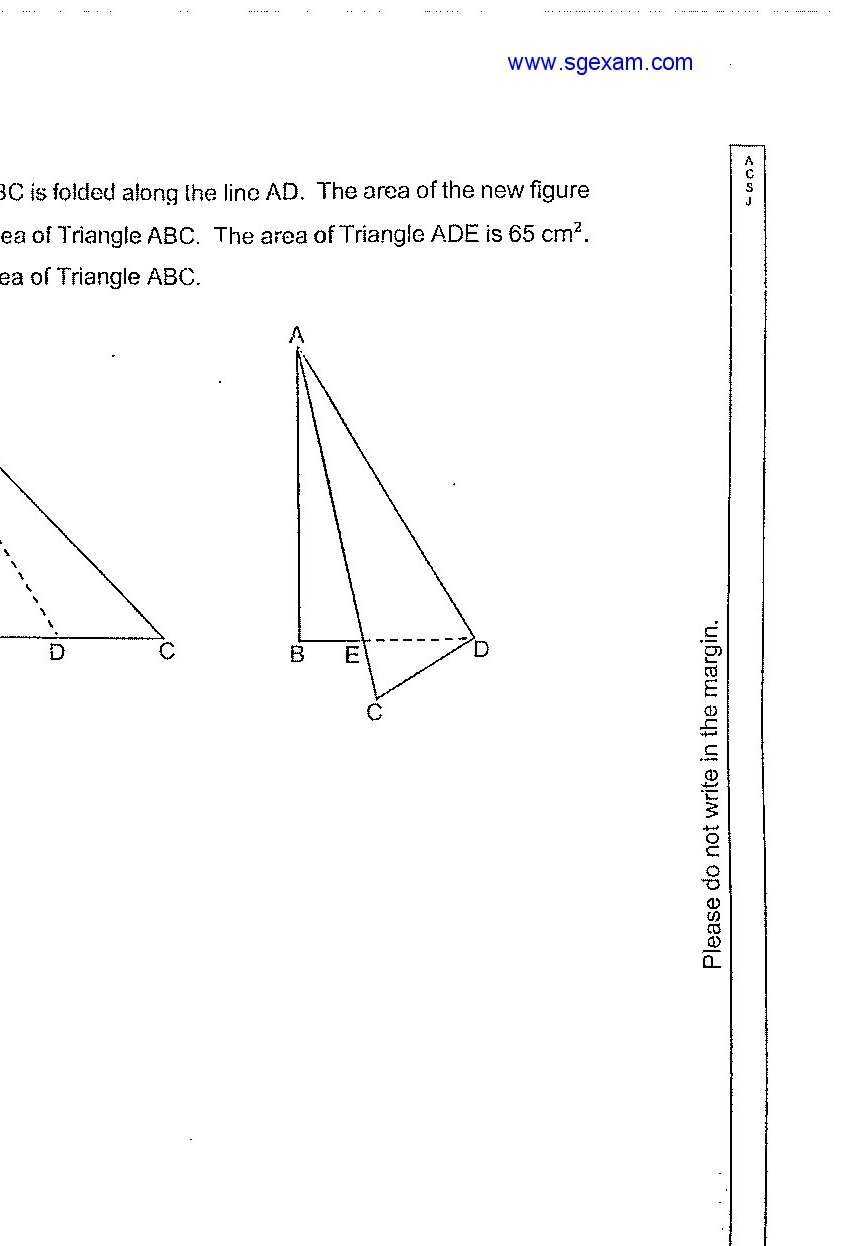
Two diagrams showing Triangle ABC before and after folding. The left diagram shows Triangle ABC with point D on side BC and a fold line AD indicated by a dashed line. The right diagram shows the result after folding along AD, with the folded portion creating triangle ADE, where E is the new position of point C after folding.
📊 Diagram: Two diagrams showing Triangle ABC before and after folding. The left diagram shows Triangle ABC with point D on side BC and a fold line AD indicated by a dashed line. The right diagram shows the result after folding along AD, with the folded portion creating triangle ADE, where E is the new position of point C after folding.
5 marks
2022-P6-Maths-Prelim-ACSJ 2022
Q6

What is the price of the tennis racket after discount?
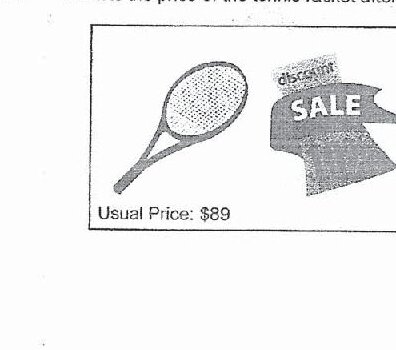
Image shows a tennis racket with a 'SALE' banner/tag. The usual price is listed as $89.
📊 Diagram: Image shows a tennis racket with a 'SALE' banner/tag. The usual price is listed as $89.
2022-P6-Maths-Prelim-Catholic_High 2022
Q7

The shaded figure below is formed using 3 different squares and a triangle. The perimeter of the triangle is 24 cm. What is the perimeter of the shaded figure?
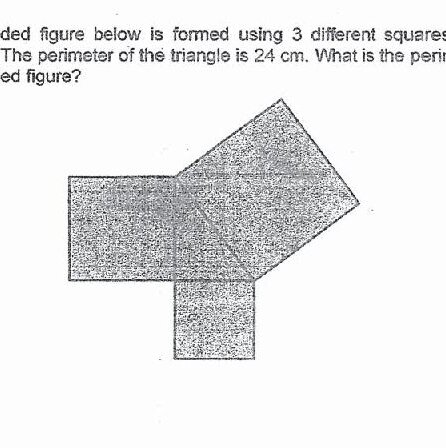
A composite shaded figure made up of 3 squares and a triangle arranged in an arrow or pointer shape. The figure consists of a horizontal rectangle (made of 2 squares) on the left, a smaller square below pointing downward, and a triangle on the upper right pointing to the upper right.
📊 Diagram: A composite shaded figure made up of 3 squares and a triangle arranged in an arrow or pointer shape. The figure consists of a horizontal rectangle (made of 2 squares) on the left, a smaller square below pointing downward, and a triangle on the upper right pointing to the upper right.
2022-P6-Maths-Prelim-Catholic_High 2022
Q8

A parallelogram ABCD is drawn on a square grid inside a box. By joining the dots on the grid with straight lines. (a) draw a triangle ACE such that AE is parallel to CB and it has the same area as triangle ABC. (b) draw a triangle BCF such that ∠CBF is a right angle and BF = CF. Triangle BCF must not overlap with the parallelogram ABCD.
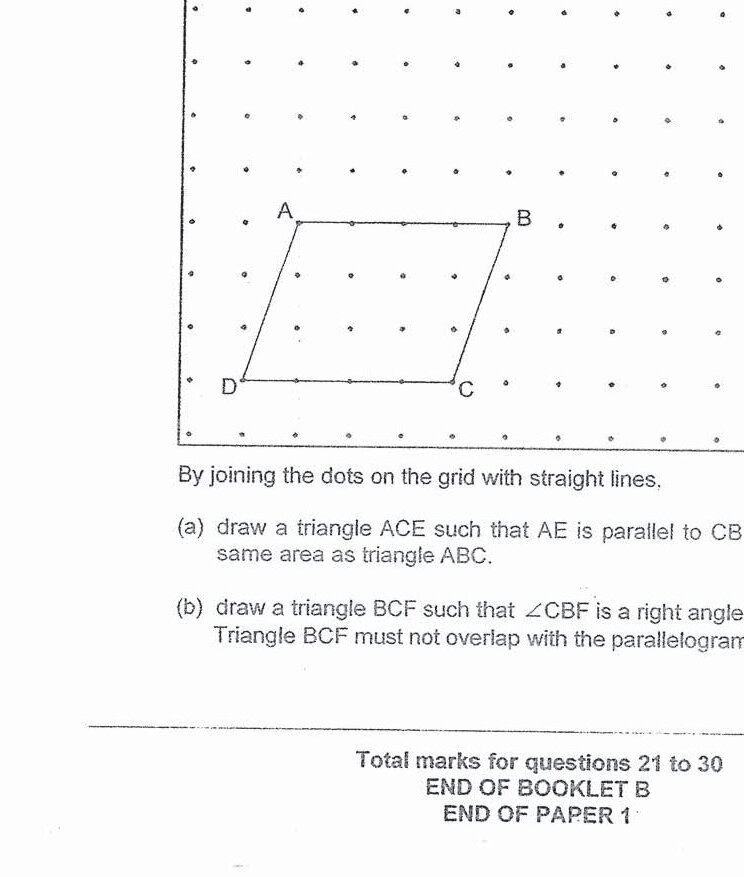
A square grid with dots arranged in rows and columns. A parallelogram ABCD is drawn on the grid with vertices labeled A, B, C, and D. The parallelogram appears to be slanted, with A and B on an upper horizontal line, and D and C on a lower horizontal line. Grid dimensions appear to be approximately 13 columns × 10 rows of dots.
📊 Diagram: A square grid with dots arranged in rows and columns. A parallelogram ABCD is drawn on the grid with vertices labeled A, B, C, and D. The parallelogram appears to be slanted, with A and B on an upper horizontal line, and D and C on a lower horizontal line. Grid dimensions appear to be approximately 13 columns × 10 rows of dots.
20 marks
2022-P6-Maths-Prelim-Catholic_High 2022
Q9

A rectangular paper OPQS of area 432 cm² is folded along the dotted line OO to form the figure OSRPQ of area 312 cm². RP = 18 cm. What is the length of PQ?
Two diagrams showing a rectangular paper OPQS before folding and after folding along dotted line OO. The 'Before folding' diagram shows a rectangle with vertices labeled O (top-left), P (top-right), Q (bottom-right), and S (bottom-left), with a dotted line from O to Q and a curved arrow indicating the fold. The 'After folding' diagram shows the folded figure OSRPQ with a point S at the top, and vertices O, R, P, Q marked. A measurement of 18 cm is shown as RP.
📊 Diagram: Two diagrams showing a rectangular paper OPQS before folding and after folding along dotted line OO. The 'Before folding' diagram shows a rectangle with vertices labeled O (top-left), P (top-right), Q (bottom-right), and S (bottom-left), with a dotted line from O to Q and a curved arrow indicating the fold. The 'After folding' diagram shows the folded figure OSRPQ with a point S at the top, and vertices O, R, P, Q marked. A measurement of 18 cm is shown as RP.
3 marks
2022-P6-Maths-Prelim-Catholic_High 2022
Q10

Find the perimeter of the shaded figure.
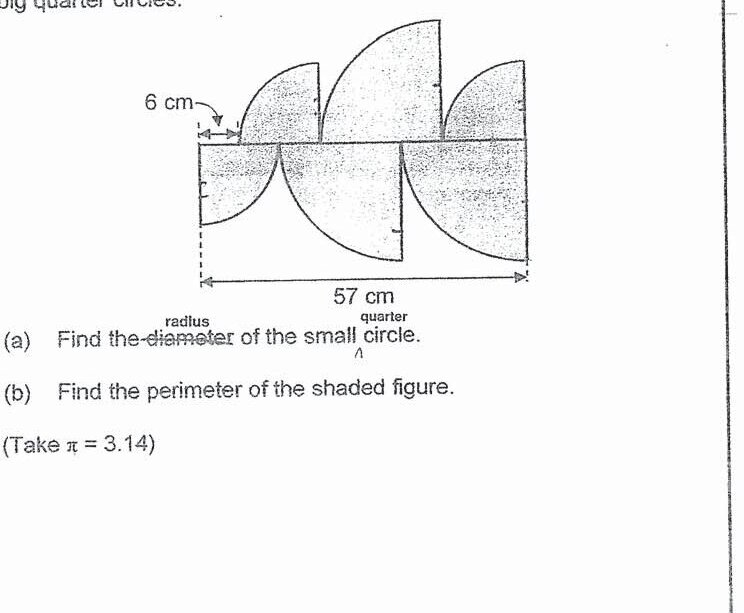
Same rectangular figure as 16a. The shaded regions consist of the 3 big quarter circles (unshaded in the diagram are the 3 small quarter circles and the rectangular sections between them).
📊 Diagram: Same rectangular figure as 16a. The shaded regions consist of the 3 big quarter circles (unshaded in the diagram are the 3 small quarter circles and the rectangular sections between them).
3 marks
2022-P6-Maths-Prelim-Catholic_High 2022
Q11

Given that AC is the base of the triangle ABC, what is the height of the triangle?
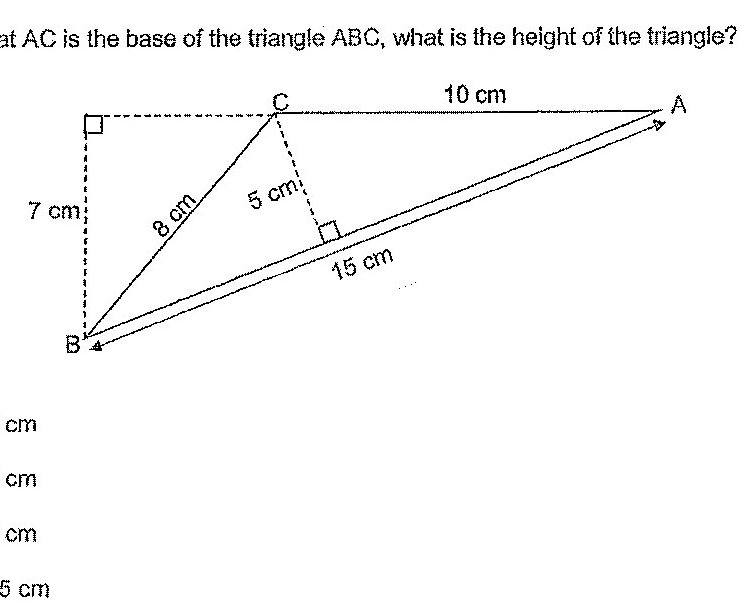
Triangle ABC with base AC = 10 cm. Point C is at top left, point A is at top right. Point B is at bottom left. A perpendicular line is drawn from B to AC, meeting AC at a right angle. This perpendicular has length 7 cm (marked on the left side). Side BC is labeled 8 cm. Side BA is labeled 15 cm. There is also a measurement of 3 cm marked on segment CB near point C, and 6 cm marked on another segment near C.
📊 Diagram: Triangle ABC with base AC = 10 cm. Point C is at top left, point A is at top right. Point B is at bottom left. A perpendicular line is drawn from B to AC, meeting AC at a right angle. This perpendicular has length 7 cm (marked on the left side). Side BC is labeled 8 cm. Side BA is labeled 15 cm. There is also a measurement of 3 cm marked on segment CB near point C, and 6 cm marked on another segment near C.
A. 5 cm
B. 7 cm
C. 8 cm
D. 15 cm
2022-P6-Maths-Prelim-Henry_Park 2022
Q12

The semicircle below has a diameter of 40 cm. What is the area of the semicircle? Take π = 3.14
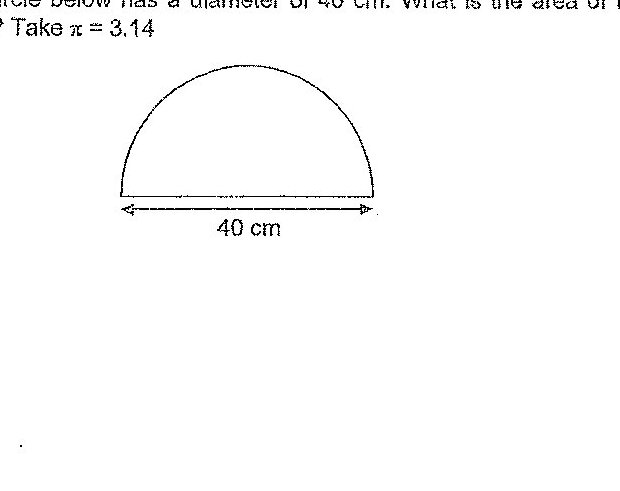
A semicircle with a horizontal diameter labeled as 40 cm at the base.
📊 Diagram: A semicircle with a horizontal diameter labeled as 40 cm at the base.
2022-P6-Maths-Prelim-Henry_Park 2022
Q13

The figure below is made up of a quarter circle and an equilateral triangle. Find the perimeter of the figure. Take π = 22/7
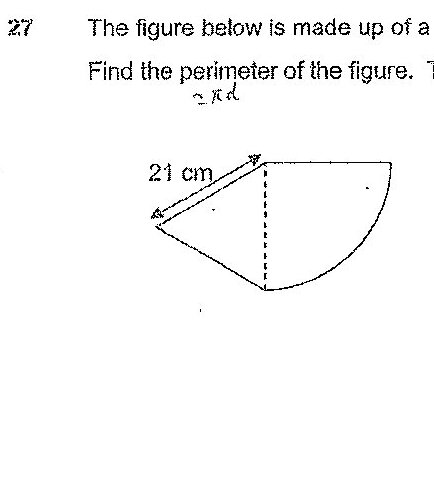
A composite figure consisting of a quarter circle and an equilateral triangle. The side length is labeled as 21 cm. The quarter circle appears to be attached to one side of the triangle, with the radius equal to the side length of the equilateral triangle (21 cm). A dashed vertical line indicates the radius of the quarter circle.
📊 Diagram: A composite figure consisting of a quarter circle and an equilateral triangle. The side length is labeled as 21 cm. The quarter circle appears to be attached to one side of the triangle, with the radius equal to the side length of the equilateral triangle (21 cm). A dashed vertical line indicates the radius of the quarter circle.
2022-P6-Maths-Prelim-Henry_Park 2022
Q14

A pyramid and its net are shown below. The base of the pyramid in both diagrams are shaded. Find the perimeter of the net of the pyramid.
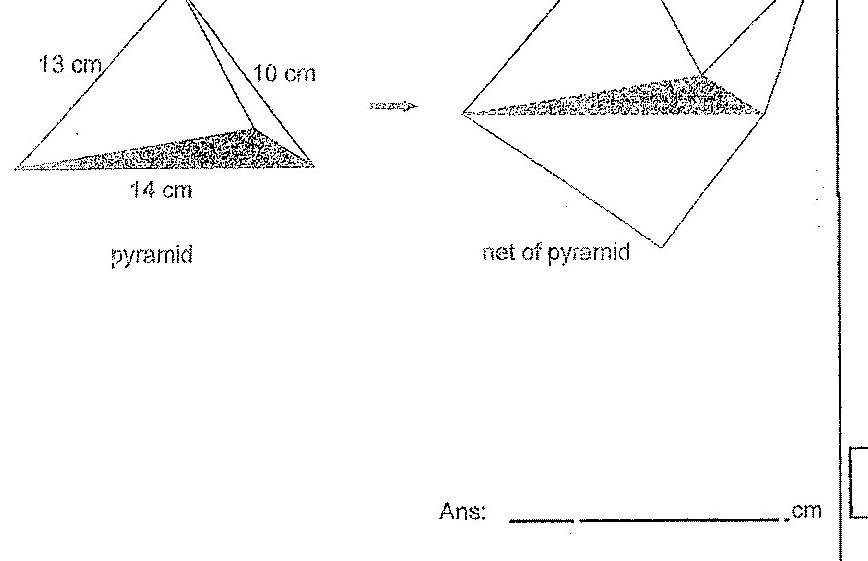
Two diagrams shown: (1) A pyramid with a rectangular base (14 cm × base width) and two triangular faces with slant heights of 13 cm and 10 cm labeled. The base is shaded. (2) The net of the pyramid showing the unfolded shape with the same rectangular base (shaded) and four triangular faces arranged around it.
📊 Diagram: Two diagrams shown: (1) A pyramid with a rectangular base (14 cm × base width) and two triangular faces with slant heights of 13 cm and 10 cm labeled. The base is shaded. (2) The net of the pyramid showing the unfolded shape with the same rectangular base (shaded) and four triangular faces arranged around it.
2022-P6-Maths-Prelim-Henry_Park 2022
Q15

The figure below is made up of triangles WXY and ABX. The total unshaded area of the figure is 180 cm². Find the shaded area BXZ.
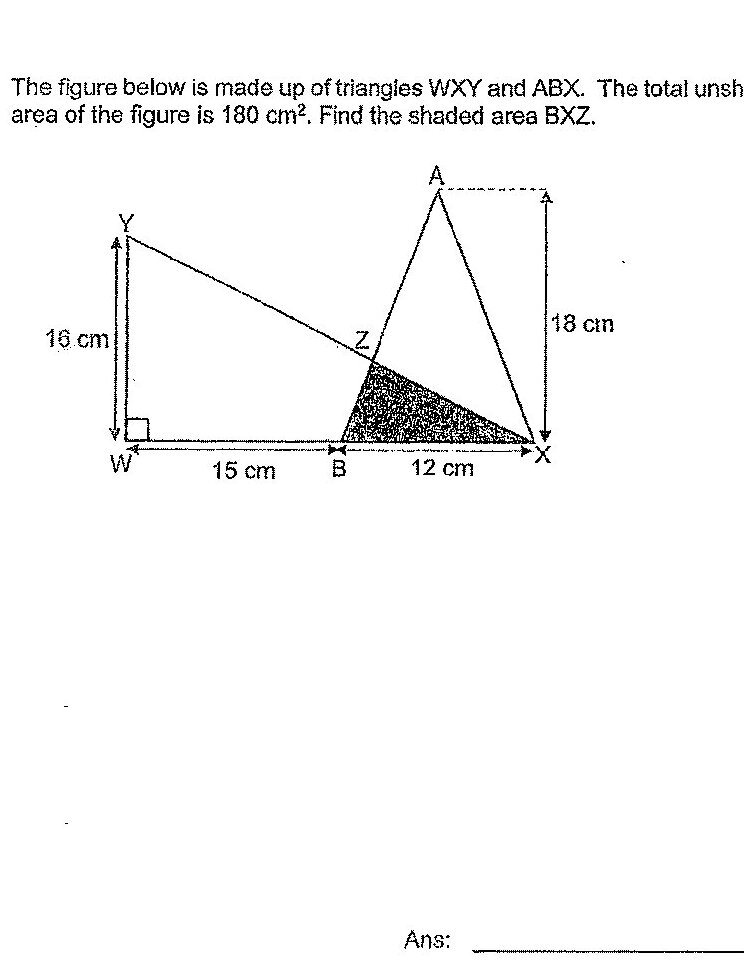
A composite figure made up of two triangles. Triangle WXY has: W at bottom left with a right angle marked, Y at top left, X at bottom right. WY = 16 cm (vertical side), WB = 15 cm (horizontal distance from W to B). Triangle ABX is positioned to the right with: A at top, X at bottom right, B on the base between W and X. AX = 18 cm (vertical side), BX = 12 cm (horizontal distance from B to X). Point Z lies on line segment AX inside triangle ABX. The shaded region is triangle BXZ (shown with dark shading/crosshatching). Z appears to be on the line from Y to X.
📊 Diagram: A composite figure made up of two triangles. Triangle WXY has: W at bottom left with a right angle marked, Y at top left, X at bottom right. WY = 16 cm (vertical side), WB = 15 cm (horizontal distance from W to B). Triangle ABX is positioned to the right with: A at top, X at bottom right, B on the base between W and X. AX = 18 cm (vertical side), BX = 12 cm (horizontal distance from B to X). Point Z lies on line segment AX inside triangle ABX. The shaded region is triangle BXZ (shown with dark shading/crosshatching). Z appears to be on the line from Y to X.
2022-P6-Maths-Prelim-Henry_Park 2022
Q16

The figure below shows a right-angled triangle and a semicircle of radius 14 cm. Use the calculator value of π to find the perimeter of the figure. Round your answer to 2 decimal places.
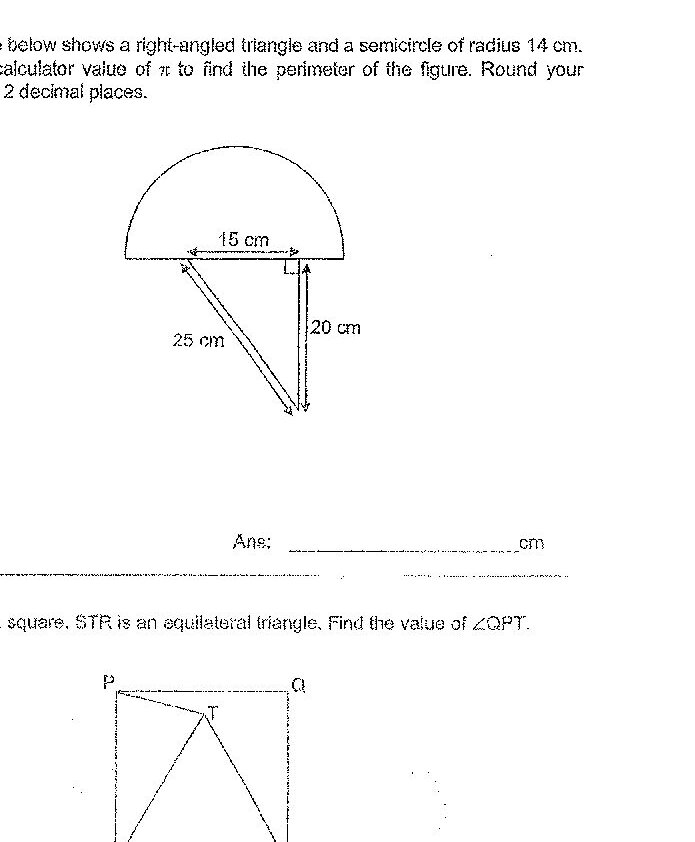
A composite figure consisting of a right-angled triangle with a semicircle on top. The semicircle has a radius of 14 cm (diameter 28 cm, but the base shown is 15 cm). The right-angled triangle has a vertical height of 20 cm, a hypotenuse of 25 cm, and the base is labeled as 15 cm. The right angle appears to be at the top right corner where the semicircle meets the triangle.
📊 Diagram: A composite figure consisting of a right-angled triangle with a semicircle on top. The semicircle has a radius of 14 cm (diameter 28 cm, but the base shown is 15 cm). The right-angled triangle has a vertical height of 20 cm, a hypotenuse of 25 cm, and the base is labeled as 15 cm. The right angle appears to be at the top right corner where the semicircle meets the triangle.
2022-P6-Maths-Prelim-Henry_Park 2022
Q17

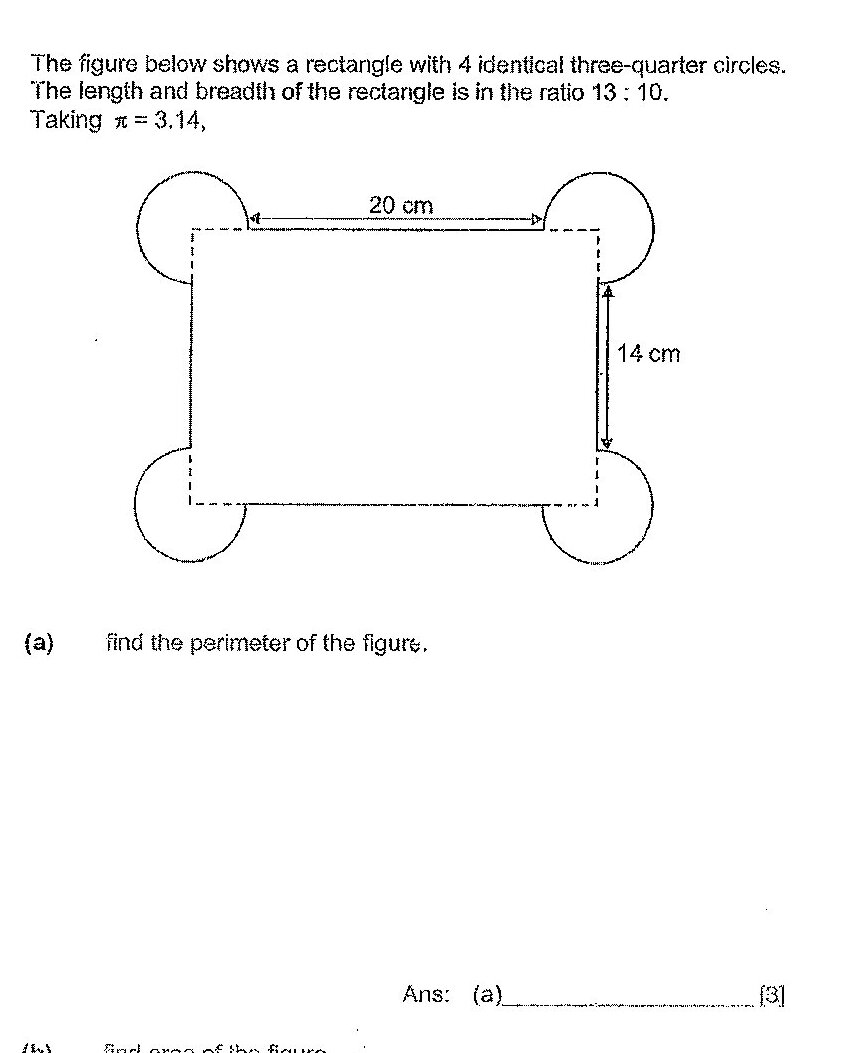
The figure below shows a rectangle with 4 identical three-quarter circles. The length and breadth of the rectangle is in the ratio 13 : 10. Taking π = 3.14, find the perimeter of the figure.
A rectangle with dimensions 20 cm (length) by 14 cm (breadth) with four identical three-quarter circles positioned at each corner of the rectangle, with the circles extending outward from the rectangle.
📊 Diagram: A rectangle with dimensions 20 cm (length) by 14 cm (breadth) with four identical three-quarter circles positioned at each corner of the rectangle, with the circles extending outward from the rectangle.
9 marks
2022-P6-Maths-Prelim-Henry_Park 2022
Q18

Find area of the figure.

Same as question 13a
📊 Diagram: Same as question 13a
2 marks
2022-P6-Maths-Prelim-Henry_Park 2022
Q19

The figure below is made up of 3 identical quarter circles with radius 7 cm. Find its perimeter. (Take π = 22/7)

A composite figure made of 3 identical quarter circles with radius 7 cm arranged in a shape resembling the letter 'D' rotated. The figure shows a quarter circle on top right, another quarter circle on bottom right, and their combination creates a curved shape. A vertical line of 7 cm is marked on the left side indicating the radius.
📊 Diagram: A composite figure made of 3 identical quarter circles with radius 7 cm arranged in a shape resembling the letter 'D' rotated. The figure shows a quarter circle on top right, another quarter circle on bottom right, and their combination creates a curved shape. A vertical line of 7 cm is marked on the left side indicating the radius.
A. 47 cm
B. 75 cm
C. 115.5 cm
D. 129.5 cm
2022-P6-Maths-Prelim-MGS 2022
Q20

ABCD is a square and AEFG is a rectangle. AB = 24 cm and GF = 30 cm. Point E lies on BC while Point D lies on FG. Find the length of AG.
A geometric figure showing a square ABCD with side length 24 cm positioned on top of a rectangle AEFG with width 24 cm and length GF = 30 cm. Point E lies on side BC of the square, and point D lies on side FG of the rectangle. The figure shows how the square and rectangle overlap/connect.
📊 Diagram: A geometric figure showing a square ABCD with side length 24 cm positioned on top of a rectangle AEFG with width 24 cm and length GF = 30 cm. Point E lies on side BC of the square, and point D lies on side FG of the rectangle. The figure shows how the square and rectangle overlap/connect.
2022-P6-Maths-Prelim-MGS 2022
Q21

Draw 3 more such triangles to form a parallelogram with the largest possible perimeter.
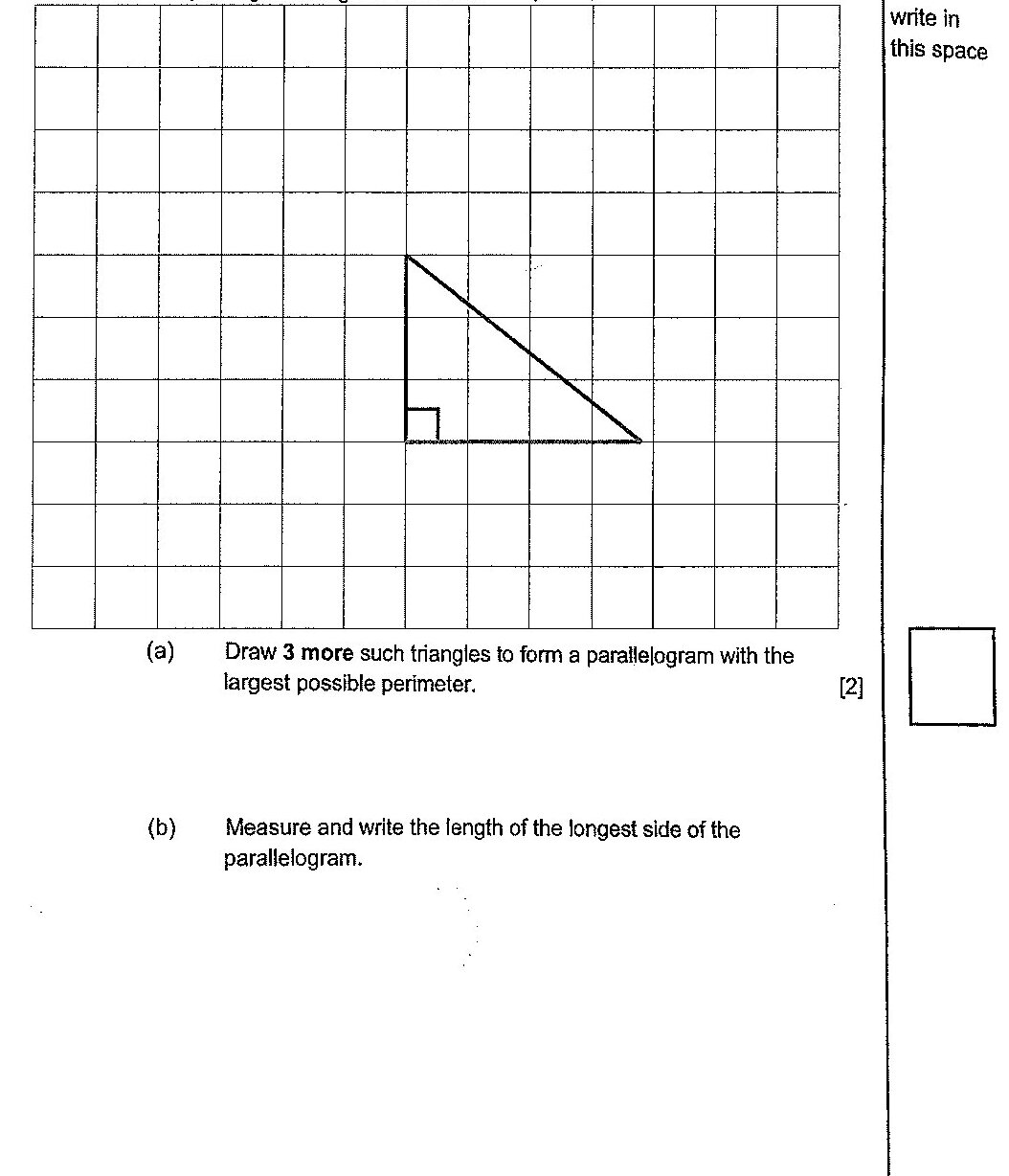
A square grid is shown with a right-angled triangle already drawn. The triangle has vertices at approximately (5, 4), (6, 4), and (9, 1) on the grid. The right angle is marked at approximately (6, 3). The grid appears to be roughly 12 units wide and 10 units tall with dotted and solid gridlines.
📊 Diagram: A square grid is shown with a right-angled triangle already drawn. The triangle has vertices at approximately (5, 4), (6, 4), and (9, 1) on the grid. The right angle is marked at approximately (6, 3). The grid appears to be roughly 12 units wide and 10 units tall with dotted and solid gridlines.
2 marks
2022-P6-Maths-Prelim-MGS 2022
Q22

Measure and write the length of the longest side of the parallelogram.

Diagram for question 9b
1 mark
2022-P6-Maths-Prelim-MGS 2022
Q23

Two identical semicircles and two identical quadrants are cut out from a square piece of grey paper as shown below. Taking π = 22/7, find the perimeter of the remaining paper
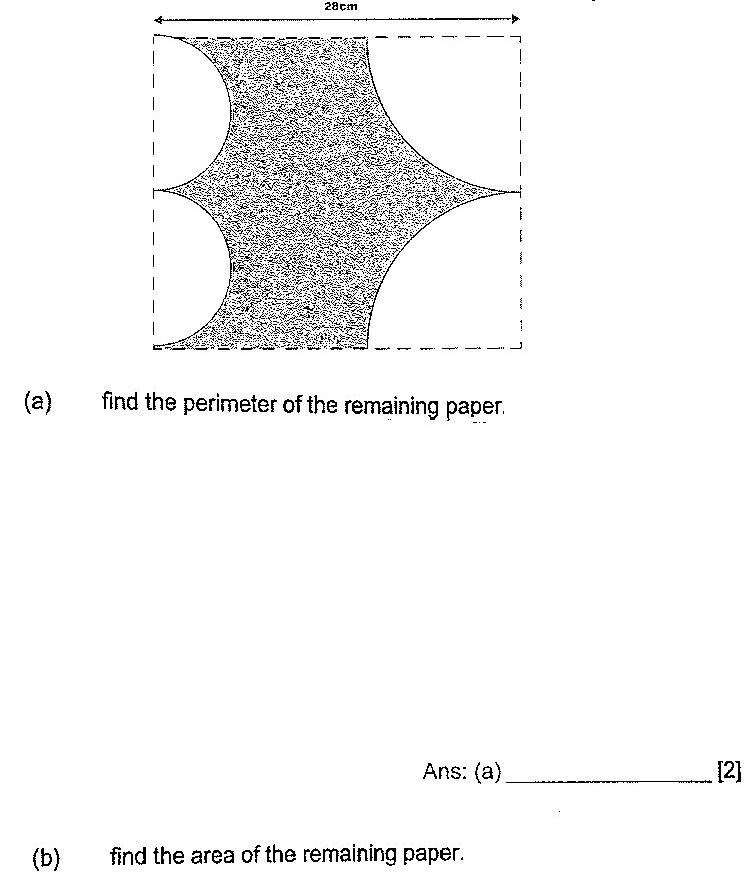
A square with side length 28cm. Two semicircles are cut out from the top and bottom edges (one from each), and two quadrants are cut out from the left and right sides (one from each). The remaining paper (shown in grey with stippled pattern) forms a shape with four curved indentations.
📊 Diagram: A square with side length 28cm. Two semicircles are cut out from the top and bottom edges (one from each), and two quadrants are cut out from the left and right sides (one from each). The remaining paper (shown in grey with stippled pattern) forms a shape with four curved indentations.
2 marks
2022-P6-Maths-Prelim-MGS 2022
Q24

find the area of the remaining paper.
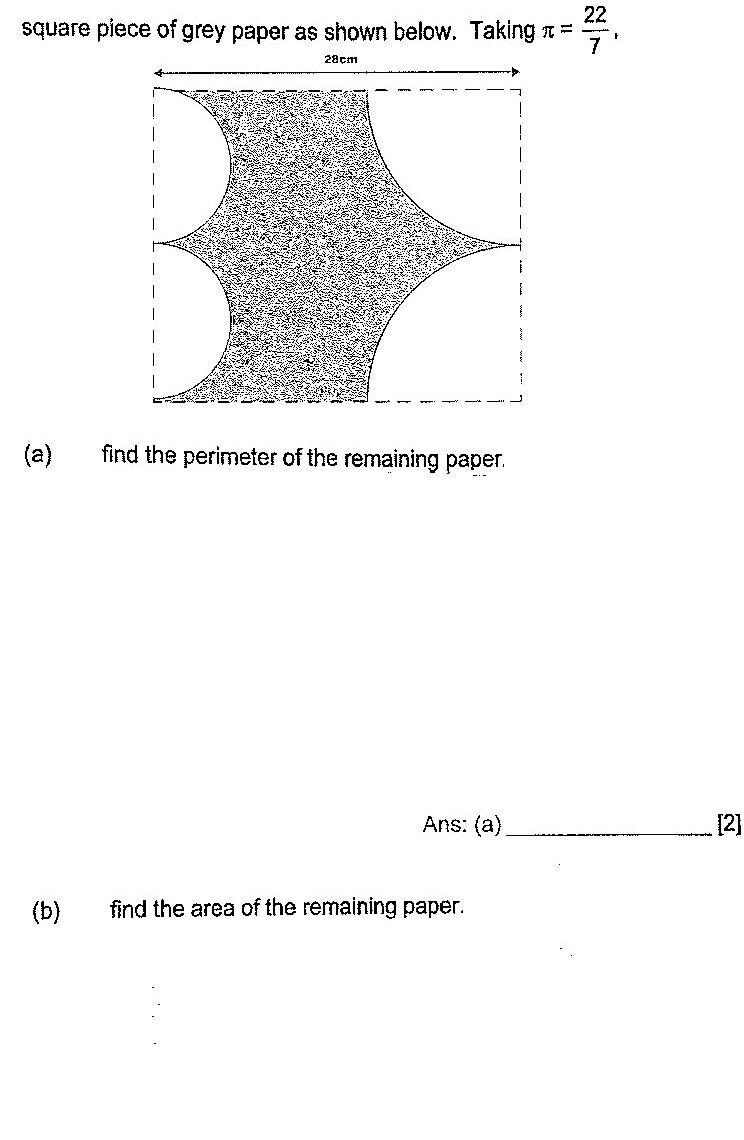
Same diagram as 12a
📊 Diagram: Same diagram as 12a
2 marks
2022-P6-Maths-Prelim-MGS 2022
Q25

There were 5/7 as many red marbles as blue marbles in a jar. Dave took some blue marbles out of the jar and replaced them with the same number of red marbles. The number of red marbles became 5/9 of all the marbles in the jar. Which of the following is a possible number of blue marbles that were replaced?
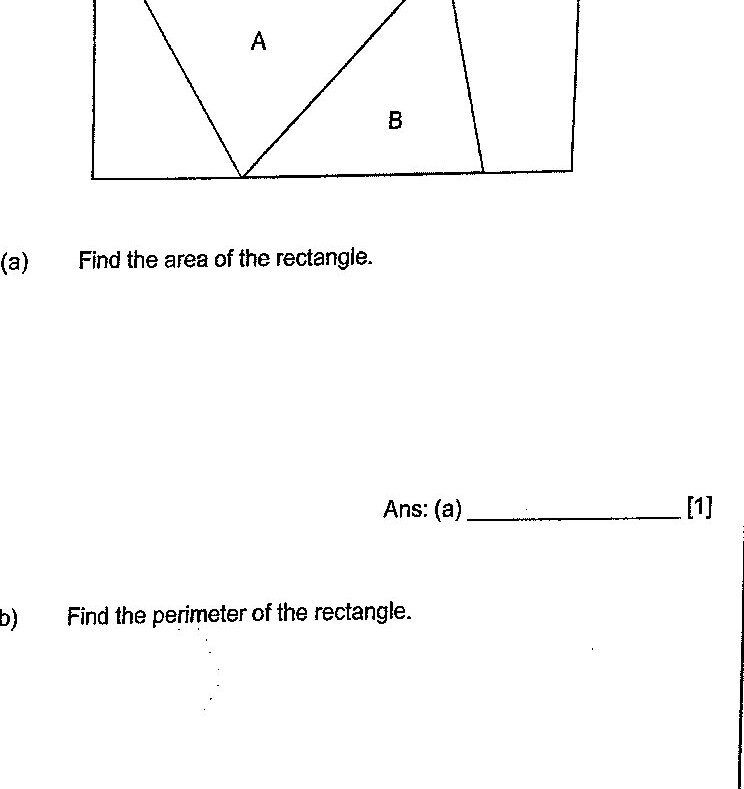
A rectangle with width 7.2 cm containing two triangles labeled A and B. Triangle A is in the upper left portion, and triangle B is in the lower right portion. The triangles are formed by diagonal lines within the rectangle.
📊 Diagram: A rectangle with width 7.2 cm containing two triangles labeled A and B. Triangle A is in the upper left portion, and triangle B is in the lower right portion. The triangles are formed by diagonal lines within the rectangle.
1 mark
2022-P6-Maths-Prelim-MGS 2022
Q26

Find the perimeter of the rectangle.

Diagram for question 15b
3 marks
2022-P6-Maths-Prelim-MGS 2022
Q27

The figure shows a semicircle of diameter 12 cm. What is the perimeter of the figure? Leave your answer in π.
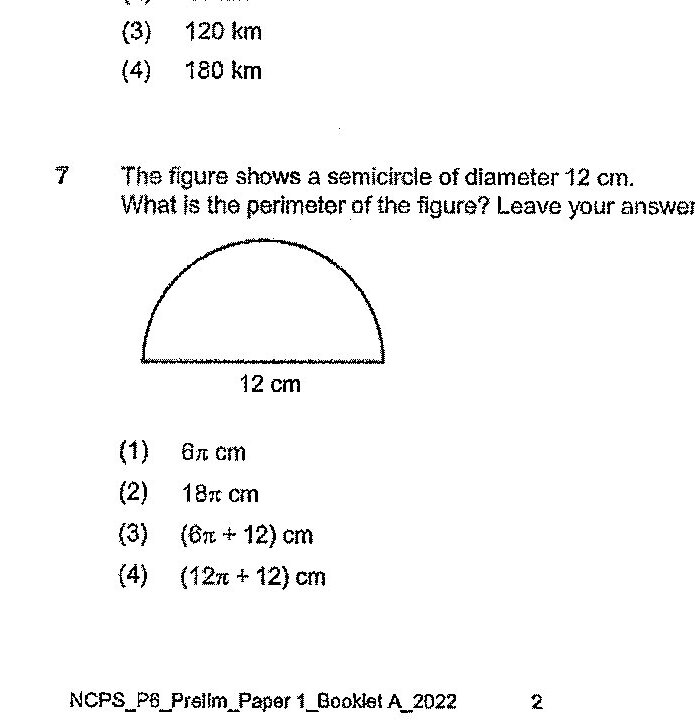
A semicircle with diameter labeled as 12 cm at the base.
📊 Diagram: A semicircle with diameter labeled as 12 cm at the base.
A. 8π cm
B. 18π cm
C. (6π + 12) cm
D. (12π + 12) cm
2022-P6-Maths-Prelim-Nan_Chiau 2022
Q28

Square ACEG is made up of 4 small triangles, 1 large triangle and 1 small square. AB = BC = CD. What fraction of the square ACEG is shaded?
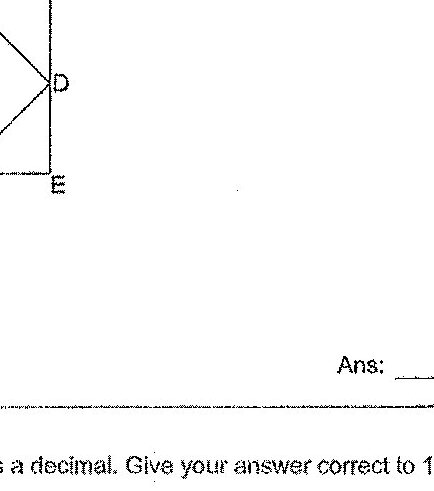
A square ACEG with vertices labeled. The square is subdivided into regions. There is a shaded region consisting of: a small square in the upper left (ABHG area), and a triangular region in the lower left (CGF area). The points are positioned as follows: A and B are on the top edge, C is to the right of B on the top edge, D is on the right edge, E is at the bottom right corner, F is on the bottom edge, G is at the bottom left corner, and H is on the left edge. The constraint AB = BC = CD indicates equal divisions along the top and right edges.
📊 Diagram: A square ACEG with vertices labeled. The square is subdivided into regions. There is a shaded region consisting of: a small square in the upper left (ABHG area), and a triangular region in the lower left (CGF area). The points are positioned as follows: A and B are on the top edge, C is to the right of B on the top edge, D is on the right edge, E is at the bottom right corner, F is on the bottom edge, G is at the bottom left corner, and H is on the left edge. The constraint AB = BC = CD indicates equal divisions along the top and right edges.
1 mark
2022-P6-Maths-Prelim-Nan_Chiau 2022
Q29

The figure below is made up of 5 identical rectangles. The breadth of one rectangle is 8 cm. What is the area of the figure?
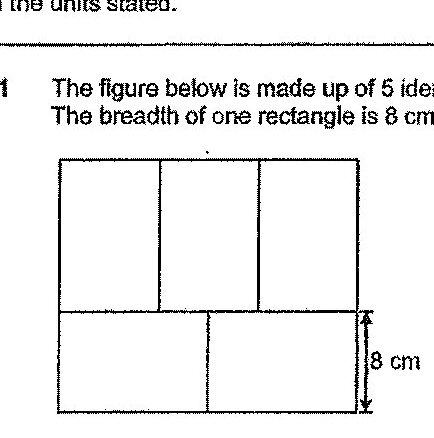
A composite figure made up of 5 identical rectangles arranged in a specific pattern. The top row contains 3 rectangles placed side by side horizontally. The bottom row contains 2 rectangles. The right edge of the figure is marked with a vertical line indicating a height of 8 cm.
📊 Diagram: A composite figure made up of 5 identical rectangles arranged in a specific pattern. The top row contains 3 rectangles placed side by side horizontally. The bottom row contains 2 rectangles. The right edge of the figure is marked with a vertical line indicating a height of 8 cm.
2 marks
2022-P6-Maths-Prelim-Nan_Chiau 2022
Q30

The figure below is made up of 4 identical quadrants and a square. What is the area of the shaded part? (Take π = 22/7)
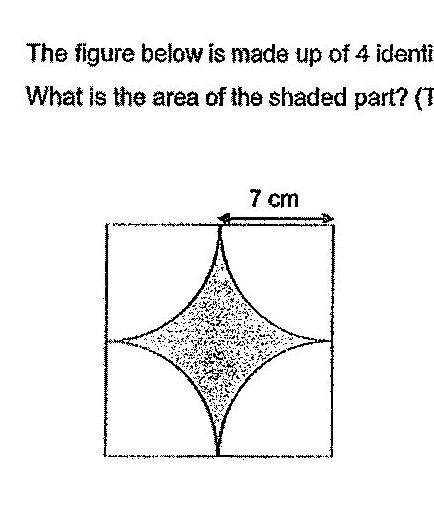
A square with side length 7 cm containing a shaded four-petaled flower or star-like shape in the center. The shape appears to be formed by four identical circular quadrants (quarter circles) positioned at the corners curving inward toward the center, creating a symmetric four-pointed star pattern with the shaded region in the middle.
📊 Diagram: A square with side length 7 cm containing a shaded four-petaled flower or star-like shape in the center. The shape appears to be formed by four identical circular quadrants (quarter circles) positioned at the corners curving inward toward the center, creating a symmetric four-pointed star pattern with the shaded region in the middle.
2022-P6-Maths-Prelim-Nan_Chiau 2022

Past year papers cover the full exam — browse by subject below.