Measurement and Geometry P6 PSLE Mathematics

Volume

Volume

Key Concepts

  • Volume is the amount of space an object takes up.

    • It tells us how much space is inside a solid.
    • It can also tell us how much liquid a container can hold.
  • The standard unit for volume of solids is cubic units.

    • Examples:
      • cm³ = cubic centimetres
      • = cubic metres
    • The word cubic means the unit is multiplied 3 times:
      • 1 cm3=1 cm×1 cm×1 cm1 \text{ cm}^3 = 1 \text{ cm} \times 1 \text{ cm} \times 1 \text{ cm}
  • For liquids, volume is often measured in:

    • millilitres (mL)
    • litres (L)
  • Useful conversion:

    • 1 L = 1000 mL
    • 1 cm³ = 1 mL

Unit Conversions for Volume

  • 1 cm³ = 1 mL (cubic centimetres and millilitres are EQUAL)

  • 1 litre (L) = 1000 mL = 1000 cm³

  • 1 m³ = 1,000,000 cm³ (but this is rarely tested at PSLE)

  • Common PSLE conversions:

    • A container holds 2.5 L → 2500 mL → 2500 cm³
    • A bottle holds 330 cm³ → 330 mL → 0.33 L
  • Key tip: cm³ and mL are interchangeable — if a question gives volume in cm³ and asks for litres, divide by 1000.

  • Worked example: “A fish tank is 40 cm long, 20 cm wide and 25 cm deep. It is filled to 80% capacity. How many litres of water does it contain?”

    • Full volume = 40 × 20 × 25 = 20 000 cm³
    • 80% = 0.8 × 20 000 = 16 000 cm³ = 16 000 mL = 16 L

Volume of Cubes and Cuboids

  • A cuboid is a solid shape with:

    • 6 rectangular faces
    • a length, width, and height
  • A cube is a special cuboid where:

    • all edges are equal in length
    • all faces are squares
  • Formula for volume of a cuboid:

    Volume=length×width×height \text{Volume} = \text{length} \times \text{width} \times \text{height}
  • Formula for volume of a cube:

    Volume=side×side×side=side3 \text{Volume} = \text{side} \times \text{side} \times \text{side} = \text{side}^3
  • The answer must always be written in cubic units for solids.

    • Example: 120 cm3120 \text{ cm}^3, not just 120 cm

Volume of Composite Solids

  • A composite solid is a solid made by joining 2 or more simple solids together.

  • In Primary 6, composite solids usually involve cuboids and cubes.

  • To find the volume of a composite solid:

    1. Split the solid into smaller cubes or cuboids.
    2. Find the volume of each part.
    3. Add the volumes together.
  • If the solid has a missing part or hollow part:

    1. Find the volume of the whole solid first.
    2. Find the volume of the missing part.
    3. Subtract.
  • You must study the dimensions carefully.

    • Some lengths may need to be found by subtraction.
    • Example: total length = 12 cm, one part = 5 cm, so remaining length = 7 cm

Volume of Liquids

  • Liquids take the shape of their container, but they still have volume.

  • The volume of liquids is commonly measured using:

    • measuring cylinders
    • beakers
    • jugs
    • containers marked with mL or L
  • Important ideas:

    • Capacity means the maximum amount of liquid a container can hold.
    • The amount of liquid actually inside may be less than the capacity.
  • Conversion between liquid and solid volume:

    • 1 cm³ = 1 mL
    • 1000 cm³ = 1000 mL = 1 L
  • Example:

    • A tank with volume 5000 cm35000 \text{ cm}^3 can hold 5000 mL5000 \text{ mL}, or 5 L

Rate of Flow Problems

  • Rate of flow tells us how much liquid moves in or out in a certain time.

  • It is usually measured in:

    • mL per minute
    • L per minute
    • cm³ per second
  • Basic formula:

    Rate of flow=VolumeTime \text{Rate of flow} = \frac{\text{Volume}}{\text{Time}}
  • Rearranged formulas:

    Volume=Rate of flow×Time \text{Volume} = \text{Rate of flow} \times \text{Time}
    Time=VolumeRate of flow \text{Time} = \frac{\text{Volume}}{\text{Rate of flow}}
  • When solving rate of flow questions:

    • make sure the units match
    • convert when needed
      • minutes to seconds
      • mL to L
      • cm³ to mL
  • In filling and emptying problems:

    • inflow means liquid enters the container

    • outflow means liquid leaves the container

    • if both happen at the same time:

      Net rate of change=Inflow rateOutflow rate \text{Net rate of change} = \text{Inflow rate} - \text{Outflow rate}

Finding Length, Width or Height Given Volume

  • If you know the volume of a cuboid and two of its dimensions, you can find the missing dimension.

  • Since:

    Volume=length×width×height \text{Volume} = \text{length} \times \text{width} \times \text{height}
  • To find a missing dimension:

    Missing dimension=VolumeProduct of the other 2 dimensions \text{Missing dimension} = \frac{\text{Volume}}{\text{Product of the other 2 dimensions}}
  • Example:

    • Volume = 96 cm³

    • length = 8 cm

    • width = 3 cm

    • height:

      96÷(8×3)=96÷24=4 cm 96 \div (8 \times 3) = 96 \div 24 = 4 \text{ cm}
  • Always check:

    • Are the units the same?
    • Does the answer make sense?

Important Definitions

  • Volume: the amount of space taken up by a solid or the amount of space inside a container.

  • Cuboid: a 3D solid with 6 rectangular faces.

  • Cube: a 3D solid with 6 square faces and all edges equal.

  • Length: the measurement from one end of an object to the other, usually the longest side of a base.

  • Width: the measurement across an object from side to side.

  • Height: the vertical measurement from bottom to top.

  • Composite solid: a solid made from two or more simple solids joined together.

  • Capacity: the maximum volume of liquid a container can hold.

  • Liquid volume: the amount of liquid in a container.

  • Rate of flow: the volume of liquid moving in or out per unit time.

  • Cubic centimetre (cm³): the volume of a cube with side length 1 cm.

  • Millilitre (mL): a unit used to measure liquid volume.

  • Litre (L): a larger unit used to measure liquid volume.

  • Inflow: liquid flowing into a container.

  • Outflow: liquid flowing out of a container.

  • Net rate: the actual rate of change after subtracting outflow from inflow.


Worked Examples

Example 1: Volume of a Cuboid

A cuboid has:

  • length = 12 cm
  • width = 5 cm
  • height = 4 cm

Find its volume.

Step 1: Write the formula

Volume=length×width×height \text{Volume} = \text{length} \times \text{width} \times \text{height}

Step 2: Substitute the values

Volume=12×5×4 \text{Volume} = 12 \times 5 \times 4

Step 3: Calculate

12×5=60 12 \times 5 = 60
60×4=240 60 \times 4 = 240

Answer

240 cm3 \boxed{240 \text{ cm}^3}

Example 2: Volume of a Composite Solid

A solid is made of 2 cuboids.

  • Bottom cuboid:

    • length = 10 cm
    • width = 4 cm
    • height = 3 cm
  • Top cuboid:

    • length = 6 cm
    • width = 4 cm
    • height = 2 cm

Find the total volume.

Step 1: Find the volume of the bottom cuboid

10×4×3=120 cm3 10 \times 4 \times 3 = 120 \text{ cm}^3

Step 2: Find the volume of the top cuboid

6×4×2=48 cm3 6 \times 4 \times 2 = 48 \text{ cm}^3

Step 3: Add the volumes

120+48=168 120 + 48 = 168

Answer

168 cm3 \boxed{168 \text{ cm}^3}

Example 3: Rate of Flow and Time

Water flows into a tank at 250 mL per minute.
How much water flows into the tank in 12 minutes?

Step 1: Write the formula

Volume=Rate of flow×Time \text{Volume} = \text{Rate of flow} \times \text{Time}

Step 2: Substitute the values

Volume=250×12 \text{Volume} = 250 \times 12

Step 3: Calculate

250×12=3000 250 \times 12 = 3000

Step 4: Write the unit

3000 mL 3000 \text{ mL}

Step 5: Convert if needed

3000 mL=3 L 3000 \text{ mL} = 3 \text{ L}

Answer

3000 mL or 3 L \boxed{3000 \text{ mL}} \text{ or } \boxed{3 \text{ L}}

Example 4: Finding a Missing Height

A cuboid has volume 180 cm³.
Its length is 9 cm and width is 4 cm.
Find its height.

Step 1: Write the formula

Volume=length×width×height \text{Volume} = \text{length} \times \text{width} \times \text{height}

Step 2: Rearrange to find height

height=Volumelength×width \text{height} = \frac{\text{Volume}}{\text{length} \times \text{width}}

Step 3: Substitute the values

height=1809×4 \text{height} = \frac{180}{9 \times 4}

Step 4: Calculate

9×4=36 9 \times 4 = 36
180÷36=5 180 \div 36 = 5

Answer

5 cm \boxed{5 \text{ cm}}

Common Mistakes to Avoid

  • Forgetting to write cubic units for solid volume.

    • Wrong: 120 cm
    • Correct: 120 cm³
  • Mixing up area and volume.

    • Area uses square units.
    • Volume uses cubic units.
  • Using the wrong formula.

    • Volume of cuboid is:

      l×w×h l \times w \times h
    • Not l+w+hl + w + h

  • Forgetting to convert units before calculating.

    • Example:
      • 2 L must be changed to 2000 mL if the rate is in mL/min
  • Reading composite solids wrongly.

    • Missing hidden dimensions
    • Not subtracting or adding correctly
  • Using the total height when only the extra height is needed, or the extra height when the total height is needed.

  • Forgetting that:

    • 1 cm³ = 1 mL
    • 1000 mL = 1 L
  • In flow questions, adding rates when you should subtract.

    • If water flows in and out at the same time:
      • use inflow − outflow
  • Dividing wrongly when finding a missing dimension.

    • You divide the volume by the product of the other 2 dimensions.
  • Leaving the answer in the wrong unit.


Exam Tips

  • Underline or circle the important information:

    • dimensions
    • units
    • rate
    • time
    • words like total, remaining, capacity, filled, emptied
  • For cuboid questions, write the formula first:

    • Volume = length × width × height
    • This helps you gain method marks.
  • For composite solids:

    • state clearly:
      • Volume of whole solid = …
      • Volume of part A = …
      • Total volume = …
    • or
      • Volume of whole block − volume of missing block
  • For liquid questions:

    • check whether the answer should be in mL or L
  • For flow questions:

    • use the correct relationship:
      • Volume = rate × time
      • Time = volume ÷ rate
      • Rate = volume ÷ time
  • If both filling and emptying happen:

    • write:
      • Net rate = inflow − outflow
  • Always include units in every step when possible.

  • After solving, ask yourself:

    • Is the answer reasonable?
    • Can a small box have a volume larger than a tank? If not, check again.
  • In word problems, use mark-earning phrases such as:

    • Find the volume of each part
    • Add the volumes
    • Subtract the missing part
    • Convert to the same unit first
    • Using volume = length × width × height

Quick Summary

  • Volume is the amount of space taken up by a solid.

  • Volume of a cuboid:

    l×w×h l \times w \times h
  • Volume of a cube:

    side3 \text{side}^3
  • Solid volume is written in cubic units such as cm³ and .

  • Composite solid volume is found by adding parts or subtracting missing parts.

  • Liquid volume is measured in mL and L.

  • 1 cm³ = 1 mL

  • 1000 mL = 1 L

  • Rate of flow:

    Rate=VolumeTime \text{Rate} = \frac{\text{Volume}}{\text{Time}}
  • For filling and emptying together:

    Net rate=inflowoutflow \text{Net rate} = \text{inflow} - \text{outflow}
  • Missing dimension of a cuboid:

    dimension=Volumeother 2 dimensions multiplied \text{dimension} = \frac{\text{Volume}}{\text{other 2 dimensions multiplied}}
  • Always check units before and after calculating.

  • Always write the final answer with the correct unit.

✏️ 30 practice questions available

30 questions from school exam papers

Q1

What is the volume of a cuboid that has a square base of side 6 cm and height 16 cm?
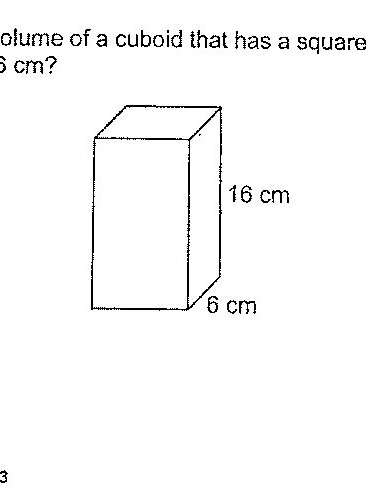
A cuboid (rectangular prism) with a square base. The base side length is labeled as 6 cm and the height is labeled as 16 cm.
📊 Diagram: A cuboid (rectangular prism) with a square base. The base side length is labeled as 6 cm and the height is labeled as 16 cm.
A. 96 cm³
B. 216 cm³
C. 576 cm³
D. 1536 cm³
2022-P6-Maths-Prelim-ACSJ 2022
Q2

How much water is in the container? Give your answer in millilitres.
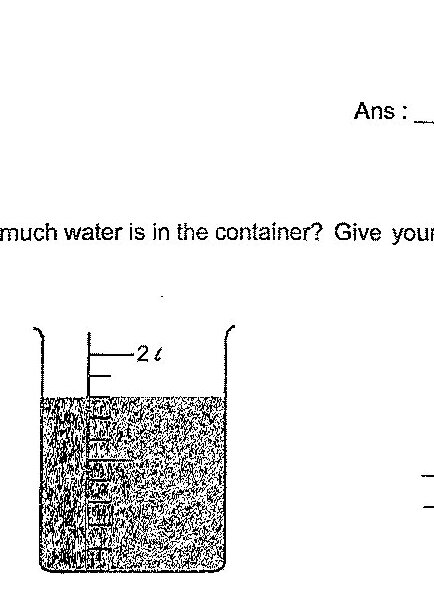
A rectangular container with water shown as shaded area. The container has a height marking of 2 ℓ indicated on the left side. The water level appears to be marked on the right side with two horizontal lines showing the measurement.
📊 Diagram: A rectangular container with water shown as shaded area. The container has a height marking of 2 ℓ indicated on the left side. The water level appears to be marked on the right side with two horizontal lines showing the measurement.
1 mark
2022-P6-Maths-Prelim-ACSJ 2022
Q3

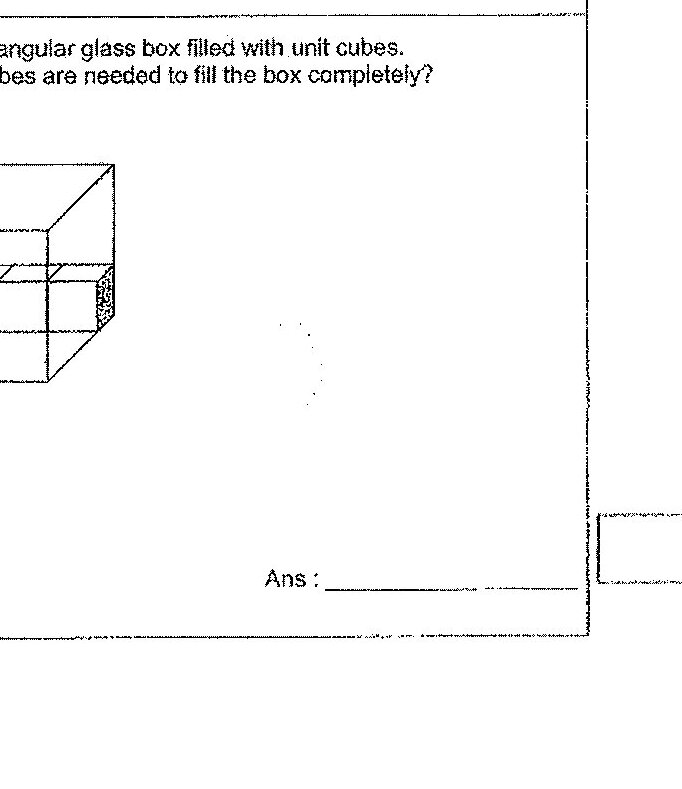
The figure shows a rectangular glass box partly filled with unit cubes. When the box is completely filled with unit cubes, how many unit cubes are there altogether?
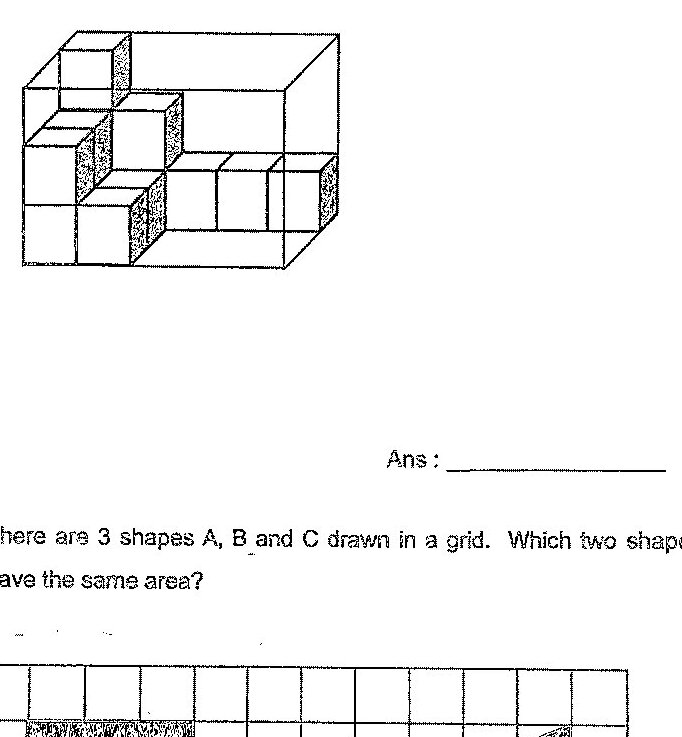
A 3D rectangular glass box shown in isometric view, partially filled with unit cubes (shown with shading/hatching). The cubes are stacked in layers. The box appears to have dimensions that can be counted from the visible cube arrangement.
📊 Diagram: A 3D rectangular glass box shown in isometric view, partially filled with unit cubes (shown with shading/hatching). The cubes are stacked in layers. The box appears to have dimensions that can be counted from the visible cube arrangement.
2022-P6-Maths-Prelim-ACSJ 2022
Q4

A rectangular tank, 6 cm long and 6 cm wide, is 4/5 filled with water. It contains 600 m³ of water. Find the height of the tank.
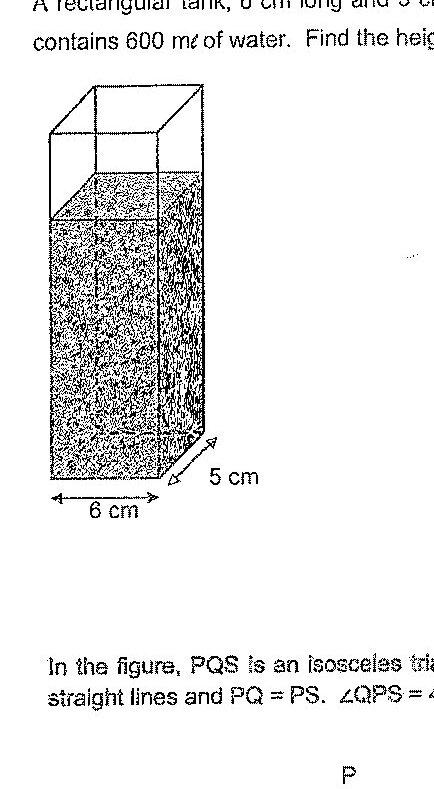
A rectangular prism (tank) with dimensions labeled: length 6 cm, width 5 cm. The tank is partially filled with water shown by shaded region. The water level is indicated inside the tank.
📊 Diagram: A rectangular prism (tank) with dimensions labeled: length 6 cm, width 5 cm. The tank is partially filled with water shown by shaded region. The water level is indicated inside the tank.
2022-P6-Maths-Prelim-ACSJ 2022
Q5

Two rectangular tanks are shown below. At first, Tank A was empty and Tank B was 1/4 filled with water. Tap A and Tap B were turned on at the same time and water from both taps flowed at the same rate of 1.2 litres per minute. What was the height of water in Tank A after 1 minute?

Two rectangular tanks are shown. Tank A has dimensions 60 cm (length) × 10 cm (width) × unknown height, with Tap A at the top. Tank B has dimensions 40 cm (length) × 20 cm (width) × 30 cm (height), with Tap B at the top. Tank B is initially filled to some level (shown with shading indicating water).
📊 Diagram: Two rectangular tanks are shown. Tank A has dimensions 60 cm (length) × 10 cm (width) × unknown height, with Tap A at the top. Tank B has dimensions 40 cm (length) × 20 cm (width) × 30 cm (height), with Tap B at the top. Tank B is initially filled to some level (shown with shading indicating water).
1 mark
2022-P6-Maths-Prelim-ACSJ 2022
Q6

At first, Kairu covered the base of a rectangular box completely with a layer of unit cubes. He then turned the box to rest on the ground. The unit cubes, when re-arranged, covered 50% of its base. How many cubes can fill the box completely without any gap?
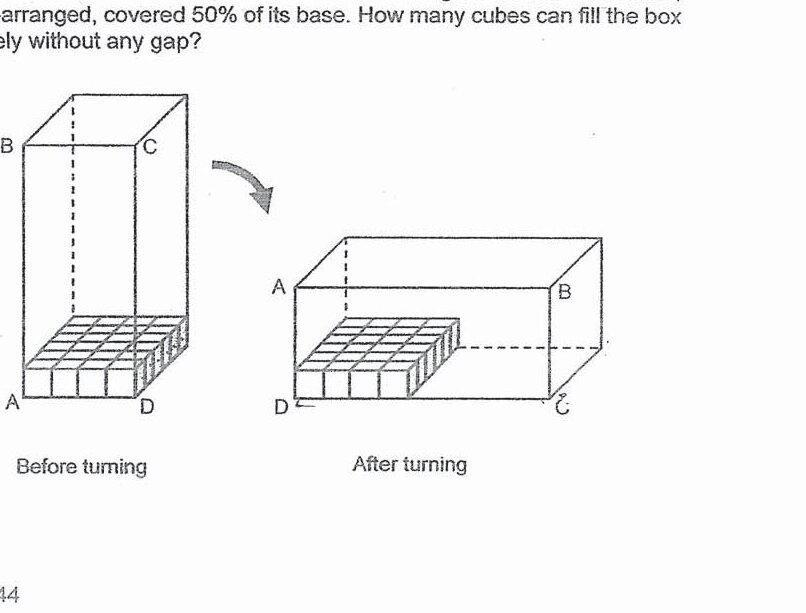
Two diagrams of rectangular boxes are shown. The 'Before turning' diagram shows a box with vertices labeled A, B, C, D, with unit cubes covering the base. The 'After turning' diagram shows the same box rotated and resting on the ground with unit cubes covering 50% of the base. The boxes are drawn in 3D perspective with dashed lines indicating hidden edges.
📊 Diagram: Two diagrams of rectangular boxes are shown. The 'Before turning' diagram shows a box with vertices labeled A, B, C, D, with unit cubes covering the base. The 'After turning' diagram shows the same box rotated and resting on the ground with unit cubes covering 50% of the base. The boxes are drawn in 3D perspective with dashed lines indicating hidden edges.
A. 144
B. 168
C. 192
D. 384
2022-P6-Maths-Prelim-Catholic_High 2022
Q7

A cuboid was cut along the dotted line into two smaller cuboids as shown below. The shaded face is a square and the volume of cuboid S is 500 cm³ more than that of cuboid T. What is the height of cuboid T?
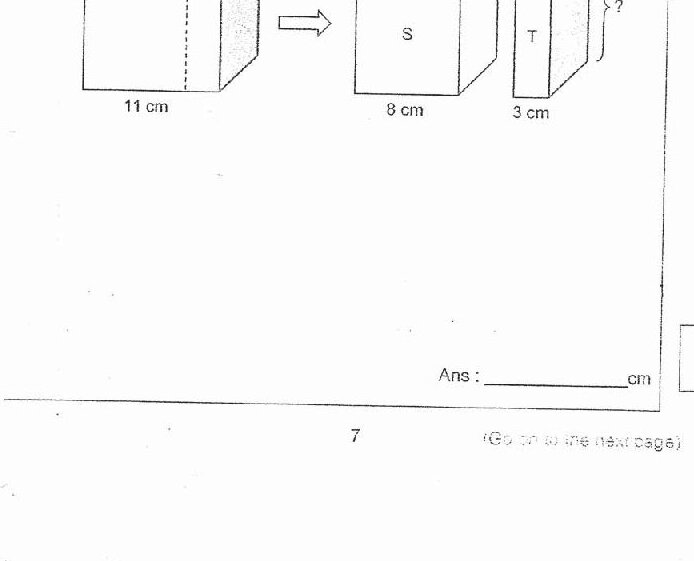
A diagram showing an original cuboid with dimensions 11 cm (length) being cut along a dotted line into two smaller cuboids labeled S and T. Cuboid S has a width of 8 cm, and cuboid T has a width of 3 cm. The height of cuboid T is marked with a question mark. The shaded face is a square.
📊 Diagram: A diagram showing an original cuboid with dimensions 11 cm (length) being cut along a dotted line into two smaller cuboids labeled S and T. Cuboid S has a width of 8 cm, and cuboid T has a width of 3 cm. The height of cuboid T is marked with a question mark. The shaded face is a square.
2022-P6-Maths-Prelim-Catholic_High 2022
Q8

From the 4th minute to the 14th minute, how much water flowed out of the tank?

Diagram for question 11c
2 marks
2022-P6-Maths-Prelim-Catholic_High 2022
Q9

A cuboid of height 5 cm has a square base of side 4 cm. What is its volume?
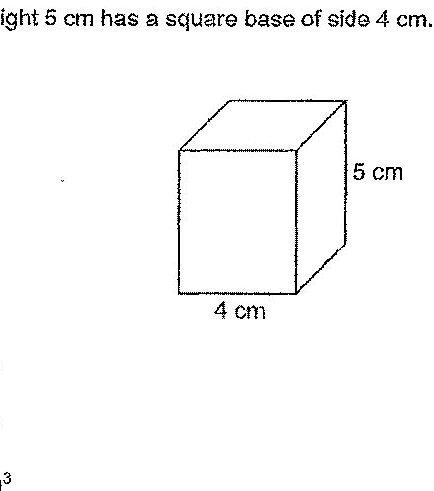
A 3D cuboid (rectangular prism) with a square base. The base side is labeled 4 cm and the height is labeled 5 cm.
📊 Diagram: A 3D cuboid (rectangular prism) with a square base. The base side is labeled 4 cm and the height is labeled 5 cm.
A. 20 cm³
B. 80 cm³
C. 100 cm³
D. 125 cm³
2022-P6-Maths-Prelim-Henry_Park 2022
Q10

The figure shows a rectangular box partly filled with 1-cm cubes. What is the volume of the rectangular box?
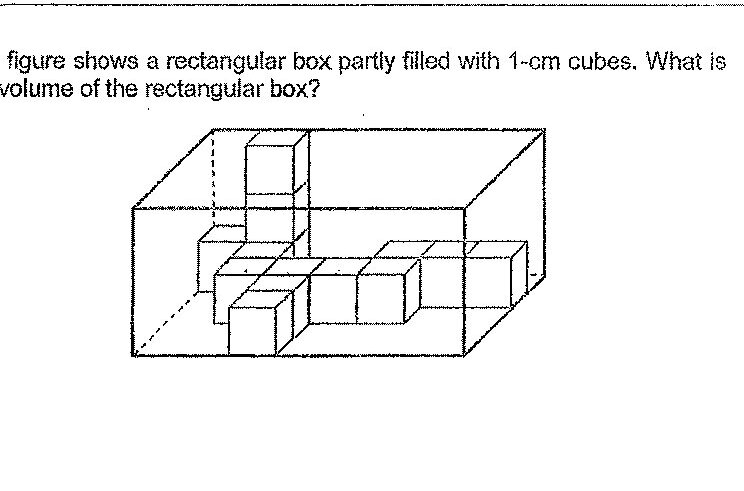
A 3D drawing of a rectangular box (cuboid) with some 1-cm cubes visible inside it. The cubes are shown in an isometric view, with multiple small cubes stacked within the larger box to indicate the filling pattern.
📊 Diagram: A 3D drawing of a rectangular box (cuboid) with some 1-cm cubes visible inside it. The cubes are shown in an isometric view, with multiple small cubes stacked within the larger box to indicate the filling pattern.
2 marks
2022-P6-Maths-Prelim-Henry_Park 2022
Q11

Sam wanted to fill an empty tank measuring 125 cm long and 80 cm wide with water. He turned on Tap A first and after 3 minutes, he turned on Tap B. Both taps were turned off at the same time when the tank was filled to the brim without overflowing. The line graph shows the amount of water in the tank over 10 minutes.
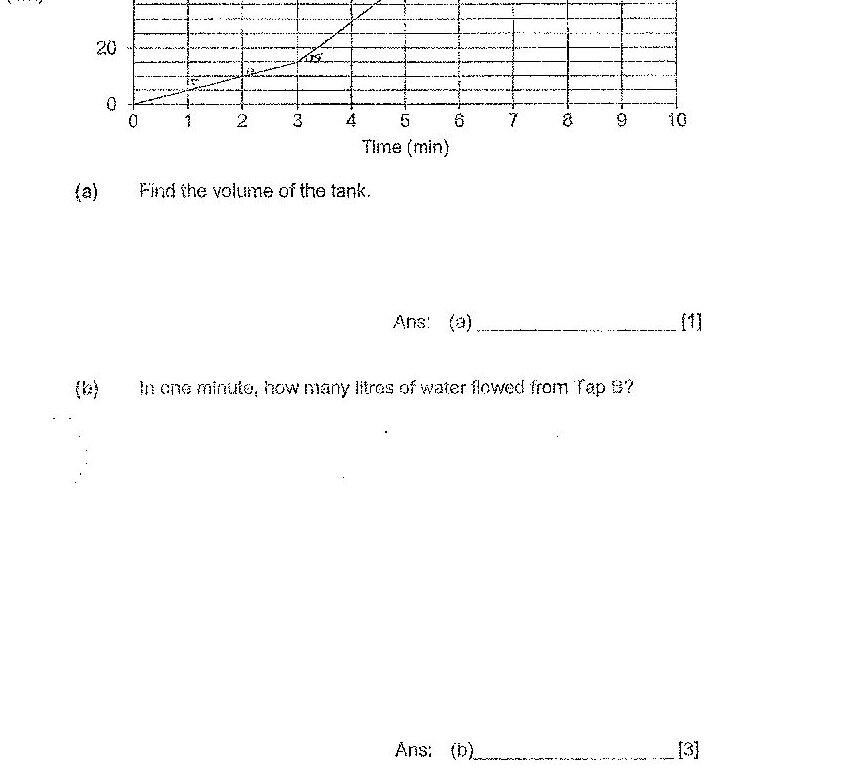
A line graph titled 'Height of water in the tank (cm)' on the y-axis (ranging from 0 to 100 cm) and 'Time (min)' on the x-axis (ranging from 0 to 10 minutes). The graph shows a line starting at approximately (0, 5), increasing linearly to approximately (3, 15), then the slope increases more steeply from (3, 15) onwards, reaching approximately (8, 100) where it levels off horizontally until 10 minutes.
📊 Diagram: A line graph titled 'Height of water in the tank (cm)' on the y-axis (ranging from 0 to 100 cm) and 'Time (min)' on the x-axis (ranging from 0 to 10 minutes). The graph shows a line starting at approximately (0, 5), increasing linearly to approximately (3, 15), then the slope increases more steeply from (3, 15) onwards, reaching approximately (8, 100) where it levels off horizontally until 10 minutes.
2022-P6-Maths-Prelim-Henry_Park 2022
Q12

Find the volume of the tank.

Diagram for question 12a
1 mark
2022-P6-Maths-Prelim-Henry_Park 2022
Q13

Two tanks, A and B, are shown below. Tank A was filled to the brim with water. Water was transferred from Tank A to Tank B until the height of the water level in both tanks are the same. What is the new height of water level in each tank?
Tank A: An L-shaped prism with dimensions shown as 45 m (base length), 12 m (base width), 46 m (left height), and a step with 20 m (top length) and 27 m (top section height). Tank B: A rectangular prism (cuboid) with dimensions 20 m (length), 18 m (width), and 23 m (height).
📊 Diagram: Tank A: An L-shaped prism with dimensions shown as 45 m (base length), 12 m (base width), 46 m (left height), and a step with 20 m (top length) and 27 m (top section height). Tank B: A rectangular prism (cuboid) with dimensions 20 m (length), 18 m (width), and 23 m (height).
3 marks
2022-P6-Maths-Prelim-Henry_Park 2022
Q14

An empty tank has a rectangular base measuring 30 cm by 20 cm. Water from 5 bottles is emptied into the tank without spillage. Each bottle contains 1.5 ℓ of water. What is the height of water in the tank?

2022-P6-Maths-Prelim-MGS 2022
Q15

The wooden block as shown in Diagram A was dipped completely into a pail of paint. Then, it was cut along the dotted lines as shown in Diagram B to form the solid as shown in Diagram C. The solid formed could be divided into 6 identical cubes. The total unpainted area of the solid in Diagram C was 337.5 cm². (a) Find the volume of the wooden block at first.
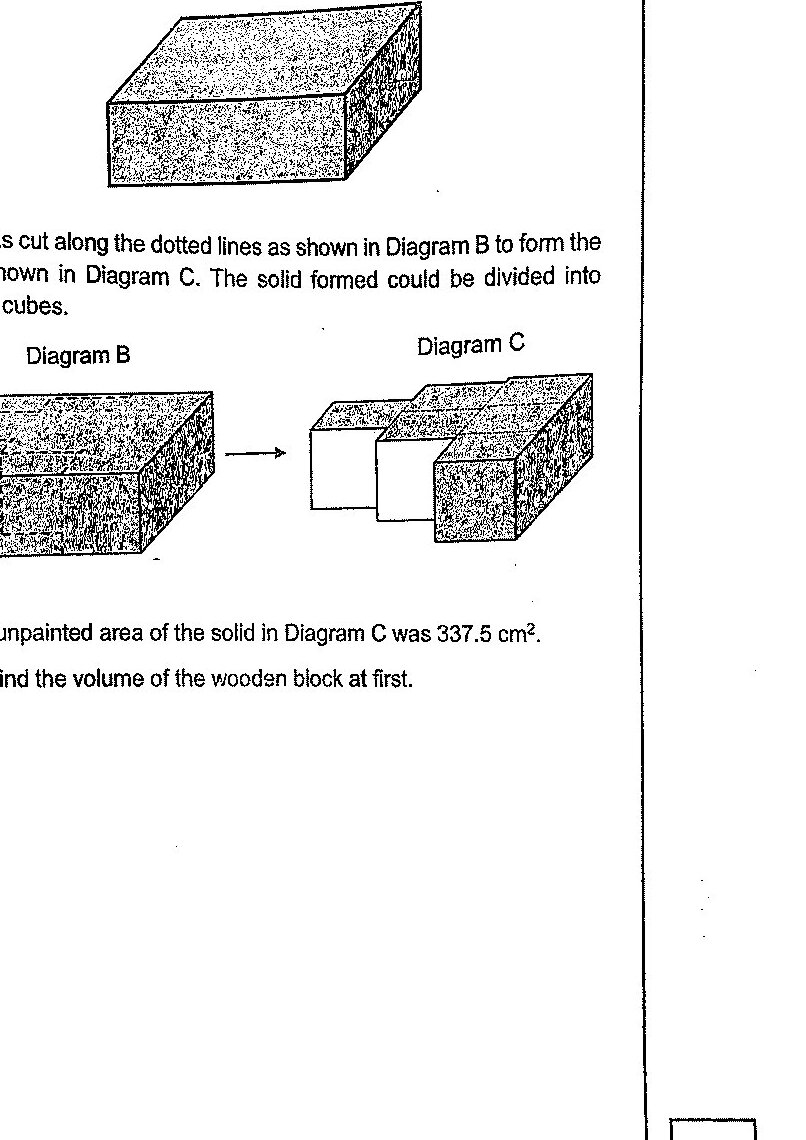
Diagram A shows a rectangular wooden block (cuboid) with paint texture covering all surfaces. Diagram B shows the same block with dotted lines indicating where cuts will be made. Diagram C shows the resulting solid after cutting - a larger painted cuboid with two unpainted cube-shaped cavities or indentations carved into it, indicating the block has been divided into 6 identical cubes with 2 removed.
📊 Diagram: Diagram A shows a rectangular wooden block (cuboid) with paint texture covering all surfaces. Diagram B shows the same block with dotted lines indicating where cuts will be made. Diagram C shows the resulting solid after cutting - a larger painted cuboid with two unpainted cube-shaped cavities or indentations carved into it, indicating the block has been divided into 6 identical cubes with 2 removed.
3 marks
2022-P6-Maths-Prelim-MGS 2022
Q16

Fadilah pours the same amount of water into two empty tanks A and B shown below. Tank A is half-filled with water. What is the height of water in Tank B?
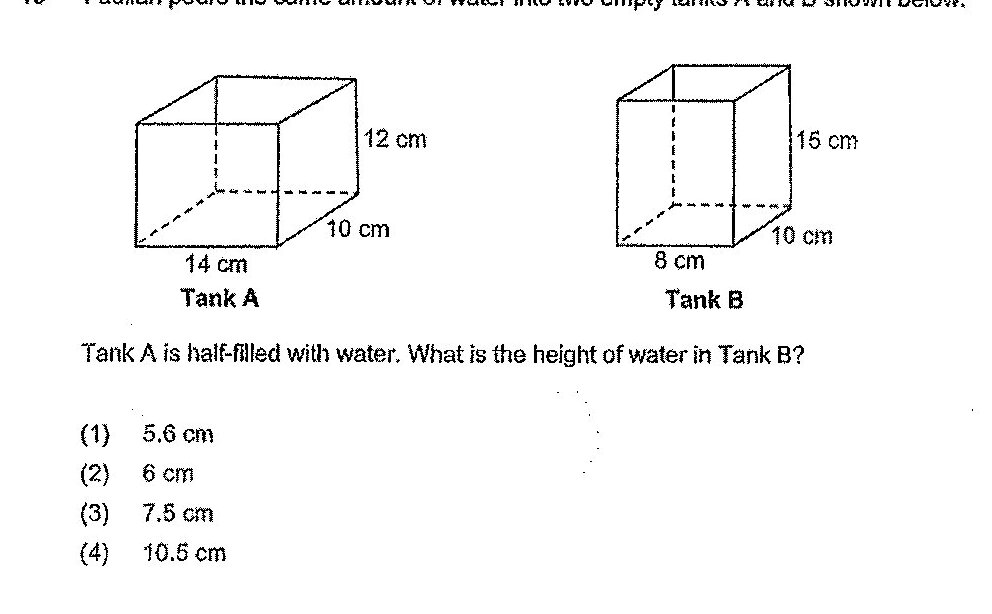
Two rectangular tanks are shown. Tank A has dimensions 14 cm × 10 cm × 12 cm (length × width × height). Tank B has dimensions 8 cm × 10 cm × 15 cm (length × width × height). Both tanks are shown as 3D rectangular prisms with dashed lines indicating hidden edges.
📊 Diagram: Two rectangular tanks are shown. Tank A has dimensions 14 cm × 10 cm × 12 cm (length × width × height). Tank B has dimensions 8 cm × 10 cm × 15 cm (length × width × height). Both tanks are shown as 3D rectangular prisms with dashed lines indicating hidden edges.
2022-P6-Maths-Prelim-Nan_Chiau 2022
Q17

A container contained some water at first as shown below. Harry used 0.06 l of water from the container. How much water was left?
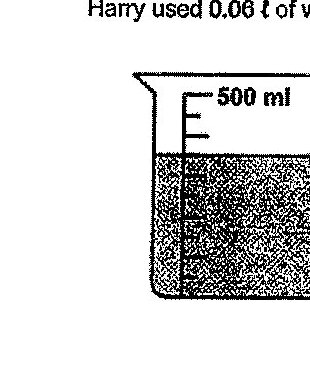
A measuring cylinder/container with a scale marked up to 500 ml. The water level is shown filled to approximately the 500 ml mark (indicated by shaded/filled area).
📊 Diagram: A measuring cylinder/container with a scale marked up to 500 ml. The water level is shown filled to approximately the 500 ml mark (indicated by shaded/filled area).
2022-P6-Maths-Prelim-Nan_Chiau 2022
Q18

Jason builds a solid using 10 unit cubes and glued them together.
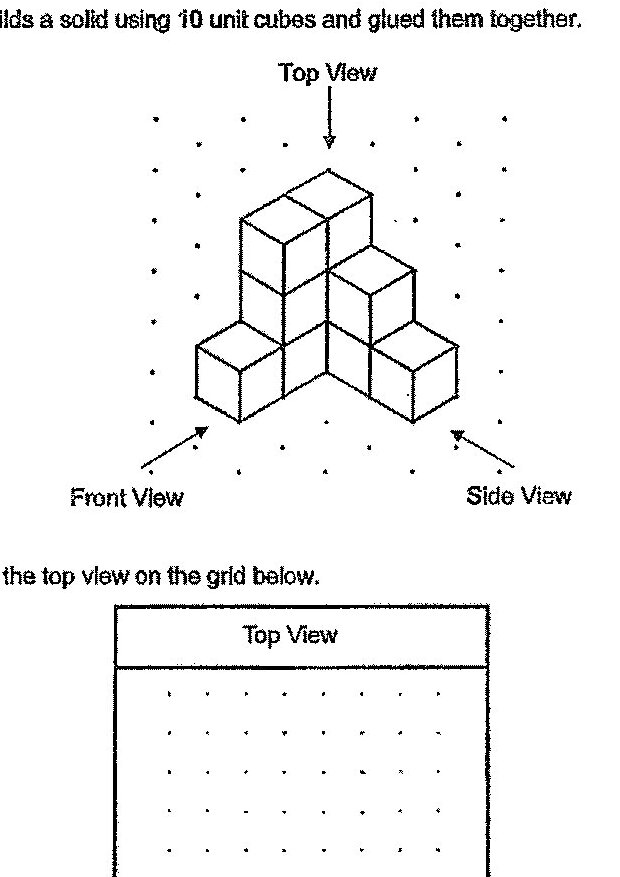
An isometric drawing of a 3D solid made from 10 unit cubes arranged in a stepped pyramid-like structure. The solid is shown from three perspectives: Front View (left), Top View (top), and Side View (right). The structure appears to have 3 cubes on the bottom layer, 3 cubes on the middle layer, and 2 cubes on the top layer, arranged in a staggered formation.
📊 Diagram: An isometric drawing of a 3D solid made from 10 unit cubes arranged in a stepped pyramid-like structure. The solid is shown from three perspectives: Front View (left), Top View (top), and Side View (right). The structure appears to have 3 cubes on the bottom layer, 3 cubes on the middle layer, and 2 cubes on the top layer, arranged in a staggered formation.
2022-P6-Maths-Prelim-Nan_Chiau 2022
Q19

Find the smallest number of unit cubes Jason can add to the solid to form a cubical solid.

Diagram for question 25b
2022-P6-Maths-Prelim-Nan_Chiau 2022
Q20

The figure below shows an empty container. A tap was turned on and water flowed into the container at a rate of 0.8 litres per minute. The tap was turned off 6 minutes later. Find the height of the water level from the base of the container.
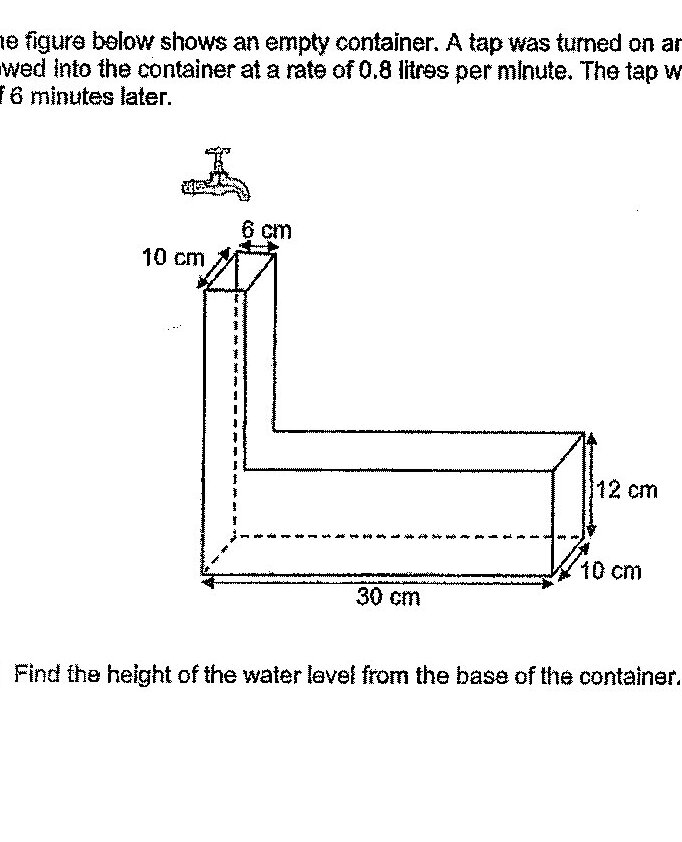
A 3D diagram of an L-shaped container. The container consists of a vertical rectangular section (6 cm wide, 10 cm deep, 10 cm tall) connected to a horizontal rectangular base section (30 cm long, 10 cm wide, 12 cm tall). The tap is shown at the top of the vertical section.
📊 Diagram: A 3D diagram of an L-shaped container. The container consists of a vertical rectangular section (6 cm wide, 10 cm deep, 10 cm tall) connected to a horizontal rectangular base section (30 cm long, 10 cm wide, 12 cm tall). The tap is shown at the top of the vertical section.
3 marks
2022-P6-Maths-Prelim-Nan_Chiau 2022
Q21

All the water was then poured into a cubical tank with a base area of 289 cm². How much more water was needed to fill the tank to its brim?

Diagram for question 16b
2 marks
2022-P6-Maths-Prelim-Nan_Chiau 2022
Q22

The volume of the cuboid is 96 cm³. The area of the shaded face is 8 cm². Find the height of the cuboid.
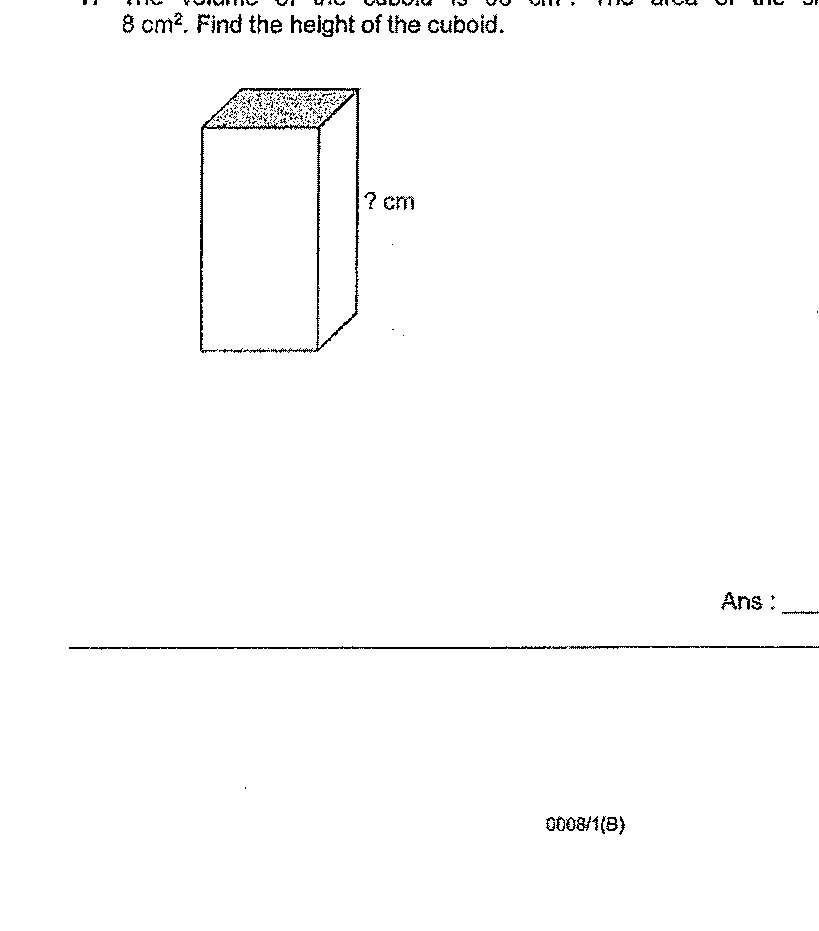
A cuboid (rectangular prism) with the top face shaded. The height is marked as 2 cm on the right side of the cuboid.
📊 Diagram: A cuboid (rectangular prism) with the top face shaded. The height is marked as 2 cm on the right side of the cuboid.
1 mark
2022-P6-Maths-Prelim-Nan_Hua 2022
Q23

Draw the following cuboid on the isometric grid.
A cuboid with dimensions 3 units (length), 2 units (width), and 2 units (height) is shown in isometric view on the left. An isometric grid with dots is provided on the right for drawing the cuboid.
📊 Diagram: A cuboid with dimensions 3 units (length), 2 units (width), and 2 units (height) is shown in isometric view on the left. An isometric grid with dots is provided on the right for drawing the cuboid.
2022-P6-Maths-Prelim-Nan_Hua 2022
Q24

The figure shows a rectangular glass box filled with unit cubes. How many more unit cubes are needed to fill the box completely?
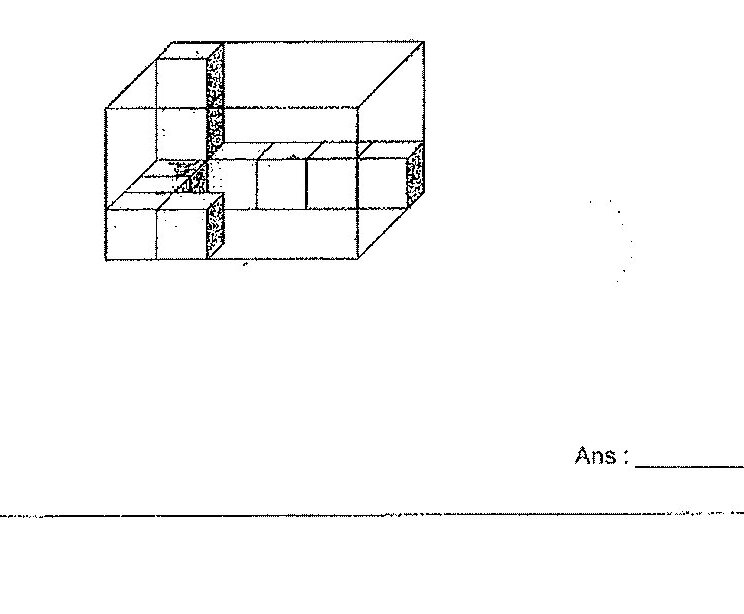
A rectangular glass box is shown with some unit cubes already placed inside it (shown with shading/darker coloring). The cubes are partially filling the box, and the student needs to determine how many additional unit cubes are required to completely fill the box.
📊 Diagram: A rectangular glass box is shown with some unit cubes already placed inside it (shown with shading/darker coloring). The cubes are partially filling the box, and the student needs to determine how many additional unit cubes are required to completely fill the box.
2022-P6-Maths-Prelim-Nan_Hua 2022
Q25

The figure below shows 2 containers, A and B. Container A contains 10 l of water. Container B has a base area of 1000 cm² and was empty at first. When Tap A is turned on, the height of water in container B increases by 2 cm per minute. What is the volume of the water left in container A after Tap A is turned on for 2 minutes?
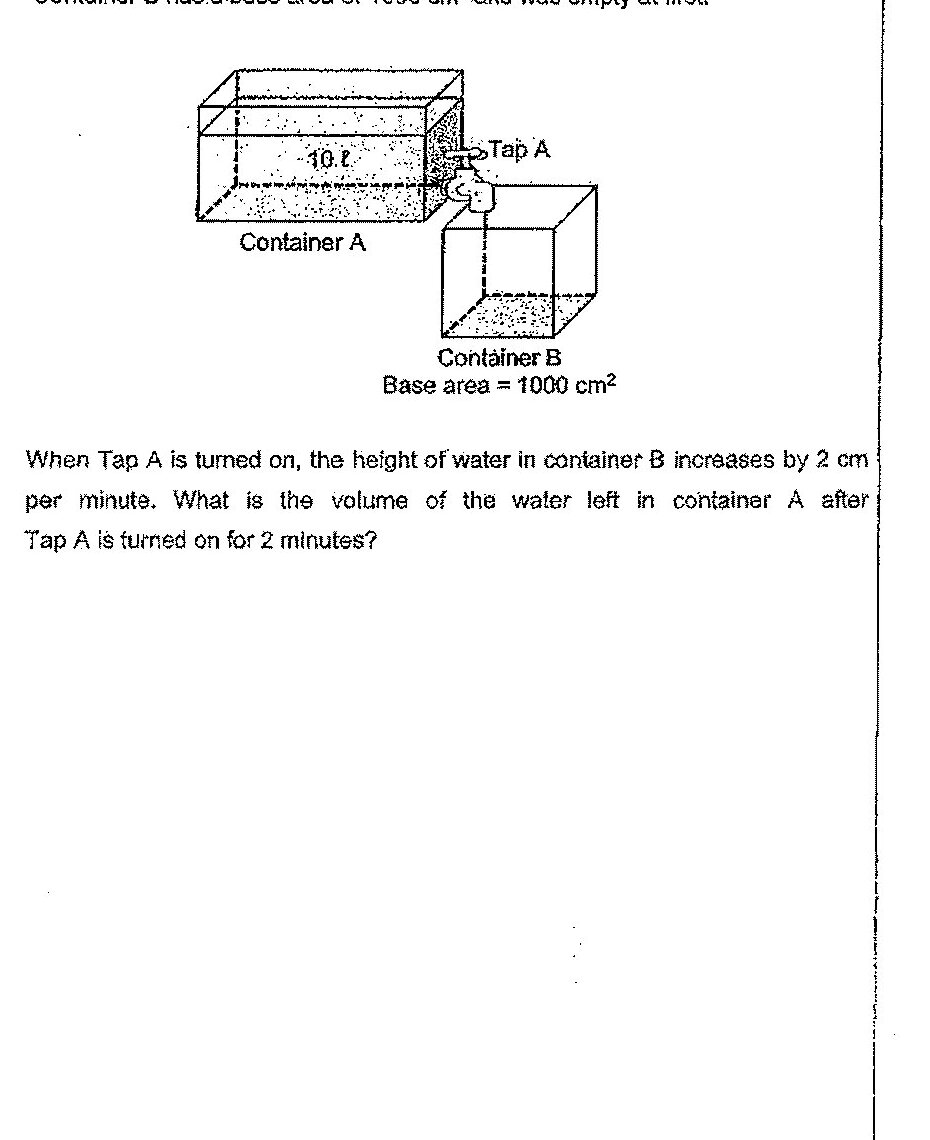
Two containers are shown: Container A is a rectangular prism containing 10 l of water with a tap (Tap A) at the bottom right that can dispense water into Container B. Container B is a rectangular prism with a base area of 1000 cm² positioned below and to the right of Container A, initially empty. Water flows from Container A through Tap A into Container B.
📊 Diagram: Two containers are shown: Container A is a rectangular prism containing 10 l of water with a tap (Tap A) at the bottom right that can dispense water into Container B. Container B is a rectangular prism with a base area of 1000 cm² positioned below and to the right of Container A, initially empty. Water flows from Container A through Tap A into Container B.
2022-P6-Maths-Prelim-Nan_Hua 2022
Q26

Find the charges when 40 m³ of water is used.
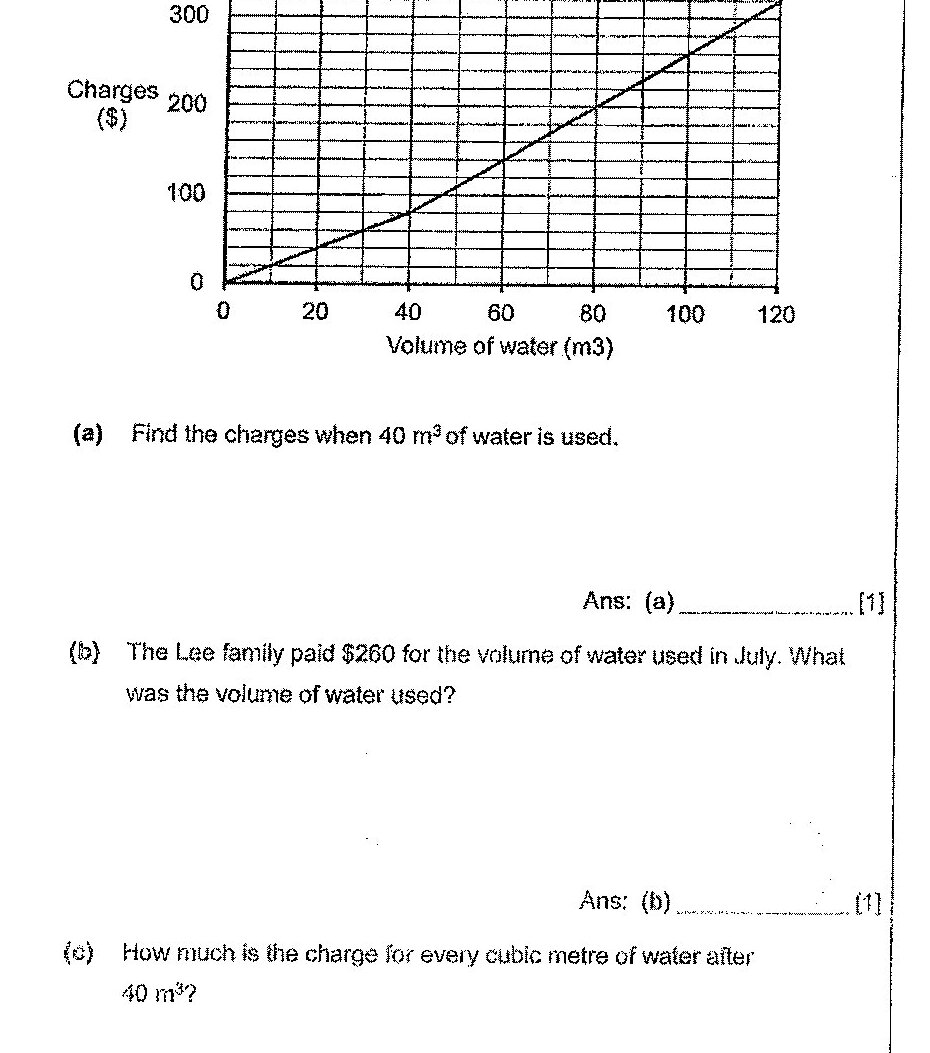
A line graph showing water usage charges. The x-axis represents 'Volume of water (m³)' ranging from 0 to 120. The y-axis represents 'Charges ($)' ranging from 0 to 400. A straight line starts from the origin (0,0) and passes through approximately (40, 80), (80, 160), and (120, 300), showing a linear relationship between water volume and charges.
📊 Diagram: A line graph showing water usage charges. The x-axis represents 'Volume of water (m³)' ranging from 0 to 120. The y-axis represents 'Charges ($)' ranging from 0 to 400. A straight line starts from the origin (0,0) and passes through approximately (40, 80), (80, 160), and (120, 300), showing a linear relationship between water volume and charges.
1 mark
2022-P6-Maths-Prelim-Nan_Hua 2022
Q27

The Lee family paid $260 for the volume of water used in July. What was the volume of water used?
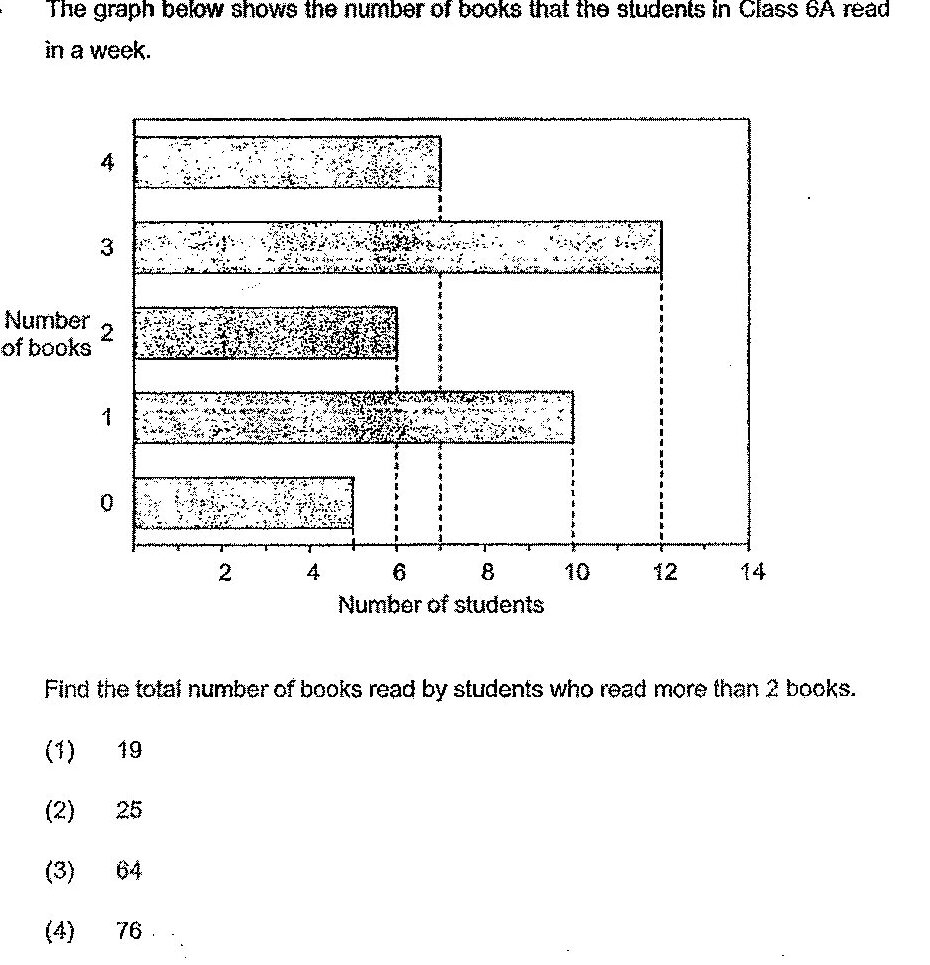
Diagram for question 14b
1 mark
2022-P6-Maths-Prelim-Nan_Hua 2022
Q28

The solid below is made up of 1-cm cubes. What is the volume of the solid?
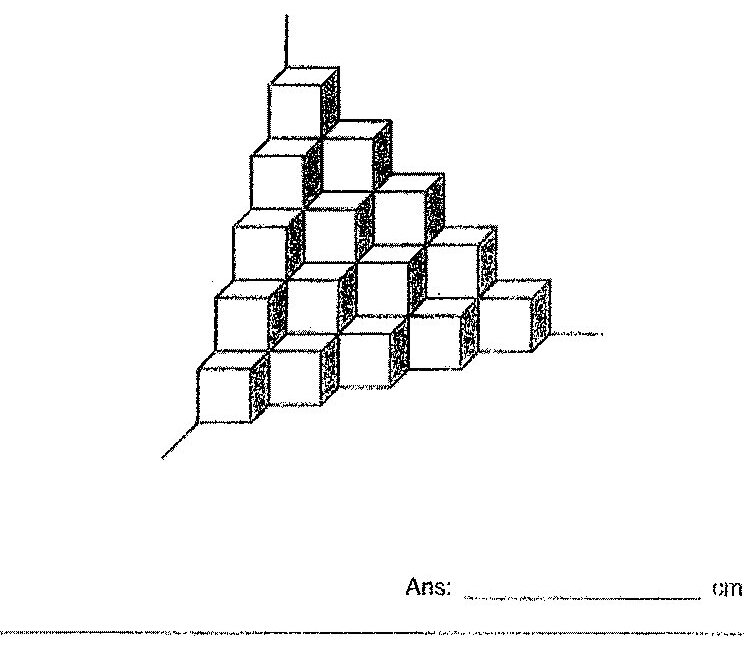
A 3D isometric drawing of a stepped/pyramidal solid made up of unit cubes. The structure appears to be a pyramid-like shape with a base layer containing multiple cubes arranged in rows, and successive layers above with fewer cubes, creating a staircase or stepped pyramid effect. The shaded faces of the cubes are visible to show the 3D perspective.
📊 Diagram: A 3D isometric drawing of a stepped/pyramidal solid made up of unit cubes. The structure appears to be a pyramid-like shape with a base layer containing multiple cubes arranged in rows, and successive layers above with fewer cubes, creating a staircase or stepped pyramid effect. The shaded faces of the cubes are visible to show the 3D perspective.
2022-P6-Maths-Prelim-Nanyang 2022
Q29

Paminder stacked 14 unit cubes and glued them together to form the solid below. Draw the side view of the solid on the grid below.
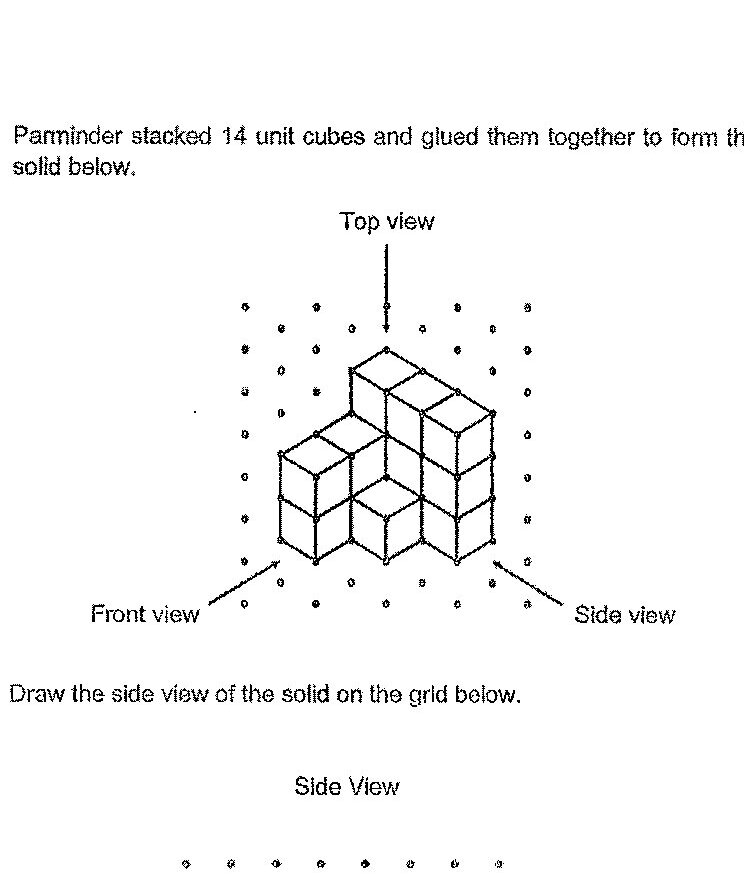
A 3D isometric drawing showing 14 unit cubes arranged in a stepped formation. The solid is shown with a top view, front view, and side view indicated. The structure appears to be 4 cubes wide at the base, with varying heights creating a stepped pattern. Below this is an empty grid labeled 'Side View' with 8 columns and 6 rows of dots for students to draw their answer.
📊 Diagram: A 3D isometric drawing showing 14 unit cubes arranged in a stepped formation. The solid is shown with a top view, front view, and side view indicated. The structure appears to be 4 cubes wide at the base, with varying heights creating a stepped pattern. Below this is an empty grid labeled 'Side View' with 8 columns and 6 rows of dots for students to draw their answer.
2022-P6-Maths-Prelim-Nanyang 2022
Q30

Tank Y and Tank Z are two rectangular tanks. At first, Tank Y contained some water to a height of 42 cm and Tank Z was empty. What was the volume of the water in Tank Y at first?
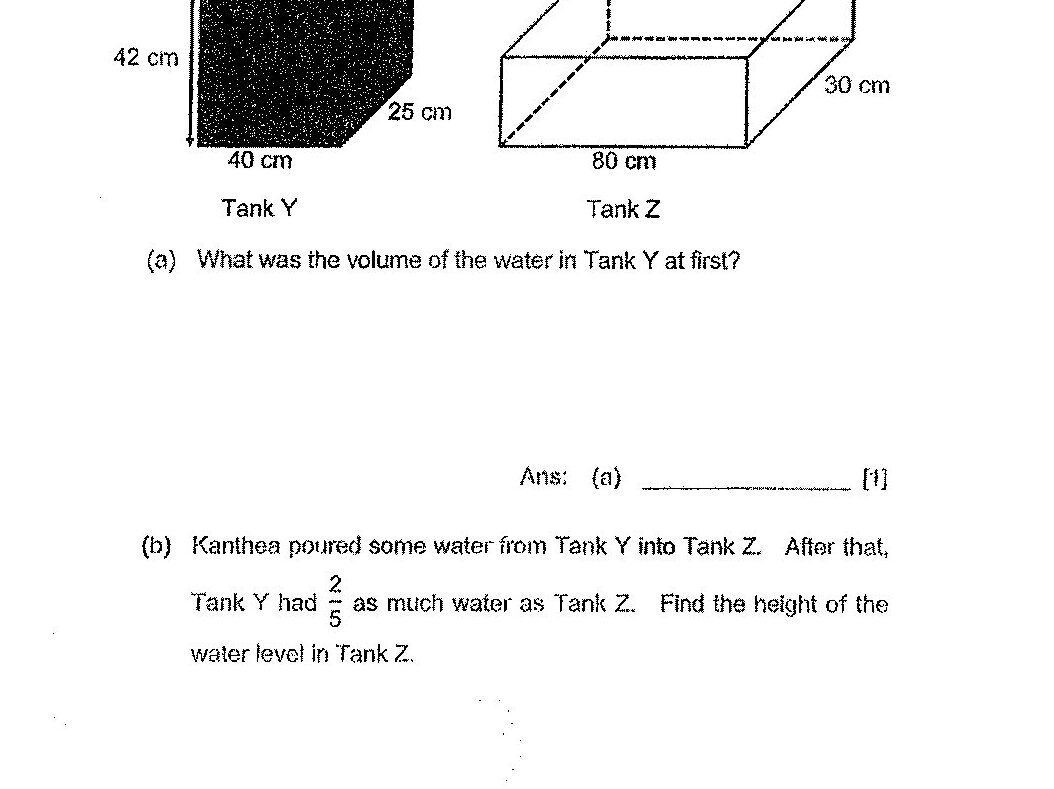
Tank Y is a rectangular tank with dimensions: length 40 cm, width 25 cm, and water height 42 cm (shown with shading). Tank Z is an empty rectangular tank with dimensions: length 80 cm, width 30 cm, and height not fully specified.
📊 Diagram: Tank Y is a rectangular tank with dimensions: length 40 cm, width 25 cm, and water height 42 cm (shown with shading). Tank Z is an empty rectangular tank with dimensions: length 80 cm, width 30 cm, and height not fully specified.
1 mark
2022-P6-Maths-Prelim-Nanyang 2022

Past year papers cover the full exam — browse by subject below.