Algebra
Numbers and Algebra: Algebra
Key Concepts
- Algebra is a branch of Mathematics where letters are used to represent numbers.
- A letter in algebra can stand for:
- an unknown value we need to find
- a value that can change
- a general rule or pattern
Using letters to represent unknown values
-
We use letters such as x, y, n, a, b to stand for numbers.
-
Example:
- If Ali has some marbles and we do not know how many, we can say he has m marbles.
-
A letter helps us write:
- number patterns
- rules
- word problems more easily
-
Example:
- “A number plus 5” can be written as n + 5
- “3 times a number” can be written as 3n
Terms, coefficients and constants
- An algebraic expression is a mathematical phrase with numbers, letters and operations.
- Example: 3x + 4
- A term is a part of an expression separated by + or −.
- In 3x + 4, the terms are 3x and 4
- A coefficient is the number multiplying a letter.
- In 3x, the coefficient is 3
- A constant is a number on its own, with no letter.
- In 3x + 4, the constant is 4
Simplifying algebraic expressions
- To simplify means to write an expression in its shortest and clearest form.
- We can simplify by:
- combining like terms
- removing unnecessary signs
- writing repeated multiplication properly
Like terms
- Like terms are terms with the same letter part.
- Example: 3x and 5x are like terms
- Example: 2a and 7a are like terms
- We can add or subtract like terms.
- 3x + 5x = 8x
- 9a - 4a = 5a
- We cannot combine unlike terms.
- 3x + 2y cannot become 5xy
- 4a + 3 cannot become 7a
Writing multiplication in algebra
- In algebra, we usually do not write the multiplication sign between a number and a letter.
- 3 × x = 3x
- a × b = ab
- Be careful:
- 2a means 2 × a
- it does not mean 20 + a
Evaluating algebraic expressions
-
To evaluate an expression means to find its value when the letters are given.
-
Steps:
- substitute the given value into the expression
- use brackets if needed
- carry out the operations carefully
-
Example:
- Evaluate 3x + 2 when x = 4
- Substitute: 3(4) + 2
- Calculate: 12 + 2 = 14
Solving simple linear equations
-
An equation is a mathematical statement showing that two sides are equal.
- Example: x + 5 = 12
-
A simple linear equation has:
- one unknown
- the unknown is not squared or cubed
- the highest power of the unknown is 1
-
To solve an equation means to find the value of the unknown that makes the equation true.
Balance idea in equations
-
Think of an equation like a balance scale.
-
Both sides must stay equal.
-
Whatever you do to one side, you must do the same to the other side.
-
Example:
- If x + 3 = 10
- subtract 3 from both sides
- x = 7
Inverse operations
-
Inverse operations undo each other.
- addition and subtraction
- multiplication and division
-
We use inverse operations to solve equations.
-
Example:
- x + 8 = 15
- subtract 8 from both sides
- x = 7
-
Example:
- 4x = 20
- divide both sides by 4
- x = 5
Algebra word problems
-
In word problems, algebra helps us represent unknown amounts clearly.
-
Usual steps:
- choose a letter for the unknown
- write the information as an equation or expression
- solve carefully
- check if the answer makes sense in the context
-
Keywords to notice:
- sum means add
- difference means subtract
- product means multiply
- quotient means divide
- more than means add
- less than means subtract
- twice means multiply by 2
- three times means multiply by 3
Translating words into algebra
- “A number increased by 6” → n + 6
- “5 less than a number” → n - 5
- “Twice a number” → 2n
- “A number divided by 4” → n ÷ 4 or n/4
- “The total of x and 7” → x + 7
Two-Step Linear Equations
-
One-step recap: equations such as 4x = 20 need just one step — divide both sides by 4.
-
Two-step equations need two operations to isolate the unknown.
- Example: 2x + 3 = 11
- Step 1: Subtract 3 from both sides first (undo the addition).
- Step 2: Divide both sides by 2 (undo the multiplication).
- Always undo addition or subtraction first, then undo multiplication or division.
- Example: 2x + 3 = 11
-
Equations with brackets: expand the brackets OR divide first, then solve.
- Example: 3(x + 2) = 18
- Method 1 (expand): 3x + 6 = 18 → subtract 6 → 3x = 12 → divide by 3 → x = 4
- Method 2 (divide first): divide both sides by 3 → x + 2 = 6 → subtract 2 → x = 4
- Example: 3(x + 2) = 18
Worked Example: Solve 2x + 3 = 11
Step 1: Subtract 3 from both sides
- 2x + 3 − 3 = 11 − 3
- 2x = 8
Step 2: Divide both sides by 2
- 2x ÷ 2 = 8 ÷ 2
- x = 4
Step 3: Check
- Substitute x = 4: 2(4) + 3 = 8 + 3 = 11 ✔
Answer: x = 4
Worked Example: Solve 3(x + 2) = 18
Step 1: Divide both sides by 3
- 3(x + 2) ÷ 3 = 18 ÷ 3
- x + 2 = 6
Step 2: Subtract 2 from both sides
- x + 2 − 2 = 6 − 2
- x = 4
Step 3: Check
- Substitute x = 4: 3(4 + 2) = 3(6) = 18 ✔
Answer: x = 4
Checking answers
- After solving, always substitute your answer back into the equation.
- Example:
- If x = 5 for 2x + 1 = 11
- Check: 2(5) + 1 = 10 + 1 = 11
- Correct
Important Definitions
- Algebra: a branch of Mathematics that uses letters and symbols to represent numbers and relationships.
- Variable: a letter that represents an unknown or changing value.
- Unknown: a value that is not yet known and must be found.
- Algebraic expression: a mathematical phrase made up of numbers, letters and operations, without an equals sign.
- Term: a part of an algebraic expression separated by addition or subtraction signs.
- Coefficient: the number multiplying a variable.
- Constant: a number without any variable.
- Like terms: terms with the same variable part.
- Simplify: to write an expression in a shorter or easier form without changing its value.
- Substitute: to replace a variable with a given number.
- Evaluate: to find the value of an expression after substituting the given number.
- Equation: a mathematical statement showing that two expressions are equal.
- Linear equation: an equation in which the variable has a power of 1.
- Inverse operations: operations that undo each other, such as addition and subtraction, or multiplication and division.
- Solution: the value of the variable that makes an equation true.
Worked Examples
Example 1: Simplifying an algebraic expression
Simplify 3a + 5a - 2
Step 1: Identify like terms
- 3a and 5a are like terms because both have a
- 2 is a constant
Step 2: Combine the like terms
- 3a + 5a = 8a
Step 3: Write the simplified expression
- 8a - 2
Answer: 8a - 2
Example 2: Evaluating an algebraic expression
Evaluate 2x + 3 when x = 6
Step 1: Substitute the value of x
- 2x + 3 = 2(6) + 3
Step 2: Multiply first
- 2(6) = 12
Step 3: Add
- 12 + 3 = 15
Answer: 15
Example 3: Solving a simple linear equation
Solve 3x = 21
Step 1: Identify the operation
- x is being multiplied by 3
Step 2: Use the inverse operation
- Divide both sides by 3
Step 3: Simplify
- x = 7
Step 4: Check
- Substitute x = 7
- 3(7) = 21
- 21 = 21, so the answer is correct
Answer: x = 7
Example 4: Algebra word problem
Sam has 4 more stickers than Ben. Sam has 15 stickers. How many stickers does Ben have?
Step 1: Let the unknown be a letter
- Let b be the number of stickers Ben has.
Step 2: Write Sam’s number using b
- Sam has b + 4 stickers
Step 3: Form the equation
- b + 4 = 15
Step 4: Solve the equation
- Subtract 4 from both sides:
- b = 15 - 4
- b = 11
Step 5: Write the answer clearly
- Ben has 11 stickers.
Step 6: Check
- If Ben has 11 stickers, Sam has 11 + 4 = 15
- This matches the question
Answer: Ben has 11 stickers.
Common Mistakes to Avoid
- Combining unlike terms wrongly
- Wrong: 3x + 2 = 5x
- Correct: 3x + 2 cannot be simplified further
- Forgetting to substitute properly
- Wrong: if x = 4, writing 3x = 34
- Correct: 3x = 3(4) = 12
- Not using brackets when substituting
- Example: for 2x + 3, write 2(4) + 3, not 24 + 3
- Doing different operations on the two sides of an equation
- Both sides must stay balanced
- Forgetting inverse operations
- To undo +5, subtract 5
- To undo ×3, divide by 3
- Mixing up 5 less than a number and a number less 5
- Both mean n - 5
- Misreading “less than”
- “5 less than 12” means 12 - 5, not 5 - 12
- Forgetting to check the answer in the original equation
- Leaving the answer without units or context in word problems
- Example: write 11 stickers, not just 11
- Writing multiplication signs in confusing ways
- Avoid writing x × x if it may be mistaken for the variable x
- Use clear notation like 3a, 2b
Exam Tips
- Always let the unknown be a letter first in word problems.
- Example: “Let x be the number of apples.”
- Translate the words carefully before calculating.
- Look for operation keywords:
- total, sum → add
- difference → subtract
- times, twice → multiply
- shared equally, quotient → divide
- When simplifying:
- combine only like terms
- When solving equations:
- show the operation clearly
- keep both sides equal
- When evaluating:
- substitute the value correctly
- use brackets if needed
- Always check:
- Does the answer fit the question?
- Is the value reasonable?
- In word problems:
- write a final statement
- Example: “Therefore, Ben has 11 stickers.”
- If marks are given for working, do not skip steps.
- Neat and correct algebra helps avoid careless mistakes.
Useful mark-earning phrases:
- “Let x be the number of …”
- “Therefore,…”
- “Substitute x = …”
- “Check: …”
- “The equation is …”
Quick Summary
- Algebra uses letters to represent unknown or changing numbers.
- A variable is the letter used to stand for a number.
- An algebraic expression has numbers, letters and operations, but no equals sign.
- An equation has an equals sign and can be solved.
- Terms are separated by + or − signs.
- A coefficient is the number multiplying the variable.
- A constant is a number without a variable.
- Combine only like terms when simplifying.
- To evaluate, substitute the given value into the expression and calculate.
- To solve equations, use inverse operations and keep both sides balanced.
- In word problems, let a letter represent the unknown, form an equation, solve, and check.
- Always give the final answer clearly, with units or labels when needed.
Express y + 11 + 7y - 9 - 3y in the simplest form.
Find the value of 3w + w/2 when w = 8.
Jamie paid $63 for a bag and 2 pencil cases. The price of a pencil case was 2/5 the price of the bag. How much did Jamie pay for the bag?
Gerald, Leon and Ali went for a jog. Gerald ran y km. Leon ran 3 km more than Gerald. Ali ran twice as far as Leon. Express the total distance the three boys ran in terms of y.
The three boys ran a total of 53 km. Find the value of y.
Student D threw the same number of balls as Student A but obtained 16 points more. How many balls did student D toss into the basket?
How long did it take for the height of the water to be the same in both tanks?

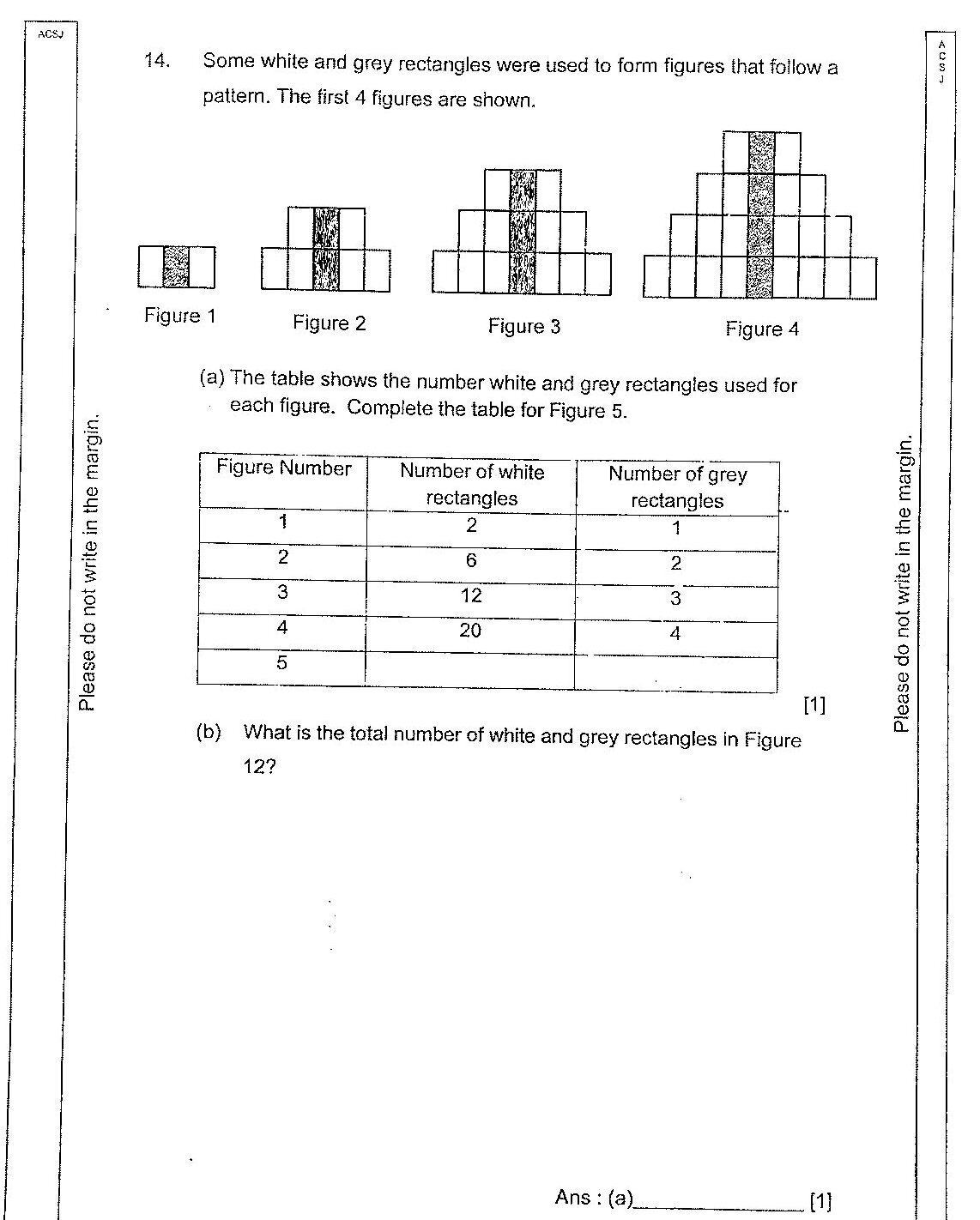
What is the total number of white and grey rectangles in Figure 12?
James used 1/4 of his money to buy 3 pencil cases and 7 key chains. The cost of each pencil case is 3 times the cost of each key chain. He bought some more key chains with 1/3 of his remaining money. He spent $30.40 more on all the key chains than on all the pencil cases. How much was the cost of one key chain?
Find the value of 14m/3 + 1 when m = 6.
Mrs Lee wanted to buy 9 boxes of mooncakes but she was short of $28. She bought 7 boxes of mooncakes and had $22 left. How much money did she have at first?
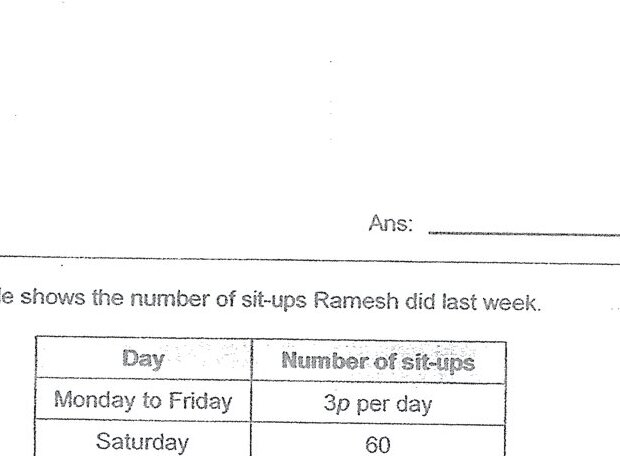
The table shows the number of sit-ups Ramesh did last week. What was the total number of sit-ups Ramesh did last week? Give your answer in terms of p in the simplest form.
A roll of ribbon can be cut equally into 9 short ribbons or 5 long ribbons. A short ribbon is 24 cm shorter than a long ribbon. What is the length of a short ribbon?
At a bread shop, a customer could buy one additional bun at half its usual price for every 3 buns bought. Petra paid $16.80 for 12 buns. What was the usual price of one bun?
John had 24k marbles. Kelvin had 16 fewer marbles than John while Mike had half as many marbles as John. How many marbles do the 3 boys have in total? Give your answer in terms of k in the simplest form.
Ahmad had a sum of money. He could only buy 10 notebooks with all the money he had. He decided to buy 8 notebooks and 4 pens. He had $2.40 left. Each pen cost $0.80. How much money did Ahmad have at first?
Jane and Siti had a number of beads. Jane had 432 more beads than Siti. After Jane gave away 7/9 of her beads and Siti gave away 5/6 of her beads, Jane had 441 more beads than Siti. How many beads did Jane have at first?
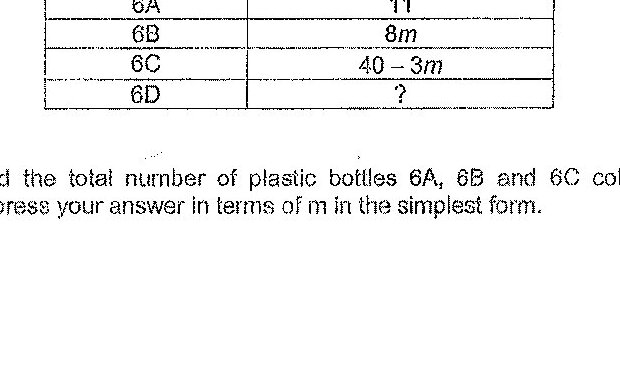
Find the total number of plastic bottles 6A, 6B and 6C collected. Express your answer in terms of m in the simplest form.
A money box contained some money at first. A took 1/2 the amount of money and another $1500 from the box. After that, B took 1/4 of the remaining amount of money and another $360 from the box. In the end, C took the rest of the money left in the box. Given that C took $1400, find the amount of money in the box at first.

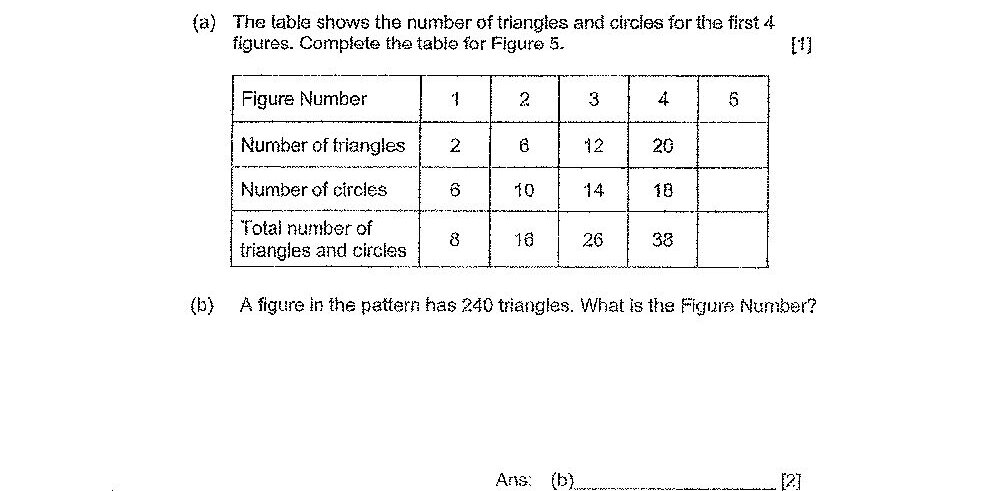
A figure in the pattern has 240 triangles. What is the Figure Number?
Mei Ling baked 5y tarts. She gave her mother 25 of them and packed the rest equally into 3 boxes. How many tarts were there in each box?
The average height of a group of children was 129.6 cm. One of the children's height was wrongly recorded as 162 cm when it should have been 126 cm. As a result, the average height calculated became 132.6 cm. How many children were there in the group?
Find the value of (8w - 7)/5 when w = 8.
Kim baked 259 more cookies than Li Min. After each of them sold some cookies, Kim had 2/5 of her cookies left and Li Min had 3/5 of her cookies left. Both Kim and Li Min had the same number of cookies left. How many cookies did Li Min bake at first?
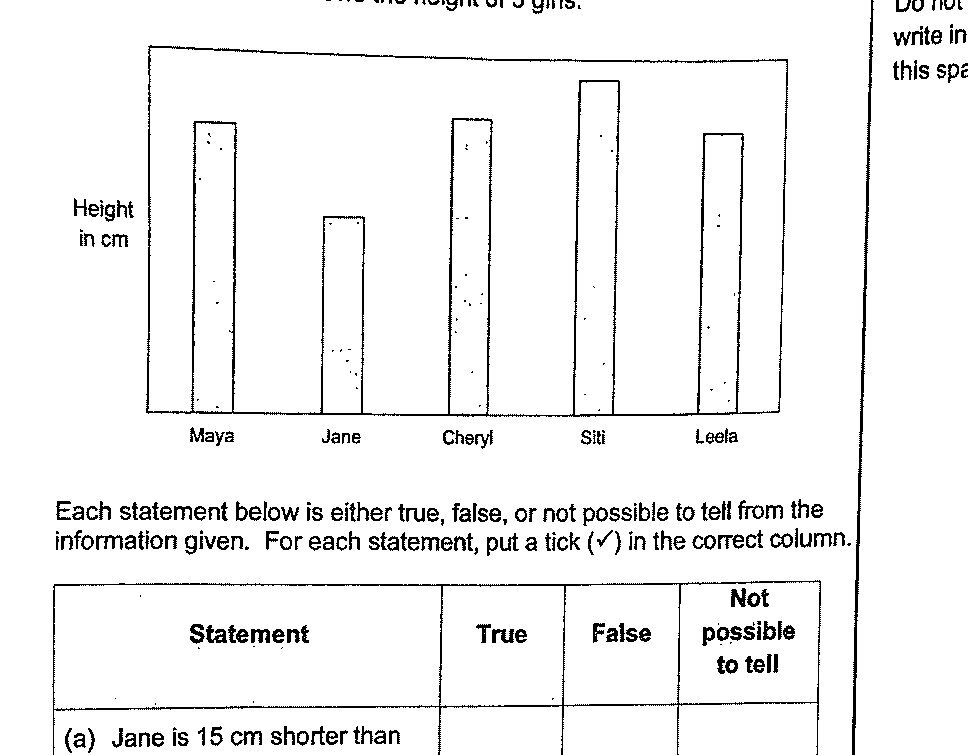
Jane is 15 cm shorter than Maya.
A pen costs $p. A notebook costs $2 more than the pen. What is the cost of 3 pens and 2 notebooks? Express your answer in terms of p in its simplest form.
Lee Lian paid $22.50 for 3 pens and 2 notebooks. Find the cost of one notebook.
Mariam baked some strawberry, apple and pear tarts. There were 12 more strawberry tarts than pear tarts and 20 more apple tarts than strawberry tarts. She sold 3/4 of the apple tarts and half of the strawberry tarts. She had 145 tarts left. (a) How many pear tarts did she bake?
A deck of cards is numbered 1 to 50. Pamela draws 3 cards from it. The sum of the numbers on any of the 2 cards are 60, 28 and 58. Find the 3 numbers.
Past year papers cover the full exam — browse by subject below.