Decimals
Decimals
Key Concepts
-
Decimals are numbers that show parts of a whole using place value.
- Example: 3.45
- 3 is in the ones place
- 4 is in the tenths place
- 5 is in the hundredths place
- Example: 3.45
-
The decimal point separates the whole number part from the fractional part.
- Example: In 12.7, 12 is the whole number and 7 means 7 tenths.
-
Each place value on the right of the decimal point becomes 10 times smaller as you move right.
- Tenths:
- Hundredths:
- Thousandths:
- Tenths:
Multiplying decimals
-
When multiplying a decimal by a whole number:
- Multiply as usual.
- Then place the decimal point correctly in the answer.
-
When multiplying a decimal by 10, 100, or 1000:
- The digits move to the left in value, so the decimal point appears to move to the right.
- Multiply by 10: move 1 place right
- Multiply by 100: move 2 places right
- Multiply by 1000: move 3 places right
- Example:
-
When multiplying a decimal by another decimal:
- Ignore the decimal points first.
- Multiply the numbers as whole numbers.
- Count the total number of decimal places in both factors.
- Put the decimal point in the product so that it has the same total number of decimal places.
- Example:
- Multiply
- There are 2 decimal places in total
- Answer: 3.12
Dividing decimals
-
When dividing a decimal by a whole number:
- Divide as usual.
- Put the decimal point in the quotient directly above the decimal point in the dividend.
- Example:
-
When dividing by 10, 100, or 1000:
- The digits move to the right in value, so the decimal point appears to move to the left.
- Divide by 10: move 1 place left
- Divide by 100: move 2 places left
- Divide by 1000: move 3 places left
- Example:
-
When dividing a decimal by a decimal:
- Change the divisor into a whole number.
- Multiply both the dividend and divisor by the same power of 10.
- Then divide.
- Example:
- Multiply both by 10
-
Always check whether the answer is reasonable.
- Example:
, so the answer can be greater than 6.
- Example:
Conversion between fractions and decimals
-
A fraction shows equal parts of a whole.
-
A decimal is another way to write some fractions.
-
Fractions with denominators of 10, 100, 1000 can be easily written as decimals.
-
To convert a fraction to a decimal:
- Rewrite it as an equivalent fraction with denominator 10, 100, or 1000 if possible, or
- Divide the numerator by the denominator.
- Example:
-
To convert a decimal to a fraction:
- Write the digits after the decimal point over the correct place value.
- Simplify the fraction if needed.
- Example:
-
Some decimals terminate.
- A terminating decimal ends after a certain number of digits.
- Example:
-
Some fractions give recurring (repeating) decimals — the digits repeat forever.
- For PSLE, you will either be given a rounded answer or asked to round to a specific decimal place.
- You do not need to use dot notation (e.g.
) at PSLE level.
Rounding decimals
-
Rounding means changing a number to the nearest required place value.
-
Common place values for rounding:
- nearest whole number
- nearest tenth
- nearest hundredth
-
Steps for rounding:
- Find the digit at the place you are rounding to.
- Look at the digit immediately to its right.
- If that digit is 5 or more, round up.
- If that digit is 4 or less, keep the digit the same.
- Change all digits to the right into zeroes if rounding a whole number, or remove them if writing a decimal answer.
-
Examples:
rounded to the nearest tenth = 4.4 rounded to the nearest whole number = 7 rounded to the nearest hundredth = 10.00 or 10.0 depending on required form
-
Be careful:
- The digit you look at is the one immediately to the right of the place you are rounding to.
Decimal word problems
-
Decimal word problems often involve:
- money
- mass
- length
- volume
- distance
- measurement comparisons
-
Important strategies:
- Read the question carefully.
- Underline key information and units.
- Decide whether to add, subtract, multiply, or divide.
- Convert all values to the same unit before calculating if needed.
- Check whether the answer should be rounded.
-
Common clues:
- each, every, per → often multiplication or division
- total, altogether → often addition
- difference, how much more, how much less → subtraction
- shared equally → division
-
In money problems:
- Write answers correctly to 2 decimal places when using dollars and cents.
- Example: $3.50, not $3.5 in final money form
Important Definitions
- Decimal: a number that represents a whole number and/or part of a whole using place value and a decimal point.
- Decimal point: the dot that separates the whole number part from the fractional part of a decimal.
- Place value: the value of a digit depending on its position in a number.
- Tenths: parts out of 10; the first digit to the right of the decimal point.
- Hundredths: parts out of 100; the second digit to the right of the decimal point.
- Thousandths: parts out of 1000; the third digit to the right of the decimal point.
- Multiply: to find the total when equal groups of the same amount are combined.
- Divide: to split into equal parts or find how many times one number is contained in another.
- Fraction: a number that represents part of a whole, written as
. - Equivalent fractions: different fractions that have the same value.
- Terminating decimal: a decimal that ends after a fixed number of digits.
- Round off / Rounding: changing a number to the nearest value of a stated place.
- Nearest tenth: closest value with 1 digit after the decimal point.
- Nearest hundredth: closest value with 2 digits after the decimal point.
- Quotient: the answer when one number is divided by another.
- Product: the answer when numbers are multiplied.
- Reasonable answer: an answer that makes sense based on estimation and the numbers given.
Worked Examples
Example 1: Multiplying decimals
Find
Step 1: Ignore the decimal points first.
Step 2: Count total decimal places.
has 1 decimal place has 1 decimal place - Total = 2 decimal places
Step 3: Put the decimal point into the product.
Answer:
Check:
Example 2: Converting between fractions and decimals
Convert
Method 1: Make the denominator 100
Answer:
Now convert 0.48 to a fraction.
Step 1: Write it over 100.
Step 2: Simplify.
Answer:
Example 3: Decimal word problem
A bottle contains 1.5 L of juice. Mei drinks 0.35 L and her brother drinks 0.4 L. How much juice is left?
Step 1: Find the total amount drunk.
Step 2: Subtract from the original amount.
Answer:
Check:
- They drank less than 1 L in total.
- The amount left should be less than 1.5 L.
is reasonable.
Common Mistakes to Avoid
- Putting the decimal point in the wrong place after multiplication.
- Forgetting to count the total number of decimal places in both factors.
- Moving the decimal point in the wrong direction when multiplying or dividing by 10, 100, or 1000.
- Forgetting to multiply both numbers when dividing a decimal by a decimal.
- Writing a fraction from a decimal but not simplifying it.
- Example: leaving
as instead of
- Example: leaving
- Rounding using the wrong digit.
- Always check the digit immediately to the right.
- Ignoring zeroes that are important for place value.
- Example:
is 7 hundredths, not 7 tenths
- Example:
- Mixing up units in word problems.
- Example: adding metres and centimetres without converting
- Forgetting to line up decimal points when adding or subtracting decimals.
- Writing money answers incorrectly.
- Example: write $2.30, not $2.3 if the question is about money
Exam Tips
- Always write decimals in place value form carefully.
- For addition and subtraction, line up the decimal points.
- For multiplication:
- multiply first as whole numbers
- then count decimal places
- For division by a decimal:
- change the divisor into a whole number first
- multiply both dividend and divisor by the same power of 10
- Use estimation to check your answer.
- Example:
is about
- Example:
- In word problems:
- write the operation statement
- include the correct unit
- check whether the final answer needs rounding
- For money:
- write to 2 decimal places
- include the dollar sign if needed
- Mark-earning habits:
- show working clearly
- do not skip steps in multistep problems
- box or underline your final answer
- Helpful phrases to write in solutions:
- “Convert to the same unit first.”
- “Round to the nearest tenth/hundredth.”
- “Therefore, …”
- “So, the amount left is …”
- “Hence, the total cost/mass/length is …”
Quick Summary
- A decimal uses a decimal point to separate whole numbers from parts of a whole.
- The first 3 decimal places are tenths, hundredths, thousandths.
- Multiplying by 10, 100, 1000 moves the decimal point right.
- Dividing by 10, 100, 1000 moves the decimal point left.
- To multiply decimals, multiply as whole numbers first, then place the decimal point using the total number of decimal places.
- To divide by a decimal, first change the divisor into a whole number by multiplying both numbers by the same power of 10.
- Fractions and decimals can represent the same value.
- Decimals can be written as fractions using place value, then simplified.
- To round decimals, look at the digit immediately to the right of the required place value.
- In word problems, use the correct operation and convert all values to the same unit.
- Line up decimal points carefully in addition and subtraction.
- Check whether your answer is reasonable and write the correct unit.
Express 12 tenths as a decimal.
Find the value of 70 + 7/10 + 7/1000. Give your answer as a decimal.
What is the value of 60 ÷ 4500?
Find the value of 2.7 ÷ 90.
Arrange the following numbers from the smallest to the largest. 5 5.6 5.06
3 ones, 8 hundredths and 1 thousandth is ___________
Express 5 4/11 as a decimal. Give your answer correct to 1 decimal place.
In 18,624, which digit is in the tenths place?
Express 1/8 as a decimal.
Find the value of 2 + 9. Give your answer correct to 1 decimal place.
The mass of a watermelon is 4.82 kg. The mass of a pineapple is 2.66 kg lighter than the mass of the watermelon. What is the total mass of the two fruits?
10 hundredths and 75 thousandths is ___________.
Find the value of 3.707 ℓ + 1.373 ℓ. Express the answer in litres and millilitres.
Mr Liew paid $78.69 for a pair of shoes and $19.90 for a towel.
How much did he spend altogether? Round the answer to the nearest dollar.
Round off 83.569 to the nearest tenth.
Mrs Devi poured 8.08 l of water equally into 40 identical containers. How many litres of water did she pour into each container?
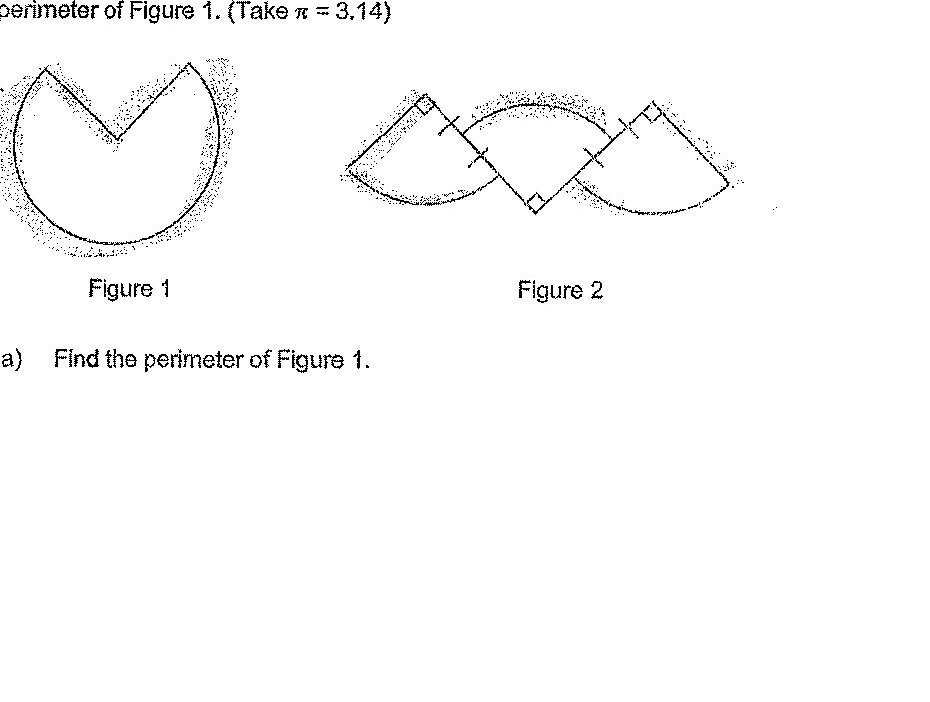
Shaun drew a three-quarter circle as shown in Figure 1 below. He then cut the three-quarter circle into 3 identical quadrants and arranged them as shown in Figure 2. The perimeter of Figure 2 is 12 cm longer than the perimeter of Figure 1. (Take π = 3.14) Find the perimeter of Figure 1.
Round off 299.996 to 2 decimal places.
In 52.179, what does the digit 7 stand for?
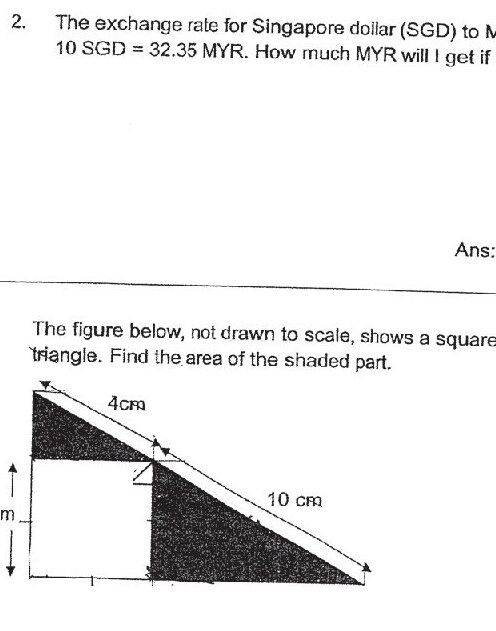
Arrange the following numbers in ascending order. 2.10 2.01 2.21
Express 7 2/5 as a decimal.
Find the value of 2.6 x 40.
What is the value of 4 hundreds, 9 tenths and 7 hundredths?
Write a decimal that is between 8.4 and 8.5
Round 324 456 to the nearest hundred.
Express 7 7/25 as a decimal.
Express 56 hundredths as a decimal.
Find the value of 9000 ÷ 9 + 2/100 + 9/1000. Give your answer as a decimal.
Arrange the following from the smallest to the greatest. 21/5, 2.15, 2 1/5
Past year papers cover the full exam — browse by subject below.