Fractions
Fractions
Key Concepts
-
A fraction shows part of a whole.
- It is written as
. - The numerator is the top number.
- The denominator is the bottom number.
- Example: In
, 3 is the numerator and 4 is the denominator.
- It is written as
-
Fractions can represent:
- part of a shape
- part of a set
- a number on the number line
- division
-
A proper fraction has a numerator smaller than its denominator.
- Example:
- Example:
-
An improper fraction has a numerator greater than or equal to its denominator.
- Example:
- Example:
-
A mixed number has a whole number and a fraction.
- Example:
- Example:
-
Equivalent fractions are fractions with the same value.
- Example:
- Example:
-
To get an equivalent fraction, multiply or divide the numerator and denominator by the same non-zero number.
- Example:
- Example:
-
A fraction is in its simplest form when the numerator and denominator have no common factor other than 1.
- Example:
in simplest form
- Example:
Adding and Subtracting Fractions with Unlike Denominators
-
Unlike denominators means the denominators are different.
- Example:
and
- Example:
-
Fractions can only be added or subtracted directly if they have the same denominator.
-
When denominators are different:
- Find the lowest common denominator (LCD).
- Rewrite each fraction as an equivalent fraction with the LCD.
- Add or subtract the numerators.
- Keep the denominator the same.
- Simplify the answer if possible.
-
Example idea:
- LCD of 3 and 4 is 12
,
Adding and Subtracting Mixed Numbers
Method 1 — Convert to improper fractions (recommended for PSLE):
- Change each mixed number to an improper fraction.
- Find the LCD and make equivalent fractions.
- Add or subtract the numerators.
- Convert back to a mixed number if needed.
-
Example:
Method 2 — Add whole numbers and fractions separately:
- Add (or subtract) the whole number parts.
- Add (or subtract) the fractional parts using LCD.
- Combine, and regroup if the fractional part is more than 1.
-
Example:
Subtracting mixed numbers (with borrowing):
-
When the fraction being subtracted is larger, borrow 1 from the whole number.
-
Example:
-
Method 1 (convert to improper fractions):
-
Method 2 (borrow 1):
- Borrow 1 from 3: rewrite
as - Then:
— the fraction part becomes negative, so:
- Borrow 1 from 3: rewrite
-
Answer:
-
PSLE Exam Tip: Always convert to improper fractions first if you are unsure — it is safer than the mental method and less likely to cause errors with borrowing.
Multiplying Fractions
-
To multiply fractions:
- Multiply the numerators.
- Multiply the denominators.
- Simplify.
-
Formula:
-
You can also multiply a whole number by writing it as a fraction over 1.
- Example:
- Example:
-
Cross-cancel before multiplying if possible.
-
This makes numbers smaller and easier to work with.
-
Example:
Cancel 2 with 10 to get 1 and 5, and 9 with 3 to get 3 and 1.
-
Dividing Fractions
-
To divide by a fraction:
- Keep the first fraction.
- Change division to multiplication.
- Turn the second fraction upside down (take its reciprocal).
- Multiply.
- Simplify.
-
Formula:
-
The reciprocal of a fraction is found by swapping the numerator and denominator.
- Example: reciprocal of
is
- Example: reciprocal of
-
To divide a whole number by a fraction:
-
Write the whole number as a fraction over 1 first.
-
Example:
-
Mixed Numbers and Improper Fractions
-
To change a mixed number to an improper fraction:
- Multiply the whole number by the denominator.
- Add the numerator.
- Put the result over the same denominator.
-
Formula:
-
Example:
-
To change an improper fraction to a mixed number:
- Divide the numerator by the denominator.
- The quotient is the whole number.
- The remainder becomes the numerator of the fractional part.
- The denominator stays the same.
-
Example:
-
In PSLE, answers are often left in:
- simplest fraction form, or
- mixed number form if the value is more than 1, unless the question states otherwise.
Fraction Word Problems
-
Fraction word problems often involve:
- finding a fraction of a quantity
- comparing parts
- adding or subtracting parts
- repeated sharing or grouping
- finding what is left
-
Important steps:
- Read the question carefully.
- Underline keywords.
- Decide what operation is needed.
- Draw a model or bar diagram if helpful.
- Write the fraction sentence clearly.
- Check whether the answer should be a fraction, whole number, or mixed number.
- Include units if needed.
-
Useful keywords:
- of usually means multiply
- shared equally may mean divide
- left may mean subtract
- total may mean add
Division with Remainder as a Fraction
-
Sometimes division does not give a whole number answer.
-
Instead of writing a remainder, you can write the remainder as a fraction of the divisor.
-
Rule:
-
Example:
-
The remainder becomes the numerator.
-
The divisor becomes the denominator.
-
This is closely linked to changing improper fractions to mixed numbers.
-
Example:
-
Important Definitions
- Fraction: a number that represents part of a whole, part of a set, or division.
- Numerator: the top number in a fraction; it shows how many parts are taken.
- Denominator: the bottom number in a fraction; it shows how many equal parts the whole is divided into.
- Proper fraction: a fraction with numerator less than denominator.
- Improper fraction: a fraction with numerator greater than or equal to denominator.
- Mixed number: a number made up of a whole number and a proper fraction.
- Equivalent fractions: fractions that have the same value though they look different.
- Simplest form: a fraction written so that the numerator and denominator have no common factor other than 1.
- Common denominator: a denominator shared by two or more fractions.
- Lowest common denominator (LCD): the smallest common denominator that two or more fractions can have.
- Reciprocal: the fraction formed by swapping the numerator and denominator.
- Remainder: the amount left after division when a number cannot be divided exactly.
- Fraction of a quantity: part of a number or amount, found by multiplying.
- Bar model: a diagram used to show parts and wholes in word problems.
Worked Examples
Example 1: Adding and Subtracting Fractions with Unlike Denominators
Find:
Step 1: Find the LCD of 4 and 5
- Multiples of 4: 4, 8, 12, 16, 20
- Multiples of 5: 5, 10, 15, 20
- LCD = 20
Step 2: Change each fraction to an equivalent fraction with denominator 20
Step 3: Add the numerators
Step 4: Change to a mixed number
Answer:
Find:
Step 1: Find the LCD of 8 and 6
- Multiples of 8: 8, 16, 24
- Multiples of 6: 6, 12, 18, 24
- LCD = 24
Step 2: Rewrite both fractions
Step 3: Subtract
Answer:
Example 2: Multiplying and Dividing Fractions
Find:
Step 1: Cross-cancel before multiplying
- 10 and 5 can both divide by 5:
- 3 and 21 can both divide by 3:
So the calculation becomes:
Step 2: Multiply
Answer:
Find:
Step 1: Change the mixed number to an improper fraction
Step 2: Change division to multiplication and take the reciprocal
Step 3: Cross-cancel
- 9 and 3 can divide by 3:
- 8 and 4 can divide by 4:
So:
Answer:
Example 3: Fraction Word Problem and Division with Remainder as a Fraction
A ribbon is
Step 1: Convert the mixed number to an improper fraction
Step 2: Use a common denominator
Step 3: Subtract
Step 4: Change to a mixed number
Answer:
A teacher shares 23 worksheets equally among 4 groups. How many worksheets does each group get, written with remainder as a fraction?
Step 1: Divide
Step 2: Write the remainder as a fraction
- remainder = 3
- divisor = 4
Answer:
Example 4: Multi-Step Fraction Word Problem
Jamie had some sweets. He gave
Bar Model Method:
Draw a bar divided into 12 equal parts (LCM of 3 and 4 is 12).
= 4 parts (given to sister) = 3 parts (given to friend) - Remaining = 12 − 4 − 3 = 5 parts = 20 sweets
Step 1: Find the value of 1 part
Step 2: Find the total
Answer:
Check:
Key Strategy: For multi-step fraction problems:
- Find the LCM of all denominators to get total parts.
- Find remaining parts.
- Use remaining parts to find the value of 1 part.
- Multiply to find the total.
Common Mistakes to Avoid
-
Adding or subtracting both the numerator and denominator.
- Wrong:
- Denominators must first be made the same.
- Wrong:
-
Forgetting to find the lowest common denominator before adding or subtracting unlike fractions.
-
Changing only the denominator but not the numerator when making equivalent fractions.
-
Not simplifying the final answer.
-
Forgetting to convert mixed numbers to improper fractions before multiplying or dividing.
-
Dividing fractions without taking the reciprocal of the second fraction.
-
Taking the reciprocal of the first fraction by mistake.
-
Making errors in cross-cancelling.
- Only cancel factors, not terms after adding or subtracting.
-
Writing the remainder as the denominator and divisor as the numerator.
-
Correct form is:
-
-
Forgetting units in word problems.
- Example: cm, m, kg, litres
-
Giving an improper fraction when the question asks for a mixed number, or vice versa.
Exam Tips
-
For addition and subtraction of unlike fractions, always show:
- the common denominator
- the equivalent fractions
- the simplified final answer
-
Use the keyword “equivalent fraction” when explaining how you changed the fractions.
-
For multiplication:
- Cross-cancel first if possible.
- This reduces mistakes with large numbers.
-
For division:
- Remember: Keep, Change, Flip
- Keep the first fraction
- Change
to - Flip the second fraction
- Remember: Keep, Change, Flip
-
When converting mixed numbers:
- Multiply the whole number by the denominator first, then add the numerator.
-
In word problems:
- Underline words like of, left, shared equally, remaining, altogether
- These help you choose the correct operation.
-
Draw a bar model if the question involves parts of a whole or comparison.
-
Always check whether your answer is reasonable.
- Example:
should be more than , not less.
- Example:
-
If the answer is more than 1, consider whether it should be written as a mixed number.
-
Check the final instruction carefully:
- simplest form?
- improper fraction?
- mixed number?
- with units?
Quick Summary
- A fraction has a numerator on top and a denominator below.
- Proper fractions are less than 1; improper fractions are 1 or more.
- A mixed number has a whole number and a proper fraction.
- To add or subtract fractions with unlike denominators, find the lowest common denominator first.
- Rewrite fractions as equivalent fractions before adding or subtracting.
- To multiply fractions, multiply the numerators and denominators, then simplify.
- To divide fractions, change division to multiplication and use the reciprocal of the second fraction.
- Convert mixed numbers to improper fractions before multiplying or dividing.
- To convert an improper fraction to a mixed number, divide the numerator by the denominator.
- In division with remainder as a fraction, write:
- quotient
- quotient
- In word problems, identify key words, choose the correct operation, and include units.
- Always simplify your answer and check if the required form is fraction or mixed number.
Find the value of 4/5 ÷ 2.
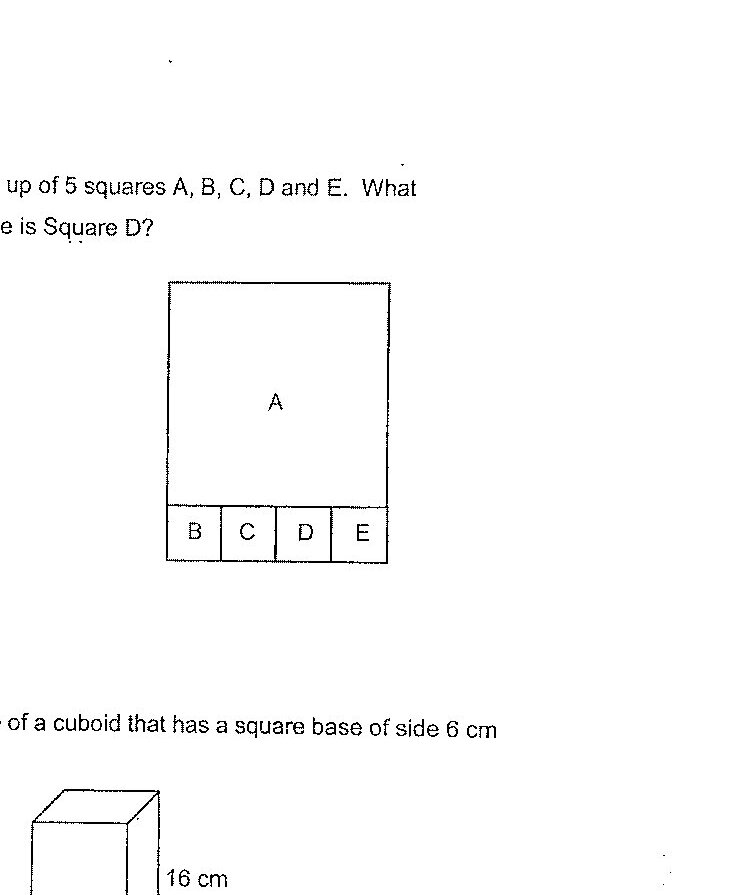
The figure is made up of 5 squares A, B, C, D and E. What fraction of the figure is Square D?
Miss Koh had a bag of flour. She used an equal amount of flour each day to bake bread. At the end of 8th day, 2/5 of the flour was left. At the end of 10th day, the amount of flour left was 1.2 kg. How many kilograms of flour did Miss Koh have at first?
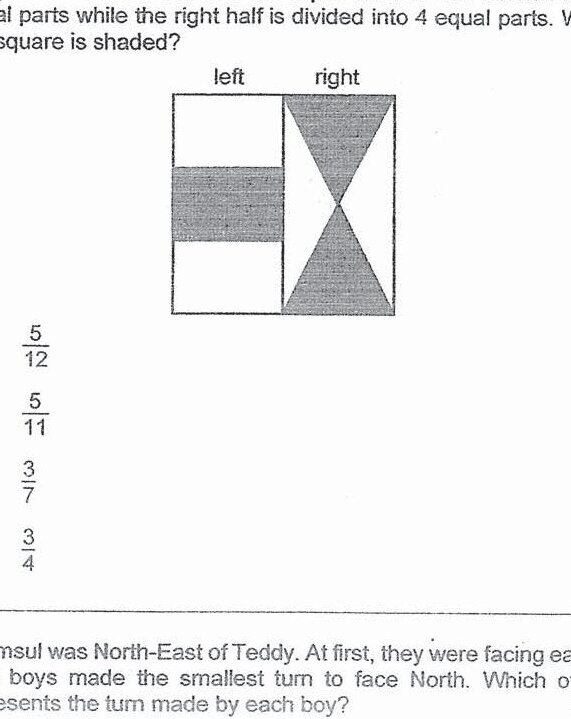
A square is first divided into two equal halves. The left half is divided into 3 equal parts while the right half is divided into 4 equal parts. What fraction of the square is shaded?
Which one of the following fractions is the furthest from 1/2?
Round 29 947 to the nearest hundred.
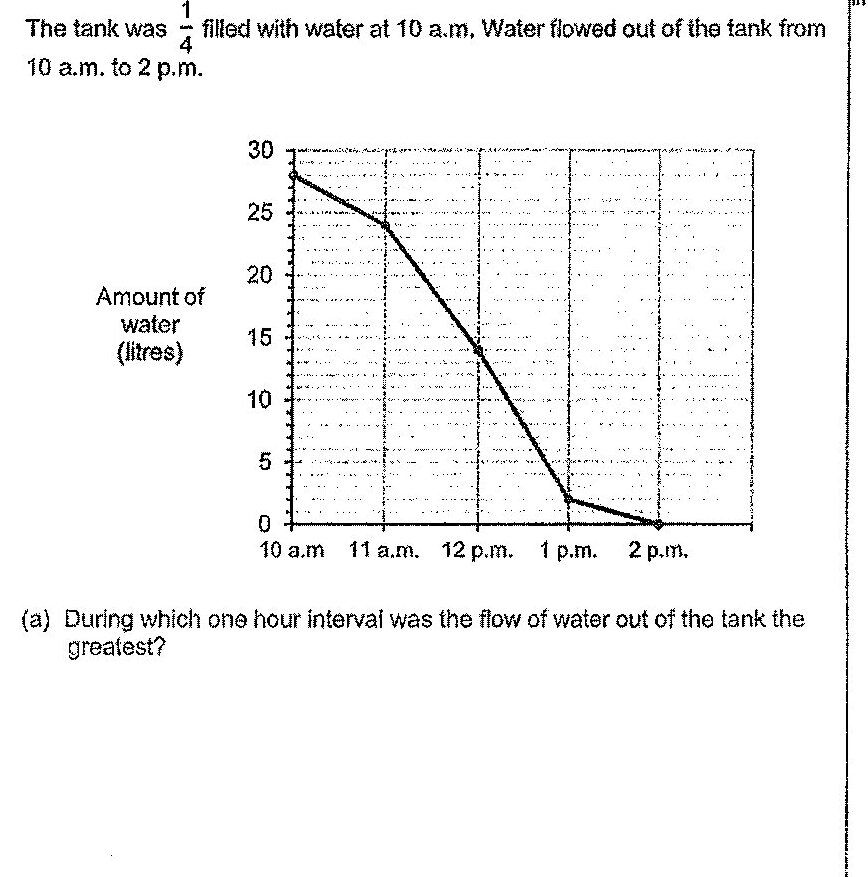
What fraction of the tank was filled with water at first before Tap A was turned on? Give your answer in the simplest form.
A fruit seller bought some plums. He threw away 152 plums that were damaged. After selling 2/3 of the remaining plums, he was left with 1/7 of the plums bought. He packed these into large boxes of 12 plums and small boxes of 8 plums. All the boxes were full and there was no left over.
Arrange the following fractions from the largest to the smallest. 2/11, 3/10, 1/5
What fraction of the pens sold were blue?
Joan, Siti and Xiuli had 60 beads each. Joan gave 2/5 of her beads to Xiuli. Siti gave some of her beads to Xiuli. Xiuli had 3 times the total of the remaining beads Joan and Siti had. How many beads did Siti give Xiuli?
Jacky had some stickers. He gave 1/6 of the stickers each to his two sisters. He put aside 2/3 of his remaining stickers to be shared equally among his brothers. Each of his brothers received 1/4 of the stickers. How many brothers did Jacky have?
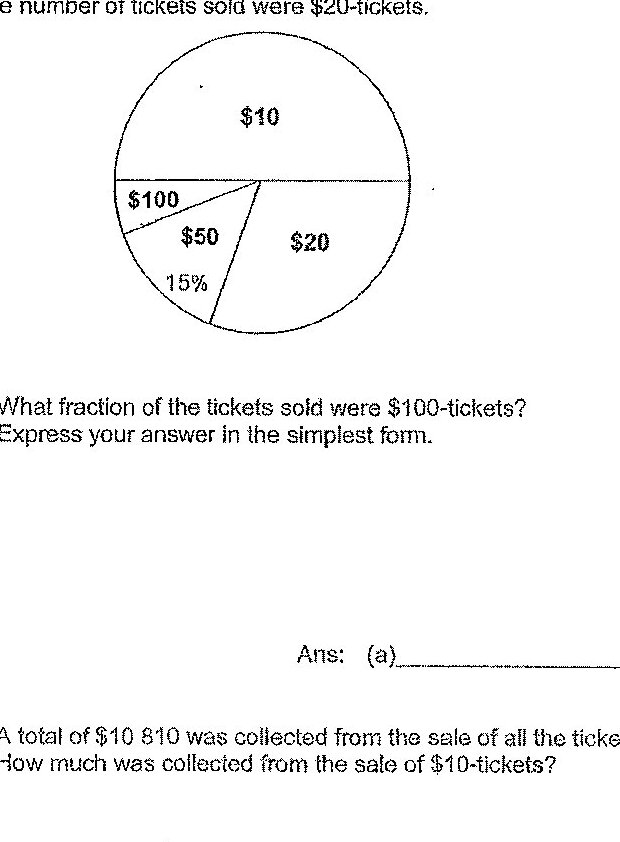
What fraction of the tickets sold were $100-tickets? Express your answer in the simplest form.
Prawns are sold at the supermarket at $1.36 per 100 g. Kelly bought 3.6 kg of prawns. How much did she pay?
There were 5/7 as many red marbles as blue marbles in a jar. Dave took some blue marbles out of the jar and replaced them with the same number of red marbles. The number of red marbles became 5/9 of all the marbles in the jar. Which of the following is a possible number of blue marbles that were replaced?
Find the value of 2/3 + 4/7. Give your answer as a mixed number in the simplest form.
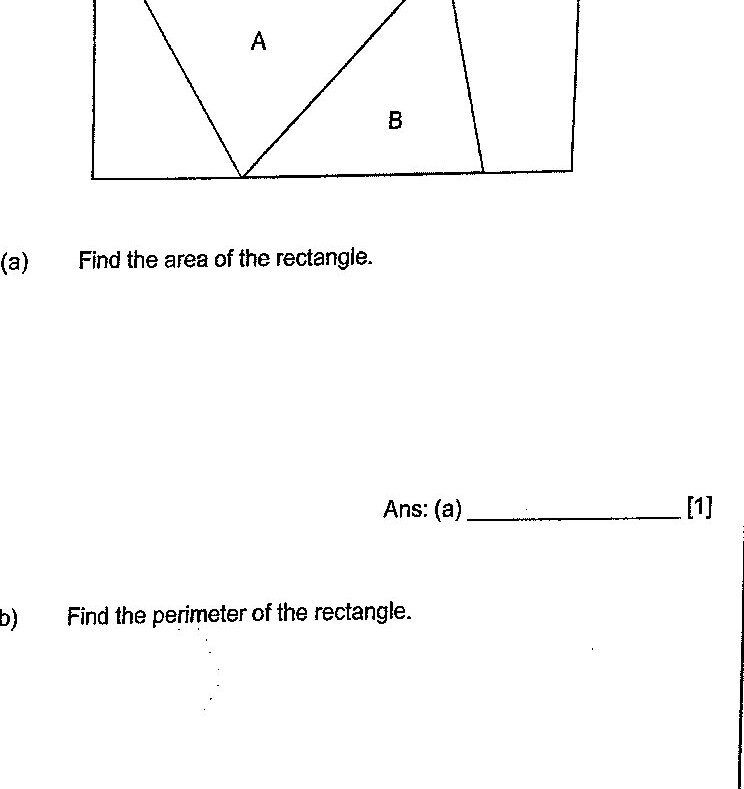
The figure is made up of 4 identical squares. AE = EF. What fraction of the figure is shaded?

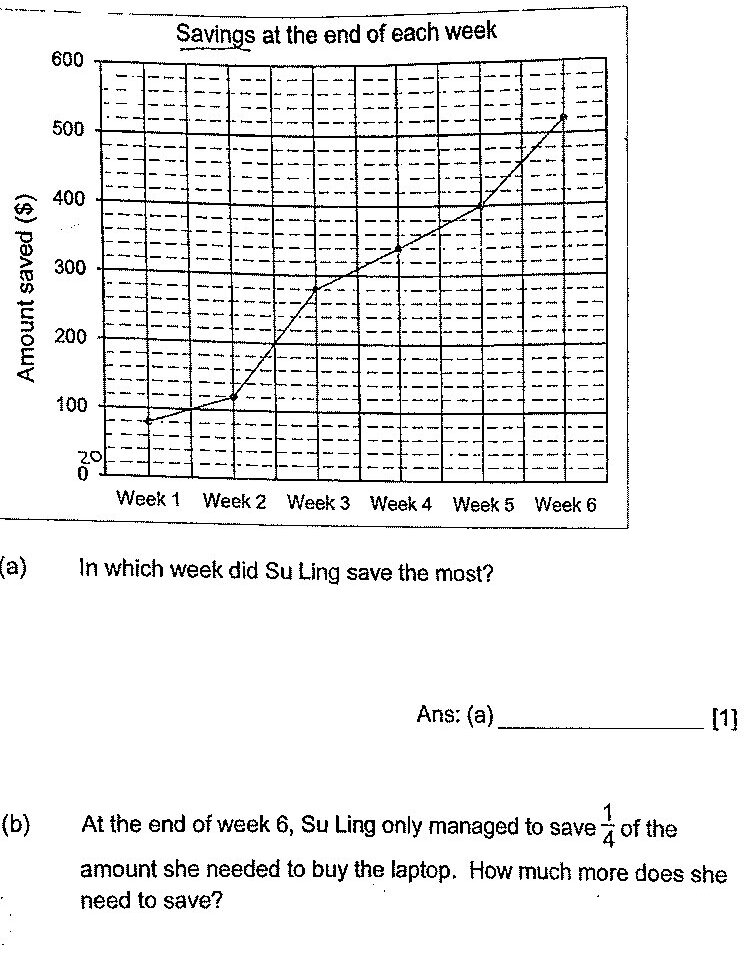
At the end of week 6, Su Ling only managed to save 1/4 of the amount she needed to buy the laptop. How much more does she need to save?
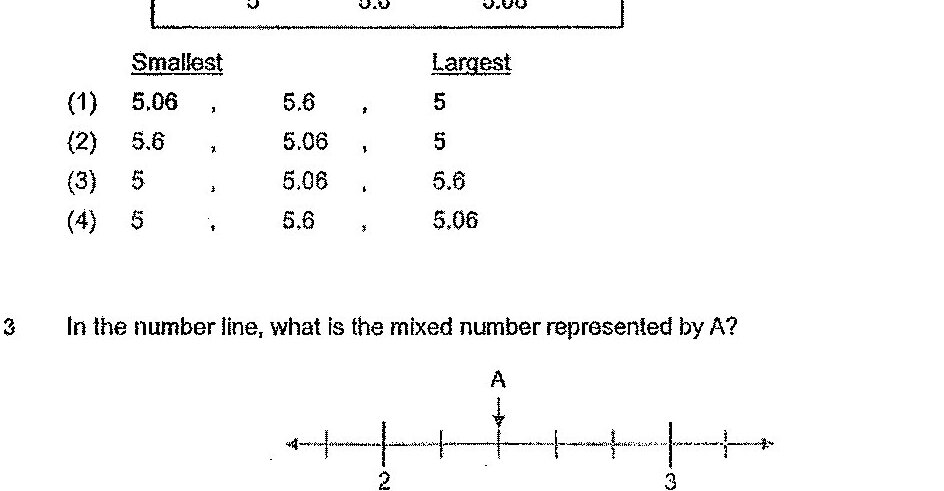
In the number line, what is the mixed number represented by A?
Mary had $350. She spent the same amount of money each day. After 5 days, she was left with 4/5 of her money. How much did she spend each day?
Mrs Lim has a jug which contains 5 l of water. She uses the water to fill some identical cups to the brim. The capacity of each cup is 2/3 l. At most, how many such cups can she fill to the brim?
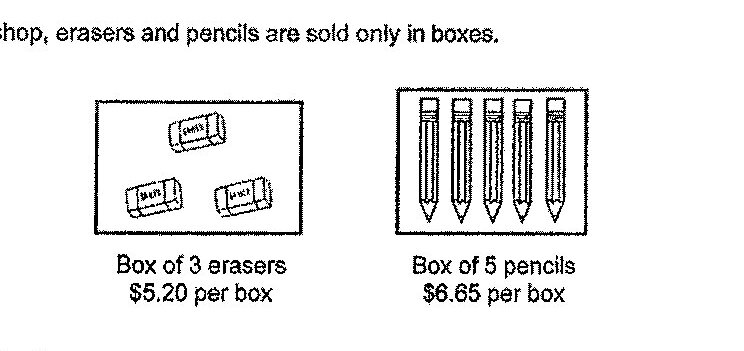
Samantha has some blue, pink and white beads. 7/10 of the beads are blue. There are twice as many pink beads as white beads. What fraction of the beads is white?
At 11 a.m., what fraction of the tank was filled with water?
Statement 2: 1/5 of the students walk to school.

The number of red balloons is 2/11 of the number of blue balloons. There are 1953 more blue balloons than red balloons. How many red balloons are there?
Mrs Raia made some pineapple tarts and nutella tarts. She sold 7/10 of her tarts. 75% of the tarts sold were nutella tarts. She sold 350 pineapple tarts. 30% of the unsold tarts were pineapple tarts. How many pineapple tarts were not sold?
Mrs Lim had 2/5 ℓ of syrup. She mixed the syrup with 9/10 ℓ of water to make fruit punch. The fruit punch was poured into bottles, each containing 1/5 ℓ. How much fruit punch was left?
Mrs Lim had 1/10 t of syrup. She mixed the syrup with 4/5 t of water to make fruit punch. The fruit punch was poured into bottles, each containing 1/5 t. How much fruit punch was left?
Find the value of 2/7 + 4. Give your answer in fraction in the simplest form.
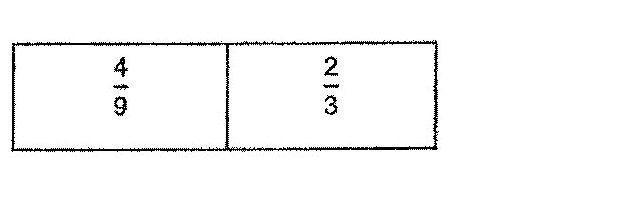
Which fraction is smaller?
Past year papers cover the full exam — browse by subject below.