Percentages
Percentages
Key Concepts
-
A percentage means “out of 100”.
- The symbol for percentage is %.
- For example:
- 25% means 25 out of 100
- 50% means 50 out of 100
- 100% means the whole amount
-
Percentages can be written in different forms:
- Percentage: 40%
- Fraction: 40/100 = 2/5
- Decimal: 0.4
-
To change a percentage to a decimal:
- divide by 100
- Example: 35% = 35/100 = 0.35
-
To find a percentage of a quantity:
- Change the percentage to a fraction or decimal
- Then multiply by the quantity
- Formula:
- Percentage of a quantity = Percentage × Total quantity
-
Discount means the amount taken off the original price.
- It is a reduction in price.
- Formula:
- Discount = Discount rate × Original price
- Selling price after discount = Original price − Discount
-
GST stands for Goods and Services Tax.
- It is a tax added to the price of goods and services.
- Formula:
- GST amount = GST rate × Price before GST
- Price including GST = Price before GST + GST amount
-
A percentage increase happens when an amount becomes larger.
- Formula:
- Increase = Percentage increase × Original amount
- New amount = Original amount + Increase
- Formula:
-
A percentage decrease happens when an amount becomes smaller.
- Formula:
- Decrease = Percentage decrease × Original amount
- New amount = Original amount − Decrease
- Formula:
-
When finding the original amount, work backwards.
- If a value is increased or decreased by a percentage, the final amount is only a part of the original.
- Example:
- After a 20% decrease, 80% remains
- After a 15% increase, 115% of the original remains as the new amount
-
Profit and loss compare the selling price and the cost price.
- Cost price = amount paid to buy or make an item
- Selling price = amount the item is sold for
-
If selling price is more than cost price:
- there is a profit
- Formula:
- Profit = Selling price − Cost price
-
If selling price is less than cost price:
- there is a loss
- Formula:
- Loss = Cost price − Selling price
-
To find profit percentage:
- Profit % = (Profit ÷ Cost price) × 100%
-
To find loss percentage:
- Loss % = (Loss ÷ Cost price) × 100%
-
Important idea:
- Profit and loss percentages are usually based on cost price, not selling price.
Expressing One Quantity as a Percentage of Another
-
Formula:
-
Both quantities must be in the same unit before dividing.
-
Worked example 1: “Express 45 cm as a percentage of 3 m.”
- Convert: 3 m = 300 cm
-
Worked example 2: “In a class of 40 students, 24 are girls. What percentage are girls?”
-
Common mistake: forgetting to convert to the same unit first.
Percentage Change
-
Percentage change measures how much something has increased or decreased as a percentage of the original value.
- Formula:
- Percentage change = (change ÷ original) × 100%
- The change is the difference between the new value and the original value.
- Formula:
-
Percentage increase: the new value is greater than the original.
- Change = New value − Original value
- Percentage increase = (increase ÷ original) × 100%
-
Percentage decrease: the new value is less than the original.
- Change = Original value − New value
- Percentage decrease = (decrease ÷ original) × 100%
-
Important note: Always use the ORIGINAL value as the denominator, not the new value.
Important Definitions
-
Percentage: a number or ratio expressed as a fraction of 100.
-
Quantity: the amount or number of something.
-
Original amount: the starting amount before any increase, decrease, discount, or GST is applied.
-
Discount: the amount taken away from the original price.
-
Discount rate: the percentage of the original price that is reduced.
-
GST (Goods and Services Tax): a tax added to the price of goods and services.
-
Increase: the amount by which something becomes more.
-
Decrease: the amount by which something becomes less.
-
Percentage increase: the increase written as a percentage of the original amount.
-
Percentage decrease: the decrease written as a percentage of the original amount.
-
Cost price: the amount paid to buy or produce an item.
-
Selling price: the amount for which an item is sold.
-
Profit: the amount gained when the selling price is more than the cost price.
-
Loss: the amount lost when the selling price is less than the cost price.
-
Profit percentage: the profit expressed as a percentage of the cost price.
-
Loss percentage: the loss expressed as a percentage of the cost price.
Worked Examples
Example 1: Percentage of a Quantity
A class has 40 pupils. 35% of them are boys. How many boys are there?
Step 1: Change the percentage to a decimal or fraction
- 35% = 35/100 = 0.35
Step 2: Multiply by the total number of pupils
- Number of boys = 35% of 40
- = 0.35 × 40
- = 14
Answer: There are 14 boys.
Example 2: Discount and GST
A bag costs $80. It is sold at a 10% discount. Then 9% GST is added to the discounted price. Find the final price paid.
Step 1: Find the discount
- Discount = 10% of $80
- = 0.10 × 80
- = $8
Step 2: Find the price after discount
- Price after discount = $80 − $8
- = $72
Step 3: Find the GST
- GST = 9% of $72
- = 0.09 × 72
- = $6.48
Step 4: Find the final price paid
- Final price = $72 + $6.48
- = $78.48
Answer: The final price paid is $78.48.
Example 3: Finding the Original Amount
After a 20% discount, a shirt costs $48. What was the original price?
Step 1: Understand what remains
- If there is a 20% discount, then:
- 100% − 20% = 80%
- So $48 is 80% of the original price.
Step 2: Find 1%
- 80% = $48
- 1% = $48 ÷ 80
- = $0.60
Step 3: Find 100%
- 100% = $0.60 × 100
- = $60
Answer: The original price was $60.
Example 4: Profit
A shopkeeper bought a toy for $24 and sold it for $30. Find:
- the profit
- the profit percentage
Step 1: Find the profit
- Profit = Selling price − Cost price
- = $30 − $24
- = $6
Step 2: Find the profit percentage
- Profit % = (Profit ÷ Cost price) × 100%
- = (6 ÷ 24) × 100%
- = 1/4 × 100%
- = 25%
Answer:
- Profit = $6
- Profit percentage = 25%
Example 5: Percentage Increase
A price rose from $40 to $50. Find the percentage increase.
Step 1: Find the increase
- Increase = $50 − $40 = $10
Step 2: Apply the formula
- Percentage increase = (increase ÷ original) × 100%
- = (10 ÷ 40) × 100%
- = 0.25 × 100%
- = 25%
Answer: The percentage increase is 25%.
Example 6: Percentage Decrease
A shirt was $60. It now costs $45. Find the percentage decrease.
Step 1: Find the decrease
- Decrease = $60 − $45 = $15
Step 2: Apply the formula
- Percentage decrease = (decrease ÷ original) × 100%
- = (15 ÷ 60) × 100%
- = 0.25 × 100%
- = 25%
Answer: The percentage decrease is 25%.
Remember: Always divide by the original value, not the new value.
Common Mistakes to Avoid
-
Mixing up percentage and amount.
- Example: 20% is not $20 unless the question says so.
-
Forgetting that % means out of 100.
-
Using the wrong base when calculating percentages.
- For profit and loss, percentage is usually based on cost price.
- For discount, percentage is based on original price.
-
Adding and subtracting percentages wrongly.
- A 20% decrease means 80% remains, not 20% remains.
-
Finding GST from the wrong amount.
- GST is usually added to the price before GST, not after.
-
Applying discount and GST in the wrong order.
- Read the question carefully.
-
Forgetting to convert the percentage to a decimal or fraction before multiplying.
-
Writing money answers without correct units.
- Always write $ when needed.
- Money is usually written to 2 decimal places.
-
Confusing original amount with final amount.
- If the final amount is given after an increase or decrease, work backwards.
-
Using selling price instead of cost price for profit or loss percentage.
Exam Tips
-
Circle important keywords in the question:
- discount
- GST
- increase
- decrease
- original price
- cost price
- selling price
- profit
- loss
-
Ask yourself:
- “What is the 100% in this question?”
- This helps you choose the correct base.
-
For percentage of a quantity:
- write clearly:
35% of 40 = 0.35 × 40 = 14
- write clearly:
-
For original amount questions:
- state what percentage remains first.
- Example:
- “After a 15% discount, 85% remains.”
-
For profit and loss:
- always show:
- cost price
- selling price
- difference
- percentage based on cost price
- always show:
-
For questions involving money:
- check if the final answer should be in dollars and cents.
-
Use mark-earning phrases such as:
- “100% represents the original amount.”
- “After the discount, 90% of the price remains.”
- “Profit is calculated by subtracting cost price from selling price.”
- “Loss percentage is based on the cost price.”
-
Check whether your answer makes sense:
- After a discount, the price should be less
- After GST, the price should be more
- After a percentage increase, the new amount should be greater
Quick Summary
- Percentage means out of 100.
- To find a percentage of a quantity, multiply the quantity by the percentage.
- Convert percentages to fractions or decimals before calculating.
- Discount is an amount taken off the original price.
- GST is a tax added to the price.
- Percentage increase means the amount becomes more.
- Percentage decrease means the amount becomes less.
- To find the original amount, work out what percentage remains first.
- After a discount or decrease, subtract from 100% to find the remaining percentage.
- Profit = Selling price − Cost price.
- Loss = Cost price − Selling price.
- Profit and loss percentages are usually based on the cost price.
A jar of peanut butter costs $2.80 and a bundle of 3 jars of peanut butter costs $7. Samuel wants to buy exactly 26 jars of peanut butter. What is the least amount of money he needs?
Jonathan was given a fixed amount of pocket money each month. In July, he spent $80 and saved the rest. In August, he spent 10% less and his savings increased by 20%. How much was Jonathan's pocket money for each month?
Mrs Tan had a box of green, blue and red beads. She had 248 green beads. 30% of her beads were blue. She had 24 fewer red beads than blue beads. What was the total number of beads she had in the box?
Mrs Tan's son bought her some blue beads. Her total number of beads then increased by 25%. How many blue beads did she have in the end?
Jai and Kyle entered a gym at 6.30 p.m. Jai left 2 h 30 min later. Kyle left 20 min earlier than Jai. At what time did Kyle leave the gym? Give your answer in 24-hour clock format.
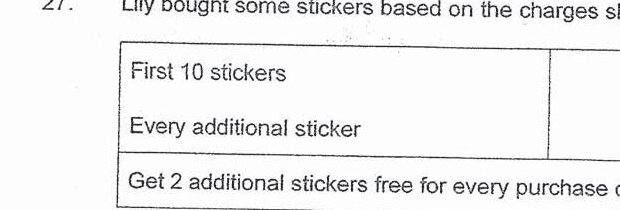
Lily bought some stickers based on the charges shown below. First 10 stickers: $7 Every additional sticker: 50¢ Get 2 additional stickers free for every purchase of 30 stickers She paid $17 for the stickers. How many stickers did she get in all?
A funfair was decorated with red and white balloons. At first, there were 19 more white balloons than red balloons. 25% of the white balloons burst. More red balloons were added so that there were 26 more red balloons than white balloons. In the end, there was a total of 170 red and white balloons. (a) How many red balloons were there in the end? (b) What was the percentage increase in the number of red balloons? Round your answer to 1 decimal place.

Express 0.003 as a percentage.
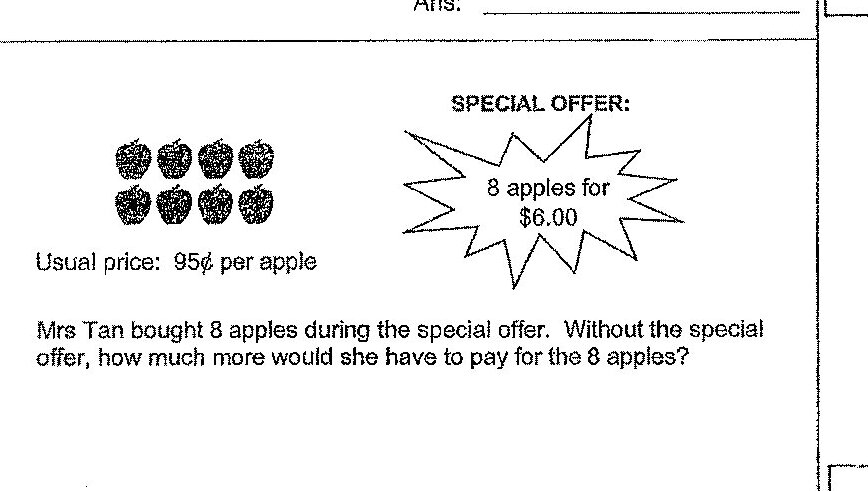
Mrs Tan bought 8 apples during the special offer. Without the special offer, how much more would she have to pay for the 8 apples?
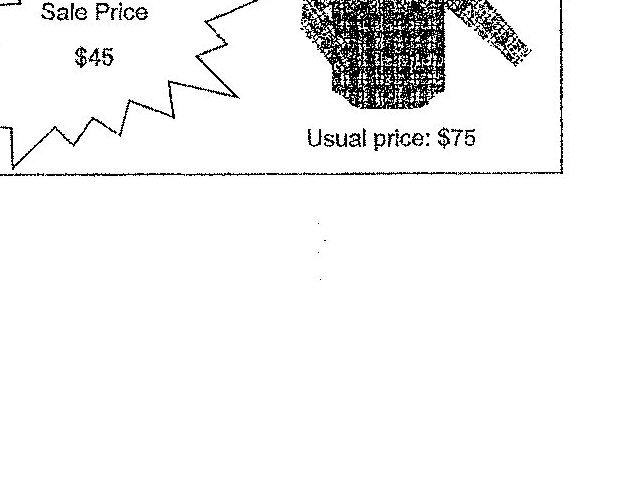
What is the percentage discount for the shirt shown?
At a paint shop, there were some identical containers. 70% of the containers were completely filled with paint. The remaining 120 containers were empty. The total volume of paint in the containers was 1400 l. What was the volume of paint in one container? Give your answer in litres.
A total of $10 610 was collected from the sale of all the tickets. How much was collected from the sale of $10-tickets?
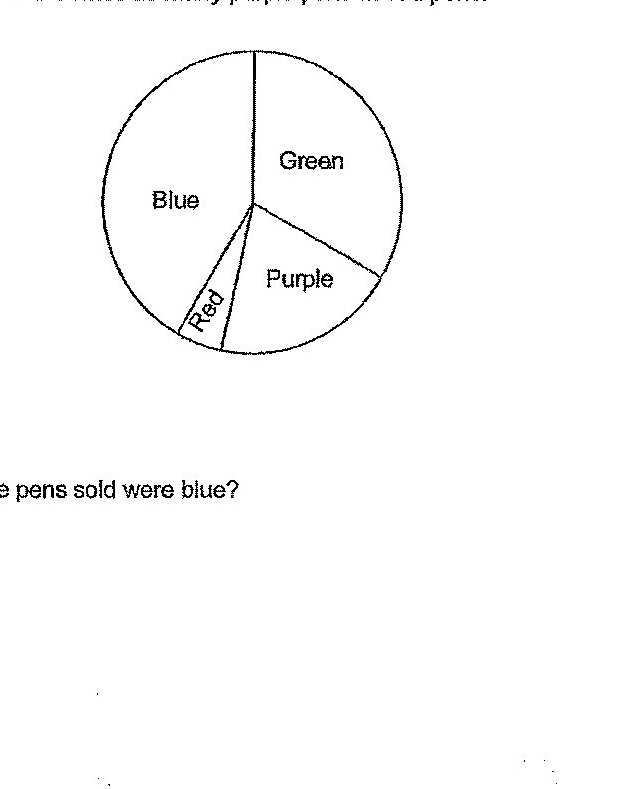
Last year, the ratio of the number of men to the number of women who signed up for a marathon was 5 : 4. This year, the number of men who signed up for the marathon increased by 50% and the number of women who signed up for the marathon decreased by 50%. A total of 4913 men and women signed up for the marathon this year. What is difference between the total number of people who signed up for the marathon in the two years?
Express 1.8 as a percentage.
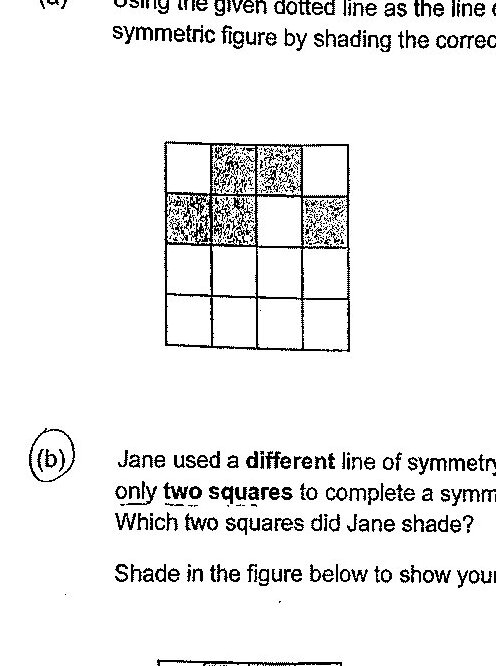
Alan bought some stalks of flowers. 60% of them are roses and the rest are orchids. 50% of the roses are red roses. There are 24 red roses. How many stalks of orchids are there?
The pie chart below shows the favourite food of a group of children. What is the ratio of the number of children who like burger to the number of children who like pasta?
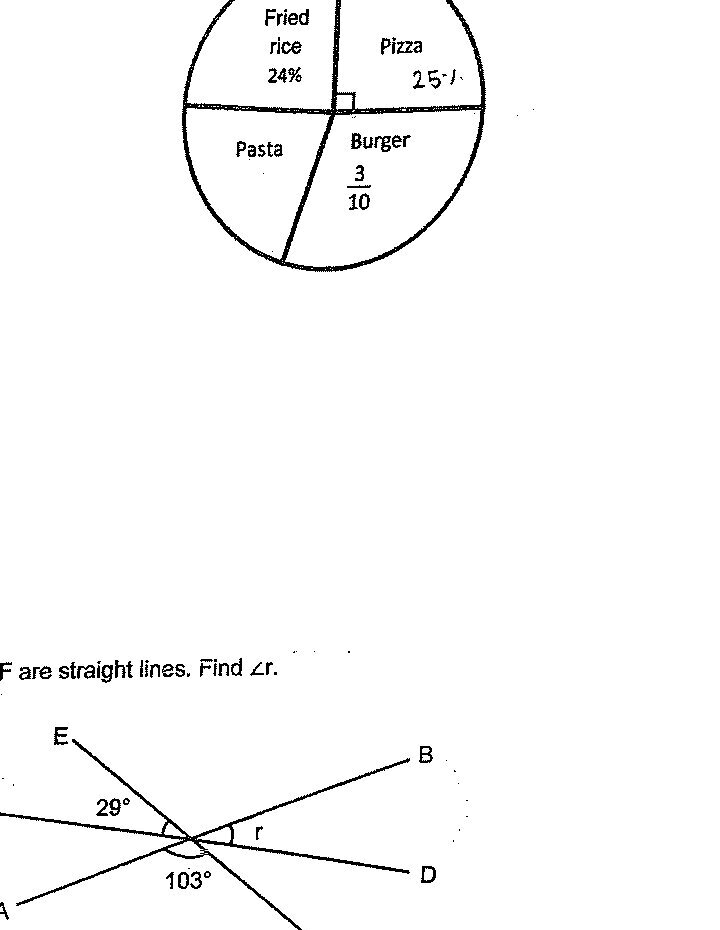
What was the percentage decrease in the number of people who took part in Badminton from March to April? Give your answer correct to 2 decimal places.

What percentage of the wooden block is the solid formed in Diagram C? Give your answer correct to 1 decimal place.
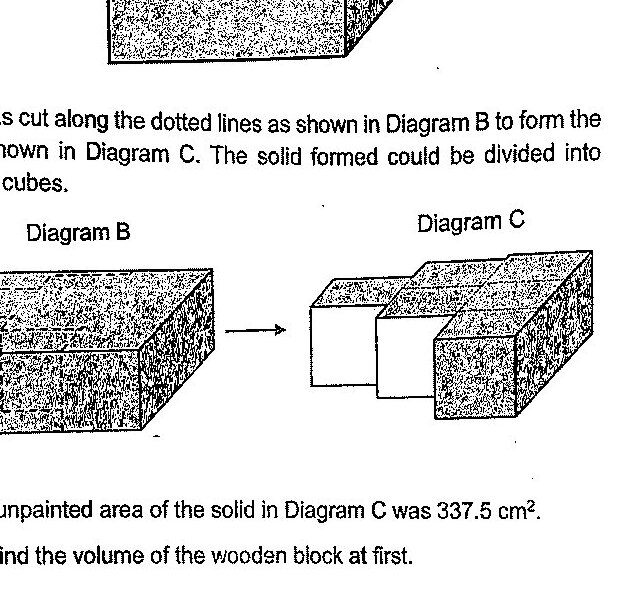
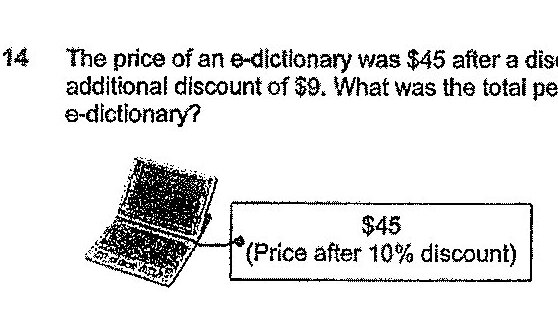
The price of an e-dictionary was $45 after a discount of 10%. Rina was then given an additional discount of $9. What was the total percentage discount given to Rina for the e-dictionary?
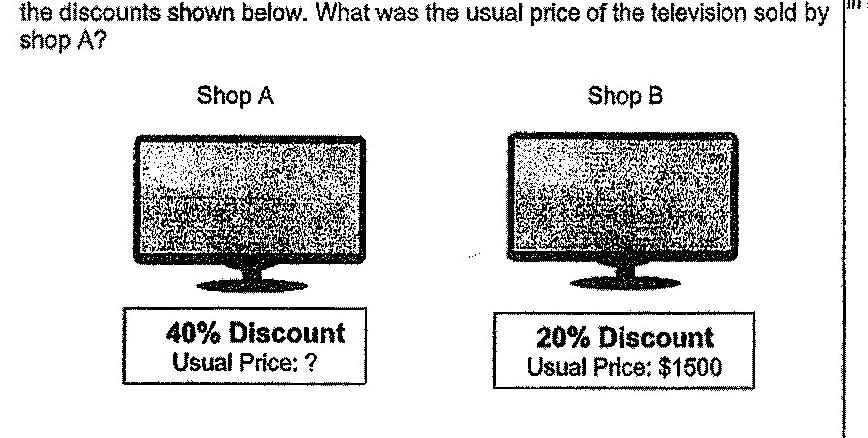
Shop A and shop B sold an identical television each at the same price, after the discounts shown below. What was the usual price of the television sold by shop A?
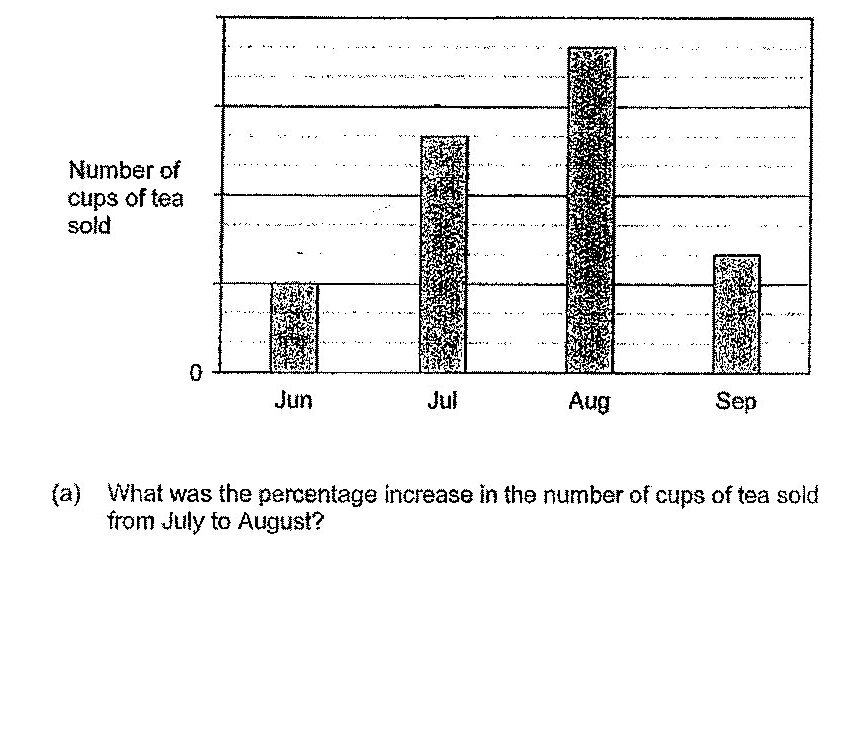
What was the percentage increase in the number of cups of tea sold from July to August?
John is thinking of a number. 40% of the number is 36. What is the number?
Aini spent $40 in school in January. In February, she spent $32 in school. Find the percentage decrease in her spending.
A red T-shirt is sold at a 15% discount and a blue T-shirt at a 30% discount. Both shirts have the same price before the discount. The discounted price of the red T-shirt is $6 more than the discounted price of the blue T-shirt. What is the price of a red T-shirt before the discount?
A day camp lasted 6 h 20 min. The day camp started 1 h 45 min before the snack break. Snack break was at 11.30 a.m. What time did the day camp end? Give your answer in 24 hour clock.
Dana bought an oven from Shop A at 15% discount during a sale. The price of the oven was $800 before discount at Shop A. Hailey bought an identical oven from Shop B at 20% discount and paid the same amount as Dana. What was the price of the oven before discount at Shop B?
During a sale, a chair was sold at $210. This was 30% less than the usual price of the chair. What was the usual price of the chair?
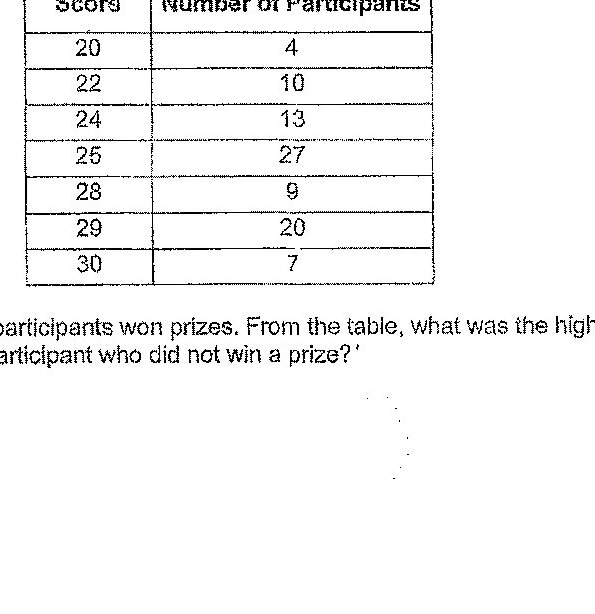
Participants of a quiz must obtain at least a certain score to win a prize. There were 90 participants and the table below shows the number of participants with the following scores. 30% of the participants won prizes. From the table, what was the highest score of a participant who did not win a prize?
In a school hall, the number of girls was 49% less than the number of boys. There were 408 children altogether. How many girls were there in the hall?
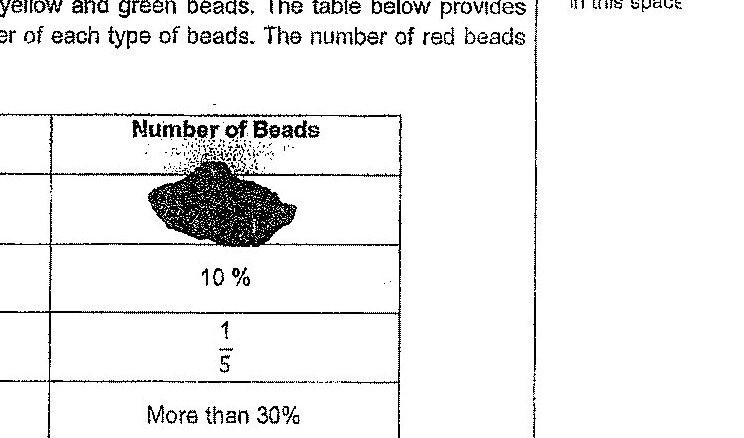
40% of the beads are red.
Past year papers cover the full exam — browse by subject below.