Rate and Speed
Rate and Speed
Not in PSLE 2026: Speed and Rate topics have been removed from the PSLE Mathematics syllabus under the 2021 MOE curriculum. Students sitting PSLE from 2026 onwards do not need to study this topic — it has moved to Secondary 1. This page is kept for reference only.
Key Concepts
Rate
-
A rate compares a quantity to a unit of something else (often time).
-
It tells us how much of something happens per unit.
-
Examples of rates:
- $15/hour (money earned per hour)
- 3 litres/minute (water flowing per minute)
- 60 words/minute (typing speed)
-
Speed is a specific type of rate — it is distance per unit time.
- All speeds are rates, but not all rates are speeds.
Worked Example: Rate
A tap fills a tank at 4 litres per minute. How long does it take to fill a 60-litre tank?
Answer: 15 minutes
-
Speed tells us how fast something is moving.
-
It is found using the formula:
-
This means:
- if something travels a longer distance in the same time, it has a greater speed
- if something takes more time to travel the same distance, it has a lower speed
The 3 related quantities
-
Distance
- the length of the path travelled by an object
- common units:
- metre (m)
- kilometre (km)
-
Time
- how long the object takes to travel
- common units:
- second (s)
- minute (min)
- hour (h)
-
Speed
- the distance travelled in a unit of time
- common units:
- metres per second (m/s)
- kilometres per hour (km/h)
Formula triangle idea
You can remember the relationship between speed, distance and time like this:
- Speed = Distance ÷ Time
- Distance = Speed × Time
- Time = Distance ÷ Speed
Average speed
- Sometimes an object does not move at the same speed throughout the whole journey.
- It may:
- speed up
- slow down
- stop for a while
- In such cases, we use average speed.
- Important:
- use the total distance
- use the total time
- include any stopping time if it is part of the journey time given
Converting units of speed
To calculate speed correctly, the units of distance and time must match the unit of speed required.
Common conversions
- 1 km = 1000 m
- 1 h = 60 min
- 1 min = 60 s
- 1 h = 3600 s
Converting speed units
- To convert km/h to m/s:
- multiply by 1000
- divide by 3600
- so overall, divide by 3.6
- To convert m/s to km/h:
- multiply by 3600
- divide by 1000
- so overall, multiply by 3.6
Distance-time graphs
A distance-time graph shows how distance changes with time.
- The horizontal axis (x-axis) shows time
- The vertical axis (y-axis) shows distance
What the graph tells us
- A straight sloping line means the object is moving at constant speed
- A steeper line means greater speed
- A less steep line means lower speed
- A horizontal line means the object is not moving because distance does not change with time
Comparing speeds on a graph
- The gradient or steepness of the line shows speed
- Greater gradient = greater speed
Solving speed word problems
When solving word problems:
- Identify the distance, time, and speed
- Decide which formula to use
- Convert units first if needed
- Substitute the values carefully
- Write the answer with the correct unit
Real-life examples of speed
- walking speed may be measured in m/s
- car speed is usually measured in km/h
- athletes in races may have speeds compared using the same formula
Important Definitions
- Speed: the distance travelled per unit time.
- Distance: the length of the path travelled by an object.
- Time: the duration taken for an event or journey.
- Average speed: the total distance travelled divided by the total time taken.
- Constant speed: a speed that does not change over time.
- Unit: a standard way of measuring a quantity, such as metre, second, or kilometre per hour.
- Distance-time graph: a graph that shows how distance changes with time.
- Gradient / Steepness: how steep a line is on a graph; on a distance-time graph, it shows speed.
- Stationary: not moving.
- Metres per second (m/s): the speed of an object travelling a certain number of metres each second.
- Kilometres per hour (km/h): the speed of an object travelling a certain number of kilometres each hour.
Worked Examples
Example 1: Finding speed
A boy cycles 600 m in 3 min. Find his speed in m/min.
Step 1: Write the formula
Step 2: Substitute the values
Step 3: Calculate
Step 4: Write the unit
Speed = 200 m/min
Example 2: Finding average speed
A van travels 40 km in the first hour and 20 km in the second hour. Find its average speed for the whole journey.
Step 1: Find total distance
Step 2: Find total time
Step 3: Use the average speed formula
Step 4: Calculate
Answer: 30 km/h
Example 3: Converting units and finding speed
A runner covers 1800 m in 6 min. Find his speed in m/s.
Step 1: Check the units
Distance is in metres, but time is in minutes.
Since the answer must be in m/s, convert minutes to seconds.
Step 2: Use the formula
Step 3: Calculate
Step 4: Write the unit
Answer: 5 m/s
Common Mistakes to Avoid
- Using the wrong formula
- for example, multiplying distance and time instead of dividing
- Forgetting to convert units before calculating
- e.g. using km with minutes and giving answer in km/h
- Leaving out the unit in the final answer
- Mixing up average speed with one part of the journey
- average speed must use total distance and total time
- Forgetting to include stopping time when finding average speed
- Reading a distance-time graph wrongly
- a horizontal line means stationary, not moving at constant speed
- Thinking that a line higher on the graph always means faster
- it is the steepness, not the height, that shows speed
- Converting speed units incorrectly
- remember:
- km/h to m/s → divide by 3.6
- m/s to km/h → multiply by 3.6
- remember:
- Copying numbers wrongly from the question
- Giving answers in the wrong form or wrong unit asked in the question
Exam Tips
- Always underline or note the 3 important quantities:
- distance
- time
- speed
- Check what the question is asking for before calculating.
- Write the formula first:
- Speed = Distance ÷ Time
- Distance = Speed × Time
- Time = Distance ÷ Speed
- If units are different, convert them before substituting into the formula.
- For average speed questions, use the phrase:
- total distance travelled
- total time taken
- For distance-time graph questions, describe the line clearly:
- The object moved at constant speed
- The object was stationary
- The object moved faster because the line is steeper
- When comparing two objects on a graph:
- mention steeper line = greater speed
- Always include units such as:
- m/s
- km/h
- m/min
- Recheck whether your answer is reasonable:
- a person usually does not walk at 100 km/h
- a car usually does not move at 2 m/h
- If the answer looks strange, check your unit conversion again.
Quick Summary
- Speed tells how fast an object moves.
- Formula: Speed = Distance ÷ Time
- Rearranged formulas:
- Distance = Speed × Time
- Time = Distance ÷ Speed
- Common distance units: m, km
- Common time units: s, min, h
- Common speed units: m/s, km/h
- Average speed = total distance ÷ total time
- Include stopping time when finding average speed if it is part of the whole journey.
- Convert units before calculating when needed.
- 1 km = 1000 m
- 1 h = 60 min = 3600 s
- On a distance-time graph:
- sloping straight line = constant speed
- steeper line = faster
- horizontal line = stationary
- In graphs, speed depends on the steepness of the line, not how high the line is.
- Always give the final answer with the correct unit.
A van travelled 240 km at a speed of 80 km/h. A car took 1/2 h less than the van to travel the same distance. How long did the car take to cover the same distance?
Ron and Harry started running in opposite directions on a running trail. Ron ran at a speed of 110 m/min. At the end of 15 minutes, they were 3525 m apart. Find Harry's running speed in m/min.
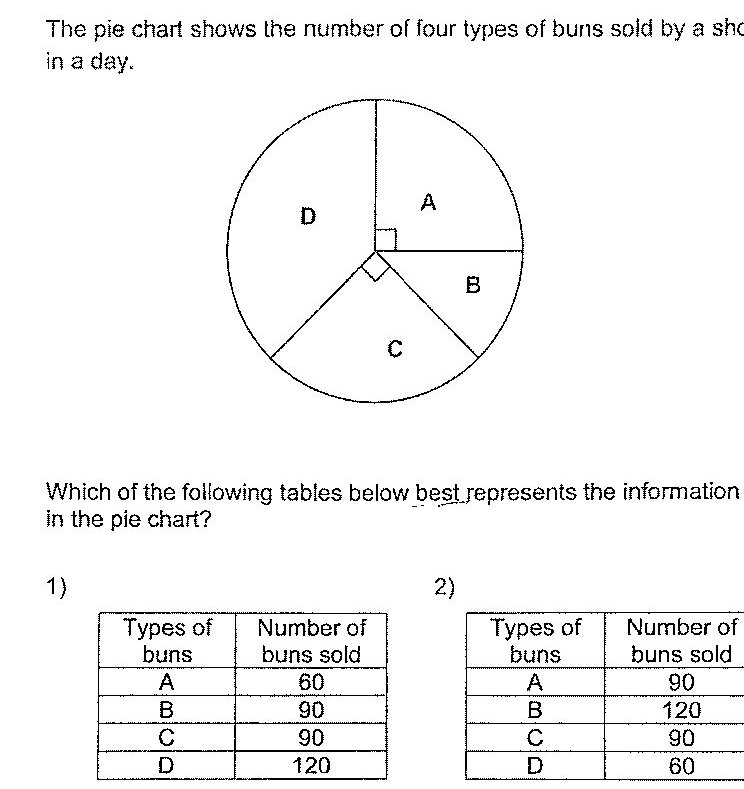
Which of the following is the same as 70 ÷ 90 ml?
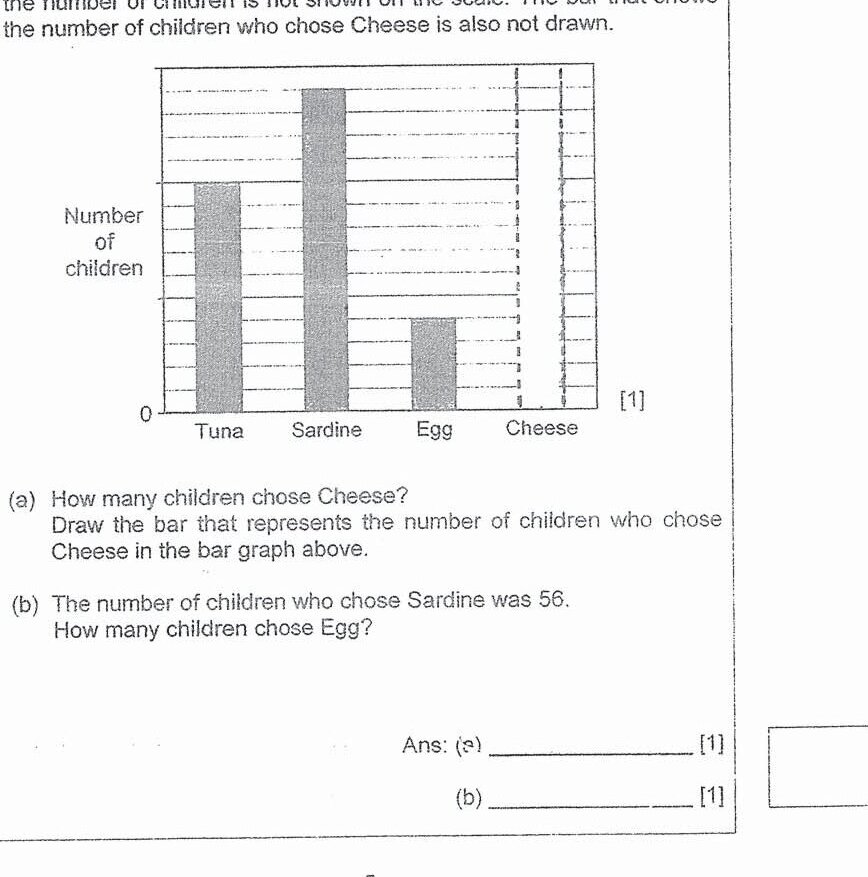
The figure shows half of a symmetric figure. Draw lines to complete the symmetric figure with the dotted line AB as the line of symmetry.
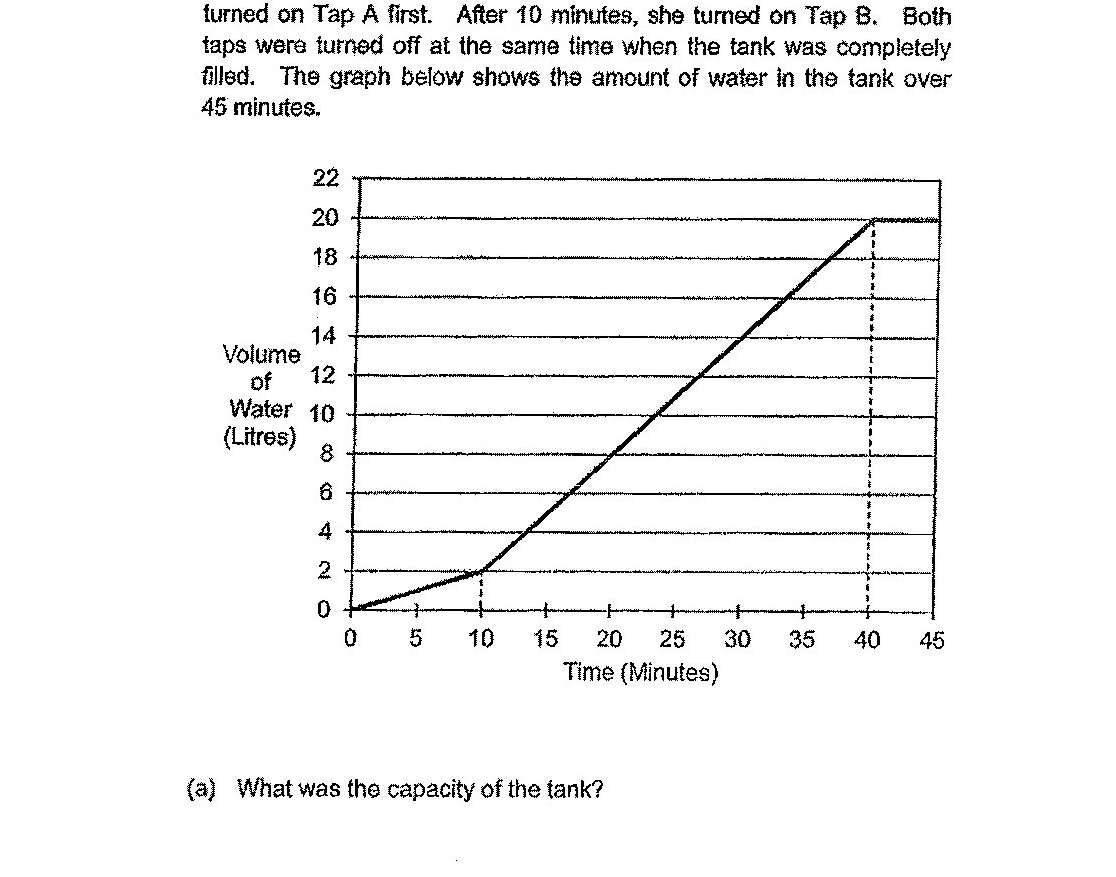
How many litres of water flowed into the tank per minute before Tap B was turned on?
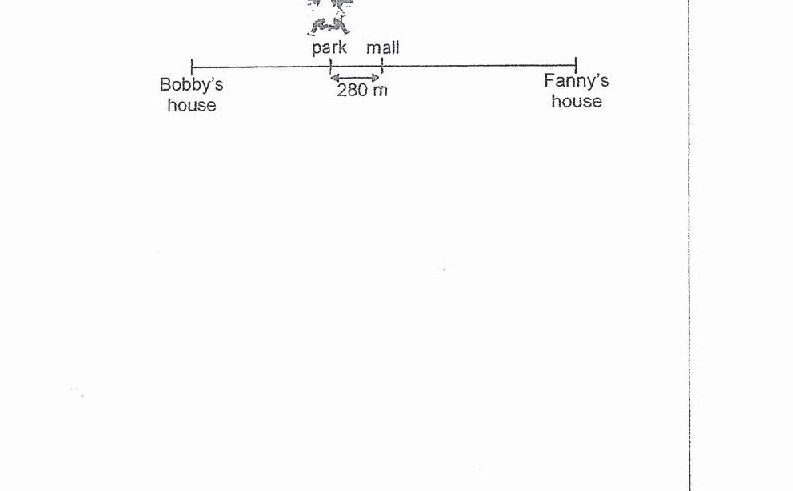
Bobby and Fenny started jogging from a park to their houses at the same time. A mall was exactly halfway between their houses. It was also 280 m away from the park as shown below. Bobby jogged at 120 m/min while Fenny jogged at 40 m/min faster than Bobby. Both did not change their speeds throughout and reached their houses at the same time. How far was Bobby's house from the park?
Mr Lee drove for 6 hours from City A to City B. In the first two hours, he drove at an average speed of 75 km/h. For the rest of the journey, he drove at an average speed of 60 km/h. What was his average speed for the whole journey?
Jen and Grace took part in a race and both of them started running from the same point at the same time. After 35 min, Jen completed the race, but Grace had only run 5/7 of the distance. Given that both girls did not change their speeds throughout the race and that Jen ran at a constant speed of 30 m/min faster than Grace, find Grace's average speed for the first 35 min.
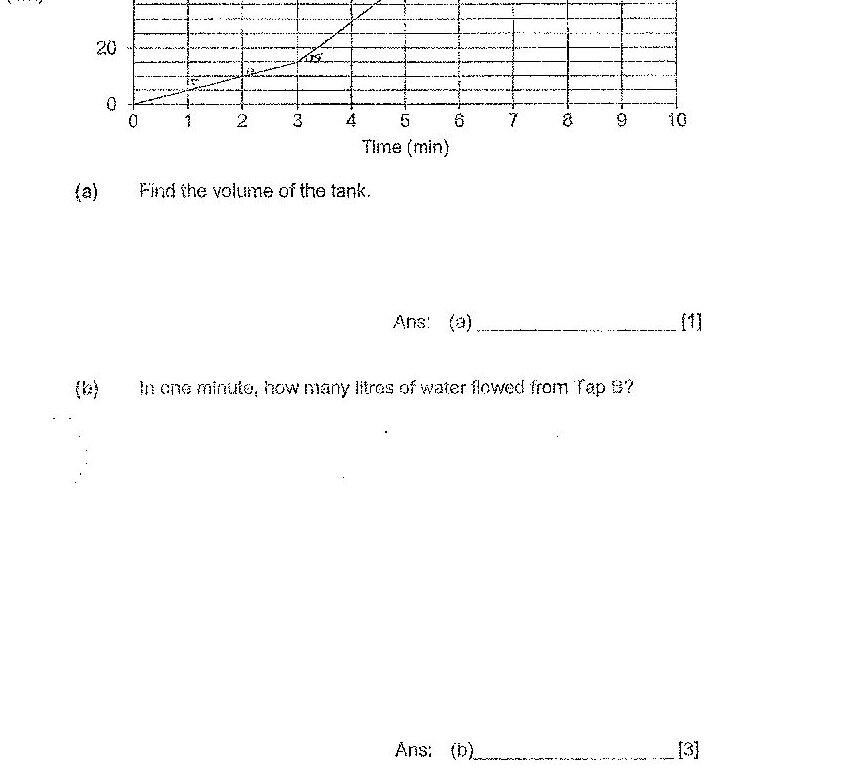
In one minute, how many litres of water flowed from Tap B?
Megan took 45 minutes to travel from Point A to Point B at an average speed of 72 km/h. Find the distance between Point A and Point B.
Prawns are sold at the supermarket at $1.36 per 100 g. Kelly bought 3.6 kg of prawns. How much did she pay?
Alex and Ben started cycling at the same time from the start of a 6.12 km cycling path. Both did not change their speeds from the start to finish. Alex cycled at 340 m/min. When he reached the end of the path, Ben was 460 m behind him. Find Ben's speed in m/min.
Mrs Nathan took 30 minutes to drive from her house to her office. Her average driving speed was 90 km/h. What was the distance from her house to her office?
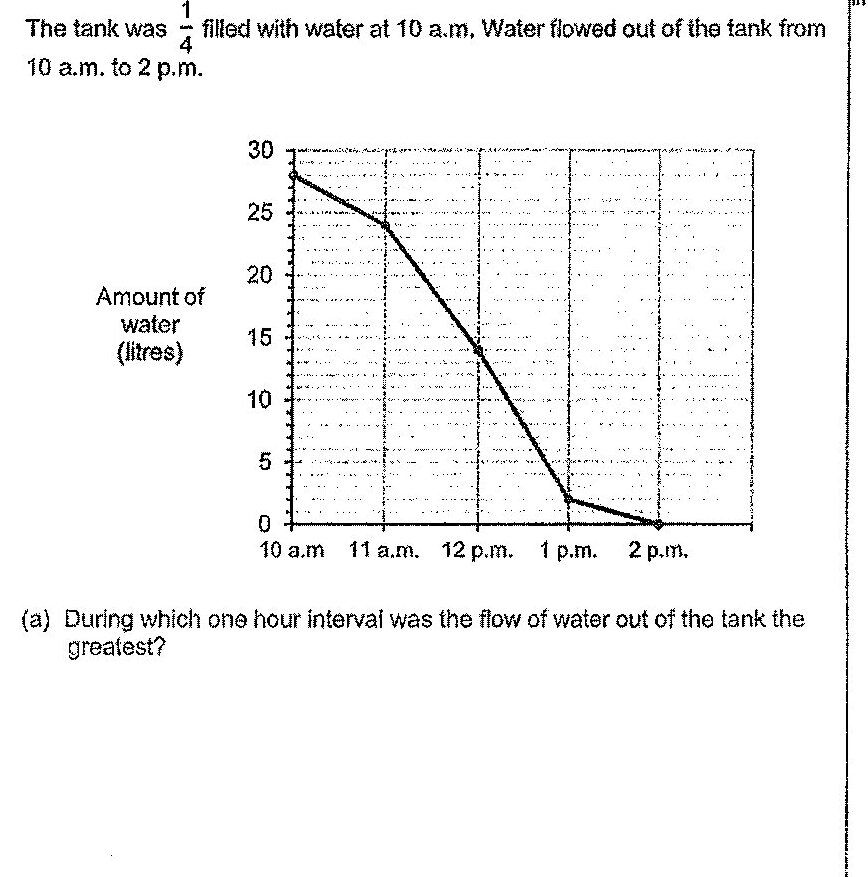
During which one hour interval was the flow of water out of the tank the greatest?
Two machines, X and Y, cut shapes at the rate shown below. Machine X: 12 pieces per second Machine Y: 20 pieces every 3 seconds Machine X started cutting the shapes at 08 00 and it stopped at 08 30. Machine Y cut shapes for 45 minutes. How many shapes were cut in total by the two machines?
Town A and B are 400 km apart. Alex left Town A for Town B travelling at a constant speed of 65 km/h. At the same time, Ben left Town B for Town A, travelling at a constant speed of 85 km/h. Both of them took the same route. How long did they take to pass each other? Leave your answers in hours and minutes.

How much is the charge for every cubic metre of water after 40 m³?
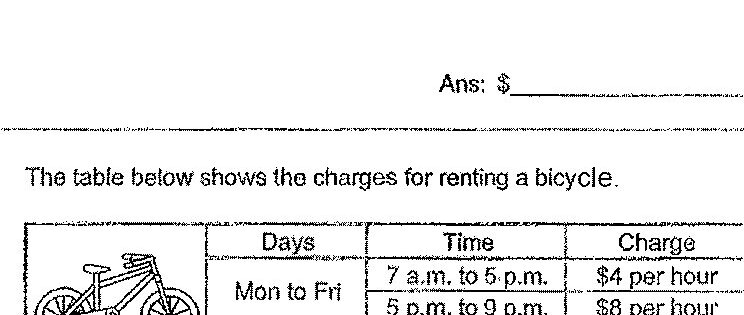
The table below shows the charges for renting a bicycle. On Friday, Mr Wu rented a bicycle and returned it at 6 p.m. He paid a total of $24. For how many hours did he rent the bicycle?
Mr Toh left Town B and drove to Town C at 11 a.m. at a constant speed of 60 km/h. Mr Lee left Town A at 12 noon and drove to Town C at a constant speed of 80 km/h. Town A and Town B were 15 km apart. After travelling from Town A to Town B, Mr Lee then travelled to Town C along the same route as Mr Toh. At what time did Mr Lee catch up with Mr Toh?

How many litres of water flowed from Tap B per minute?
Which of the following is the same as 3050 cm?
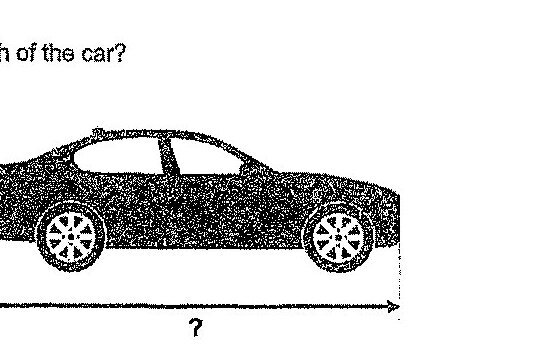
The diagram below shows a car. Which of the following could be the length of the car?
Muthu cycled from point A to point B at 375 m/min. Then, he used the same amount of time to cycle from point B to point C. What was his average speed for the entire journey? Express your answer in m/min.
Kumar travelled 3/4 of his journey in 2 h. He then travelled the remaining 240 km at a speed of 80 km/h. Find Kumar's average speed for the whole journey.
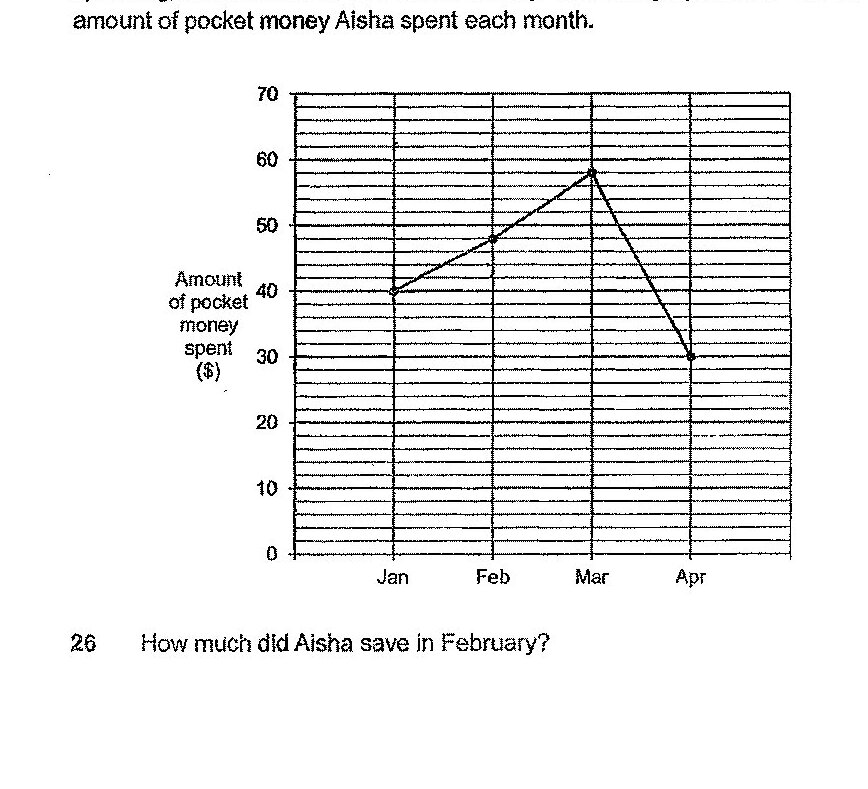
In which month did Aisha save the most?
Josh and Ken started cycling from the same place in opposite direction along a straight road. Josh was cycling at 20 km/h and the two boys were 50 km apart after cycling for 80 minutes. (a) How far did Josh cycle?
(b) Circle the words that describe Josh and Ken's cycling speed correctly in the following statement: Ken was cycling (slower than / as fast as / faster than) Josh.
Ali took part in a race. He ran for 3 km and cycled for 9 km. He took a total time of 120 min. What was his average speed for the race?
Mr Tan started cycling from home to work at 450 m/min for 30 minutes. His wife, Mrs Tan, started cycling from home 5 minutes before Mr Tan and reached the same work place 5 minutes after Mr Tan. They travelled the same distance. Find Mrs Tan's cycling speed.
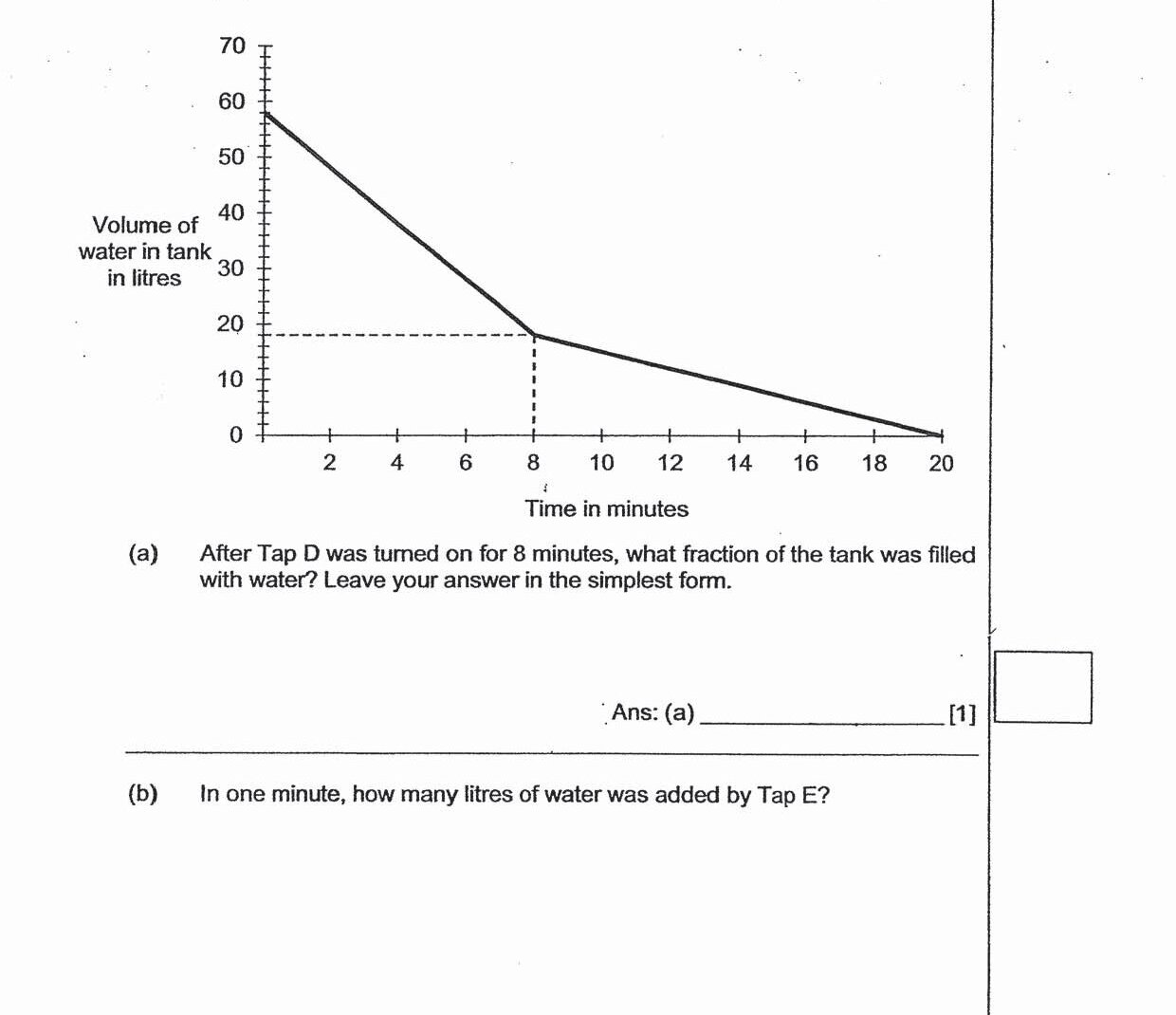
In one minute, how many litres of water was added by Tap E?
Past year papers cover the full exam — browse by subject below.