Forces
Forces - Complete Study Notes
Key Concepts
What is a Force?
- Force is a push or a pull acting on an object
- Forces cannot be seen, but we can observe their effects on objects
- Forces are measured in units called Newtons (N)
- Forces have both magnitude (strength/size) and direction
- Forces can act on objects even without direct contact (e.g., magnetism, gravity)
- Force is an interaction between objects — it is not something an object possesses or has. A force is always exerted BY one object ON another object (e.g., the spring exerts a force on the ball, not the ball has force).
Types of Forces
1. Contact Forces
- Friction - force that opposes motion between surfaces in contact
- Elastic spring force - force exerted by compressed or stretched springs
- Applied force - force applied directly by pushing or pulling an object
2. Non-Contact Forces
- Gravitational force - force of attraction between objects with mass
- Magnetic force - force between magnets or between magnets and magnetic materials
- Non-magnetized objects cannot attract magnets — magnetic force only acts on magnetic materials (iron, steel, nickel, cobalt). A plastic or wooden object cannot attract a magnet.
Effects of Force
Forces can cause four main effects on objects:
-
Change the speed of an object
- Make a stationary object start moving
- Make a moving object speed up
- Make a moving object slow down
- Make a moving object stop
-
Change the direction of motion
- Make an object turn left, right, up, or down
- Make an object change its path
-
Change the shape of an object
- Stretch, compress, bend, or twist objects
- This change can be temporary (elastic) or permanent (plastic)
-
Change the size of an object
- Make objects bigger (expand)
- Make objects smaller (compress)
Gravitational Force
- Gravitational force is the force of attraction between any two objects with mass
- Earth’s gravitational force pulls all objects towards its centre
- This is why objects fall downwards when dropped
- Weight is the gravitational force acting on an object
- The greater the mass of an object, the greater its weight
- Gravitational force acts on objects even when they are not touching the Earth (non-contact force)
- All planets, moons, and stars have gravitational force
- The Moon’s gravitational force is weaker than Earth’s (about 1/6 of Earth’s gravity)
- Gravitational force on Earth’s surface remains constant as long as the object’s mass does not change. Horizontal position on Earth does not affect it — gravitational force only becomes significantly weaker in deep space, far from any planet or star.
Gravitational Potential Energy (GPE)
- Gravitational potential energy (GPE) is a form of energy stored in an object because of its position above the ground
- An object has GPE when it is raised above the ground
- GPE depends on TWO factors:
- The mass of the object — greater mass means greater GPE
- The height of the object above the ground — greater height means greater GPE
- When an object is lifted higher, its GPE increases
- When an object falls, its GPE decreases
- At primary level, ‘potential energy’ alone is acceptable when referring to gravitational potential energy
GPE vs Gravitational Force — Key Comparison
| Gravitational Force | Gravitational Potential Energy (GPE) | |
|---|---|---|
| What it is | A force (pull towards Earth) | A form of stored energy |
| Depends on mass? | Yes | Yes |
| Depends on height? | No | Yes |
| Changes when height changes? | No — stays the same | Yes — increases with height |
| Changes when mass changes? | Yes | Yes |
- An object falling from a height: its GPE decreases but its gravitational force stays constant (because mass has not changed)
Frictional Force
- Friction is a force that opposes or resists motion between two surfaces in contact
- Friction always acts in the opposite direction to the motion
- Friction occurs when surfaces rub against each other
- Friction produces heat energy (e.g., rubbing hands together makes them warm)
Factors Affecting Friction
-
Type of surface
- Rough surfaces produce MORE friction (e.g., sandpaper, concrete, carpet)
- Smooth surfaces produce LESS friction (e.g., ice, polished marble, glass)
-
Weight/Mass of object
- Heavier objects produce MORE friction
- Lighter objects produce LESS friction
Useful Effects of Friction
- Allows us to walk without slipping
- Helps brakes stop vehicles
- Allows us to grip objects
- Enables writing with pencils (graphite friction on paper)
- Helps nails and screws stay in place
Harmful Effects of Friction
- Wears down surfaces (e.g., shoe soles, tire treads)
- Slows down moving objects
- Produces unwanted heat in machines
- Wastes energy
Ways to Reduce Friction
- Use lubricants (oil, grease, wax, soap)
- Use smooth surfaces instead of rough ones
- Use rollers or wheels (rolling friction is less than sliding friction)
- Use ball bearings in machines
- Streamline shapes to reduce resistance from air or water (note: from 2026 PSLE, you do not need to use the specific terms “air resistance” or “water resistance” — describe it as friction from air/water instead)
- Polish surfaces to make them smoother
Ways to Increase Friction
- Use rough surfaces (e.g., rubber soles, sandpaper)
- Increase the weight of the object
- Use materials with high friction (rubber, cork)
- Add treads or grooves (e.g., on tire surfaces, shoe soles)
Elastic Spring Force
- Elastic spring force is the force exerted by a spring when it is compressed (squashed) or stretched
- Springs can return to their original shape after being compressed or stretched (if not overstretched)
- The more a spring is compressed or stretched, the greater the force it exerts
- This force can be used to store energy and then release it
Characteristics of Springs
- When compressed: spring pushes back outward
- When stretched: spring pulls back inward
- Springs always try to return to their original length
- If stretched too much, springs lose their elasticity and cannot return to original shape
Elastic Limit and Extension
- Elastic limit: the maximum extent to which a spring may be stretched without permanent alteration of its properties
- When a spring exceeds its elastic limit, it cannot return to its original length/shape
- On a graph or table, a spring has exceeded its elastic limit when the final length remains constant (plateaus) despite additional weights being added
- Original length is the length of the spring when no load is applied (weight = 0g)
- Extension = Final length − Original length
- Different springs may have the same final length but different extensions if their original lengths differ — always use each spring’s own original length
Spring Stiffness, Elastic Limit, and Choosing the Right Spring
- Elastic limit: the maximum load a spring can take before it is permanently damaged and cannot return to its original length. Exceeding the elastic limit means the spring will not work accurately afterwards.
- Example: if Spring A has an elastic limit of 40g, placing a 55g object on it will permanently deform it
- Spring stiffness: some springs are stiffer than others. A stiffer spring stretches less for the same increase in mass; a less stiff spring stretches more
- Sensitivity: a less stiff spring is more sensitive — it produces a larger extension for a small change in mass, making small differences easier to measure
- Mass-vs-extension graph: when springs are plotted on this type of graph, a steeper slope means the spring extends more per unit of mass (less stiff, more sensitive)
- Comparing springs on a graph: the spring with the steepest slope is least stiff. If Spring C has a steeper slope than Spring B, Spring C is less stiff than Spring B
- Selecting the right spring: to detect small differences in mass, choose the least stiff spring (steepest slope) whose elastic limit is NOT exceeded by the object being measured
Applications of Spring Force
- Mattresses and sofas - provide comfort and support
- Weighing scales - springs compress based on weight
- Mechanical toys - store and release energy
- Trampolines - springs stretch and compress to bounce people
- Pens - springs push the nib in and out
- Vehicle suspension systems - absorb shocks from bumps
- Door closers - springs pull doors shut
Important Definitions
Force: A push or a pull acting on an object, measured in Newtons (N).
Contact force: A force that acts on an object only when it is touching the object (e.g., friction, elastic spring force).
Non-contact force: A force that acts on an object without touching it (e.g., gravitational force, magnetic force).
Gravitational force: The force of attraction between any two objects with mass; on Earth, it pulls all objects towards the centre of the Earth.
Weight: The gravitational force acting on an object.
Frictional force (Friction): A force that opposes or resists motion between two surfaces in contact.
Elastic spring force: The force exerted by a spring when it is compressed or stretched.
Magnitude: The size or strength of a force.
Direction: The way in which a force acts (e.g., upward, downward, left, right).
Lubricant: A substance used to reduce friction between surfaces (e.g., oil, grease, wax).
Streamlining: Shaping an object to reduce friction from air or water (reduces resistance from the surrounding medium). (Note: From 2026 PSLE, use “friction from air/water” rather than “air resistance” or “water resistance”.)
Elasticity: The ability of an object to return to its original shape after being stretched or compressed.
Gravitational potential energy (GPE): A form of stored energy that an object has because of its height above the ground. It depends on both the mass of the object and its height.
Worked Examples
Example 1: Identifying Types of Forces and Their Effects
Question: David pushes a toy car on a rough carpet. The car moves forward slowly, then stops.
(a) Name TWO forces acting on the toy car.
(b) Explain why the car eventually stops.
© Suggest how David can make the car travel further.
Solution:
(a) TWO forces acting on the toy car:
- Applied force (push from David’s hand)
- Frictional force (from the rough carpet)
Alternative acceptable answers: Gravitational force, Supporting force from carpet
(b) The car eventually stops because:
- Friction from the rough carpet opposes the motion of the car
- This frictional force acts in the opposite direction to the car’s movement
- The friction slows down the car gradually until it stops completely
- (Note: Friction converts kinetic energy to heat, though this is beyond PSLE scope)
Mark-earning keywords: “Friction opposes motion”, “acts in opposite direction”, “slows down the car”
© Ways David can make the car travel further:
Method 1: Reduce friction by changing the surface
- Push the car on a smooth surface (e.g., wooden floor, marble floor) instead of rough carpet
- Smooth surfaces produce less friction
Method 2: Reduce friction by using lubricants
- Apply oil or wax on the carpet or car wheels
- Lubricants reduce friction between surfaces
Method 3: Increase the applied force
- Push the car with a greater force
- Greater force will overcome friction better and make the car travel further
Example 2: Gravitational Force
Question: Ahmad drops a basketball and a table tennis ball from the same height at the same time.
(a) Name the force that causes both balls to fall.
(b) Which ball will hit the ground first? Explain your answer.
© Ahmad’s friend says, “The basketball falls faster because it is heavier.” Is this statement correct? Explain.
Solution:
(a) The force that causes both balls to fall is gravitational force (or gravity/weight).
(b) For PSLE: Both objects fall at the same rate and hit the ground at the same time. Gravitational force acts equally on all objects regardless of mass, so both balls accelerate downward at the same rate.
PSLE answer: Both balls hit the ground at the same time.
Note: In reality, air resistance affects lighter or less streamlined objects more, so the table tennis ball may be slowed slightly more. However, at PSLE this effect is ignored unless the question specifically mentions air resistance.
© The statement is not correct.
PSLE-appropriate answer: “The statement is not correct. Both balls fall due to gravitational force, and gravitational force acts on all objects equally regardless of mass. Both balls will hit the ground at the same time.”
Example 3: Spring Force Application
Question: Mrs. Tan uses a spring scale to weigh vegetables at the market.
(a) When vegetables are placed on the scale, what happens to the spring inside?
(b) Explain how the spring scale is able to show the weight of the vegetables.
© What would happen if Mrs. Tan overloads the scale with too many vegetables repeatedly?
Solution:
(a) When vegetables are placed on the scale, the spring inside is stretched (or extended) — a hanging spring scale works by the weight pulling the spring downward.
(b) How the spring scale works:
- The vegetables have weight due to gravitational force pulling them down
- This weight presses down on the spring, causing it to compress
- The heavier the vegetables, the more the spring compresses
- The compression of the spring moves a pointer or dial
- The pointer indicates the weight on a scale marked in units (grams or kilograms)
- Different weights compress the spring by different amounts, giving different readings
Mark-earning keywords: “weight compresses spring”, “heavier vegetables compress more”, “pointer moves to show weight”
© If Mrs. Tan overloads the scale repeatedly:
- The spring will be compressed too much, beyond its elastic limit
- The spring will lose its elasticity
- The spring will not be able to return to its original shape/length
- The spring scale will no longer work accurately or may become permanently damaged
- The readings will become inaccurate
Key concept: Springs have a limit to how much they can be compressed or stretched while still returning to their original shape.
Common Mistakes to Avoid
Mistake 1: Confusing Mass and Weight
❌ Wrong: “The mass of the object pulls it down.” ✅ Correct: “The weight of the object (which is the gravitational force acting on its mass) pulls it down.”
- Remember: Mass is the amount of matter; weight is the gravitational force on that mass
Mistake 2: Thinking Friction Only Occurs When Objects Are Moving
❌ Wrong: “There is no friction when the box is stationary.” ✅ Correct: “Friction can occur between surfaces even when objects are stationary.”
- Friction exists whenever surfaces are in contact, whether moving or not
Mistake 3: Forgetting That Friction Acts in the OPPOSITE Direction
❌ Wrong: Drawing friction arrow in the same direction as motion ✅ Correct: Friction ALWAYS opposes motion - draw arrow opposite to movement direction
Mistake 4: Saying “Gravity” Instead of “Gravitational Force”
❌ Wrong: “The object falls due to gravity.” ✅ Correct: “The object falls due to gravitational force (or the force of gravity).”
- Use proper scientific terms; “force” should be included
Mistake 5: Thinking Springs Only Push
❌ Wrong: “Springs only exert force when compressed.” ✅ Correct: “Springs exert force both when compressed (push outward) and when stretched (pull inward).”
Mistake 6: Not Explaining HOW Friction Helps or Harms
❌ Wrong: “Friction is useful for walking.” ✅ Correct: “Friction between shoe soles and the ground prevents slipping and allows us to grip the ground and walk forward.”
- Always explain the mechanism, not just state the fact
Mistake 7: Confusing “Reduce Friction” with “Remove Friction”
❌ Wrong: “Oil removes friction completely.” ✅ Correct: “Oil reduces friction between surfaces but does not remove it completely.”
- Friction can be reduced but not eliminated entirely
Mistake 8: Not Specifying Which Surface When Discussing Friction
❌ Wrong: “It has more friction.” ✅ Correct: “The rough carpet has more friction than the smooth wooden floor.”
- Always be specific about what surfaces you are comparing
Mistake 9: Saying Objects “Lose Weight” in Space
❌ Wrong: “Objects have no weight in space.” ✅ Correct: “Objects appear weightless in space because gravitational force is much weaker, but they still have mass.”
- Weight depends on gravitational force; mass remains constant
Mistake 10: Not Reading What the Question Is Asking For
- If asked for “effects of force,” don’t just name forces - describe what forces DO to objects
- If asked for “ways to reduce friction,” give specific methods, not just “use smooth surfaces” without explanation
Mistake 11: Confusing Final Length with Elastic Limit
❌ Wrong: “The spring has reached its elastic limit because the final length in the table is the largest value.” ✅ Correct: “The spring has exceeded its elastic limit only when the final length stays constant (does not increase) despite more weights being added.”
- The maximum length in a set of readings does not by itself prove the elastic limit has been reached
Mistake 12: Assuming Same Final Length Means Same Extension
❌ Wrong: “Both springs have the same final length, so they have the same extension.” ✅ Correct: “Extension = Final length − Original length. Different springs can share the same final length but have different original lengths, giving different extensions.”
- Always subtract each spring’s own original (no-load) length
Mistake 13: Not Reading the 0g Mark on Spring Graphs
❌ Wrong: Starting extension calculations from zero without checking what the spring’s length is when no weight is applied. ✅ Correct: Read the spring’s length at the 0g (no-load) point on the graph first — this is the original length to use in Extension = Final length − Original length.
Mistake 14: Saying a Spring ‘Breaks’ When Overloaded
❌ Wrong: “The spring breaks when too much weight is added.” ✅ Correct: “The spring exceeds its elastic limit and can no longer return to its original shape/length.”
- Use the term ‘elastic limit’ and avoid the word ‘breaks’ unless the spring physically snaps
Mistake 15: Selecting a Spring That Exceeds the Elastic Limit
❌ Wrong: Choosing Spring A (elastic limit 40g) to weigh a 55g apple because Spring A has the steepest slope. ✅ Correct: Spring A’s elastic limit (40g) is less than the apple’s mass (55g), so Spring A would be permanently damaged. Eliminate Spring A first, then pick the least stiff remaining spring.
- Remember: Always check elastic limit BEFORE comparing stiffness
Mistake 16: Confusing Stiffness with Sensitivity
❌ Wrong: ‘Use the stiffest spring to measure small mass differences because it is more precise.’ ✅ Correct: A stiffer spring gives a SMALLER extension for the same mass, making differences harder to see. Use the LEAST stiff spring (largest extension per unit mass) to detect small differences.
Mistake 17: Ignoring the ‘Small Difference’ Requirement
❌ Wrong: Picking any spring that can hold the load. ✅ Correct: If the question asks which spring is best for detecting small mass differences, you must choose the least stiff spring within its elastic limit — not just any spring that holds the load.
Mistake 18: Using “has force” or “possesses force” instead of “exerts force on”
❌ Wrong: “The spring has force.” / “The object possesses force.” ✅ Correct: “The spring exerts a force on the object.” Force is an interaction; it is never owned by an object.
Mistake 19: Reversing which object exerts the force
❌ Wrong: Saying the ball exerts force on the spring when the question asks what force acts ON the ball. ✅ Correct: Re-read the question carefully to confirm the direction. If asked what force acts ON the ball, the answer is the spring exerts force on the ball, not the other way around.
Mistake 20: Missing comparative language in comparison questions
❌ Wrong: Naming the surfaces without stating which has more or less friction. ✅ Correct: Always use “greatest”, “roughest”, “least”, “more than”, “less than” when comparing. Do not just name the surfaces; state which has more/less friction and by how much (relatively).
Mistake 21: Confusing Gravitational Force with Gravitational Potential Energy (GPE)
❌ Wrong: ‘The gravitational force of the ball increases as it is lifted higher.’ ✅ Correct: ‘The gravitational potential energy (GPE) of the ball increases as it is lifted higher. The gravitational force stays the same because the mass has not changed.’
- Remember: Gravitational force depends ONLY on mass. GPE depends on BOTH mass AND height.
Mistake 22: Thinking Gravitational Force Changes with Height
❌ Wrong: ‘The ball is higher up, so it has a greater gravitational force.’ ✅ Correct: ‘The ball is higher up, so it has greater gravitational potential energy (GPE). The gravitational force does not change because the mass is the same.’
- Height affects GPE — NOT gravitational force
Mistake 23: Assuming Both GPE and Gravitational Force Depend on Height
❌ Wrong: ‘Both the GPE and the gravitational force increase when the object is lifted higher.’ ✅ Correct: ‘Only the GPE increases when the object is lifted higher. The gravitational force remains the same as long as the mass does not change.’
Exam Tips
For Force Identification Questions
- Look for action words: push, pull, stretch, compress, fall, stop
- Always write “force” in your answer: “frictional force” not just “friction”
- Include direction when relevant: “gravitational force acting downwards”
For Friction Questions
When explaining why friction is useful, use this structure:
- State what friction does (opposes motion/provides grip)
- Explain the specific benefit (prevents slipping/stops vehicle)
- Connect to the real-world example
Example: “Friction between the brake pads and wheels opposes the motion of the wheels. This helps the vehicle slow down and stop safely.”
When suggesting ways to reduce friction, always include:
- What you would do (use oil, change surface, etc.)
- Why it works (oil is a lubricant that reduces friction between moving parts)
Keywords to earn marks:
- “opposes motion”
- “acts in the opposite direction”
- “between two surfaces in contact”
- “rough/smooth surface”
- “produces heat”
Always name BOTH surfaces in contact when discussing friction (e.g., “between the rubber sole and the concrete floor”). Naming only one surface will not earn full marks.
Use explicit comparative language — include “greatest”, “roughest”, “least”, “more than”, “less than” in comparison answers. A statement without a comparative word is incomplete.
For Gravitational Force Questions
Mark-earning phrases:
- “Gravitational force pulls objects towards the centre of the Earth”
- “Weight is the gravitational force acting on an object”
- “Acts on all objects with mass”
- “Non-contact force” (if relevant)
- “The greater the mass, the greater the weight”
Common question type: Comparing falling objects
- Remember: Air resistance affects lighter objects more
- Don’t just say “falls faster” - explain WHY
Distinguishing GPE from Gravitational Force in exam questions:
- If the question asks about a force — it is asking about gravitational force → ask yourself: has the mass changed? If no, the gravitational force stays the same.
- If the question asks about energy or potential energy — it is asking about GPE → ask yourself: has the height changed? If yes, GPE changes accordingly.
Systematic approach for GPE vs gravitational force questions:
- Identify which concept is being tested (force or energy?)
- Identify the factors that affect it (gravitational force: mass only; GPE: mass and height)
- Determine whether that factor has changed in the scenario
- State your conclusion clearly
Note on terminology: At primary level, ‘potential energy’ alone is acceptable when referring to gravitational potential energy. However, always read the question carefully and use the term the question uses.
For Spring Force Questions
When explaining compression: “The spring is compressed/squashed and pushes back outward”
When explaining extension: “The spring is stretched/extended and pulls back inward”
Mark-earning phrases:
- “Returns to original shape/length”
- “The more it is compressed/stretched, the greater the force”
- “Stores energy when compressed/stretched”
- “Can lose elasticity if overstretched”
Calculating extension:
- Always find the original length first: read the 0g / no-load value from the graph or table
- Apply the formula: Extension = Final length − Original length
- When comparing springs, compare extensions, not final lengths
Identifying when the elastic limit is exceeded:
- Look for a flat/plateau section in a graph where the length stays constant despite more weights
- A plateau = elastic limit has been exceeded
- Cannot make this conclusion from a single maximum value alone — need to see the length stop increasing
Keyword phrases for exam answers about overloaded springs:
- “The spring has exceeded its elastic limit”
- “The spring cannot return to its original length/shape”
Always use the full term “elastic spring force”, not just “spring force”
For Spring Selection / Graph Interpretation Questions
Step-by-step method for ‘which spring is best?’ questions:
- Check the elastic limit first — eliminate any spring whose elastic limit is less than the object’s mass (exceeded = permanently damaged, cannot use)
- Compare the slopes — among the remaining springs, identify which has the steepest slope on the mass-vs-extension graph
- Select the steepest slope — this spring is the least stiff and most sensitive to small mass differences
- Confirm the range — verify the selected spring remains within its elastic limit for all masses being compared
Key rule: When asked which spring is best for measuring small differences in mass, the answer is always the least stiff spring (steepest slope) that still operates within its elastic limit.
Graph reading technique: Pick a specific mass on the x-axis, draw a vertical pencil line up to each spring’s plotted line, then read across to the y-axis. The spring that gives the largest extension reading is the least stiff.
Mark-earning phrases for spring selection questions:
- ‘Spring X has a steeper slope, meaning it extends more for the same increase in mass’
- ‘Spring X is less stiff than Spring Y’
- ‘Spring X is more sensitive to small changes in mass’
- ‘The elastic limit of Spring X is not exceeded by the object’s mass’
- ‘Spring X is the best choice because it gives a larger extension for small mass differences and its elastic limit is not exceeded’
For “Effects of Force” Questions
Always structure your answer around the 4 effects:
- Change speed (start moving, speed up, slow down, stop)
- Change direction (turn, change path)
- Change shape (stretch, compress, bend, twist)
- Change size (expand, compress)
Tip: The question often asks for effects in a specific scenario - pick the most relevant ones and explain clearly
For Comparison Questions
When comparing friction on different surfaces:
- Name both surfaces clearly
- State which has more/less friction
- Explain why (rough vs. smooth)
- Link to the outcome (moves faster/slower, travels further/shorter distance)
Structure: “Surface A is rougher than Surface B. Therefore, there is more friction on Surface A. This means the object will slow down more quickly / travel a shorter distance on Surface A.”
General Exam Strategy
-
Underline key instruction words: name, state, explain, compare, suggest
- “Name” = just give the answer (1 mark)
- “Explain” = give reason/how it works (2 marks)
- “Compare” = discuss similarities AND differences
-
Use scientific terminology correctly
- Don’t use casual language (“thing,” “stuff”)
- Write “frictional force” not “friction force”
- Write “gravitational force” not “gravity”
- Use “exerts force on” not “has force” or “possesses force” — this is a high-frequency language error. Every force answer should name the object doing the exerting and the object receiving the force.
-
For diagram questions:
- Draw neat, labeled arrows
- Arrows should be proportional (bigger force = longer arrow)
- Always label the direction
-
Link back to the question
- If question asks about a toy car, mention “toy car” in your answer
- If question asks about specific conditions (rough carpet), reference it
-
Check you’ve answered all parts
- Questions often have (a), (b), © - make sure you answer each part
- Each part usually tests a different skill (identify, explain, apply)
-
Build cause-and-effect chains in your answers — connect observations to conclusions with words like “because”, “therefore”, “as a result”. Example: “Because the carpet is rougher than the wooden floor, there is more friction between the shoe and the carpet, therefore the person moves more slowly on the carpet.”
Quick Summary
✓ Force is a push or a pull that can act on objects, measured in Newtons (N), with both magnitude and direction
✓ Two main categories of forces: Contact forces (friction, elastic spring force) and Non-contact forces (gravitational force, magnetic force)
✓ Four effects of force: Change speed (start, speed up, slow down, stop), change direction, change shape (stretch/compress/bend), change size
✓ Gravitational force is the force of attraction between objects with mass; on Earth, it pulls all objects toward the centre; weight is gravitational force acting on an object
✓ Friction opposes motion between two surfaces in contact, always acting in the opposite direction to movement; produces heat energy
✓ Factors affecting friction: Type of surface (rough = more friction, smooth = less friction) and weight of object (heavier = more friction)
✓ Reduce friction by using lubricants (oil, grease, wax), smooth surfaces, rollers/wheels, ball bearings, streamlining, or polishing surfaces
✓ Increase friction by using rough surfaces, increasing weight, using high-friction materials (rubber), or adding treads/grooves
✓ Friction is useful for walking without slipping, stopping vehicles with brakes, gripping objects, and writing; but it is harmful because it wears down surfaces, slows motion, produces unwanted heat, and wastes energy
✓ Elastic spring force is exerted when springs are compressed (push outward) or stretched (pull inward); springs return to original shape unless overstretched
✓ Springs follow this principle: The more compressed or stretched, the greater the force; used in weighing scales, mattresses, toys, trampolines, and vehicle suspension
✓ In exams: Always use proper scientific terms (include “force”), explain mechanisms not just facts, specify directions for forces (especially friction opposes motion), and structure answers clearly with mark-earning keywords
Final Reminder: Forces are invisible but their effects are visible and measurable. Focus on understanding WHAT forces do (their effects) and HOW they interact with objects in different situations. Practice drawing force diagrams with proper labels and arrows!
Diagrams
Free-Body Diagram: Forces on a Box
Spring Diagrams: No Load vs With Load
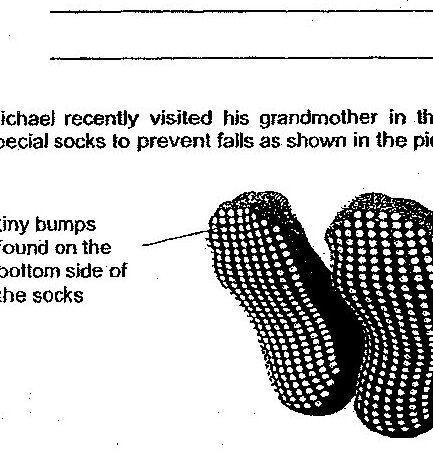
How does wearing these special pairs of socks prevent falls?
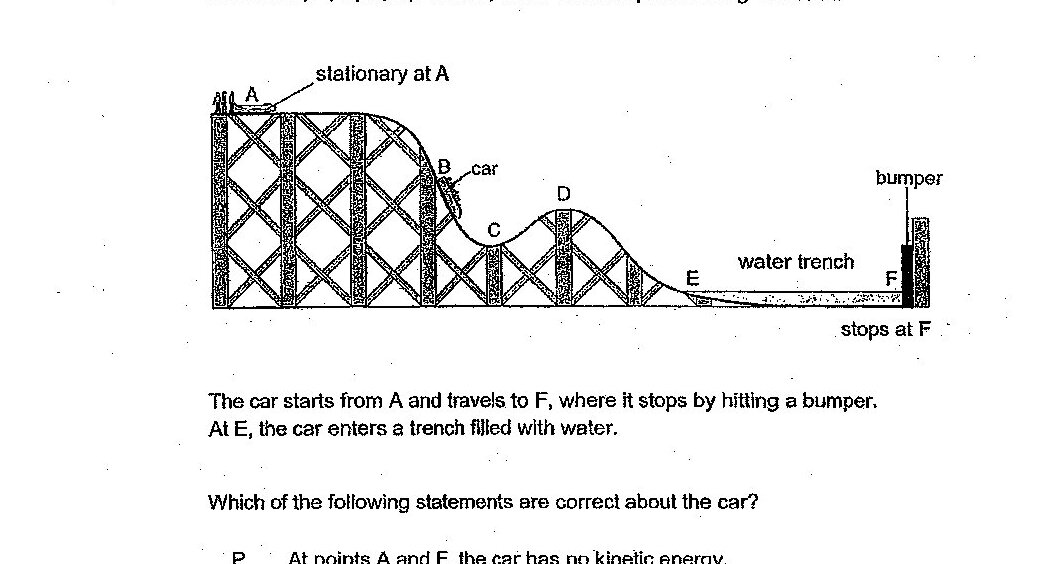
The diagram below shows a theme park ride. The letters, A, B, C, D, E and F, show different points along the track. The car starts from A and travels to F, where it stops by hitting a bumper. At E, the car enters a trench filled with water. Which of the following statements are correct about the car? P: At points A and F, the car has no kinetic energy. Q: The car has maximum gravitational potential energy at point D. R: The car slows down when it moves through the water at E due to the water resistance. S: The car moves along the track from B to C because of gravity.
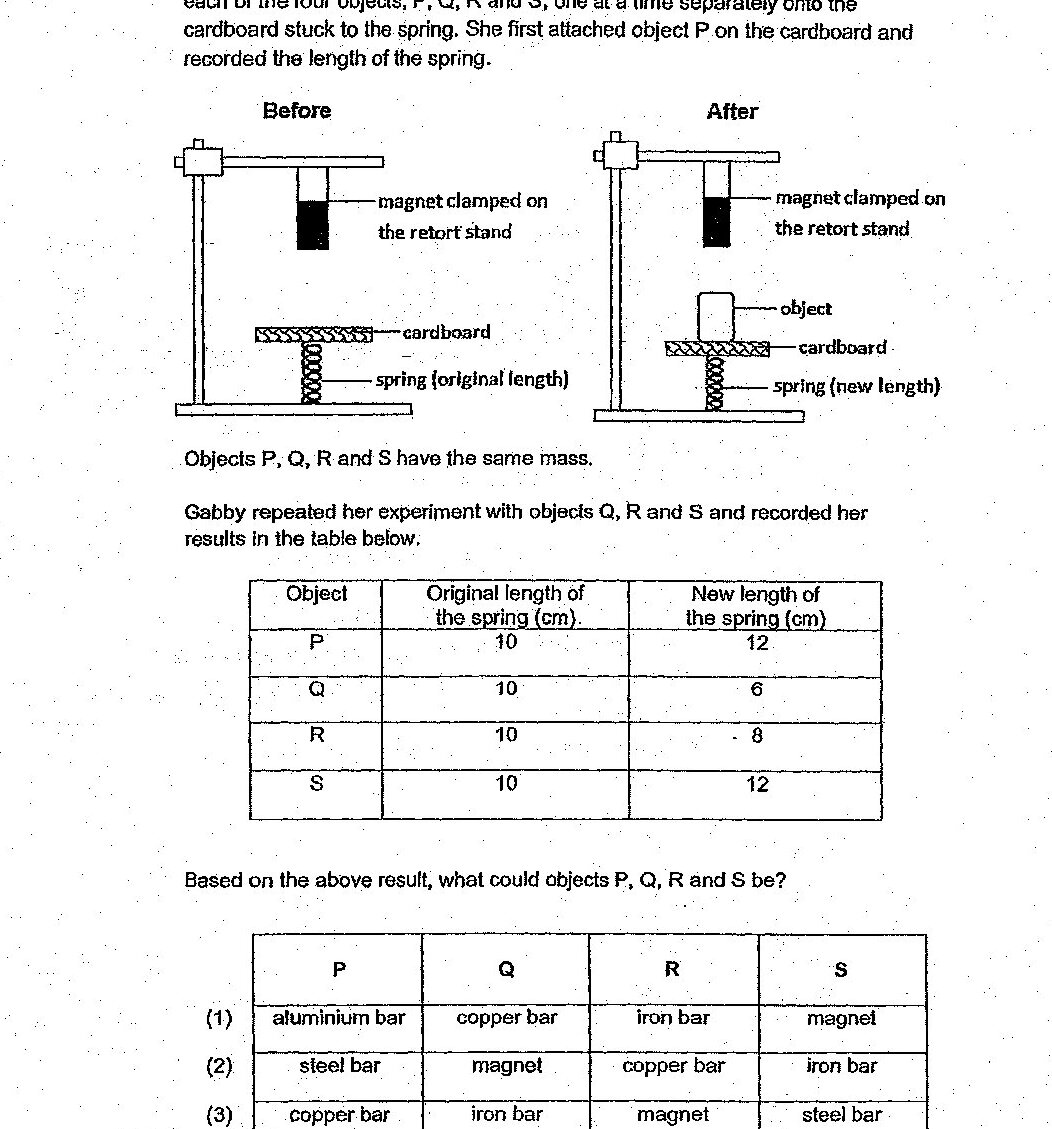
Gabby set up an experiment as shown in the diagrams below. She attached each of the four objects, P, Q, R and S, one at a time separately onto the cardboard stuck to the spring. She first attached object P on the cardboard and recorded the length of the spring. Gabby repeated her experiment with objects Q, R and S and recorded her results in the table below. Based on the above result, what could objects P, Q, R and S be?
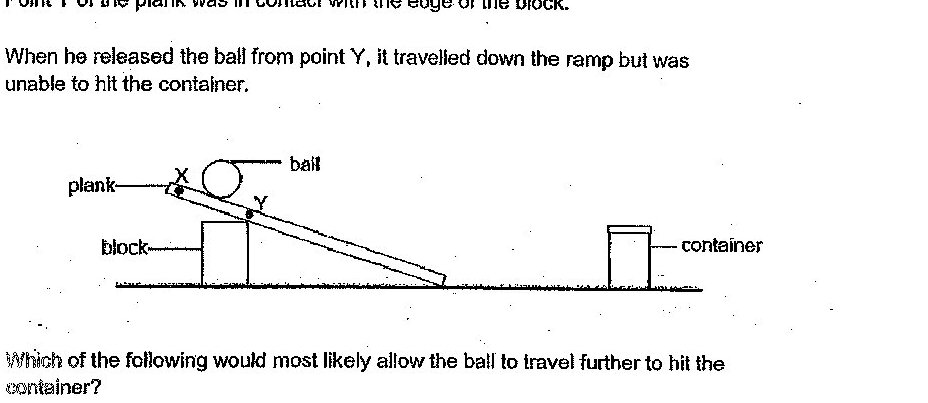
Ray set up the experiment shown in the diagram below. Point Y of the plank was in contact with the edge of the block. When he released the ball from point Y, it travelled down the ramp but was unable to hit the container. Which of the following would most likely allow the ball to travel further to hit the container?
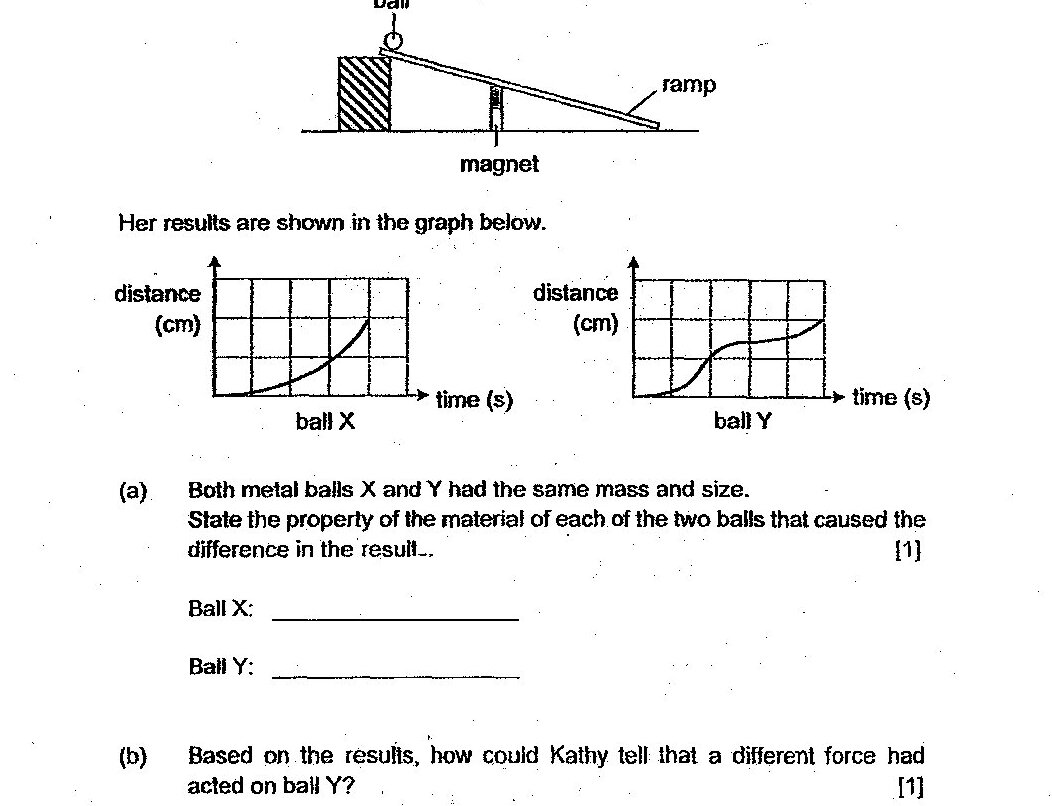
Based on the results, how could Kathy tell that a different force had acted on ball Y?
Which graph, K or L, shows the correct results when a rougher ramp was used? Explain your answer.
Suggest what the stuntman could do in order to jump successfully over the six oil barrels using the same ramp in part(b).
Explain, in terms of forces, why it is necessary for cars to travel at a slower speed during such weather conditions.
Explain, in term of forces, how snow chains will help the car to travel more safely in snowy areas.
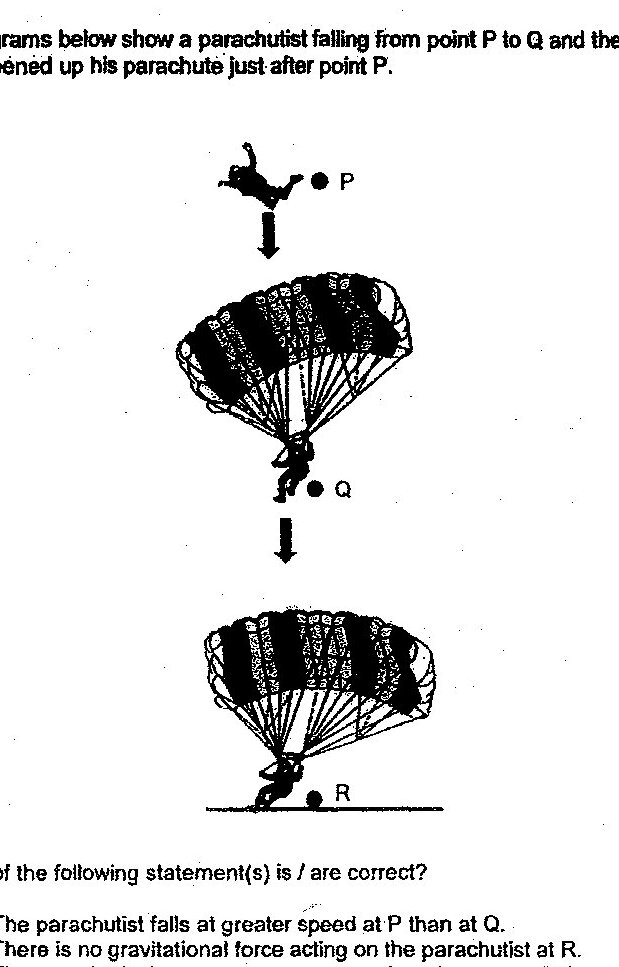
The diagrams below show a parachutist falling from point P to Q and then landing at R. He opened up his parachute just after point P. Which of the following statement(s) is / are correct? A: The parachutist falls at greater speed at P than at Q. B: There is no gravitational force acting on the parachutist at R. C: The parachutist has to overcome more air resistance at Q than at P. D: There is more gravitational force acting on the parachutist at P than at R.
A man wanted to move a box down a slope. He gave a push to the box at X, but the box only reached point Y. Which of the following actions will allow the box to move a greater distance down the slope?
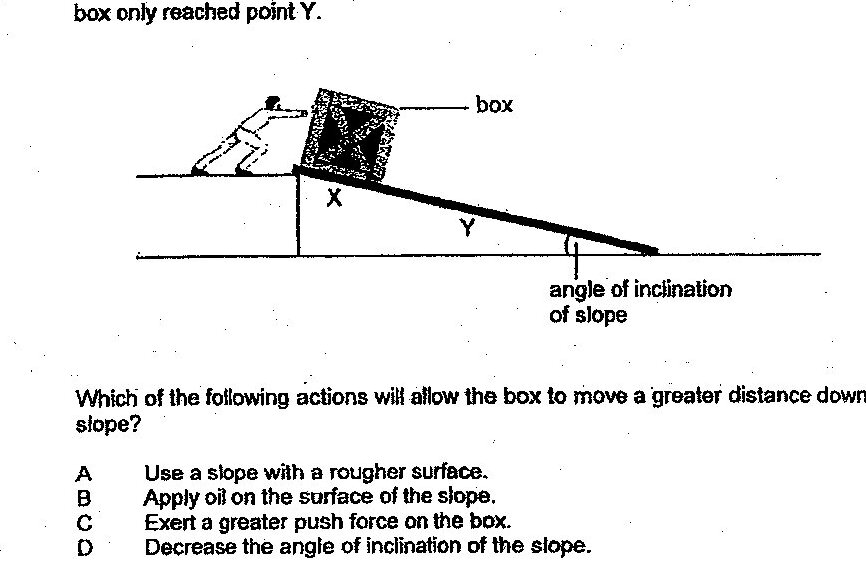
Choose which combination of actions will allow the box to move a greater distance down the slope:
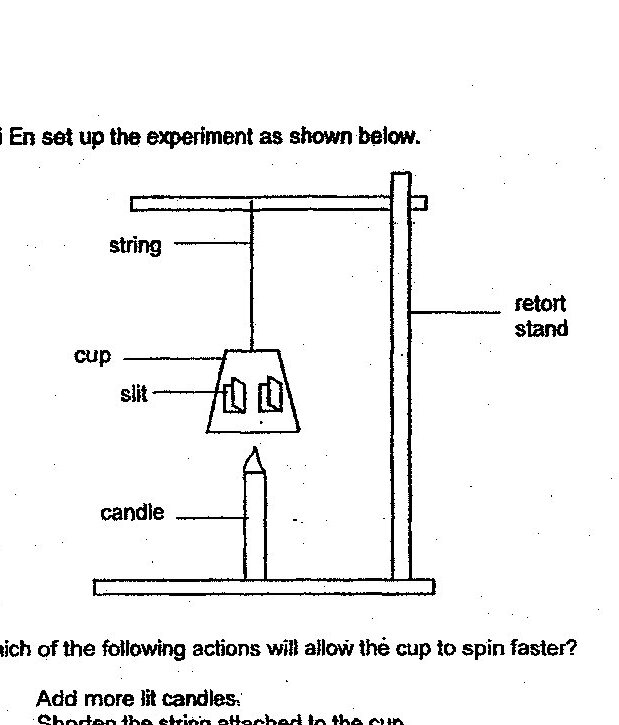
Hui En set up the experiment as shown below. Which of the following actions will allow the cup to spin faster?
How does dusting her hands with rock climbing chalk prevent Belle from falling during her climb?
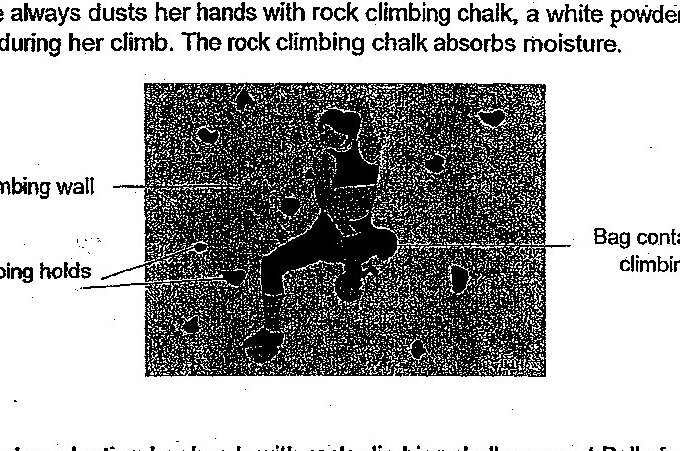
When Belle is climbing, what are the forces that make it more difficult or easier for her?
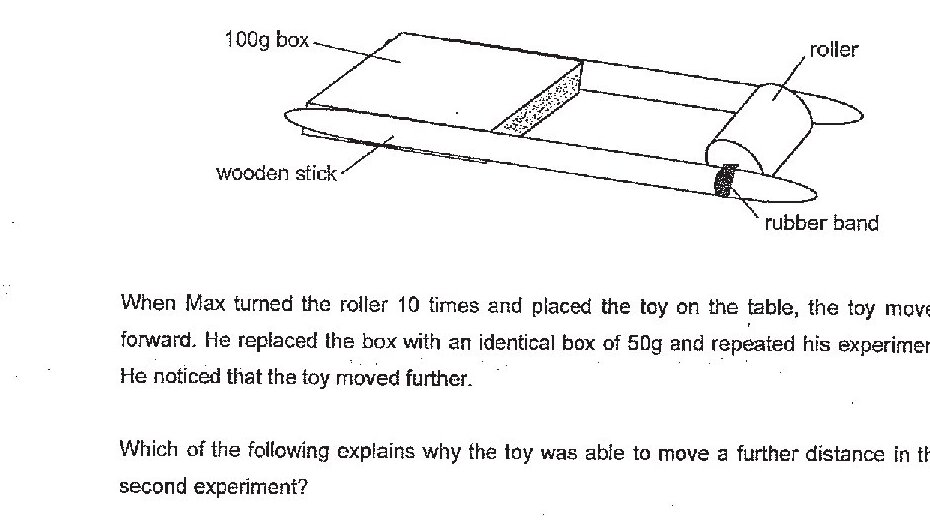
Max made a toy as shown. When Max turned the roller 10 times and placed the toy on the table, the toy moved forward. He replaced the box with an identical box of 50g and repeated his experiment. He noticed that the toy moved further. Which of the following explains why the toy was able to move a further distance in the second experiment?
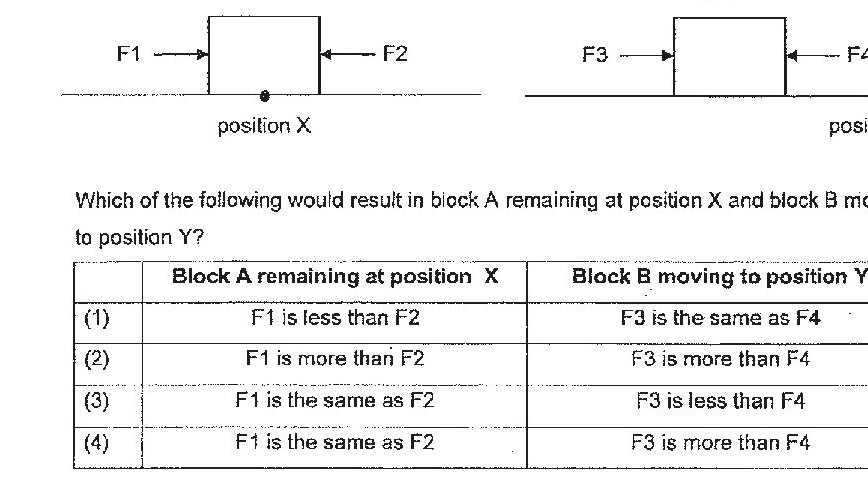
Alan placed two identical blocks on his desk. He exerted forces F1 and F2 on block A at the same time and forces F3 and F4 on block B all at the same time. Which of the following would result in block A remaining at position X and block B moving to position Y?
Explain why the fan continued to spin for a while even after the switch was turned off.
Based on the results in the table above, what is the relationship between the depth of depression made and the area of the square wooden piece?
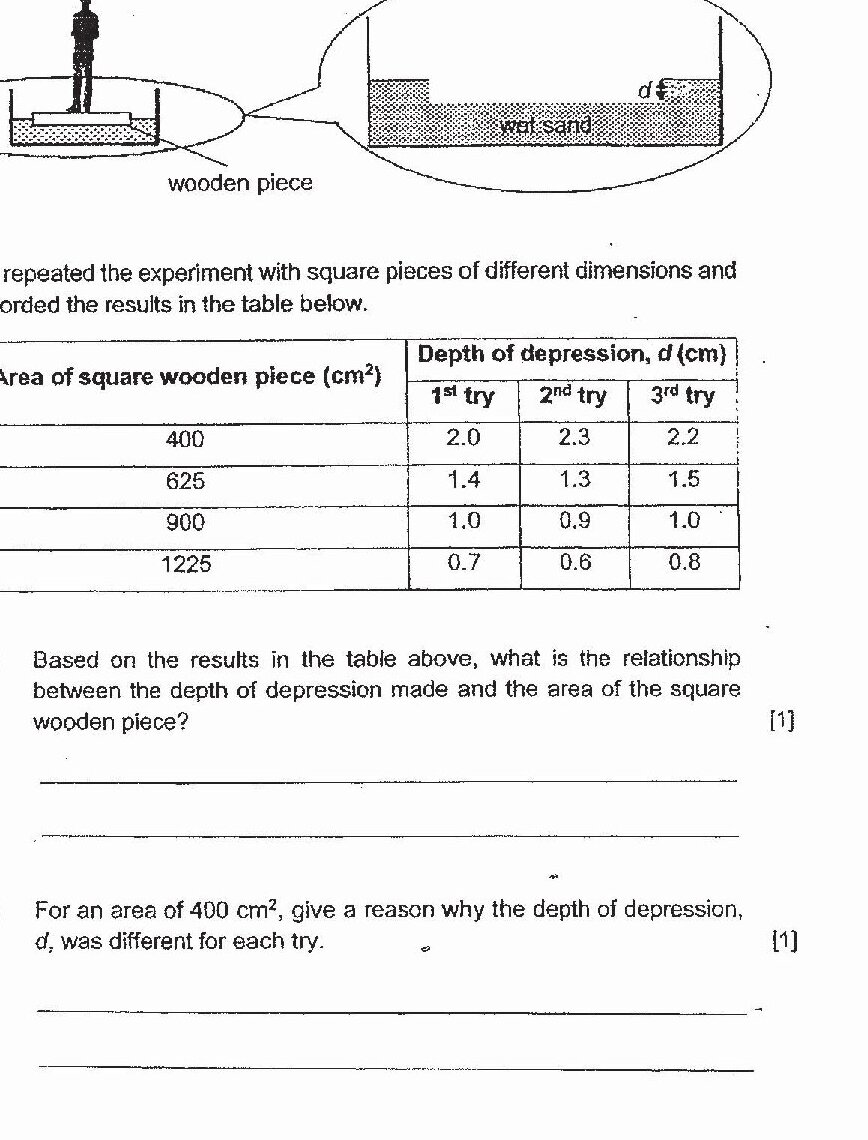
For an area of 400 cm², give a reason why the depth of depression, d, was different for each try.

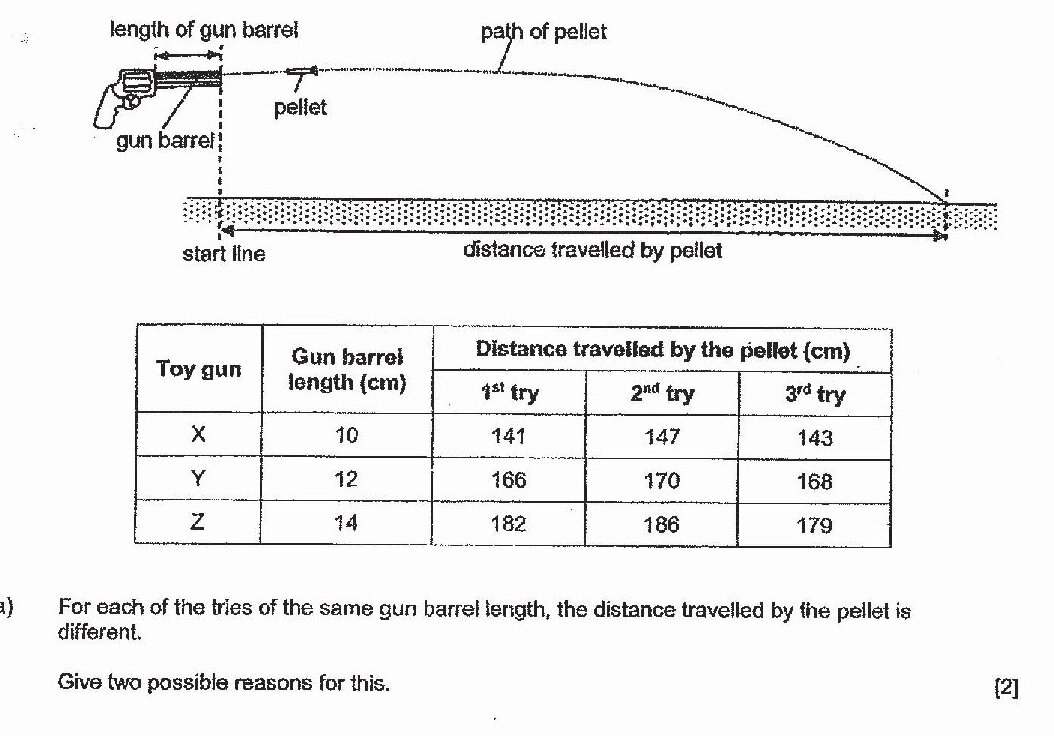
For each of the tries of the same gun barrel length, the distance travelled by the pellet is different. Give two possible reasons for this.
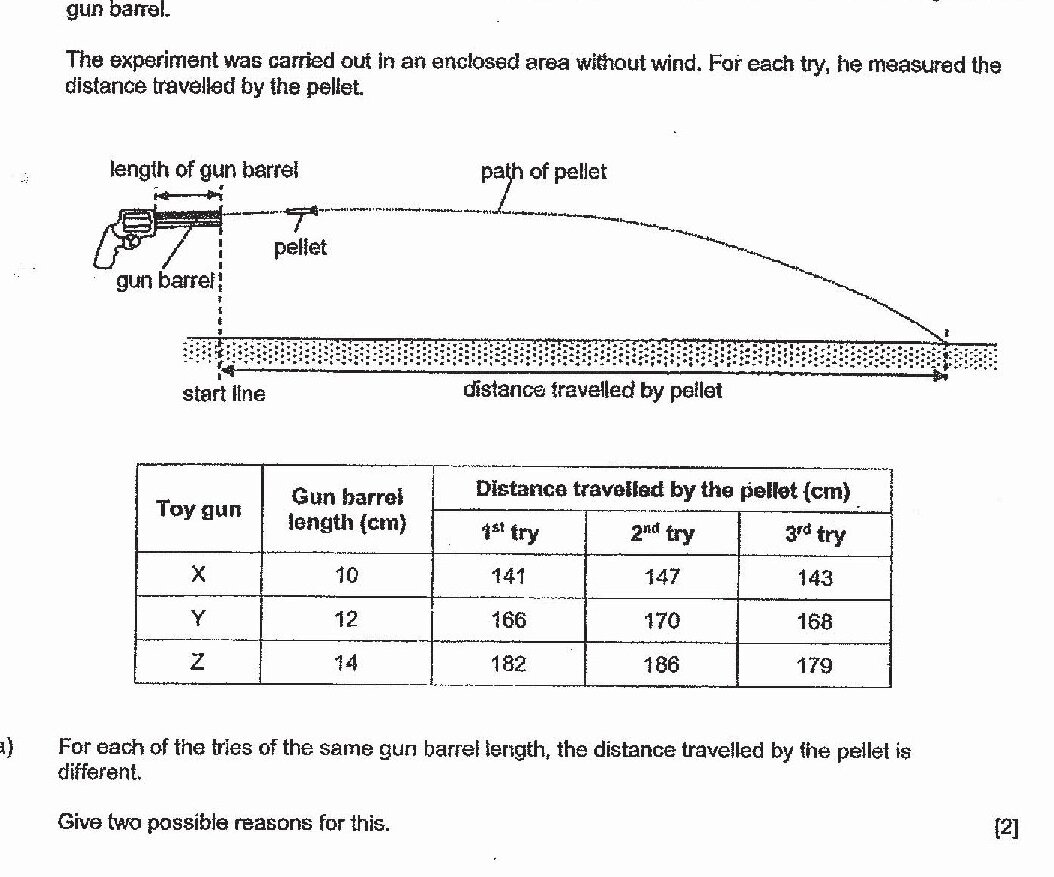
How is the distance travelled by the pellet affected by the length of the gun barrel of the toy gun?
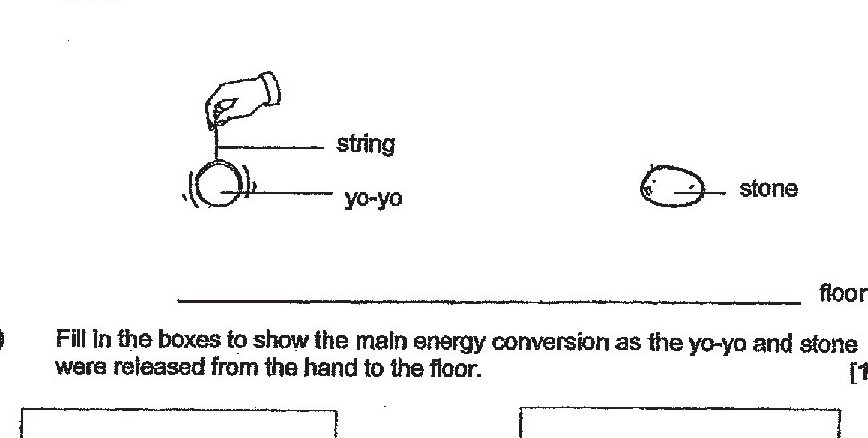
Andy released a yo-yo from one of his hands and a stone from the other hand above the floor as shown below. Both the yo-yo and the stone are of the same mass.
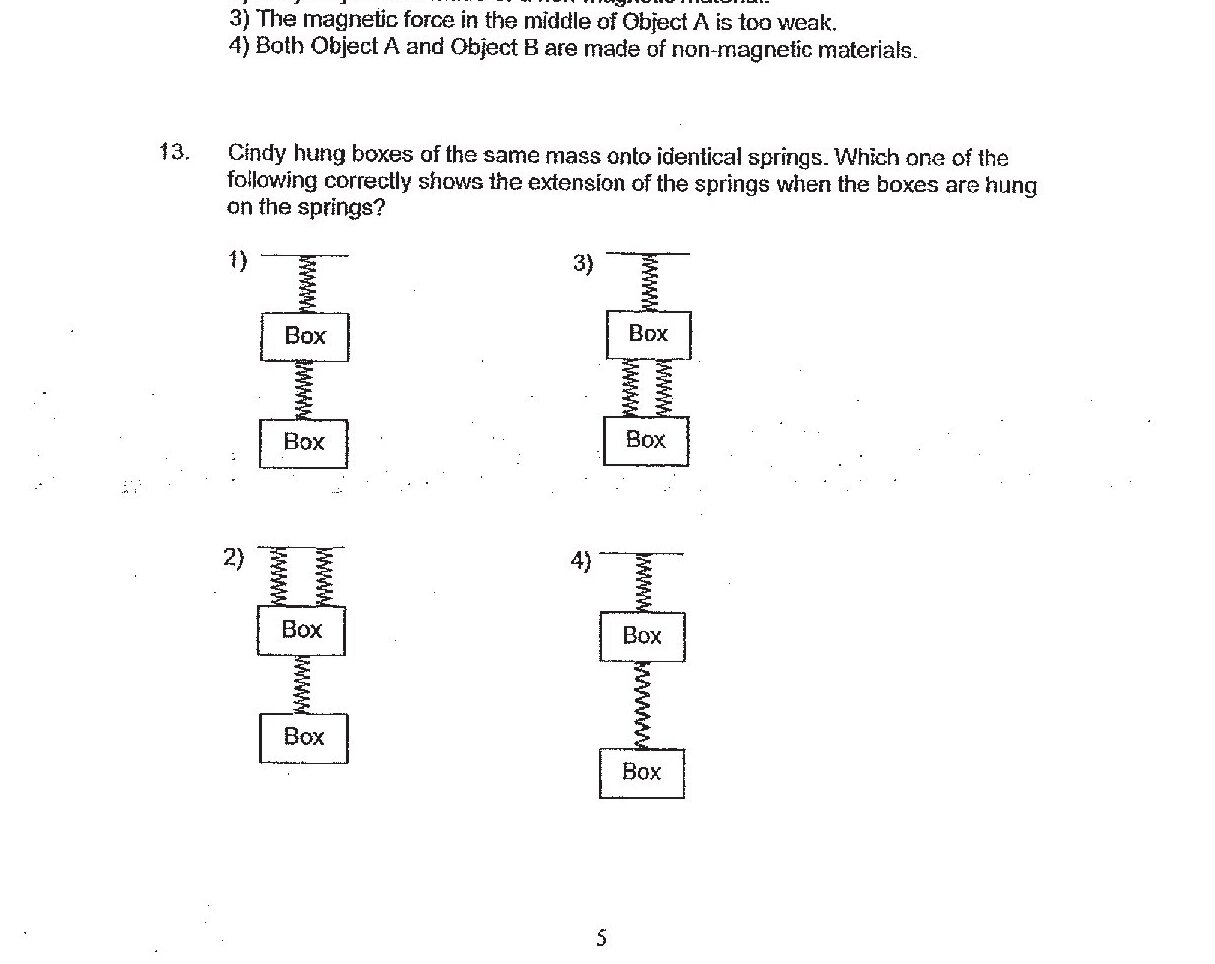
Cindy hung boxes of the same mass onto identical springs. Which one of the following correctly shows the extension of the springs when the boxes are hung on the springs?
When Yhi removed a few pieces of candy quickly from the top, the metal disc moved up continuously. Name two types of force acting on the metal disc.
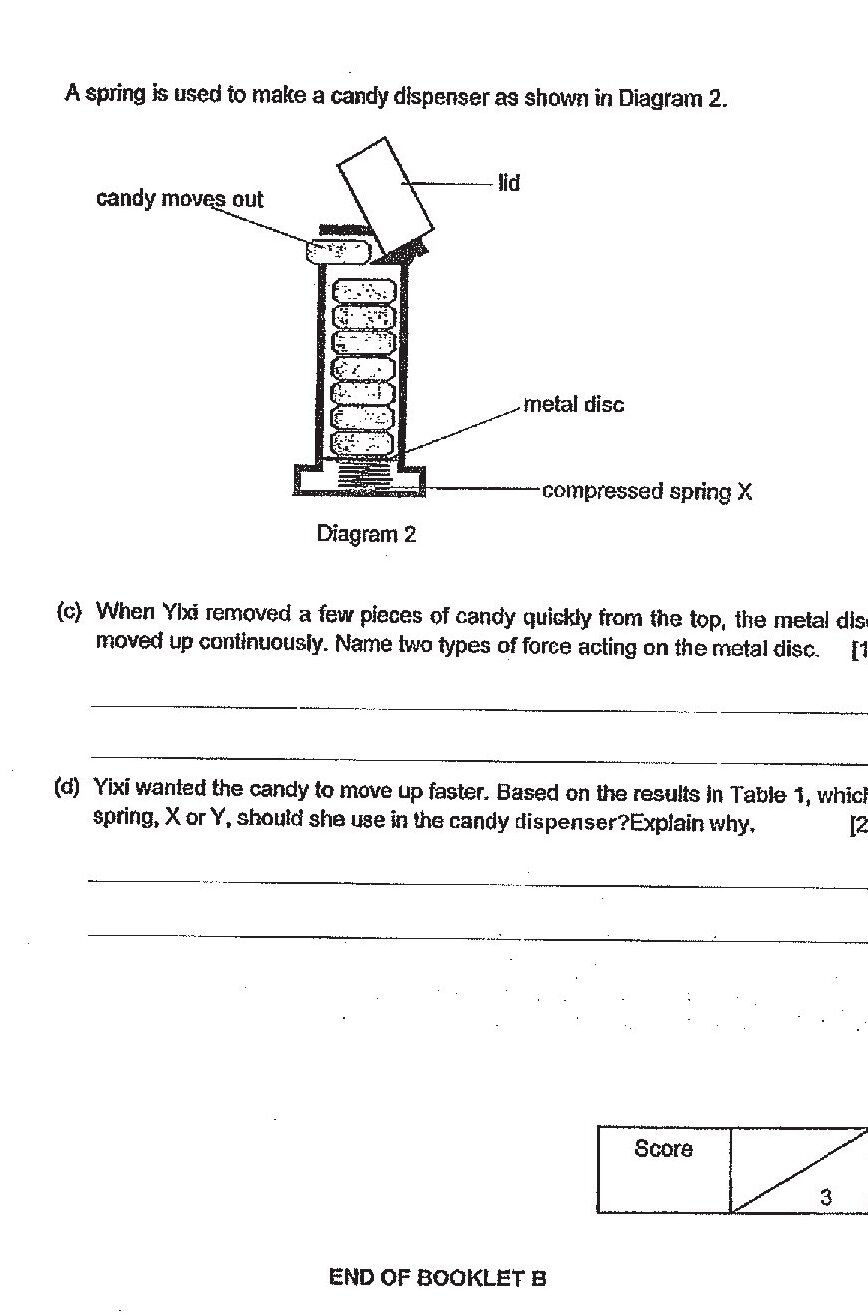
Yixi wanted the candy to move up faster. Based on the results in Table 1, which spring, X or Y, should she use in the candy dispenser? Explain why.
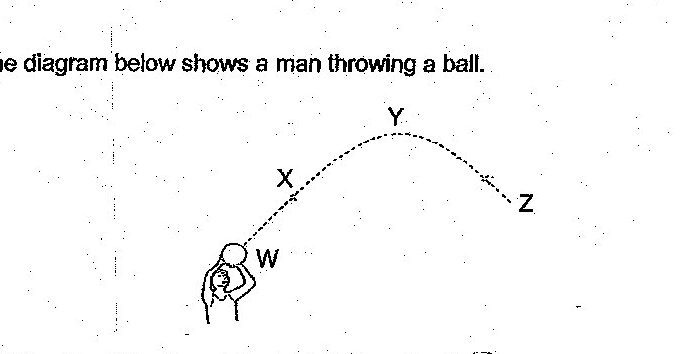
The diagram below shows a man throwing a ball. Which of the following statements is / are true?
Explain why the fan continued to spin for a while even after the switch was turned off.
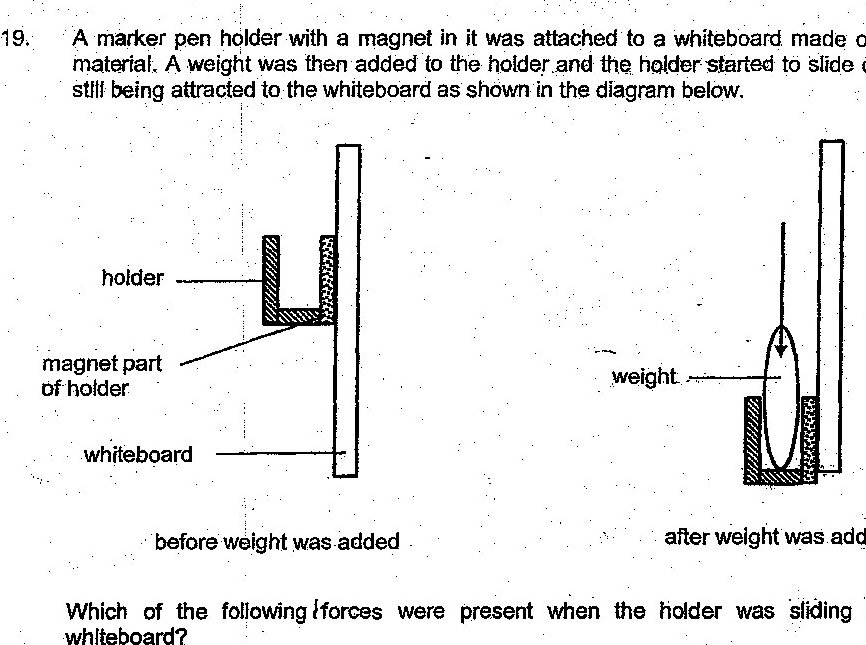
Which of the following forces were present when the holder was sliding down the whiteboard?
Past year papers cover the full exam — browse by subject below.
View All Papers ›