Forms of Energy
Forms of Energy - Primary 6 PSLE Science Study Notes
Key Concepts
What is Energy?
- Energy is the ability to do work or cause change
- Energy cannot be created or destroyed, but it can be changed from one form to another (Law of Conservation of Energy)
- Energy exists in different forms and can be converted from one form to another
- All living things and machines need energy to function
Light Energy
- Light energy is a form of energy that allows us to see
- Sources of light energy:
- Natural sources: Sun (main source), stars, fireflies, lightning
- Man-made sources: Light bulbs, candles, torches, fire
- Light travels in straight lines
- Light energy can be converted to other forms:
- Solar panels convert light energy to electrical energy
- Plants convert light energy to chemical energy during photosynthesis
- Properties of light energy:
- Travels very fast (fastest form of energy)
- Can travel through transparent materials (glass, water, air)
- Cannot travel through opaque materials (wood, metal, concrete)
Heat Energy
- Heat energy is the energy that makes things feel hot or warm
- Heat always flows from a hotter object to a cooler object until both reach the same temperature
- Sources of heat energy:
- Natural sources: Sun (main source), hot springs, volcanic lava, lightning
- Man-made sources: Fire, stoves, heaters, friction, light bulbs
- Heat energy can be transferred by:
- Conduction: Heat travels through solids (e.g., metal spoon getting hot in hot water)
- Convection: Heat travels through liquids and gases (e.g., hot air rising, water boiling)
- Radiation: Heat travels through space without needing a medium (e.g., Sun’s heat reaching Earth)
- Effects of heat:
- Causes expansion (things get bigger when heated)
- Can change the state of matter (solid → liquid → gas)
- Can change the temperature of objects
Sound Energy
- Sound energy is a form of energy that we can hear
- Sound is produced when objects vibrate (move back and forth quickly)
- Sources of sound energy:
- Natural sources: Thunder, animals, human voice, wind, waterfalls
- Man-made sources: Musical instruments, machines, bells, speakers
- Properties of sound energy:
- Travels in the form of waves
- Needs a medium (solid, liquid, or gas) to travel - cannot travel through vacuum (empty space)
- Travels fastest through solids, slower through liquids, slowest through gases
- Can be reflected (echo), absorbed (carpets, curtains), or transmitted (through materials)
- Characteristics of sound:
- Loudness: How loud or soft a sound is (measured in decibels)
- Pitch: How high or low a sound is (depends on frequency of vibration)
Kinetic Energy
- Kinetic energy is the energy that moving objects have
- The faster an object moves, the more kinetic energy it has
- The heavier an object is, the more kinetic energy it has when moving at the same speed
- Examples of kinetic energy:
- A moving car, bicycle, or train
- A rolling ball
- Running water
- Moving wind (wind energy)
- A swinging pendulum
- Falling objects
Potential Energy
- Potential energy is stored energy that an object has because of its position or condition
- Types of potential energy:
- Gravitational potential energy: Energy stored in objects at a height (e.g., water in a reservoir, a book on a shelf)
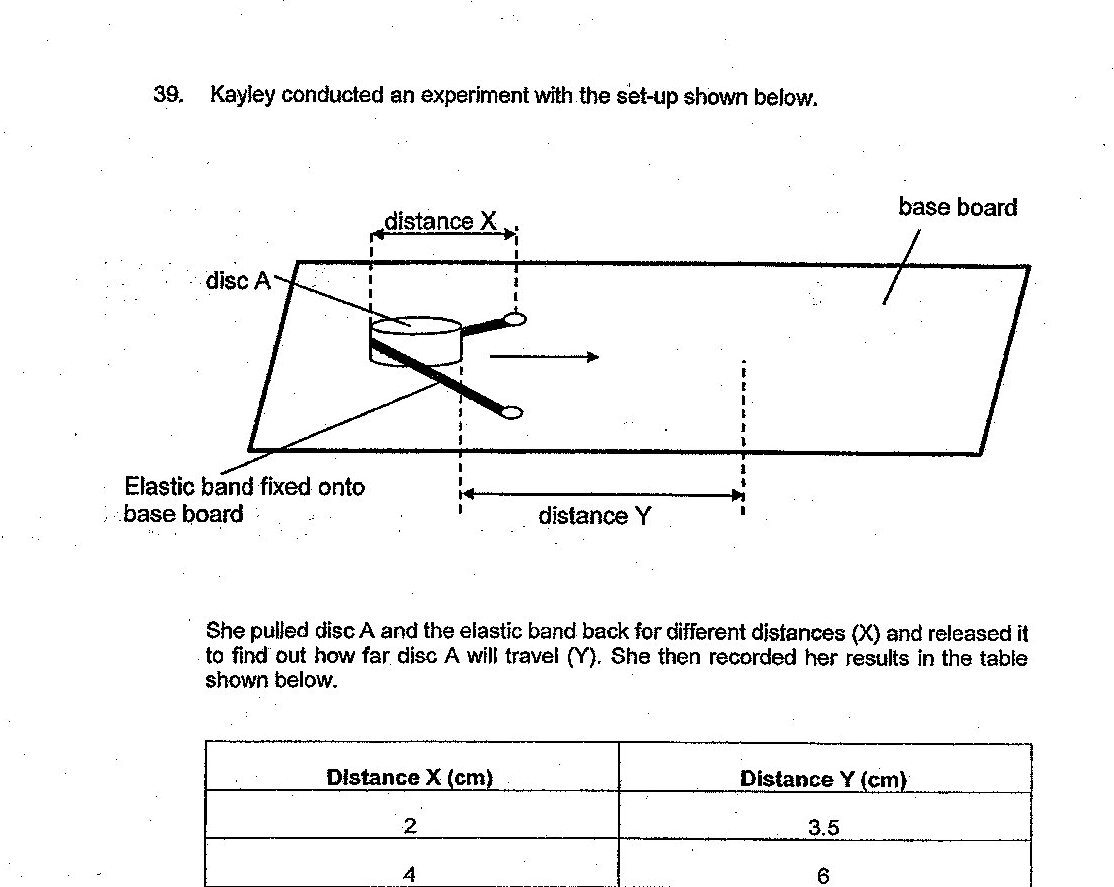
- Elastic potential energy: Energy stored in stretched or compressed objects (e.g., stretched rubber band, compressed spring)
- The higher an object is positioned, the more gravitational potential energy it has
- Gravitational potential energy depends on TWO factors: (1) the mass of the object — the greater the mass, the greater the gravitational potential energy; (2) the vertical distance between the object and the surface — the greater the vertical distance, the greater the gravitational potential energy.
- The more an elastic object is stretched or compressed, the more elastic potential energy it has
- Important: An elastic object at its ORIGINAL (rest) length has NO elastic potential energy — elastic PE is only stored when the object is stretched or compressed.
- When an elastic object is at its original (natural) length — neither stretched nor compressed — it stores NO elastic potential energy.
- Potential energy can be converted to kinetic energy (e.g., when an object falls, when a stretched rubber band is released)
- Real-world example — archery: (1) Pulling the bow back stretches it → the bow stores elastic potential energy. (2) Releasing the bow → elastic potential energy is converted to kinetic energy in the arrow. (3) The more the bow is stretched, the more E.P.E. stored, and the more kinetic energy the arrow gains, so the arrow travels a greater distance.
Relationship Between Kinetic and Potential Energy
- Energy conversion between kinetic and potential energy:
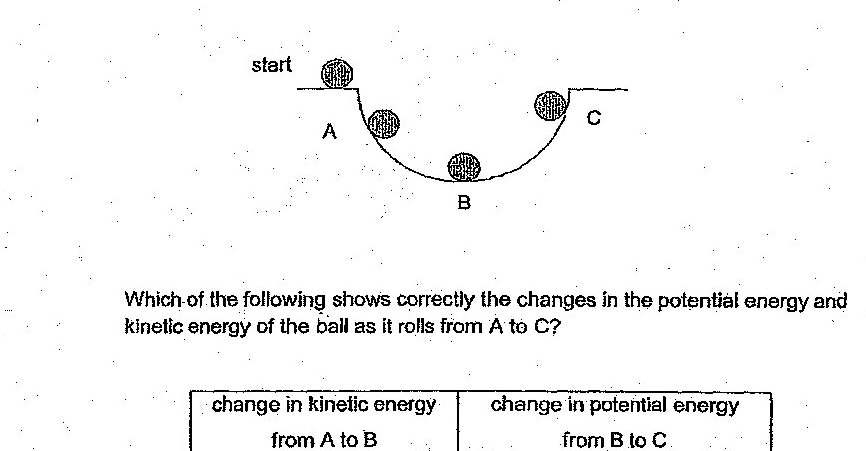
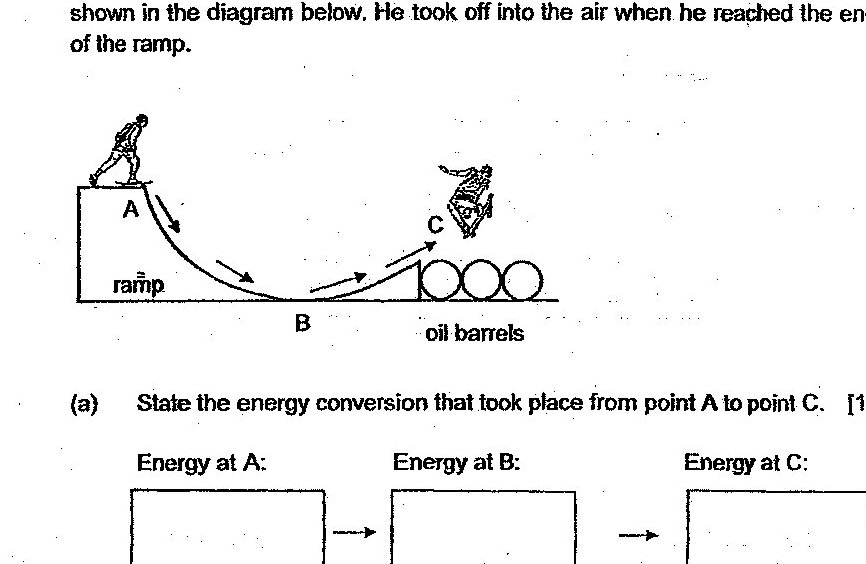
- Potential → Kinetic: When objects fall or are released (e.g., roller coaster going down)
- Kinetic → Potential: When objects are raised or slowed down (e.g., roller coaster going up)
- Example: A pendulum continuously converts between kinetic and potential energy:
- At the highest points: Maximum potential energy, zero kinetic energy
- At the lowest point: Maximum kinetic energy, minimum potential energy
- Effect of slope steepness on energy conversion: A steeper slope means a greater height difference, so the object starts with more gravitational potential energy. More gravitational PE is converted to kinetic energy, giving the object greater speed. Greater kinetic energy means the object travels a farther distance before stopping. A less steep slope produces the opposite effect — less height drop, less PE, less KE, shorter stopping distance.
- Friction causes kinetic energy to be converted to heat energy. Reducing friction (e.g. by applying oil as a lubricant) means less kinetic energy is converted to heat energy, so more kinetic energy remains and the object travels a farther distance.
Chemical Energy
- Chemical energy is energy stored in substances that can be released during chemical reactions
- Chemical energy is stored in the bonds between atoms in substances
- Sources of chemical energy:
- Food: Stores chemical potential energy that is released through RESPIRATION in our bodies, converting it to heat energy and kinetic energy.
- Fuels: Petrol, diesel, natural gas, coal, wood
- Batteries: Store chemical energy that can be converted to electrical energy
- When chemical energy is released:
- Usually through burning (combustion) or digestion
- Converted to other forms like heat, light, or kinetic energy
- Example: Burning wood releases heat and light energy
Electrical Energy
- Electrical energy is energy carried by moving electric charges (electric current)
- Electrical energy is one of the most useful forms of energy because it can be easily converted to other forms
- Sources of electrical energy:
- Batteries: Convert chemical energy to electrical energy
- Generators/Power stations: Convert kinetic energy (from burning fuel, wind, water, etc.) to electrical energy
- Solar panels: Convert light energy to electrical energy
- Electrical energy can be converted to:
- Light energy: Light bulbs, LEDs
- Heat energy: Electric heaters, toasters, hair dryers
- Sound energy: Speakers, buzzers
- Kinetic energy: Electric motors, fans, electric vehicles
- Examples in daily life:
- A fan: electrical energy → kinetic energy (+ some heat and sound)
- A light bulb: electrical energy → light energy + heat energy
- A speaker: electrical energy → sound energy (+ some heat)
- An electric kettle: electrical energy → heat energy
Energy Conversions (Important for PSLE)
Common energy conversions you must know:
| Device/Process | Energy Conversion |
|---|---|
| Solar panel | Light → Electrical |
| Light bulb | Electrical → Light and Heat |
| Speaker | Electrical → Sound |
| Microphone | Sound → Electrical |
| Battery in torch | Chemical → Electrical → Light |
| Burning candle | Chemical → Light and Heat |
| Photosynthesis | Light → Chemical |
| Eating food | Chemical → Heat and Kinetic |
| Striking a match | Kinetic → Heat and Light |
| Sliding/falling object | Gravitational Potential → Kinetic → Heat + Sound |
| Hydroelectric dam | Potential → Kinetic → Electrical |
| Archery (bow and arrow) | Elastic Potential (bow) → Kinetic (arrow) |
| Spring launching a ball | Elastic potential → Kinetic → Heat (friction) |
- Energy conversions happen in sequence (one stage at a time), not simultaneously. A ball falling and hitting the floor first converts GPE → KE (while falling), then KE → Sound (on impact). These are separate steps, not one conversion producing all forms at once.
- When describing an energy conversion, always name the specific object that possesses the energy. Do not write just the energy type alone. Example: Write “the ball’s gravitational potential energy is converted to kinetic energy”, not just “gravitational potential energy is converted to kinetic energy”.
Role of Friction in Energy Conversion
- When a moving object experiences friction, some of its kinetic energy is converted to heat energy. Lubricants such as oil reduce friction between surfaces. With less friction, less kinetic energy is converted to heat energy, so the object retains more kinetic energy and can travel farther.
Energy vs Force
- Energy is POSSESSED IN objects (e.g. a moving ball has kinetic energy). Force is an INTERACTION BETWEEN objects (e.g. gravity pulls the ball downward). These are different categories — never say energy converts to a force, and avoid using force language (“acting on”) when describing energy conversions.
Important Definitions
Energy: The ability to do work or cause change.
Light energy: A form of energy that enables us to see objects.
Heat energy: A form of energy that makes things hot or warm and can flow from a hotter object to a cooler object.
Sound energy: A form of energy produced when objects vibrate and that we can hear.
Kinetic energy: The energy that a moving object possesses.
Potential energy: Stored energy that an object has because of its position or condition.
Gravitational potential energy: Energy stored in an object due to its height above the ground.
Elastic potential energy: Energy stored in stretched or compressed elastic objects like springs or rubber bands.
Chemical energy: Energy stored in substances that can be released during chemical reactions.
Vibration: Rapid back-and-forth movement that produces sound.
Medium: A substance (solid, liquid, or gas) through which sound or heat can travel.
Energy conversion: The process of changing energy from one form to another.
Law of Conservation of Energy: Energy cannot be created or destroyed, but can only be changed from one form to another.
Conduction: The transfer of heat through solids by direct contact.
Convection: The transfer of heat through liquids and gases by the movement of heated particles.
Radiation: The transfer of heat through space without needing a medium.
Worked Examples
Example 1: Identifying Energy Conversions
Question: A boy switches on an electric fan on a hot day. Describe the energy conversions that take place.
Step-by-step solution:
-
Identify the starting form of energy:
- The fan is connected to an electrical socket
- Starting energy: Electrical energy
-
Identify what the fan does:
- The blades of the fan rotate (move)
- Movement = kinetic energy
- So electrical energy is converted to kinetic energy
-
Check for other energy forms produced:
- When the fan operates, it becomes slightly warm
- Some energy is also converted to heat energy
- The fan may also produce a humming sound
- Some energy is converted to sound energy
-
Write the complete answer:
Answer: Electrical energy is converted to kinetic energy (movement of the fan blades), heat energy, and sound energy.
Mark-earning keywords: Electrical energy, kinetic energy, converted
Example 2: Comparing Kinetic and Potential Energy
Question: Car P and Car Q are both at the top of a slope. Car P has a mass of 1000 kg and Car Q has a mass of 1500 kg. Both cars then roll down the slope. Which car has more gravitational potential energy at the top of the slope? Which car has more kinetic energy at the bottom of the slope? Explain your answers.
Step-by-step solution:
-
Analyze gravitational potential energy at the top:
- Both cars are at the same height
- Gravitational potential energy depends on: height AND mass
- Car Q is heavier (1500 kg vs 1000 kg)
- Therefore: Car Q has more gravitational potential energy at the top
-
Analyze kinetic energy at the bottom:
- Both cars start from rest and roll down
- The potential energy is converted to kinetic energy
- Car Q started with more potential energy
- By Law of Conservation of Energy, Car Q will have more kinetic energy at the bottom
- Therefore: Car Q has more kinetic energy at the bottom
-
Write the complete answer:
Answer:
- At the top: Car Q has more gravitational potential energy because it is heavier (has more mass) than Car P, and both are at the same height.
- At the bottom: Car Q has more kinetic energy because it had more potential energy at the top which was converted to kinetic energy as it rolled down the slope.
Mark-earning keywords: Gravitational potential energy, heavier/more mass, same height, converted, kinetic energy
Example 3: Energy Conversion in a Candle
Question: A candle is burning. Name the form of energy stored in the candle wax and describe what happens when the candle burns.
Step-by-step solution:
-
Identify stored energy in candle wax:
- Candle wax is made of chemicals
- Energy stored in chemicals = chemical energy
-
Identify what happens during burning:
- When the candle burns, you see a flame (light)
- Chemical energy is converted to light energy
- The area around the flame feels hot (heat)
- Chemical energy is also converted to heat energy
-
Write the complete answer:
Answer: The candle wax stores chemical energy. When the candle burns, the chemical energy is converted to light energy (we can see the flame) and heat energy (we can feel the heat from the flame).
Mark-earning keywords: Chemical energy, stored, converted, light energy, heat energy
Example 4: Friction and Energy Conversion
Question: A spring is used to launch a ball along a track. When oil is applied to the track, the ball travels a farther distance. Explain why, in terms of energy conversion.
Step-by-step solution:
-
Identify the energy conversion chain without oil:
- Elastic potential energy (in compressed spring) → Kinetic energy (moving ball) → Heat energy (due to friction between ball and track)
-
Identify what oil does:
- Oil is a lubricant that reduces friction between the ball and the track
-
Explain the effect on energy conversion:
- With less friction, less kinetic energy is converted to heat energy
- Therefore, the ball retains more kinetic energy
-
Connect to the observable outcome:
- Because the ball has more kinetic energy, it travels a farther distance
Answer: The elastic potential energy stored in the spring is converted to kinetic energy as the ball moves. Without oil, friction between the ball and the track causes some kinetic energy to be converted to heat energy. When oil is applied, friction is reduced, so less kinetic energy is converted to heat energy. The ball therefore retains more kinetic energy and travels a farther distance.
Mark-earning keywords: elastic potential energy, kinetic energy, converted, friction reduced, heat energy, more kinetic energy, farther distance
Common Mistakes to Avoid
1. Confusing Energy Forms
- ❌ WRONG: Saying “electricity” is a form of energy
- ✅ CORRECT: The correct term is “electrical energy”
- Always add the word “energy” after the type (light energy, heat energy, sound energy, etc.)
2. Forgetting That Heat is Also Produced
- ❌ WRONG: “A light bulb converts electrical energy to light energy only”
- ✅ CORRECT: “A light bulb converts electrical energy to light energy and heat energy”
- Remember: Most devices also produce unwanted heat energy (this is why they become warm)
3. Mixing Up Kinetic and Potential Energy
- ❌ WRONG: “A ball at the top of a hill has kinetic energy”
- ✅ CORRECT: “A ball at the top of a hill has (gravitational) potential energy”
- Remember:
- Stationary objects at a height = Potential energy
- Moving objects = Kinetic energy
4. Saying Sound Can Travel Through Vacuum
- ❌ WRONG: “Sound can travel through space like light does”
- ✅ CORRECT: “Sound cannot travel through a vacuum (empty space). It needs a medium (solid, liquid, or gas) to travel”
- Light can travel through vacuum, but sound cannot
5. Incomplete Energy Conversion Chains
- ❌ WRONG: “A battery-operated toy car: Chemical energy → Kinetic energy”
- ✅ CORRECT: “A battery-operated toy car: Chemical energy → Electrical energy → Kinetic energy (+ heat energy + sound energy)”
- Don’t skip the intermediate steps in energy conversions
6. Not Using the Word “Converted”
- ❌ WRONG: “Chemical energy becomes light energy”
- ❌ WRONG: “Chemical energy turns into / changes to light energy”
- ✅ CORRECT: “Chemical energy is converted to light energy”
- Use the correct scientific term: “converted” or “conversion”
7. Confusing “Potential Energy” with “Potential”
- Always write the full term “potential energy” not just “potential”
- Same for “kinetic energy” - don’t write just “kinetic”
8. Forgetting Multiple Energy Outputs
- When devices operate, they usually produce MORE THAN ONE form of energy
- Example: An electric drill produces kinetic energy, heat energy, AND sound energy (not just kinetic energy)
9. Wrong Heat Transfer Terminology
- ❌ WRONG: “Heat travels through metal by convection”
- ✅ CORRECT: “Heat travels through metal by conduction”
- Remember:
- Conduction = through solids
- Convection = through liquids and gases
- Radiation = through empty space
10. Not Explaining HOW Energy is Converted
- For full marks, always state the SITUATION/CONTEXT (e.g. ‘as the ball falls’, ‘when the spring is released’) before stating the conversion.
- Example: Don’t just say “Potential energy is converted to kinetic energy”
- Better answer: “As the ball falls from a height, its potential energy is converted to kinetic energy, causing it to move faster”
11. Not Naming the Object That Possesses the Energy
- ❌ WRONG: “Gravitational potential energy is converted to kinetic energy”
- ✅ CORRECT: “The ball’s gravitational potential energy is converted to kinetic energy as it falls”
- Always state which object has the energy — examiners expect this for full marks.
12. Saying Energy is “Used Up”
- ❌ WRONG: “The battery’s chemical energy was used up”
- ✅ CORRECT: “The chemical energy in the battery was converted to electrical energy, and then to light energy and heat energy”
- The phrase “used up” implies energy is destroyed, which violates the Law of Conservation of Energy. Always say the energy “converted to” another form.
13. Not Naming the Object That Stores Elastic Potential Energy
- ❌ WRONG: “Elastic potential energy is stored when the bow is pulled back.”
- ✅ CORRECT: “The bow possesses elastic potential energy when it is pulled back.”
- Always state clearly which object holds the energy.
14. Assuming a Less Steep Slope Means an Object Travels Farther
- ❌ WRONG: “A less steep slope means the object will slide farther before stopping”
- ✅ CORRECT: A steeper slope gives a greater height drop → more gravitational potential energy → more kinetic energy → greater distance traveled before stopping
- A less steep slope produces LESS kinetic energy, so the object actually stops sooner.
15. Saying Energy is “Lost” or “Produced”
- ❌ WRONG: “Heat energy is lost due to friction” or “Friction produces heat energy”
- ✅ CORRECT: “Kinetic energy is converted to heat energy due to friction”
- Energy is never lost or produced — it is always converted from one form to another (Law of Conservation of Energy)
16. Implying Energy Conversions Happen Simultaneously
- ❌ WRONG: “GPE is converted to kinetic energy and sound energy” (suggests all happen at once)
- ✅ CORRECT: Write two separate sentences — “The ball’s GPE is converted to kinetic energy as it falls. The ball’s kinetic energy is converted to sound energy when it hits the ground.”
- Conversions happen in stages. Use separate sentences to show the correct order.
17. Saying Energy Converts to a Force
- ❌ WRONG: “Kinetic energy is converted to a pushing force”
- ✅ CORRECT: “Kinetic energy is converted to heat energy and sound energy (on impact)”
- Force and energy are different categories. Energy converts to another form of ENERGY, never to a force. Also avoid the phrase “acting on” when describing energy — it is force terminology.
18. Dropping Comparative Language Mid-Answer
- If the question uses comparative words (“further”, “more”, “greater”), your entire answer chain must use comparatives.
- ❌ WRONG: “The bow stores elastic potential energy. This is converted to kinetic energy and the arrow moves.”
- ✅ CORRECT: “The bow stores MORE elastic potential energy. More E.P.E. is converted to more kinetic energy in the arrow, causing the arrow to travel a GREATER distance.”
19. Incomplete Friction/Lubricant Explanations
- ❌ WRONG: “The ball travels farther because oil reduces friction”
- ✅ CORRECT: “Oil reduces friction between the ball and the surface. With less friction, less kinetic energy is converted to heat energy. Therefore, the ball retains more kinetic energy and travels a farther distance.”
- Always complete the full energy conversion chain: change in friction → change in energy conversion → observable outcome
Exam Tips
Keywords to Include (Mark-Earning Phrases)
-
For Energy Conversion Questions:
- Always use: “converted to” or “conversion”
- Name BOTH the initial and final energy forms
- Example: “Chemical energy is converted to electrical energy”
-
For Heat Energy Questions:
- “Heat flows from a hotter object to a cooler object”
- Name the method: “by conduction/convection/radiation”
- For conduction: mention “through the solid material”
- For convection: mention “hot liquid/gas rises, cool liquid/gas sinks”
-
For Kinetic/Potential Energy Questions:
- Use descriptors: “gravitational potential energy” or “elastic potential energy”
- For comparisons: mention “mass” and “height” for gravitational potential energy
- For elastic: mention “stretched” or “compressed”
-
For Sound Energy Questions:
- Always mention: “vibration” or “vibrate”
- “Sound needs a medium to travel”
- “Sound cannot travel through a vacuum”
-
For Light Energy Questions:
- “Light travels in straight lines”
- Mention if light is “reflected”, “absorbed”, or “transmitted”
-
For Slope/Height Comparison Questions: Identify the energy conversion chain first (Gravitational PE → KE → Heat + Sound). Name the type of energy AND the object possessing it. State the full chain in the correct order. Use the word “converted” — e.g., “The gravitational potential energy of the object is converted to kinetic energy as it slides down, and then to heat energy and sound energy when it stops.”
-
For Friction and Lubricant Questions:
- Never say energy is “lost” — say it is “converted to heat energy”
- State the effect on friction first, then the energy conversion, then the outcome
- Use comparative words: “less kinetic energy is converted to heat energy”, “more kinetic energy remains”
- Example structure: “Oil reduces friction → less kinetic energy is converted to heat energy → the ball retains more kinetic energy → the ball travels a farther distance”
Answering Different Question Types
Type 1: “Name the form of energy…” questions
- Give the specific name with the word “energy” (e.g., “Chemical energy”)
- Don’t write long explanations unless asked
- 1 mark = 1 form of energy named
Type 2: “Describe the energy conversion…” questions
- Use the format: “[Initial energy] is converted to [Final energy]”
- Include ALL forms of energy produced (including unwanted heat/sound)
- Draw arrows if helpful: Chemical energy → Electrical energy → Light energy + Heat energy
- Name the specific object before the energy type in each sentence. Use a separate sentence for each step in a sequential conversion chain to show the correct order and avoid implying conversions happen simultaneously.
- Structured answer formula: [Initial energy form] + [describe the situation/action, e.g. “as the ball falls”] + “is converted to” + [final energy form(s)] + [outcome/effect]. Following this four-part structure ensures you earn all available marks.
Type 3: “Explain why…” questions
- Give the reason using scientific concepts
- Link cause and effect
- Use “because”, “this is due to”, “therefore”
- Example: “The metal spoon becomes hot because heat is conducted through the metal from the hot water”
Type 4: “Compare…” questions
- Make direct comparisons using comparative words (more, less, greater, higher, faster)
- State what is the same and what is different
- Explain WHY there is a difference
- Use names/labels given in the question (Object A vs Object B)
Type 5: Fill-in-the-blanks in diagrams
- Read the entire diagram first to understand the process
- Look for arrows showing energy flow or conversion
- Use the exact scientific terms (don’t use casual language)
Type 6: MCQ / Choose the correct statement questions
- Before looking at the options, identify the energy conversion chain that applies to the scenario
- Evaluate each option against the correct energy principles one by one
- Do not pick an option based on intuition — verify using the Law of Conservation of Energy
How to Score Full Marks
-
Read the question carefully - How many marks? How many points to make?
- 1 mark = 1 correct point
- 2 marks = usually 2 forms of energy or 1 conversion with explanation
-
Use correct scientific terminology:
- Say “converted” not “changed” or “turned into”
- Say “medium” not “material” or “substance” when talking about sound
- Say “gravitational potential energy” not just “potential energy” (be specific)
-
For 2-3 mark questions, give complete explanations:
- Name the energy forms (1 mark)
- Describe the conversion process (1 mark)
- Explain why/how if asked (1 mark)
-
Draw and label diagrams when asked:
- Use a ruler for straight lines
- Label all parts clearly
- Add arrows to show direction of energy flow or movement
- Keep diagrams simple and clear
-
Check your spelling of scientific terms:
- Kinetic (not kenetic)
- Potential (not potencial)
- Chemical (not cemical)
- Electrical (not electric - add “al”)
-
For “Give a reason” questions:
- Don’t repeat the question
- Give a scientific explanation
- Link it to the concept being tested
-
For sequential energy conversions (e.g. GPE → KE → Sound), write each step as a separate sentence and name the object that holds the energy at each stage. Do not combine all conversions into one sentence as this implies they happen at the same time.
-
Use superlative and comparative language precisely when comparing: write “highest”, “fastest”, “most”, “greater”, “less” rather than vague phrases. E.g. “Ball A has MORE gravitational potential energy than Ball B because it is at a GREATER height”.
-
Three-Step Method for elastic energy questions: (1) Name the object that stores E.P.E. (2) Use the word “converted” to describe the energy change and name the object that gains kinetic energy. (3) State the outcome in comparative language that mirrors the question wording. Model answer: “When the bow is pulled further, the bow possesses more elastic potential energy. When released, more elastic potential energy is converted to more kinetic energy in the arrow, causing the arrow to travel a greater distance.”
Quick Summary
Essential Points for PSLE Revision - Forms of Energy
✓ Energy is the ability to do work. It cannot be created or destroyed, only converted from one form to another (Law of Conservation of Energy)
✓ Seven forms of energy: Light, Heat, Sound, Kinetic, Potential (gravitational and elastic), Chemical, and Electrical energy
✓ Light energy allows us to see. Sources: Sun (natural), light bulbs (man-made). Light travels in straight lines and can be converted to other energy forms (e.g., in solar panels → electrical energy)
✓ Heat energy makes things hot. Heat flows from hotter to cooler objects. Methods of heat transfer: Conduction (through solids), Convection (through liquids and gases), Radiation (through empty space)
✓ Sound energy is produced when objects vibrate. Sound needs a medium (solid, liquid, or gas) to travel and cannot travel through vacuum. Sound travels fastest through solids, slower through liquids, slowest through gases
✓ Kinetic energy is energy of moving objects. The faster and heavier an object, the more kinetic energy it has
✓ Potential energy is stored energy due to position or condition. Two types: Gravitational potential energy (height) and Elastic potential energy (stretched/compressed objects)
✓ Kinetic ↔ Potential energy conversions: Falling objects (PE → KE), lifting objects (KE → PE). Example: Pendulum swings - maximum PE at highest points, maximum KE at lowest point
✓ Chemical energy is stored in substances and released during chemical reactions (burning, digestion). Found in: food, fuels (petrol, wood, coal), batteries
✓ Electrical energy is energy carried by moving electric charges; produced by batteries (chemical → electrical), solar panels (light → electrical), and generators. Can be converted to light, heat, sound, or kinetic energy
✓ Common energy conversions to memorize:
- Battery torch: Chemical → Electrical → Light + Heat
- Light bulb: Electrical → Light + Heat
- Photosynthesis: Light → Chemical
- Burning candle: Chemical → Light + Heat
- Falling object: Potential → Kinetic
- Solar panel: Light → Electrical
✓ Most devices produce multiple forms of energy, including unwanted heat and sound energy. Always mention all forms produced for full marks
✓ Key exam words: “converted”, “vibrate/vibration”, “medium”, “gravitational potential energy”, “elastic potential energy”, “hotter to cooler”, “conduction/convection/radiation”
Remember: Energy is always being converted around us. Look for examples in daily life to help you remember these concepts!
A ball is rolled down as shown in the diagram below. Which of the following shows correctly the changes in the potential energy and kinetic energy of the ball as it rolls from A to C?
State the energy conversion that took place from point A to point C.
Explain, in terms of energy, how distance Y is affected by distance X.
Kayley noticed that disc B travelled at a slower speed as compared to disc A. Explain, in terms of energy, why.

Put a tick (✓) in the correct box(es) to indicate that the light bulb has lit up.
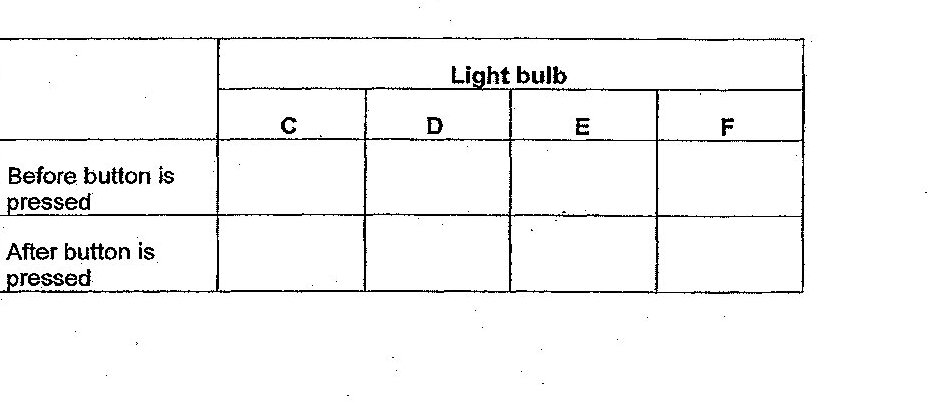
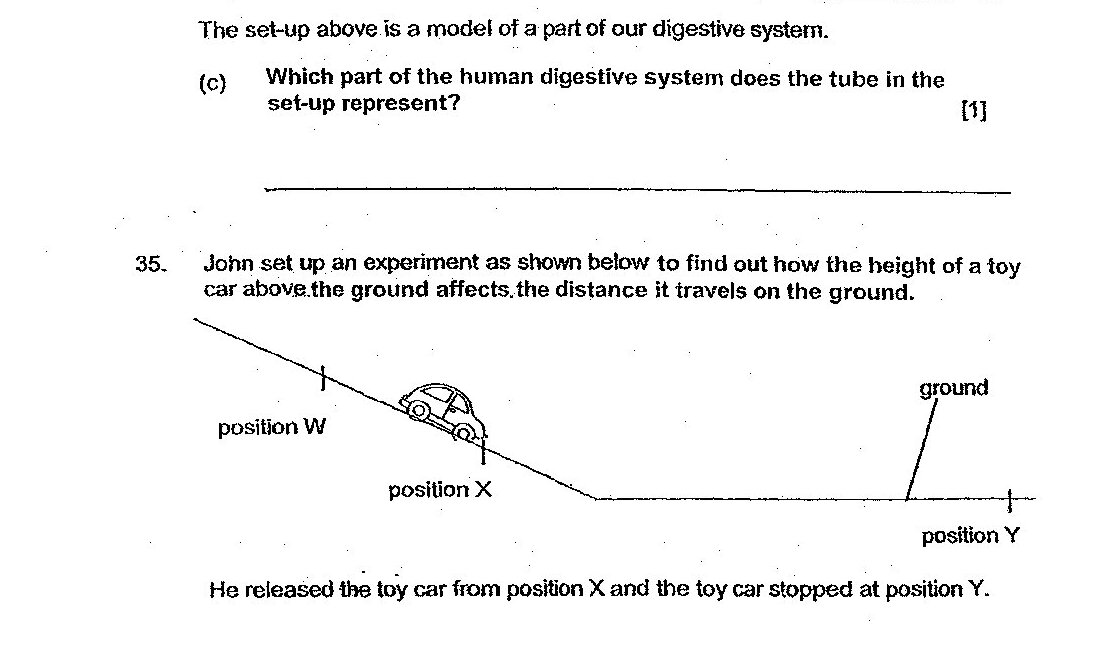
State the form of energy possessed by the toy car at position X just before it was released.
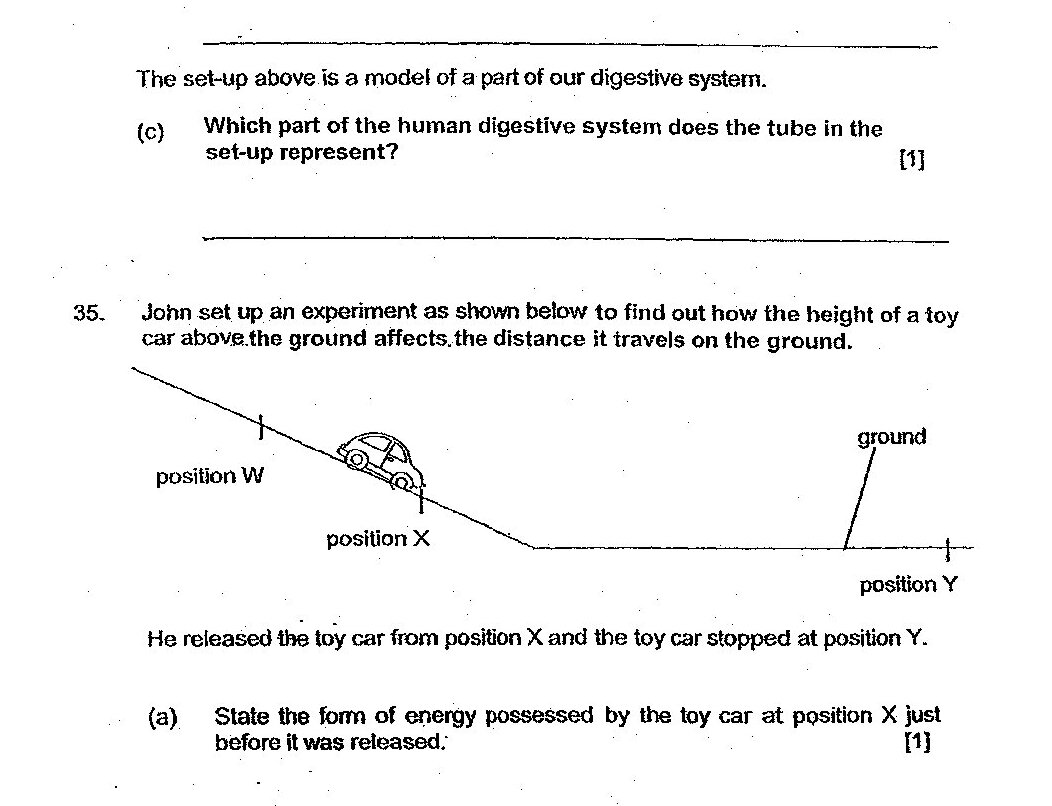
Explain the energy conversion as the car was released from position X to the moment it came to a complete stop at position Y.
Tim noticed that the toy car moved slower at point A than at point B. Explain in terms of energy, why this happened.
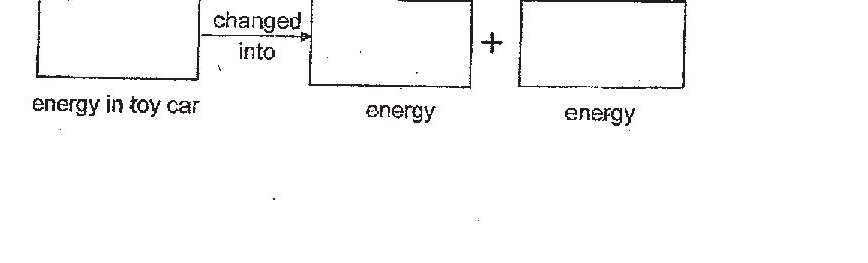
Fill in the blanks below to show the energy changes that caused the toy car to stop moving at point C.
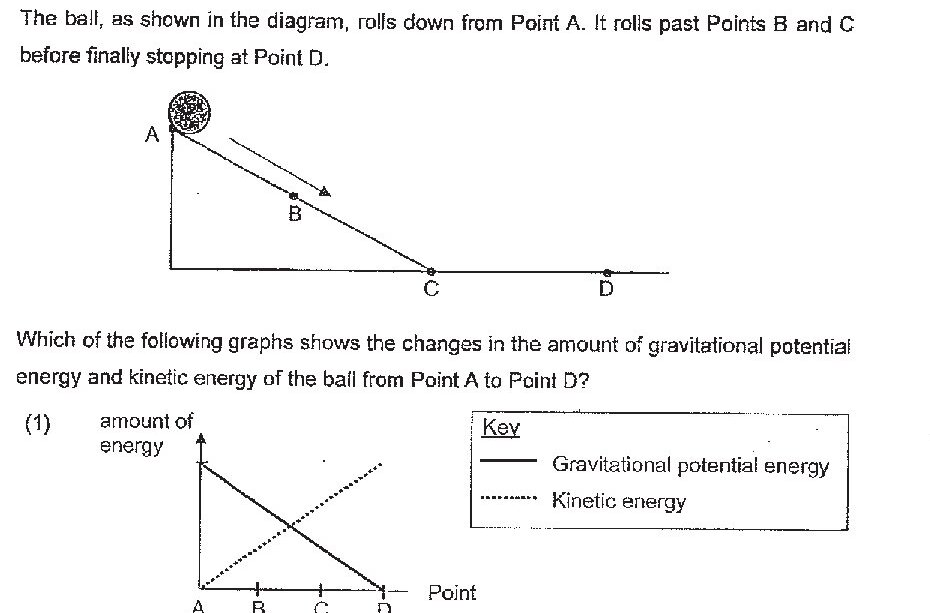
Which of the following graphs shows the changes in the amount of gravitational potential energy and kinetic energy of the ball from Point A to Point D?
Complete the conversion of energy when the switch is turned on. Electrical energy → [blank] energy + [blank] energy + [blank] energy
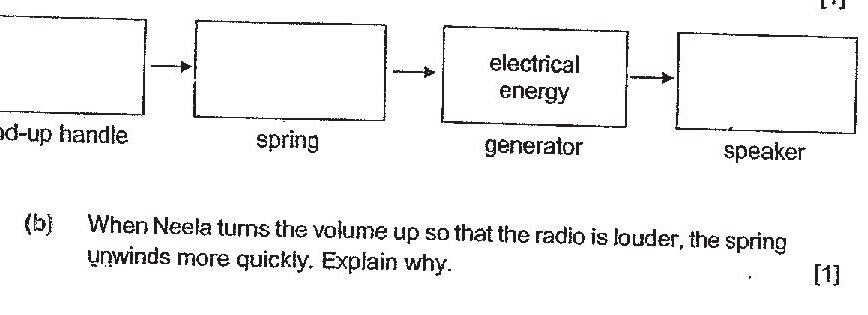
When Neela turns the volume up so that the radio is louder, the spring unwinds more quickly. Explain why.
Which of the following is correct about heat and light?
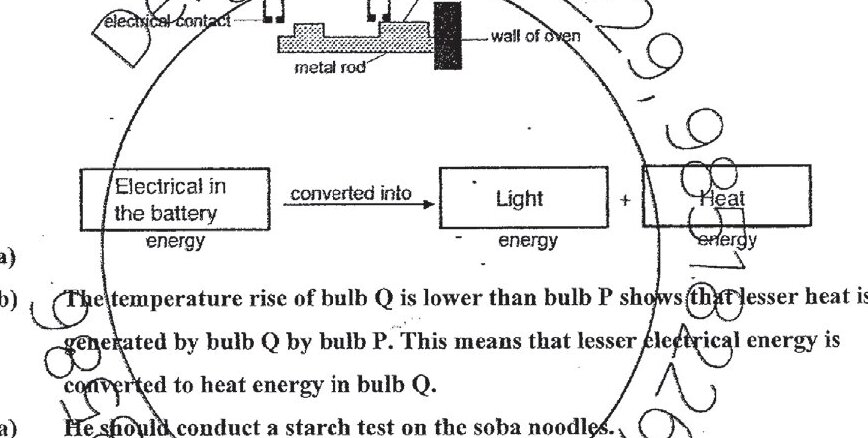
Fill in the boxes to show the energy conversion in the bulb.
![A diagram showing three boxes connected by arrows. The sequence is: [empty box] labeled 'energy' converted into [empty box] labeled 'energy' + [empty box] labeled 'energy'](/assets/question-images/p6_P6_Science_2019_Prelims_SA2_-_Pei_Hwa_p29_q36a.jpg)
Sue wants to replace the light bulb in her room with a more energy-saving one. Based on the results of Sue's experiment, which of the two bulbs, P or Q, should she use? Explain your answer.
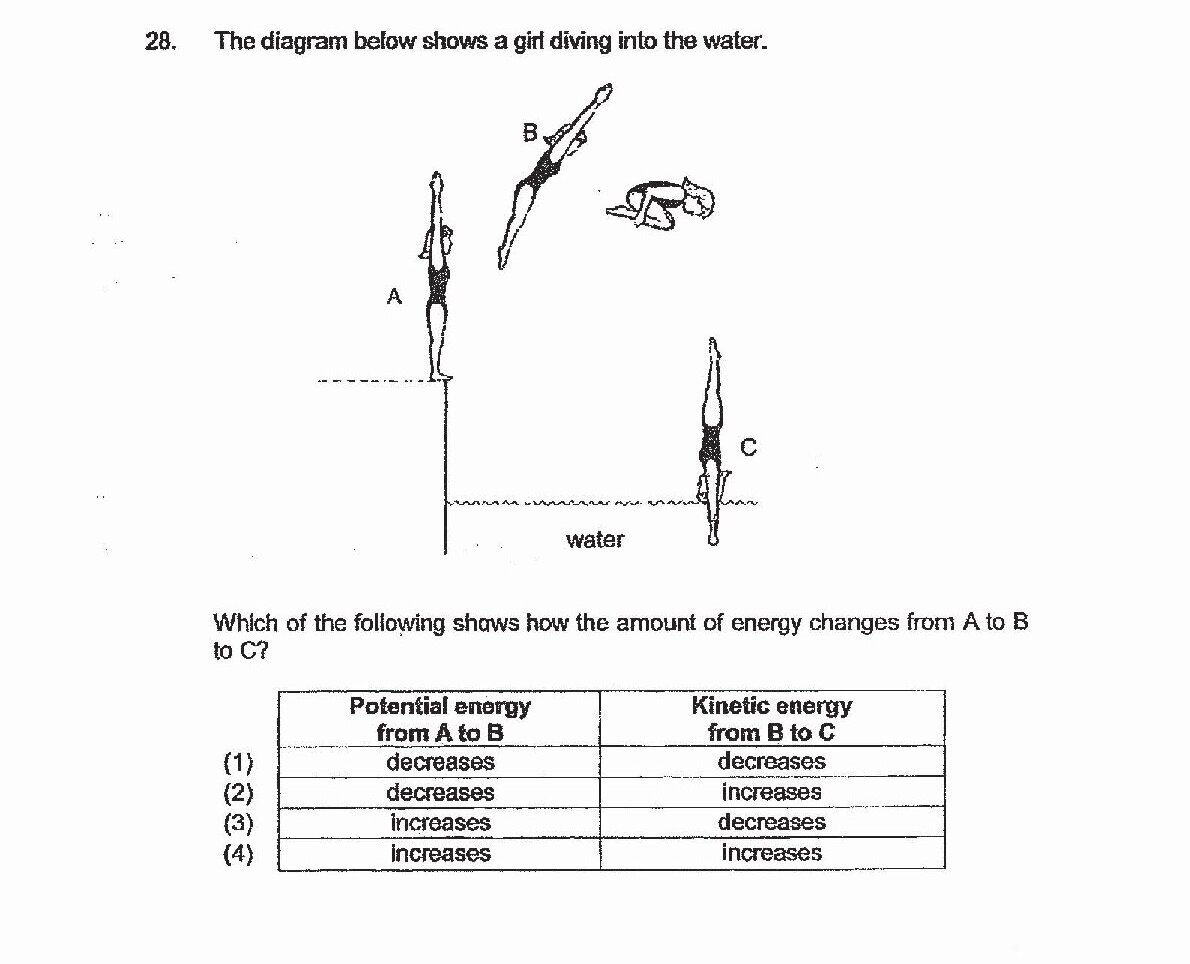
The diagram below shows a girl diving into the water. Which of the following shows how the amount of energy changes from A to B to C?
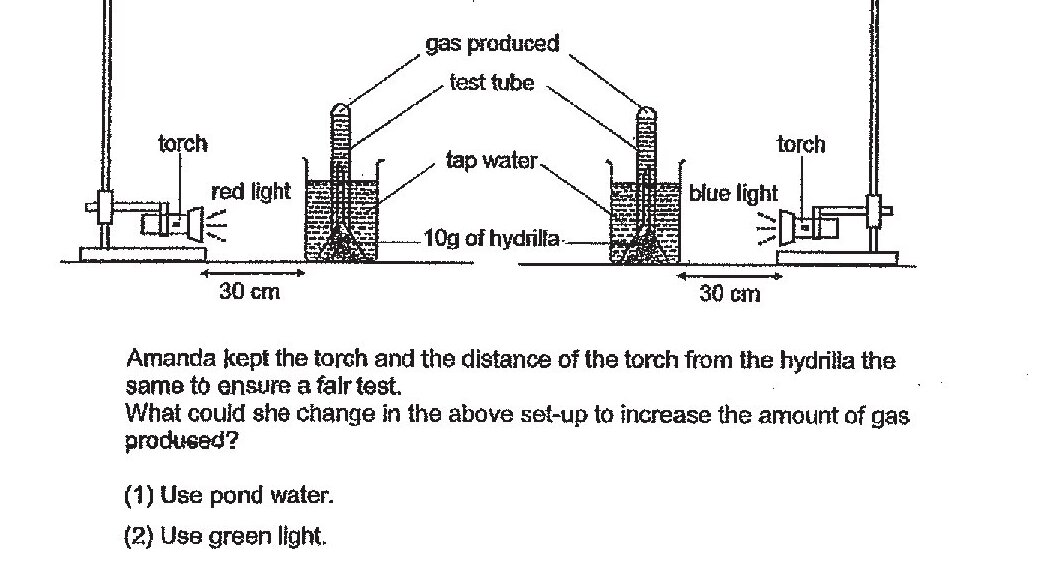
Amanda carried out an experiment using the set-ups as shown below. Amanda kept the torch and the distance of the torch from the hydrilla the same to ensure a fair test. What could she change in the above set-up to increase the amount of gas produced?
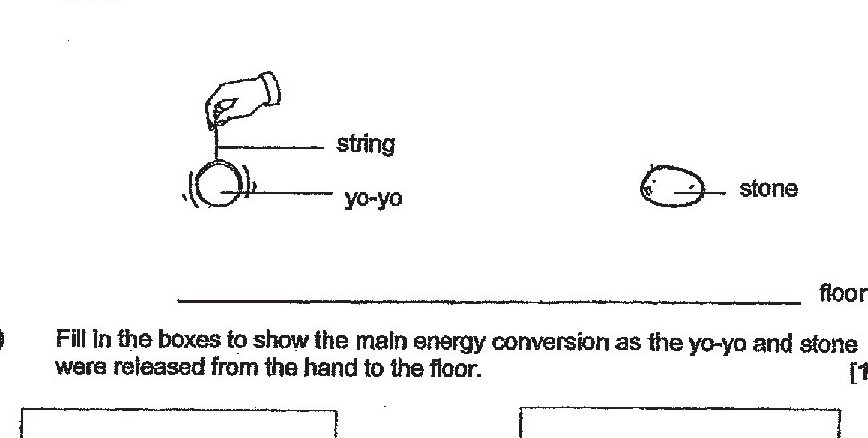
Fill in the boxes to show the main energy conversion as the yo-yo and stone were released from the hand to the floor.

Andy observed the yo-yo spinning as it was falling but the stone did not spin. Explain why the yo-yo fell slower than the stone in terms of energy changes.
Andy also observed that yo-yo continued to move up and down for a few times before stopping completely. Explain why.
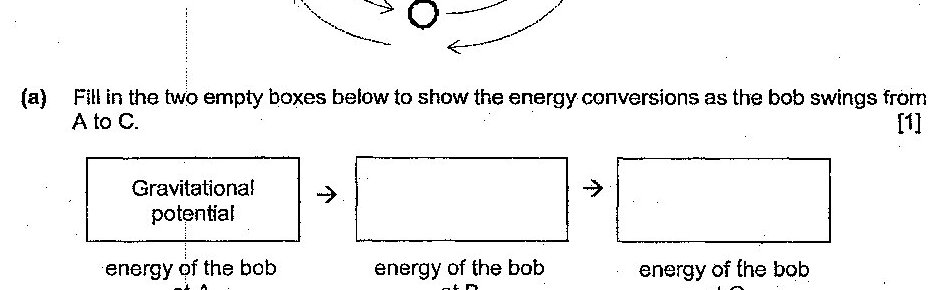
Fill in the two empty boxes below to show the energy conversions as the bob swings from A to C.
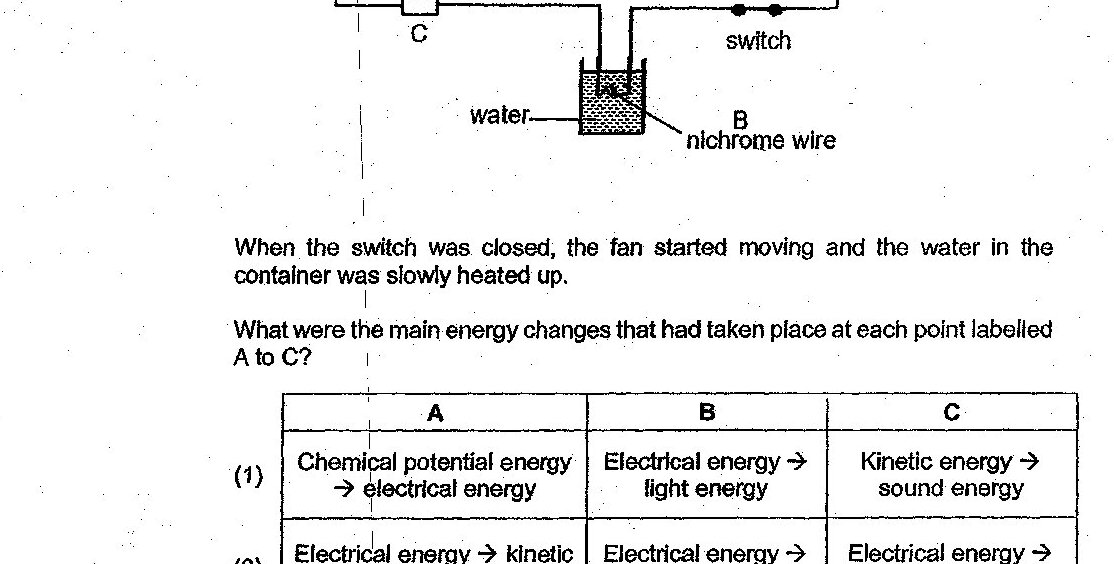
A fan and a container of water were connected to a circuit as shown below. When the switch was closed, the fan started moving and the water in the container was slowly heated up. What were the main energy changes that had taken place at each point labelled A to C?
Complete the conversion of energy when the switch is turned on. Electrical energy → [___] energy + [___] energy + [___] energy
John cut down a tree to set up a campfire as shown in the diagram below. Which one of the following shows the main energy conversion?

Fill in the boxes below to show the main energy conversion when the string was cut.
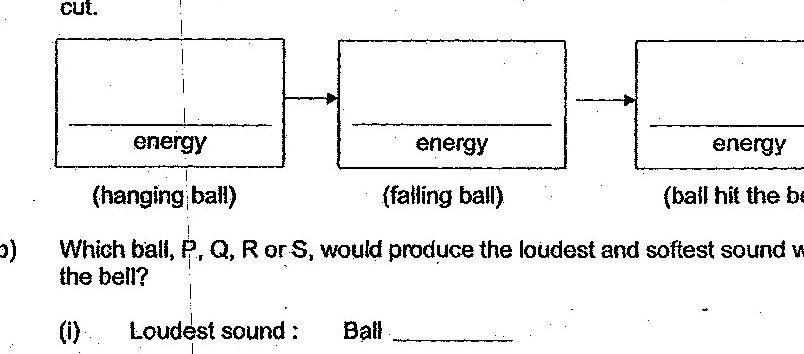
Which ball, P, Q, R or S, would produce the loudest and softest sound when it hit the bell?

Loudest sound: Ball _______
Softest sound: Ball _______

Past year papers cover the full exam — browse by subject below.
View All Papers ›