Heat
Heat (Energy) - Primary 6 PSLE Science Study Notes
Key Concepts
Heat as a Form of Energy
- Heat is a form of energy that flows from a hotter object to a cooler object
- Heat is not the same as temperature:
- Temperature measures how hot or cold an object is (measured in °C)
- Heat is the energy that transfers between objects at different temperatures
- When an object gains heat energy:
- Its temperature rises
- Its particles move faster
- It may expand (get bigger)
- When an object loses heat energy:
- Its temperature falls
- Its particles move slower
- It may contract (get smaller)
- Heat energy always flows from hot to cold, never the reverse
- Heat flow continues until both objects reach the same temperature (thermal equilibrium)
- Perception of warmth or coldness depends on relative temperature, not absolute temperature:
- If your hand is colder than an object, you feel warmth (you are gaining heat from it)
- If your hand is warmer than an object, you feel cold (you are losing heat to it)
- The same object can feel warm to one hand and cold to another — if the two hands are at different temperatures
- Example: A basin of water at 30°C feels warm to a hand conditioned in 10°C water, but feels cold to a hand conditioned in 50°C water
Heat Transfer Methods
There are three ways heat can travel:
1. Conduction
- Heat transfer through solids by direct contact
- Particles vibrate faster when heated and pass energy to neighboring particles
- No movement of particles from place to place
- Occurs mainly in solids (especially metals)
- Example: Metal spoon getting hot in hot soup
2. Convection
- Heat transfer through liquids and gases by the movement of the heated particles themselves
- When heated, liquids/gases expand, become less dense, and rise
- Cooler, denser liquids/gases sink to take their place
- This creates a convection current (circular movement)
- Does not occur in solids (particles cannot move freely)
- Examples: Boiling water, air-conditioner cooling a room
3. Radiation
- Heat transfer through empty space or air without needing particles
- Travels as infrared waves (a type of energy wave)
- Can travel through vacuum (empty space)
- Does not need particles or direct contact
- All hot objects give off heat radiation
- Dark, dull surfaces are better at absorbing and emitting radiation
- Shiny, light-colored surfaces reflect radiation
- Examples: Sun warming Earth, heat from a fire, heat from a light bulb
Good and Poor Conductors of Heat
Good Conductors (Conductors)
- Materials that allow heat to pass through quickly
- All metals are good conductors:
- Copper (best common conductor)
- Aluminum
- Iron
- Steel
- Silver
- Gold
- Have particles that are closely packed
- Used when we want heat to transfer quickly
- Examples of use:
- Cooking pots and pans
- Kettle bases
- Radiators
- Heat sinks in computers
Poor Conductors (Insulators)
- Materials that allow heat to pass through slowly or not at all
- Also called thermal insulators
- Common insulators:
- Wood
- Plastic
- Cloth/fabric
- Paper
- Cork
- Rubber
- Air (trapped air is an excellent insulator)
- Water
- Glass
- Ceramic
- Used when we want to prevent heat transfer
- Examples of use:
- Pot handles (wood/plastic)
- Oven gloves
- Thermos flask walls
- Winter clothing (traps air)
- Cooler boxes/ice boxes
Expansion and Contraction
Expansion (Getting Bigger)
- When materials are heated, they expand (increase in size)
- Happens because particles gain energy and move faster
- Moving particles take up more space
- Applies to solids, liquids, and gases
- Gases expand the most, liquids expand moderately, solids expand the least
- Examples:
- Thermometer liquid rising when heated
- Metal railway tracks have gaps to allow expansion in hot weather
- Telephone wires sag more in hot weather
- Balloon expands when heated
Contraction (Getting Smaller)
- When materials are cooled, they contract (decrease in size)
- Happens because particles lose energy and move slower
- Particles take up less space
- Applies to solids, liquids, and gases
- Examples:
- Thermometer liquid falling when cooled
- Metal jar lid contracts when cooled, making it easier to open
- Balloon shrinks when cooled
- Telephone wires become tighter in cold weather
Applications of Expansion and Contraction
- Thermometer: Liquid (mercury or colored alcohol) expands when heated and rises up the tube
- Bi-metallic strip: Two different metals expand at different rates when heated
- Used in thermostats and fire alarms
- When heated, the strip bends toward the metal that expands less
- Gaps in structures:
- Railway tracks have gaps between sections
- Bridges have expansion joints
- Prevents buckling when metal expands in hot weather
- Loosening tight lids: Pour hot water over tight metal lid
- Metal lid expands more than glass jar
- Becomes easier to unscrew
- Inverted flask experiment: When a flask of air is heated, air expands and bubbles out through water in a connected tube. When the heat source is removed, the air cools and contracts — the reduced air volume draws water up into the glass tube (water level in the tube rises, not in the basin)
- Exam trap: Questions ask what happens AFTER heating stops — contraction (water rising in tube) is the answer, not expansion (bubbles escaping)
Temperature-Time Graph (Heating Curve)
When a substance is heated continuously from solid through to gas, a temperature-time graph shows a characteristic shape:
- Rising segments: Temperature increases as the substance gains heat (solid heating up, or liquid heating up)
- Flat plateau segments: Temperature stays constant during a state change (melting or boiling). All heat energy goes into changing state, not raising temperature
Key points for ice → water → steam:
- 0°C plateau: Ice melting to water. The substance is gaining heat but temperature does not rise during this stage
- 100°C plateau: Water boiling to steam. Temperature stays at 100°C while water turns to steam
- Between plateaus: Liquid water gaining heat; temperature rises steadily
PSLE exam trap — Ice at the plateau:
- If the question asks “Is ice gaining heat from point B to C?” where B→C is the flat 0°C segment — the answer is: ice is NOT present at that stage. At point B, all ice has already melted into water. From B to C, it is water (not ice) gaining heat
- Always identify: which state of matter is present in each segment of the graph
Important Definitions
Heat: A form of energy that flows from a hotter object to a cooler object.
Temperature: A measure of how hot or cold an object is, measured in degrees Celsius (°C).
Conduction: The transfer of heat through a solid by direct contact, where heat passes from particle to particle without the particles themselves moving from place to place.
Convection: The transfer of heat through liquids and gases, where heated particles move from one place to another, creating convection currents.
Radiation: The transfer of heat in the form of infrared waves that can travel through empty space without needing particles.
Conductor: A material that allows heat to pass through it quickly (e.g., metals).
Insulator: A material that allows heat to pass through it slowly or not at all (e.g., wood, plastic, air).
Thermal equilibrium: When two objects reach the same temperature and heat stops flowing between them.
Expansion: The increase in size of a material when it is heated.
Contraction: The decrease in size of a material when it is cooled.
Convection current: The circular movement of heated liquid or gas that rises (becomes less dense) and cooler liquid or gas that sinks (more dense).
Bi-metallic strip: A strip made of two different metals joined together that bend when heated or cooled because the metals expand at different rates.
Worked Examples
Example 1: Identifying Heat Transfer Methods
Question: Tom places a metal spoon in a cup of hot coffee. After a while, the handle of the spoon becomes hot even though it is not in the coffee.
a) Name the method of heat transfer that caused the handle to become hot. b) Explain how this method works. c) Why did Tom’s mother tell him to use a plastic spoon instead?
Solution:
a) Conduction (1 mark)
b) Explanation: (2-3 marks)
- Heat from the hot coffee is transferred to the metal spoon through conduction.
- The particles in the metal spoon vibrate faster when heated.
- These vibrating particles transfer energy to neighboring particles along the spoon.
- This continues until the heat reaches the handle, making it hot.
- The particles themselves do not move from place to place.
Keywords to include: particles, vibrate faster, transfer energy, neighboring particles
c) Why plastic spoon: (2 marks)
- Plastic is a poor conductor of heat / insulator.
- Heat will not be transferred quickly through the plastic spoon, so the handle will not become hot.
- This prevents Tom from burning his hand.
Example 2: Convection Current Question
Question: Sarah noticed that when her mother boils water in a pot, the water at the top becomes hot even though the heat source is at the bottom.
a) Name the method of heat transfer in the water. b) Explain how the water at the top becomes hot. c) Why does this method not occur in a metal pot?
Solution:
a) Convection (1 mark)
b) Explanation of convection: (3-4 marks)
- The water at the bottom of the pot is heated first by conduction from the pot.
- The heated water expands and becomes less dense (lighter).
- The less dense hot water rises to the top.
- The cooler water at the top is denser (heavier) and sinks to the bottom.
- The cooler water then gets heated and rises again.
- This creates a convection current, causing all the water to become hot.
Keywords to include: expands, less dense, rises, denser, sinks, convection current
c) Why not in metal pot: (2 marks)
- Convection only occurs in liquids and gases.
- Metal is a solid, and its particles cannot move freely from place to place.
- Heat is transferred through the metal pot by conduction instead.
Example 3: Application of Expansion and Contraction
Question: A glass bottle has a tight metal lid that cannot be opened. John’s father ran hot water over the metal lid for a minute, and then the lid could be opened easily.
a) Explain why the lid became easier to open after being heated. b) What would happen to the metal lid if it was cooled instead?
Solution:
a) Explanation: (3 marks)
- When the metal lid is heated by the hot water, it expands (becomes larger).
- The glass bottle also expands but less than the metal lid / Glass expands at a slower rate than metal.
- The gap between the lid and the bottle becomes larger, making it easier to twist and open.
Keywords to include: heated, expands/expansion, gap becomes larger
b) If cooled: (2 marks)
- If the metal lid is cooled, it will contract (become smaller).
- The lid will fit even more tightly on the bottle, making it harder to open / The gap between the lid and bottle becomes smaller.
Common Mistakes to Avoid
Mistake 1: Confusing Heat and Temperature
- ❌ Wrong: “Heat is measured in degrees Celsius”
- ✅ Correct: “Temperature is measured in degrees Celsius; heat is a form of energy”
- Remember: Heat flows, temperature measures hotness
Mistake 2: Wrong Heat Transfer Method
- ❌ Wrong: “Heat travels through a metal rod by convection”
- ✅ Correct: “Heat travels through a metal rod by conduction”
- Remember:
- Conduction = solids (mainly metals)
- Convection = liquids and gases
- Radiation = through empty space/no particles needed
Mistake 3: Saying Convection Occurs in Solids
- ❌ Wrong: “Convection occurs when heat passes through the metal pot”
- ✅ Correct: “Conduction occurs when heat passes through the metal pot; convection only occurs in liquids and gases”
- Remember: Convection requires particles to move from place to place; solid particles are fixed in position
Mistake 4: Incomplete Explanation of Convection
- ❌ Wrong: “Hot water rises”
- ✅ Correct: “Hot water expands, becomes less dense, and rises. Cool water is denser and sinks to take its place, creating a convection current”
- Remember: Must mention density changes and convection current for full marks
Mistake 5: Forgetting Which Materials Expand Most
- ❌ Wrong: “Solids expand more than gases when heated”
- ✅ Correct: “Gases expand the most, then liquids, then solids expand the least”
- Remember: The order from most to least: Gases > Liquids > Solids
Mistake 6: Direction of Heat Flow
- ❌ Wrong: “Cold flows from the ice to the warm drink”
- ✅ Correct: “Heat flows from the warm drink to the ice”
- Remember: Heat always flows from hot to cold (cold doesn’t flow!)
Mistake 7: Poor vs Good Conductor Properties
- ❌ Wrong: “Plastic is used for pot handles because it is strong”
- ✅ Correct: “Plastic is used for pot handles because it is a poor conductor of heat/insulator, preventing heat from reaching the hand”
- Remember: Always link material choice to its heat conducting property
Mistake 8: Radiation Explanations
- ❌ Wrong: “The Sun heats Earth by conduction”
- ✅ Correct: “The Sun heats Earth by radiation through empty space”
- Remember: Radiation is the only method that works through a vacuum
Mistake 9: Thermos Flask Explanations
- Must mention all three methods of heat transfer prevention:
- Vacuum/air gap → prevents conduction and convection
- Shiny surfaces → prevent radiation
- Cork/plastic stopper → prevents conduction
- Don’t just list features; explain what each prevents
Mistake 10: Expansion Applications
- ❌ Wrong: “Gaps in railway tracks prevent the tracks from expanding”
- ✅ Correct: “Gaps in railway tracks allow space for the metal to expand in hot weather, preventing the tracks from buckling”
- Remember: Gaps don’t prevent expansion; they provide space for expansion
Exam Tips
Keywords That Earn Marks
For Conduction:
- “particles vibrate faster”
- “transfer energy to neighboring particles”
- “through solids/direct contact”
- “particles do not move from place to place”
- “good conductor” (metals) or “poor conductor/insulator”
For Convection:
- “heated liquid/gas expands”
- “becomes less dense”
- “rises”
- “cooler liquid/gas is denser”
- “sinks”
- “convection current”
- “circular movement”
- “only in liquids and gases”
For Radiation:
- “infrared waves/heat waves”
- “through empty space/vacuum”
- “does not need particles”
- “all hot objects emit radiation”
- “shiny surfaces reflect radiation”
- “dark, dull surfaces absorb radiation”
For Expansion/Contraction:
- “expand when heated/contract when cooled”
- “particles move faster/slower”
- “take up more/less space”
- “gases expand most, then liquids, then solids”
- “gap allows for expansion”
- “prevents buckling”
Structure Your Answers
For “Explain” questions (worth 3-4 marks):
- State what happens first (e.g., “The water at the bottom is heated”)
- Explain the science (e.g., “It expands and becomes less dense”)
- Describe the result (e.g., “The hot water rises”)
- Describe the complete process (e.g., “Cool water sinks, creating a convection current”)
For “Why” questions:
- Always link back to heat transfer properties
- Use “because” to connect your answer
- Example: “Plastic handles are used because plastic is a poor conductor of heat, which prevents heat from reaching the hand”
Observation vs. Conclusion Questions
- You can only conclude what the observations directly support
- If an experiment shows water fills different containers, you can conclude water has fixed volume and no fixed shape — but NOT that it has fixed mass (no weighing was done)
- Always ask: “Was this property actually measured in the experiment?”
Timing of Observations
- Read carefully whether the question asks what happens during heating or after heating stops
- Example: During heating of a flask, air expands (bubbles out). After heating stops, air contracts (water rises into tube). These are opposite observations — do not confuse them
“Which is NOT true” Questions
- These are reversal traps — find the false statement, not the true ones
- Eliminate clearly true statements first, then confirm why the remaining one is false
Specific Question Types
Thermos Flask Questions:
- Mention all three methods of heat prevention
- Name the feature and explain what it prevents
- Format: “[Feature] prevents heat loss by [method] because [reason]”
Material Selection Questions:
- Always mention if it’s a conductor or insulator
- Explain why this property is useful for that purpose
- Don’t just describe the material; link it to function
Experimental Questions (e.g., wax on rods):
- State what you observe (“Wax on metal rod melts first”)
- Explain using heat transfer method (“Metal is a good conductor”)
- Compare with other materials (“Wood is poor conductor, so wax melts slower”)
Drawing Diagrams
If asked to draw:
- Use a pencil and ruler for straight lines
- Label clearly with arrows pointing to the correct parts
- Show direction of heat flow with arrows
- For convection, show the circular current with curved arrows
- Keep diagrams simple but accurate
Common Mark Allocation
- 1 mark: Name the method, name a material, simple definition
- 2 marks: Brief explanation with one key concept, compare two materials
- 3-4 marks: Full explanation with scientific terms, complete process description
- Always check the marks available and give enough detail points to match!
Quick Summary
Must-Know Points for PSLE
✓ Heat is a form of energy that flows from hot objects to cold objects until thermal equilibrium is reached
✓ Three heat transfer methods:
- Conduction - through solids, particles vibrate and transfer energy, no particle movement
- Convection - through liquids/gases, hot fluid rises (less dense), cool fluid sinks (denser), creates currents
- Radiation - through empty space as infrared waves, no particles needed
✓ Conductors (good conductors) - all metals allow heat to pass through quickly; used for pots, pans, kettles
✓ Insulators (poor conductors) - wood, plastic, cloth, air, glass allow heat to pass through slowly; used for handles, oven gloves, thermos flasks
✓ Air is an excellent insulator when trapped (in clothing, thermos flasks, double-glazed windows)
✓ Materials expand when heated - particles move faster and take up more space
✓ Materials contract when cooled - particles move slower and take up less space
✓ Expansion order: gases expand most > liquids > solids expand least
✓ Applications of expansion/contraction:
- Thermometers - liquid expands up tube when heated
- Gaps in railway tracks and bridges - allow for expansion, prevent buckling
- Bi-metallic strips - bend when heated (fire alarms, thermostats)
- Loosening tight lids - heat metal lid to expand
✓ Thermos flask prevents heat loss using:
- Vacuum/air gap (stops conduction and convection)
- Shiny surfaces (reflect radiation)
- Cork/plastic stopper (insulator stops conduction at top)
✓ Heat always flows from hot to cold, never the reverse - there is no such thing as “cold flowing”
✓ Temperature measures hotness (in °C), heat is energy that transfers between objects - they are not the same thing!
Remember: For PSLE Science, always explain your answers using proper scientific terms, link material properties to their uses, and describe complete processes step-by-step for full marks!
Diagrams
Three Methods of Heat Transfer
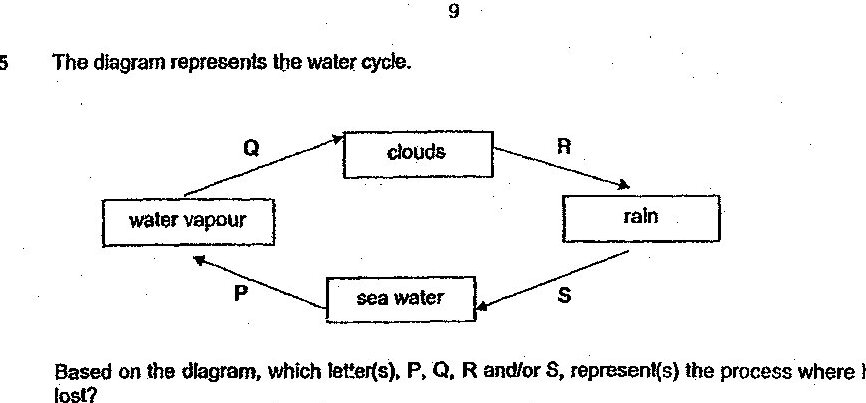
Based on the diagram, which letter(s), P, Q, R and/or S, represent(s) the process where heat is lost?
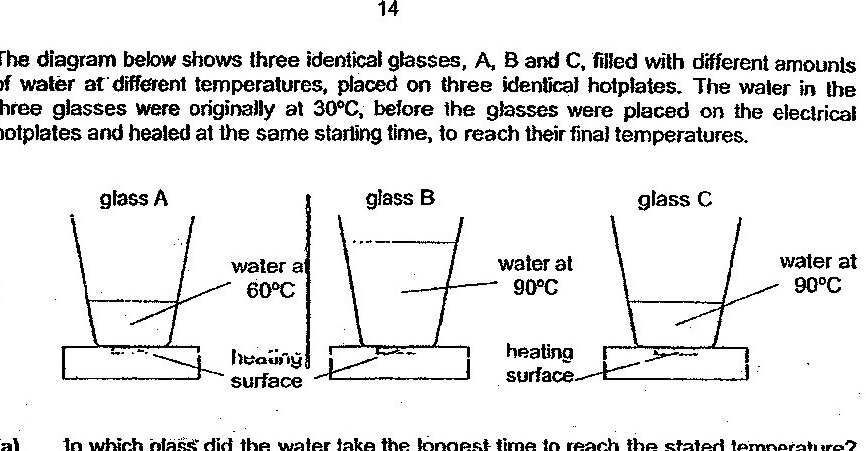
In which glass did the water take the longest time to reach the stated temperature? Explain your answer.
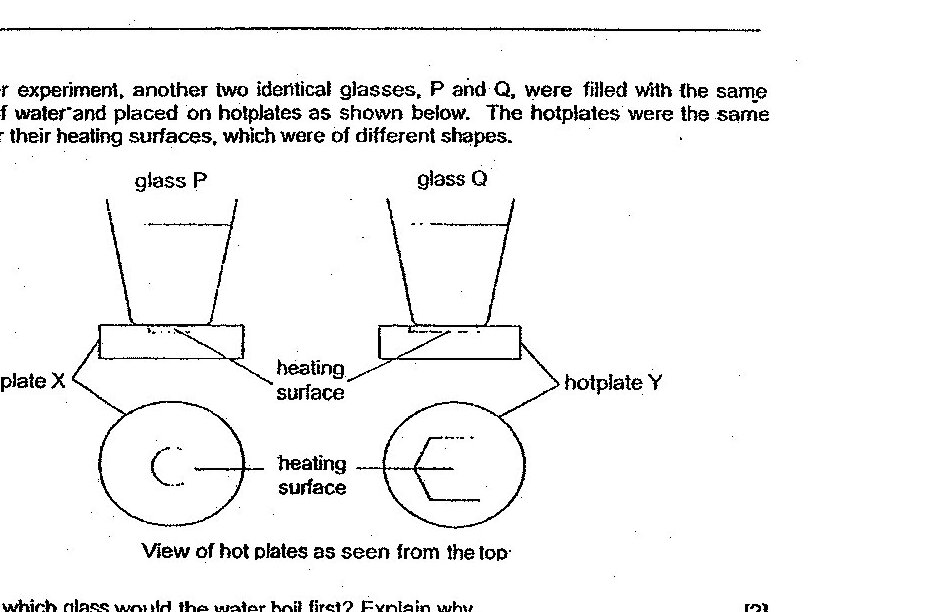
In which glass would the water boil first? Explain why.
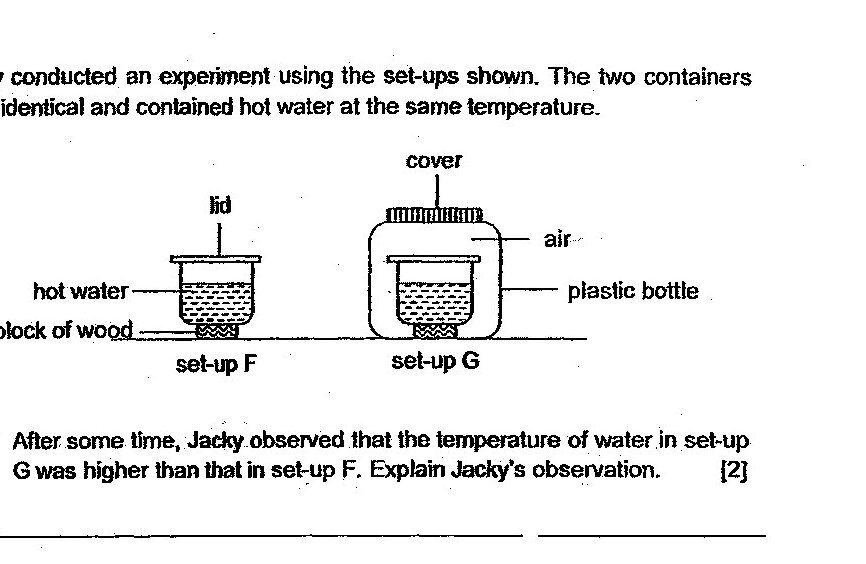
After some time, Jacky observed that the temperature of water in set-up G was higher than that in set-up F. Explain Jacky's observation.
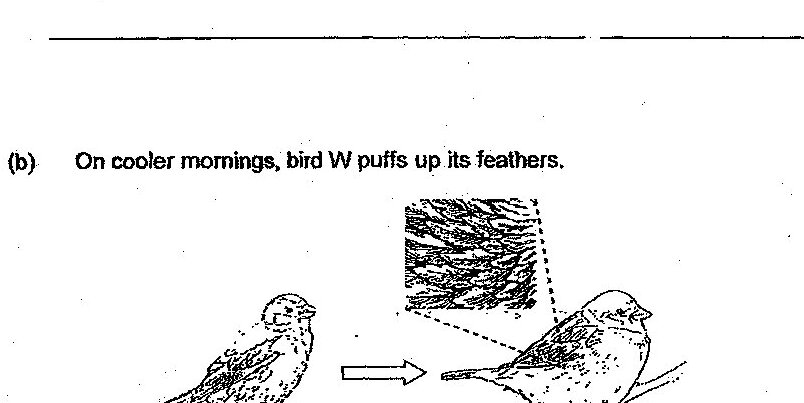
On cooler mornings, bird W puffs up its feathers. Based on the results of Jacky's experiment, explain how puffing up the feathers of bird W would help to keep it warm.
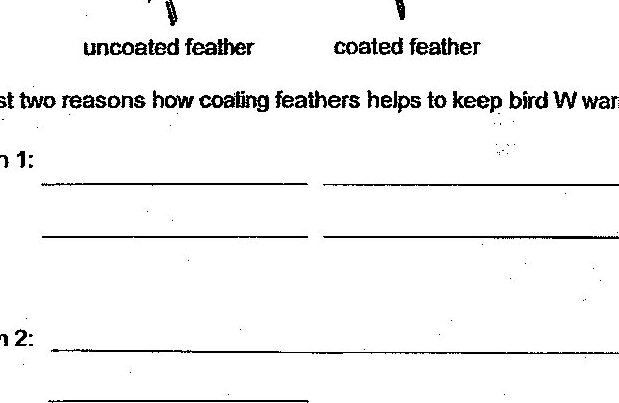
Bird W can coat special oil on its feathers so that they could become waterproof. Suggest two reasons how coating feathers helps to keep bird W warm.
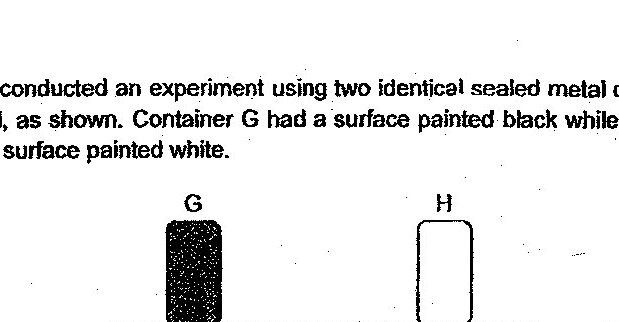
Based on her observation, what could Irene conclude about the difference between the surface of containers G and H?
Irene observed that a building has thick black tiles on the roof. Based on Irene's experiment, explain why it is more likely for the thick black tiles to crack on a very hot day.
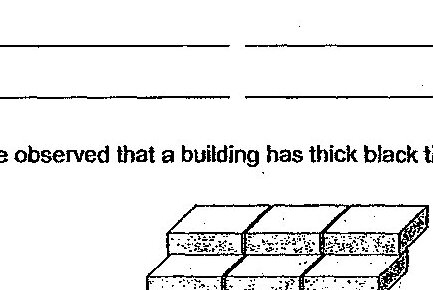
Suggest one change to the roof tiles so that they would not crack easily on a very hot day.
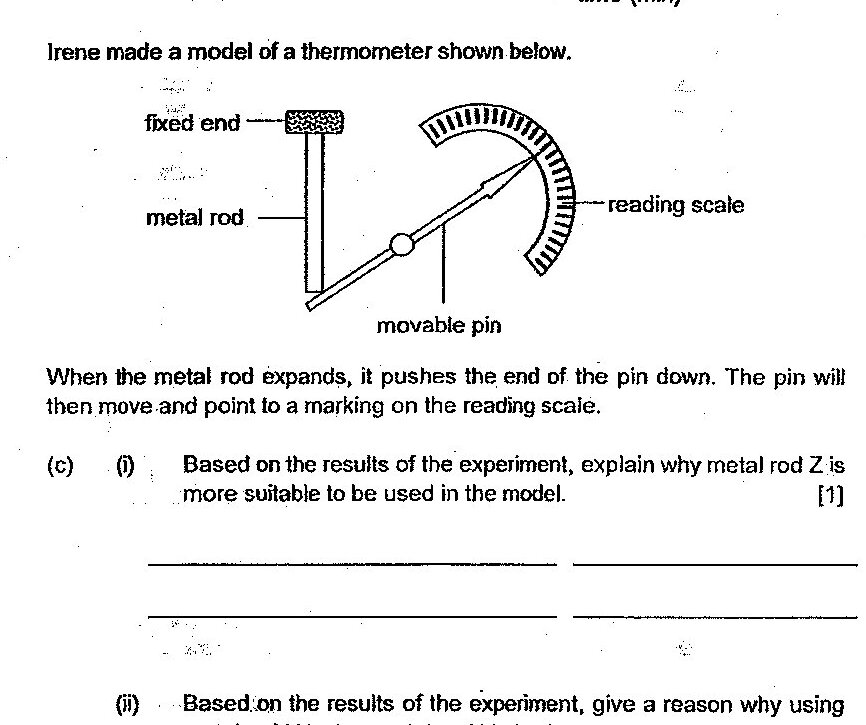
Based on the results of the experiment, explain why metal rod Z is more suitable to be used in the model.
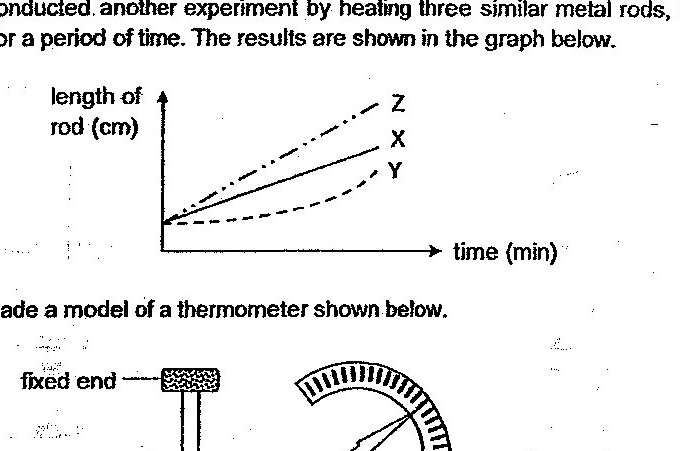
Based on the results of the experiment, give a reason why using metal rod Y in the model would give inaccurate reading.
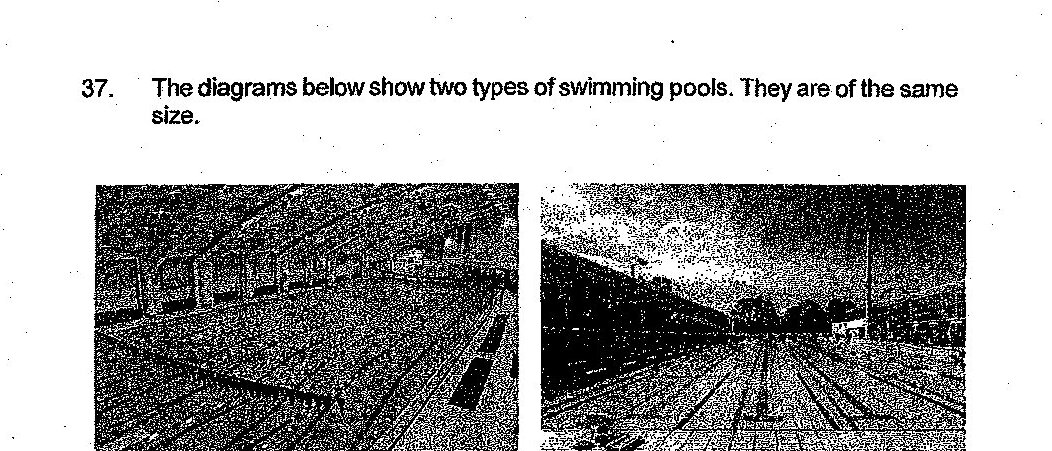
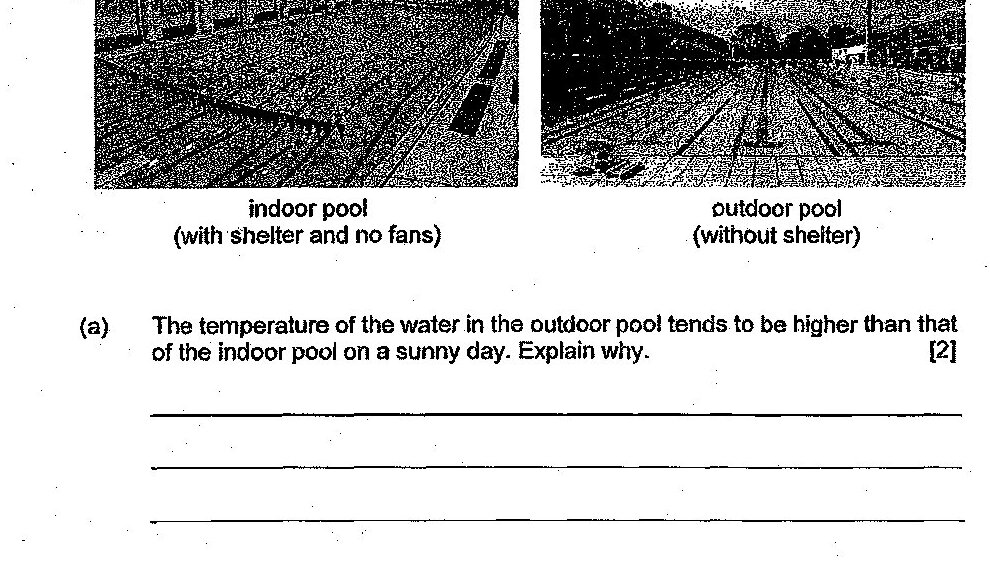
The temperature of the water in the outdoor pool tends to be higher than that of the indoor pool on a sunny day. Explain why.
The water level in the swimming pool needs to be maintained for swimmers to use. The rate at which water needs to be pumped into the outdoor pool is usually higher than the indoor pool. Give two reasons to explain why.
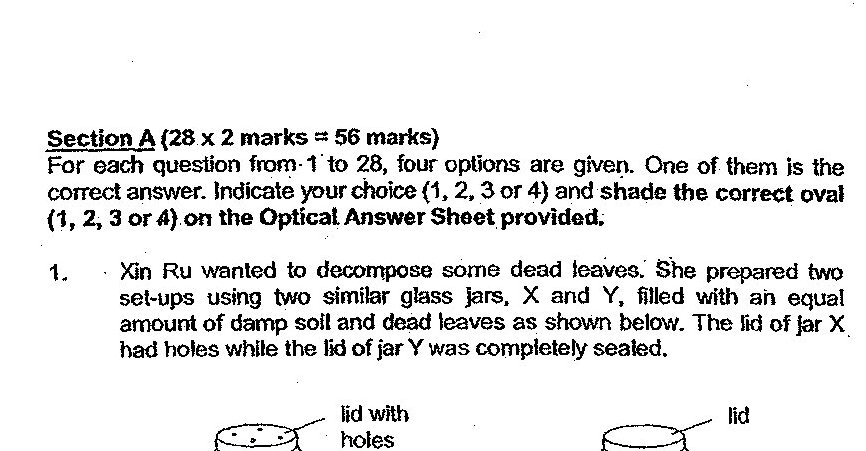
Xin Ru wanted to decompose some dead leaves. She prepared two set-ups using two similar glass jars, X and Y, filled with an equal amount of damp soil and dead leaves as shown below. The lid of jar X had holes while the lid of jar Y was completely sealed. Which of the following is/are the correct observation(s) and explanation(s) after two weeks?
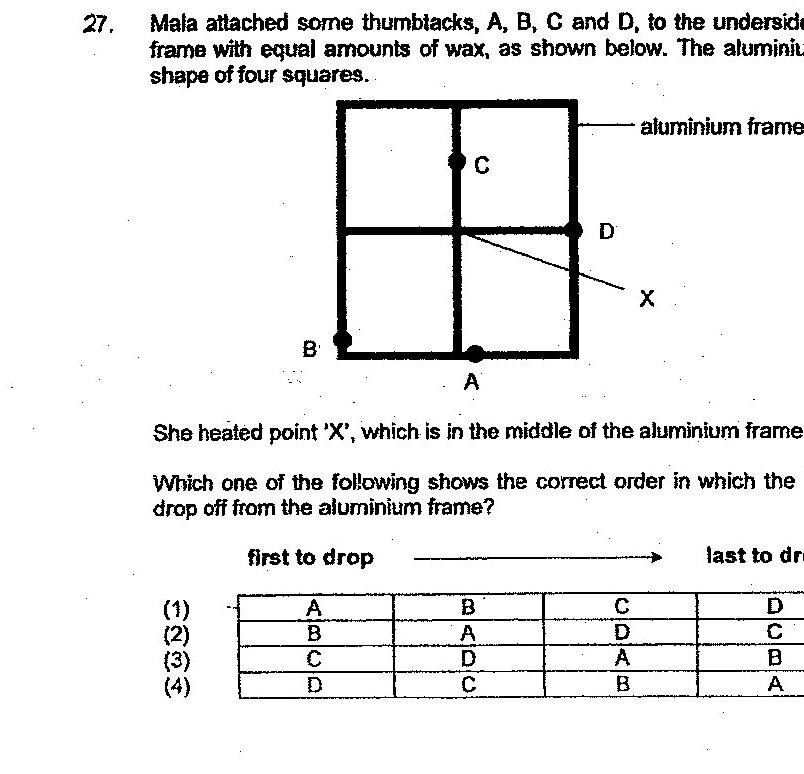
Mala attached some thumbtacks, A, B, C and D, to the underside of an aluminium frame with equal amounts of wax, as shown below. The aluminium frame is in the shape of four squares. She heated point 'X', which is in the middle of the aluminium frame, with a lit candle. Which one of the following shows the correct order in which the thumbtacks would drop off from the aluminium frame?
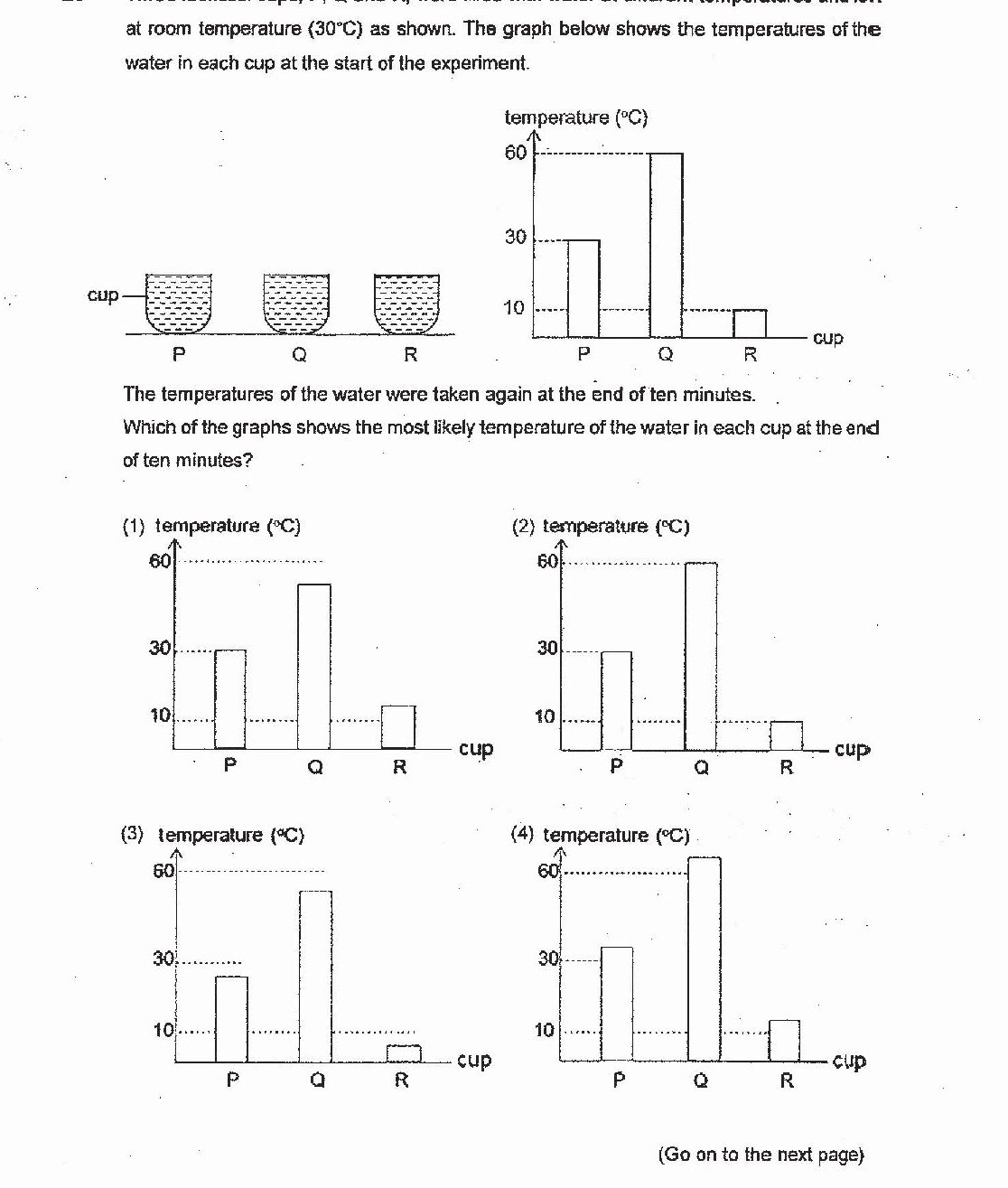
Three identical cups, P, Q and R, were filled with water at different temperatures and left at room temperature (30°C) as shown. The graph below shows the temperatures of the water in each cup at the start of the experiment. The temperatures of the water were taken again at the end of ten minutes. Which of the graphs shows the most likely temperature of the water in each cup at the end of ten minutes?
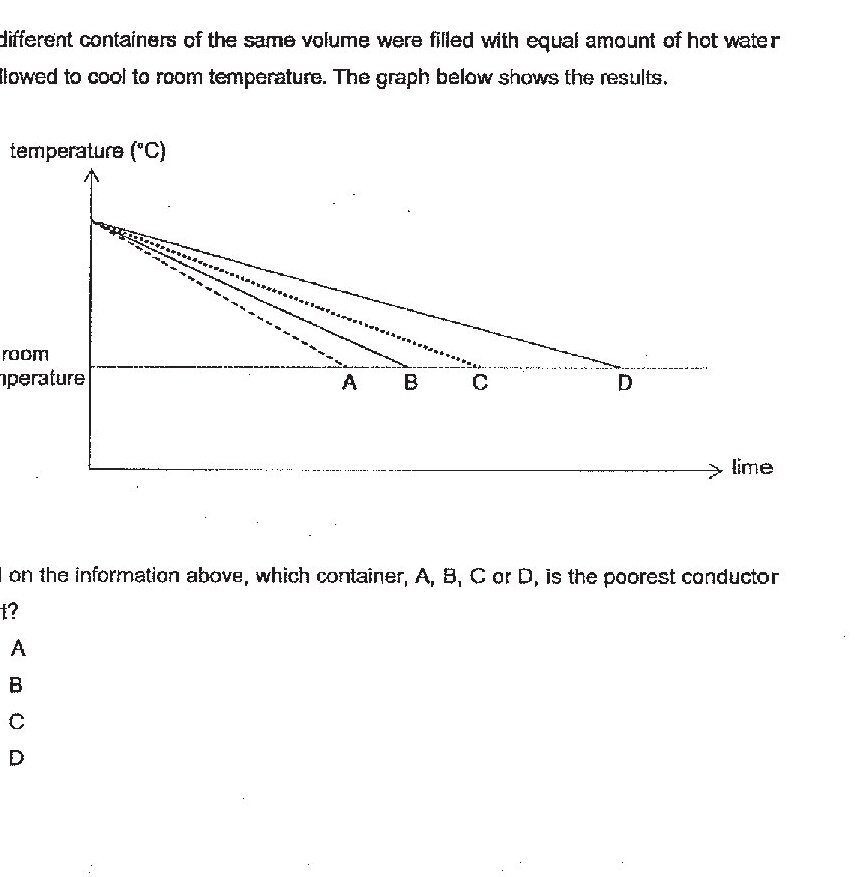
Four different containers of the same volume were filled with equal amount of hot water and allowed to cool to room temperature. The graph below shows the results. Based on the information above, which container, A, B, C or D, is the poorest conductor of heat?
What is the difference between heat and temperature?
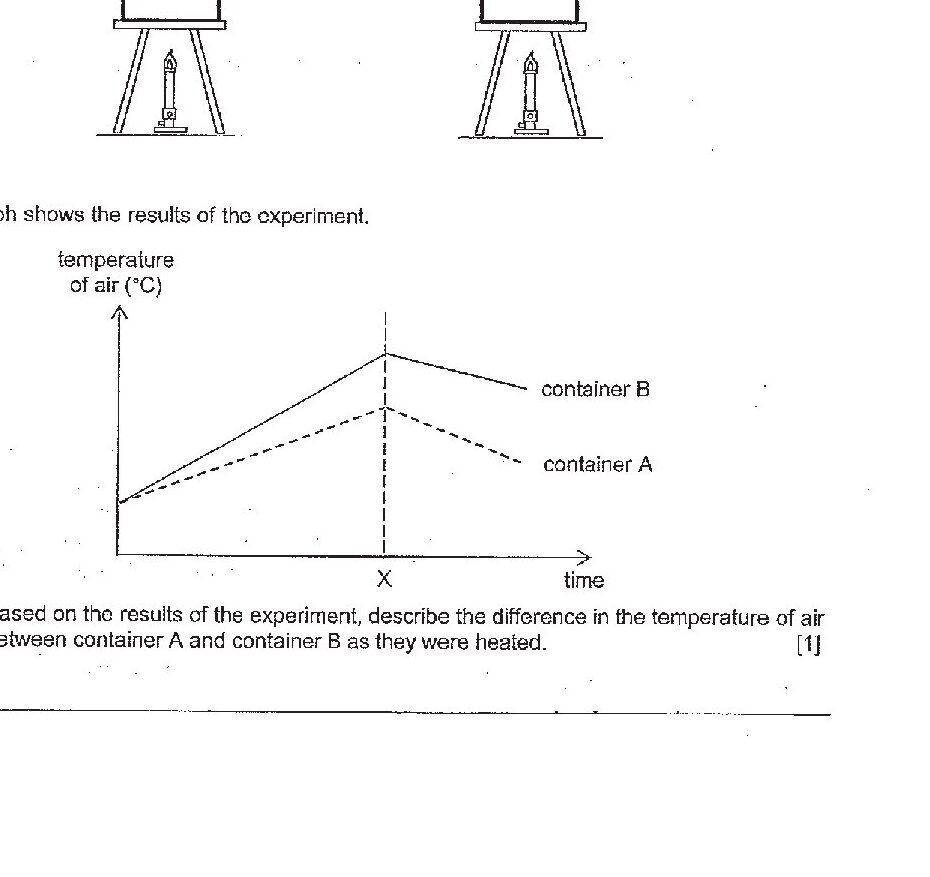
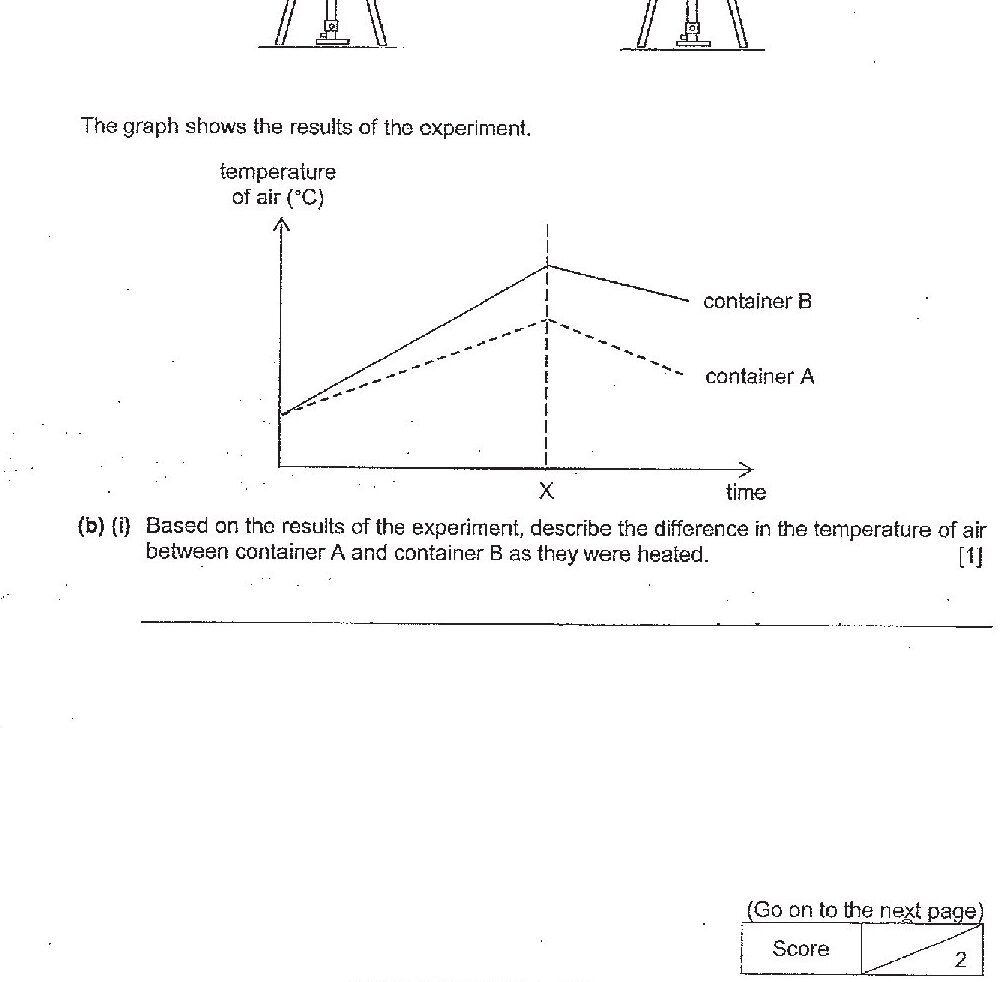
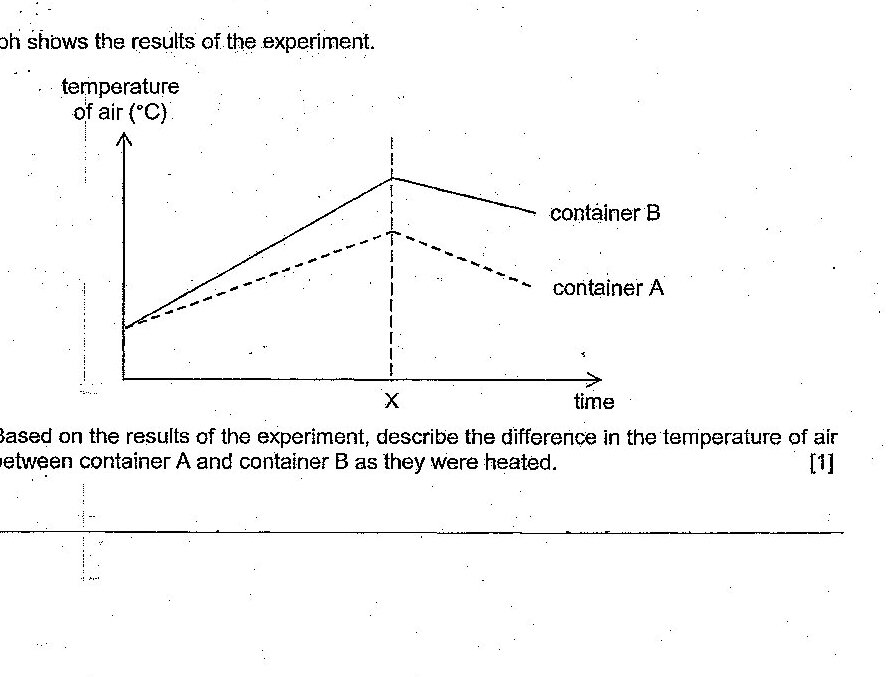
Based on the results of the experiment, describe the difference in the temperature of air between container A and container B as they were heated.
How does the cotton wool result in the difference between the temperatures of air in both containers when they were being heated?
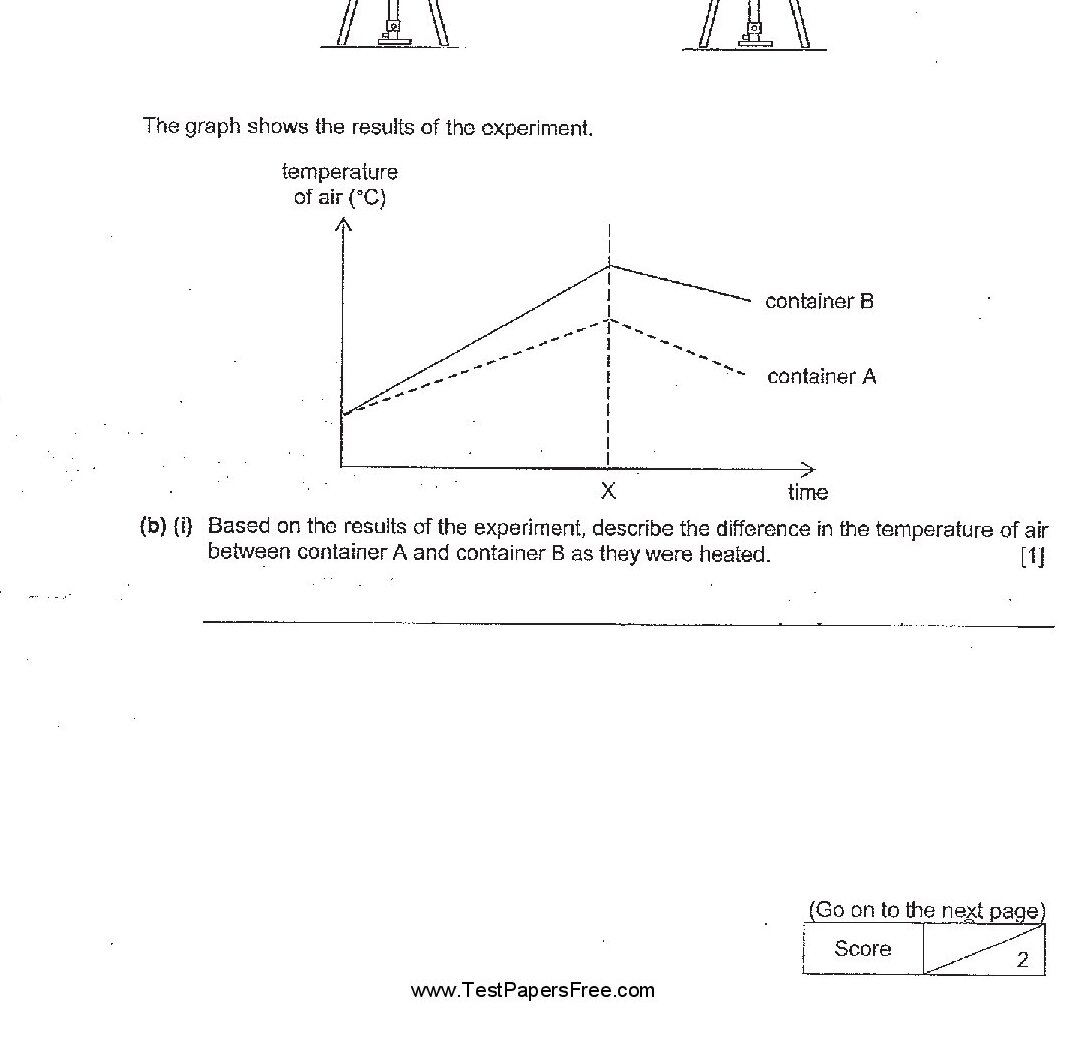
What was done at time X to cause a change in the temperature of air in both the containers?
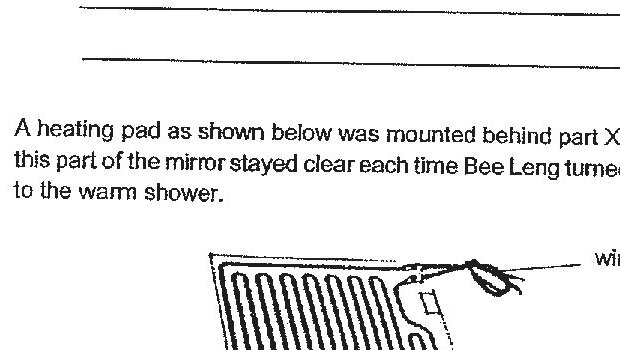
Explain how part Y of the mirror became fogged.
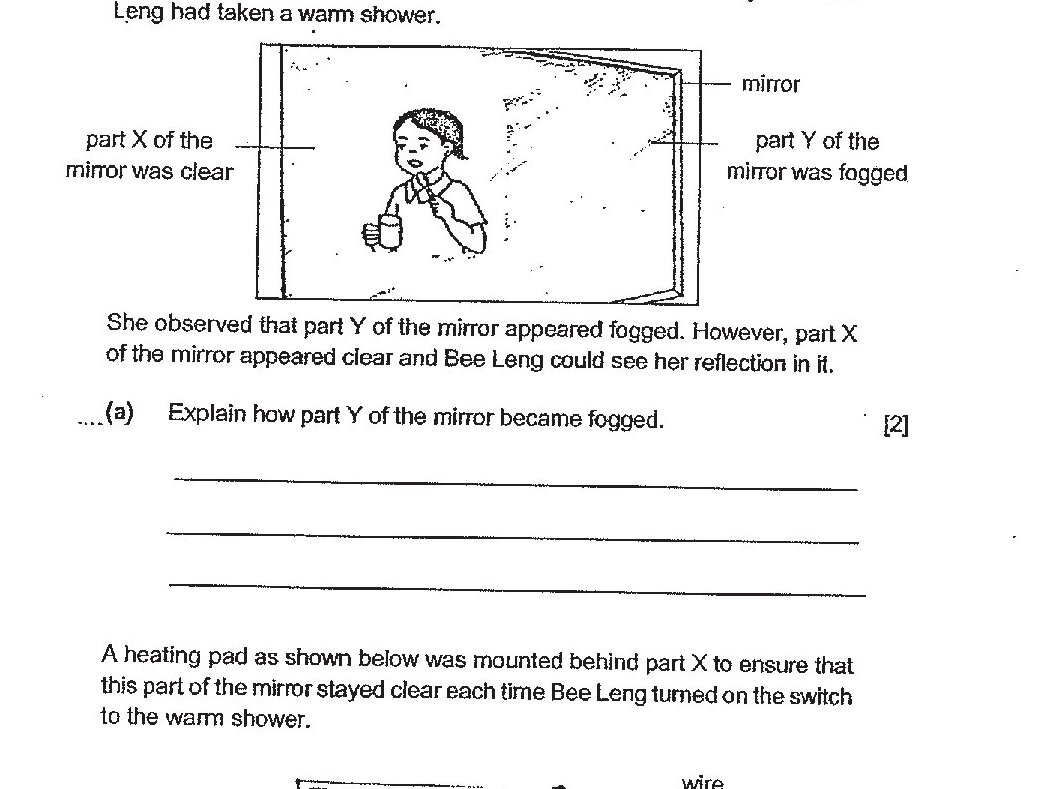
Explain how the heating pad kept part X of the mirror clear when the switch was turned on.
Mrs Lim decided to grill a thicker piece of meat of 200 g at 210°C. Based on her results, would the time require to fully cook this piece of meat be more than, same as or less than 15 minutes?
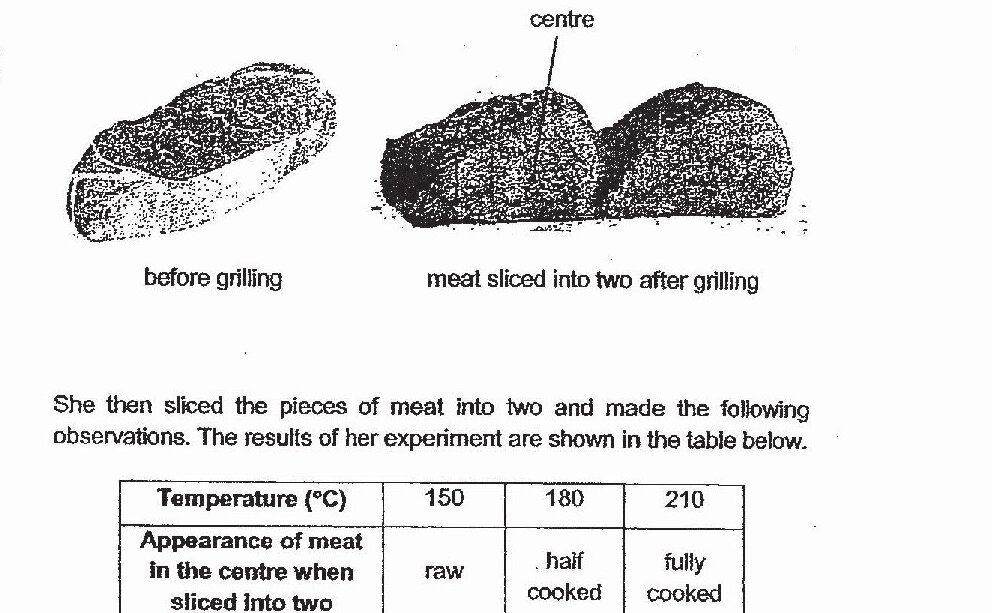
Explain your answer in (a).

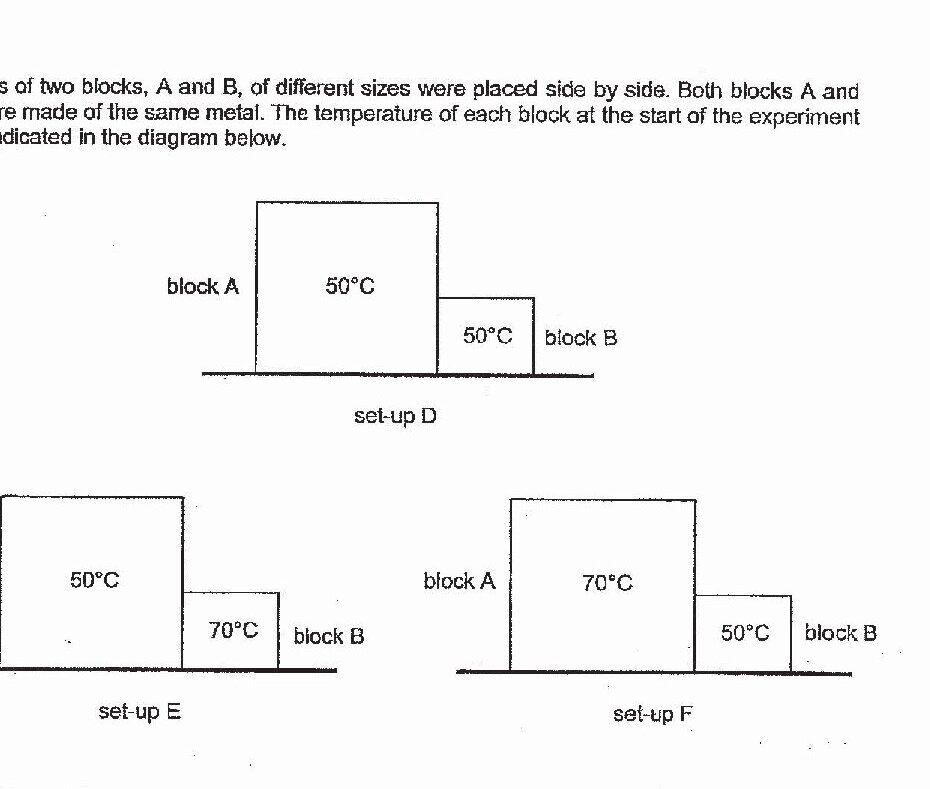
Sets of two blocks, A and B, of different sizes were placed side by side. Both blocks A and B are made of the same metal. The temperature of each block at the start of the experiment is indicated in the diagram below. In which of the set-up(s) will the temperature of block B increase immediately after being placed beside block A?
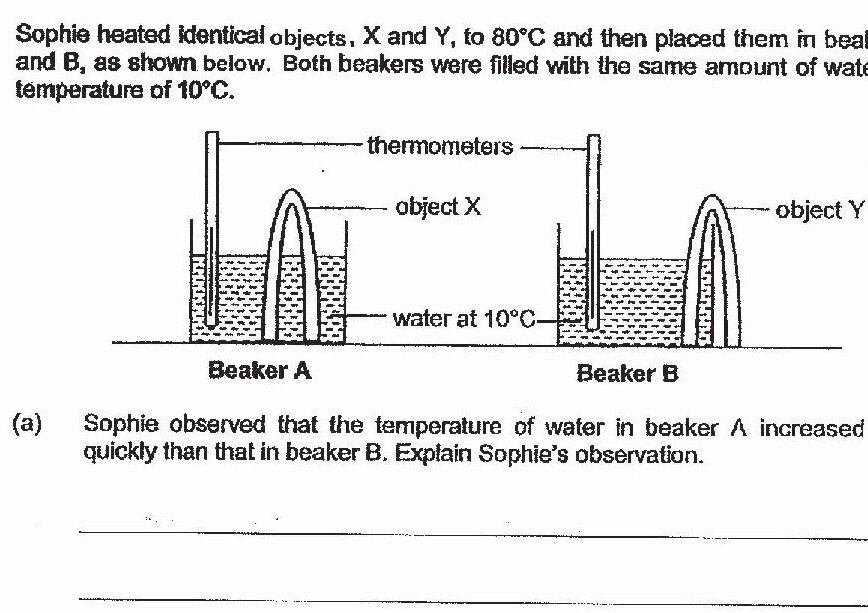
Sophie observed that the temperature of water in beaker A increased more quickly than that in beaker B. Explain Sophie's observation.
Which one of the following is a good conductor of heat?
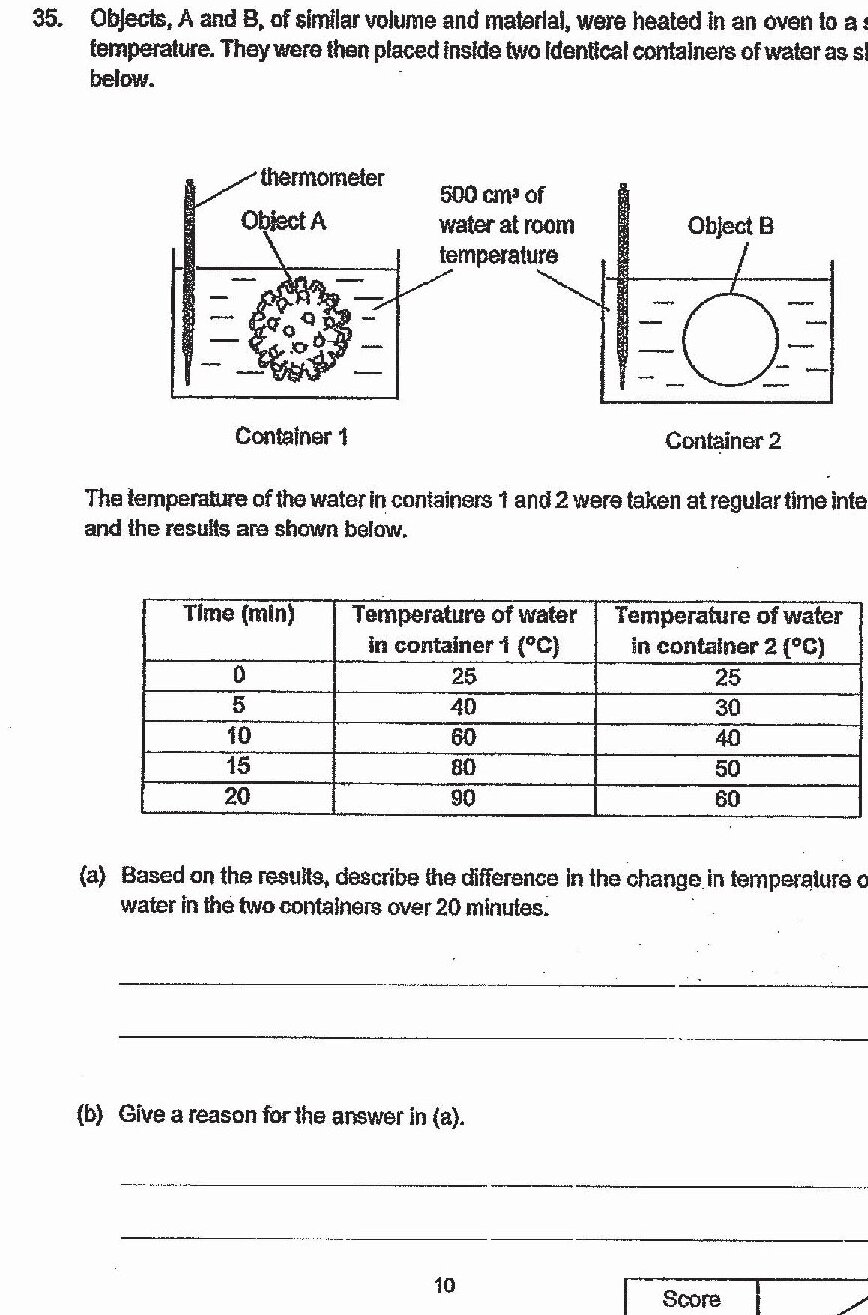
Objects, A and B, of similar volume and material, were heated in an oven to a same temperature. They were then placed inside two identical containers of water as shown below. The temperature of the water in containers 1 and 2 were taken at regular time intervals and the results are shown below. (a) Based on the results, describe the difference in the change in temperature of the water in the two containers over 20 minutes.
What is the difference between heat and temperature?
Past year papers cover the full exam — browse by subject below.
View All Papers ›