Light
Light - PSLE Science Study Notes
Key Concepts
Sources of Light
Natural Sources of Light:
- The Sun - the most important natural source of light for Earth
- Stars - distant suns that produce their own light
- Lightning - electrical discharge in the atmosphere that produces light
- Fireflies - insects that produce light through chemical reactions in their bodies
- Fire - burning materials that give off light and heat
Artificial (Man-made) Sources of Light:
- Light bulbs - including incandescent, fluorescent, and LED bulbs
- Torches/Flashlights - portable light sources using batteries
- Candles - wax burning to produce light
- Television screens and computer monitors - electronic displays
- Lamps - various types of lighting fixtures
Luminous vs Non-luminous Objects:
- Luminous objects - objects that produce and give out their own light (e.g., sun, candles, light bulbs)
- Non-luminous objects - objects that do not produce their own light but can be seen when light reflects off them (e.g., moon, book, table, people)
- The Moon appears bright but is actually non-luminous - it reflects light from the Sun
Key Understanding:
- Light is a form of energy
- Light travels in straight lines
- Light travels extremely fast (fastest thing in the universe)
- We need light to see objects around us
Reflection
What is Reflection?
- Reflection occurs when light bounces off a surface
- All objects reflect light to some degree
- The smoothness and type of surface affects how light reflects
Types of Surfaces:
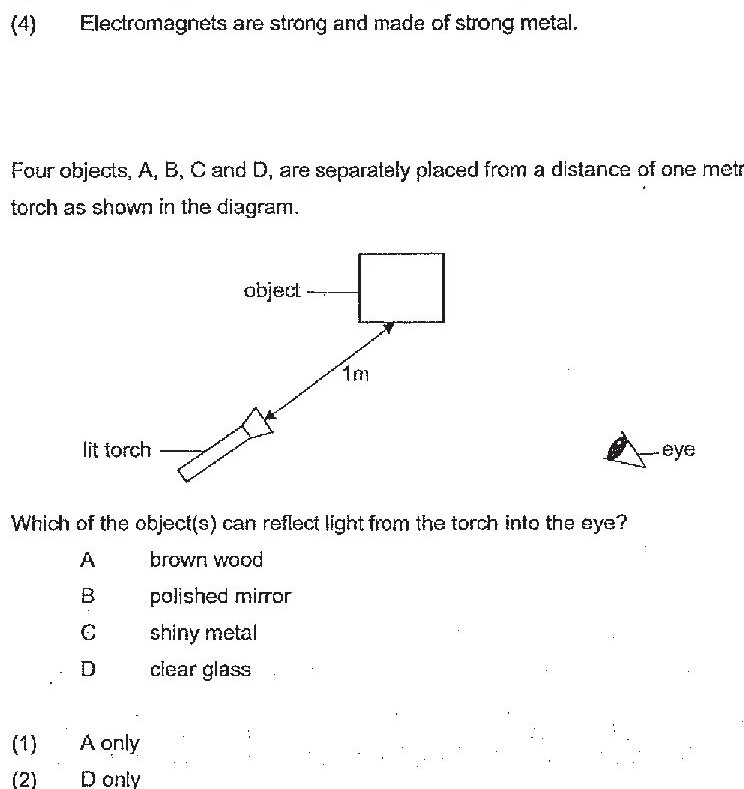
Smooth, Shiny Surfaces (e.g., mirrors, polished metal, still water):
- Reflect light in an organized, predictable way
- Produce clear reflections/images
- This is called regular reflection or specular reflection
Rough, Dull Surfaces (e.g., paper, wood, cloth, walls):
- Reflect light in many different directions
- Do not produce clear reflections
- This is called diffuse reflection or irregular reflection
- We can still see these objects because they reflect light into our eyes
Properties of Reflected Images (in a plane/flat mirror):
- The image is the same size as the object
- The image is upright (not upside down)
- The image is laterally inverted (left and right are reversed)
- The image appears to be the same distance behind the mirror as the object is in front of it
- The image is virtual (cannot be projected onto a screen - it appears to be behind the mirror)
Laws of Reflection:
- The angle of incidence equals the angle of reflection
- The incident ray, reflected ray, and normal (perpendicular line to the surface) all lie in the same plane
- (Note: You need to understand the concept but don’t need to calculate exact angles for PSLE)
Refraction
What is Refraction?
- Refraction is the bending of light when it passes from one medium (material) into another medium of different density
- Light bends because it travels at different speeds in different materials
Key Rules:
- When light travels from a less dense medium to a denser medium (e.g., air to water, air to glass), it bends towards the normal
- When light travels from a denser medium to a less dense medium (e.g., water to air), it bends away from the normal
- If light hits the boundary at 90° (along the normal), it passes straight through without bending
Everyday Examples of Refraction:
- A straw in a glass of water appears bent or broken at the surface — because light from the lower part of the straw bends as it travels from water into air before reaching our eyes
- A swimming pool looks shallower than it really is — because light bends as it exits the water, making the bottom appear closer
- A magnifying glass (lens) uses refraction to focus or bend light rays to make things appear larger
The Normal:
- The normal is an imaginary line drawn perpendicular (at 90°) to the surface at the point where light meets it
- Angles of incidence and refraction are always measured from the normal, not from the surface
Summary:
| Direction of travel | What happens |
|---|---|
| Air → Water (or air → glass) | Light bends toward the normal (angle of refraction < angle of incidence) |
| Water → Air (or glass → air) | Light bends away from the normal (angle of refraction > angle of incidence) |
| Along the normal (90° to surface) | No bending — light goes straight through |
Shadows and Eclipses
How Shadows Form:
- A shadow is formed when an opaque object blocks light
- Light cannot pass through opaque objects, creating a dark area behind them
- Shadows form because light travels in straight lines
- A light source, an opaque object, and a screen/surface are needed to observe a shadow
Types of Materials:
- Opaque materials - do not allow light to pass through (e.g., wood, metal, cardboard, brick) - form dark shadows
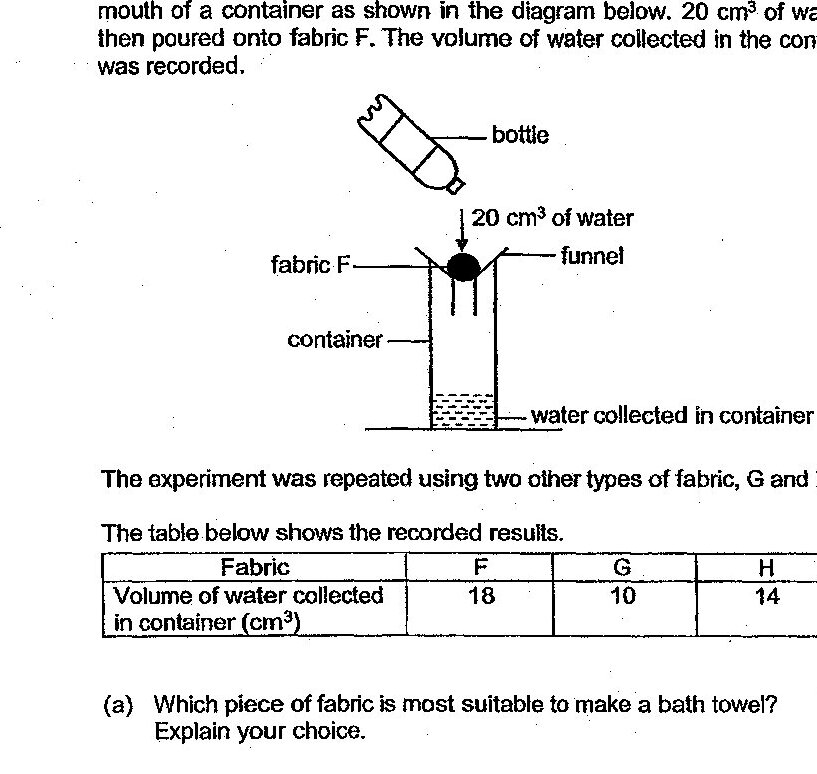
- Transparent materials - allow most light to pass through clearly (e.g., clear glass, clear plastic, air, water) - form no shadow or very faint shadows
- Translucent materials - allow some light to pass through but you cannot see clearly through them (e.g., frosted glass, tissue paper, wax paper, thin cloth) - form lighter, less dark shadows
Degrees of Opacity:
- Opacity is not just yes/no — it exists on a spectrum
- Objects that block more light are more opaque
- Objects that block less light are less opaque (more translucent)
- This can be measured by how much light passes through the object
Characteristics of Shadows:
- Shadows are always on the opposite side of the light source
- Shadows have the same shape as the object (silhouette)
- Shadows do not have color (they are dark/black)
- Shadows do not show surface details like texture or patterns
Shadow Darkness and Material Type: The darkness of a shadow indicates how much light passed through the material. The darker the shadow, the less light was able to pass through the material. Opaque materials produce the darkest (black) shadows because no light passes through. Translucent materials produce lighter (grey) shadows because some light passes through. Transparent materials produce no visible shadow (or a very faint one) because almost all light passes through.
Size of Shadows:
Shadow becomes LARGER when:
- The object moves closer to the light source
- The light source moves closer to the object
- The screen moves further from the object
Shadow becomes SMALLER when:
- The object moves further from the light source
- The light source moves further from the object
- The screen moves closer to the object
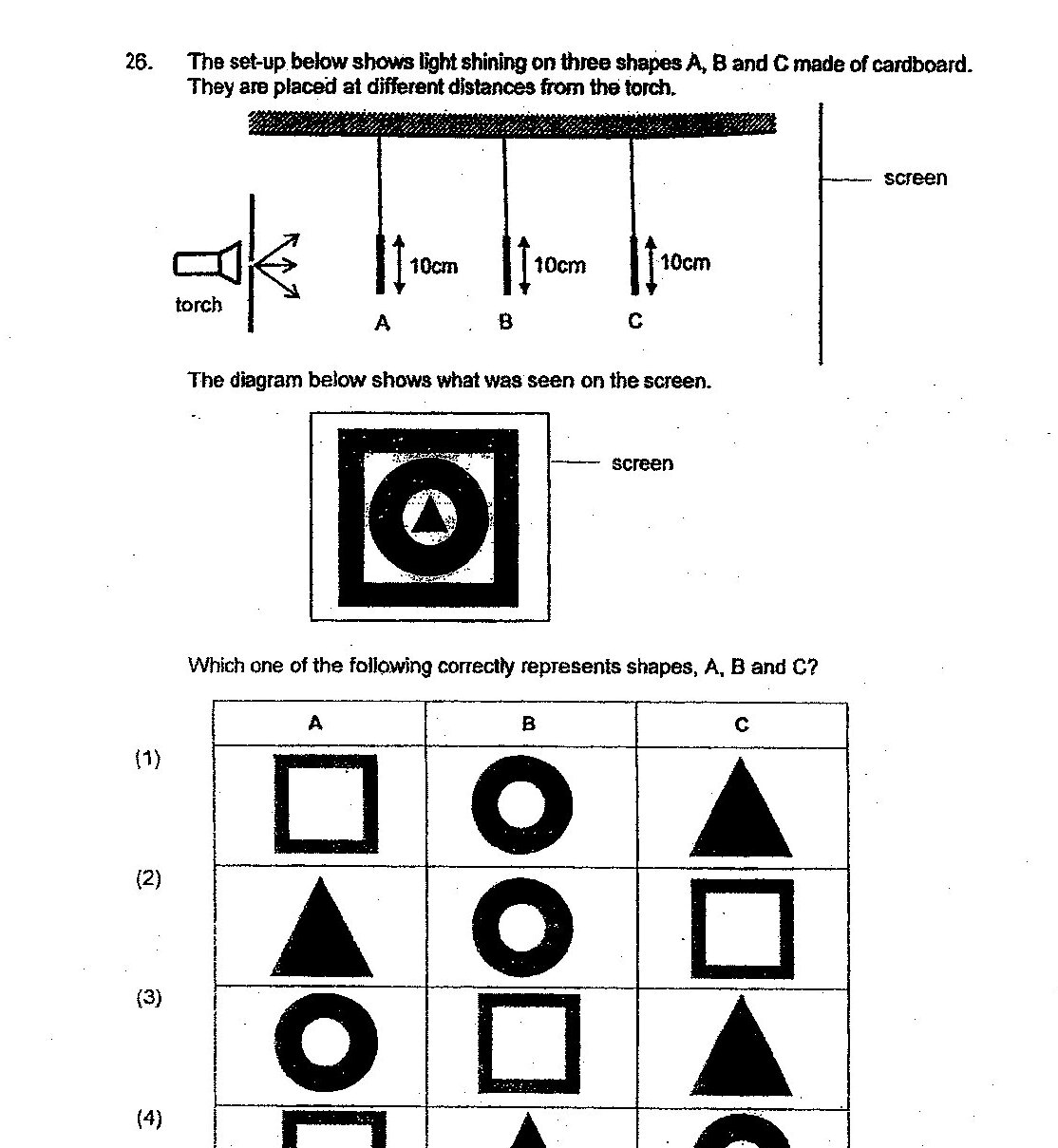
Important: Identical materials at different distances from the light source will produce shadows of different sizes. Shadow size is determined by distance from the light source, not by the material type. Two objects of the same material can cast shadows of very different sizes.
Reading Shadows — Two Independent Clues: Shadow darkness → tells you about the material type (opaque / translucent / transparent). Shadow size → tells you about the object’s distance from the light source. These two properties are independent. Always analyse them separately.
Special Case: Object Moving Along the Ground or Screen
The standard closer/further rules ONLY apply when the object moves toward or away from the torch (i.e., the gap between object and torch changes).
If the object is moving along the ground or along the screen (parallel to the surface), a different rule applies:
- As the object moves further from the torch along the surface, the shadow becomes LONGER, because light rays hit the object at a shallower angle and are projected further along the surface.
- Drawing light rays on a diagram is the best way to see why this happens.
Why Shadow Size Changes — The Mechanism:
- Light rays spread outward from a point/small light source
- When an object is close to the light source, the spreading rays hit it at a wide angle → large shadow
- When an object is far from the light source, the rays are more parallel where they reach the object → small shadow
- Understanding this geometry helps you work out any shadow-size scenario, not just the standard cases
Comparing Shadow Sizes of Different-Shaped Objects:
- Two objects of the same height and width placed at the same distance from a light source do NOT necessarily cast shadows of the same size
- The shape of the object matters: an X-shaped object’s pointed tips/edges can extend further out than a ring of the same overall width, so the X casts a larger shadow
- To identify which object is closest to the light source when multiple shadows are compared, rank all shadows from smallest to largest: the largest shadow = closest object; smallest shadow = furthest object
- Look carefully at whether edges of one shadow extend beyond the outline of another shadow — this “jutting out” is evidence that one shadow is actually larger
Multiple Light Sources:
- When there are two or more light sources, an object can cast multiple shadows
- Each light source creates its own shadow
- Where shadows overlap, the shadow appears darker
Eclipses:
Solar Eclipse (Eclipse of the Sun):
- Occurs when the Moon passes between the Sun and Earth
- The Moon blocks sunlight from reaching part of Earth
- The Moon casts a shadow on Earth
- People in the Moon’s shadow see the Sun partially or completely blocked
- Should NEVER look directly at a solar eclipse - can damage eyes permanently
- Happens during a New Moon phase
Lunar Eclipse (Eclipse of the Moon):
- Occurs when Earth passes between the Sun and Moon
- Earth blocks sunlight from reaching the Moon
- Earth casts a shadow on the Moon
- The Moon appears dark or reddish during the eclipse
- Safe to watch with naked eyes
- Happens during a Full Moon phase
Key Understanding for Eclipses:
- Eclipses happen because light travels in straight lines
- The Sun, Moon, and Earth must be in a straight line (or nearly so)
- Eclipses are special types of shadow formation on a cosmic scale
Sun’s Shadow Throughout the Day
- The Sun’s angle in the sky changes throughout the day
- Morning and evening — the Sun is low in the sky (low angle), so shadows are long
- Noon — the Sun is highest in the sky (most directly overhead), so shadows are shortest
- Shadow length decreases from morning to noon, then increases from noon to evening
- This is caused by the changing angle of sunlight, NOT by the Sun being closer or further from Earth during the day
Light Sensors
- A light sensor measures the amount of light reaching it (light detected)
- A higher reading = more light is passing through or around the object
- A lower reading = more light is being blocked by the object
- Light sensors do NOT measure how much light is blocked directly — they measure light detected
How We See
The Process of Seeing:
- Light source produces or reflects light
- Light travels from the source or reflects off objects
- Light enters the eye through the pupil
- The eye focuses the light
- Light-sensitive cells in the eye detect the light
- Signals are sent to the brain through the optic nerve
- The brain interprets these signals, and we “see” the object
Important Points:
- We see luminous objects when light from them enters our eyes directly
- We see non-luminous objects when light reflects off them and enters our eyes
- We cannot see objects in total darkness because there is no light to reflect off them or to enter our eyes
- Light must enter our eyes for us to see
The Eye and Light:
- The pupil is the opening that allows light to enter the eye
- The pupil appears black because the inside of the eye is dark
- In bright light, the pupil becomes smaller to protect the eye
- In dim light, the pupil becomes larger to allow more light in
Why We See Objects:
- Luminous objects - seen when their light travels directly to our eyes
- Non-luminous objects - seen when light from a source reflects off them and travels to our eyes
- The light reflected from objects carries information about their color, shape, and brightness
- This information is processed by our brain to create the image we see
Conditions Needed to See an Object:
- There must be a light source (natural or artificial)
- Light must travel from the source
- For non-luminous objects, light must reflect off the object
- The reflected or emitted light must enter our eyes
- Our eyes and brain must process the information
Important Definitions
Light: A form of energy that allows us to see; travels in straight lines
Luminous object: An object that produces and gives out its own light (e.g., sun, stars, light bulbs, candles, fire)
Non-luminous object: An object that does not produce its own light but can be seen when light reflects off it (e.g., moon, book, table, people)
Reflection: The bouncing of light off a surface
Regular reflection: Reflection from smooth, shiny surfaces that produces clear images (e.g., mirrors)
Diffuse reflection: Reflection from rough surfaces that scatters light in many directions; does not produce clear images
Opaque material: A material that does not allow light to pass through (e.g., wood, metal, cardboard)
Transparent material: A material that allows light to pass through clearly (e.g., clear glass, water, air)
Translucent material: A material that allows some light to pass through but objects cannot be seen clearly through it (e.g., frosted glass, tissue paper)
Shadow: A dark area formed when an opaque object blocks light
Solar eclipse: An event when the Moon passes between the Sun and Earth, blocking sunlight from reaching Earth; the Moon casts a shadow on Earth
Lunar eclipse: An event when Earth passes between the Sun and Moon, blocking sunlight from reaching the Moon; Earth casts a shadow on the Moon
Lateral inversion: The reversal of left and right in a mirror image
Virtual image: An image that appears to be behind the mirror and cannot be projected onto a screen
Worked Examples
Example 1: Identifying Luminous and Non-luminous Objects
Question: Classify the following objects as luminous or non-luminous: television screen (switched on), book, Moon, torch (switched on), mirror
Step-by-step solution:
Step 1: Remember the definition
- Luminous objects produce their own light
- Non-luminous objects do not produce their own light
Step 2: Analyze each object
Television screen (switched on):
- Produces its own light through electronic display
- Answer: Luminous
Book:
- Does not produce its own light
- We see it because light reflects off it
- Answer: Non-luminous
Moon:
- This is a common trick question!
- The Moon appears bright, but it does not produce its own light
- It only reflects light from the Sun
- Answer: Non-luminous
Torch (switched on):
- Produces its own light using batteries
- Answer: Luminous
Mirror:
- Does not produce light; only reflects it
- Answer: Non-luminous
Example 2: Predicting Shadow Size
Question: Sarah places a ball between a lamp and a wall. The ball is 20 cm from the lamp and 80 cm from the wall. She then moves the ball to 40 cm from the lamp and 60 cm from the wall. What happens to the size of the shadow?
Step-by-step solution:
Step 1: Understand the initial position
- Ball is 20 cm from lamp (close to light source)
- Ball is 80 cm from wall (far from screen)
- This creates a LARGE shadow
Step 2: Understand the new position
- Ball moves to 40 cm from lamp (further from light source than before)
- Ball is 60 cm from wall (closer to screen than before)
Step 3: Apply the rule
- When object moves further from light source → shadow becomes smaller
- When object moves closer to screen → shadow becomes smaller
- Both changes work together!
Step 4: Conclusion Answer: The shadow becomes smaller.
Full explanation for exam: “The shadow becomes smaller because the ball has moved further away from the lamp (light source) and closer to the wall (screen). When an object moves further from the light source, its shadow becomes smaller. Additionally, when an object moves closer to the screen, its shadow also becomes smaller. Therefore, the shadow will be smaller than before.”
Example 3: Understanding Eclipses
Question: During a lunar eclipse, explain: (a) The positions of the Sun, Earth, and Moon (b) Why the Moon appears dark © Whether it is safe to view directly with our eyes
Step-by-step solution:
(a) Positions:
Step 1: Recall what a lunar eclipse is
- “Lunar” refers to the Moon
- In a lunar eclipse, Earth’s shadow falls on the Moon
Step 2: Determine the arrangement
- The Sun must be the light source
- Earth must be in the middle to cast a shadow
- The Moon must be in Earth’s shadow
Answer for (a): “The Sun, Earth, and Moon are arranged in a straight line, with Earth in the middle. The order is: Sun → Earth → Moon”
(b) Why the Moon appears dark:
Step 1: Understand shadow formation
- Shadows form when light is blocked
Step 2: Apply to lunar eclipse
- Earth blocks the Sun’s light
- The Moon is in Earth’s shadow
- Little or no sunlight reaches the Moon
Answer for (b): “The Moon appears dark because Earth blocks the Sun’s light from reaching the Moon. Earth casts a shadow on the Moon, so the Moon cannot reflect sunlight back to us on Earth.”
© Safety:
Step 1: Consider the light source
- During a lunar eclipse, we are looking at the Moon
- The Sun’s light is blocked from reaching the Moon
- We are not looking directly at the Sun
Answer for ©: “Yes, it is safe to view a lunar eclipse directly with our eyes because we are looking at the Moon, not the Sun. Earth is blocking the Sun’s light from reaching the Moon, so there is no risk of eye damage.”
Note: For solar eclipse, the answer would be different - NEVER safe to look directly at the Sun!
Common Mistakes to Avoid
Mistake 1: Confusing Luminous and Non-luminous Objects
❌ Wrong: “The Moon is luminous because it is bright at night.” ✓ Correct: “The Moon is non-luminous because it does not produce its own light. It only reflects light from the Sun.”
- Remember: Brightness doesn’t mean luminous! The Moon, mirrors, and white surfaces can be bright but are non-luminous.
Mistake 2: Saying Shadows Have Colour
❌ Wrong: “The shadow of a red ball is red.” ✓ Correct: “Shadows are always dark/black regardless of the object’s color. A shadow is an area where light is blocked.”
- Remember: Shadows are the ABSENCE of light, so they have no color.
Mistake 3: Wrong Eclipse Positions
❌ Wrong: “In a solar eclipse, Earth is between the Sun and Moon.” ✓ Correct: “In a solar eclipse, the Moon is between the Sun and Earth.”
- Tip: SOLAR eclipse = Sun is blocked (Moon blocks it)
- LUNAR eclipse = Moon appears dark (Earth blocks sunlight to it)
Mistake 4: Shadow Size Rules Reversed
❌ Wrong: “When an object moves closer to the light source, the shadow becomes smaller.” ✓ Correct: “When an object moves closer to the light source, the shadow becomes larger.”
- Remember: Think of hand shadow puppets - move your hand closer to the torch, shadow gets BIGGER!
Mistake 5: How We See Objects
❌ Wrong: “We see objects because light from our eyes hits the objects.” ✓ Correct: “We see objects when light reflects off them and enters our eyes.”
- Remember: Light goes INTO our eyes, not OUT of our eyes.
Mistake 6: Properties of Mirror Images
❌ Wrong: “The image in a mirror is smaller than the object.” ✓ Correct: “The image in a plane mirror is the same size as the object.”
- Remember: Also mention it is laterally inverted and the same distance behind the mirror.
Mistake 7: Transparent vs Translucent
❌ Wrong: “Frosted glass is transparent because light passes through it.” ✓ Correct: “Frosted glass is translucent because some light passes through but you cannot see clearly through it.”
- Remember:
- Transparent = see CLEARLY through (clear glass, water)
- Translucent = light passes but CANNOT see clearly (frosted glass, tissue paper)
Mistake 8: Materials That Form Shadows
❌ Wrong: “Transparent and translucent materials form dark shadows.” ✓ Correct: “Only opaque materials form dark shadows. Transparent materials form no shadow or very faint shadows. Translucent materials form lighter shadows.”
Mistake 9: Virtual Images Can Be Projected
❌ Wrong: “You can project a mirror image onto a screen.” ✓ Correct: “Mirror images are virtual - they appear to be behind the mirror and cannot be projected onto a screen.”
Mistake 10: Incomplete Explanations for “How We See”
❌ Wrong: “Light reflects off the object.” ✓ Correct: “Light from the source reflects off the object and enters our eyes. Our brain then interprets this to form an image.”
- Remember: Always complete the process - mention that light must enter the eye!
Mistake 11: Applying Standard Shadow Rules When Object Moves Along the Ground or Screen
❌ Wrong: “When the ball rolls away from the torch along the ground, the shadow gets smaller because the ball is further from the torch.” ✓ Correct: “When the ball rolls away from the torch along the ground, the shadow gets LONGER because light rays hit the ball at a shallower angle, projecting the shadow further along the surface.”
- Remember: Standard closer/further rules apply only when the object moves directly toward or away from the torch. When the object moves along the ground or screen, use the surface-movement rule or draw a ray diagram.
Mistake 12: Not Recognising the Trigger to Switch Shadow Rules
❌ Wrong: Automatically using the standard shadow rule for every shadow question. ✓ Correct: First check whether the object is moving (a) toward/away from the torch → use standard rule, or (b) along the ground/screen → use surface-movement rule and/or draw light rays.
Mistake 13: Explaining Sun-Shadow Length by Distance from Earth
❌ Wrong: ‘At noon the Sun is furthest from Earth, so shadows are shorter.’ ✓ Correct: ‘At noon the Sun is at its highest angle in the sky (most overhead), so its rays hit the ground most directly, creating the shortest shadows. The Sun’s distance from Earth does not change significantly during a single day.’
- Remember: Always explain shadow length using the angle of the Sun, not distance.
Mistake 14: Missing Critical Keywords in Questions
❌ Wrong: Answering ‘which object can be seen’ when the question asks ‘which object cannot be seen’. ✓ Correct: Highlight keywords like ‘cannot’, ‘largest’, ‘smallest’, ‘explain’, ‘suggest’ before writing your answer — these words change what the question is asking entirely.
- Remember: One missed keyword can make your entire answer wrong even if the science is correct.
Mistake 15: Confusing What a Light Sensor Measures
❌ Wrong: ‘The light sensor reads how much light is blocked by the object.’ ✓ Correct: ‘The light sensor reads how much light is detected (reaching the sensor). A lower reading means more light is being blocked; a higher reading means more light is getting through.’
- Remember: Sensors measure what they receive, not what is taken away.
Mistake 16: Stating the Shadow Rule Without Explaining the Mechanism
❌ Wrong: ‘As the object moves closer to the light source, the shadow becomes larger.’ ✓ Correct: ‘As the object moves closer to the light source, the shadow becomes larger because light rays spread outward from the source. When the object is closer, it intercepts the rays at a wider spread, projecting a larger shadow on the screen.’
- Remember: State the relationship AND explain why using the spreading of light rays.
Mistake 17: Assuming Same Shadow Darkness Means Same Shadow Size
❌ Wrong: “Both shadows are the same shade of grey, so they must be the same size.” ✓ Correct: Shadow darkness and shadow size are independent. Two objects of the same material (same shadow darkness) can produce different shadow sizes if they are at different distances from the light source.
- Remember: Darkness = material type. Size = distance from light source.
Mistake 18: Concluding Distance from Shadow Size Without Checking Material Type
❌ Wrong: “Shadow A is larger than Shadow B, so object A is closer to the light source.” ✓ Correct: You can only compare shadow sizes to determine distance when the objects are made of the same material. If the materials are different, the shadow size difference may be caused by material type, not distance.
- Remember: Always confirm the materials are the same before drawing conclusions about distance from shadow size.
Mistake 19: Assuming Two Similar-Looking Shadows Are the Same Size
❌ Wrong: “The two shadows look the same size, so the objects must be at the same distance from the light source.” ✓ Correct: “Check the exact outlines carefully. The examiner may deliberately make shadows appear similar as a trap. Look for edges that extend beyond the other shadow.”
- Remember: When a question presents shadows that look the same, this is often the examiner’s trick — inspect the outlines more carefully.
Mistake 20: Missing the “Jutting Out” Edge in Shadow Comparisons
❌ Wrong: “The X-shadow and ring shadow look the same size, so they are equal.” ✓ Correct: “Look at whether any corners or tips of the X-shadow extend beyond the ring shadow’s circular boundary. If they do, the X-shadow is larger.”
- Remember: Focus on the specific edges or protruding points, not just the overall impression of size.
Mistake 21: Not Ranking Shadows Before Identifying Positions
❌ Wrong: Immediately guessing which object is closest/furthest without comparing all shadows. ✓ Correct: Arrange all shadows from smallest to largest first, then match: smallest shadow = furthest from light source; largest shadow = closest to light source.
- Remember: Always rank before concluding!
Exam Tips
For “Sources of Light” Questions:
Keywords to use:
- “produces its own light” (for luminous)
- “does not produce its own light” (for non-luminous)
- “reflects light” (for non-luminous)
Mark-earning phrases:
- “Luminous objects such as the Sun/light bulbs/candles produce and give out their own light.”
- “Non-luminous objects such as the Moon/books/mirrors do not produce their own light but reflect light from other sources.”
For “Reflection” Questions:
Keywords to use:
- “smooth surface” / “rough surface”
- “regular reflection” / “diffuse reflection”
- “same size”, “laterally inverted”, “same distance behind mirror”
- “virtual image”
When describing mirror images, always mention:
- Same size as object
- Upright (not upside down)
- Laterally inverted (left-right reversed)
- Same distance behind mirror as object is in front
- Virtual (cannot be captured on screen)
Mark-earning phrases:
- “Smooth, shiny surfaces like mirrors reflect light in an organized way to produce clear images.”
- “Rough surfaces scatter light in many directions, so no clear image is formed.”
For “Shadows” Questions:
Keywords to use:
- “opaque object blocks light”
- “light travels in straight lines”
- “opposite side of light source”
- “same shape as object”
- “no color” / “dark” / “black”
When shadow size changes:
- ALWAYS state whether shadow becomes “larger” or “smaller”
- ALWAYS explain WHY with distance relationships
Mark-earning phrases for shadow size:
- “The shadow becomes larger because the object is moved closer to the light source.”
- “The shadow becomes smaller because the object is moved further from the light source.”
- “When the object moves closer to the light source and further from the screen, the shadow becomes larger.”
For multiple light sources:
- “When there are two light sources, two shadows are formed, one from each light source.”
Check the condition first:
- If the object moves toward or away from the torch: use the standard closer = bigger, further = smaller rule.
- If the object moves along the ground or screen: do NOT use the standard rule. Draw light rays to show the change in shadow length.
For surface-movement questions, draw a ray diagram showing light rays from the torch past the object to the ground — compare where the outermost ray lands at two different object positions.
Always state the change (longer/shorter/larger/smaller) and explain WHY with the correct reasoning for the scenario.
When comparing shadows in an experiment (two or more setups):
- Compare shadow darkness first → determine material type (darker = more opaque, lighter = more translucent, no shadow = transparent)
- Compare shadow sizes next → determine distance from light source (larger shadow = closer to light source), but only when both objects are the same material
- Always state the reason explicitly: “The shadow is larger because the object is closer to the light source.” Do not just state the observation — give the cause.
- Use precise scientific terms: opaque, translucent, transparent. Do not say “dark material” or “see-through stuff”.
When comparing multiple shadows to identify object positions:
- Step 1: Arrange all shadows from smallest to largest
- Step 2: Match positions — largest shadow = object closest to light source; smallest shadow = object furthest from light source
- Step 3: If two shadows appear the same size, look carefully at the outlines — check whether any edges or corners of one shadow “jut out” beyond the boundary of the other
- Step 4: The shadow whose edges extend beyond the other is the larger shadow, meaning that object is closer to the light source
When shadows look the same size (examiner trap):
- This is a common exam trick — the examiner deliberately draws shadows that appear identical
- Do NOT conclude they are equal without checking the fine details of the outlines
- Look for protruding tips, corners, or edges that extend past the other shadow’s boundary
For “Eclipse” Questions:
For Solar Eclipse:
- Position: “Sun → Moon → Earth” or “Moon is between Sun and Earth”
- What happens: “Moon blocks sunlight from reaching Earth” OR “Moon casts shadow on Earth”
- What we see: “Sun appears partially or completely blocked”
- Safety: “NEVER look directly at solar eclipse - can cause permanent eye damage”
For Lunar Eclipse:
- Position: “Sun → Earth → Moon” or “Earth is between Sun and Moon”
- What happens: “Earth blocks sunlight from reaching Moon” OR “Earth casts shadow on Moon”
- What we see: “Moon appears dark or reddish”
- Safety: “Safe to view directly with naked eyes”
Mark-earning phrases:
- “A solar eclipse occurs when the Moon passes between the Sun and Earth, blocking sunlight from reaching Earth.”
- “A lunar eclipse occurs when Earth passes between the Sun and Moon, blocking sunlight from reaching the Moon.”
For “How We See” Questions:
Always describe the complete process:
- Light source (state what it is)
- Light travels / reflects
- Light enters our eyes
- Brain interprets
Mark-earning phrases:
- For luminous objects: “Light from the luminous object (e.g., candle) travels directly to our eyes.”
- For non-luminous objects: “Light from the source reflects off the non-luminous object and enters our eyes.”
- Always end with: “Our brain interprets this light, allowing us to see the object.”
Never say:
- “Light comes from our eyes” ❌
- “We see because there is light” (too vague - explain the full process) ❌
General Exam Tips:
-
Draw clear diagrams:
- Use ruler for straight lines (light rays, mirrors)
- Label all parts clearly
- Use arrows to show direction of light
-
Use scientific terms correctly:
- Don’t say “shiny material” - say “smooth, shiny surface”
- Don’t say “see-through” - say “transparent”
-
For 2-mark questions: Usually need TWO points or one point with explanation
-
For comparison questions: Make direct comparisons
- “Object A is luminous while Object B is non-luminous”
- Not just: “Object A is luminous” (incomplete)
-
Read carefully:
- “Suggest” = give reasonable answers
- “State” = brief answer
- “Explain” = must give reasons
-
For practical questions:
- Consider what is changed (variable)
- Consider what stays the same (controlled variables)
- State clear observations
7. Highlight keywords before writing: Before writing any answer, underline or circle key words in the question — especially ‘cannot’, ‘largest’, ‘smallest’, ‘explain’, ‘suggest’, ‘name one’. These words define exactly what is being asked.
8. For sun/shadow time-of-day questions: Always connect shadow length to the angle of the sun in the sky, never to the sun’s distance from Earth. Use phrases like: ‘At noon, the Sun is at its highest angle (most overhead), so shadows are shortest.’ ‘In the morning/evening, the Sun is at a low angle, so shadows are longest.’
9. Visualise the mechanism: For shadow size questions, picture the light rays spreading from the source. Ask: is the object intercepting a wide or narrow spread of rays? This mental model works for any scenario, not just the ones you have memorised.
Answering Explanation Questions — Three-Step Structure:
- Identify the relationship from the data or scenario (e.g. ‘the shadow becomes larger’)
- Define the variables clearly (e.g. ‘the object was moved closer to the light source’)
- Explain the cause and effect (e.g. ‘because light rays spread from the source, the object intercepts a wider spread of rays, producing a larger shadow’)
Claim → Evidence → Reasoning format:
- Claim: state what happens
- Evidence: refer to the specific change in the question
- Reasoning: explain the mechanism (WHY it happens)
Quick Summary
Essential Points to Remember:
✓ Light is a form of energy that travels in straight lines and allows us to see
✓ Luminous objects produce their own light (Sun, stars, light bulbs, candles, fire, fireflies); non-luminous objects don’t (Moon, book, mirror, table, people)
✓ Reflection is light bouncing off surfaces - smooth surfaces give clear images (regular reflection); rough surfaces scatter light (diffuse reflection)
✓ Mirror images are: same size, upright, laterally inverted, same distance behind mirror as object is in front, and virtual (cannot be projected)
✓ Shadows form when opaque objects block light - they are on the opposite side of the light source, same shape as object, and have no color (always dark/black)
✓ Three types of materials: Opaque (no light through - wood, metal), Transparent (light passes clearly - clear glass, water), Translucent (some light passes, can’t see clearly - frosted glass, tissue paper)
✓ Shadow size: Gets LARGER when object closer to light or screen further away; gets SMALLER when object further from light or screen closer
✓ Solar eclipse: Moon between Sun and Earth → blocks sunlight → NEVER look directly at it (eye damage)
✓ Lunar eclipse: Earth between Sun and Moon → Earth’s shadow on Moon → safe to view
✓ How we see luminous objects: Light travels directly from object to our eyes
✓ How we see non-luminous objects: Light from a source reflects off the object, then enters our eyes → brain interprets the signals
✓ We cannot see in total darkness because there is no light to reflect off objects or enter our eyes
✓ Refraction is the bending of light when it passes from one medium into another of different density; light bends toward the normal when going from less dense to denser medium (e.g., air to water), and away from normal when going from denser to less dense (e.g., water to air)
✓ Everyday refraction examples: straw in water looks bent; swimming pool looks shallower than it is; lenses use refraction to bend light
Final Reminders:
- Always complete your explanations - don’t leave out steps
- Use correct scientific terms
- Draw clear, labeled diagrams
- Check your answers make logical sense
- For shadow questions, clearly state if size increases or decreases and explain why
Diagrams
Ray Diagram: Reflection at a Flat Mirror
Ray Diagram: Refraction at a Water Surface
State a property of light that is demonstrated in the above experiment.
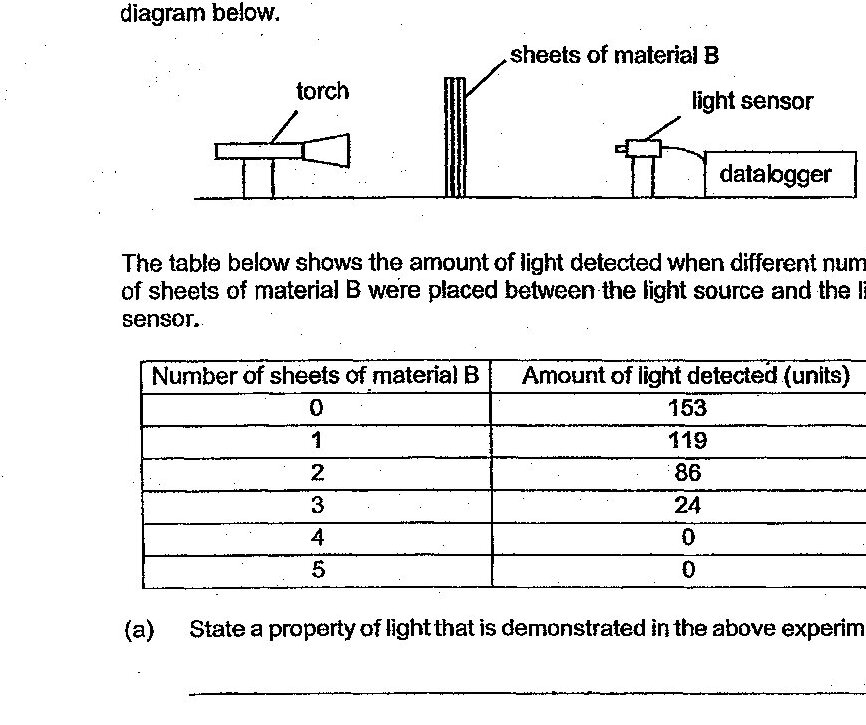
If six sheets of material B were used, state the amount of light detected by the datalogger.
The set-up below shows light shining on three shapes A, B and C made of cardboard. They are placed at different distances from the torch. The diagram below shows what was seen on the screen. Which one of the following correctly represents shapes A, B and C?
Four objects, A, B, C and D, are separately placed from a distance of one metre from a lit torch as shown in the diagram. Which of the object(s) can reflect light from the torch into the eye?
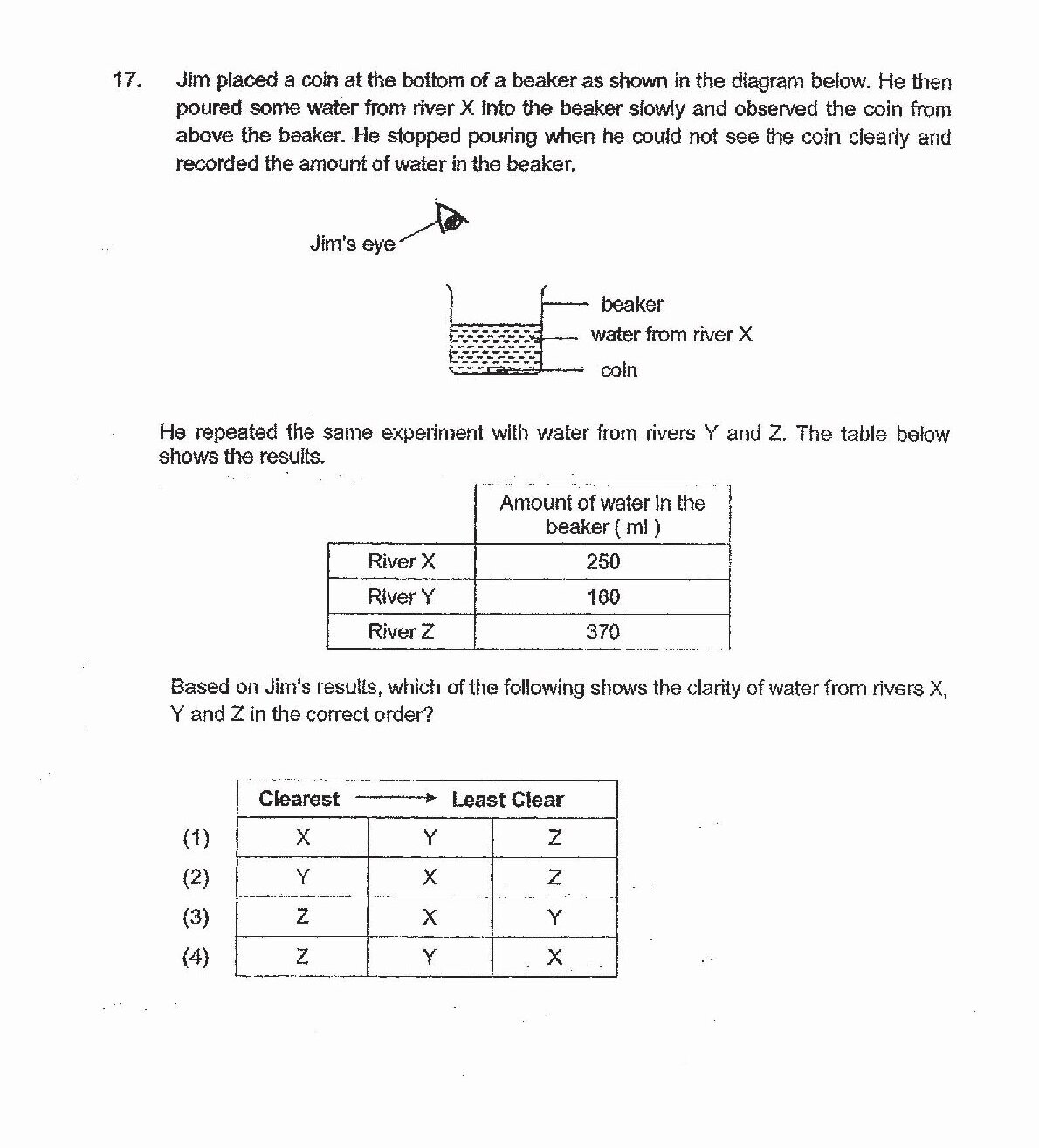
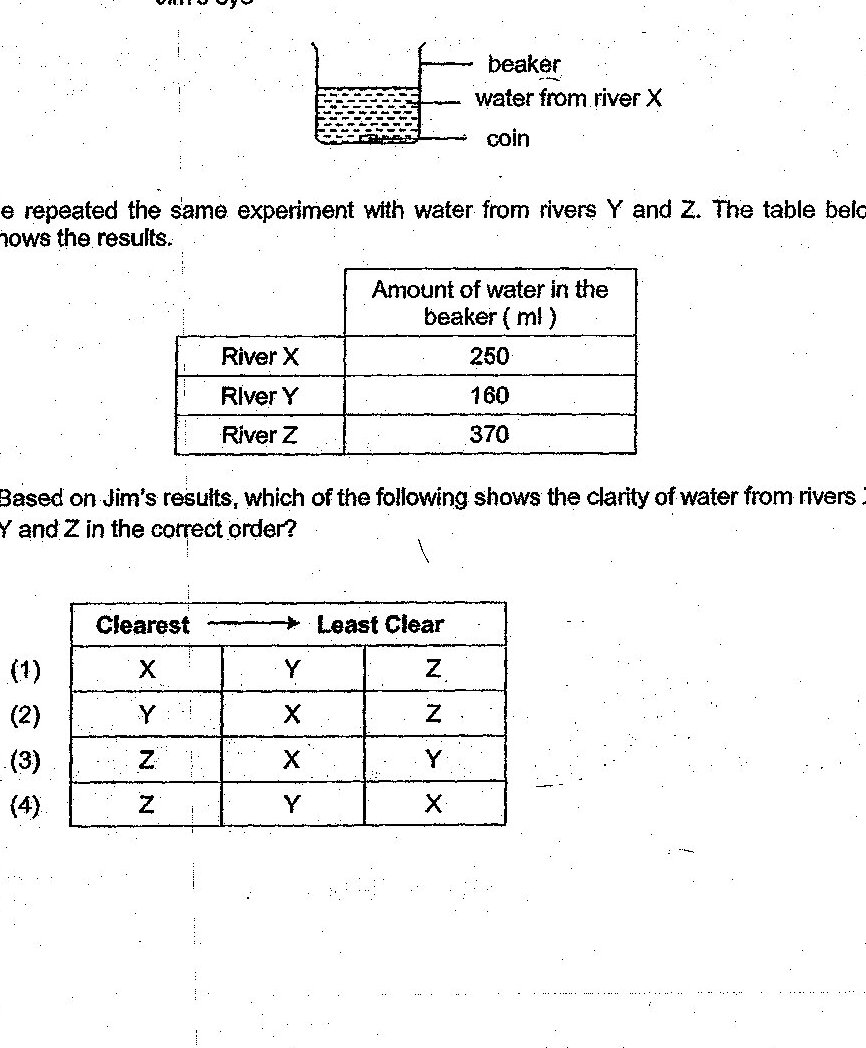
Jim placed a coin at the bottom of a beaker as shown in the diagram below. He then poured some water from river X into the beaker slowly and observed the coin from above the beaker. He stopped pouring when he could not see the coin clearly and recorded the amount of water in the beaker. He repeated the same experiment with water from rivers Y and Z. The table below shows the results. Based on Jim's results, which of the following shows the clarity of water from rivers X, Y and Z in the correct order?
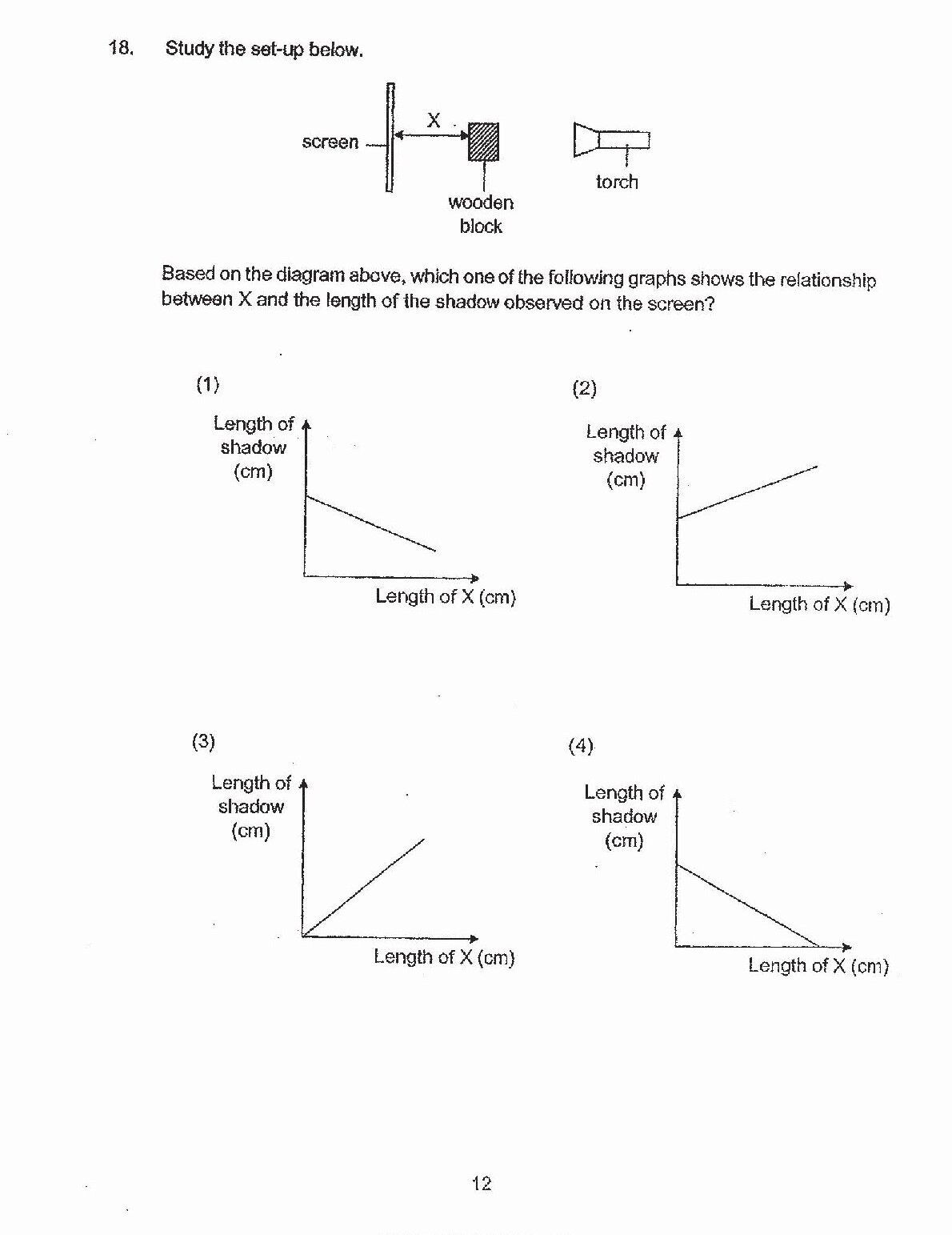
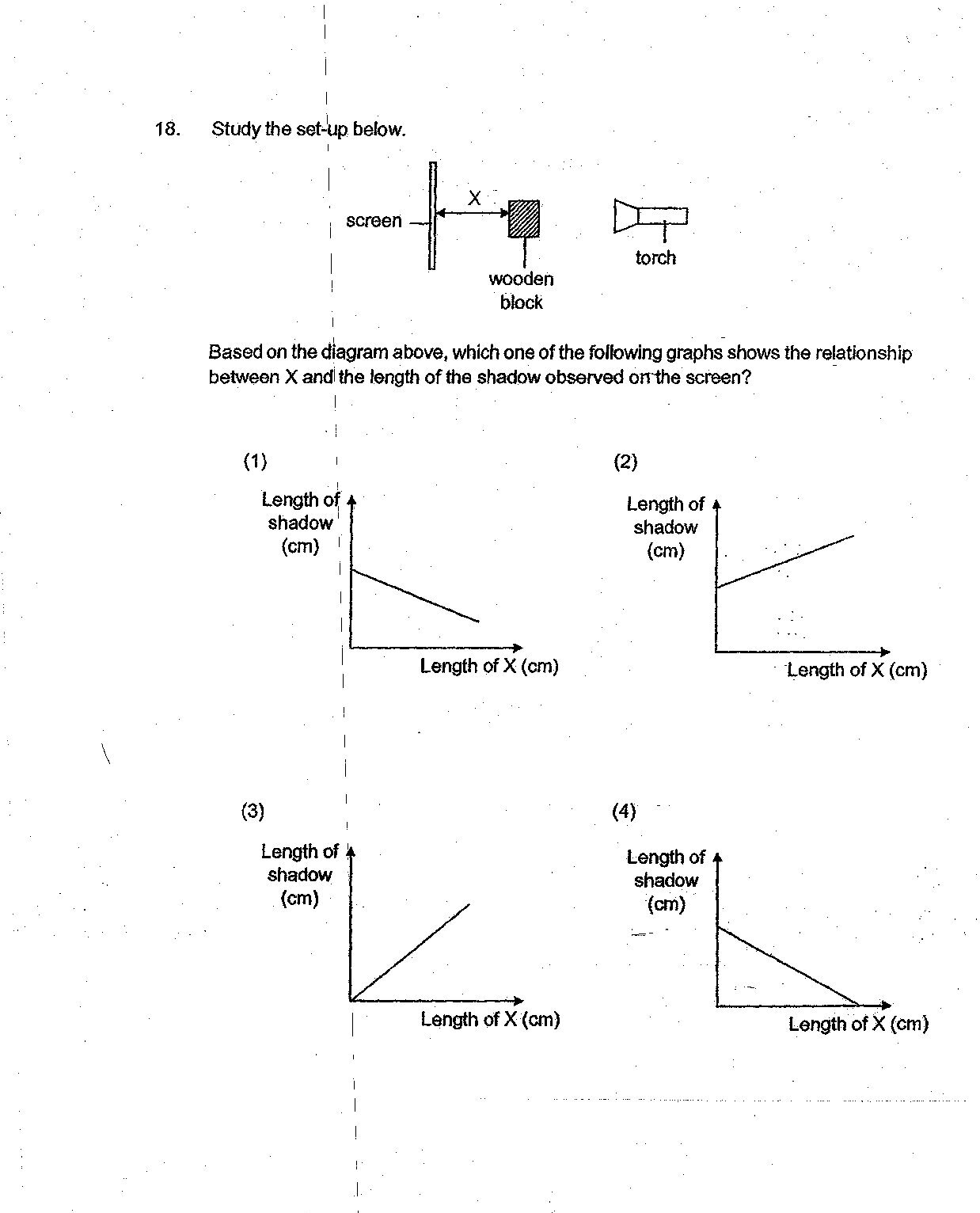
Based on the diagram above, which one of the following graphs shows the relationship between X and the length of the shadow observed on the screen?
Jake is in a completely dark room with several objects. Which of the objects below would he be able to see?
Jake is in a completely dark room with several objects. Which of the objects below would he be able to see? [Answer choices for combinations]
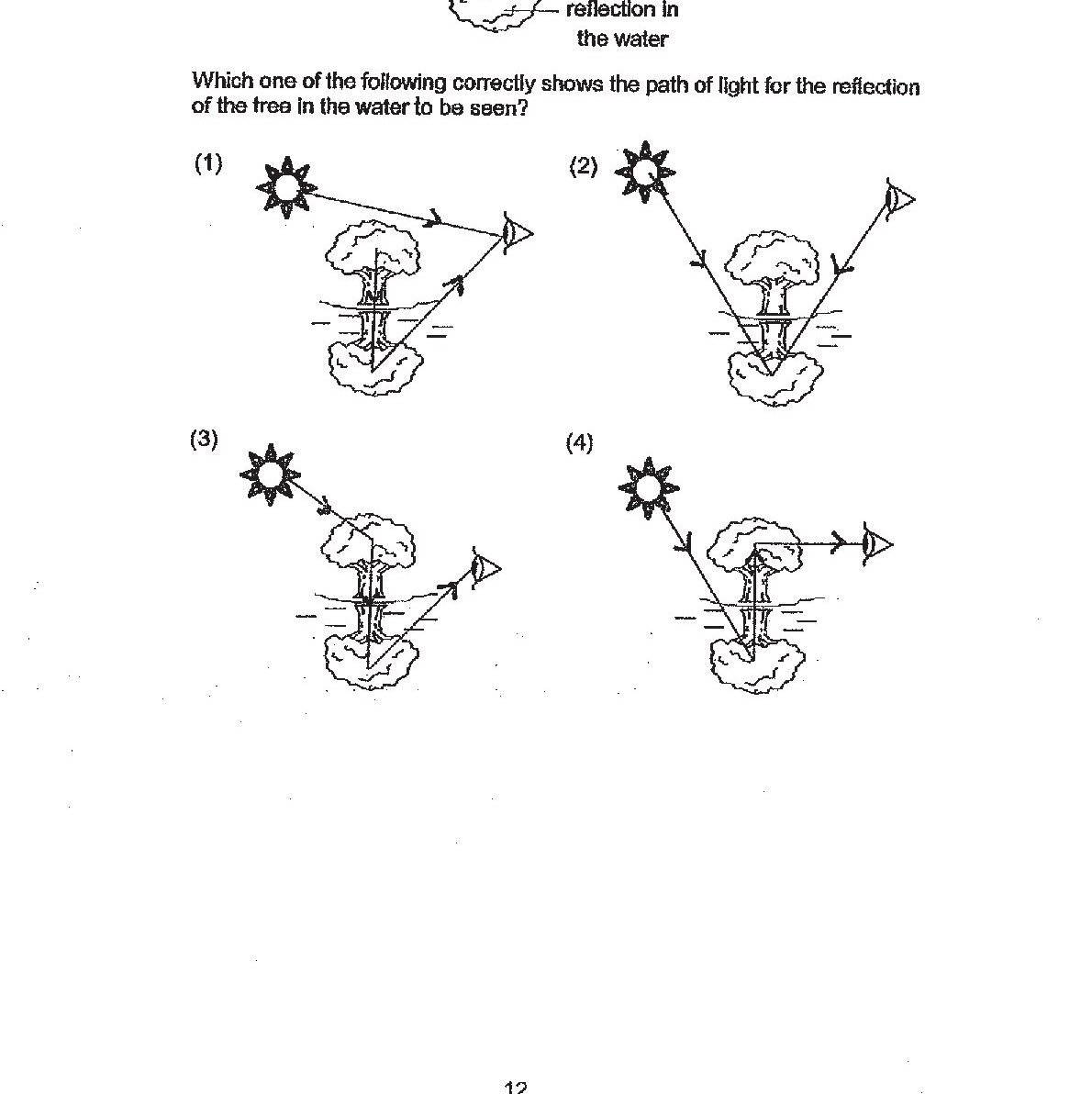
The picture below shows a tree and its reflection in the water. Which one of the following correctly shows the path of light for the reflection of the tree in the water to be seen?
Using water at 35°C, Bala shifted the light source further away from the water plant. What change would he observe? Explain his observation.
Jim placed a coin at the bottom of a beaker as shown in the diagram below. He then poured some water from river X into the beaker slowly and observed the coin from above the beaker. He stopped pouring when he could not see the coin clearly and recorded the amount of water in the beaker. He repeated the same experiment with water from rivers Y and Z. The table below shows the results. Based on Jim's results, which of the following shows the clarity of water from rivers X, Y and Z in the correct order?
Based on the diagram above, which one of the following graphs shows the relationship between X and the length of the shadow observed on the screen?
Jake is in a completely dark room with several objects. Which of the objects below would he be able to see?
Which combination of objects would Jake be able to see in a completely dark room?
Arrange the length of the shadow cast by sticks P, Q and R, starting with the longest shadow.
Using wooden stick P and without changing its position, suggest one way to increase the length of the shadow cast by it.
Sumin conducted an experiment as shown below. She placed different materials in front of a torch and measured the amount of light that passed through each material.
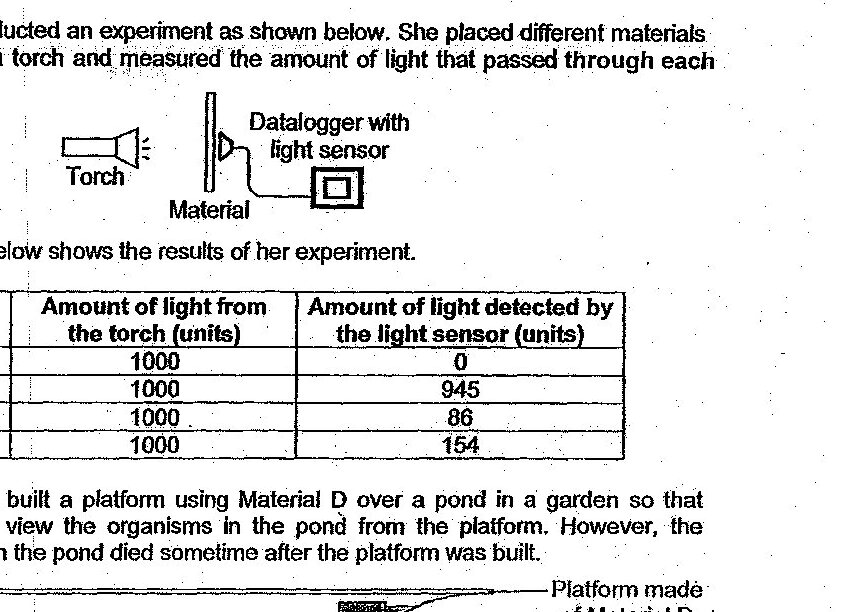
Based on Sumin's experiment, which material should Sumin use to build the platform instead of Material D so that the plants and animals in the pond will not die? Explain your answer.
The diagram below shows a paper counting system made up of a datalogger and a light sensor. Paper A is placed at a fixed distance between the light source and the light sensor. The light sensor measures the amount of light passing through the paper. The graph below shows the number of sheets of paper A and the amount of light measured by the light sensor. (c) Suggest why does carrying out the experiment in a dark room improve the experiment?
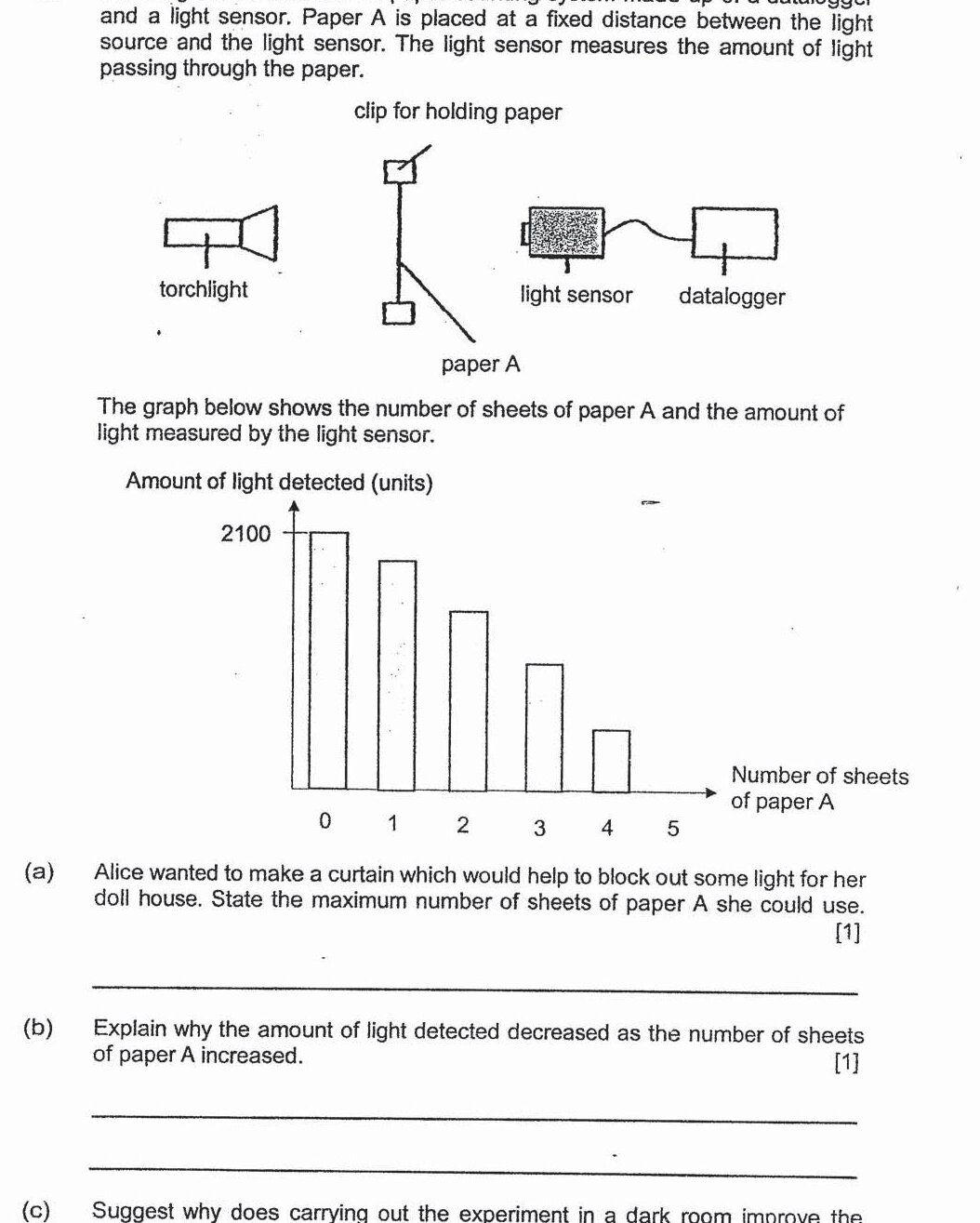
Alice wanted to make a curtain which would help to block out some light for her doll house. State the maximum number of sheets of paper A she could use.
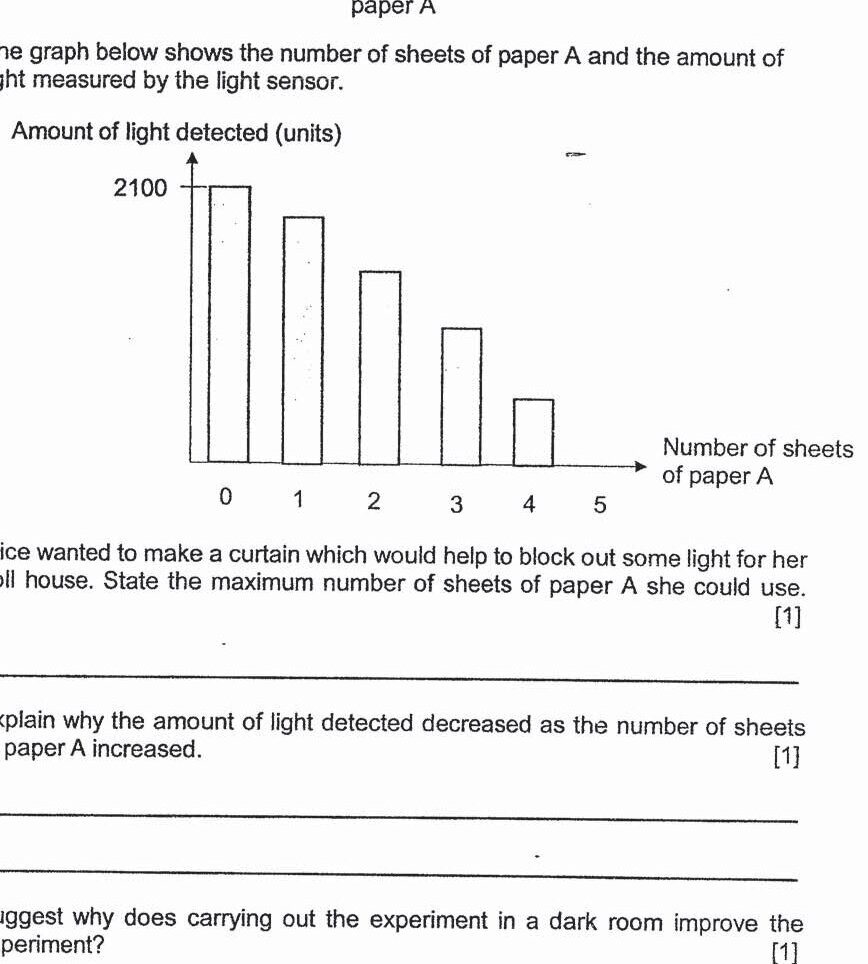
Explain why the amount of light detected decreased as the number of sheets of paper A increased.

Suggest why does carrying out the experiment in a dark room improve the experiment?

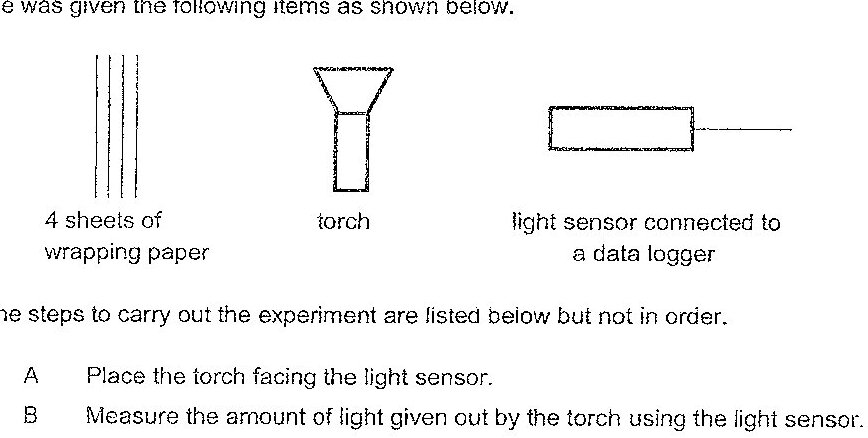
Samuel wanted to conduct an experiment to measure how the number of sheets of wrapping paper affects the amount of light passing through them. He was given the following items as shown below. The steps to carry out the experiment are listed below but not in order. A Place the torch facing the light sensor. B Measure the amount of light given out by the torch using the light sensor. C Repeat the same experiment with increasing number of sheets of wrapping paper. D Place a wrapping paper between the torch and the light sensor and measure the light given out by the torch using the light sensor. What is the correct order of the steps Samuel should take to carry out this experiment?
Explain why a shadow was formed on the picture.
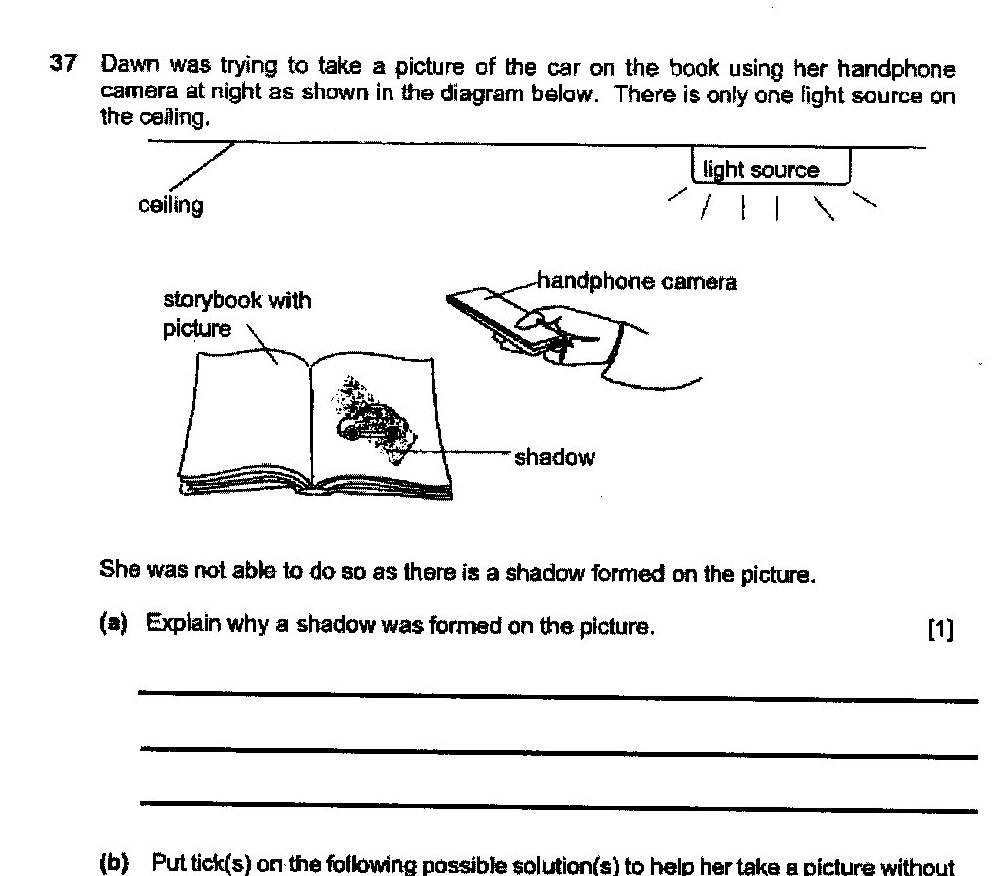
Put tick(s) on the following possible solution(s) to help her take a picture without the shadow forming on the book.
Based on the shadows cast on the screen, complete the table below to show the correct positions of the frames.
Give a reason why Ali conducted the experiment in a dark room.

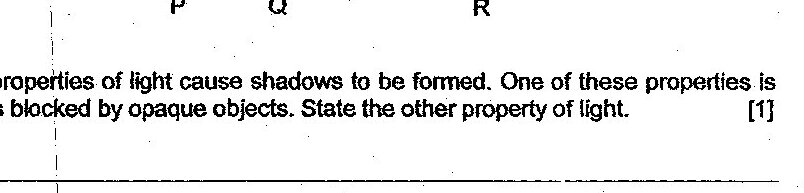
State the property of light which allows a shadow to be formed.
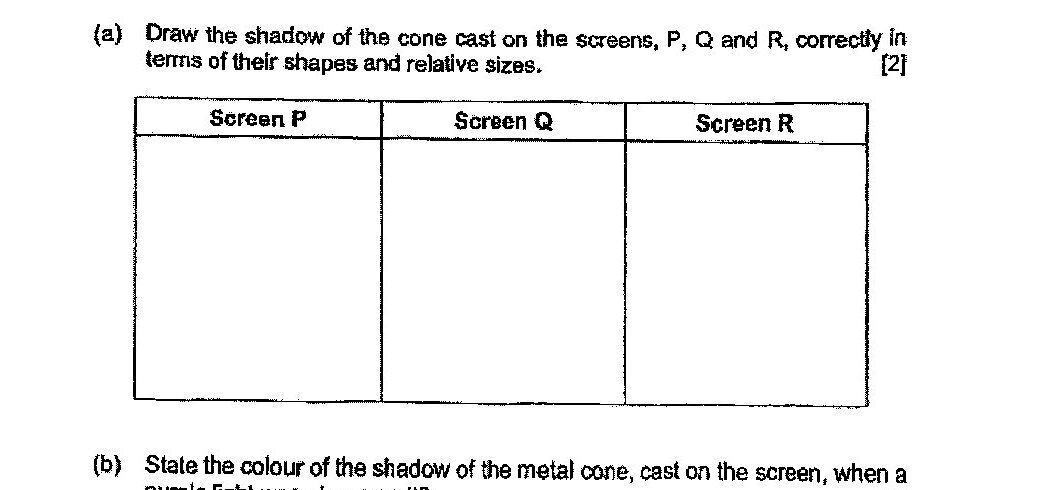
Joe wanted to find out how the position of a metal cone can affect the shape and size of the shadows casted on the screen, in a dark room. Three identical metal cones are positioned differently and placed at varying distances away from identical lamps as shown.
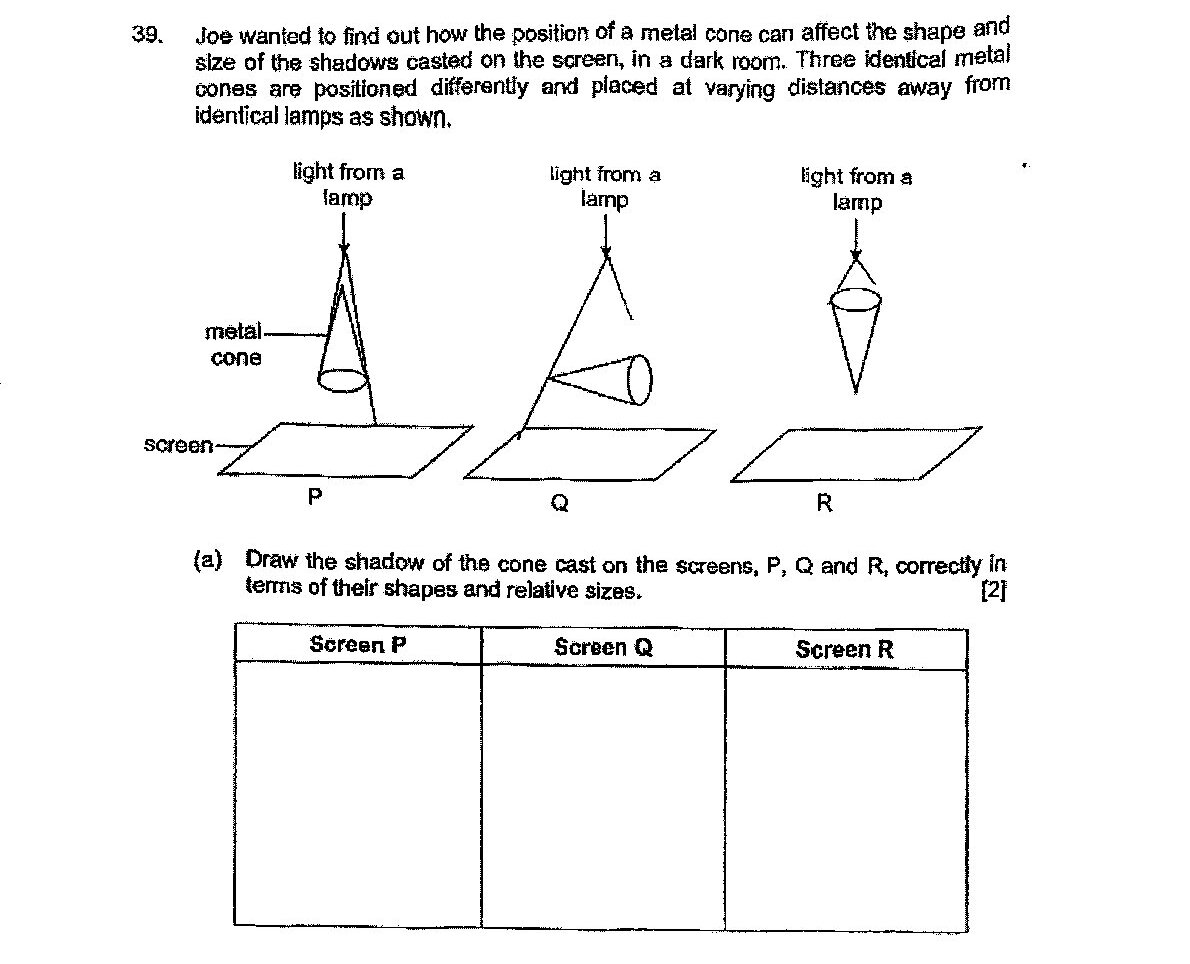
Draw the shadow of the cone cast on the screens, P, Q and R, correctly in terms of their shapes and relative sizes.
Past year papers cover the full exam — browse by subject below.
View All Papers ›