Magnets
Magnets - Comprehensive Study Notes
Key Concepts
Properties of Magnets
- Magnets attract magnetic materials (like iron, steel, nickel, and cobalt) towards them
- Magnets can attract magnetic materials without touching them - this is called a non-contact force
- Magnets can attract magnetic materials through some materials such as paper, cardboard, cloth, plastic, glass, and water
- Magnets do not need to touch magnetic materials to attract them - they work across a distance
- The strength of attraction decreases as the distance between the magnet and magnetic material increases
- Magnets have two poles - a North pole and a South pole
- The magnetic force is strongest at the poles of the magnet and weakest at the middle (center)
- Magnets always have both poles - you cannot have a magnet with only one pole
- If you break a magnet into pieces, each piece becomes a smaller magnet with its own North and South poles
Magnetic and Non-Magnetic Materials
Magnetic Materials:
- Materials that are attracted to magnets
- Common examples include:
- Iron (found in nails, paper clips, pins)
- Steel (found in spoons, cans, scissors)
- Nickel (found in some coins)
- Cobalt (less common in daily life)
- These materials contain iron or substances similar to iron
Non-Magnetic Materials:
- Materials that are NOT attracted to magnets
- Common examples include:
- Wood (pencils, rulers, furniture)
- Plastic (bottles, toys, containers)
- Paper (books, cards)
- Glass (windows, bottles)
- Rubber (erasers, bands)
- Cloth/Fabric (clothing, bags)
- Aluminium (drink cans, foil) - this is important as students often think all metals are magnetic
- Copper (coins, wires)
- Gold and Silver (jewelry)
Important Note: Not all metals are magnetic! Only iron, steel, nickel, and cobalt are magnetic materials.
Poles of Magnets
Basic Pole Behavior:
- Every magnet has two poles: North (N) and South (S)
- The poles are located at the ends of the magnet
- The middle part of the magnet has the weakest magnetic force
Law of Magnetic Poles:
- Like poles repel (push away from each other)
- North pole repels North pole (N ↔ N)
- South pole repels South pole (S ↔ S)
- Unlike poles attract (pull towards each other)
- North pole attracts South pole (N → ← S)
- South pole attracts North pole (S → ← N)
Repulsion vs Attraction:
- Repulsion (pushing away) happens only between two magnets with like poles facing each other
- Attraction (pulling together) happens when:
- Unlike poles of two magnets face each other, OR
- Any pole of a magnet is near a magnetic material
Important: A magnetic material (like iron) will be attracted to both poles of a magnet, but magnets only attract or repel other magnets depending on which poles face each other.
Induced Magnetism
What is Induced Magnetism?
- Induced magnetism occurs when a magnetic material (such as iron or steel) is brought close to or in contact with a magnet, and the magnetic material temporarily becomes a magnet itself
- The magnetic material is said to have been induced (made magnetic) by the nearby magnet
- The induced magnet will attract other nearby magnetic materials
Key Features of Induced Magnetism:
- Only magnetic materials (iron, steel, nickel, cobalt) can be magnetised by induction
- Non-magnetic materials (wood, plastic, aluminium) cannot be induced
- When the permanent magnet is removed:
- Iron: quickly loses its induced magnetism (temporary magnet)
- Steel: retains its induced magnetism for a longer time (can become a permanent magnet)
- The end of the magnetic material closest to the magnet always becomes the opposite pole to the pole of the magnet near it (unlike poles attract)
Everyday Example:
- A magnet picks up a paper clip. The paper clip then picks up another paper clip below it — because the first paper clip has been induced to become a temporary magnet by the permanent magnet above it
- When the permanent magnet is removed, the chain of paper clips falls apart (iron loses its magnetism quickly)
Why iron is used in electromagnet cores:
- Iron is easily magnetised (induced) when current flows through the coil
- Iron also loses its magnetism quickly when the current stops — this is why electromagnets can be switched on and off
Magnetic Field
What is a Magnetic Field?
- A magnetic field is the region around a magnet where the magnetic force can be detected
- Any magnetic material or another magnet placed within the magnetic field will experience a magnetic force
- The magnetic field is invisible, but its effects can be detected using iron filings or a compass
Magnetic Field Lines:
- Magnetic field lines are used to represent the magnetic field around a magnet
- Field lines show the direction and strength of the magnetic field
- By convention, field lines go from the North pole to the South pole (outside the magnet)
- Where field lines are close together: the magnetic field is strong (near the poles)
- Where field lines are far apart: the magnetic field is weak (away from the poles, near the middle)
Using a Compass to Detect Magnetic Fields:
- A compass has a small magnetised needle that is free to rotate
- The compass needle always aligns with the local magnetic field
- Near a magnet, the compass needle points along the magnetic field lines
- The north-seeking end of the compass needle points toward the South pole of the nearby magnet (because unlike poles attract)
- Earth itself acts like a giant magnet, which is why a compass needle points approximately North-South when no other magnets are nearby
Pattern of Field Lines Around a Bar Magnet:
- Field lines leave the North pole and curve around to enter the South pole
- The field lines are densest (closest together) at the poles
- Field lines never cross each other
Uses of Magnets
Everyday Uses:
- Refrigerator doors - Magnetic strips in the rubber seal keep the door closed tightly
- Magnetic clasps - Used on bags, pencil cases, and cabinet doors to keep them shut
- Fridge magnets - Hold papers, photos, and notes on metal surfaces
- Magnetic toys - Building blocks, puzzle pieces, and educational toys
- Can openers - Magnetic part holds the lid after cutting
- Maglev trains - Use powerful magnets for levitation and movement (floating trains)
- Compasses - Use a magnetic needle to find directions (points North-South)
- Speakers and headphones - Contain magnets to produce sound
- Electric motors - Use magnets to convert electrical energy to movement
- Magnetic hooks and holders - Stick to metal surfaces to hold tools, keys, etc.
- Credit/Debit cards - Have magnetic strips to store information
- Hard disk drives - Use magnets to store computer data
Forces Diagrams and Magnets
What a Force Diagram Shows
- A force diagram uses arrows to represent the forces acting on an object
- Each arrow must be labelled with the type of force (e.g. weight, magnetic force, normal force)
- The direction of the arrow shows the direction of the force; the length of the arrow represents the size of the force
- When drawing force diagrams involving magnets, include all forces acting on each object — gravity (weight) downward AND any magnetic force acting on it
How Scales and Weighing Machines Work with Magnetic Forces
- A weighing scale (spring balance or electronic scale) measures the total downward force acting on the object placed on it
- Under normal conditions (no magnets), the scale reads the object’s weight (gravitational force pulling it down)
- When a magnet is introduced, the scale reads the combined effect of gravity AND the magnetic force on that object
- Key principle: The scale reading = total net force acting on the object (not just its weight)
Effect of Magnetic Attraction on Scale Reading
- If a magnet above the object attracts it upward:
- The magnetic force acts upward, opposing gravity
- Total downward force on the object decreases
- Scale reading decreases (less than the object’s actual weight)
- If a magnet below the object attracts it downward:
- The magnetic force acts downward, adding to gravity
- Total downward force on the object increases
- Scale reading increases (more than the object’s actual weight)
Effect of Magnetic Repulsion on Scale Reading
- If a magnet above the object repels it downward:
- The magnetic force acts downward, adding to gravity
- Total downward force on the object increases
- Scale reading increases (more than the object’s actual weight)
- If a magnet below the object repels it upward:
- The magnetic force acts upward, opposing gravity
- Total downward force on the object decreases
- Scale reading decreases (less than the object’s actual weight)
Balanced Rod / Beam with Magnetic Forces
- In balanced beam / lever questions, a beam is balanced when the total force on each side is equal
- When magnetic forces are added, analyse each object separately:
- Draw all forces on the object (weight + any magnetic force)
- Determine the net downward force on each object
- Compare the net forces on each side to decide if the beam tips or remains balanced
- If the net downward force on one side increases and the other stays the same, that side tips down
- If both sides change equally, the beam may remain balanced
Important Definitions
Magnet: An object that attracts magnetic materials (iron, steel, nickel, cobalt) and can attract or repel other magnets.
Magnetic material: A material that is attracted to a magnet. Examples: iron, steel, nickel, cobalt.
Non-magnetic material: A material that is NOT attracted to a magnet. Examples: wood, plastic, paper, glass, rubber, aluminium, copper.
North pole (N): One of the two poles of a magnet. When a magnet is free to move, the North pole points towards the Earth’s North direction.
South pole (S): One of the two poles of a magnet. When a magnet is free to move, the South pole points towards the Earth’s South direction.
Attract: A pulling force that brings objects closer together. Unlike poles attract. Magnets attract magnetic materials.
Repel: A pushing force that pushes objects apart. Like poles repel each other.
Non-contact force: A force that acts on objects without touching them. Magnetic force is a non-contact force.
Magnetic force: The force of attraction or repulsion exerted by a magnet. It is strongest at the poles and weakest at the middle.
Induced magnetism: The process by which a magnetic material (such as iron or steel) becomes temporarily magnetised when it is brought close to or in contact with a magnet.
Magnetic field: The region around a magnet where its magnetic force can be detected. Represented by magnetic field lines that go from North pole to South pole (outside the magnet).
Magnetic field lines: Lines used to represent the direction and strength of a magnetic field; they are closer together where the field is stronger (near the poles) and farther apart where the field is weaker.
Compass: An instrument containing a freely rotating magnetised needle that aligns with magnetic field lines; used to detect magnetic fields and find direction.
Worked Examples
Example 1: Identifying Magnetic and Non-Magnetic Materials
Question: Sarah has the following items: an iron nail, a wooden ruler, a steel spoon, a plastic bottle, and an aluminium can. She brings a magnet near each item. Which items will be attracted to the magnet?
Step-by-step solution:
Step 1: Identify what makes a material magnetic
- Materials attracted to magnets are: iron, steel, nickel, and cobalt
Step 2: Examine each item
- Iron nail - made of iron → MAGNETIC ✓
- Wooden ruler - made of wood → NON-MAGNETIC ✗
- Steel spoon - made of steel → MAGNETIC ✓
- Plastic bottle - made of plastic → NON-MAGNETIC ✗
- Aluminium can - made of aluminium (a metal, but not magnetic) → NON-MAGNETIC ✗
Step 3: List the magnetic items
Answer: The iron nail and steel spoon will be attracted to the magnet.
Key Learning Point: Not all metals are magnetic! Aluminium and copper are common metals that are NOT magnetic.
Example 2: Predicting Magnetic Interactions
Question: Four magnets are arranged as shown below. Predict whether they will attract or repel each other.
Setup:
- Magnet A: [N][S] facing Magnet B: [N][S] (S pole of A faces N pole of B)
- Magnet C: [S][N] facing Magnet D: [N][S] (N pole of C faces N pole of D)
Step-by-step solution:
For Magnets A and B:
Step 1: Identify which poles are facing each other
- S pole of Magnet A faces N pole of Magnet B
Step 2: Apply the rule
- Unlike poles (S and N) → ATTRACT
Answer for A and B: The magnets will attract each other.
For Magnets C and D:
Step 1: Identify which poles are facing each other
- N pole of Magnet C faces N pole of Magnet D
Step 2: Apply the rule
- Like poles (N and N) → REPEL
Answer for C and D: The magnets will repel each other.
Key Learning Point:
- Unlike poles = Attract
- Like poles = Repel Always identify which specific poles are facing each other first!
Example 3: Magnetic Force Through Materials
Question: John places a paper clip on a table. He holds a magnet above the paper clip with the following materials in between: a piece of paper, then cardboard, then plastic sheet. Will the paper clip be attracted to the magnet? Explain your answer.
Step-by-step solution:
Step 1: Identify the materials between the magnet and paper clip
- Paper, cardboard, and plastic
Step 2: Check if these materials are magnetic or non-magnetic
- Paper → non-magnetic
- Cardboard → non-magnetic
- Plastic → non-magnetic
Step 3: Apply the principle
- Magnets can attract magnetic materials through non-magnetic materials
- The magnetic force can pass through paper, cardboard, and plastic
Step 4: Check if the paper clip is magnetic
- Paper clips are made of steel (or iron) → magnetic material
Answer: Yes, the paper clip will still be attracted to the magnet. The magnetic force can pass through non-magnetic materials like paper, cardboard, and plastic to attract the steel paper clip.
Key Learning Point: Magnetic force is a non-contact force that works through non-magnetic materials, but the force gets weaker as:
- The distance increases
- More layers are added
Common Mistakes to Avoid
-
Thinking all metals are magnetic
- ✗ Wrong: “All metals are attracted to magnets”
- ✓ Correct: Only iron, steel, nickel, and cobalt are magnetic metals
- Aluminium, copper, gold, and silver are NOT magnetic
-
Confusing attraction with repulsion
- ✗ Wrong: “Like poles attract”
- ✓ Correct: Unlike poles attract, like poles repel
- Remember: “Opposites attract”
-
Thinking magnetic materials can repel magnets
- ✗ Wrong: “The iron nail will repel the magnet”
- ✓ Correct: Only magnets can repel other magnets (when like poles face each other)
- Magnetic materials (iron, steel, etc.) are ALWAYS attracted to magnets, never repelled
-
Forgetting that magnets have TWO poles
- ✗ Wrong: Drawing or describing a magnet with only one pole
- ✓ Correct: Every magnet always has both a North and South pole, even when broken into pieces
-
Thinking magnets only work when touching
- ✗ Wrong: “The magnet must touch the paper clip to attract it”
- ✓ Correct: Magnetic force is a non-contact force - it works across distances
-
Confusing the strongest and weakest parts of a magnet
- ✗ Wrong: “The middle of the magnet is the strongest part”
- ✓ Correct: The poles (ends) are strongest; the middle is weakest
-
Not recognizing steel as a magnetic material
- ✗ Wrong: “Only iron is magnetic”
- ✓ Correct: Iron, steel, nickel, and cobalt are all magnetic (steel is very common in everyday objects)
-
Thinking magnetic force cannot pass through materials
- ✗ Wrong: “The paper will block the magnetic force”
- ✓ Correct: Magnetic force can pass through non-magnetic materials like paper, plastic, glass, and water
-
Confusing plastic and aluminium as magnetic because they’re man-made or shiny
- ✗ Wrong: “Plastic toys with magnets inside are magnetic materials”
- ✓ Correct: The plastic itself is non-magnetic; only the actual magnet inside is magnetic
-
Writing incomplete explanations
- ✗ Wrong: “They attract” (no explanation)
- ✓ Correct: “The two magnets attract each other because unlike poles (North and South) are facing each other”
-
Thinking the scale only measures the object’s weight (gravity)
- ✗ Wrong: “The scale shows the weight of the object”
- ✓ Correct: The scale measures the TOTAL force acting on the object — weight plus any magnetic force acting on it
-
Missing the magnetic force arrow in a force diagram
- ✗ Wrong: Only drawing the weight arrow and ignoring the magnetic force
- ✓ Correct: Draw ALL forces acting on the object, including the magnetic force with correct direction and label
-
Not drawing force arrows at all
- ✗ Wrong: Describing forces in words without a diagram when the question asks for one
- ✓ Correct: Draw clearly labelled arrows showing each force — direction and relative size matter
-
Thinking repulsion from above decreases the scale reading
- ✗ Wrong: “The magnet above repels the object downward, so the scale reads less”
- ✓ Correct: Repulsion from above pushes the object downward, which increases the scale reading
-
Confusing the direction of attraction vs repulsion forces
- ✗ Wrong: Assuming attraction always pulls down and repulsion always pushes up
- ✓ Correct: The direction depends on where the magnet is positioned — always trace the force from the magnet to the object to determine direction
-
Jumping straight to comparing balance without analysing each object first
- ✗ Wrong: Immediately deciding which side is heavier without working out the net force on each object
- ✓ Correct: Analyse each object individually (draw its forces, find net downward force), then compare the two sides
Exam Tips
Keywords to Include in Answers:
For identification questions:
- “Magnetic material” or “non-magnetic material”
- Name the specific material: “iron”, “steel”, “nickel”, “cobalt”
- “Attracted to magnets” (not just “magnetic”)
For pole questions:
- “Like poles repel”
- “Unlike poles attract”
- “North pole” and “South pole” (use full names, not just N and S in written answers)
For force questions:
- “Non-contact force”
- “Magnetic force”
- “Does not need to touch”
- “Strongest at the poles, weakest at the middle”
For material passing questions:
- “Magnetic force can pass through non-magnetic materials”
- Name the specific materials: “paper”, “cardboard”, “plastic”, etc.
Mark-Earning Phrases:
-
When explaining why something is attracted:
- “The [object] is made of [iron/steel/nickel/cobalt], which is a magnetic material that is attracted to magnets.”
-
When explaining attraction between magnets:
- “The two magnets attract each other because unlike poles are facing each other.”
- “The North pole of magnet A is facing the South pole of magnet B, so they attract.”
-
When explaining repulsion:
- “The two magnets repel each other because like poles are facing each other.”
- “Both North poles are facing each other, so the magnets push apart.”
-
When explaining why something is NOT attracted:
- “The [object] is made of [material name], which is a non-magnetic material and is not attracted to magnets.”
-
When explaining non-contact force:
- “Magnetic force is a non-contact force, so the magnet can attract the [object] without touching it.”
-
When explaining force through materials:
- “The magnetic force can pass through [paper/cardboard/plastic] because they are non-magnetic materials.”
Answer Structure for Common Question Types:
“Will X be attracted to the magnet?”
- State yes or no
- Identify what X is made of
- State whether that material is magnetic or non-magnetic
- Give a clear reason
Example: “Yes, the nail will be attracted to the magnet because it is made of iron, which is a magnetic material.”
“Will the magnets attract or repel?”
- Identify which poles are facing each other
- State the rule (like/unlike poles)
- Give the result (attract/repel)
Example: “The magnets will repel because both North poles are facing each other, and like poles repel.”
Drawing Tips:
- Always label both poles clearly (N and S)
- Use arrows to show direction of force:
- Attraction: arrows pointing toward each other (→ ←)
- Repulsion: arrows pointing away from each other (← →)
- When showing magnetic materials, draw small arrows from the material pointing toward the magnet
Answer Structure for Forces Diagram Questions
Draw-arrows-first rule:
- Before writing anything, draw and label ALL force arrows on the diagram
- Each arrow must be labelled with: (1) the type of force and (2) direction
- Example labels: “Weight / Gravity (downward)”, “Magnetic force (upward)”
State the total force explicitly:
- After drawing arrows, write a sentence that states the total (net) force on the object
- Example: “The total downward force on the object is weight minus the upward magnetic force.”
Assigned-numbers technique:
- Assign a number to each force to keep track (e.g. Weight = 10 N, Magnetic force = 3 N upward)
- Then calculate: net force = 10 - 3 = 7 N downward → scale reads 7 N
OEQ 3-step structure for force diagram questions:
- Direction — State the direction of each force acting on the object
- Total force comparison — State the combined/net force on the object
- Conclusion — State the scale reading or which side tips, using the evidence from steps 1 and 2
Use-diagram-evidence rule:
- Always refer to your diagram when justifying whether one force overcomes another
- Example: “As shown in the diagram, the upward magnetic force is smaller than the weight, so the net force is still downward and the scale reading decreases but is not zero.”
Analyse-each-object-first rule for balanced systems:
- Never compare sides of a beam/balance directly; analyse each object individually first
- For each object: list forces → determine net downward force → then compare sides
Model conclusion sentence structure:
- “Since the [magnetic force direction] acts on the object, the total [downward/upward] force is [greater/less] than its weight alone, so the scale reading [increases/decreases].”
Exam Command Words:
- “Identify” - Just name the material or pole
- “Explain” - Give reasons using scientific terms
- “Predict” - Say what will happen and why
- “State” - Give a fact directly (no need for long explanation)
Electromagnets
What is an Electromagnet?
An electromagnet is a temporary magnet made by passing electric current through a wire coil wrapped around an iron core.
- Unlike a permanent magnet, an electromagnet can be switched ON and OFF:
- Current flowing → magnetic field is created → electromagnet is ON
- No current → no magnetic field → electromagnet is OFF
- When the current is switched off, the iron core loses its magnetism almost immediately
Factors That Affect the Strength of an Electromagnet
| Factor | How to Increase Strength |
|---|---|
| Number of coil turns | Use more turns of wire in the coil |
| Electric current | Increase the current flowing through the wire |
| Core material | Use an iron core (not air or other materials) |
Key Points:
- More coil turns → stronger electromagnet
- Increase current → stronger electromagnet
- Iron core (rather than air or other materials) → stronger electromagnet because iron is easily magnetised
Applications of Electromagnets
- Electric bell: Electromagnet attracts a metal arm to strike the bell; when contact breaks, current stops and arm springs back, repeating the cycle
- Relay switch: A small current activates the electromagnet, which then closes a second circuit carrying a larger current — allows a small current to control a larger one safely
- Scrapyard crane electromagnet: Powerful electromagnet lifts large iron/steel objects; switched off to release them
- MRI machines: Use extremely powerful electromagnets to create detailed images of the inside of the human body
Comparing Electromagnets and Permanent Magnets
| Feature | Electromagnet | Permanent Magnet |
|---|---|---|
| Duration of magnetism | Temporary (only when current flows) | Permanent |
| Switchable? | Yes — can be switched ON and OFF | No — always magnetic |
| Strength adjustable? | Yes — change current or coil turns | No — fixed strength |
| Core material | Iron (loses magnetism easily) | Steel (keeps magnetism) |
| Example | Electric bell, MRI machine | Fridge magnet, compass needle |
Important Distinction: Electromagnets use iron cores because iron is easily magnetised AND easily demagnetised. Permanent magnets use steel because steel keeps its magnetism for a long time.
Quick Summary
Essential Points to Remember:
✓ Magnetic materials: Only iron, steel, nickel, and cobalt are attracted to magnets
✓ Non-magnetic materials: Wood, plastic, paper, glass, rubber, aluminium, copper, gold, silver
✓ All magnets have TWO poles: North (N) and South (S) - you cannot have a magnet with only one pole
✓ Magnetic force is strongest at the poles (ends) and weakest at the middle of the magnet
✓ Like poles repel: N-N or S-S push away from each other
✓ Unlike poles attract: N-S or S-N pull toward each other
✓ Magnetic materials are attracted to BOTH poles of a magnet - they don’t repel
✓ Only magnets can repel other magnets - magnetic materials cannot repel magnets
✓ Magnetic force is a non-contact force - works without touching, across distances
✓ Magnetic force can pass through non-magnetic materials like paper, cardboard, plastic, glass, and water
✓ The force gets weaker as distance increases between magnet and magnetic material
✓ Induced magnetism: When a magnetic material (iron/steel) is placed near a magnet, it temporarily becomes a magnet itself; iron loses induced magnetism quickly, steel retains it longer
✓ Magnetic field: The invisible region around a magnet where its force can be detected; represented by field lines going from North to South pole (outside the magnet); field is strongest where lines are closest (at the poles)
✓ Compass needle aligns with the magnetic field and points toward the South pole of a nearby magnet (unlike poles attract); also used to detect the direction of a magnetic field
✓ Common uses of magnets: fridge doors, magnetic clasps, compasses, maglev trains, speakers, motors, fridge magnets, can openers
✓ The scale reading equals the TOTAL force on the object, not just its weight — magnetic forces change the reading
✓ Magnetic attraction from above reduces the scale reading; magnetic repulsion from above increases it
✓ In force diagram questions: draw arrows first, assign numbers, state total force, then conclude
Final Reminder: Always read questions carefully and use proper scientific terms in your answers. Look for keywords in questions like “explain”, “identify”, “material”, and “poles” to know exactly what the question is asking for!
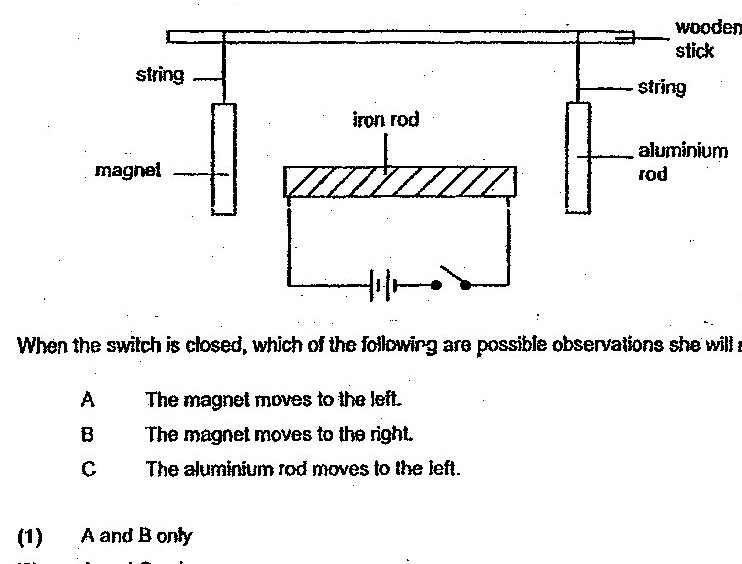
Devi set up an electromagnet and placed it in between an aluminium rod and a magnet as shown. When the switch is closed, which of the following are possible observations she will make?
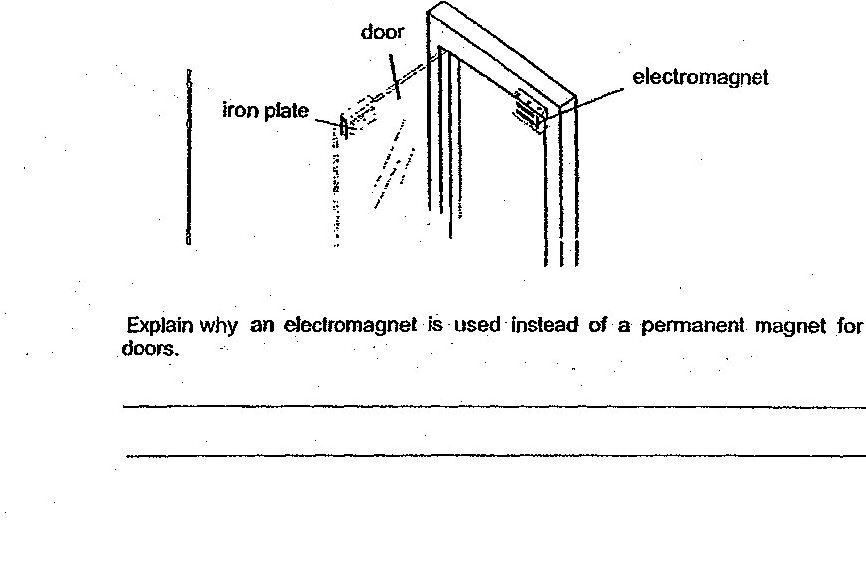
Electromagnets are often used to lock doors as shown in the diagram. Explain why an electromagnet is used instead of a permanent magnet for such doors.
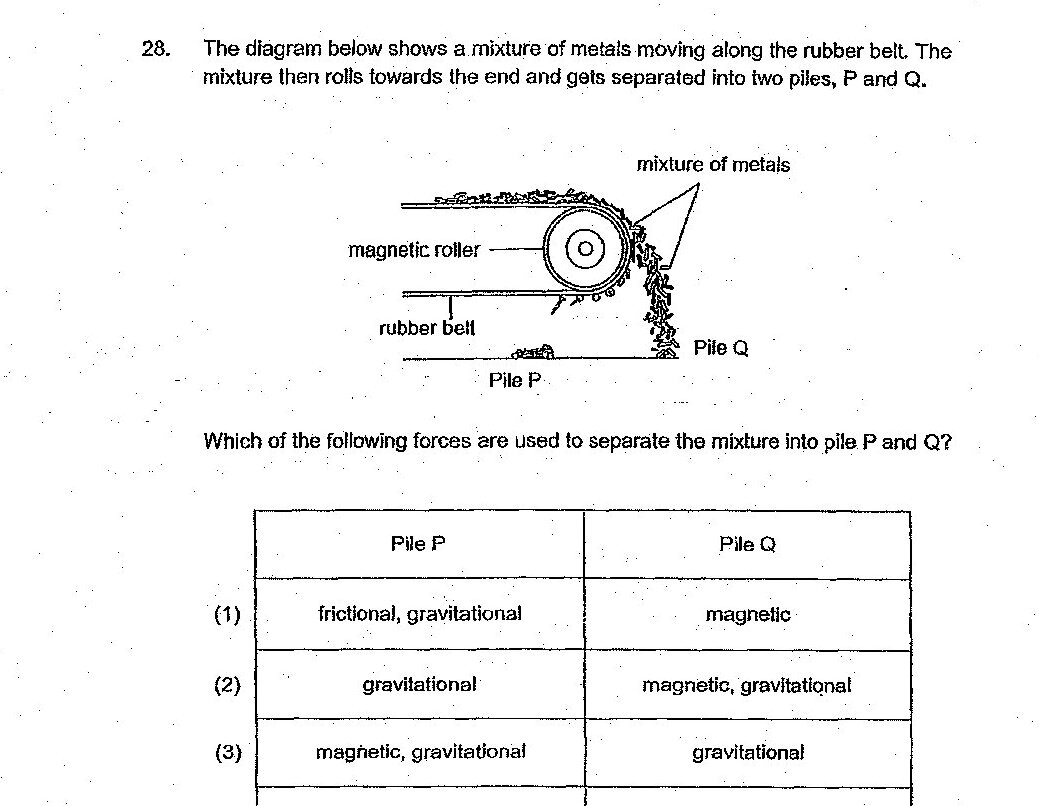
The diagram below shows a mixture of metals moving along the rubber belt. The mixture then rolls towards the end and gets separated into two piles, P and Q. Which of the following forces are used to separate the mixture into pile P and Q?
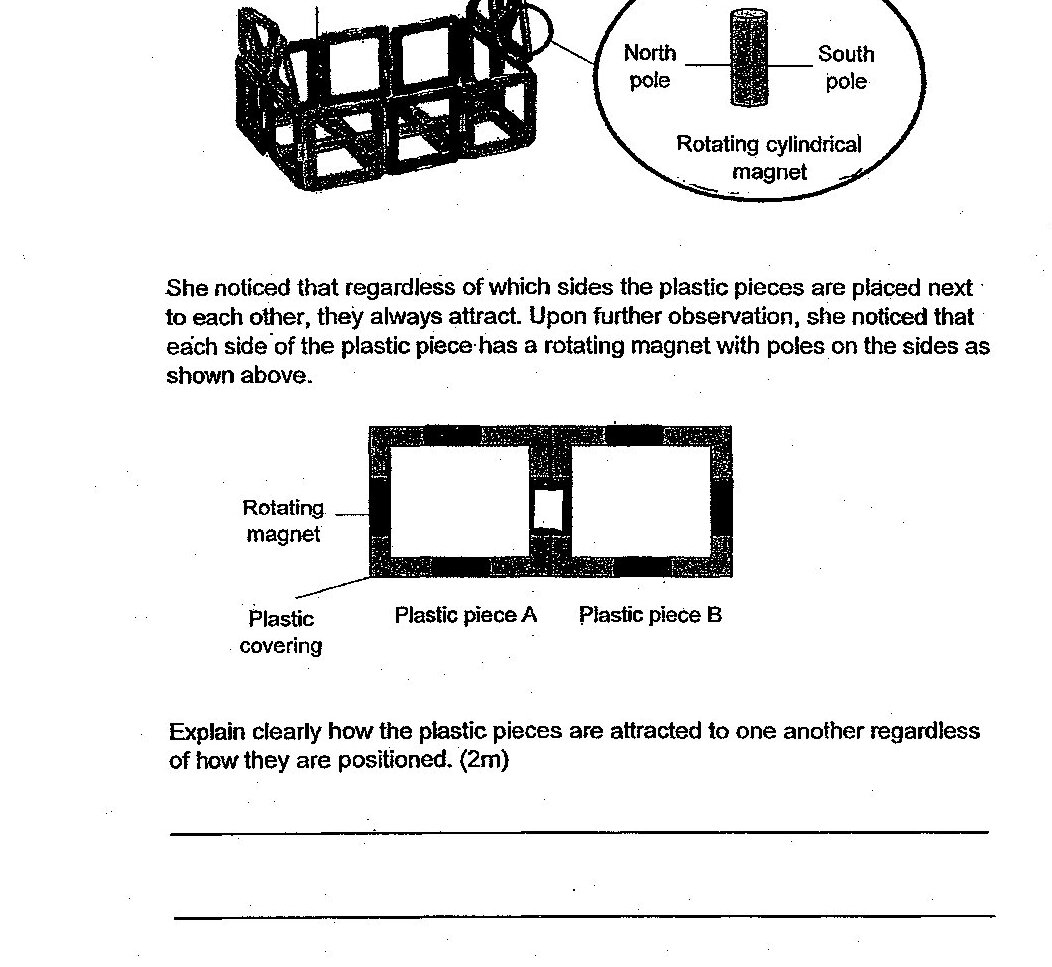
Explain clearly how the plastic pieces are attracted to one another regardless of how they are positioned. (2m)
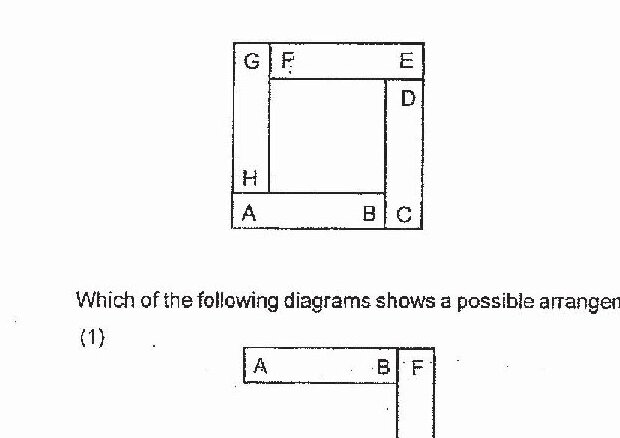
Four bar magnets with their ends marked A to H are arranged as shown. Which of the following diagrams shows a possible arrangement using three of the magnets?
In a scrap yard, electromagnets are used to separate objects. Which of the following explains why they are used?
Mei Ling wanted to investigate whether the size of a magnet affects the greatest distance it can attract a paper clip. Which of the following variables should she keep constant?
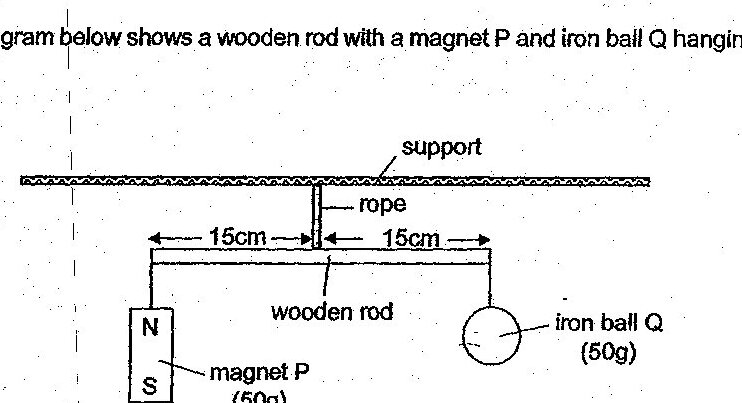
The diagram below shows a wooden rod with a magnet P and iron ball Q hanging from a rope. Which one of the following statements is false?
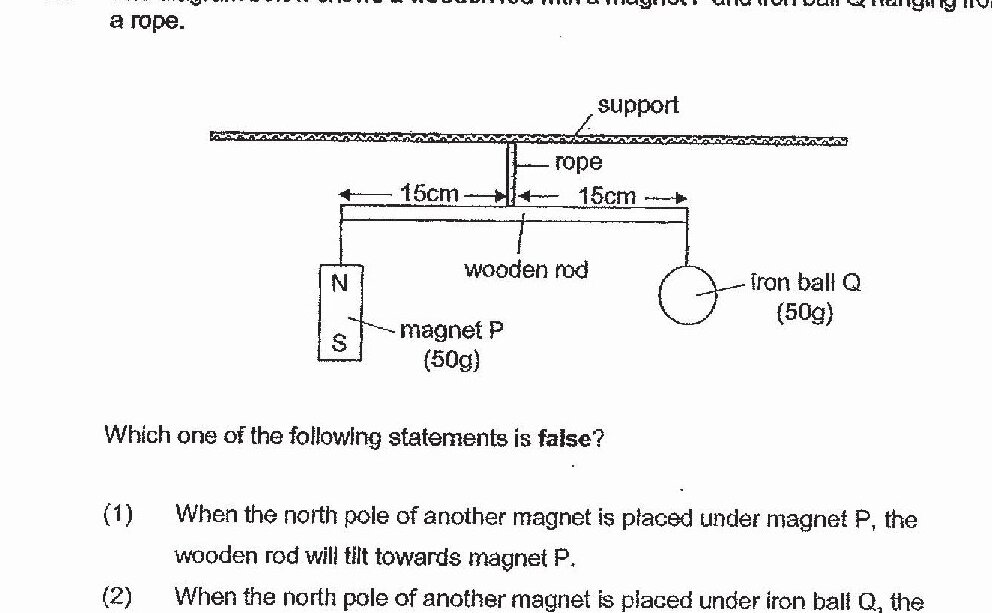
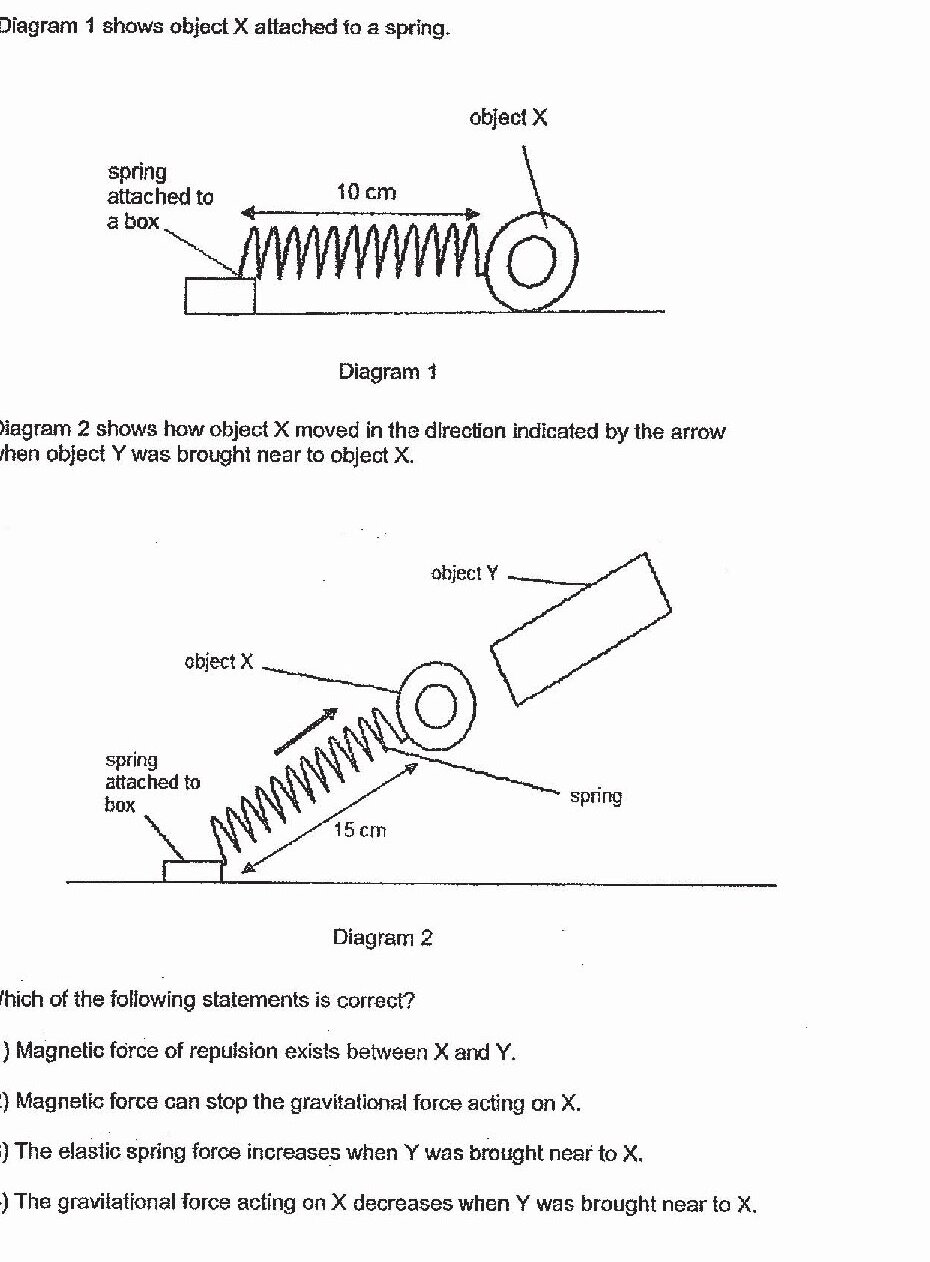
Diagram 1 shows object X attached to a spring. Diagram 2 shows how object X moved in the direction indicated by the arrow when object Y was brought near to object X. Which of the following statements is correct?
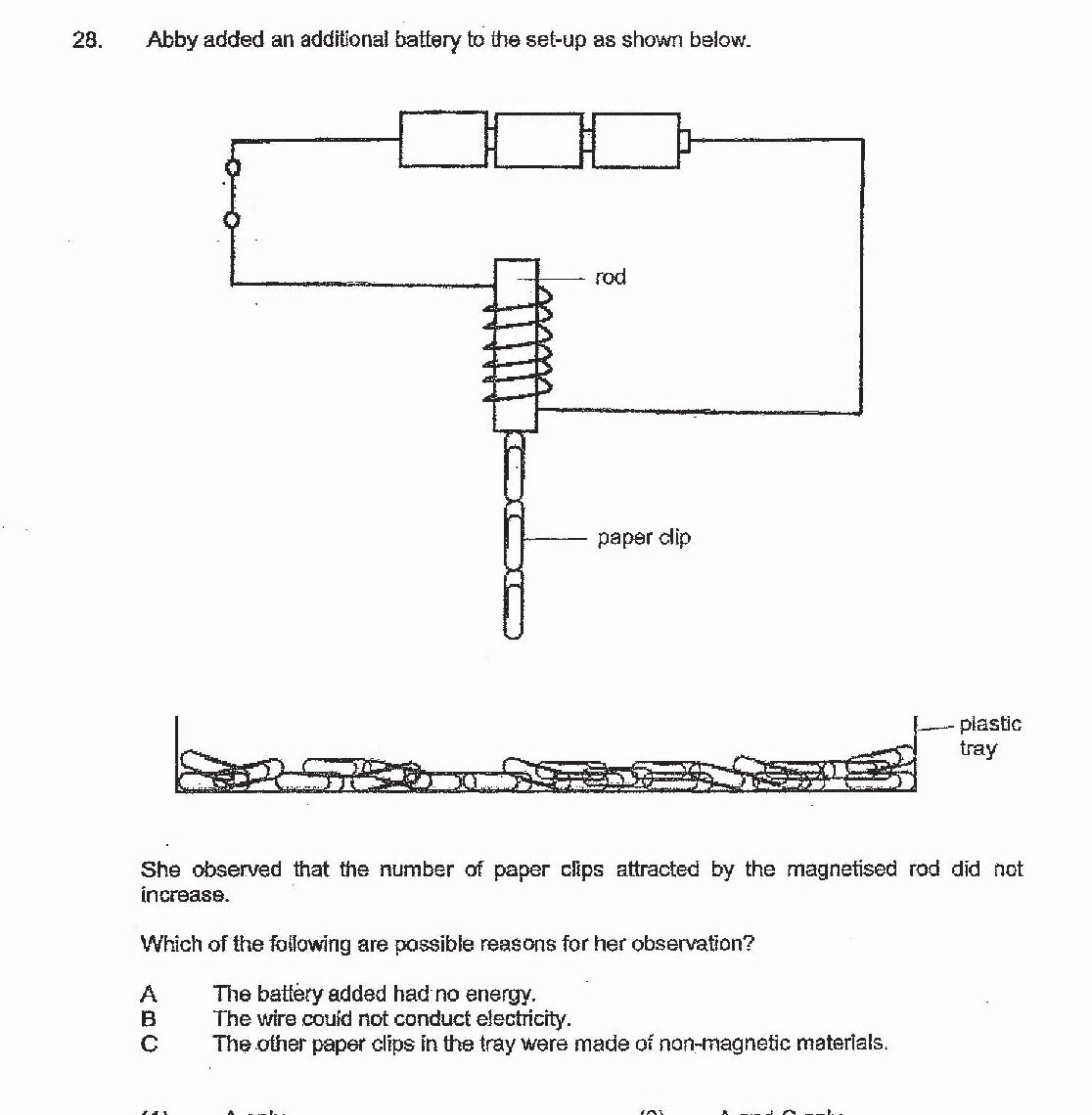
Abby added an additional battery to the set-up as shown below. She observed that the number of paper clips attracted by the magnetised rod did not increase. Which of the following are possible reasons for her observation?
The button magnet did not drop when 50 cm³ of water was poured into the cup in Diagram 2. Explain why the button magnet did not drop off.
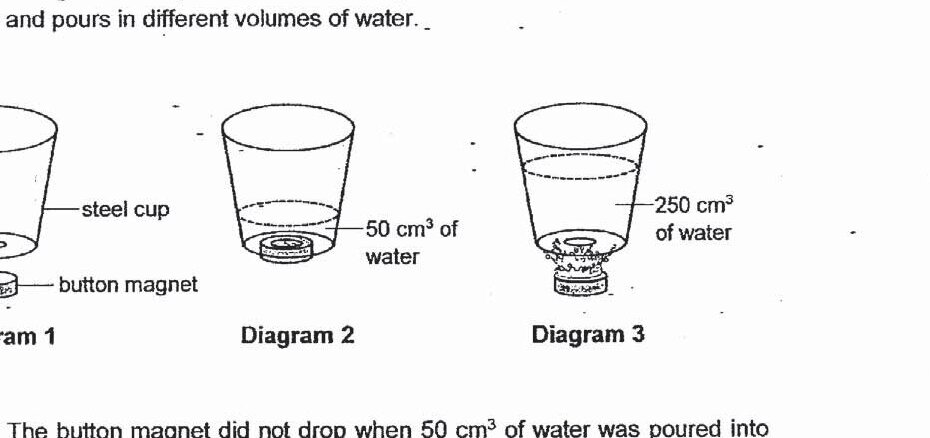
The button magnet dropped when 250 cm³ of water was poured into the cup in Diagram 3. Explain, in terms of forces, why the button magnet dropped.
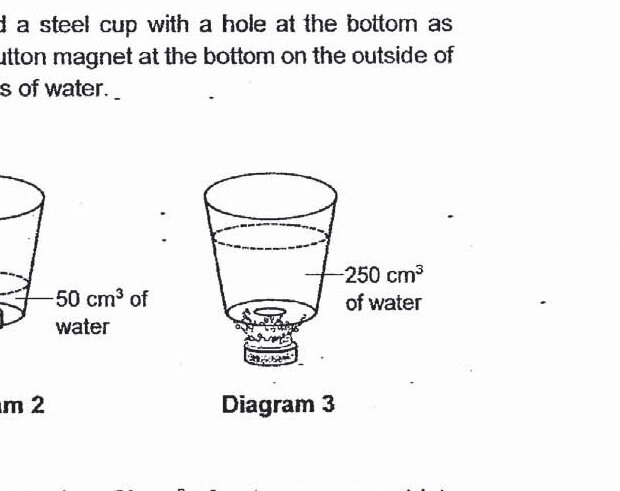
Name the force(s) acting on the button magnet in Diagram 2.
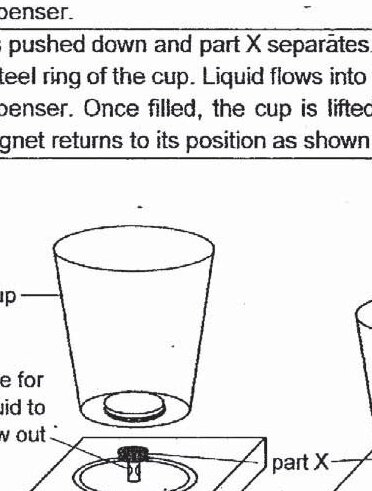
Suggest a material for part X to ensure that the button magnet remain at its position above the steel ring when the plastic cup is filled and lifted. Explain your answer.
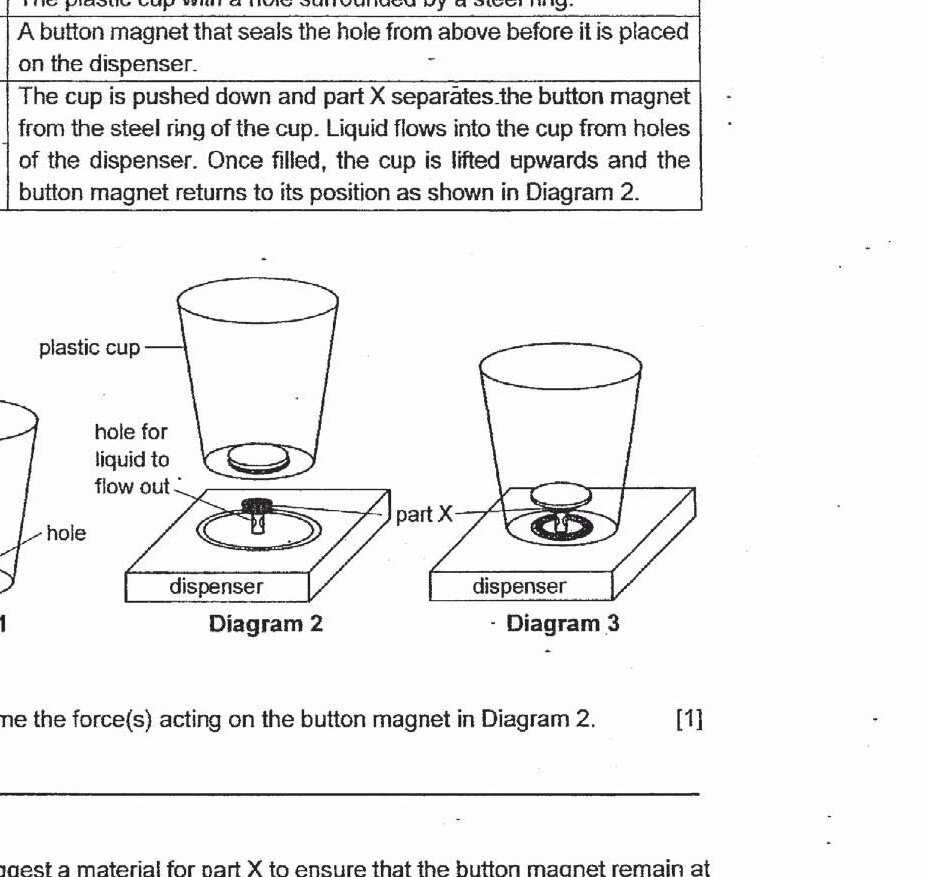
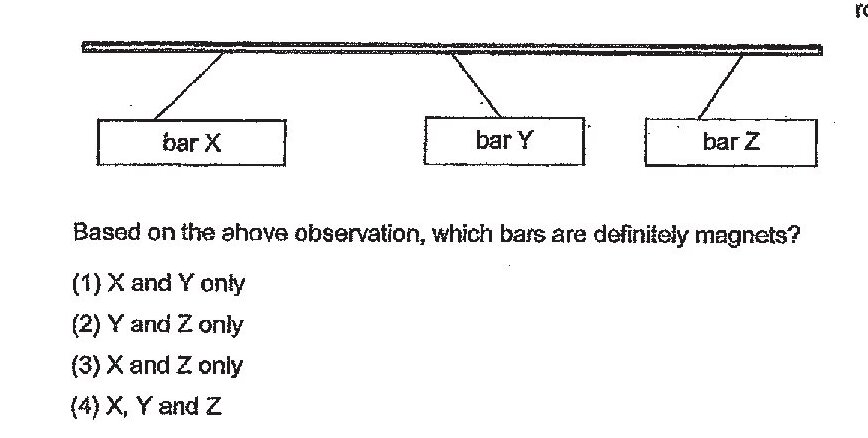
Three bars were freely suspended on a rod as shown in the diagram below. Based on the above observation, which bars are definitely magnets?
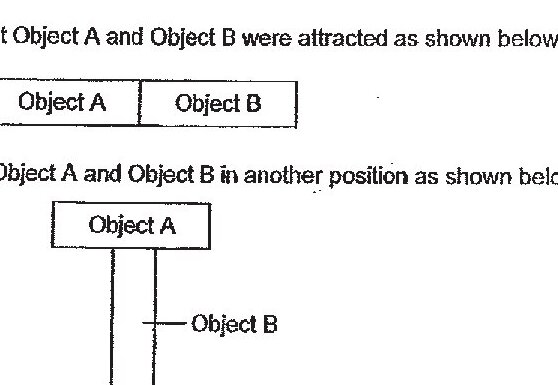
Aziz observed that Object A and Object B were attracted as shown below. Aziz then placed Object A and Object B in another position as shown below. He noticed that Object A and Object B were not attracted. Which one of the following correctly explains why this happened?
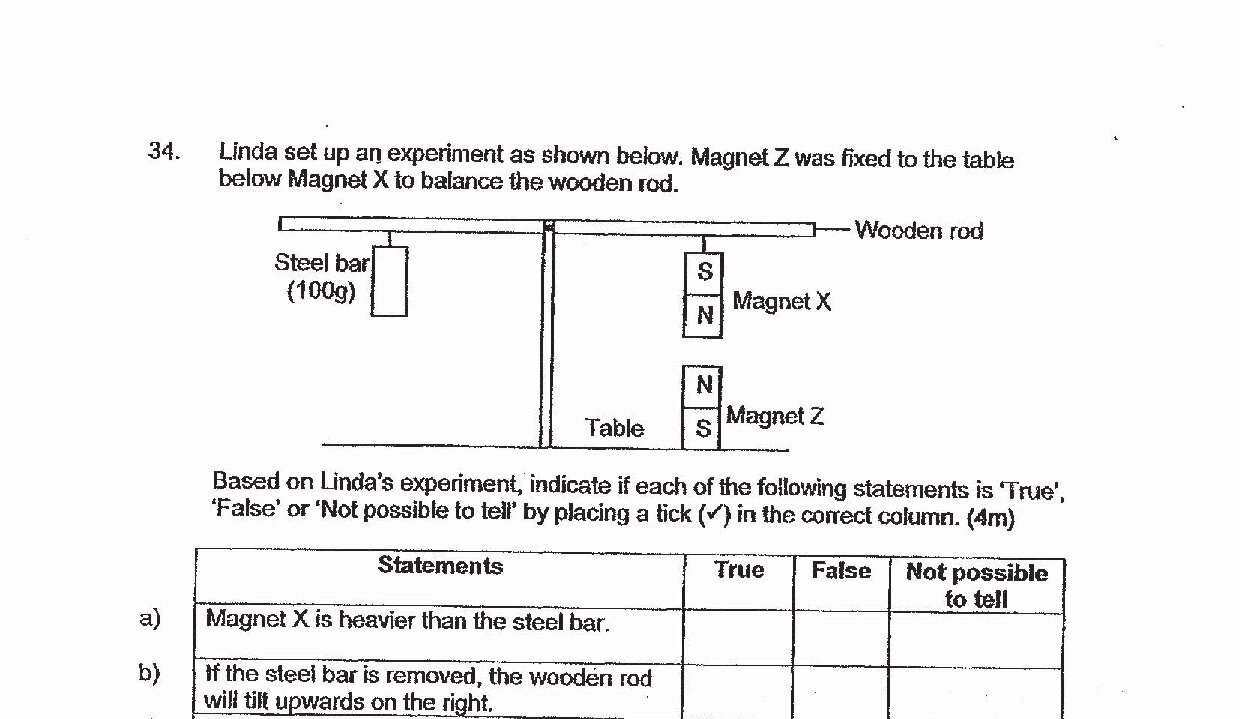
Linda set up an experiment as shown below. Magnet Z was fixed to the table below Magnet X to balance the wooden rod. Based on Linda's experiment, indicate if each of the following statements is 'True', 'False' or 'Not possible to tell' by placing a tick (✓) in the correct column.
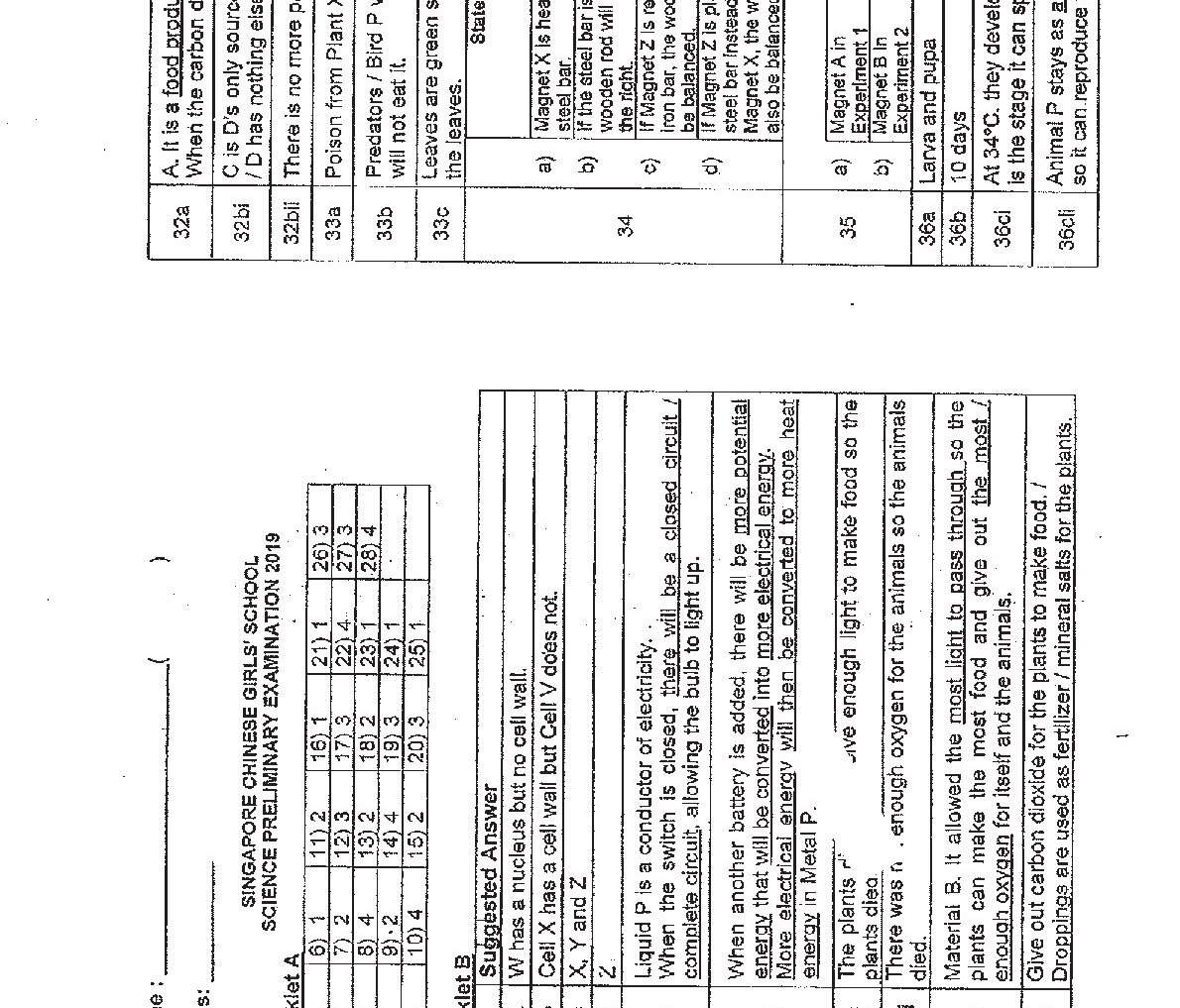
Magnet X is heavier than the steel bar.

If the steel bar is removed, the wooden rod will tilt upwards on the right.

If Magnet Z is replaced by an iron bar, the wooden rod will be balanced.

If Magnet Z is placed below the steel bar instead of below Magnet X, the wooden rod will be balanced.
In Experiment 1, Meihua placed Magnet A on a slope. Magnet A remains stationary on the slope. In Experiment 2, Meihua placed another magnet, Magnet B on the slope. Magnet B moved up the slope and touched Magnet A. In the table below, indicate the forces that are acting on the magnets by placing ticks (✓) in the appropriate columns.
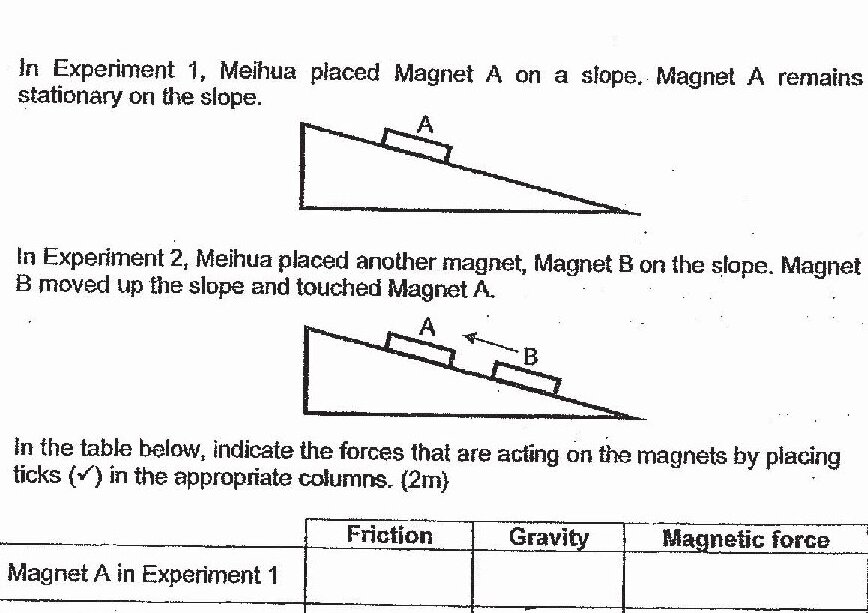
Magnet A in Experiment 1

Magnet B in Experiment 2

Why did the steel ball get attracted to the magnet?
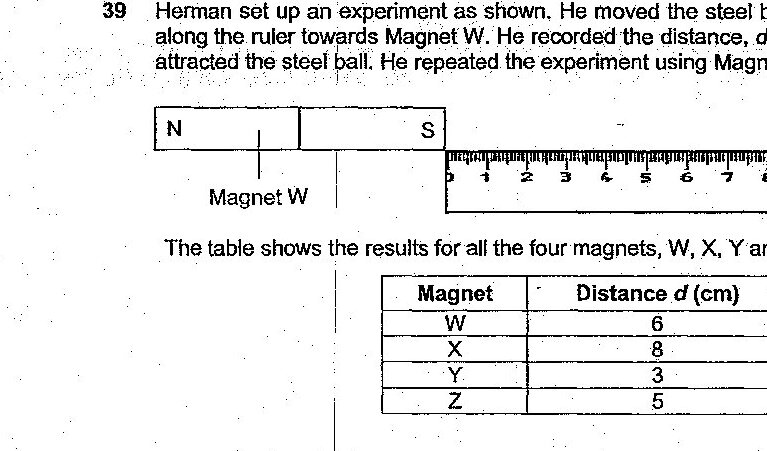
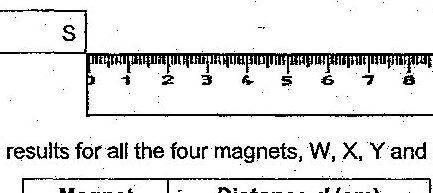
Based on the result of his experiment, arrange the magnets according to their strength from the strongest to the weakest.
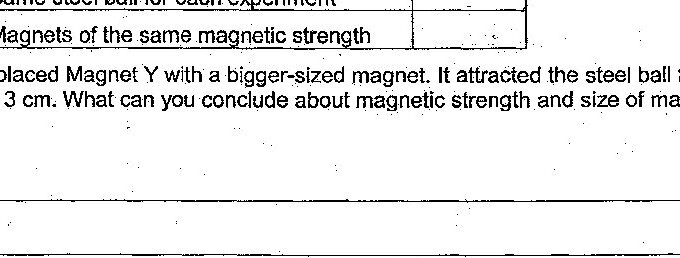
Herman replaced Magnet Y with a bigger-sized magnet. It attracted the steel ball from a distance of 3 cm. What can you conclude about magnetic strength and size of magnet?
Herman dropped Magnet X several times and tested it out again. Will Magnet X attract the steel ball from a distance of 8 cm, more than 8 cm or less than 8 cm? Explain your answer.
Mei Ling wanted to investigate whether the size of a magnet affects the greatest distance it can attract a paper clip. Which of the following variables should she keep constant?
The diagram below shows a wooden rod with a magnet P and iron ball Q hanging from a rope. Which one of the following statements is false?
Past year papers cover the full exam — browse by subject below.
View All Papers ›