Electrical System
Electrical System - Comprehensive Study Notes
Key Concepts
Electric Current
- Electric current is the flow of electric charges through a conducting material
- Current flows from the positive terminal (+) to the negative terminal (-) of a battery/cell
- Current flows only in a closed circuit (complete loop with no breaks)
- If there is a break anywhere in the circuit, current cannot flow and electrical devices will not work
- The greater the current flowing, the brighter the bulb will light up or the faster the motor will spin
- Current is measured using an ammeter, which is connected in series in a circuit
- The unit of current is Ampere (A) or milliampere (mA)
Series Circuits
- In a series circuit, electrical components are connected one after another in a single loop
- There is only ONE path for current to flow
- If one component fails or is removed, the entire circuit breaks and all components stop working
- Current is the same at all points in a series circuit
- The brightness of bulbs decreases when more bulbs are added in series (current is shared)
- Batteries/cells in series provide greater voltage (total voltage adds up)
- Example: decorative string lights where if one bulb fails, all lights go out
Parallel Circuits
- In a parallel circuit, electrical components are connected on separate branches
- There are multiple paths for current to flow
- If one component fails or is removed, other components continue to work (other branches remain complete)
- Current splits up at junctions and flows through different branches
- Bulbs in parallel circuits maintain their brightness even when more bulbs are added
- Each branch receives the same voltage from the battery
- Most household electrical circuits are parallel circuits
- Example: home lighting - when one light is switched off, others continue working
Conductors and Insulators
Conductors:
- Materials that allow electric current to flow through them easily
- They have charges (electrons) that are free to move
- Common examples:
- All metals (copper, aluminium, iron, steel, gold, silver)
- Graphite (form of carbon, used in pencil leads)
- Human body and animals (contain water and minerals)
- Water containing dissolved substances (saltwater, tap water)
- Copper is most commonly used in electrical wires because it is a good conductor and relatively inexpensive
Insulators:
- Materials that do not allow electric current to flow through them easily
- They have charges that are tightly bound and cannot move freely
- Common examples:
- Plastics (polythene, PVC)
- Rubber
- Wood (dry)
- Glass
- Ceramic
- Paper
- Air
- Pure water (distilled water)
- Used as safety materials to coat wires and electrical appliances
- Prevents electric shocks and short circuits
Factors Affecting Current
1. Number of Cells/Batteries:
- More cells connected in series = Greater voltage = Greater current
- Greater current results in:
- Bulbs glowing brighter
- Motors spinning faster
- Buzzers sounding louder
2. Number of Components in Series:
- More bulbs/motors in series = Greater resistance = Smaller current
- Smaller current results in:
- Each bulb glowing dimmer
- Motors spinning slower
- Buzzers sounding softer
3. Length of Wire:
- Longer wire = Greater resistance = Smaller current
- Shorter wire = Less resistance = Greater current
- This is why extension cords should not be too long
4. Thickness of Wire:
- Thicker wire = Less resistance = Greater current
- Thinner wire = Greater resistance = Smaller current
- Electrical appliances use appropriately thick wires for safety
5. Type of Material:
- Good conductors (like copper) = Greater current
- Poor conductors or insulators = Little or no current
6. Circuit Configuration:
- Series circuit: current is the same throughout; adding components reduces current
- Parallel circuit: current splits; each branch can have different currents; total current is sum of branch currents
Combining Electrical Systems and Forces
Examiners often combine the Electrical System topic with Forces in a single question. A common context is a barrier-lifting system triggered by a car driving onto a spring pad.
How the Barrier-Lifting System Works
- A car drives onto a sense pad containing a compressed spring with metal contacts.
- The car’s weight exerts a gravitational force downward on the sense pad.
- The spring in the pad exerts an elastic spring force upward (opposing the compression).
- When the gravitational force is greater than the elastic spring force, the spring compresses.
- Spring compression pushes the metal contacts together, closing the circuit.
- Once the circuit is closed, electric current flows through the circuit and through device D (a motor).
- The motor then lifts the barrier.
Soft Spring vs Stiff Spring
| Spring Type | Compression under the same force |
|---|---|
| Soft spring | Compresses/extends more |
| Stiff spring | Compresses/extends less |
- A soft spring requires less force to compress by the same distance.
- A stiff spring requires more force to compress by the same distance.
- If a lighter car does not trigger the system, replacing the stiff spring with a softer spring allows the contacts to still meet under the smaller force.
Important Definitions
Electric current: The flow of electric charges through a conducting material from the positive terminal to the negative terminal of a cell or battery.
Closed circuit: A complete, unbroken loop that allows electric current to flow continuously through all components.
Open circuit: A circuit with a break or gap that prevents electric current from flowing.
Series circuit: A circuit in which electrical components are connected one after another in a single path, so that the same current flows through all components.
Parallel circuit: A circuit in which electrical components are connected on separate branches, providing multiple paths for current to flow.
Conductor: A material that allows electric current to flow through it easily because it has charges that can move freely.
Insulator: A material that does not allow electric current to flow through it easily because its charges cannot move freely.
Ammeter: An instrument used to measure electric current in a circuit; it must be connected in series.
Voltage: The electrical “push” provided by a cell or battery that drives current through a circuit; measured in volts (V).
Resistance: The opposition to the flow of electric current in a circuit; greater resistance results in smaller current.
Short circuit: An unintended path in a circuit that allows current to flow without passing through the intended components, often causing excessive current and danger.
Worked Examples
Example 1: Comparing Series and Parallel Circuits
Question: Sarah sets up two circuits:
- Circuit A: 2 identical bulbs connected in series with 2 cells
- Circuit B: 2 identical bulbs connected in parallel with 2 cells
Compare the brightness of the bulbs in each circuit and explain what happens if one bulb is removed from each circuit.
Step-by-Step Solution:
Step 1: Analyze brightness in Circuit A (series)
- In series, current flows through both bulbs one after another
- The current is shared between the bulbs
- Each bulb will be dimmer compared to a single bulb in a circuit
- Both bulbs have equal brightness to each other (same current flows through both)
Step 2: Analyze brightness in Circuit B (parallel)
- In parallel, each bulb is on a separate branch
- Each bulb receives the full voltage from the battery
- Each bulb will be bright (same brightness as if it were alone in the circuit)
- Both bulbs have equal brightness to each other
Step 3: Compare the circuits
- Bulbs in Circuit B (parallel) are brighter than bulbs in Circuit A (series)
Step 4: Analyze what happens when one bulb is removed
Circuit A (series):
- Removing one bulb creates an open circuit (break in the loop)
- No current can flow
- The other bulb will go off (stop lighting)
Circuit B (parallel):
- Removing one bulb only breaks one branch
- The other branch remains a complete circuit
- Current continues to flow through the other branch
- The other bulb will continue to light up with the same brightness
Answer: The bulbs in Circuit B (parallel) are brighter than those in Circuit A (series). If one bulb is removed from Circuit A, the other bulb goes off because the circuit is broken. If one bulb is removed from Circuit B, the other bulb continues to light up because current can still flow through its branch.
Example 2: Predicting Effects on Current
Question: A circuit contains 1 cell, 1 bulb, and a switch. The bulb glows with medium brightness.
Predict and explain what happens to the brightness of the bulb when: a) Another cell is added in series b) Another bulb is added in series c) The wire connecting the circuit is replaced with a longer wire
Step-by-Step Solution:
Part (a): Another cell is added in series
Step 1: Identify the effect
- More cells in series = Greater total voltage
Step 2: Effect on current
- Greater voltage = Greater current flowing through the circuit
Step 3: Effect on bulb
- Greater current = Bulb glows brighter
Answer (a): The bulb will glow brighter because the additional cell increases the voltage, causing more current to flow through the circuit.
Part (b): Another bulb is added in series
Step 1: Identify the effect
- More components in series = Greater total resistance
Step 2: Effect on current
- Greater resistance = Smaller current flowing through the circuit
Step 3: Effect on original bulb
- Smaller current = Each bulb glows dimmer
Answer (b): The original bulb (and the new bulb) will both glow dimmer because the current flowing through the series circuit decreases when more components are added.
Part ©: Longer wire used
Step 1: Identify the effect
- Longer wire = Greater resistance in the circuit
Step 2: Effect on current
- Greater resistance = Smaller current flowing
Step 3: Effect on bulb
- Smaller current = Bulb glows dimmer
Answer ©: The bulb will glow dimmer because the longer wire increases the resistance, reducing the current flowing through the circuit.
Example 3: Identifying Conductors and Insulators
Question: David wants to test whether different materials allow electricity to pass through them. He sets up a circuit with a cell, a bulb, and a gap where he can place test materials.
He tests: copper wire, plastic ruler, iron nail, rubber band, and aluminum foil.
Predict which materials will cause the bulb to light up and explain why.
Step-by-Step Solution:
Step 1: Identify what makes the bulb light up
- The bulb lights up when the circuit is closed (complete)
- This happens when the test material is a conductor
- Conductors allow current to flow through them
Step 2: Classify each material
Copper wire:
- Copper is a metal
- All metals are good conductors
- Bulb will light up ✓
Plastic ruler:
- Plastic is an insulator
- Does not allow current to flow
- Bulb will not light up ✗
Iron nail:
- Iron is a metal
- Metals are good conductors
- Bulb will light up ✓
Rubber band:
- Rubber is an insulator
- Does not allow current to flow
- Bulb will not light up ✗
Aluminum foil:
- Aluminum is a metal
- Metals are good conductors
- Bulb will light up ✓
Step 3: Provide explanation
Answer: The bulb will light up when David tests the copper wire, iron nail, and aluminum foil because these are all metals and metals are good conductors of electricity. They allow current to flow through them, completing the circuit.
The bulb will not light up when he tests the plastic ruler and rubber band because these are insulators. They do not allow current to flow through them, so the circuit remains open.
Common Mistakes to Avoid
1. Direction of Current Flow
- ❌ WRONG: Saying current flows from negative to positive
- ✓ CORRECT: Current flows from positive (+) terminal to negative (-) terminal
- Remember: + to - (plus to minus)
2. Series vs Parallel - What Happens When One Component Fails
- ❌ WRONG: In parallel circuits, if one bulb is removed, all bulbs go off
- ✓ CORRECT: In parallel circuits, if one bulb is removed, other bulbs continue working because there are multiple paths
- ❌ WRONG: In series circuits, if one bulb is removed, other bulbs continue working
- ✓ CORRECT: In series circuits, if one bulb is removed, all bulbs go off because there is only one path
3. Brightness in Different Circuits
- ❌ WRONG: Bulbs in series are brighter than bulbs in parallel
- ✓ CORRECT: Bulbs in parallel are brighter than bulbs in series (when using same power source)
- Remember: Series = Share current (dimmer); Parallel = Full voltage (brighter)
4. Conductors and Insulators
- ❌ WRONG: Saying wood, plastic, or rubber are conductors
- ✓ CORRECT: These are insulators; only metals and graphite are common conductors
- ❌ WRONG: Saying pure water is a conductor
- ✓ CORRECT: Pure (distilled) water is an insulator; tap water/saltwater conducts because of dissolved substances
5. Effect of Adding Components
- ❌ WRONG: More bulbs in series = brighter bulbs
- ✓ CORRECT: More bulbs in series = dimmer bulbs (current decreases)
- ❌ WRONG: More cells means bulbs get dimmer
- ✓ CORRECT: More cells in series = greater current = brighter bulbs
6. Drawing Circuit Diagrams
- ❌ WRONG: Drawing pictorial representations (realistic pictures of bulbs, batteries)
- ✓ CORRECT: Use standardized circuit symbols only
- ❌ WRONG: Using curved or wavy lines for wires
- ✓ CORRECT: Use straight lines with a ruler; wires must connect properly at junctions
7. Ammeter Placement
- ❌ WRONG: Ammeter connected in parallel
- ✓ CORRECT: Ammeter must be connected in series to measure current flowing through it
- Remember: Ammeter = Along the path (series)
8. Open vs Closed Circuits
- ❌ WRONG: Current flows in an open circuit but bulbs don’t work
- ✓ CORRECT: In an open circuit, there is NO current flow at all because the circuit is broken
- A switch in the “open” position creates an open circuit (no current flows)
9. Comparing Current in Series Circuits
- ❌ WRONG: Current is greater near the battery and smaller far from it
- ✓ CORRECT: Current is the same everywhere in a series circuit
- Don’t confuse current with voltage/energy
10. Material Classification
- ❌ WRONG: Thinking wet hands are safe with electricity because skin is an insulator
- ✓ CORRECT: Human body (especially when wet) is a conductor; water and dissolved minerals make it conduct electricity
- Never touch electrical appliances with wet hands
11. Not Stating Force Directions in Combined Questions
- ❌ WRONG: Saying ‘the spring compresses when the car drives on it’ without comparing forces
- ✓ CORRECT: ‘The gravitational force acting downward on the spring is greater than the elastic spring force acting upward, so the spring compresses’
- Always name both forces and their directions before explaining spring behaviour
12. Skipping the Link Between Spring Compression and Circuit Closure
- ❌ WRONG: ‘The spring compresses, so current flows’
- ✓ CORRECT: ‘The spring compresses, bringing the metal contacts together to close/complete the circuit, so current flows’
- You must explicitly state that compression brings the contacts together
13. Wrong Solution for a Lighter Car Not Triggering the System
- ❌ WRONG: ‘Increase the force applied to the spring’ (you cannot control the car’s weight)
- ✓ CORRECT: ‘Use a softer spring, because a soft spring compresses more under the same (smaller) force, so the contacts can still touch and close the circuit’
14. Incomplete Chain of Reasoning in Combined Questions
- ❌ WRONG: Giving only part of the sequence (e.g., just mentioning the spring or just mentioning current)
- ✓ CORRECT: State all four steps — (1) force comparison → (2) spring compresses → (3) circuit closes → (4) current flows / barrier lifts
- Each step may carry a separate mark
Exam Tips
Keywords to Use in Answers
For Current Flow:
- “Current flows from the positive terminal to the negative terminal”
- “Current flows only in a closed/complete circuit”
- “No current flows when the circuit is open/broken”
For Series Circuits:
- “Components are connected one after another / in a single path”
- “Current is the same at all points in a series circuit”
- “If one component fails, all components stop working”
- “More components in series results in smaller current”
For Parallel Circuits:
- “Components are connected on separate branches / multiple paths”
- “Current splits at junctions and rejoins”
- “If one component fails, other components continue working”
- “Each branch receives the same voltage”
For Conductors:
- “Conductors allow current to flow through them easily”
- “Examples: all metals (copper, iron, aluminum) and graphite”
For Insulators:
- “Insulators do not allow current to flow through them easily”
- “Examples: plastic, rubber, glass, wood, ceramic”
For Factors Affecting Current:
- More cells: “Greater voltage results in greater current”
- More components in series: “Greater resistance results in smaller current”
- Longer/thinner wire: “Greater resistance results in smaller current”
- Effect phrases: “brighter/dimmer, faster/slower, louder/softer”
Answering Compare Questions
When asked to compare two circuits, always mention BOTH:
- ❌ “Circuit A has bright bulbs” (incomplete)
- ✓ “Circuit A has brighter bulbs than Circuit B” (complete comparison)
- ✓ “Circuit A has bright bulbs while/whereas Circuit B has dim bulbs”
Cause and Effect Explanations
Use the structure: State what happens → Explain why → Describe the result
Example:
- “When another cell is added in series (what), the voltage increases (why), causing more current to flow and the bulb glows brighter (result).”
Safety-Related Questions
If asked about safety with electricity:
- Mention that insulators (rubber, plastic) prevent electric shocks
- Explain that wires are coated with plastic/rubber insulation
- Never touch electrical appliances with wet hands (water is a conductor)
- Never overload electrical sockets
- Metal objects should not be inserted into sockets
Drawing Diagrams
Checklist for full marks:
- Use a ruler for all straight lines
- Use correct circuit symbols (not pictures)
- All components must be connected in a closed loop
- Clearly show positive (+) and negative (-) terminals
- Label all components if required
- For parallel circuits, clearly show where wires split and rejoin
Common Question Types
1. “What happens if…” questions:
- Always explain the effect on current first
- Then explain the effect on the component (brightness/speed/loudness)
2. “Explain why…” questions:
- Give the reason (more cells/more resistance/conductor/insulator)
- Link it to current flow (greater/smaller/no current)
- State the observable result (brighter/dimmer/on/off)
3. “Compare and explain…” questions:
- Make clear comparisons using comparative words (brighter than, more than)
- Explain differences based on circuit type or factors affecting current
- Usually worth 2-3 marks, so give detailed explanations
4. Conductor/Insulator identification:
- State whether material is conductor or insulator
- Give reason: “because it is a metal” OR “because it is a plastic/rubber”
- State result: “allows/does not allow current to flow”
Mark-Earning Phrases
2-mark questions typically require:
- One statement about current (increases/decreases/same)
- One statement about the observable effect (brighter/dimmer/on/off)
3-mark questions typically require:
- What changes (more cells/components/longer wire)
- How current is affected (greater/smaller current flows)
- Observable result (brighter/dimmer/faster/slower) with comparison
Answering Combined Forces-and-Electrical Questions
Use this 4-step chain:
- Compare forces: ‘The gravitational force acting downward is greater than the elastic spring force acting upward.’
- Spring compresses: ‘Therefore, the spring compresses.’
- Circuit closes: ‘The compression brings the metal contacts together, closing/completing the circuit.’
- Current flows / device activates: ‘Current flows through device D (the motor), which lifts the barrier.’
Key vocabulary to use:
- Name the forces: gravitational force (downward) and elastic spring force (upward)
- Use the word ‘compresses’ — not just ‘pushes down’ or ‘moves’
- Say the contacts ‘touch’ or ‘come together’ to ‘close/complete the circuit’
Lighter car scenario: If asked why a lighter car does not trigger the system and what can be done:
- Explain: The gravitational force of the lighter car is not greater than the elastic spring force, so the spring does not compress enough for the contacts to touch.
- Solution: Use a softer spring, because a soft spring compresses more with the same (smaller) force, allowing the contacts to touch and close the circuit.
Quick Summary
Essential Points to Remember:
✓ Current flows from positive (+) to negative (-) terminal in a closed circuit only; no current flows in an open circuit
✓ Series circuits: components in one path; same current throughout; if one fails, all stop; more components = dimmer/slower
✓ Parallel circuits: components on separate branches; current splits; if one fails, others continue; bulbs stay bright
✓ Conductors (allow current): all metals (copper, iron, aluminum, steel, gold, silver), graphite, human body, impure water
✓ Insulators (block current): plastic, rubber, wood, glass, ceramic, paper, air, pure water
✓ More cells in series → greater voltage → greater current → brighter bulbs/faster motors/louder buzzers
✓ More components in series → greater resistance → smaller current → dimmer bulbs/slower motors/softer buzzers
✓ Longer/thinner wires → greater resistance → smaller current → reduced performance
✓ Ammeter measures current and must be connected in series; circuit symbols must be used in diagrams
✓ Testing materials: if bulb lights up when material is placed in gap, the material is a conductor; if bulb doesn’t light up, material is an insulator
✓ Safety: insulators (plastic/rubber coating) prevent electric shocks; never use electricity with wet hands; body conducts electricity
✓ Household circuits are parallel circuits so that appliances work independently; if one device switches off, others continue working
Final Reminder: Always explain your answers using the correct sequence: what changes → effect on current → observable result. Use comparative words when comparing circuits and always mention both circuits being compared.
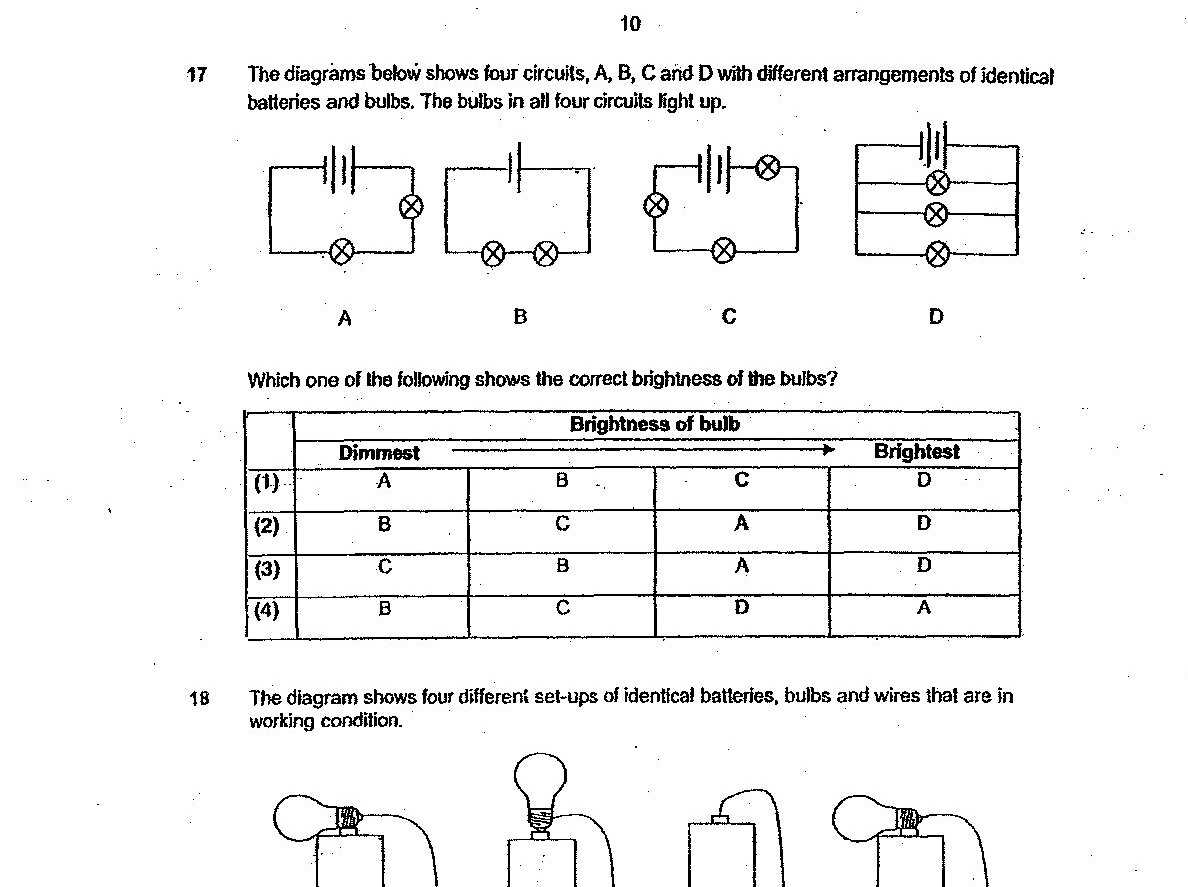
The diagrams below shows four circuits, A, B, C and D with different arrangements of identical batteries and bulbs. The bulbs in all four circuits light up. Which one of the following shows the correct brightness of the bulbs?
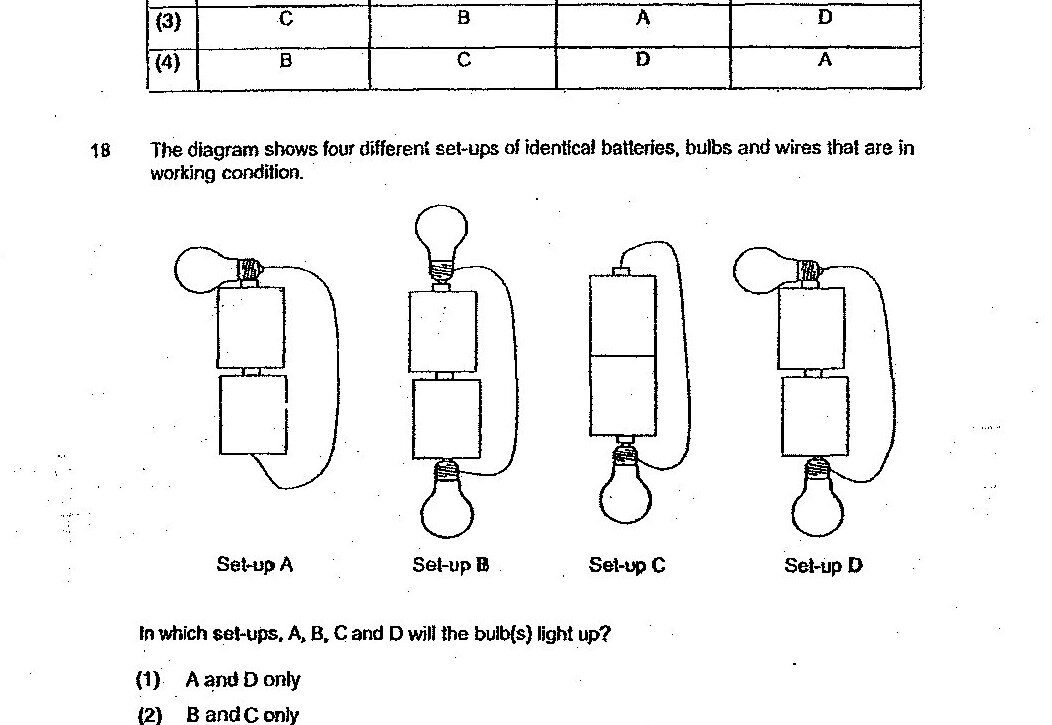
The diagram shows four different set-ups of identical batteries, bulbs and wires that are in working condition. In which set-ups, A, B, C and D will the bulb(s) light up?
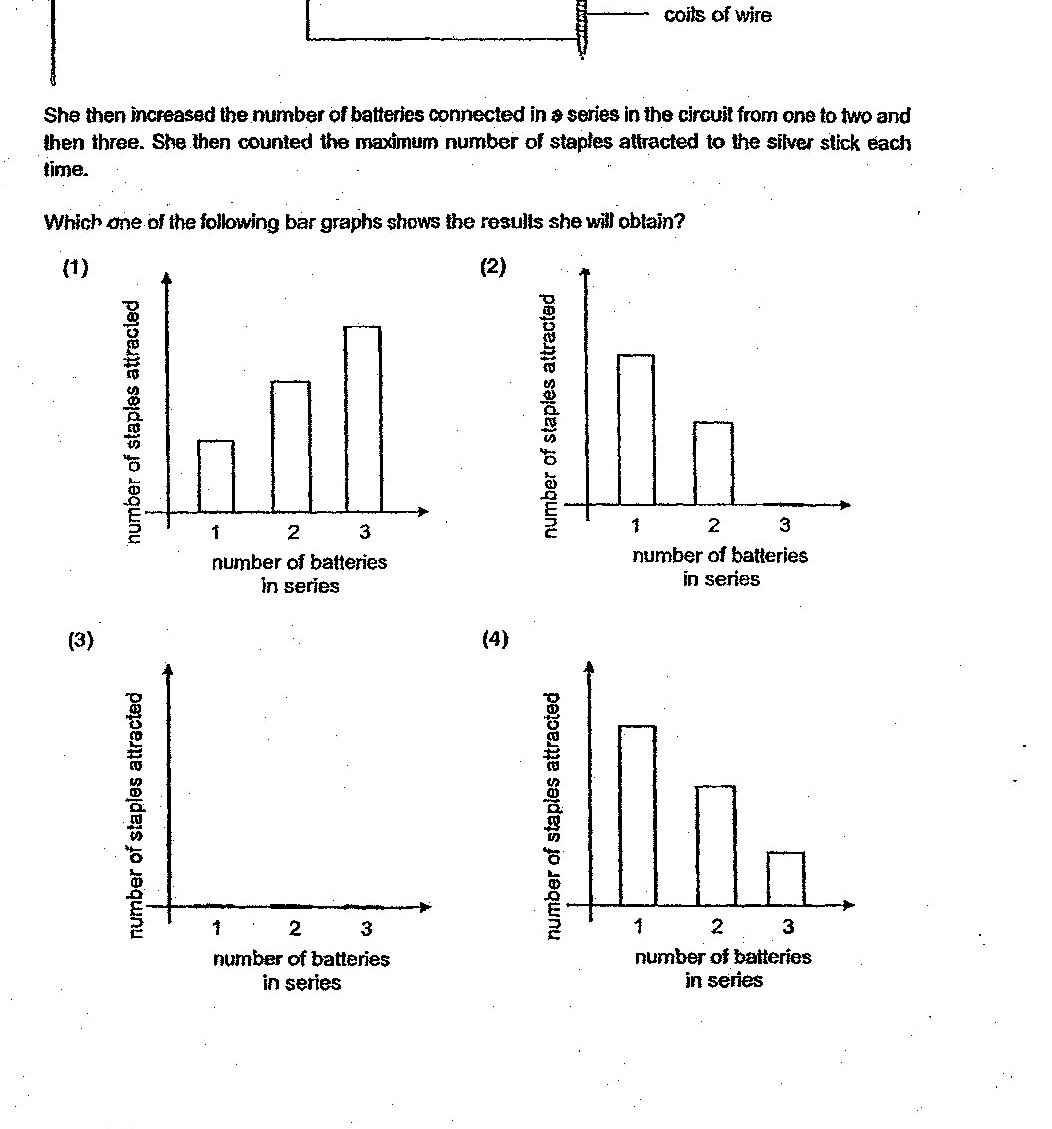
Pei Ling used a silver stick, a battery and some wires to set up the circuit as shown. She then increased the number of batteries connected in a series in the circuit from one to two and then three. She then counted the maximum number of staples attracted to the silver stick each time. Which one of the following bar graphs shows the results she will obtain?
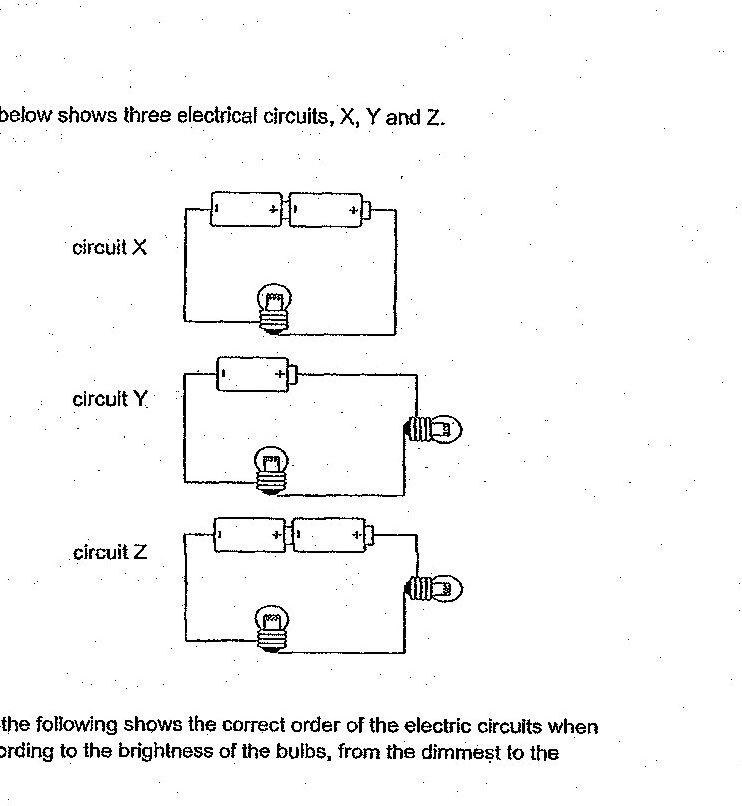
Which one of the following shows the correct order of the electric circuits when arranged according to the brightness of the bulbs, from the dimmest to the brightest?
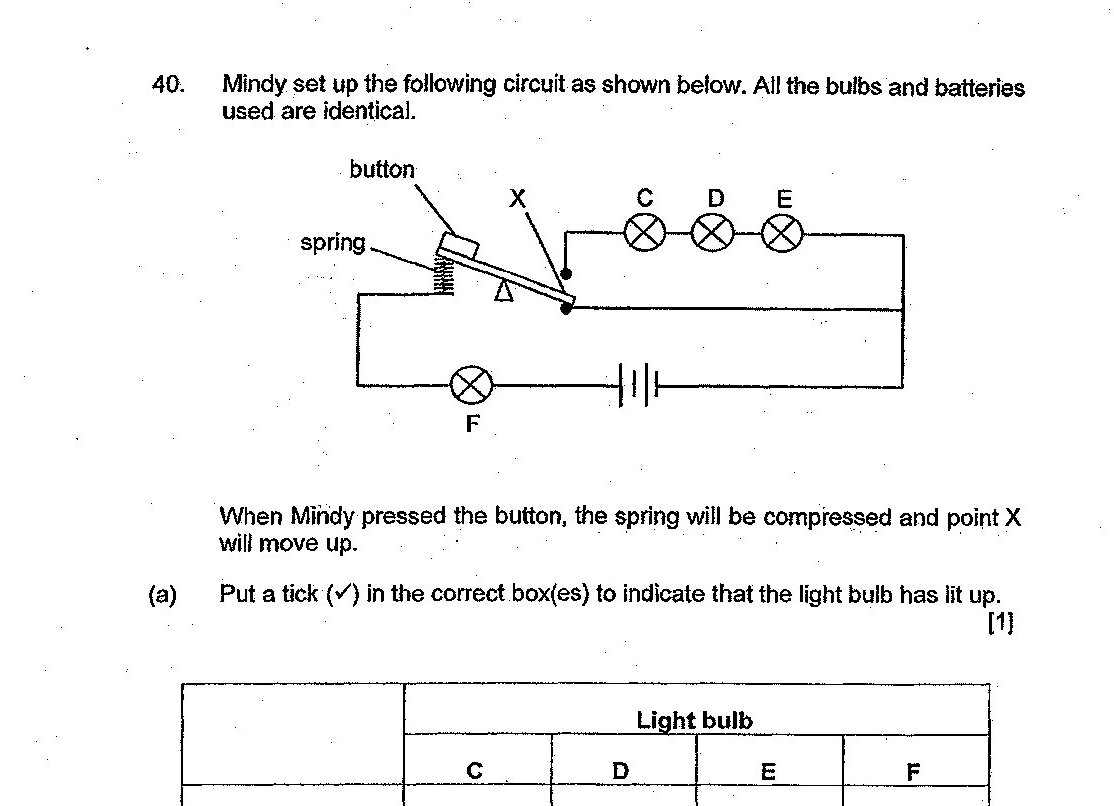
Without changing the number of batteries and bulbs, what can Mindy do to the circuit to ensure that bulb F will be lit up as brightly as before the button is pressed?
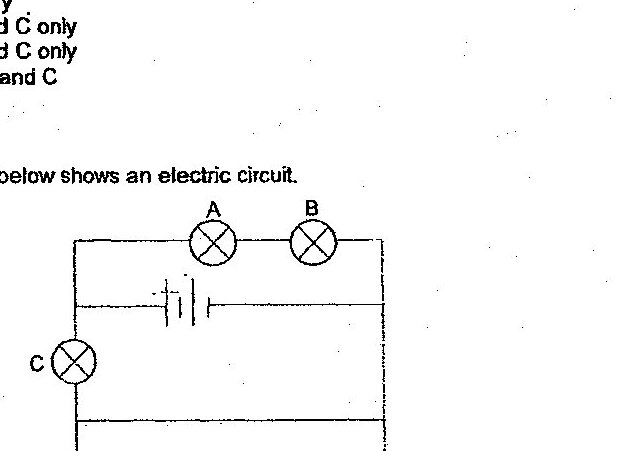
The diagram below shows an electric circuit. Which of following correctly states the number of bulb(s) that would remain lit when one of the bulbs was fused?
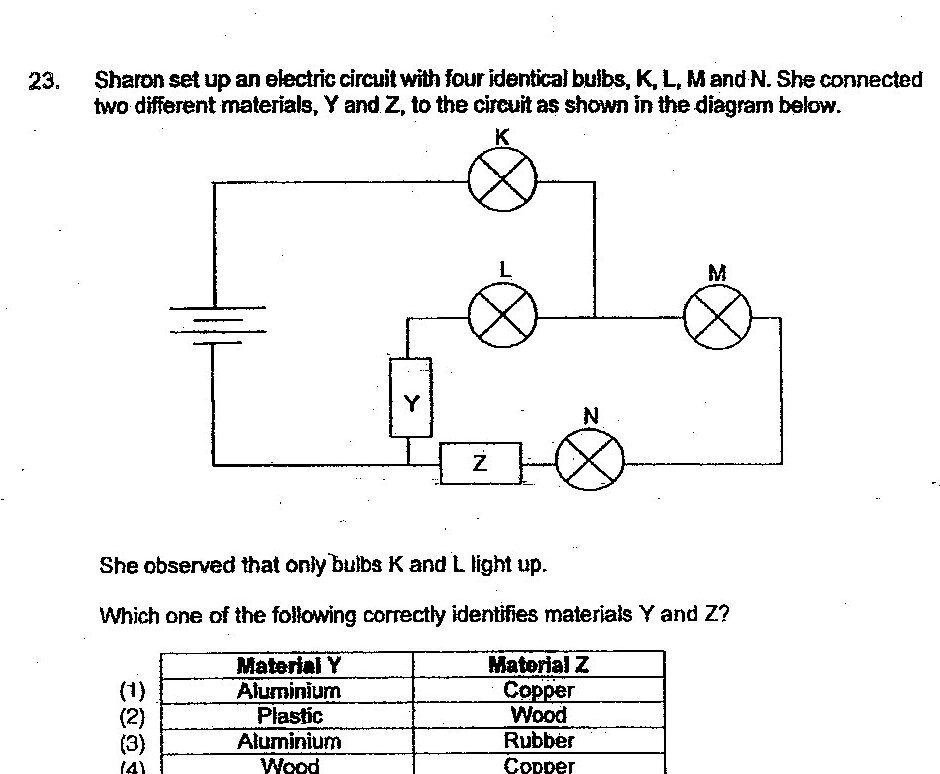
Sharon set up an electric circuit with four identical bulbs, K, L, M and N. She connected two different materials, Y and Z, to the circuit as shown in the diagram below. She observed that only bulbs K and L light up. Which one of the following correctly identifies materials Y and Z?
What is a possible measurement for the brightness of the bulb when three batteries were used?
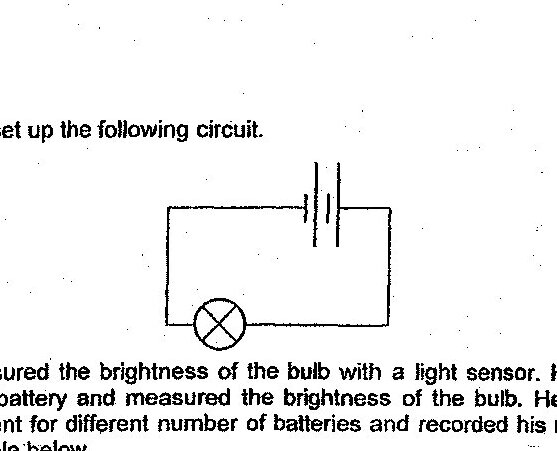
Based on the results, when the number of batteries used is four or below what is the relationship between the brightness of the bulb and the number of batteries?
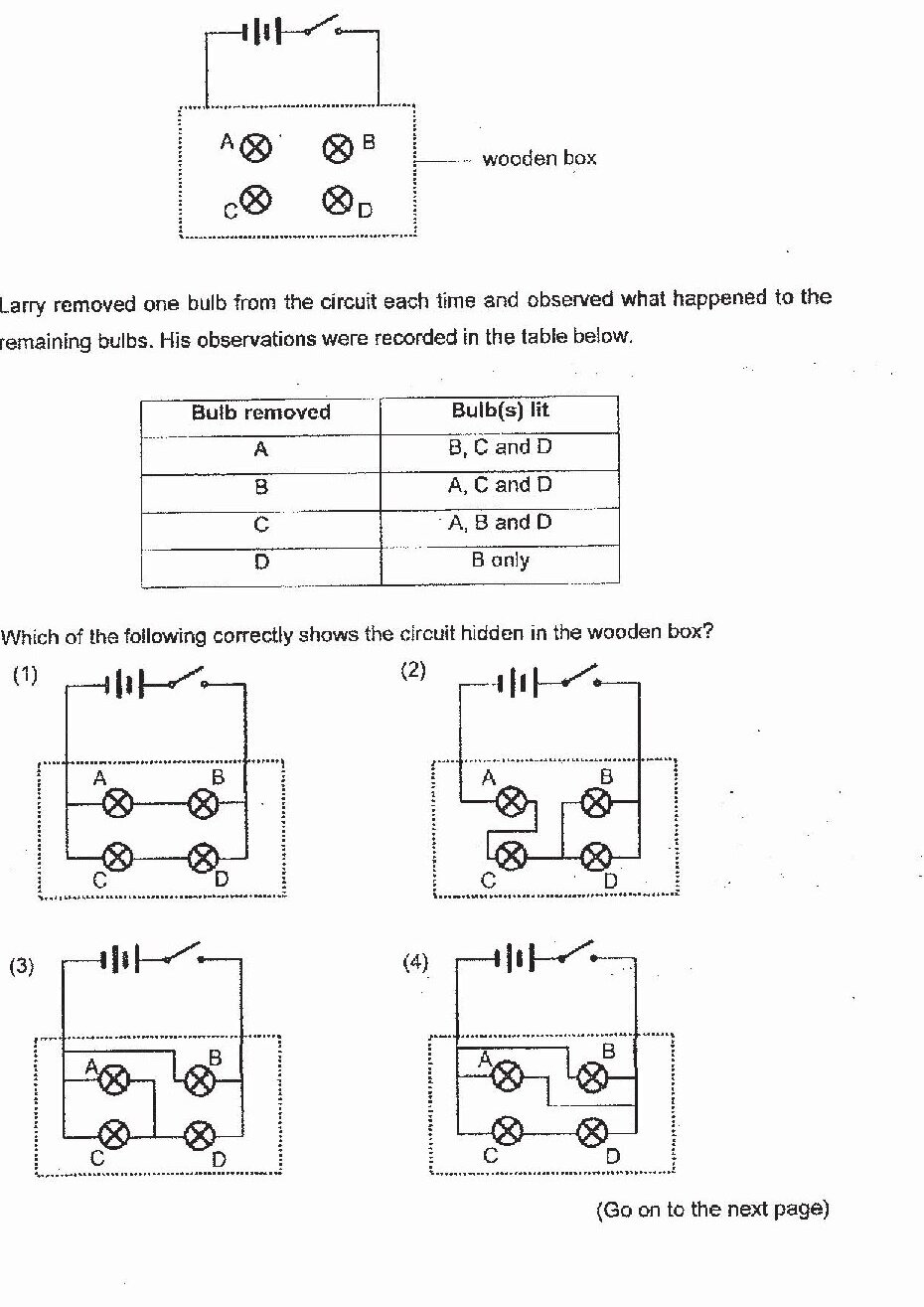
Bulbs A, B, C and D were connected in a circuit hidden in a wooden box as shown. All the bulbs lit up when the circuit was closed. Larry removed one bulb from the circuit each time and observed what happened to the remaining bulbs. His observations were recorded in the table below. Table: - Bulb removed: A | Bulb(s) lit: B, C and D - Bulb removed: B | Bulb(s) lit: A, C and D - Bulb removed: C | Bulb(s) lit: A, B and D - Bulb removed: D | Bulb(s) lit: B only Which of the following correctly shows the circuit hidden in the wooden box?
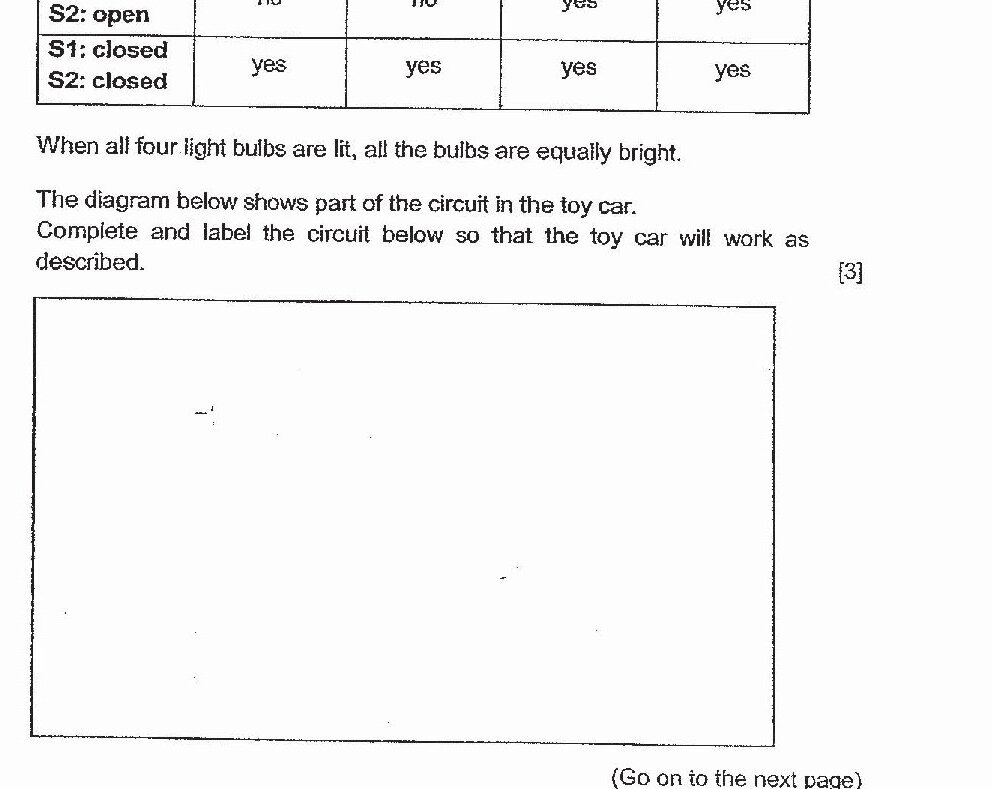
The diagram below shows the positions of light bulbs P, Q, R and S. There are two switches S1 and S2 located at the bottom of the battery-operated toy car. The bulbs in the toy car will light up as shown in the table below. When all four light bulbs are lit, all the bulbs are equally bright. Complete and label the circuit below so that the toy car will work as described.
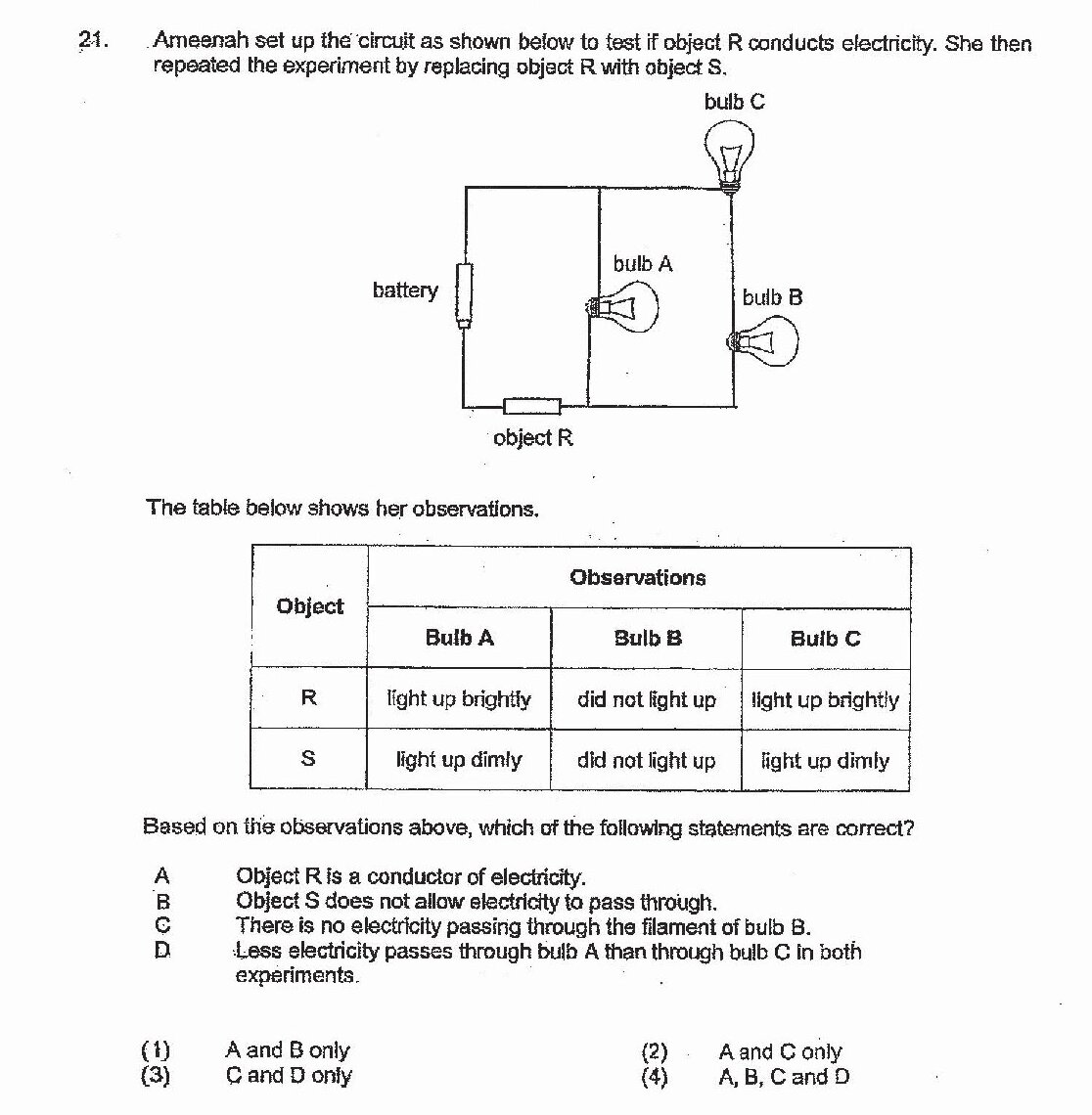
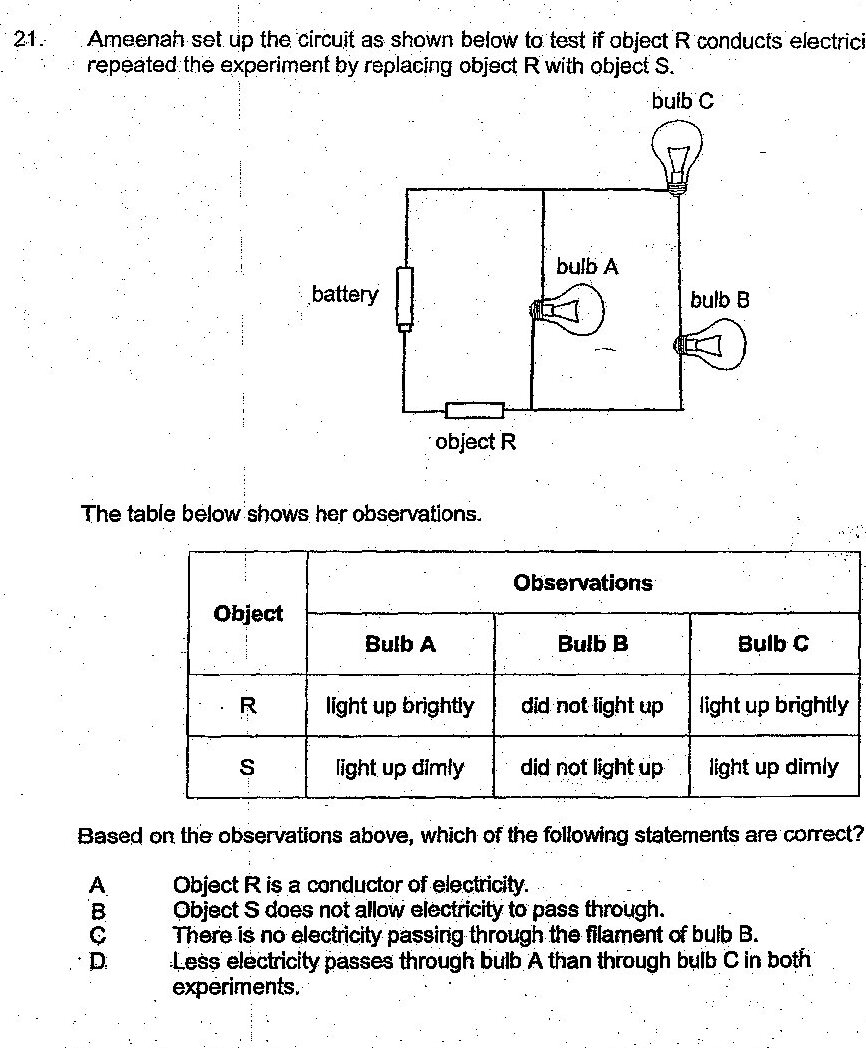
Ameanah set up the circuit as shown below to test if object R conducts electricity. She then repeated the experiment by replacing object R with object S. Based on the observations above, which of the following statements are correct? A: Object R is a conductor of electricity. B: Object S does not allow electricity to pass through. C: There is no electricity passing through the filament of bulb B. D: Less electricity passes through bulb A than through bulb C in both experiments.
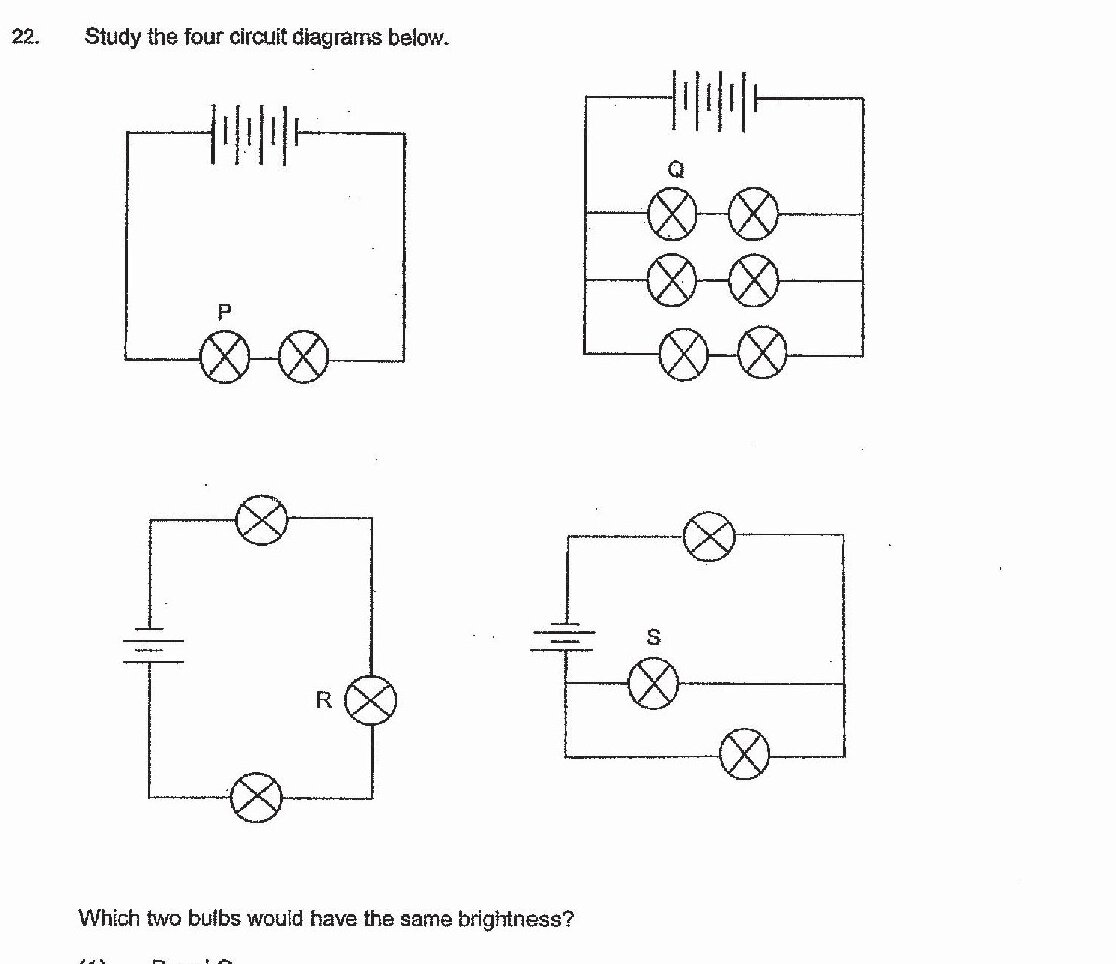
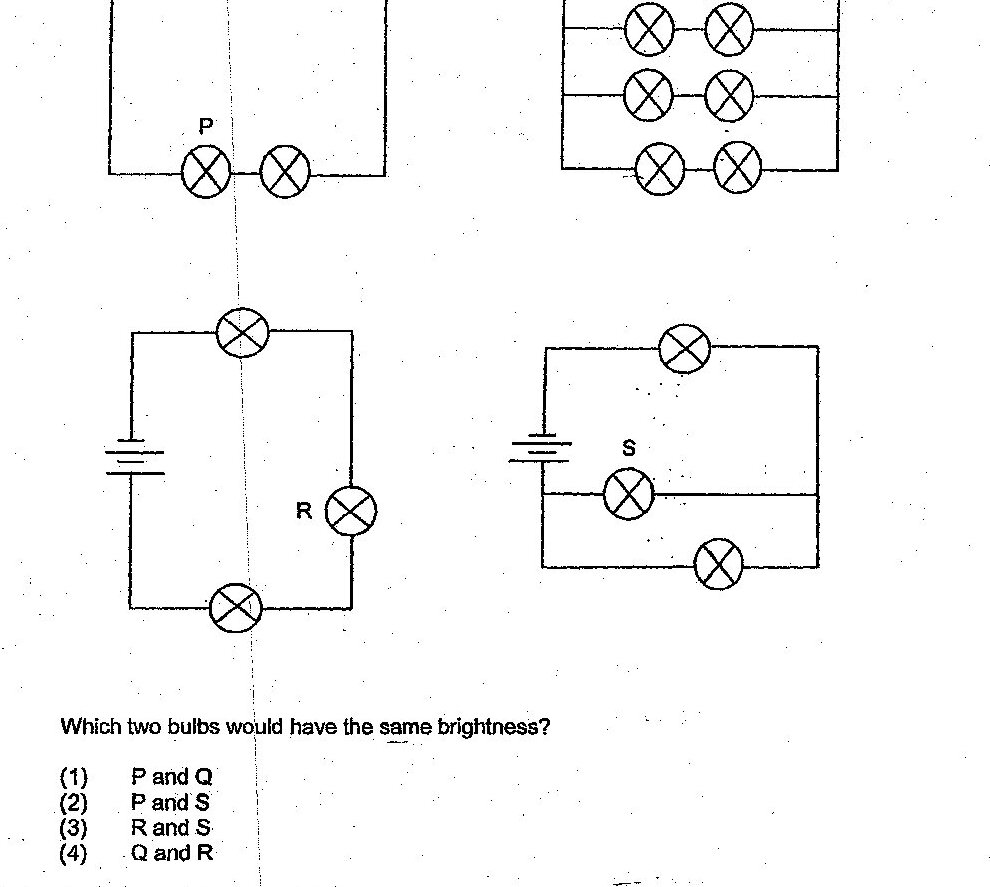
Which two bulbs would have the same brightness?
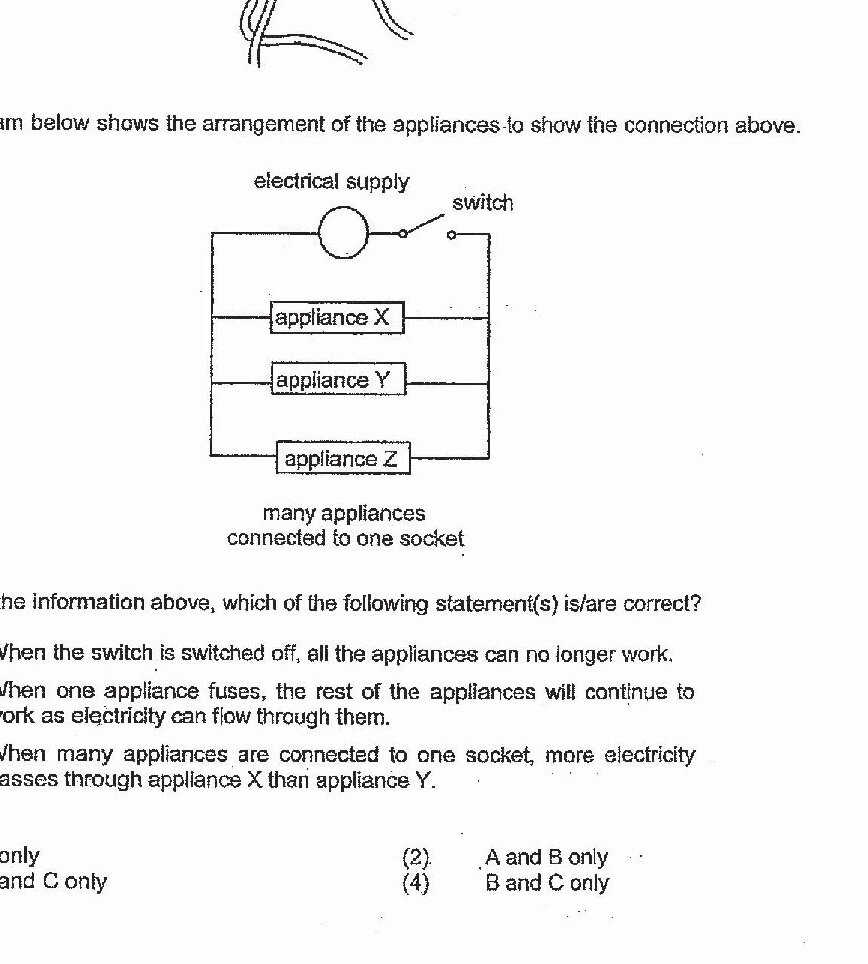
James plugs in many appliances into a single socket as shown in the diagram below. The diagram below shows the arrangement of the appliances to show the connection above. Based on the information above, which of the following statement(s) is/are correct? A: When the switch is switched off, all the appliances can no longer work. B: When one appliance fuses, the rest of the appliances will continue to work as electricity can flow through them. C: When many appliances are connected to one socket, more electricity passes through appliance X than appliance Y.
After Peter pushed disc A, he observed that disc A moved a short distance and stopped before it reached disc B. Explain, in terms of forces, why disc A stopped.
Peter wanted the discs to move faster on the board. Which substance, X, Y or Z, should Peter use on the board? Explain your answer.
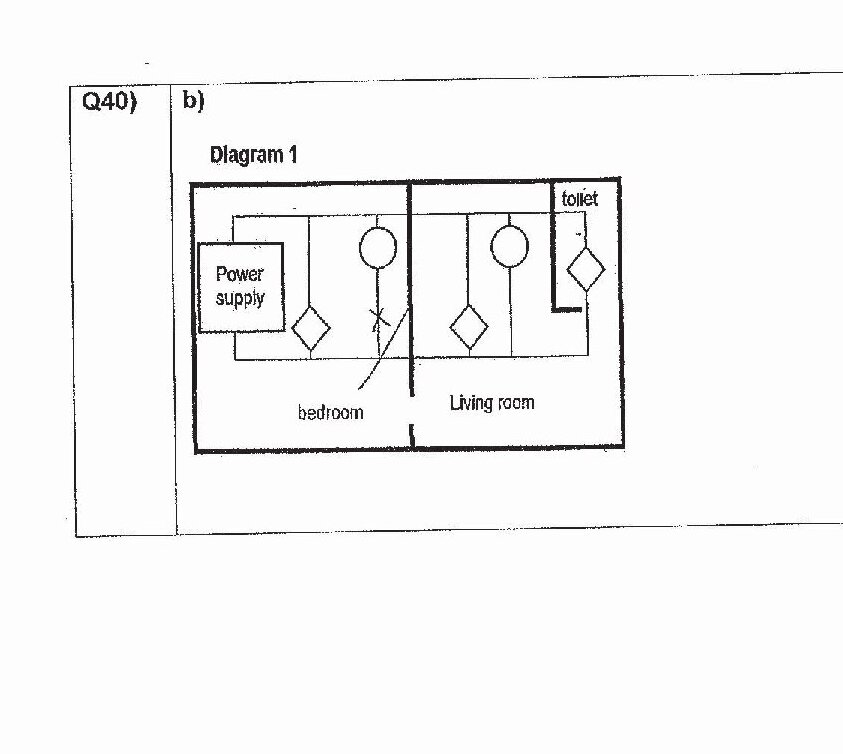
Diagram 1 shows the electrical wiring in a house. [Question text not fully visible in diagram, but this is part of question 40]
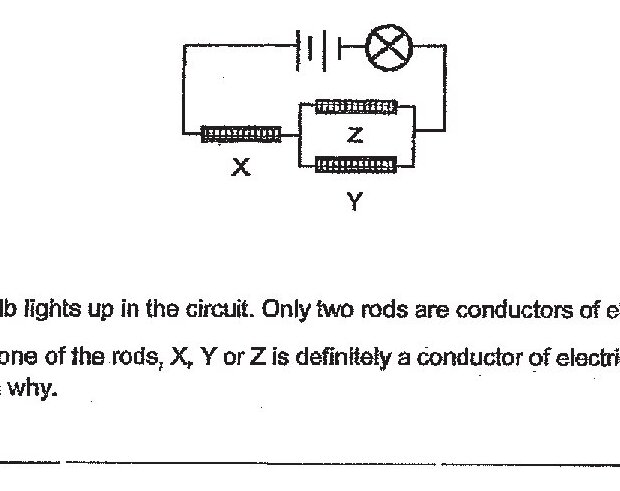
The bulb lights up in the circuit. Only two rods are conductors of electricity. Which one of the rods, X, Y or Z is definitely a conductor of electricity? Explain why.
What is the advantage of arranging the bulbs as shown in circuit A?
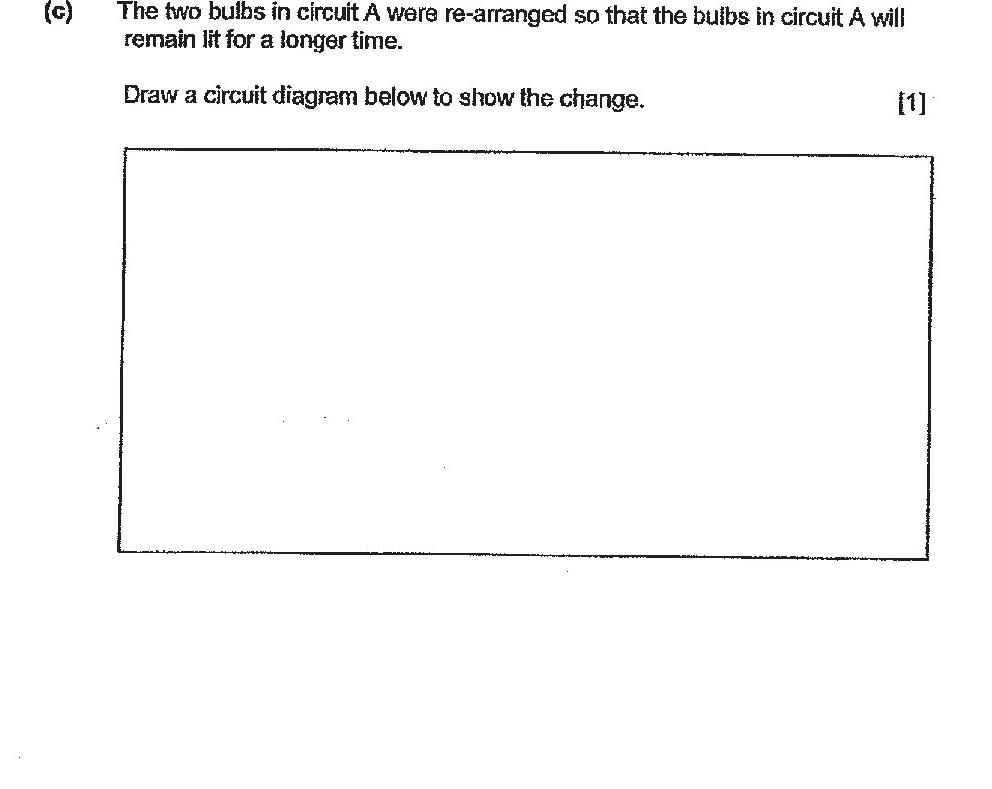
The two bulbs in circuit A were re-arranged so that the bulbs in circuit A will remain lit for a longer time. Draw a circuit diagram below to show the change.
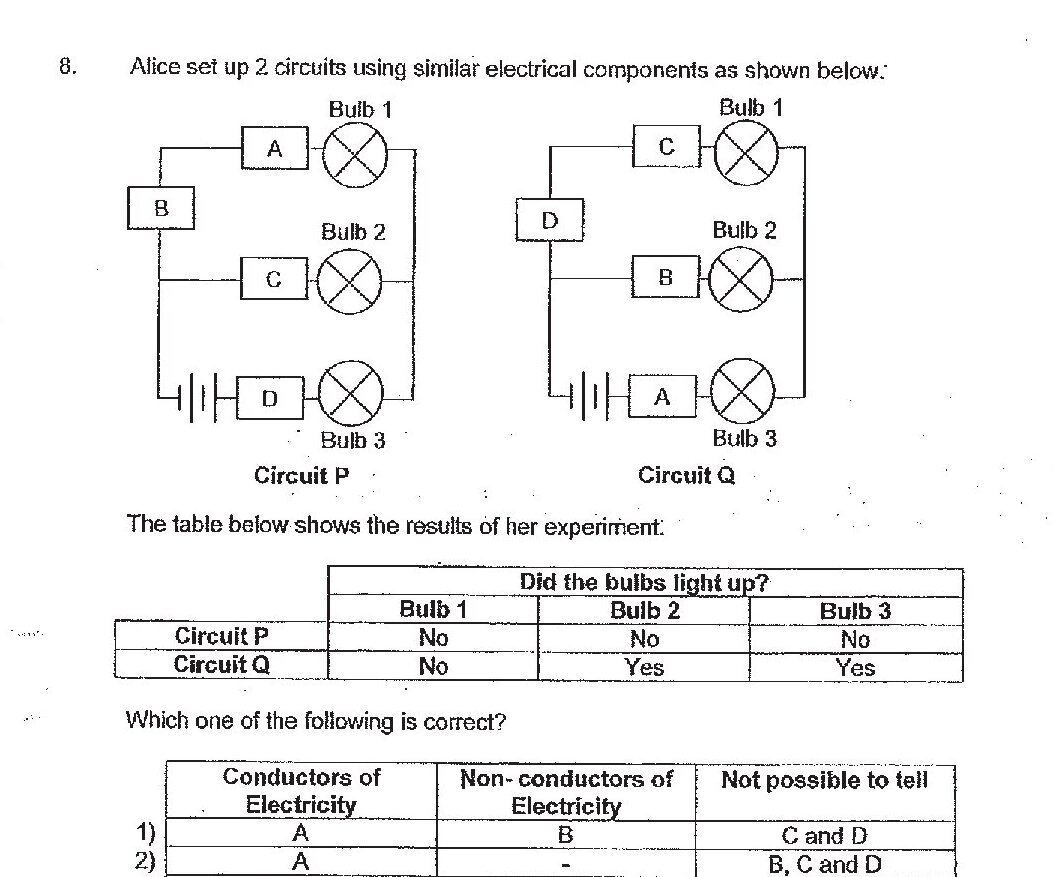
Alice set up 2 circuits using similar electrical components as shown below. The table below shows the results of her experiment. Which one of the following is correct?
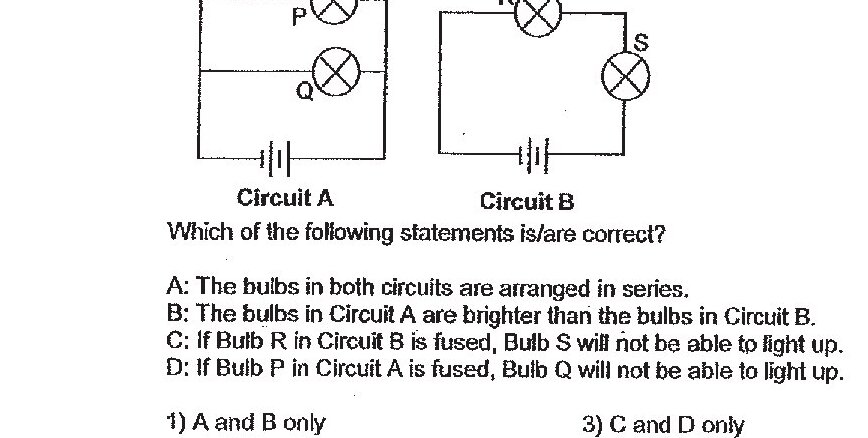
Alice set up 2 circuits using similar electrical components as shown below. Which of the following statements is/are correct? A: The hubs in both circuits are arranged in series. B: The bulbs in Circuit A are brighter than the bulbs in Circuit B. C: If Bulb R in Circuit B is fused, Bulb S will not be able to light up. D: If Bulb P in Circuit A is fused, Bulb Q will not be able to light up.
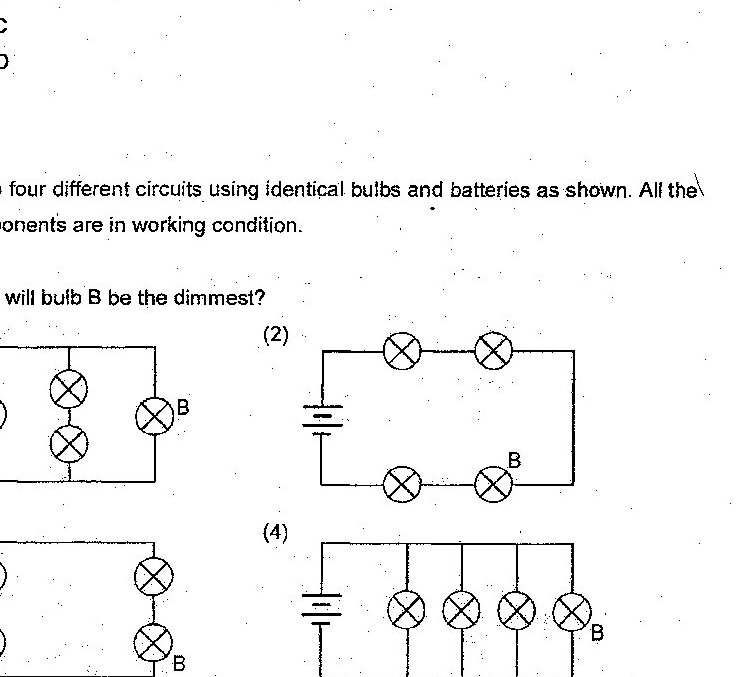
Leonard set up four different circuits using identical bulbs and batteries as shown. All the electrical components are in working condition. In which circuit will bulb B be the dimmest?
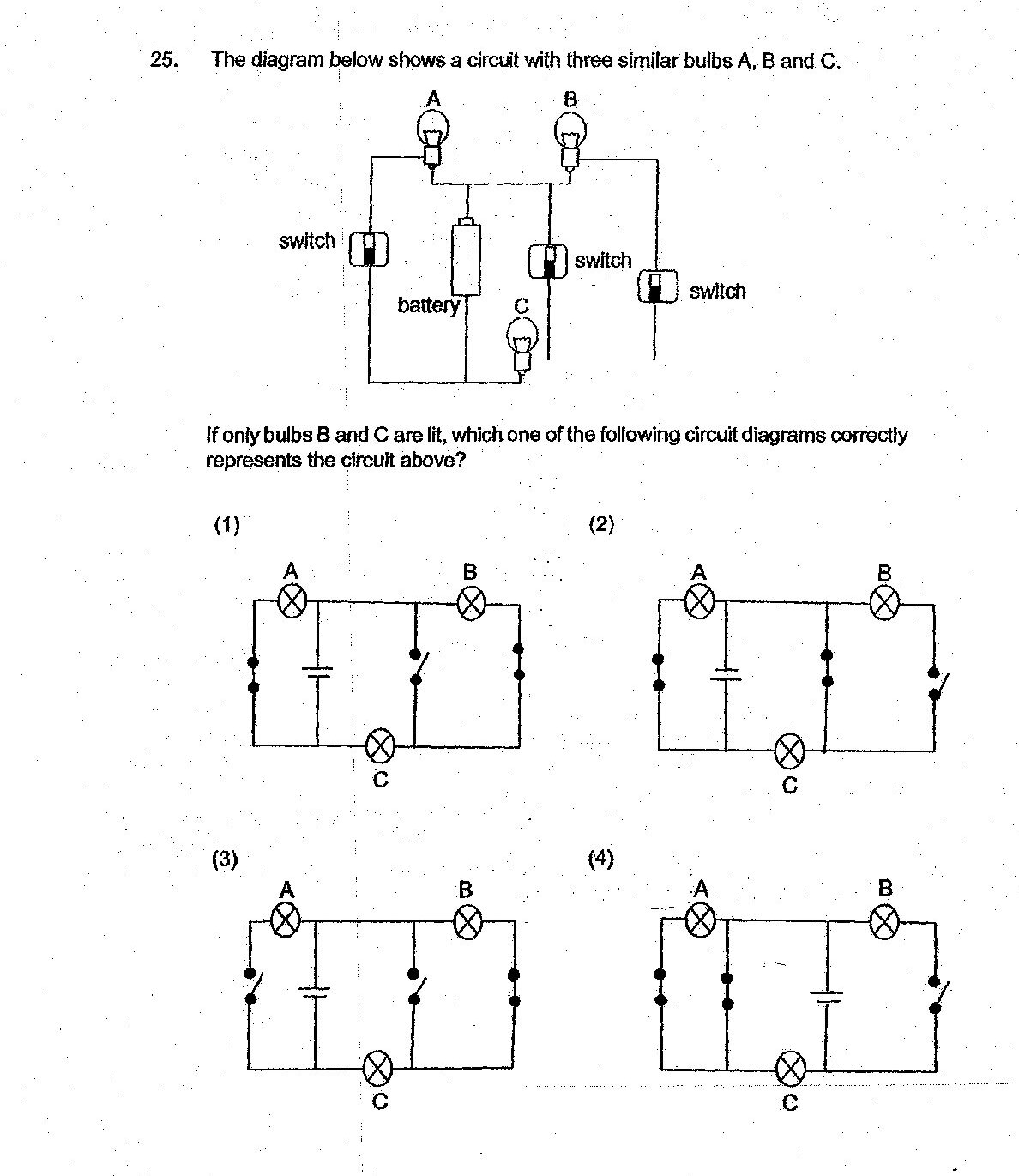
The diagram below shows a circuit with three similar bulbs A, B and C. If only bulbs B and C are lit, which one of the following circuit diagrams correctly represents the circuit above?
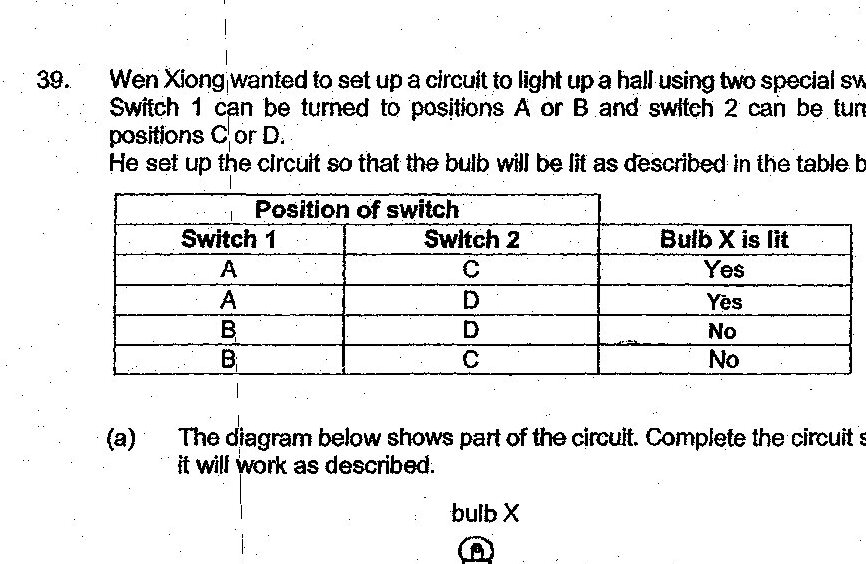
The diagram below shows part of the circuit. Complete the circuit so that it will work as described.
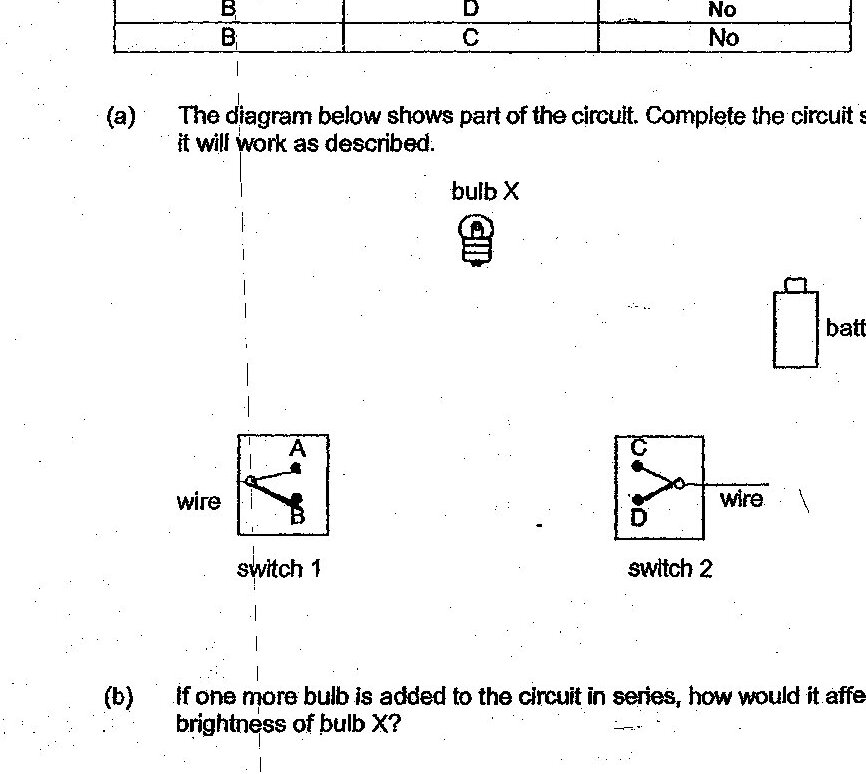
If one more bulb is added to the circuit in series, how would it affect the brightness of bulb X?
Ameenah set up the circuit as shown below to test if object R conducts electricity. She then repeated the experiment by replacing object R with object S. Based on the observations above, which of the following statements are correct?
Which two bulbs would have the same brightness?
Past year papers cover the full exam — browse by subject below.
View All Papers ›