Plant System
Plant System Study Notes
Key Concepts
1. Parts of a Plant
A plant has different parts, and each part has a special function.
Main parts of a flowering plant:
- Roots
- Stem
- Leaves
- Flowers
- Fruits
- Seeds
For this topic, you must focus especially on:
- roots
- stem
- leaves
- flowers
2. Roots
Roots are usually found underground.
Functions of roots:
- Absorb water and mineral salts from the soil
- Absorb means to take in.
- Mineral salts are useful substances in the soil needed for healthy growth.
- Anchor the plant firmly in the soil
- Anchor means to hold the plant in place so it does not fall over.
- In some plants, roots also store food
- Example: carrot, sweet potato
Important ideas:
- Tiny root hairs increase the surface area for absorbing water and mineral salts.
- Plants need water and mineral salts for growth and making food.
3. Stem
The stem is the part that usually grows above the ground and supports the plant.
Functions of the stem:
- Supports the plant
- Holds leaves, flowers and fruits up.
- Transports water and mineral salts from the roots to the leaves
- Transports food made by the leaves to other parts of the plant
- In some plants, stems can also store food
- Example: potato is a stem tuber
Important ideas:
- The stem acts like a transport pathway.
- Water travels from roots to stem to leaves.
- Food made in the leaves is transported to all parts of the plant.
4. Leaves
Leaves are the main organs that make food for the plant.
Functions of leaves:
- Make food by photosynthesis
- Contain chlorophyll
- Chlorophyll is the green substance in leaves that traps light energy from the Sun.
- Exchange gases
- Take in carbon dioxide
- Give out oxygen
- In some plants, leaves may also store food
- Example: cabbage, onion leaves
Important structures in a leaf:
- Leaf blade: broad, flat part of the leaf
- Veins: tubes in the leaf that transport water and food
- Petiole: leaf stalk that attaches the leaf to the stem
Why leaves are suitable for photosynthesis:
- Broad and flat → large surface area to absorb more sunlight
- Thin → gases can move in and out easily
- Green → contains chlorophyll
5. Flowers
Flowers are the reproductive parts of a flowering plant.
Main function of flowers:
- Help the plant reproduce
- Reproduce means to produce young of the same kind.
After reproduction:
- The flower may develop into a fruit
- The fruit contains seeds
- Seeds can grow into new plants under suitable conditions
Important idea:
- For Primary 6 Plant System, know that flowers are involved in reproduction, and fruits and seeds are formed after flowering.
6. Germination and Plant Life Cycle
Germination is when a seed starts to grow into a new plant.
During germination:
- The roots always grow first (downwards, towards gravity)
- Then the shoot grows (upwards, towards light)
Plant life cycle stages (in order):
- Seed germinates
- Seedling develops
- Plant becomes a mature plant
- Plant becomes an adult plant that bears fruits and seeds
Important ideas:
- Roots always appear before shoots during germination — this is a fixed rule.
- Roots grow downward; shoots grow upward.
6b. Fair Test
A fair test is an experiment where only one variable is changed at a time, and all other variables are kept the same (constant).
Why fair tests matter:
- If more than one variable changes, you cannot tell which variable caused the result.
- Changing only one variable ensures the result is due to that variable alone.
Example:
- To test whether a plant needs sunlight to make food:
- Changed variable: presence/absence of sunlight
- Kept constant: amount of water, type of plant, amount of carbon dioxide, temperature
7. Transport in Plants
Plants need to transport substances from one part to another.
Substances transported:
- Water
- Mineral salts
- Food
Transport of water and mineral salts
- Roots absorb water and mineral salts from the soil.
- These move through the stem to the leaves.
- Water is needed for:
- photosynthesis
- keeping the plant firm
- transporting substances
Pathway: Soil → roots → stem → leaves
Transport of food
- Leaves make food during photosynthesis.
- The food is then transported from the leaves to all parts of the plant.
- Food is used for:
- growth
- repair
- storage
- energy for life processes
Pathway: Leaves → stem → roots / flowers / fruits / seeds / other parts
Important note:
- Water and mineral salts move upwards from roots to leaves.
- Food made by leaves is transported to all parts of the plant.
7b. Xylem and Phloem (Carrying Tubes in the Stem)
The stem contains two types of tubes:
- Xylem (water-carrying tubes): found in the inner part of the stem
- Transports water and mineral salts from the roots to all parts of the plant
- Phloem (food-carrying tubes): found near the outer part of the stem
- Transports sugars (glucose) from the leaves and fruits to all parts of the plant
Memory aid — WIFO: Water Inside (xylem), Food Outside (phloem)
Important:
- Only glucose is transported through phloem. Starch is the stored form and is NOT transported.
- Food in phloem can move upwards or downwards depending on where it is needed in the plant.
8. Photosynthesis
Photosynthesis is one of the most important plant processes.
Photosynthesis is:
- the process by which green plants make food
For photosynthesis to take place, the plant needs:
- Sunlight
- Water
- Carbon dioxide
- Chlorophyll
During photosynthesis:
- leaves take in carbon dioxide from the air
- roots absorb water from the soil
- chlorophyll traps light energy from the Sun
- food is made
- oxygen is released
The food made is sugar at first, and it may later be stored as starch.
Word equation: carbon dioxide + water → food (sugar) + oxygen
- This happens in the presence of sunlight and chlorophyll.
A more complete way to write it: carbon dioxide + water --(sunlight and chlorophyll)→ sugar + oxygen
Important ideas:
- Photosynthesis takes place mainly in the leaves
- Only green parts containing chlorophyll can photosynthesise
- Oxygen is released during photosynthesis
- Plants make their own food
9. Conditions Needed for Photosynthesis
A plant cannot photosynthesise properly without these:
- Sunlight
- Water
- Carbon dioxide
- Chlorophyll
What happens if one is missing?
- No sunlight → photosynthesis cannot happen
- No water → photosynthesis cannot happen
- No carbon dioxide → photosynthesis cannot happen
- No chlorophyll → photosynthesis cannot happen in that part
10. Why Photosynthesis is Important
Photosynthesis is important because:
- it provides food for the plant
- the food is used for growth and other life processes
- excess food can be stored
- oxygen is released into the air
11. Relationship Between Plant Parts
The parts of the plant work together as a system.
How they work together:
- Roots absorb water and mineral salts
- Stem transports them to the leaves
- Leaves make food by photosynthesis
- Stem transports food to other parts
- Flowers help the plant reproduce
This shows that a plant is a system of parts working together to keep it alive.
Important Definitions
- Plant system: a group of plant parts working together to carry out life processes.
- Root: the part of a plant that absorbs water and mineral salts from the soil and anchors the plant.
- Root hair: a tiny structure on the root that increases surface area for absorption.
- Stem: the part of a plant that supports the plant and transports water, mineral salts and food.
- Leaf: the part of a plant that usually makes food by photosynthesis.
- Flower: the reproductive part of a flowering plant.
- Fruit: the part formed from a flower that contains seeds.
- Seed: the structure that can grow into a new plant under suitable conditions.
- Absorb: to take in a substance.
- Anchor: to hold firmly in place.
- Transport: to move substances from one part to another.
- Mineral salts: useful substances from the soil needed by plants for healthy growth.
- Photosynthesis: the process by which green plants make food using carbon dioxide and water, in the presence of sunlight and chlorophyll.
- Chlorophyll: the green substance in leaves that traps light energy from the Sun for photosynthesis.
- Carbon dioxide: a gas in the air used by plants during photosynthesis.
- Oxygen: a gas released by plants during photosynthesis.
- Starch: a form in which excess food may be stored in plants.
- Reproduction: the process of producing young of the same kind.
- Support: to hold up a plant part.
- Surface area: the amount of exposed outer area of a structure.
- Vein: a tube-like structure in the leaf that helps transport water and food.
Diagrams and Structures
12. Whole Flowering Plant Diagram
Draw a simple flowering plant and label the main parts.
How to draw:
- Draw a plant standing upright.
- Above the ground, draw:
- a flower at the top
- several leaves attached to the stem
- Below the ground, draw branching roots
- Draw a horizontal line to show the soil
Labels:
- Flower
- Leaves
- Stem
- Roots
- Soil
Extra note:
- Make sure roots are shown underground.
- Make sure stem connects roots to leaves and flower.
13. Root Structure Diagram
Draw a close-up of a root.
How to draw:
- Draw one main root going downward.
- Add smaller side roots branching out.
- On one small section, draw many tiny hair-like projections.
- Label these as root hairs.
Labels:
- Main root
- Side roots
- Root hairs
- Soil
What to show clearly:
- Root hairs are tiny and numerous
- They are in contact with the soil
14. Leaf Structure Diagram
Draw a single leaf.
How to draw:
- Draw a broad, flat leaf shape.
- Draw one thick line in the middle for the midrib.
- Draw smaller branching lines from the midrib for the veins.
- Draw a short stalk at the bottom for the petiole.
Labels:
- Leaf blade
- Midrib
- Veins
- Petiole
What to show clearly:
- The leaf blade is broad and flat
- Veins branch throughout the leaf
15. Transport in Plant Diagram
Draw the pathway of water and food in a plant.
How to draw:
- Draw roots, stem and leaves.
- Use upward arrows from:
- soil to roots
- roots to stem
- stem to leaves
- Label these arrows:
- water
- mineral salts
- Then draw arrows from the leaves to other parts of the plant
- downward to roots
- upward/downward to stem, flowers and fruits
- Label these arrows:
- food
Labels:
- Water
- Mineral salts
- Food
- Roots
- Stem
- Leaves
Important:
- Water and mineral salts move from roots to leaves.
- Food moves from leaves to all parts of the plant.
16. Photosynthesis Diagram
Draw a leaf on a plant showing what goes in and out.
How to draw:
- Draw a leaf attached to a stem.
- Draw arrows pointing into the leaf:
- one from the air labelled carbon dioxide
- one from the stem labelled water
- Draw the Sun above the leaf with rays pointing to the leaf.
- Write chlorophyll in leaf inside the leaf.
- Draw an arrow pointing out of the leaf labelled oxygen
- Draw arrows from the leaf to the rest of the plant labelled food
Labels:
- Sunlight
- Carbon dioxide
- Water
- Chlorophyll
- Oxygen
- Food
Worked Examples
Example 1: Explaining Why Leaves Are Important
Question type: Explain why leaves are important to a plant.
Step-by-step answer
- Identify the main function of leaves:
- Leaves make food for the plant.
- State the process:
- They do this by photosynthesis.
- Include what is needed:
- Leaves contain chlorophyll to trap sunlight.
- They use water and carbon dioxide.
- State the result:
- Food is made for growth and other life processes.
Full answer
Leaves are important because they make food for the plant by photosynthesis. They contain chlorophyll, which traps light energy from the Sun. Using water and carbon dioxide, the leaves make food for the plant.
Example 2: Tracing the Movement of Water in a Plant
Question type: Describe how water moves through a plant.
Step-by-step answer
- Start from where water comes from:
- Water is in the soil.
- State which part absorbs it:
- The roots absorb water from the soil.
- State where it goes next:
- The water is transported through the stem.
- State the final destination:
- It reaches the leaves.
Full answer
Water in the soil is absorbed by the roots. It is then transported through the stem to the leaves, where it is used for photosynthesis.
Key exam phrase
- “absorbed by the roots”
- “transported through the stem”
- “to the leaves”
Example 3: Explaining Why a Plant May Not Make Food
Question type: A plant is kept in a dark cupboard for many days. Explain why it may not make food.
Step-by-step answer
- Name the process:
- Food is made by photosynthesis.
- State one condition needed:
- Photosynthesis needs sunlight.
- Link to the situation:
- In a dark cupboard, there is no sunlight.
- Conclude:
- Therefore, the plant cannot photosynthesise and cannot make food.
Full answer
The plant may not make food because food is made by photosynthesis, and photosynthesis needs sunlight. Since the plant is kept in a dark cupboard, it does not receive sunlight, so it cannot photosynthesise.
Common Mistakes to Avoid
- Saying that roots take in food from the soil
- Plants do not get food from the soil.
- Roots absorb water and mineral salts only.
- Saying that plants take in oxygen for photosynthesis
- Plants take in carbon dioxide for photosynthesis.
- Forgetting that chlorophyll is needed for photosynthesis
- Writing that sunlight is a substance
- Sunlight is a form of light energy, not a material.
- Saying that food is made in the roots
- Food is made mainly in the leaves.
- Mixing up the transport pathways:
- Water and mineral salts: roots → stem → leaves
- Food: leaves → all parts of plant
- Saying that the stem only supports the plant
- The stem also transports substances.
- Confusing flowers with fruits
- Flowers are reproductive parts.
- Fruits form after flowering and contain seeds.
- Saying all plant parts photosynthesise
- Only green parts containing chlorophyll can photosynthesise.
- Forgetting to mention both source and destination in transport questions
- Assuming food always moves downward in the plant
- Food in the phloem moves upwards or downwards depending on where it is needed.
- Saying that starch is transported through the phloem
- Only glucose (sugar) is transported. Starch is the stored form and does not move through the phloem.
- Using casual language such as ‘bring water’ or ‘take in water’ instead of the precise term absorb
- Always say roots absorb water from the soil.
- Thinking shoots grow before roots during germination
- Roots always grow first; shoots grow after.
- Not knowing how to answer a fair test question
- State the one variable that is changed.
- Name at least one variable that is kept constant.
Exam Tips
- When asked for a function, give the precise scientific answer.
- Example: “Roots absorb water and mineral salts from the soil.”
- For explain questions, link the idea clearly:
- part → function → result
- Example: “Leaves contain chlorophyll to trap sunlight for photosynthesis, so the plant can make food.”
- Use key words that earn marks:
- absorb
- transport
- photosynthesis
- carbon dioxide
- water
- sunlight
- chlorophyll
- oxygen
- mineral salts
- If asked about movement in a plant, mention the direction:
- “from the roots to the leaves”
- “from the leaves to other parts of the plant”
- If asked why a plant grows poorly, think about:
- lack of water
- lack of sunlight
- no leaves
- damaged roots
- When writing about photosynthesis, include the full idea:
- green plants make food
- using carbon dioxide and water
- in the presence of sunlight and chlorophyll
- Do not use everyday words when a scientific word is better:
- use food or sugar, not “plant energy”
- use carbon dioxide, not just “air”
- In diagram questions:
- label neatly
- draw arrows in the correct direction
- do not cross labels if possible
- When describing xylem function, always mention both water AND mineral salts, not just water.
- When describing phloem function, include ‘all parts’ to score full marks — e.g. ‘phloem transports food to all parts of the plant’.
- Distinguish glucose (the transported, soluble form of food) from starch (the stored, insoluble form). Do not say starch is transported.
- Use the WIFO mnemonic to remember tube positions in the stem: Water Inside (xylem), Food Outside (phloem).
- Use a 3-step approach for any explain or describe question:
- Identify keywords in the question.
- Recall the relevant concept or rule.
- Piece together a structured answer using evidence from the question.
- For fair test questions, your answer must include:
- The one variable that is changed.
- At least one variable that is kept constant.
- For germination or life cycle questions, apply the germination rule:
- Roots grow first → shoots grow next → seedling → mature plant → adult plant (bears fruits)
- Extended list of key terms for this topic that often appear in exam questions:
- fair test, germination, roots, shoots, photosynthesis, water absorption, mineral salts, life cycle stages, anchor
Quick Summary
- Plants are made up of parts such as roots, stem, leaves and flowers, and each part has a function.
- Roots absorb water and mineral salts from the soil and anchor the plant.
- Root hairs help roots absorb more water because they increase surface area.
- Stem supports the plant and transports water, mineral salts and food.
- Leaves make food by photosynthesis.
- Leaves need chlorophyll, sunlight, water and carbon dioxide for photosynthesis.
- During photosynthesis, plants make food (sugar) and release oxygen.
- Excess food may be stored as starch.
- Water and mineral salts move from roots → stem → leaves.
- Food made in the leaves is transported to all parts of the plant.
- Flowers are the reproductive parts of flowering plants.
- Only green parts containing chlorophyll can photosynthesise.
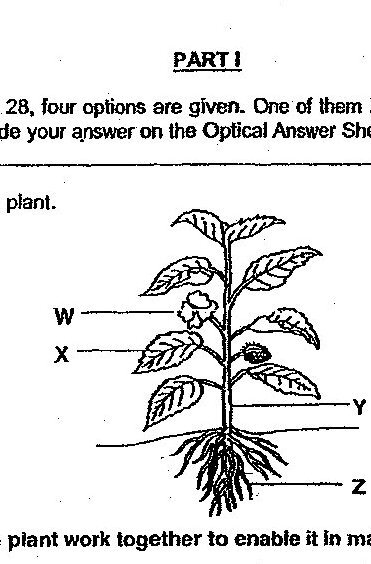
The diagram shows a plant. Which parts of the plant work together to enable it in make food?
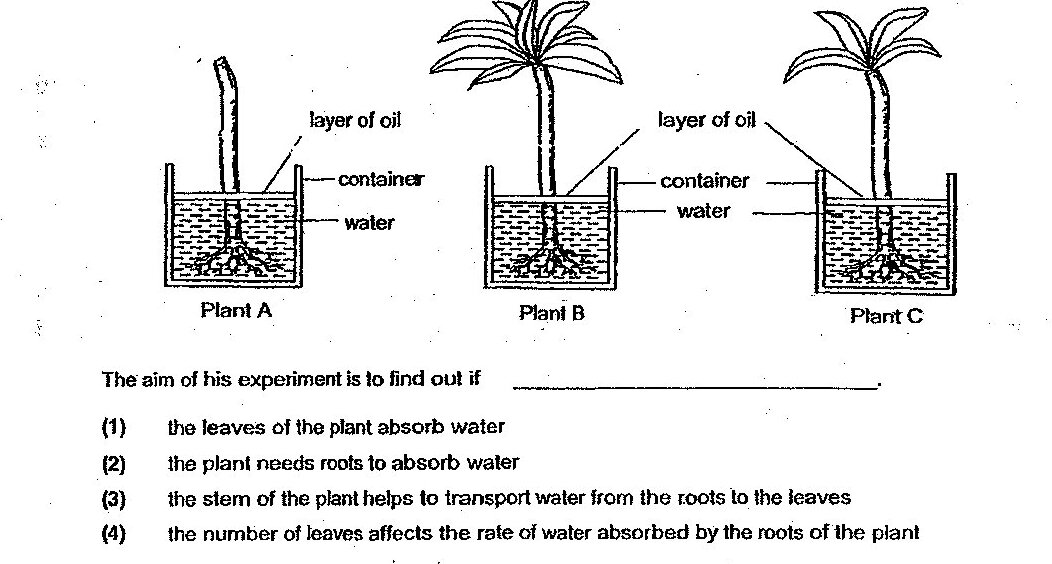
Charles used three similar plants, A, B and C, to conduct an experiment. He removed all the leaves from Plant A, and some leaves from Plant C. He then put the three plants in three identical containers with the same amount of water and placed them in the same location. After five days, Charles measured the height of the water in each container. The aim of his experiment is to find out if _______.
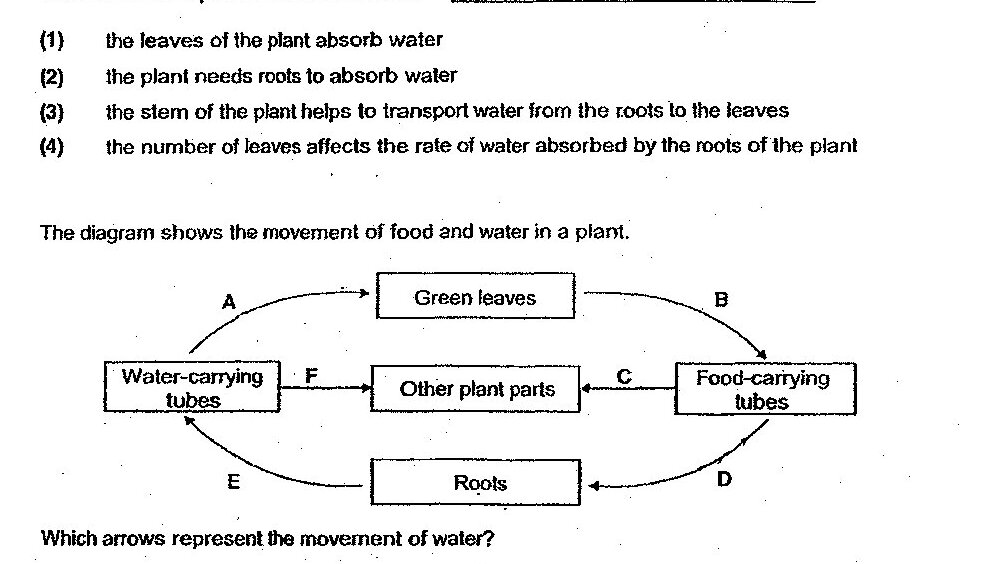
The diagram shows the movement of food and water in a plant. Which arrows represent the movement of water?
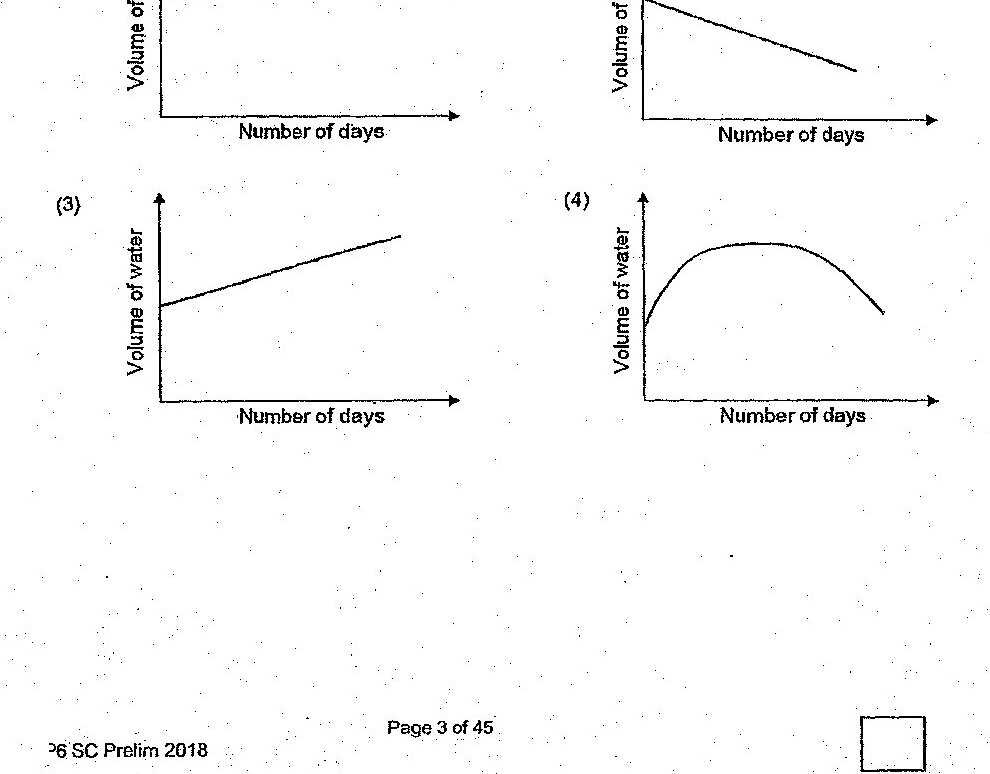
Samuel placed the plant shown in the diagram below next to a window for one week. He checked and recorded the volume of water left in the container daily. A week later, he drew a graph showing the change in the water left in the container. Which one of the following shows the change in the volume of water in the container correctly?
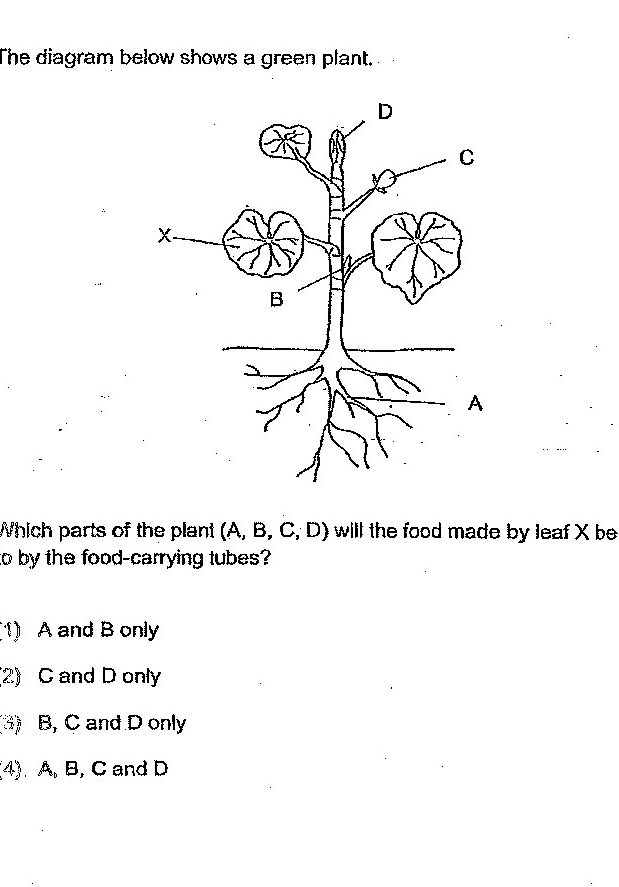
Which parts of the plant (A, B, C, D) will the food made by leaf X be transported to by the food-carrying tubes?
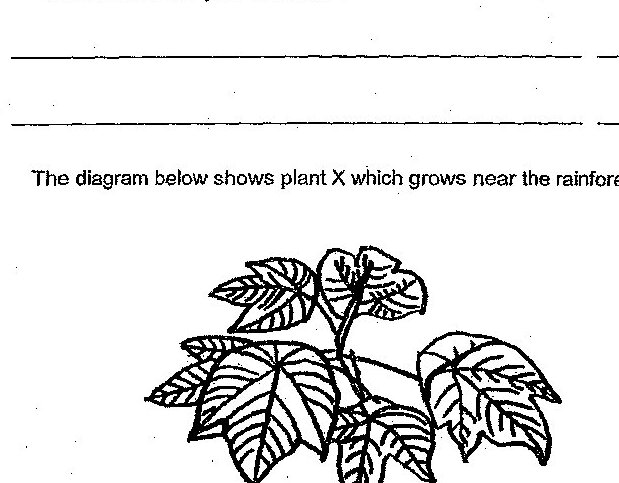
Give a reason why the leaves of plant X are large and broad.
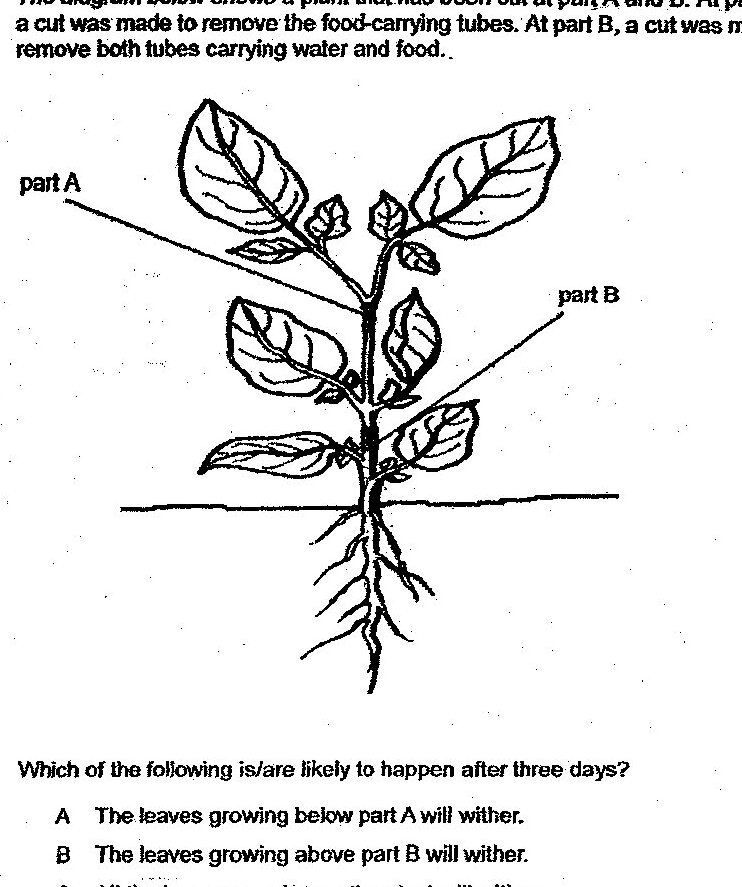
The diagram below shows a plant that has been cut at part A and B. At part A, a cut was made to remove the food-carrying tubes. At part B, a cut was made to remove both tubes carrying water and food. Which of the following is/are likely to happen after three days?
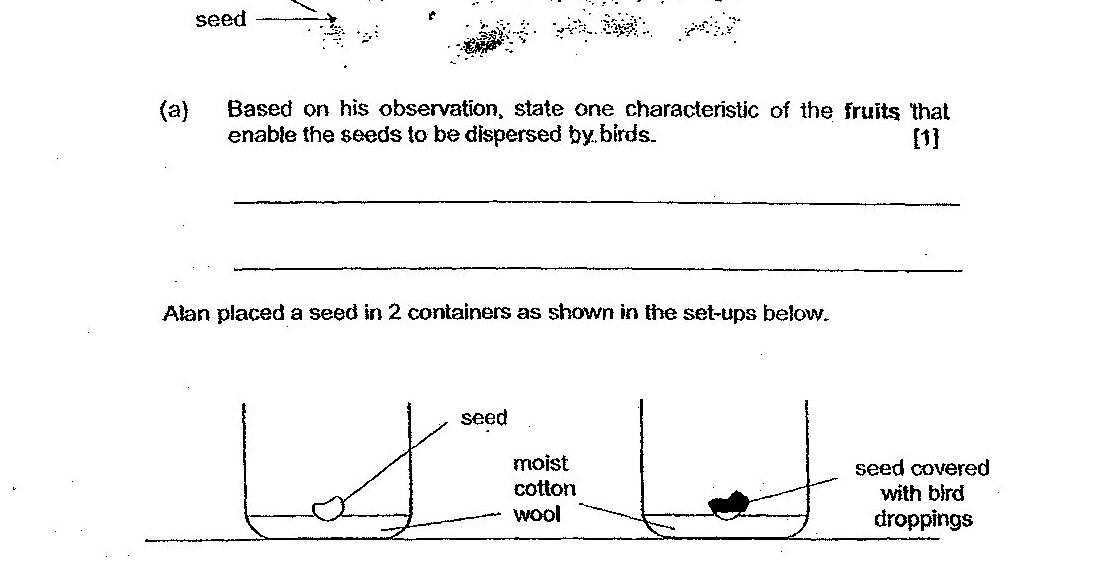
Olivia prepared two set-ups, A and B, as shown in the diagram below. She placed two identical plants under the covers. She gave both plants the same amount of water at the start of the experiment. Both set-ups were placed in the field from 7 a.m. to 12 midnight.
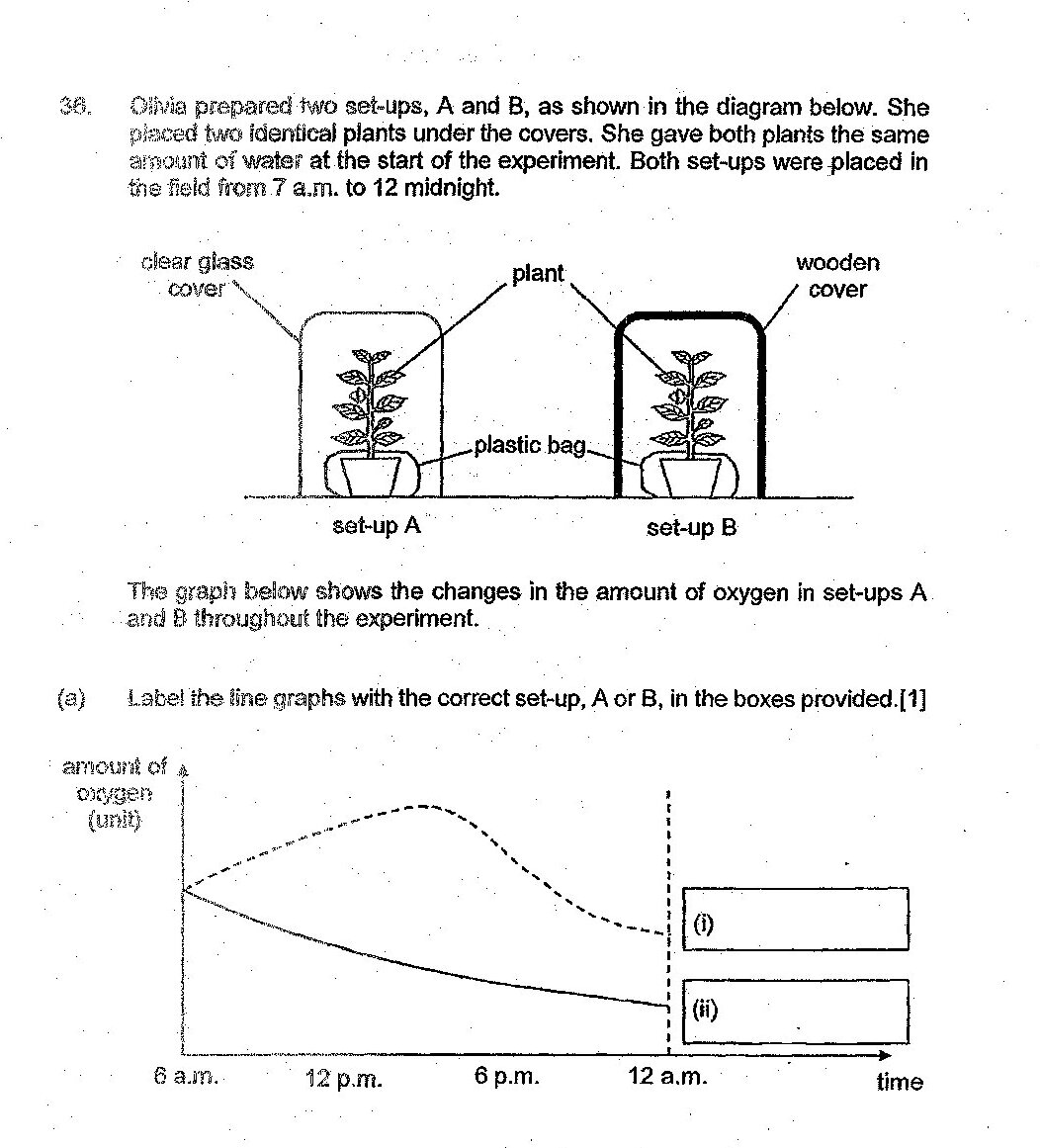
A week later, it was observed that the seedling in setup B grew better than the one in setup A. Explain why.
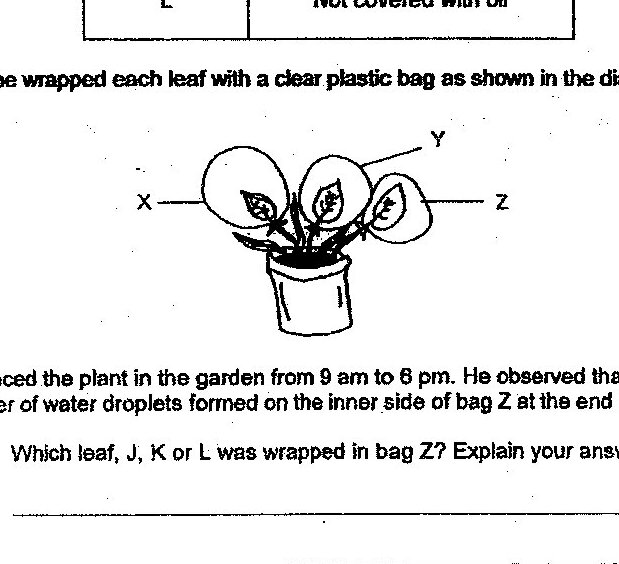
Which leaf, J, K or L was wrapped in bag Z? Explain your answer.
Stomata on leaves tend to reduce in size on hot and dry days. Give a reason for this observation.
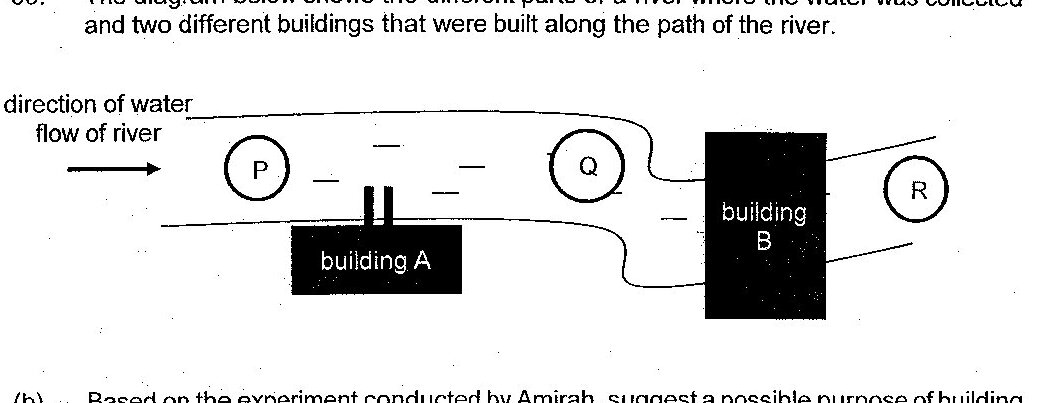
Amirah found out that fully-submerged hydrilla plants grew best in part R of the river. Explain why.
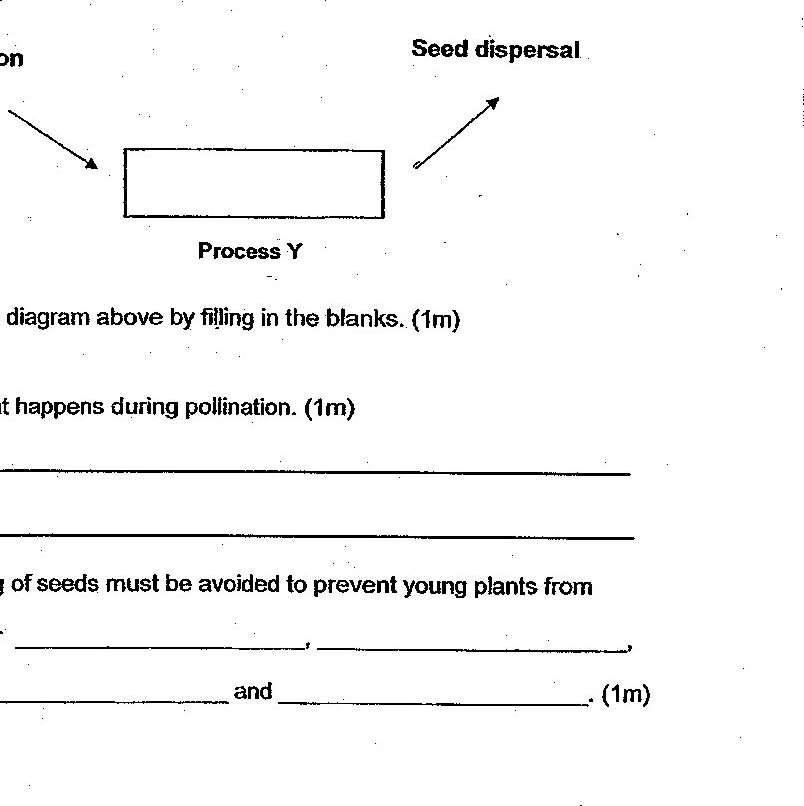
Overcrowding of seeds must be avoided to prevent young plants from competing for ______________, ______________ and ______________.
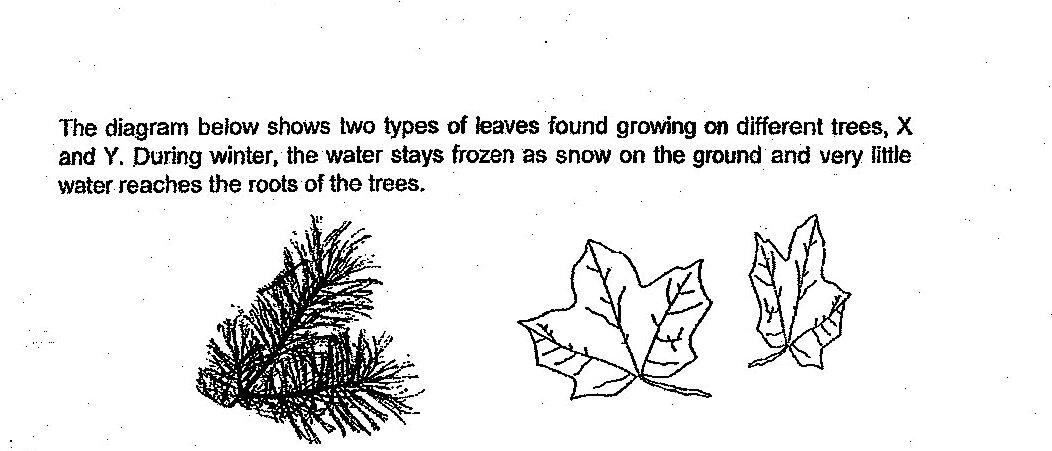
Which tree, X or Y, will not need to shed its leaves during winter? Explain your answer.
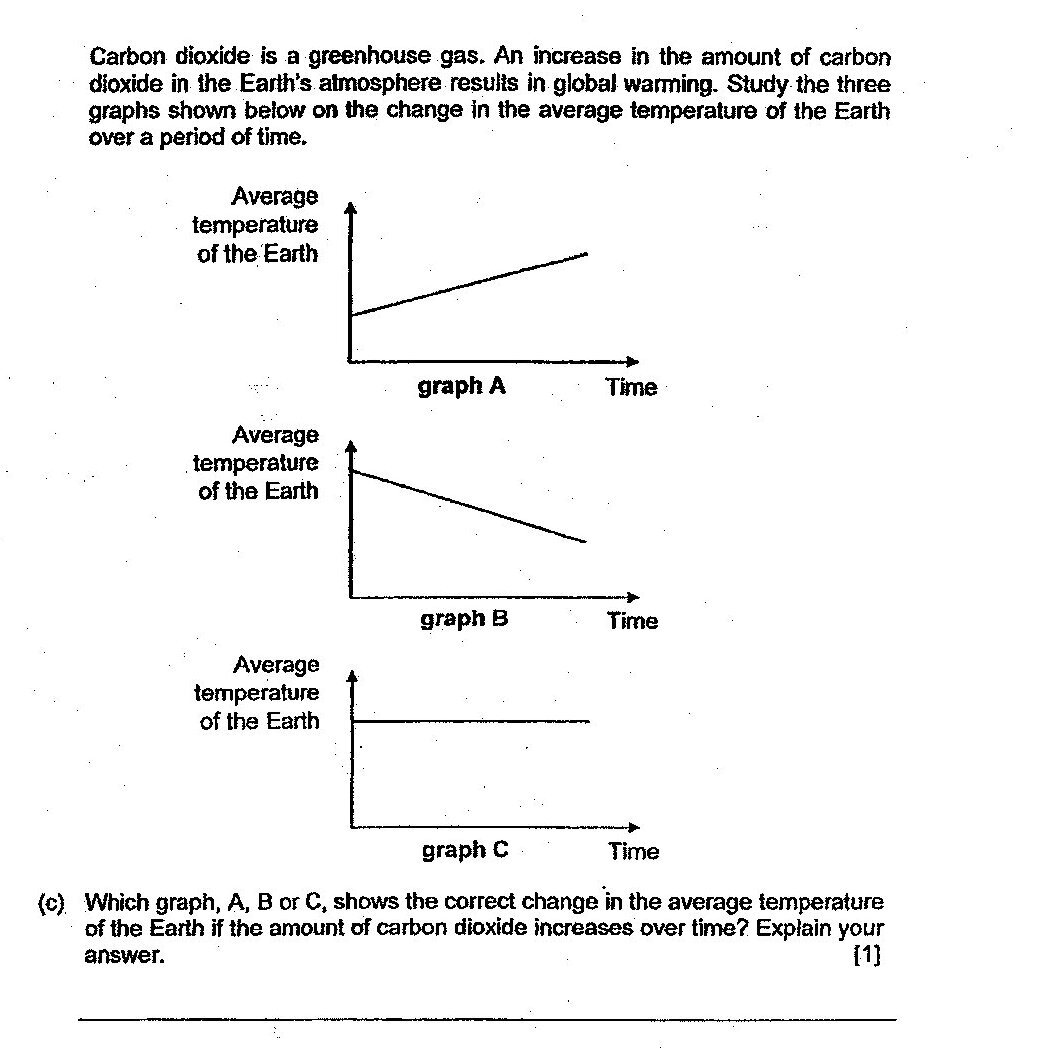
Which graph, A, B or C, shows the correct change in the average temperature of the Earth if the amount of carbon dioxide increases over time? Explain your answer.
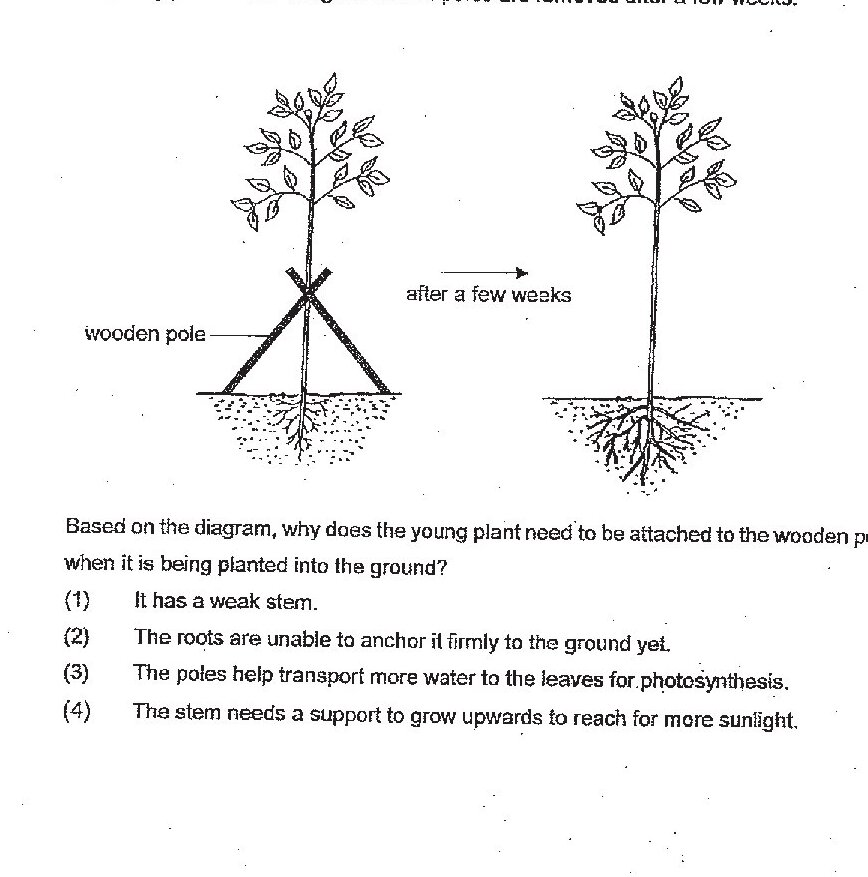
Based on the diagram, why does the young plant need to be attached to the wooden poles when it is being planted into the ground?
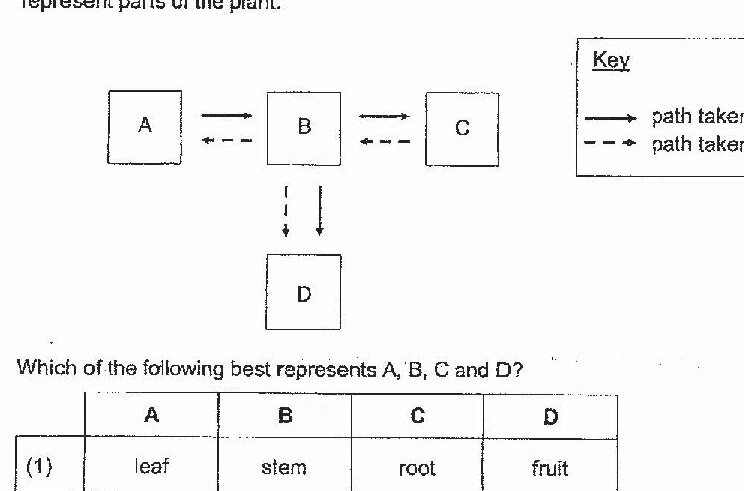
The diagram shows the different paths taken by food and water in a plant. A, B, C and D represent parts of the plant. Which of the following best represents A, B, C and D?
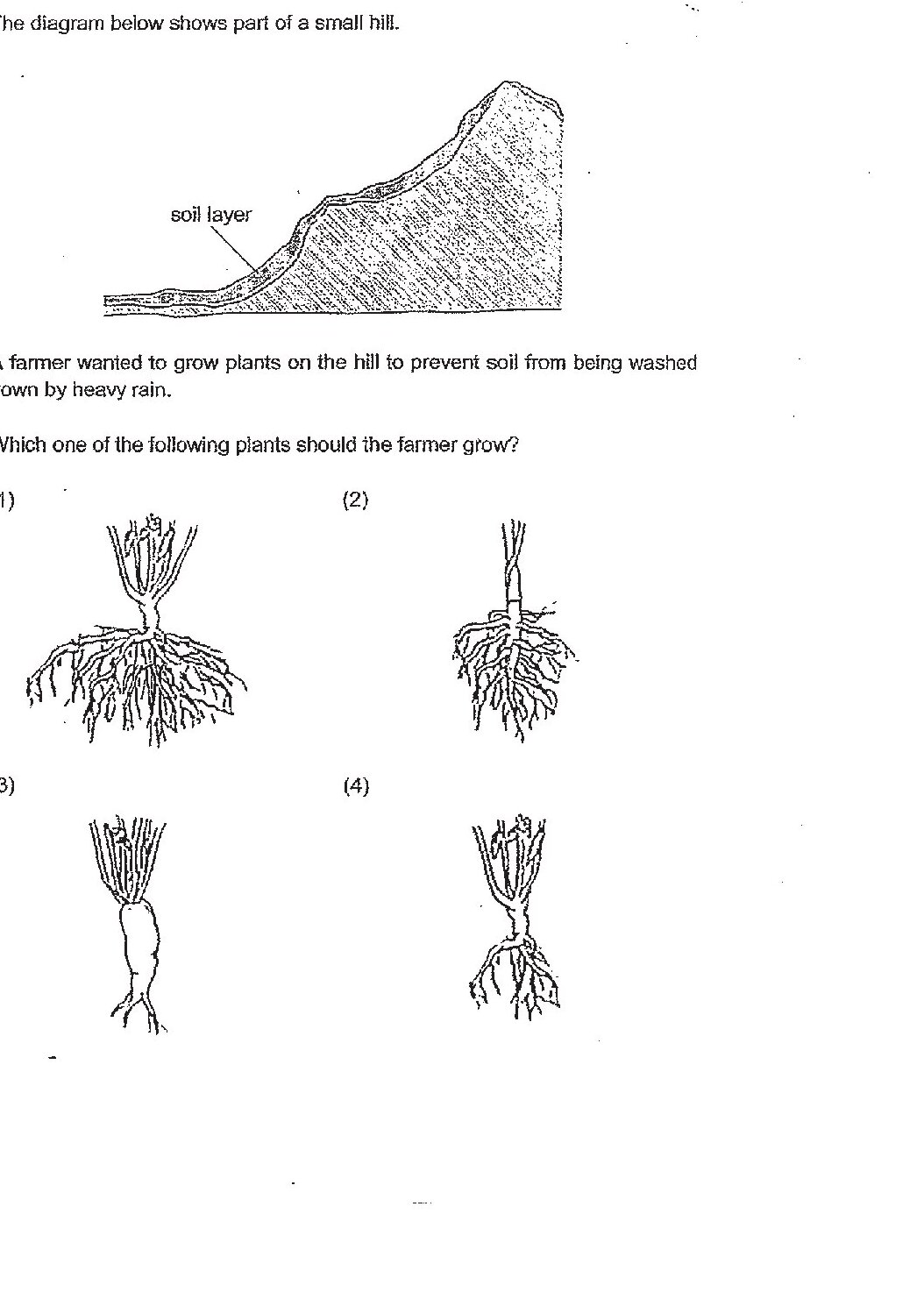
A farmer wanted to grow plants on the hill to prevent soil from being washed down by heavy rain. Which one of the following plants should the farmer grow?
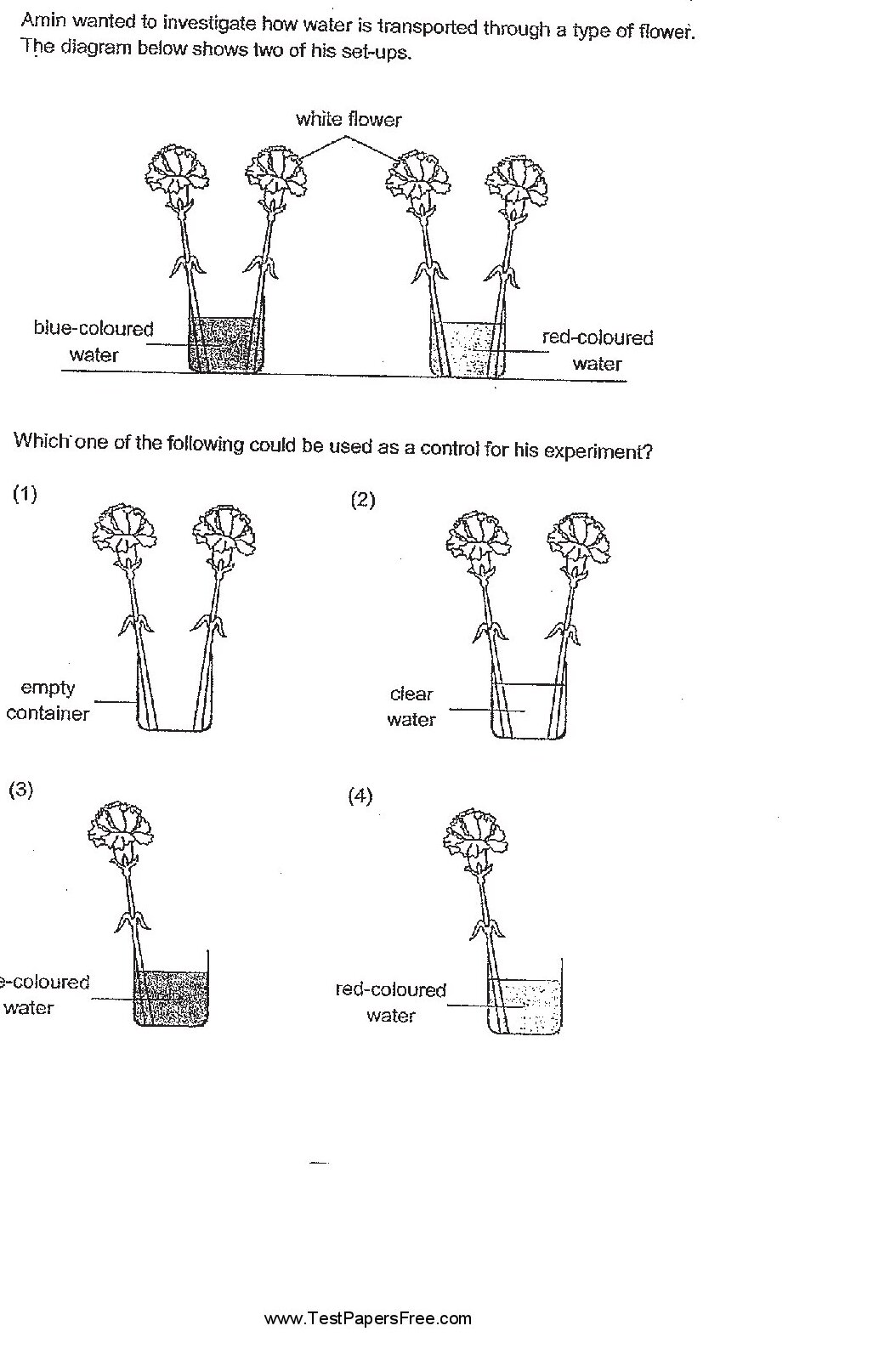
Amin wanted to investigate how water is transported through a type of flower. The diagram below shows two of his set-ups. Which one of the following could be used as a control for his experiment?
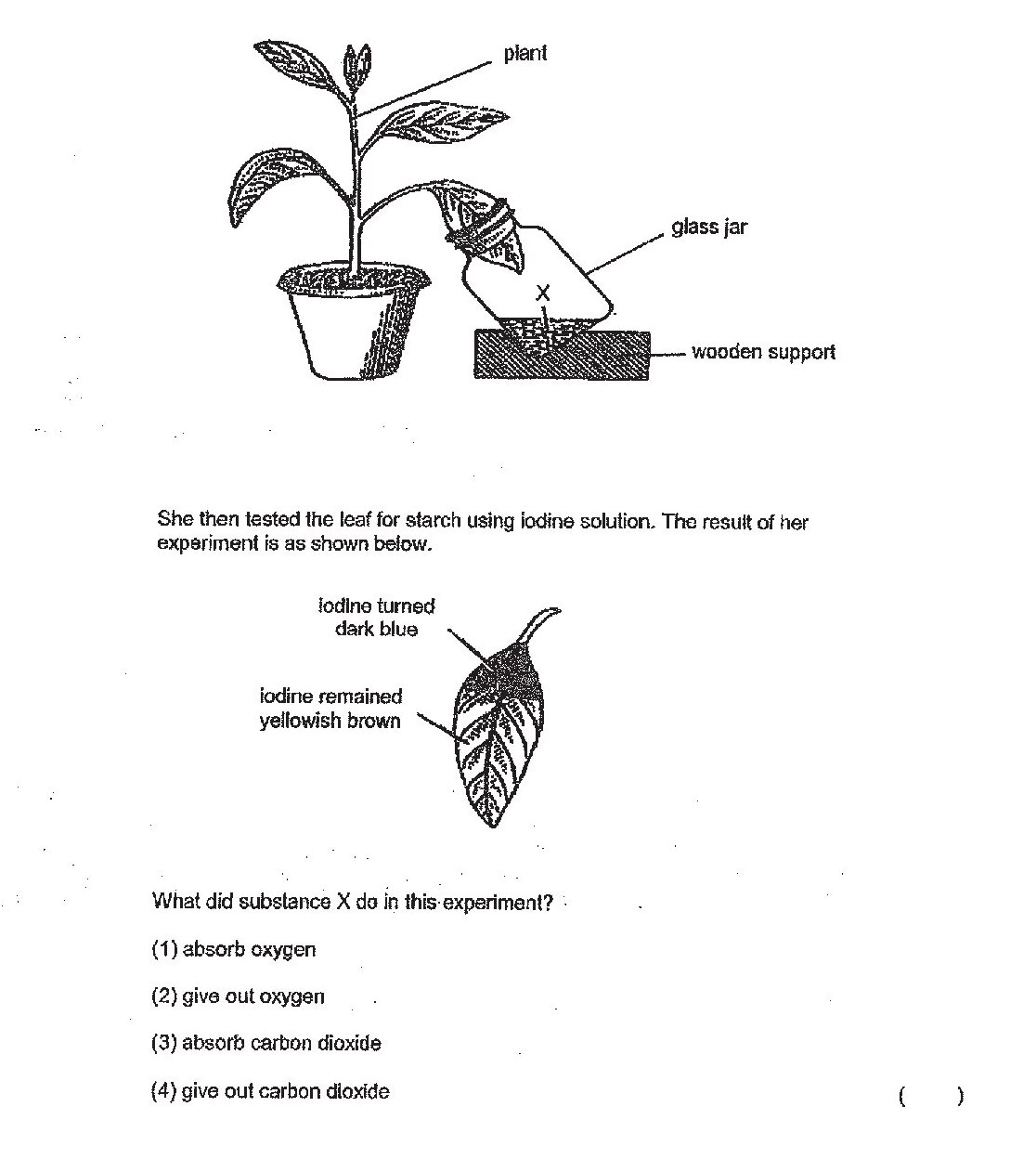
Yasmeen placed substance X in a glass jar and conducted an experiment as shown below. She then tested the leaf for starch using iodine solution. The result of her experiment is as shown below. What did substance X do in this experiment?
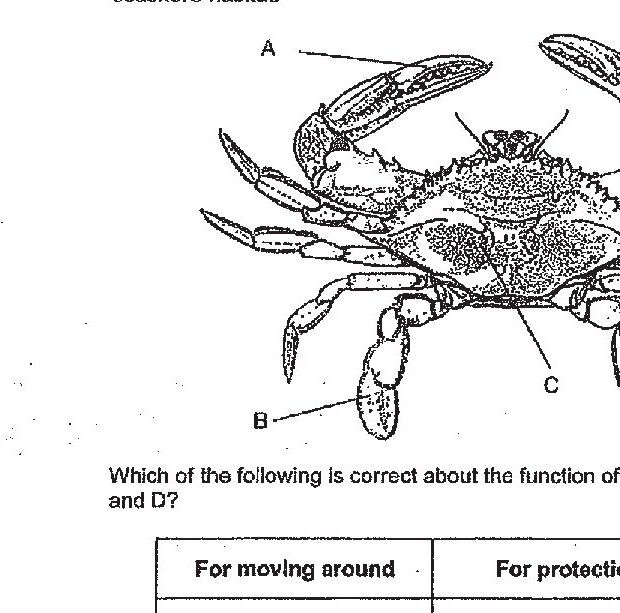
Which of the following is correct about the function of the parts labelled, A, B, C and D?
A student conducted an experiment using a circuit card joined to a parallel circuit as shown below. The table below shows the results when the metal contact is placed at points A to D. Draw in the circuit card below to show how the points are connected.
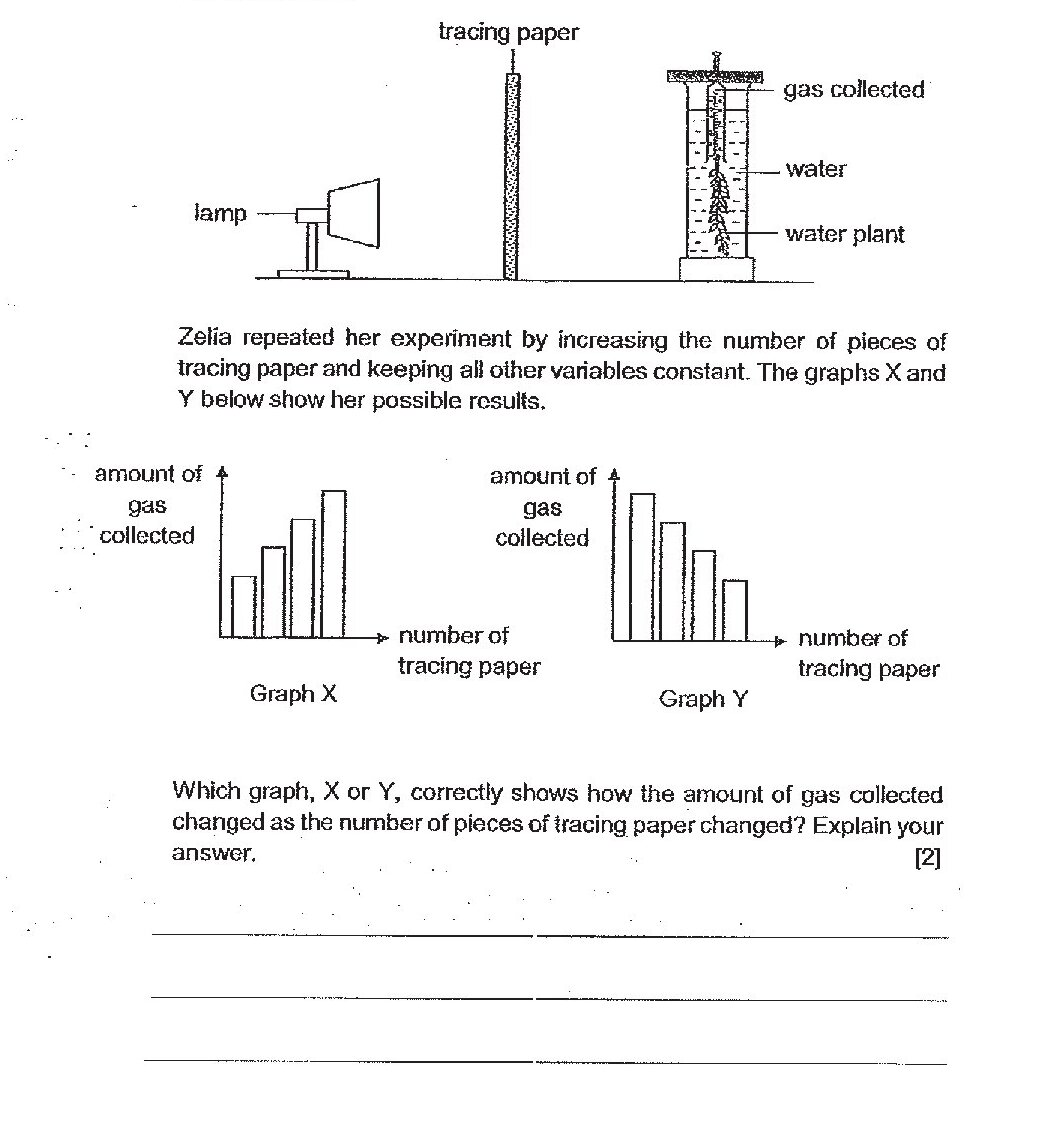
The diagram below represents one of the processes that takes place in plants. Which of the following correctly identifies A, B, C and D?
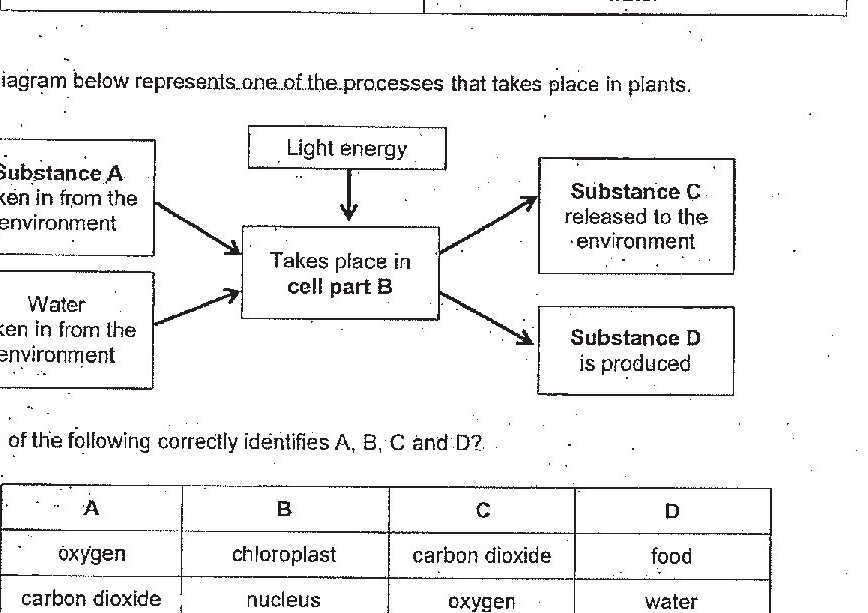
Three flowers, P, Q and R, from the same plant have different flower parts removed as shown below. Which of the flower(s) can develop into a fruit?
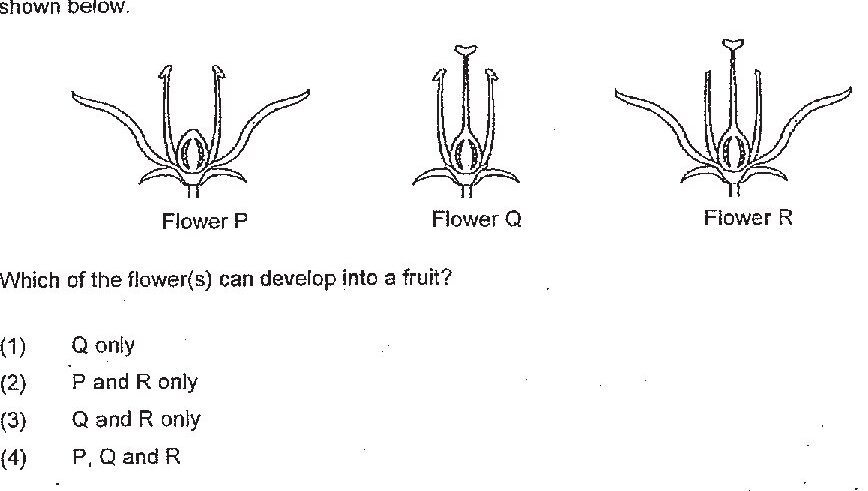
Which one of the following statements is true about parts X and Y?
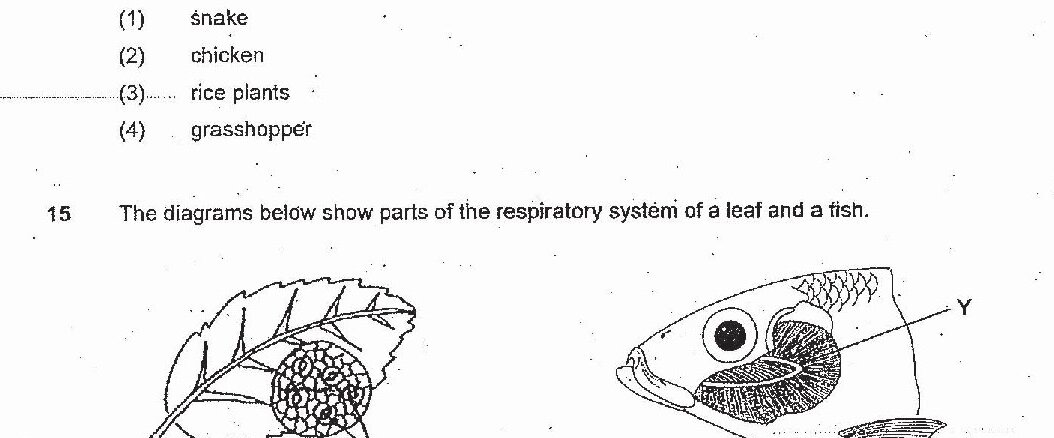
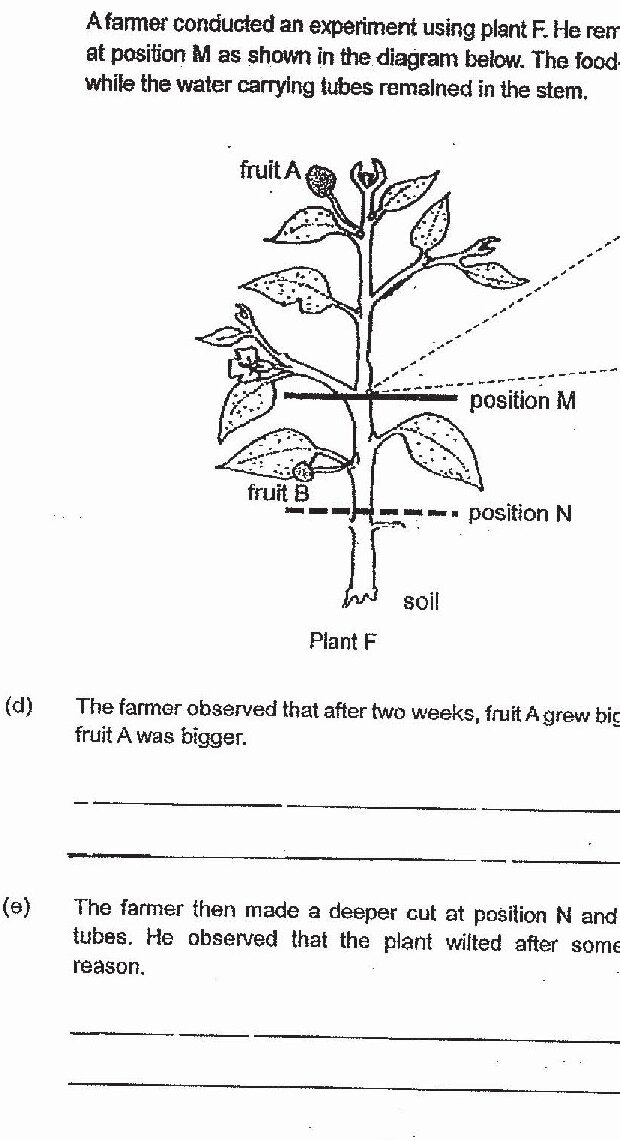
The farmer observed that after two weeks, fruit A grew bigger than fruit B. Suggest why fruit A was bigger.
The farmer then made a deeper cut at position N and removed the water-carrying tubes. He observed that the plant wilted after some time. Suggest a possible reason.
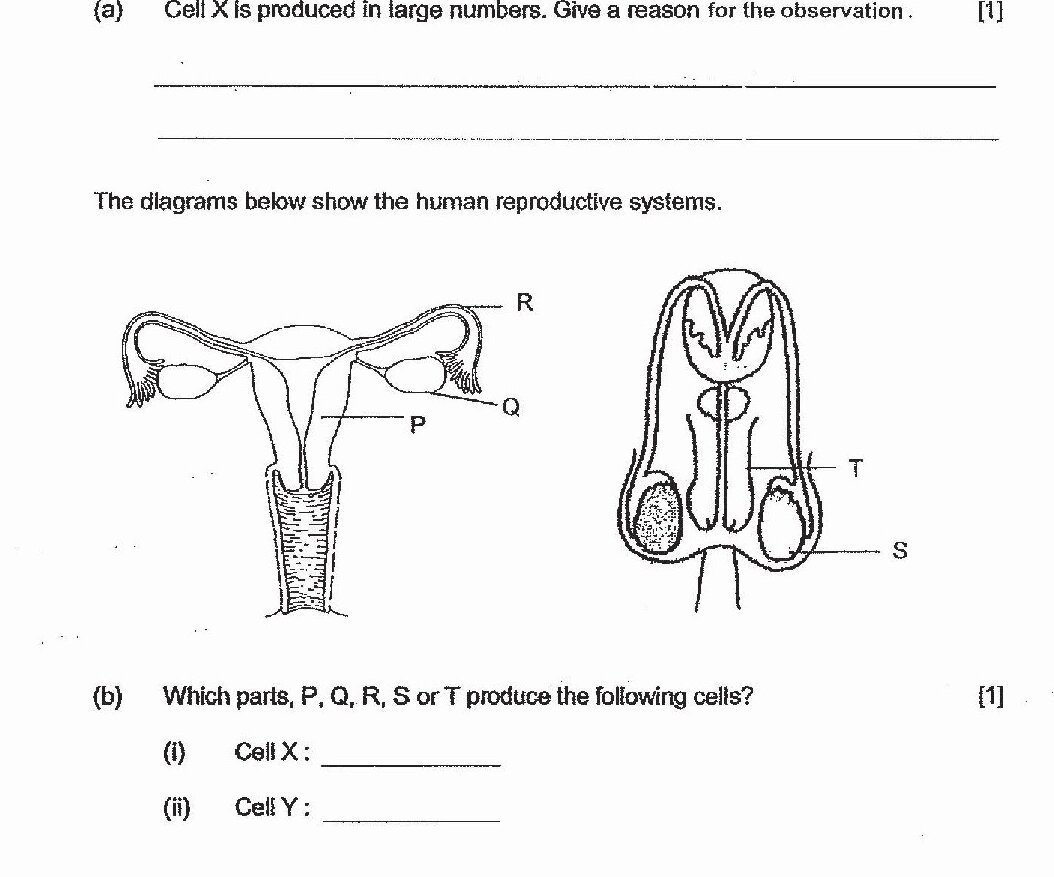
Which parts, P, Q, R, S or T produce the following cells? Cell X:
Sam's mother advised Sam to leave her wet bag under the Sun first before keeping it. Explain how leaving the wet bag under the Sun helps to reduce the growth of mould.
State one characteristic of the flower that attracts animals to pollinate it.

Past year papers cover the full exam — browse by subject below.
View All Papers ›