Pythagoras' Theorem
Pythagoras’ Theorem
Key Concepts
-
Pythagoras’ theorem applies only to a right-angled triangle.
- A right-angled triangle is a triangle that has one angle of 90°.
- The theorem states:
-
In the formula:
and are the lengths of the two shorter sides that form the right angle. is the length of the hypotenuse. - The hypotenuse is always:
- the longest side of a right-angled triangle
- the side opposite the 90° angle
-
What the formula means:
-
If you square the lengths of the two shorter sides and add them together, you get the square of the hypotenuse.
-
Example:
-
-
Finding the hypotenuse:
-
If the two shorter sides are known, use:
-
Steps:
- Square each shorter side.
- Add the squares.
- Take the square root.
-
-
Finding a shorter side:
-
If the hypotenuse and one shorter side are known, rearrange the theorem:
or
-
Then take the square root.
-
Steps:
- Square the hypotenuse.
- Square the known shorter side.
- Subtract.
- Take the square root.
-
-
Pythagorean triples are sets of 3 whole numbers that satisfy Pythagoras’ theorem exactly.
- Common examples:
- These are useful because they allow quick answers without using a calculator much.
- Common examples:
-
Applications in real-world contexts:
- Pythagoras’ theorem is used to find distances that cannot be measured directly.
- Examples include:
- the length of a ladder leaning against a wall
- the diagonal of a rectangle
- the shortest straight-line distance between two points
- the height of an object using a sloping side
- distances on maps or floor plans
-
Converse of Pythagoras’ theorem:
-
The converse is used to check whether a triangle is right-angled.
-
If the side lengths of a triangle satisfy:
where
is the longest side, then the triangle is a right-angled triangle. -
If the equation is not true, the triangle is not right-angled.
-
-
Important note about units:
- All side lengths must be in the same unit before using the formula.
- Example: convert cm to m, or m to cm, before calculating.
-
Important note about square roots:
- A length cannot be negative.
- When finding a side length, use the positive square root only.
Important Definitions
-
Pythagoras’ theorem: the rule that in a right-angled triangle, the square of the hypotenuse is equal to the sum of the squares of the other two sides,
. -
Right-angled triangle: a triangle with one angle equal to 90°.
-
Hypotenuse: the longest side of a right-angled triangle, opposite the right angle.
-
Shorter sides: the two sides that meet to form the right angle in a right-angled triangle.
-
Square of a number: the result of multiplying a number by itself, for example
. -
Square root: a number that, when multiplied by itself, gives the original number, for example
. -
Pythagorean triple: a set of three whole numbers that satisfy Pythagoras’ theorem exactly.
-
Converse of Pythagoras’ theorem: the rule used to test whether a triangle is right-angled by checking whether the side lengths satisfy
. -
Diagonal: a straight line joining two opposite corners of a shape such as a rectangle or square.
-
Perpendicular: meeting at an angle of 90°.
Worked Examples
Example 1: Finding the hypotenuse
A right-angled triangle has shorter sides of 6 cm and 8 cm. Find the hypotenuse.
Step 1: Write the formula
Step 2: Substitute the values
Step 3: Square the numbers
Step 4: Add
Step 5: Take the square root
Answer: The hypotenuse is 10 cm.
Example 2: Finding a shorter side
A right-angled triangle has hypotenuse 13 m and one shorter side 5 m. Find the other shorter side.
Step 1: Write the formula
Let the unknown side be
Step 2: Square the known numbers
Step 3: Rearrange
Step 4: Take the square root
Answer: The other shorter side is 12 m.
Example 3: Using the converse of Pythagoras’ theorem
Check whether a triangle with side lengths 9 cm, 12 cm, and 15 cm is right-angled.
Step 1: Identify the longest side
- The longest side is 15 cm.
- So let
, , .
Step 2: Use the converse Check whether:
Step 3: Square the side lengths
Step 4: Conclude Since both sides are equal, the triangle satisfies Pythagoras’ theorem.
Answer: Yes, the triangle is right-angled.
Common Mistakes to Avoid
- Using Pythagoras’ theorem on a triangle that is not right-angled.
- Choosing the wrong side as the hypotenuse.
- Remember: the hypotenuse is always opposite the 90° angle and is the longest side.
- Forgetting to square the numbers.
- Example: writing
instead of .
- Example: writing
- Forgetting to take the square root at the end when finding a side.
- Example: stopping at
and saying the answer is 81 instead of 9.
- Example: stopping at
- Mixing up the formula when finding a shorter side.
-
Correct method:
-
- Subtracting in the wrong order.
-
Always do:
-
Not the other way round.
-
- Forgetting to write units in the final answer.
- Using different units without converting first.
- Example: one side in cm and another in m.
- For the converse, not using the longest side as
. - Rounding too early during working, which may cause small errors.
Exam Tips
-
First check whether the triangle is right-angled before using Pythagoras’ theorem.
-
In your working, clearly state:
- “Using Pythagoras’ theorem”
- or “Using the converse of Pythagoras’ theorem”
-
Label the sides carefully:
= hypotenuse and = shorter sides
-
Show substitution clearly:
-
If checking whether a triangle is right-angled, write a full conclusion such as:
- “Since
, the triangle is right-angled.” - “Since
, the triangle is not right-angled.”
- “Since
-
For word problems:
- Identify the horizontal, vertical, and sloping sides.
- Draw a neat diagram before calculating.
-
Write the final answer with:
- correct units
- correct degree of accuracy if required
-
If the answer is a decimal, keep enough figures during working and round only at the end.
-
Memorise common Pythagorean triples:
Quick Summary
-
Pythagoras’ theorem applies only to a right-angled triangle.
-
The formula is:
-
The hypotenuse is the side opposite the 90° angle and is the longest side.
-
To find the hypotenuse:
-
To find a shorter side:
or
-
Common Pythagorean triples include:
-
Real-life applications include ladders, diagonals, map distances, and heights.
-
The converse of Pythagoras’ theorem is used to test whether a triangle is right-angled.
-
When using the converse, always treat the longest side as
. -
Use the same units for all sides before calculating.
-
A side length must be positive, so use the positive square root only.
-
Always include clear working, units, and a proper final statement in exam answers.
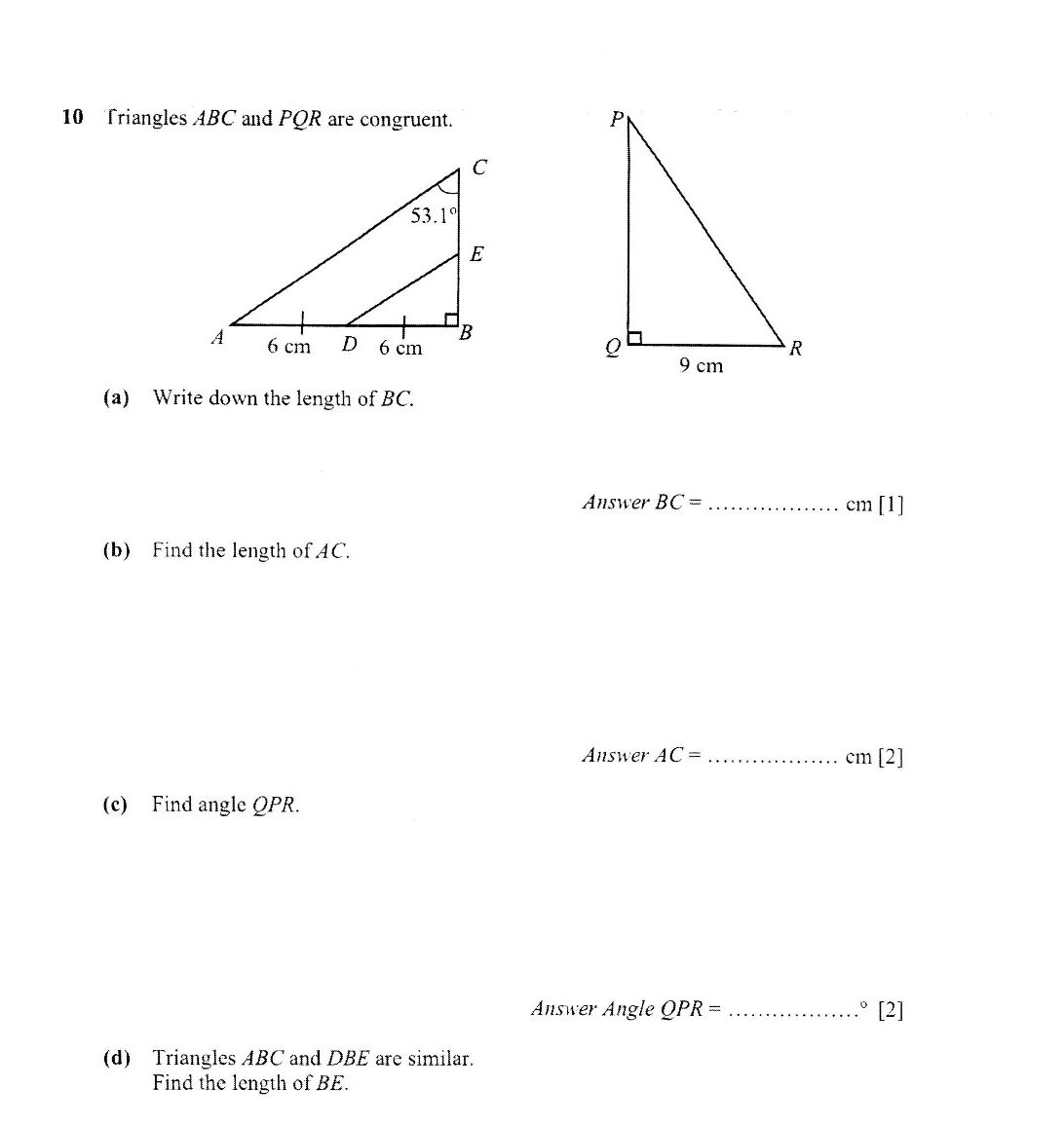
In the figure PQRS, PS = 3.75 cm, PQ = 9 cm, QS = 9.75 cm, QR = 18 cm and angle RSQ = 90°. Show that PQS is a right-angled triangle.
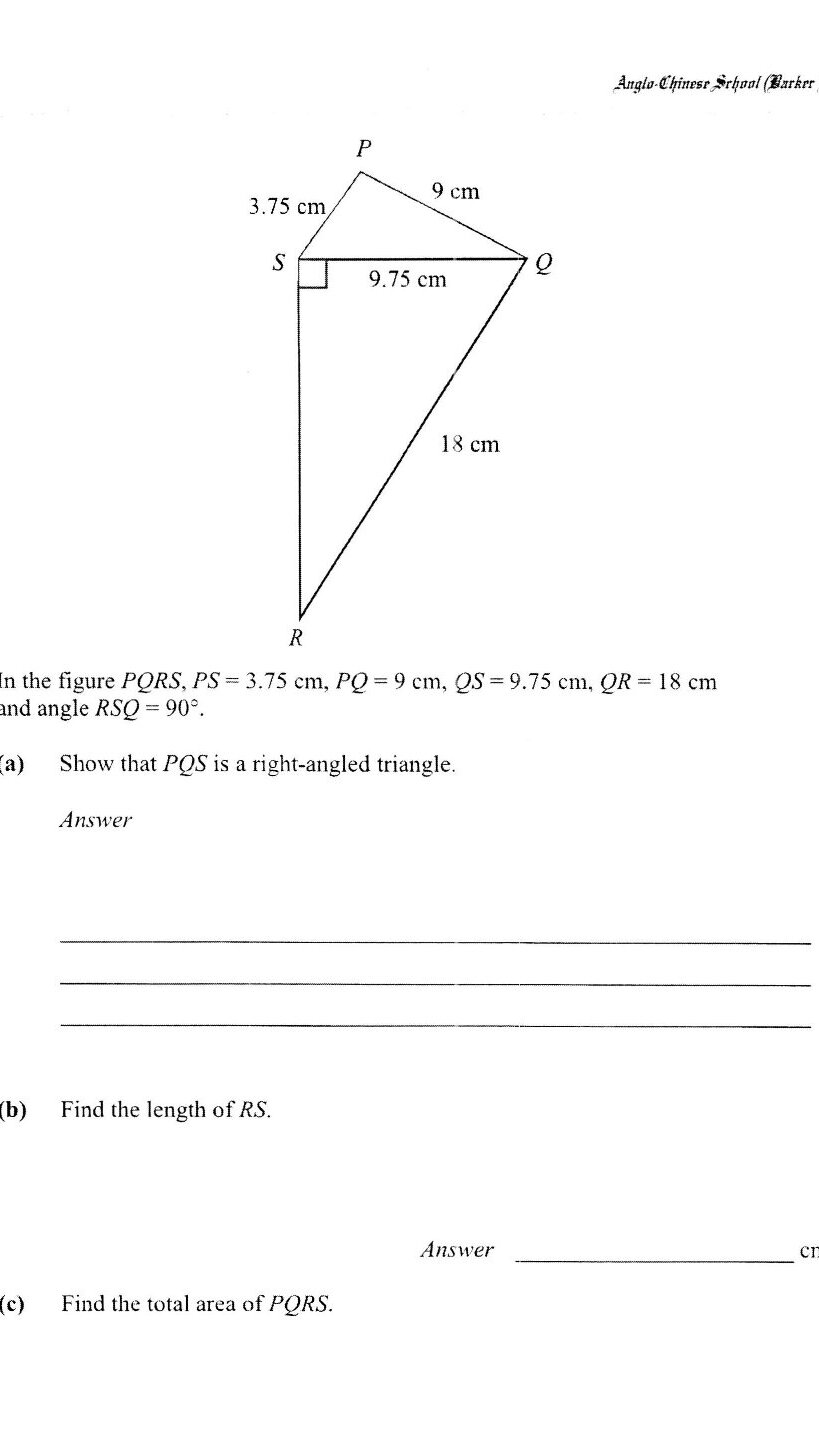
Find the length of RS.
ABC is a triangle in which AB = 17 cm, BC = 15 cm and AC = 8 cm. Show that triangle ABC is a right-angled triangle.
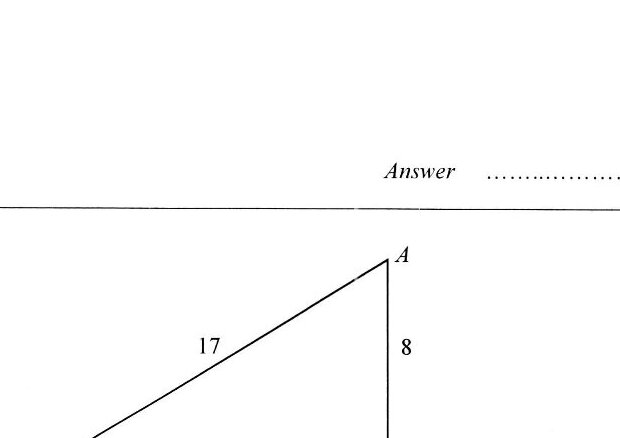
ABC is a straight line. AB = 5 cm, DB = 12 cm, DC = 16 cm and angle CBD = 90°. Find the length of AD.
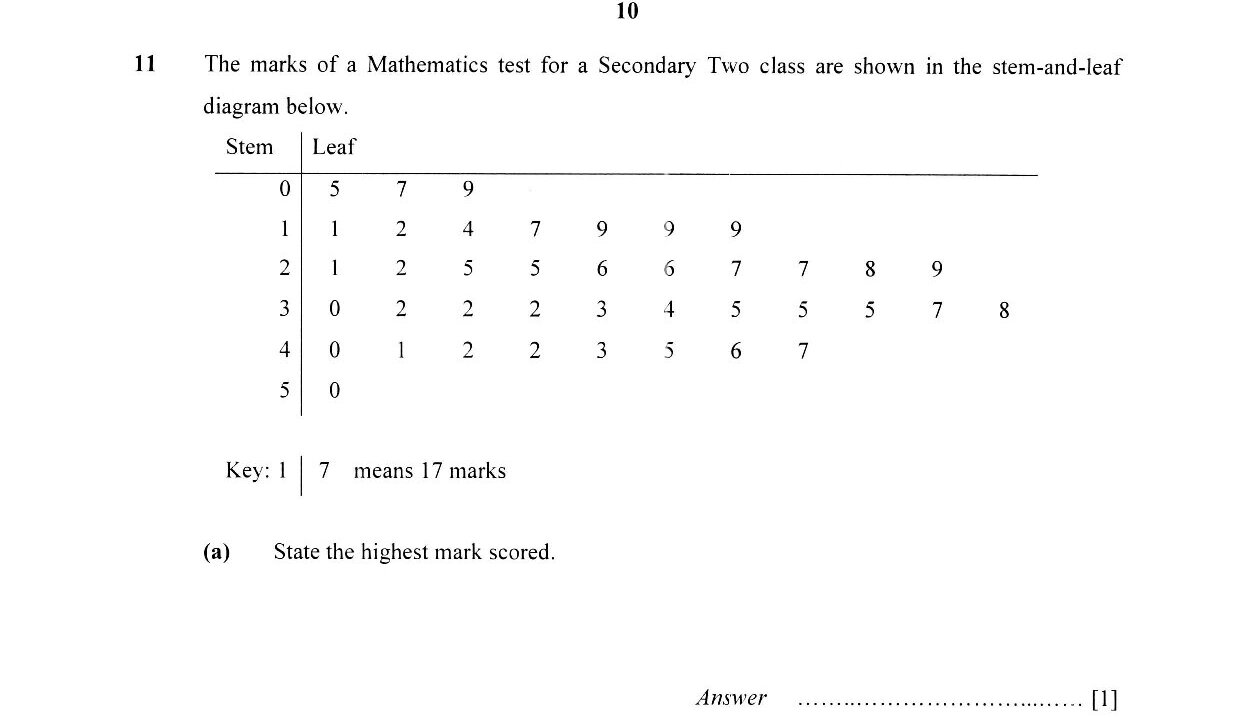
Find the number of students who scored at least 40 marks.
In triangle PQR, PQ = 20 cm, QR = 25 cm and PR = 32 cm. Show that triangle PQR is not a right-angled triangle.
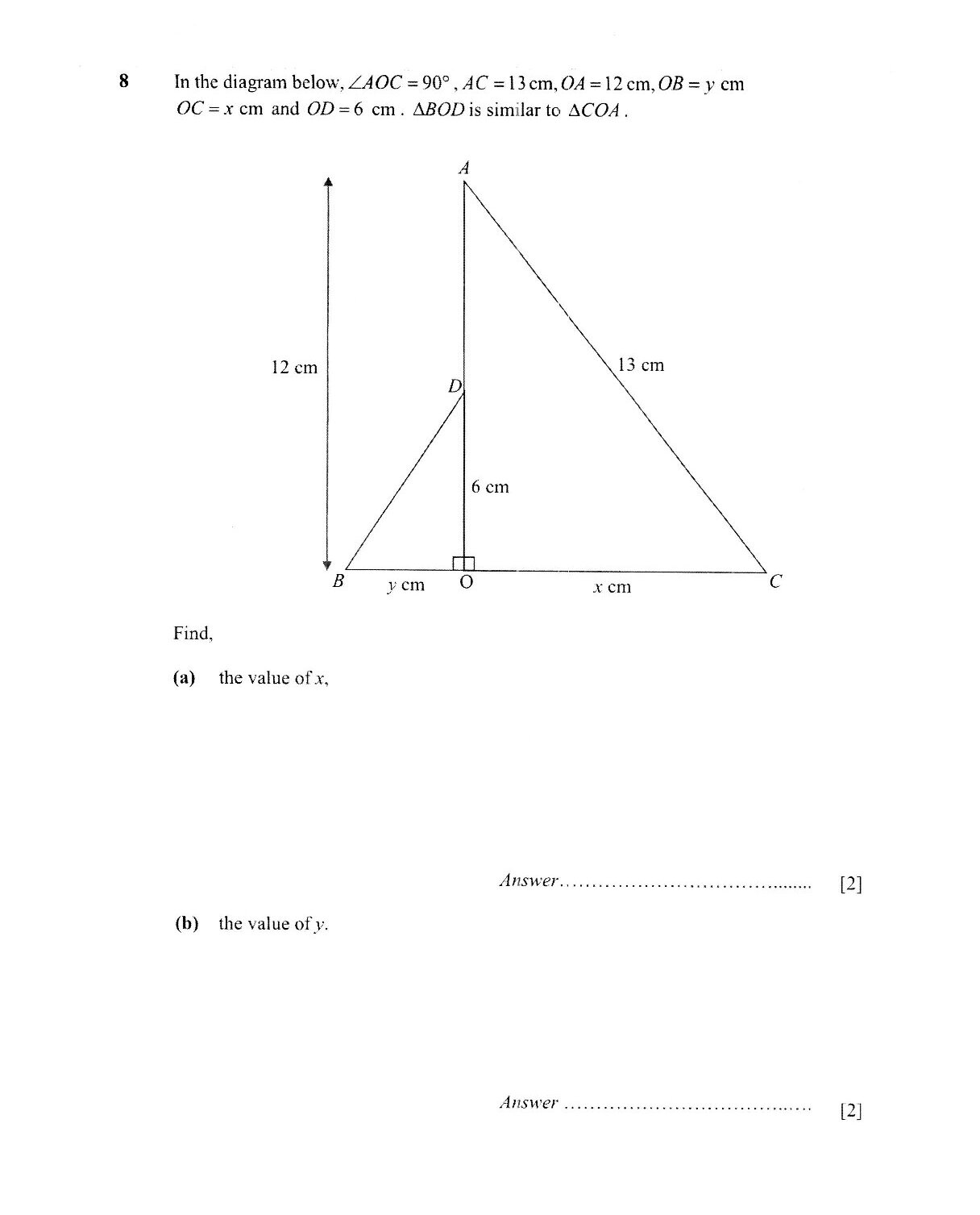
Find the length of AC.
Hence, show that the triangle is a right-angled triangle.
ABC is a right-angled triangle. Find the length of AC.
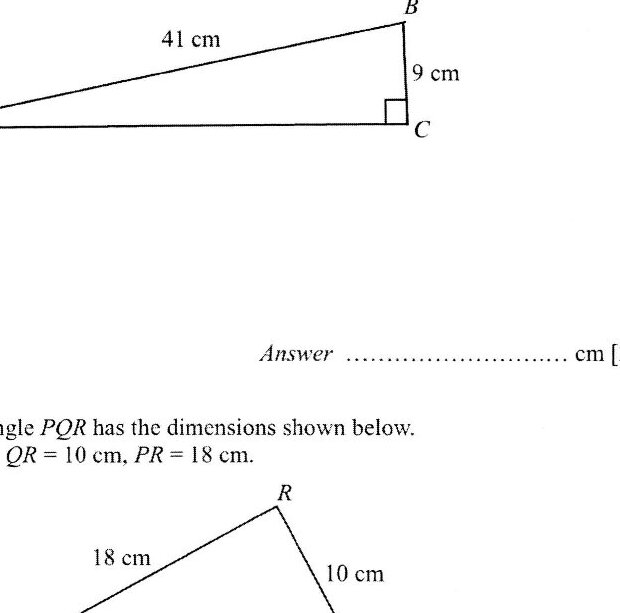
Another triangle PQR has the dimensions shown below. PQ = 20 cm, QR = 10 cm, PR = 18 cm. Stating your reasons clearly, determine whether triangle PQR is a right-angled triangle.
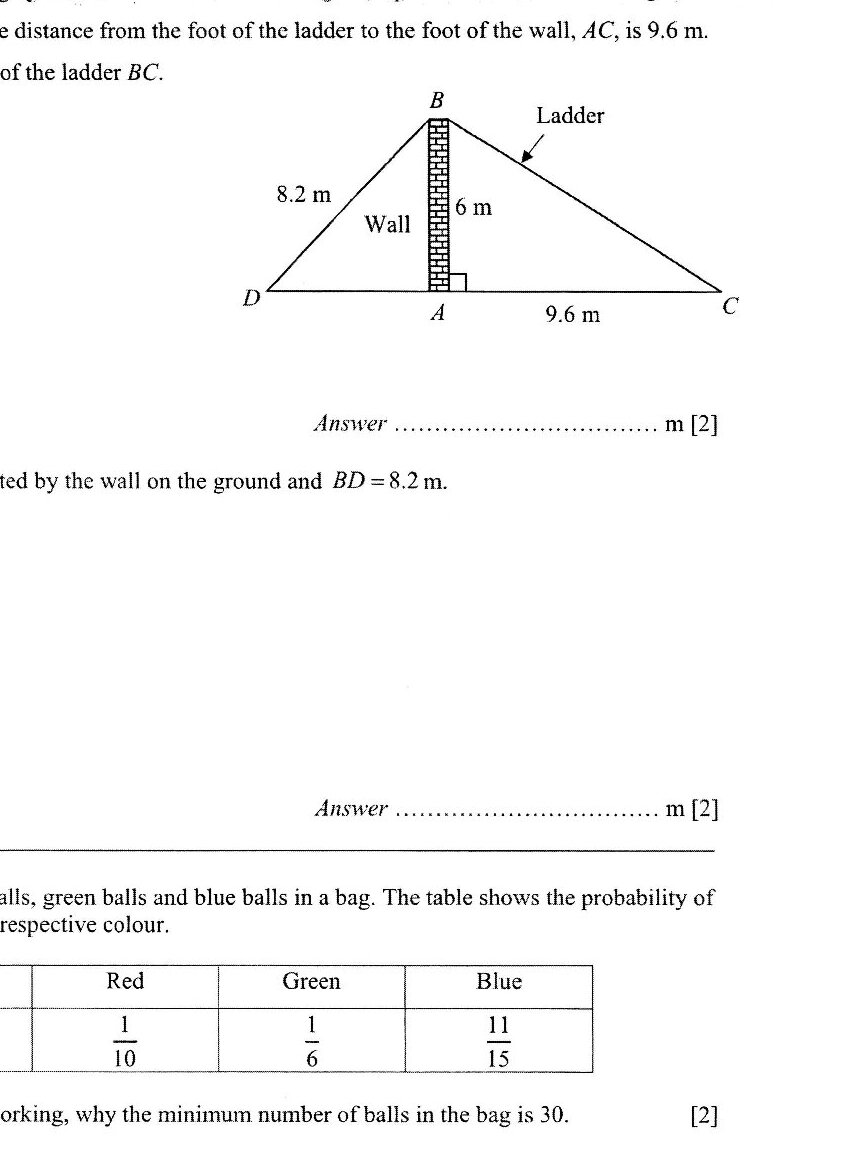
A ladder BC is leaning against the wall AB and touching the top of the wall at B. The height of the wall is 6 m and the distance from the foot of the ladder to the foot of the wall, AC, is 9.6 m. Find the length of the ladder BC.
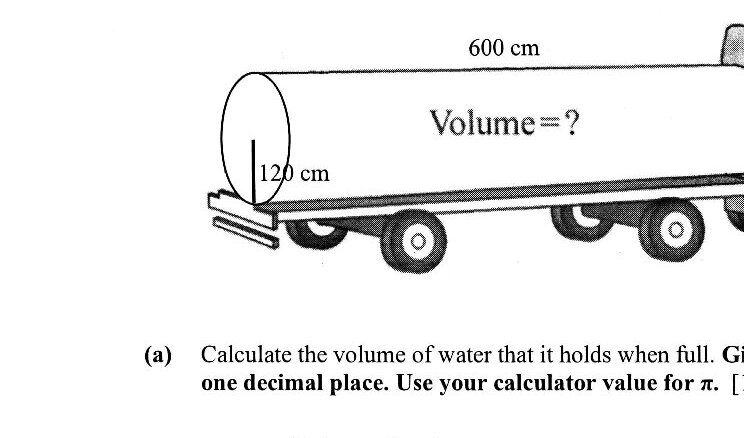
The tanker delivers the water to a factory. The factory uses the water to fill 500 cm³ bottles. How many full bottles can it fill from the tanker?
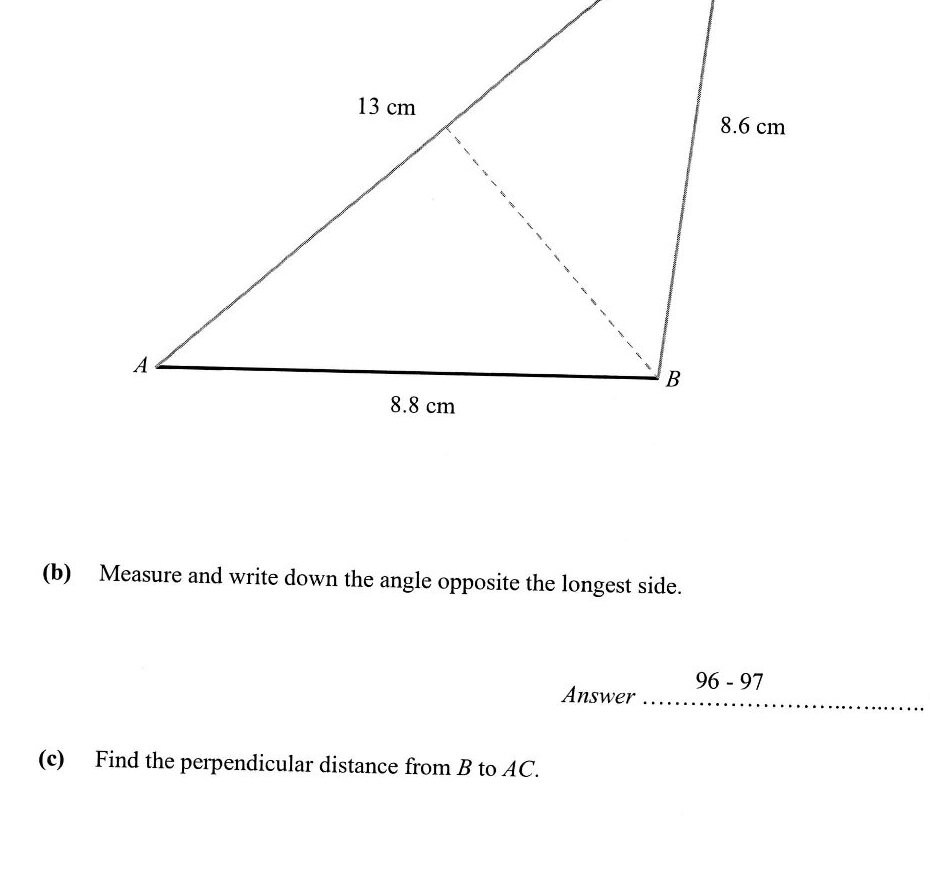
Measure and write down the angle opposite the longest side of the triangle.
Find the length of AB.
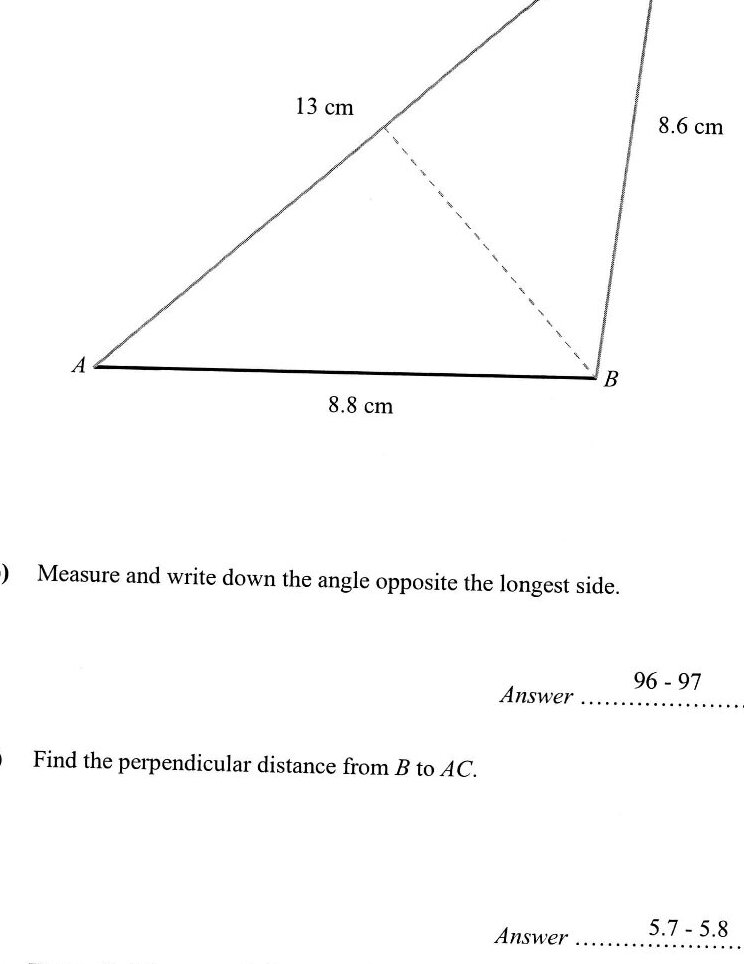
Find the perpendicular distance from B to AC.
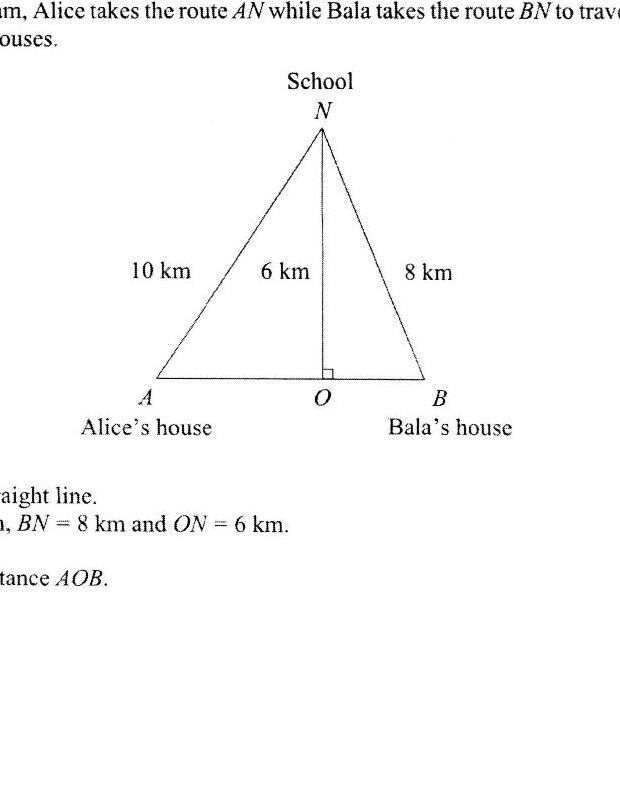
In the diagram, Alice takes the route AN while Bala takes the route BN to travel to school from their houses. AOB is a straight line. AN = 10 km, BN = 8 km and ON = 6 km. Find the distance AOB.
Show that ABN is a right-angled triangle.
Calculate the total surface area of the tent, including the base.
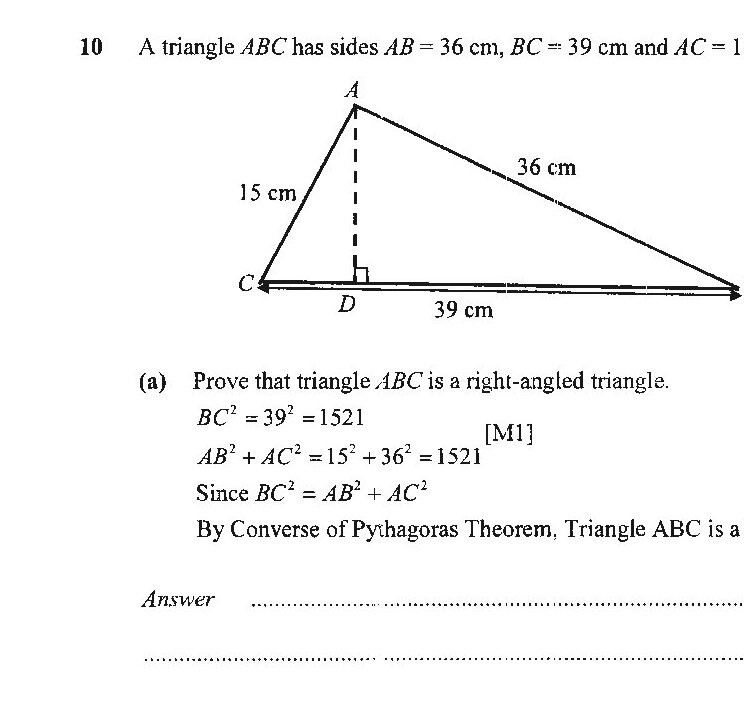
A triangle ABC has sides AB = 36 cm, BC = 39 cm and AC = 15 cm. Prove that triangle ABC is a right-angled triangle.
A bag contains 5 blue balls, 8 green balls and 3 yellow balls. A ball is drawn at random. Find the probability of getting a green ball.
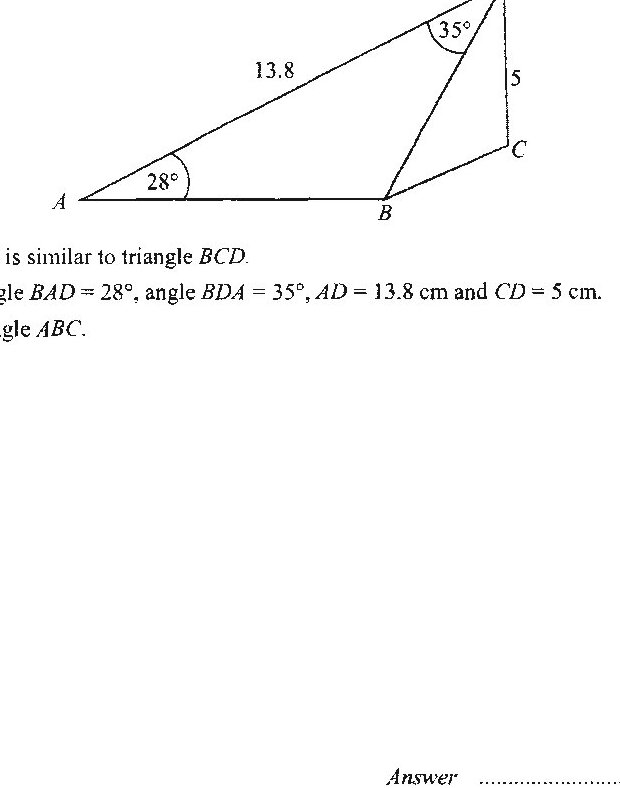
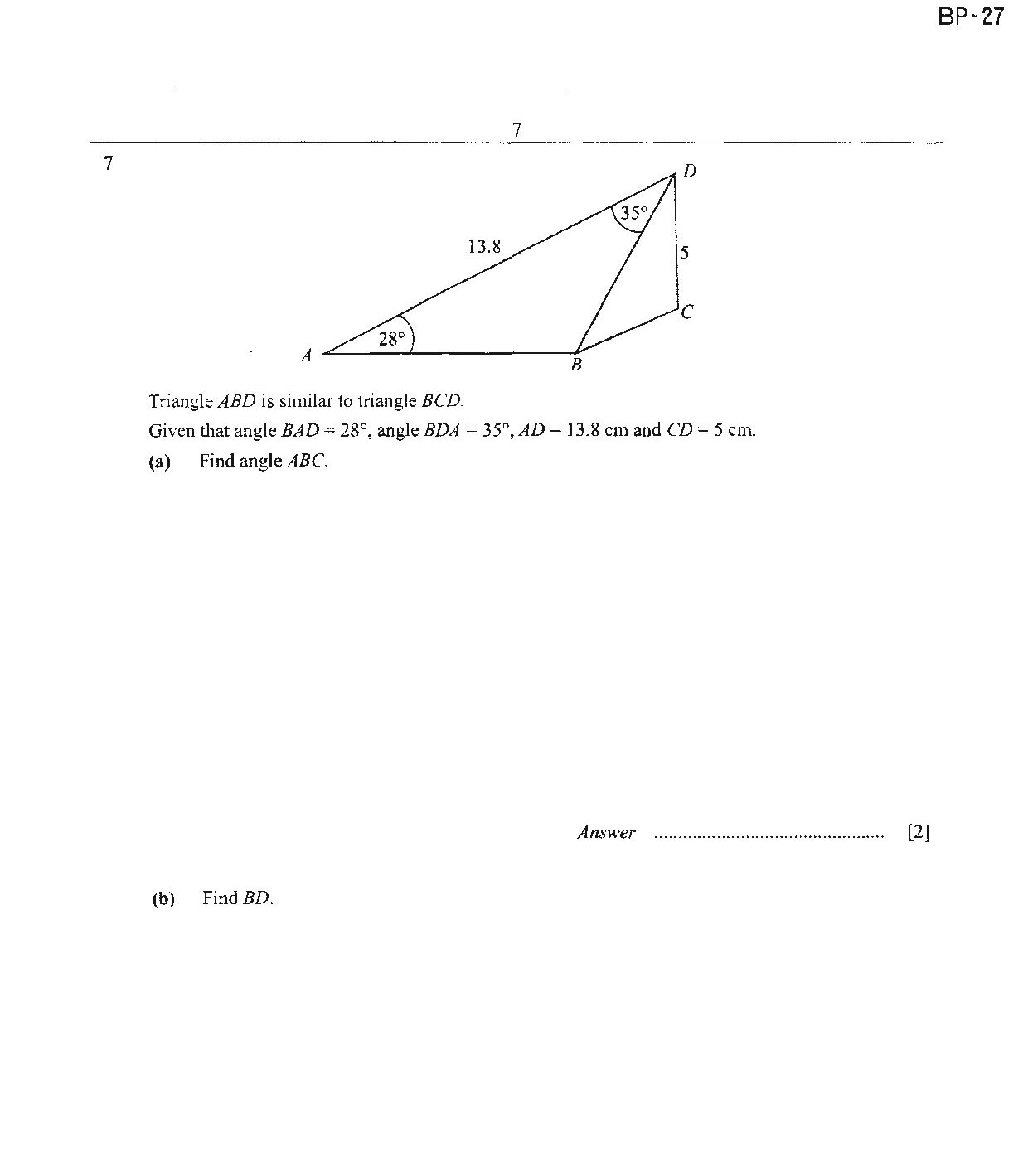
Triangle ABD is similar to triangle BCD. Given that angle BAD = 28°, angle BDA = 35°, AD = 13.8 cm and CD = 5 cm. Find angle ABC.
The total surface area of the cuboid is 325 cm². Form an equation, in terms of x, to represent this information and show that it simplifies to 18x² + 65x - 275 = 0.
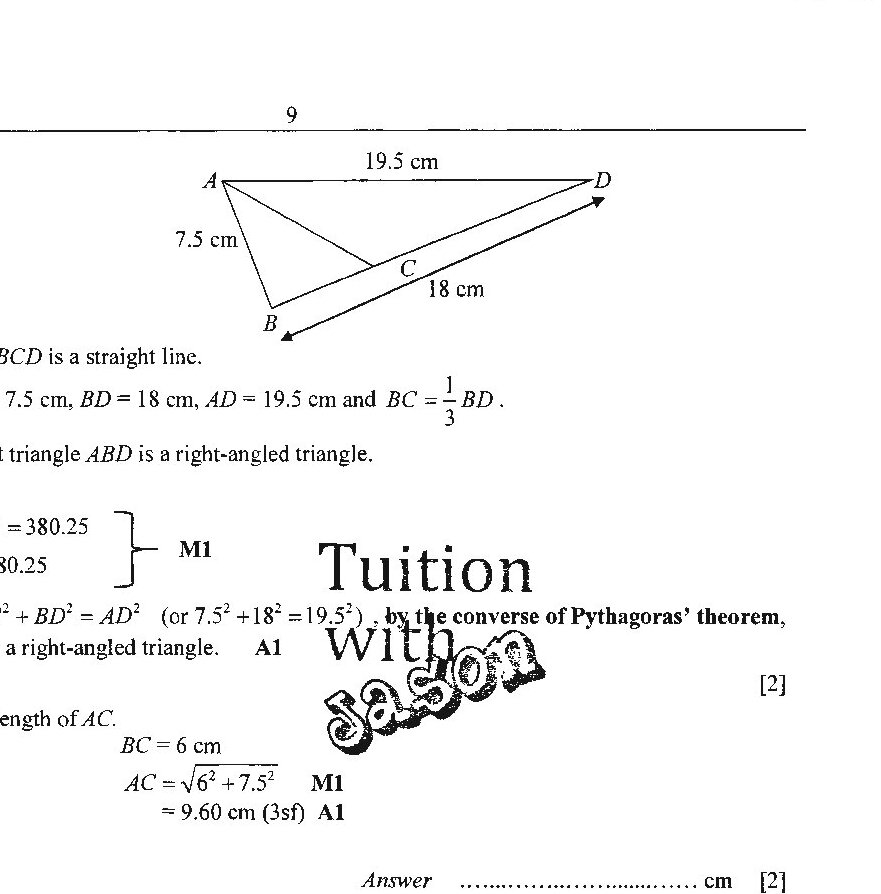
Show that triangle ABD is a right-angled triangle.
(b) Calculate the total amount, including credit card fee, Jade is charged for fuel. Give your answer in Singapore dollars correct to the nearest cent.
A triangle has sides AB = 8 cm, BC = 15 cm and AC = 17 cm.
Hence, calculate the length of XZ.
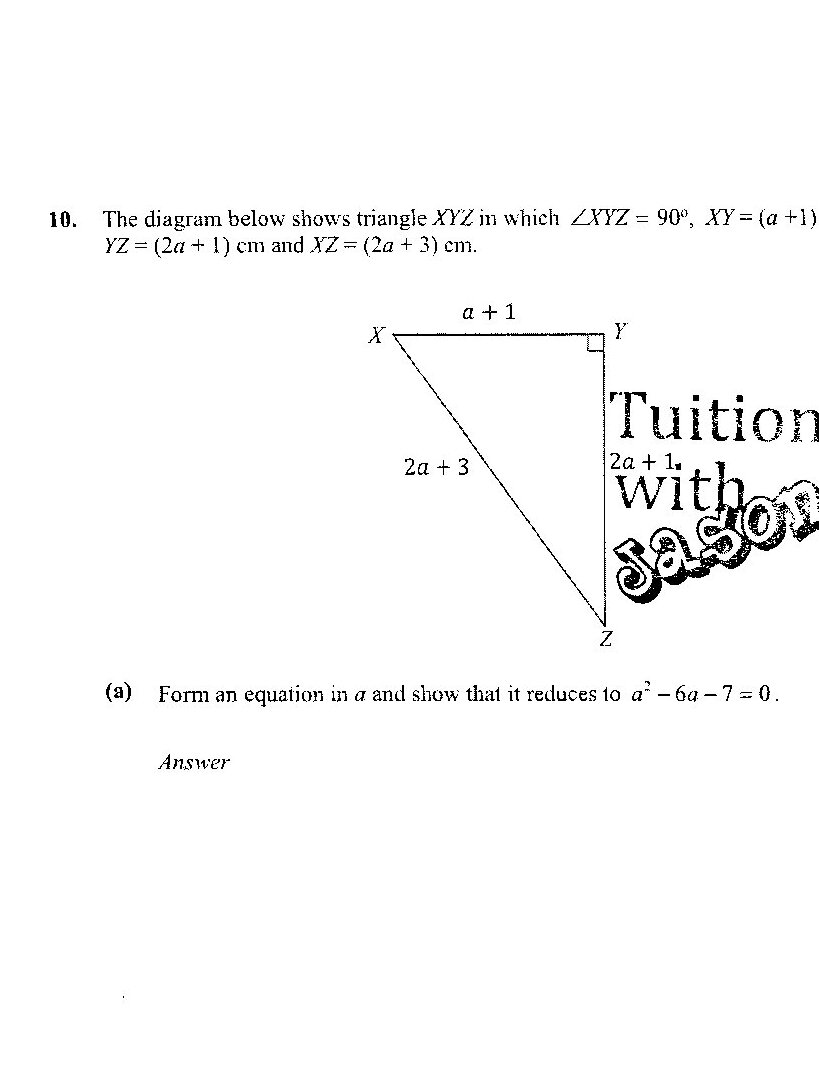
Calculate angle ADB.
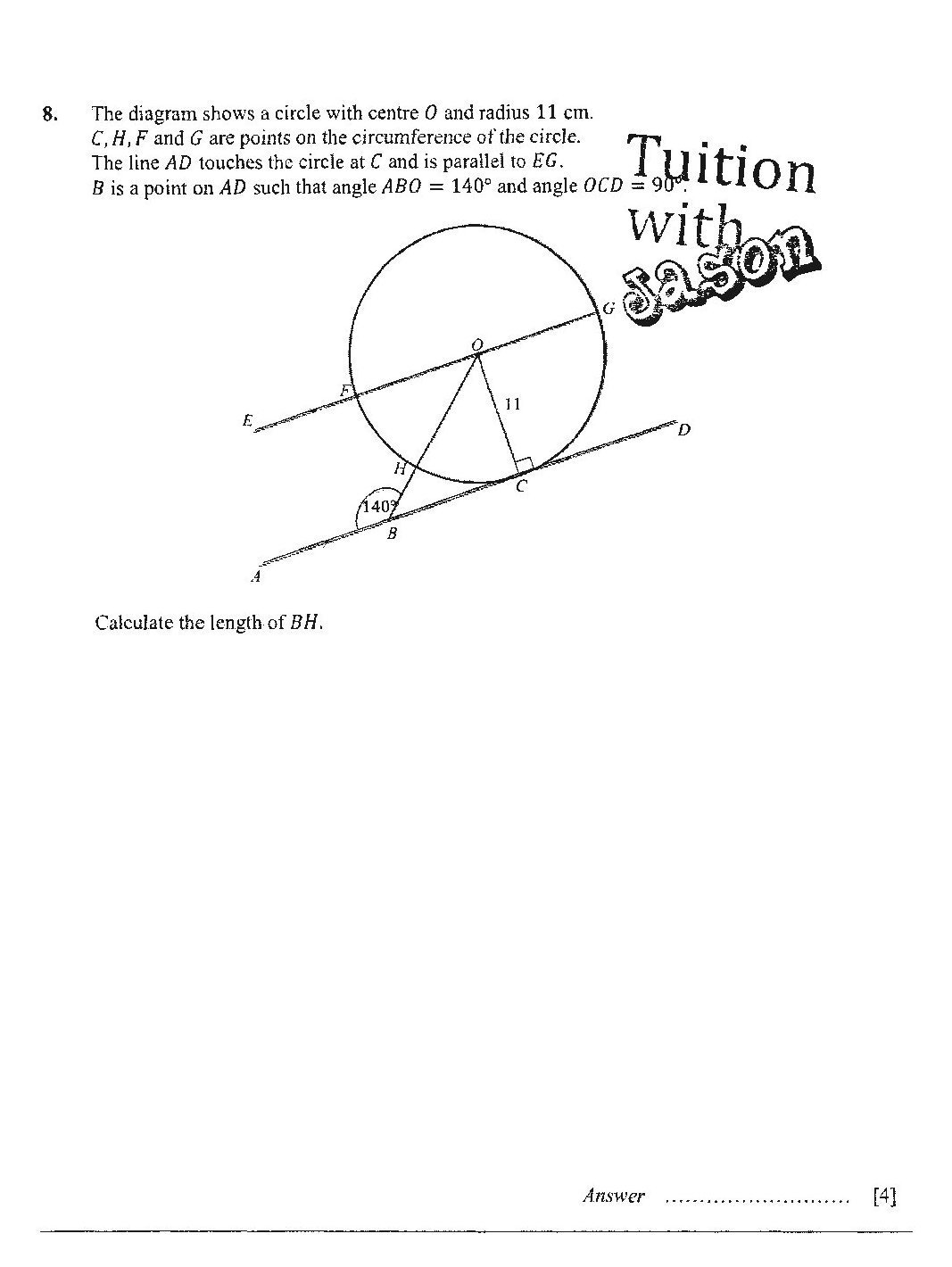
Past year papers cover the full exam — browse by subject below.
View All Papers ›