Trigonometry
Trigonometry Study Notes
Key Concepts
- Trigonometry is a branch of Mathematics that deals with the relationship between the angles and sides of triangles.
- At this level, trigonometry is mainly used with right-angled triangles.
1. Right-angled triangle
- A right-angled triangle is a triangle with one angle equal to 90°.
- The side opposite the 90° angle is always the hypotenuse.
- The hypotenuse is the longest side in the triangle.
2. Naming the sides of a right-angled triangle
To use trigonometry, you must know how to identify the sides relative to a chosen angle.
- Hypotenuse
- The side opposite the right angle.
- Opposite side
- The side directly opposite the angle you are focusing on.
- Adjacent side
- The side next to the angle you are focusing on, but it is not the hypotenuse.
Important: The opposite and adjacent sides can change depending on which angle you choose.
3. Trigonometric ratios
The three basic trigonometric ratios are:
- Sine
- Cosine
- Tangent
These ratios compare the lengths of sides in a right-angled triangle.
For an angle
4. SOH-CAH-TOA
This is a memory aid to help remember the trigonometric ratios.
- SOH → Sine = Opposite / Hypotenuse
- CAH → Cosine = Adjacent / Hypotenuse
- TOA → Tangent = Opposite / Adjacent
5. Finding unknown sides in right-angled triangles
To find an unknown side:
- Identify the given angle.
- Label the sides as opposite, adjacent, and hypotenuse.
- Choose the correct trigonometric ratio.
- Substitute the known values into the formula.
- Solve for the unknown side.
- Write the answer with the correct unit.
Example of choosing the ratio:
- If you know opposite and want hypotenuse, use sine.
- If you know adjacent and want hypotenuse, use cosine.
- If you know opposite and want adjacent, use tangent.
6. Finding unknown angles using inverse trigonometric ratios
Sometimes the side lengths are known, and you need to find an angle.
Use the inverse trig functions on the calculator:
7. Calculator use
- Make sure the calculator is in degree mode when working with angles in degrees.
- In triangle questions at this level, angles are usually given in degrees (°).
8. Angles of elevation and depression
These are used in real-life applications involving heights and distances.
Angle of elevation
- The angle between the horizontal line and the line of sight when looking upwards.
Angle of depression
- The angle between the horizontal line and the line of sight when looking downwards.
Key idea:
- Horizontal lines are parallel, so the angle of depression from the top is equal to the angle of elevation from the bottom, if they are formed by the same line of sight.
9. Bearing problems
A bearing is a direction measured:
- clockwise
- from North
- using 3 digits
Examples:
- North-East direction may be written as 045°
- East is 090°
- South is 180°
- West is 270°
When solving bearing problems:
- Always draw a North line.
- Bearings are measured clockwise from North.
- Use trigonometry if a right-angled triangle can be formed.
10. When trigonometry is useful
Trigonometry can help you find:
- heights of buildings
- width of rivers
- distance to objects
- angles in navigation and map-reading
- directions involving bearings
Important Definitions
- Trigonometry: the study of the relationships between the sides and angles of triangles.
- Right-angled triangle: a triangle with one angle of 90°.
- Hypotenuse: the side opposite the right angle in a right-angled triangle; it is the longest side.
- Opposite side: the side directly opposite the angle being considered.
- Adjacent side: the side next to the angle being considered, excluding the hypotenuse.
- Trigonometric ratio: a ratio comparing two sides of a right-angled triangle.
- Sine: the ratio of the opposite side to the hypotenuse.
- Cosine: the ratio of the adjacent side to the hypotenuse.
- Tangent: the ratio of the opposite side to the adjacent side.
- SOH-CAH-TOA: a mnemonic used to remember the definitions of sine, cosine and tangent.
- Inverse trigonometric function: a function used to find an angle when the trigonometric ratio is known.
- Angle of elevation: the angle between the horizontal and the line of sight when looking upwards.
- Angle of depression: the angle between the horizontal and the line of sight when looking downwards.
- Line of sight: the straight line from the observer’s eye to the object.
- Bearing: the direction of one point from another, measured clockwise from North and written as a 3-digit angle.
- Horizontal: a line parallel to the ground.
- Vertical: a line perpendicular to the ground.
Worked Examples
Example 1: Finding an unknown side using sine
A ladder leans against a wall. The ladder is 5.0 m long and makes an angle of 40° with the ground. Find the height reached by the ladder on the wall.
Step 1: Identify the triangle
- The ladder, wall and ground form a right-angled triangle.
- The ladder is the hypotenuse.
- The height up the wall is the opposite side to the
angle.
Step 2: Choose the correct ratio
We need opposite and hypotenuse, so use sine.
Step 3: Solve
Step 4: Write the answer
Answer: The ladder reaches a height of 3.21 m up the wall.
Example 2: Finding an unknown angle using inverse tangent
A tree casts a shadow of 8.0 m. The height of the tree is 6.0 m. Find the angle of elevation of the Sun.
Step 1: Identify the sides
- Height of tree = opposite side = 6.0 m
- Shadow length = adjacent side = 8.0 m
Step 2: Choose the correct ratio
We need opposite and adjacent, so use tangent.
Step 3: Use inverse tangent
Answer: The angle of elevation of the Sun is
Example 3: Bearing and trigonometry
A boat sails 12 km due East from a lighthouse, then 5 km due North. Find:
- its distance from the lighthouse
- the bearing of the boat from the lighthouse
Step 1: Draw the path
- Start at the lighthouse
- Move 12 km East
- Then move 5 km North to boat
This forms a right-angled triangle:
- horizontal side = 12 km
- vertical side = 5 km
Step 2: Find the distance
Use Pythagoras’ theorem:
So the boat is 13 km from the lighthouse.
Step 3: Find the angle
To find the bearing, first find the angle from the East direction or North direction.
Using angle from East:
This means the boat is
Step 4: Convert to bearing
Bearing is measured clockwise from North.
From North to East is
Write as a 3-digit bearing:
If the question requires whole-number bearing:
Answers:
- Distance from lighthouse = 13 km
- Bearing of boat from lighthouse = 067° approximately
Bearings
Definition
A bearing is an angle used to describe direction. It is always:
- Measured clockwise from North
- Written as 3 digits (e.g. 045°, not 45°; 090°, not 90°)
Key Bearing Facts
| Direction | Bearing |
|---|---|
| North | 000° |
| East | 090° |
| South | 180° |
| West | 270° |
Back Bearings (Reverse Bearings)
When you need to find the bearing of A from B, given the bearing of B from A, use:
Back bearing = bearing + 180°
If the result is greater than 360°, subtract 360°.
Worked Example:
“Town B is on a bearing of 120° from Town A. Find the bearing of A from B.”
Step 1: The bearing of B from A is 120°.
Step 2: Apply the back-bearing rule: [\text{Back bearing} = 120° + 180° = 300°]
Step 3: Check — 300° is less than 360°, so no further adjustment needed.
Answer: A is on a bearing of 300° from B.
Another example (result exceeds 360°):
- Bearing of B from A = 250°
- Back bearing = 250° + 180° = 430°
- 430° > 360°, so subtract 360°: 430° − 360° = 070°
- Bearing of A from B = 070°
Angles of Elevation and Depression (Recap)
These concepts appear alongside bearings in real-life trigonometry problems:
- Angle of elevation: The angle measured upwards from the horizontal to a line of sight
- Example: Looking up at the top of a building from ground level
- Angle of depression: The angle measured downwards from the horizontal to a line of sight
- Example: Looking down at a boat from the top of a cliff
Key property: The angle of elevation from point A to point B equals the angle of depression from point B to point A (alternate angles, parallel horizontal lines).
Common Mistakes to Avoid
- Mixing up opposite, adjacent, and hypotenuse.
- Forgetting that the hypotenuse is always opposite the 90° angle.
- Using the wrong trig ratio:
- using sine instead of cosine
- using tangent instead of sine
- Forgetting to set the calculator to degree mode.
- Entering the ratio wrongly into the calculator for inverse trig.
- Writing the angle of depression instead of the angle of elevation, or vice versa, without checking the diagram.
- Forgetting that angles of elevation and depression are measured from the horizontal, not from the vertical.
- Measuring a bearing from East or West instead of from North.
- Measuring a bearing anticlockwise instead of clockwise.
- Forgetting to write bearings using 3 digits, for example writing 45° instead of 045°.
- Rounding too early in working, causing inaccurate final answers.
- Forgetting units such as m, cm, km.
- Not checking whether the answer is reasonable:
- a side longer than the hypotenuse is impossible
- an angle in a right-angled triangle must be less than 90°
Exam Tips
- Start by drawing a clear labelled diagram if one is not given.
- Mark the right angle clearly.
- Label the side lengths and the angle you are using.
- Write which trig ratio you are using:
- “Using
” - “Using
”
- “Using
- In bearing questions, always draw a North line first.
- State clearly:
- “Bearing is measured clockwise from North.”
- For angle of elevation/depression questions, include phrases such as:
- “angle between the horizontal and line of sight”
- Use inverse trig correctly when finding angles:
- Keep full calculator values until the final step, then round the final answer appropriately.
- If the question asks for a bearing, give it in 3-digit form.
- If the question asks for working, do not skip formula steps.
- Always include the final statement, for example:
- “Therefore, the height of the building is 18.4 m.”
- “Hence, the bearing of the ship from the port is 132°.”
Quick Summary
- Trigonometry is used to relate angles and sides in a right-angled triangle.
- The hypotenuse is opposite the 90° angle and is the longest side.
- Relative to a chosen angle:
- opposite is across from the angle
- adjacent is next to the angle, not the hypotenuse
- Remember SOH-CAH-TOA:
- To find a side, choose the trig ratio that matches the known and unknown sides.
- To find an angle, use inverse trig:
, ,
- Make sure the calculator is in degree mode.
- Angle of elevation is measured upwards from the horizontal.
- Angle of depression is measured downwards from the horizontal.
- A bearing is measured clockwise from North and written using 3 digits.
- Always draw and label diagrams clearly before solving.
- Check that answers are sensible and include correct units.
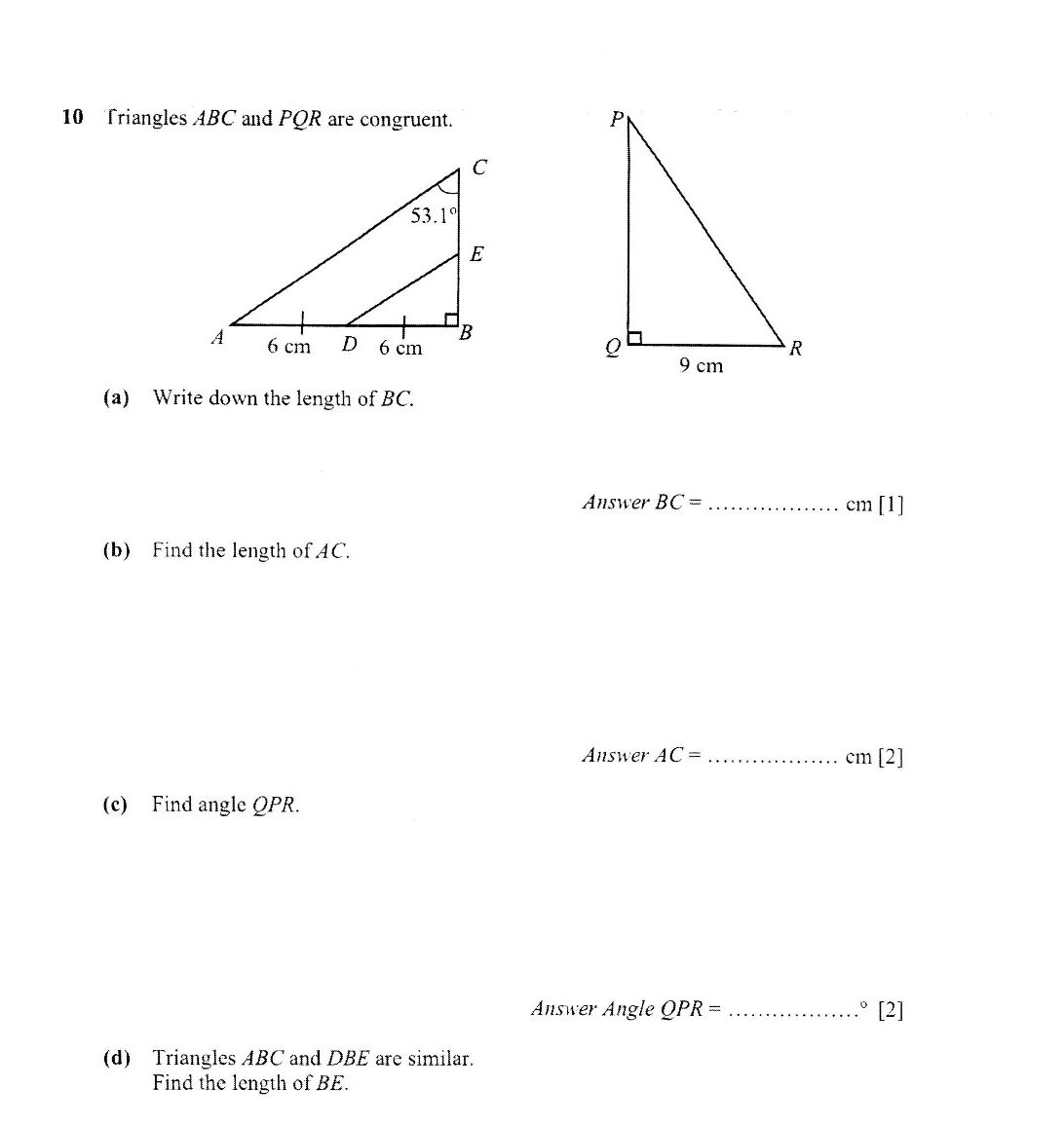
Find angle QPR.
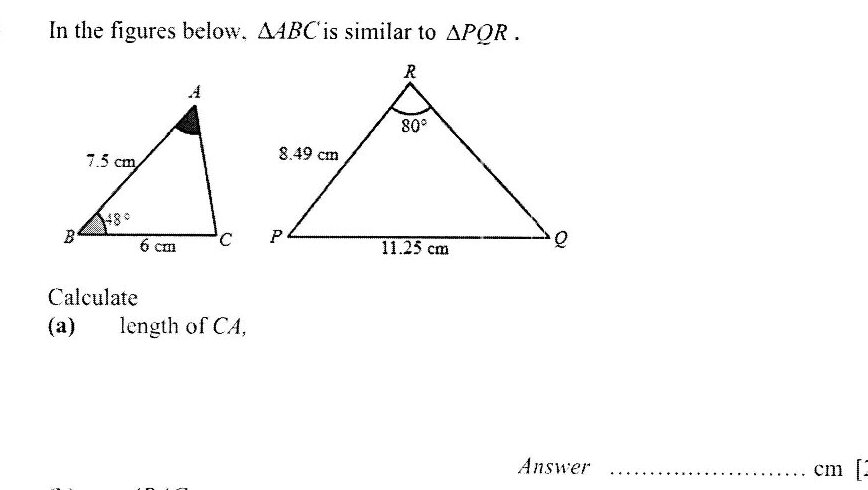
Calculate ∠BAC.
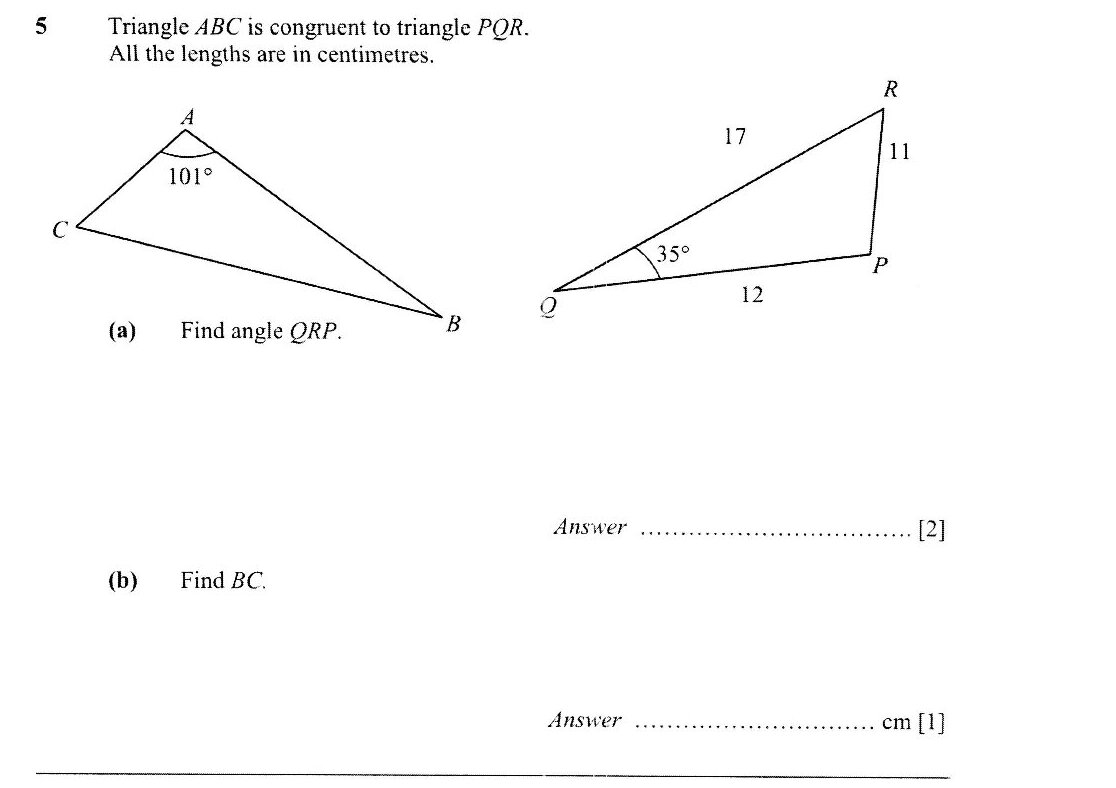
Find angle QRP.
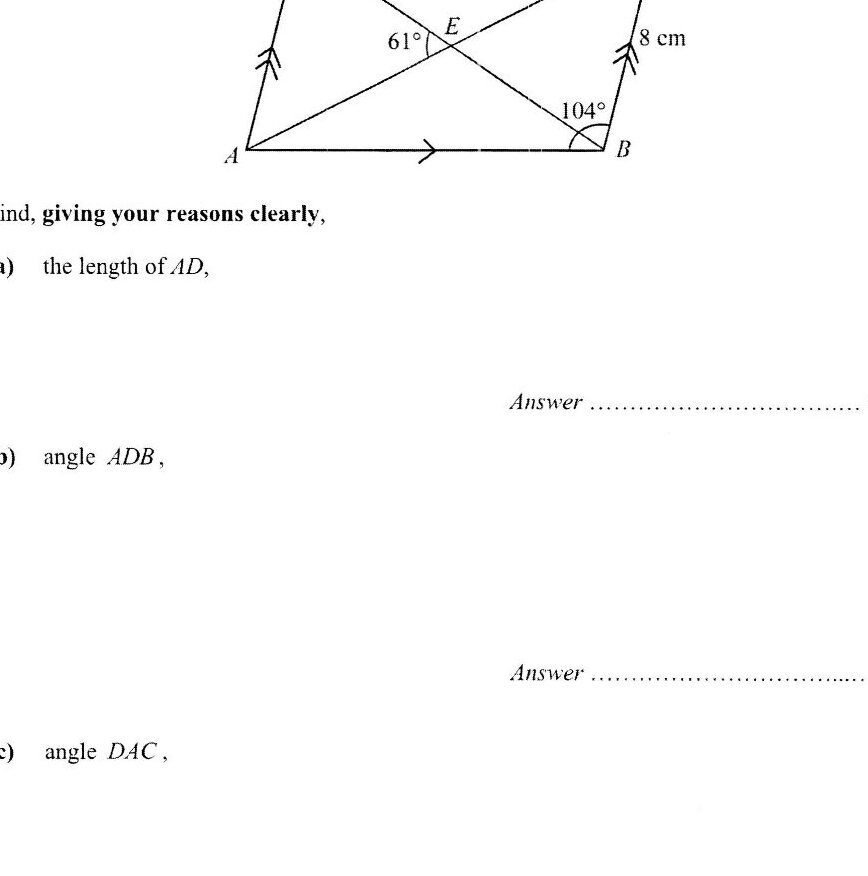
Hence, write down the smallest value of t if t is an integer.
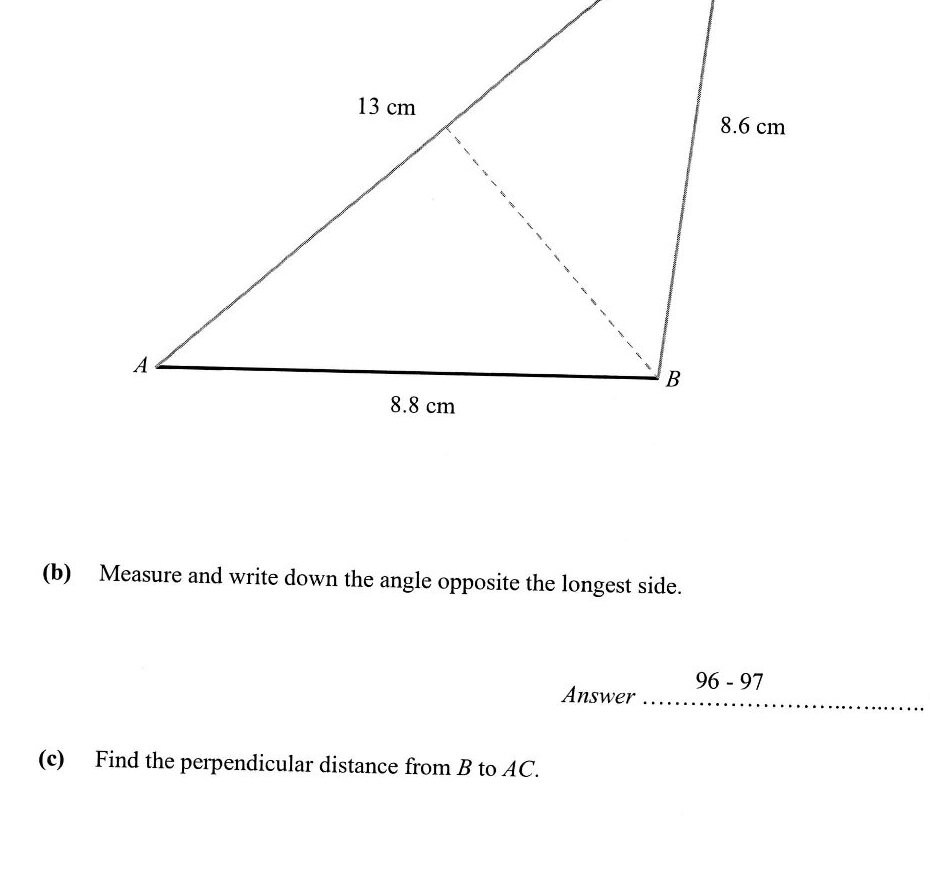
Find the perpendicular distance from B to AC.
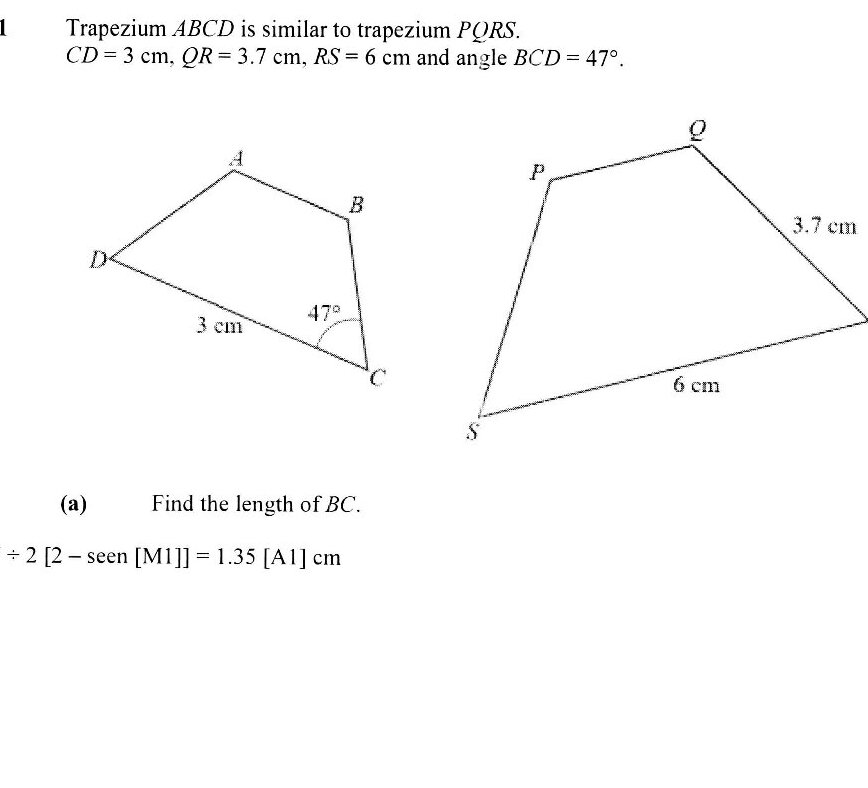
Find angle PQR.
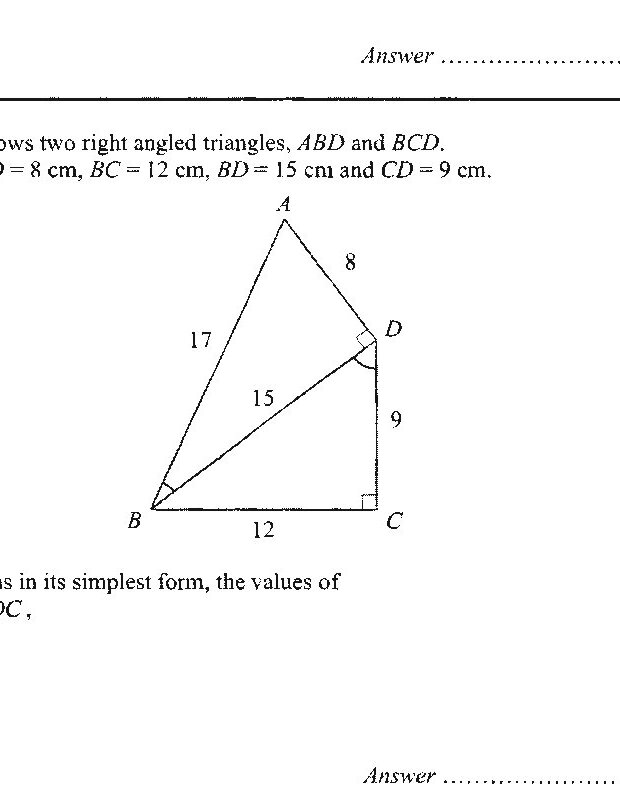
The diagram shows two right angled triangles, ABD and BCD. AB = 17 cm, AD = 8 cm, BC = 12 cm, BD = 15 cm and CD = 9 cm. Find, in fractions in its simplest form, the values of (a) sin ∠BDC, and (b) tan ∠ABD.
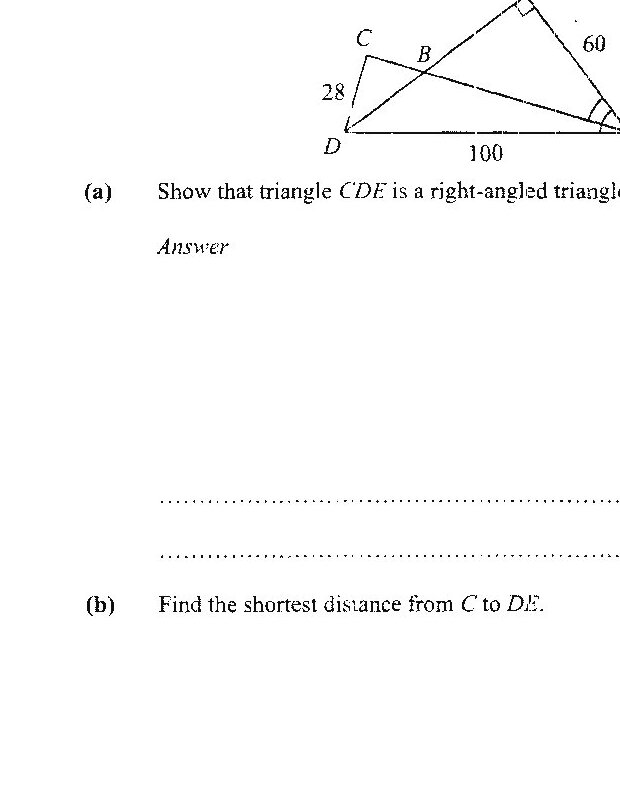
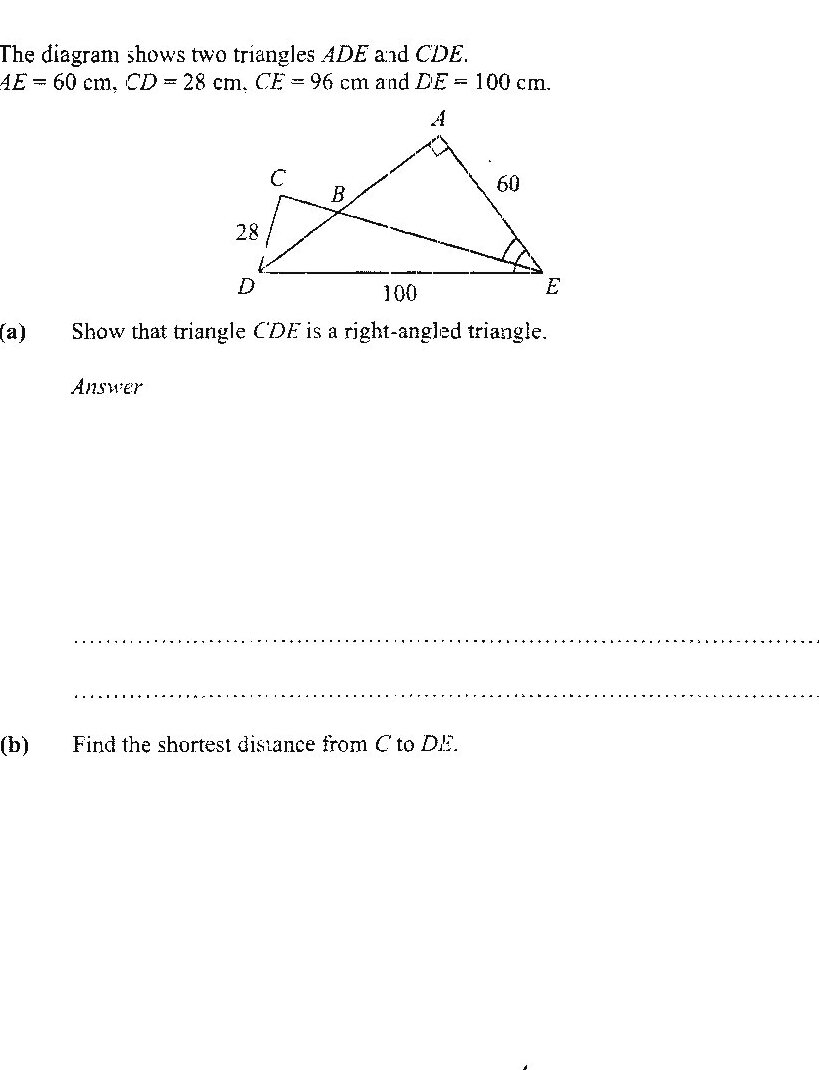
Show that triangle CDE is a right-angled triangle.
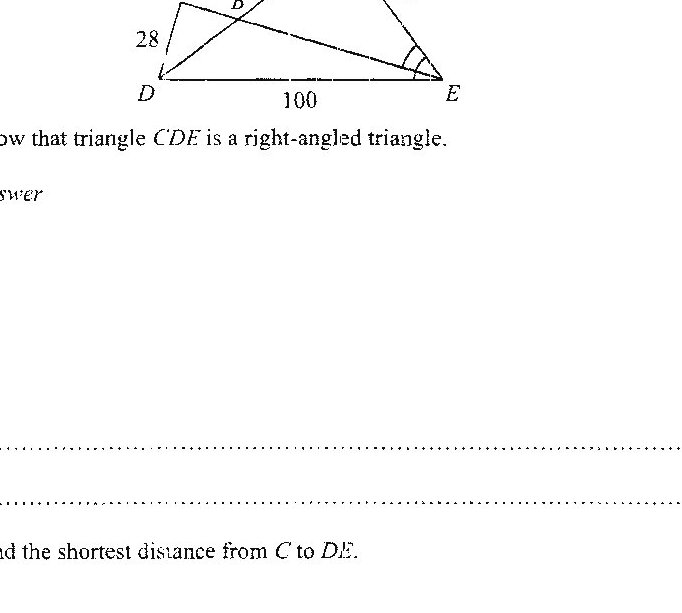
Find the shortest distance from C to DE.
Calculate ∠AED.
Hence, find the exact value of sin ABC.
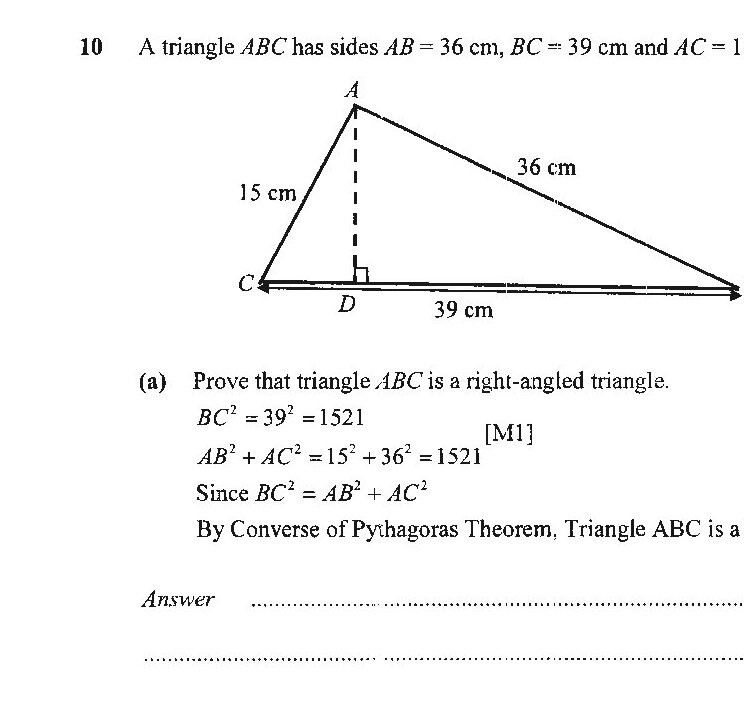
Hence, find the exact value of tan ACB.
x yellow balls are added to the bag. The probability of getting a yellow ball becomes 1/2. Find the value of x.
Show that the shortest distance from D to AC is 8.42 cm.
The total surface area of the cuboid is 325 cm². Form an equation, in terms of x, to represent this information and show that it simplifies to 18x² + 65x - 275 = 0.
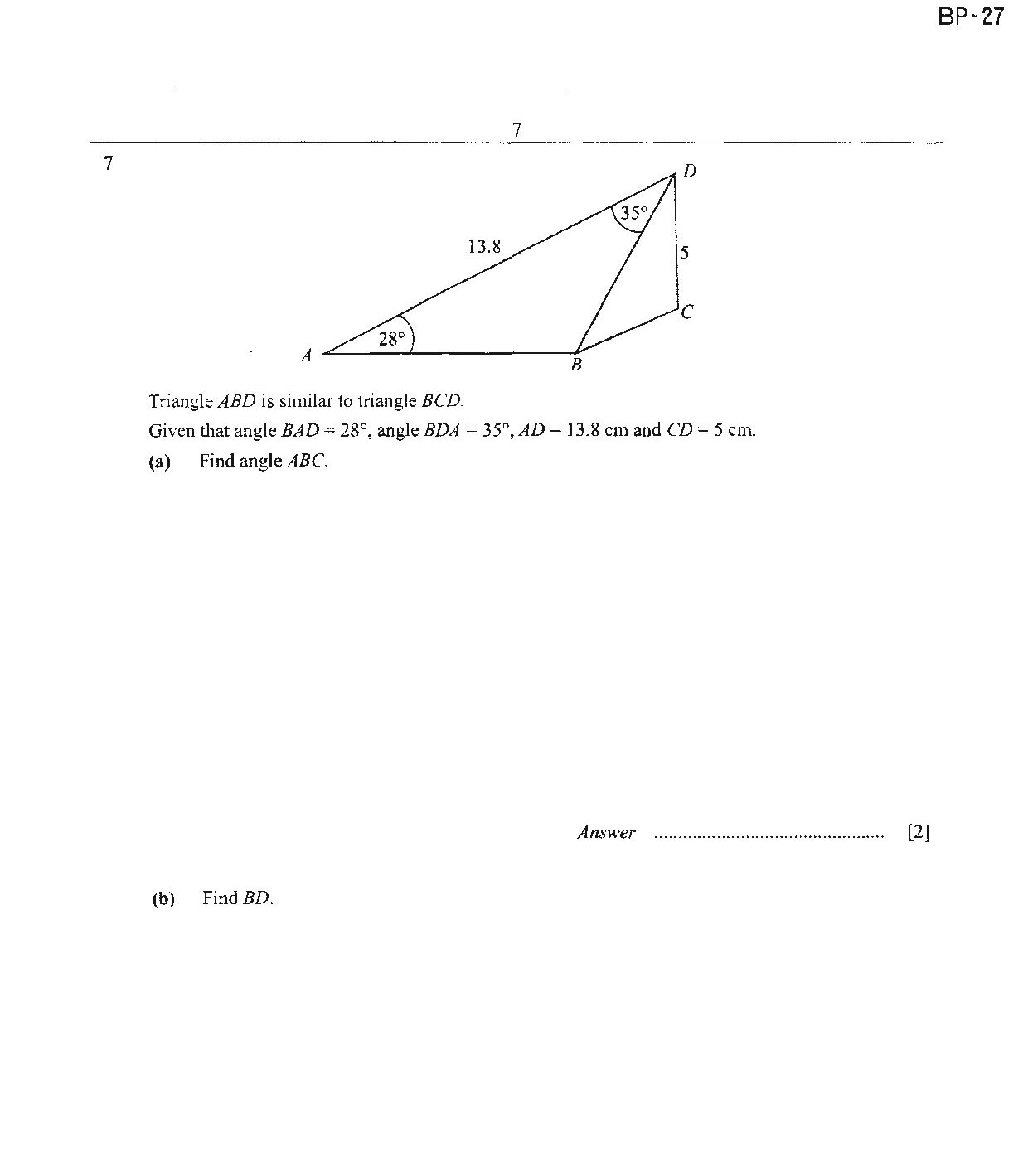
Find angle YXZ.

Find the shortest distance from the point B to the line AD.
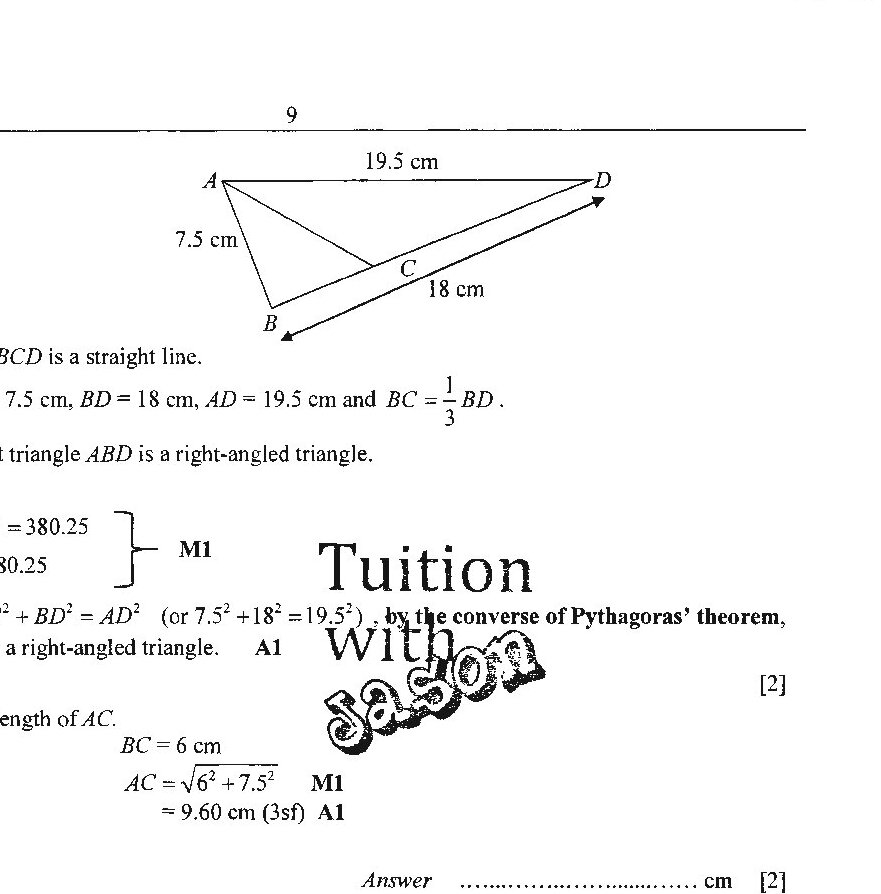
Expressing your answers as fractions in the simplest form, find sin ∠ADC.
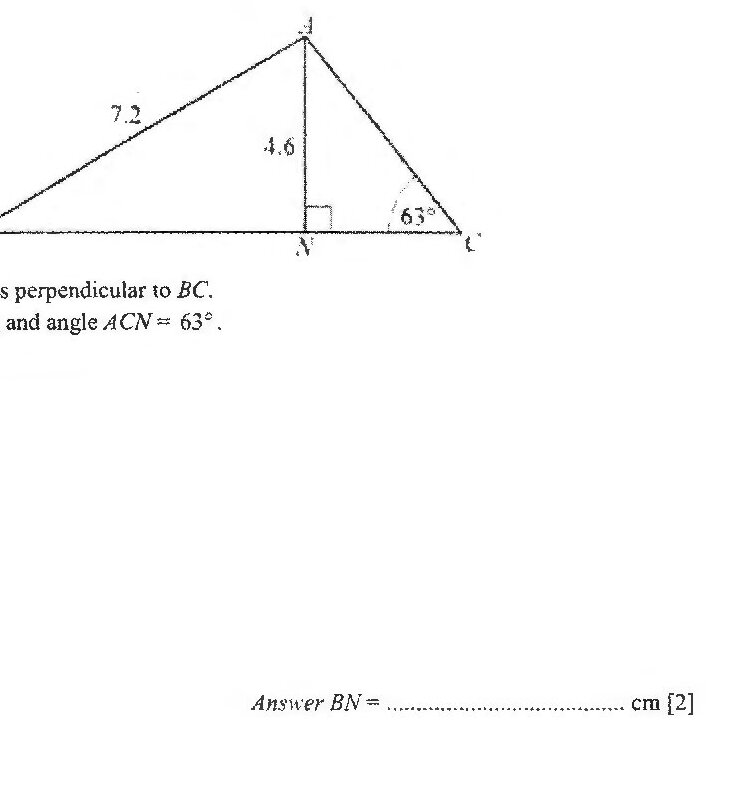
ABC is a triangle and AN is perpendicular to BC. AB = 7.2 cm, AN = 4.6 cm and angle ACN = 63°. Calculate BN.
In the diagram, AP is perpendicular to BC and BQ is perpendicular to AC. QA = 36 cm, PB = 24 cm, QB = 48 cm and AB = 60 cm. (a) Giving your answer as a fraction in its simplest form, find (i) sin ∠QAB,

Show that ∠FCQ ≈ 60.4°, correct to 1 decimal place.
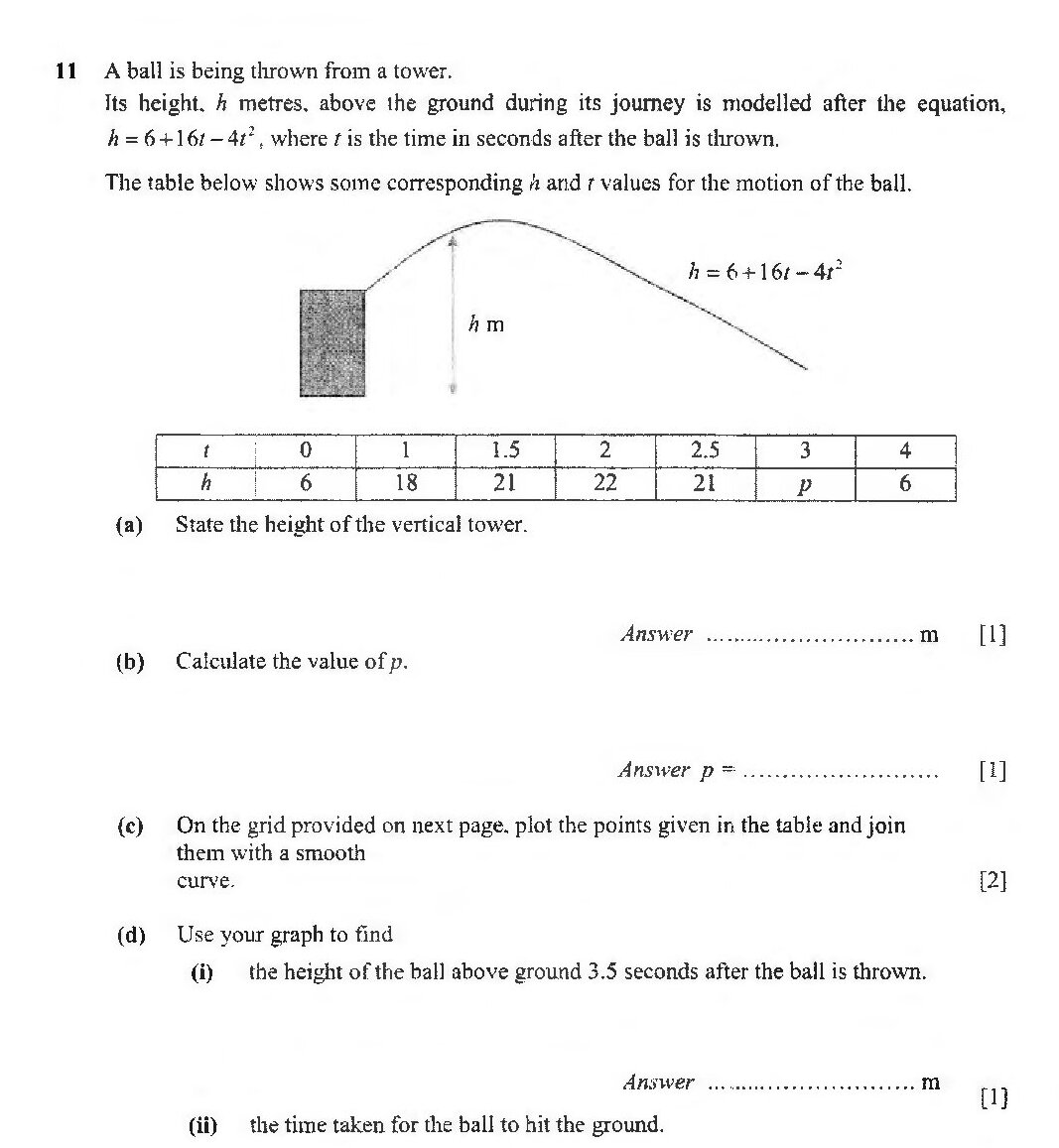
State the height of the vertical tower.
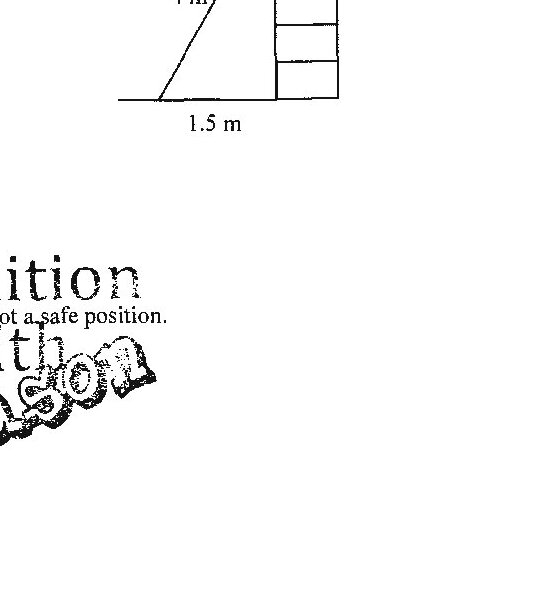
A ladder of length 4 m leans against a vertical wall and the bottom of the ladder is 1.5 m from the wall. The safe working angle for a ladder is between 74° and 76° to the horizontal. Is the ladder in a safe position to use? Show your working to justify your decision.
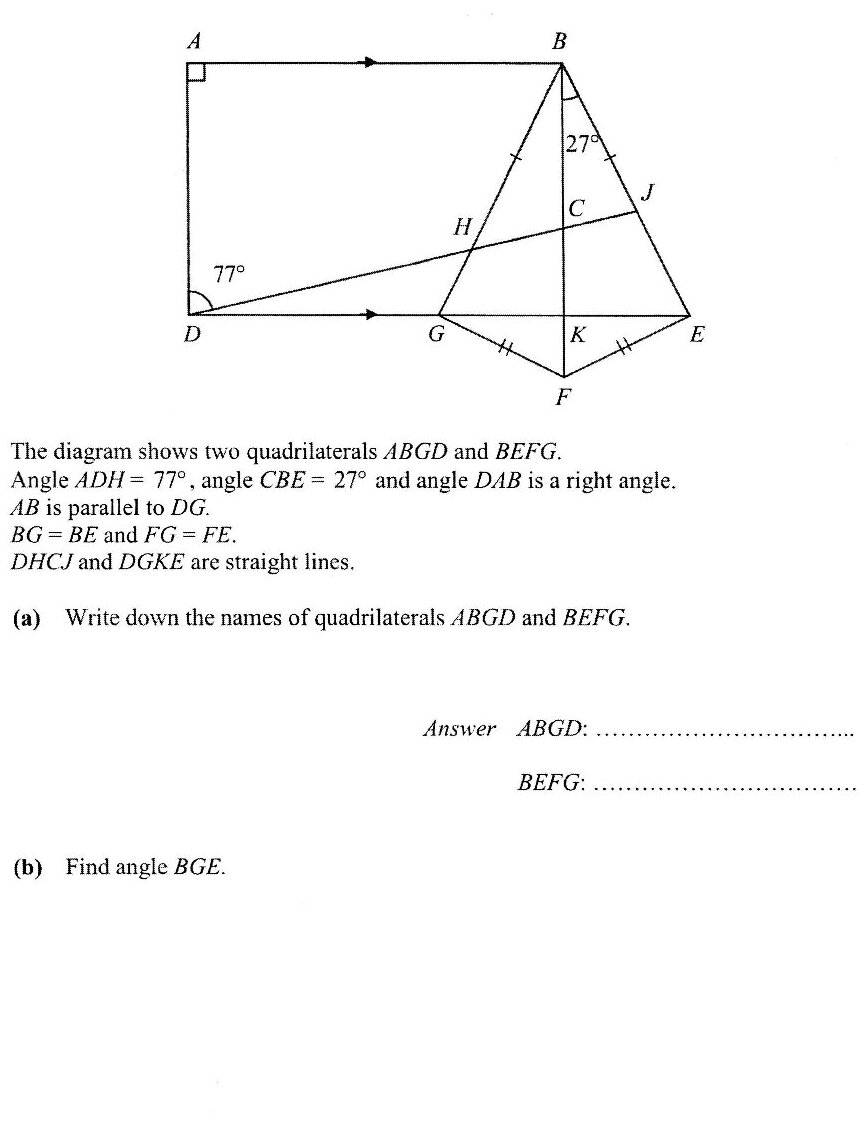
Find angle BGE.
Past year papers cover the full exam — browse by subject below.
View All Papers ›