Application of Forces and Energy Transfer
Application of Forces and Energy Transfer - Study Notes
Key Concepts
Contact and Non-Contact Forces
A force is defined as a push or a pull. Forces can change an object in the following ways: (1) change its size or shape; (2) alter its direction of motion; (3) set a stationary object in motion; (4) increase or decrease the speed of a moving object; (5) stop a moving object that is already in motion. The SI unit of force is the Newton (N).
Contact Forces:
- Forces that act when objects are physically touching each other
- The force is transmitted through direct physical contact between surfaces
- Examples include:
- Friction - resistance when surfaces slide against each other
- Normal force - support force perpendicular to a surface
- Tension - pulling force through a string, rope, or cable
- Air resistance (drag) - friction from air molecules
- Applied force - push or pull directly applied to an object
Non-Contact Forces:
- Forces that act at a distance without physical contact
- The force acts through a field (gravitational, magnetic, or electric)
- Examples include:
- Gravitational force - attraction between masses (e.g., Earth pulling objects down)
- Magnetic force - attraction or repulsion between magnets
- Electrostatic force - attraction or repulsion between charged objects
Friction
- A contact force that opposes motion between two surfaces
- Always acts in the opposite direction to the motion (or intended motion)
- Caused by microscopic bumps and irregularities on surfaces that interlock
- Factors affecting friction:
- Type of surfaces - rougher surfaces produce more friction
- Normal force - greater force pressing surfaces together increases friction
- Note: Friction does NOT depend on the surface area in contact
- Note: Friction does NOT depend on speed
Types of Friction:
- Static friction - prevents stationary objects from starting to move
- Kinetic (sliding) friction - opposes objects already in motion
- Rolling friction - when objects roll (usually less than sliding friction)
Advantages of Friction:
- Allows us to walk without slipping
- Enables vehicles to grip the road and brake
- Allows us to hold objects
- Enables writing with pen on paper
Disadvantages of Friction:
- Causes wear and tear on moving parts
- Produces unwanted heat
- Wastes energy in machinery
- Slows down motion
Reducing Friction:
- Use lubricants (oil, grease) to separate surfaces
- Polish surfaces to make them smoother
- Use ball bearings to change sliding friction to rolling friction
- Use streamlined shapes to reduce air resistance
- Use wheels instead of dragging objects
Increasing Friction:
- Use rougher surfaces (e.g., treads on shoes)
- Increase the force pressing surfaces together
- Add materials with high friction (e.g., rubber)
- Remove lubricants
Pressure
- Pressure is the force acting per unit area
- Formula: Pressure = Force / Area or P = F / A
- SI Unit: Pascal (Pa) or Newton per square metre (N/m²)
- 1 Pa = 1 N/m²
Key Principles:
- For the same force, smaller area produces higher pressure
- For the same area, larger force produces higher pressure
- Pressure acts equally in all directions at a given point in a fluid
Applications of High Pressure:
- Sharp knife - small cutting edge area concentrates force
- Thumbtacks/drawing pins - pointed end has very small area
- Needles - fine point creates high pressure for piercing
- High-heeled shoes - small heel area creates high pressure on ground
Applications of Low Pressure:
- Wide tyres - large area spreads weight to prevent sinking
- Snowshoes - large area prevents sinking in snow
- Camel’s feet - wide feet spread weight on sand
- Wide straps - distribute force to reduce discomfort
- Foundations of buildings - wide base spreads weight
Pressure in Liquids:
- Increases with depth (more liquid above exerts more weight)
- Acts equally in all directions at the same depth
- Pressure at bottom = Pressure at surface + (density × gravity × depth)
- Dams are thicker at the bottom to withstand greater pressure
Speed and Velocity
Speed:
- How fast an object is moving
- A scalar quantity (has magnitude only, no direction)
- Formula: Speed = Distance / Time or v = d / t
- SI Unit: metres per second (m/s) or kilometres per hour (km/h)
- An object moving at constant speed travels the same distance in every equal unit of time — its speed does not change throughout the journey.
Average Speed:
- Total distance travelled divided by total time taken
- Formula: Average speed = Total distance / Total time
- Used when speed varies during a journey
Velocity:
- Speed in a specific direction
- A vector quantity (has both magnitude and direction)
- Formula: Velocity = Displacement / Time
- SI Unit: metres per second (m/s) in a specified direction
- Two objects can have the same speed but different velocities if moving in different directions
Displacement vs Distance:
- Distance - total length of path travelled (scalar)
- Displacement - straight-line distance from start to end point with direction (vector)
Conversion:
- To convert km/h to m/s: divide by 3.6
- To convert m/s to km/h: multiply by 3.6
- Example: 36 km/h = 36 ÷ 3.6 = 10 m/s
Speed of Sound
Not in Sec 2 2026: The speed of sound and its dependence on medium and temperature are not part of the 2026 Sec 2 syllabus. Sound and wave properties (including speed of sound) are covered in Sec 3/4 Physics. This section is retained here for general interest but will not be assessed at Sec 2.
The speed of sound depends on the medium it travels through:
- Sound travels faster in denser mediums (e.g. seawater) than in less dense mediums (e.g. air) because molecules are packed more closely, allowing energy to be transferred more rapidly through collisions.
- Higher temperatures increase the speed of sound because particles have greater kinetic energy, vibrate more rapidly, and collide more frequently, transferring energy faster.
- Example: Sound travels at approximately 343 m/s in air at 20 °C but about 1500 m/s in seawater.
Distance-Time and Speed-Time Graphs
Distance-Time Graph:
-
y-axis = distance, x-axis = time
-
Horizontal line = stationary (object is not moving)
-
Straight line with positive gradient = constant speed
-
Steeper gradient = faster speed
-
Gradient of a distance-time graph = speed
Speed-Time Graph:
-
y-axis = speed, x-axis = time
-
Horizontal line = constant speed (no acceleration)
-
Straight line going up = constant acceleration
-
Straight line going down = constant deceleration
-
Area under a speed-time graph = distance travelled
Worked example — area under speed-time graph:
- A car travels at 20 m/s for 5 seconds. Find the distance travelled.
- Area under graph = 20 × 5 = 100 m
Work Done and Energy Transfer
Work Done:
- Work is done when a force moves an object in the direction of the force
- It is a measure of energy transferred
- Formula: Work done = Force × Distance moved in direction of force
- W = F × d
- SI Unit: Joule (J)
- 1 Joule = 1 Newton × 1 metre (1 J = 1 N⋅m)
Conditions for Work to be Done:
- A force must be applied
- The object must move
- Movement must be in the direction of the force (or have a component in that direction)
No Work Done When:
- Force is applied but object doesn’t move (pushing a wall)
- Object moves but no force acts in direction of motion (object sliding on frictionless surface after push ends)
- Force is perpendicular to motion (carrying bag while walking horizontally - no vertical motion)
Energy:
- The ability to do work
- Measured in Joules (J)
- Energy exists in many forms
- Can be transferred from one form to another
- Can be transferred from one object to another
Forms of Energy:
- Kinetic energy - energy of moving objects
- Gravitational potential energy - energy due to position in a gravitational field
- Elastic potential energy - energy stored in stretched or compressed objects
- Chemical energy - energy stored in chemical bonds (food, fuels, batteries)
- Thermal (heat) energy - energy due to temperature; kinetic energy of particles
- Light energy - energy carried by light waves
- Sound energy - energy carried by sound waves
- Electrical energy - energy carried by moving electric charges
- Nuclear energy - energy stored in atomic nuclei
Energy Transfers:
- When work is done, energy is transferred
- Energy can change from one form to another
- Examples of energy transfers:
- Falling object: gravitational potential → kinetic
- Electric motor: electrical → kinetic
- Light bulb: electrical → light + thermal
- Photosynthesis: light → chemical
- Battery in circuit: chemical → electrical
- Friction: kinetic → thermal
Conservation of Energy
Principle of Conservation of Energy:
- Energy cannot be created or destroyed
- Energy can only be converted from one form to another
- Energy can be transferred from one object to another
- The total amount of energy in a closed system remains constant
Useful and Wasted Energy:
- Not all energy is converted to the desired form
- Useful energy - converted to the intended form (e.g., kinetic energy from a car engine)
- Wasted energy - converted to unwanted forms, usually heat and sound
- Total energy input = Useful energy output + Wasted energy output
Energy Efficiency:
- Measures how much input energy is converted to useful output energy
- Formula: Efficiency = (Useful energy output / Total energy input) × 100%
- Can also be expressed as: Efficiency = (Useful power output / Total power input) × 100%
- Efficiency is expressed as a percentage (%) or as a decimal between 0 and 1
- No machine is 100% efficient (some energy always wasted as heat/sound due to friction)
Examples of Energy Conservation:
- Pendulum: potential energy ⇄ kinetic energy (back and forth)
- Roller coaster: gravitational potential energy → kinetic energy → potential energy
- Stretched spring released: elastic potential → kinetic
- At the highest point of a swing: maximum potential, zero kinetic
- At the lowest point of a swing: maximum kinetic, minimum potential
Important Definitions
Contact Force: A force that acts only when two objects are physically touching each other.
Non-Contact Force: A force that acts at a distance without the objects needing to touch.
Friction: A force that opposes motion between two surfaces that are in contact with each other.
Pressure: The force acting per unit area; calculated as P = F/A, measured in Pascals (Pa) or N/m².
Speed: The distance travelled per unit time; a scalar quantity measured in m/s or km/h.
Average Speed: The total distance travelled divided by the total time taken.
Velocity: The rate of change of displacement; speed in a specific direction; a vector quantity measured in m/s.
Displacement: The straight-line distance from the starting point to the ending point, measured in a specific direction.
Work Done: The product of force and the distance moved in the direction of the force; measured in Joules (J); W = F × d.
Energy: The ability or capacity to do work; measured in Joules (J).
Kinetic Energy: The energy possessed by an object due to its motion.
Gravitational Potential Energy: The energy possessed by an object due to its position in a gravitational field (its height above the ground).
Conservation of Energy: The principle that energy cannot be created or destroyed, only converted from one form to another or transferred from one object to another.
Efficiency: The ratio of useful energy output to total energy input, expressed as a percentage.
Scalar Quantity: A quantity that has magnitude (size) only, with no direction (e.g., speed, distance, energy, mass, temperature).
Vector Quantity: A quantity that has both magnitude and direction (e.g., velocity, displacement, force, acceleration).
Worked Examples
Example 1: Calculating Pressure
Question: A brick has dimensions 20 cm × 10 cm × 5 cm and weighs 30 N. Calculate the pressure exerted when: (a) The brick rests on its largest face (b) The brick rests on its smallest face
Solution:
(a) Largest face:
Step 1: Identify the largest face area
- Largest face = 20 cm × 10 cm = 200 cm²
Step 2: Convert area to m²
- 200 cm² = 200 ÷ 10,000 = 0.02 m²
- (Remember: 1 m² = 10,000 cm²)
Step 3: Apply pressure formula
- Pressure = Force / Area
- P = 30 N / 0.02 m²
- P = 1,500 Pa or 1,500 N/m²
(b) Smallest face:
Step 1: Identify the smallest face area
- Smallest face = 10 cm × 5 cm = 50 cm²
Step 2: Convert area to m²
- 50 cm² = 50 ÷ 10,000 = 0.005 m²
Step 3: Apply pressure formula
- Pressure = Force / Area
- P = 30 N / 0.005 m²
- P = 6,000 Pa or 6,000 N/m²
Conclusion: The pressure is 4 times greater when resting on the smallest face because the area is 4 times smaller.
Example 2: Speed and Average Speed Calculation
Question: A car travels from Town A to Town B, a distance of 120 km, in 2 hours. It then travels from Town B to Town C, a distance of 80 km, in 1 hour. Calculate: (a) The speed for each part of the journey (b) The average speed for the entire journey
Solution:
(a) Speed for each part:
For A to B:
- Speed = Distance / Time
- Speed = 120 km / 2 h
- Speed = 60 km/h
For B to C:
- Speed = Distance / Time
- Speed = 80 km / 1 h
- Speed = 80 km/h
(b) Average speed for entire journey:
Step 1: Calculate total distance
- Total distance = 120 km + 80 km = 200 km
Step 2: Calculate total time
- Total time = 2 h + 1 h = 3 h
Step 3: Calculate average speed
- Average speed = Total distance / Total time
- Average speed = 200 km / 3 h
- Average speed = 66.7 km/h (or 66⅔ km/h)
Important note: Average speed ≠ average of the two speeds!
- (60 + 80) / 2 = 70 km/h ✗ (This is WRONG)
- Must use total distance / total time ✓
Example 3: Work Done and Energy Transfer
Question: A student pushes a trolley with a force of 50 N for a distance of 12 m along a horizontal corridor. (a) Calculate the work done by the student. (b) If the trolley has a mass of 20 kg and starts from rest, explain the energy transfers that occur. © If only 400 J of energy is converted to kinetic energy of the trolley, calculate the efficiency of the energy transfer.
Solution:
(a) Work done:
Step 1: Write the formula
- Work done = Force × Distance
- W = F × d
Step 2: Substitute values
- W = 50 N × 12 m
- W = 600 J
Answer: The student does 600 J of work on the trolley.
(b) Energy transfers:
- The student’s muscles contain chemical energy (from food)
- Chemical energy is converted to kinetic energy as the student pushes
- This kinetic energy is transferred to the trolley through the applied force
- The trolley gains kinetic energy and moves
- Some energy is converted to thermal (heat) energy due to friction between the trolley wheels and floor
- Some energy may be converted to sound energy
© Efficiency:
Step 1: Identify useful and total energy
- Useful energy output = 400 J (kinetic energy of trolley)
- Total energy input = 600 J (work done by student)
Step 2: Apply efficiency formula
- Efficiency = (Useful energy output / Total energy input) × 100%
- Efficiency = (400 J / 600 J) × 100%
- Efficiency = 0.667 × 100%
- Efficiency = 66.7% or 67% (to 2 significant figures)
Step 3: Account for wasted energy
- Wasted energy = 600 J - 400 J = 200 J
- This 200 J is converted to heat (due to friction) and sound
Answer: The efficiency of the energy transfer is 67%. 33% of the energy is wasted as heat and sound.
Common Mistakes to Avoid
-
Confusing contact and non-contact forces:
- ✗ Thinking gravity only acts when objects touch the ground
- ✓ Gravity acts on all objects with mass, whether touching ground or not
-
Misunderstanding friction:
- ✗ Thinking friction depends on surface area in contact
- ✓ Friction depends on the types of surfaces and the normal force only
- ✗ Thinking friction always acts downward or in one direction
- ✓ Friction always acts opposite to the direction of motion (or intended motion)
-
Pressure calculations:
- ✗ Forgetting to convert cm² to m² (must divide by 10,000)
- ✗ Using diameter instead of area
- ✗ Confusing force with pressure
- ✓ Always use P = F/A with SI units (N and m²)
-
Speed vs. Velocity:
- ✗ Using the terms interchangeably
- ✓ Speed is scalar (no direction), velocity is vector (includes direction)
- ✗ Thinking an object moving in a circle at constant speed has constant velocity
- ✓ Velocity changes when direction changes, even if speed is constant
-
Average speed calculations:
- ✗ Taking the average of two different speeds: (v₁ + v₂)/2
- ✓ Must use: Average speed = Total distance / Total time
-
Work done misconceptions:
- ✗ Thinking work is done when holding a heavy object still
- ✓ Work requires movement in the direction of the force
- ✗ Thinking work is done when carrying a bag horizontally at constant height
- ✓ No work done in direction of force (vertical) because no vertical movement
-
Unit conversions:
- ✗ Forgetting to convert km/h to m/s (must divide by 3.6)
- ✗ Mixing units in calculations (e.g., using km and seconds together)
- ✓ Always convert to SI units before calculating
-
Energy conservation:
- ✗ Thinking energy can be lost or disappear
- ✓ Energy is always conserved; it just changes form
- ✗ Forgetting to account for “wasted” energy (heat, sound)
- ✓ Total input energy = useful output + wasted energy (always)
-
Efficiency calculations:
- ✗ Using total output instead of useful output
- ✗ Calculating efficiency greater than 100%
- ✓ Efficiency can never exceed 100% (and is usually much less)
- ✗ Forgetting to multiply by 100 to convert to percentage
-
Direction of forces:
- ✗ Drawing friction arrows in the direction of motion
- ✓ Friction always opposes motion
- ✗ Confusing weight (always downward) with normal force (perpendicular to surface)
-
Rounding errors:
- ✗ Giving an answer with too many or too few significant figures (e.g. writing 5.188 m/s)
- ✓ Unless instructed otherwise, round final answers to 3 significant figures (e.g. 5190 m/s)
- Omitting units from final answers:
- ✗ Writing a bare number such as “1500” with no unit
- ✓ Every calculated answer must include the correct SI unit (e.g. 1500 m/s, 200 Pa)
Exam Tips
Keywords and Phrases to Use for Full Marks:
For Forces:
- “The force acts in the direction of…” or “opposite to…”
- “Contact force requires physical touch between surfaces”
- “Non-contact force acts at a distance through a field”
- “Friction opposes motion” or “acts in the opposite direction to motion”
- Always specify the direction when describing forces
For Pressure:
- “Pressure is force per unit area” or “force acting per unit area”
- “Pressure = Force / Area”
- “Small area produces high pressure” (explain why using the formula)
- “Large area produces low pressure” (explain why using the formula)
- Always include units (Pa or N/m²)
For Speed/Velocity:
- “Speed is the distance travelled per unit time”
- “Velocity is speed in a specific direction”
- “Average speed = Total distance / Total time”
- Always state direction when discussing velocity
- Include units (m/s or km/h)
For Work Done:
- “Work is done when a force moves an object in the direction of the force”
- “Work done = Force × Distance moved in direction of force”
- “No work is done if there is no movement” or “if force is perpendicular to motion”
- Include units (Joules, J)
For Energy:
- Name the specific forms of energy (kinetic, gravitational potential, chemical, etc.)
- “Energy is transferred from… to…”
- “Energy is converted from [form 1] to [form 2]”
- “According to the principle of conservation of energy…”
- “Useful energy output + Wasted energy = Total energy input”
For Efficiency:
- “Efficiency = (Useful energy output / Total energy input) × 100%”
- “No machine is 100% efficient because…”
- “Energy is wasted as heat (due to friction) and sound”
- Express as a percentage with % symbol
Answering Strategies:
- Define before explaining: If asked to explain a concept, start with a definition
- Show all working: Even if you can do mental math, write all steps for partial credit
- Include units: Every numerical answer must have the correct unit
- Use formulas: Write the formula first, then substitute values, then calculate
- Draw diagrams when appropriate: Especially for forces (arrows showing direction and magnitude)
- Be specific: Instead of “it moves faster,” say “the speed increases from X m/s to Y m/s”
- Compare using numbers: When comparing, use actual calculated values
- For energy transfers: Always mention both the form converted FROM and the form converted TO
- Circle or underline final answers: Makes them easy for examiners to find
- Check reasonableness: Does your answer make sense? (e.g., efficiency > 100% is impossible)
- Significant figures: Unless the question states otherwise, give all calculated answers to 3 significant figures. Check by counting from the first non-zero digit.
For Calculation Questions:
- Write: Formula → Substitution → Answer with unit
- Example format:
Speed = Distance / Time
      = 100 m / 5 s
      = 20 m/s
For Explanation Questions:
- Use structured points (not continuous prose)
- Include scientific reasoning, not just observations
- Link cause and effect clearly
For Sound Speed Questions:
Not in Sec 2 2026: Speed of sound questions are not assessed at Sec 2. This exam tip applies to Sec 3/4 Physics only.
When asked to explain why sound travels faster or slower in a given medium:
- State whether the medium is denser or less dense (or hotter/cooler).
- Link density to molecular spacing: denser → molecules closer together.
- Link molecular spacing to energy transfer: closer molecules → more frequent collisions → faster transfer of sound energy.
- Conclude: therefore sound travels faster. Example answer: “Seawater is denser than air; its molecules are closer together. Sound energy is transferred through molecular collisions, so more frequent collisions in seawater result in a higher speed of sound.”
Common Mark-Earning Phrases:
- “Due to conservation of energy…”
- “Energy is transferred from [form] to [form]…”
- “Friction converts kinetic energy to thermal energy…”
- “As pressure increases, [state effect]…”
- “For the same force, reducing area increases pressure because…”
- “Work is done because a force causes the object to move in the direction of the force”
Quick Summary
Contact vs Non-Contact Forces:
- ✓ Contact forces require touching; friction, tension, normal force, air resistance
- ✓ Non-contact forces act at a distance; gravitational, magnetic, electrostatic
Friction:
- ✓ Opposes motion between surfaces; depends on surface type and normal force, NOT area
- ✓ Can be reduced (lubricants, smooth surfaces, ball bearings) or increased (rough surfaces, increased force)
Pressure:
- ✓ P = F/A measured in Pa or N/m²; force per unit area
- ✓ Small area = high pressure; large area = low pressure (for same force)
- ✓ Convert cm² to m² by dividing by 10,000
Speed and Velocity:
- ✓ Speed = Distance/Time (scalar, no direction); Velocity = speed with direction (vector)
- ✓ Average speed = Total distance / Total time (NOT the average of speeds)
- ✓ Convert km/h to m/s: divide by 3.6; m/s to km/h: multiply by 3.6
Work Done:
- ✓ Work = Force × Distance (in direction of force), measured in Joules (J)
- ✓ No work done if: no movement, force perpendicular to motion, or no force applied
- ✓ Work done = Energy transferred
Energy Forms and Transfers:
- ✓ Main forms: kinetic, gravitational potential, elastic potential, chemical, thermal, light, sound, electrical, nuclear
- ✓ Energy is transferred when work is done; converted from one form to another
- ✓ Energy diagrams show conversions using arrows (→)
Conservation of Energy:
- ✓ Energy cannot be created or destroyed, only converted or transferred
- ✓ Total energy in a closed system remains constant
- ✓ Total input = Useful output + Wasted output (usually as heat and sound)
Efficiency:
- ✓ Efficiency = (Useful energy output / Total energy input) × 100%
- ✓ Always less than 100%; some energy always wasted as heat due to friction
- ✓ Higher efficiency means less energy wasted
Key Formulas to Memorize:
- ✓ Pressure: P = F/A
- ✓ Speed: v = d/t
- ✓ Work: W = F × d
- ✓ Efficiency: η = (Useful output / Total input) × 100%
Units to Remember:
- ✓ Pressure: Pa or N/m²; Speed/Velocity: m/s or km/h; Work/Energy: J; Force: N; Distance: m; Time: s
Always Remember:
- ✓ State direction for velocity and forces
- ✓ Show all working with units
- ✓ Account for wasted energy in all real processes
Which action does not involve a contact force?
On Fig. 4.1, draw the frictional force acting on the object.
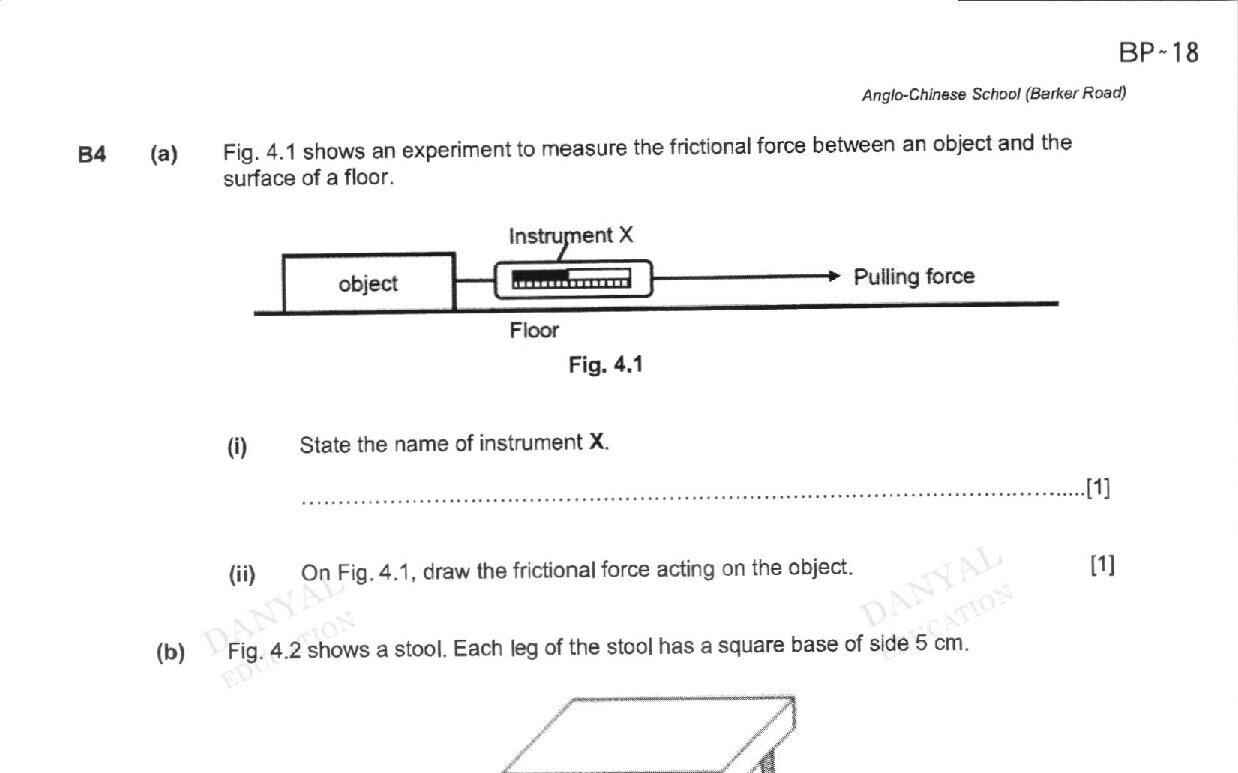
Fig. 4.2 shows a stool. Each leg of the stool has a square base of side 5 cm. The weight of the stool is 50 N. Calculate the pressure exerted on the floor by the stool when a lady of weight of 500 N sat on the stool.
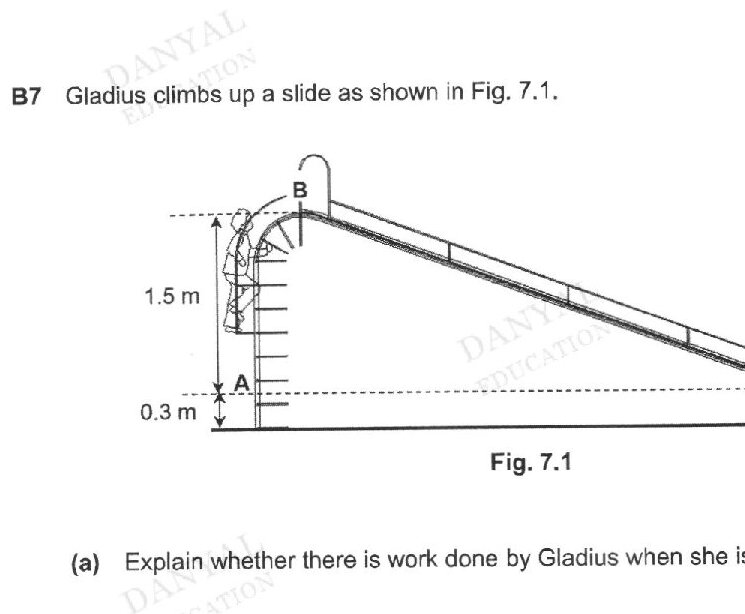
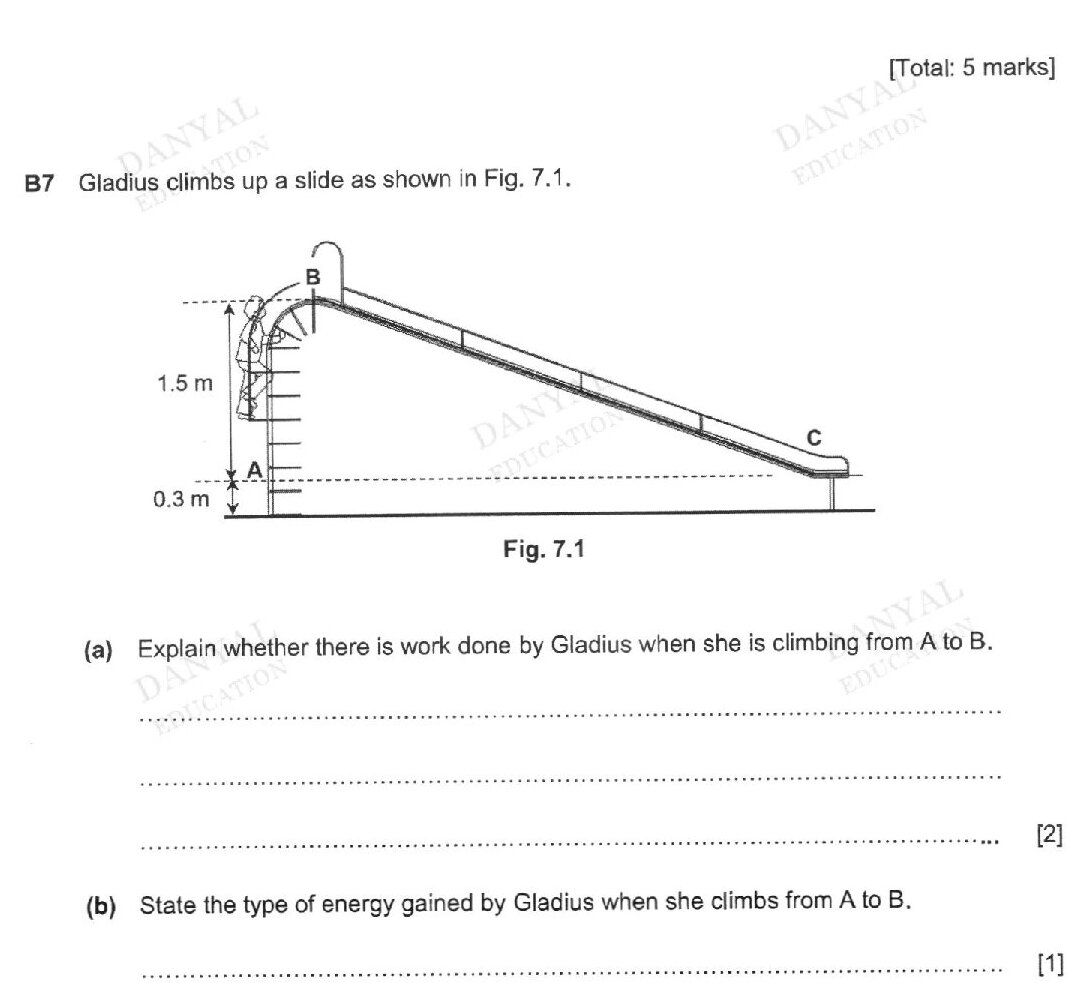
Explain whether there is work done by Gladius when she is climbing from A to B.
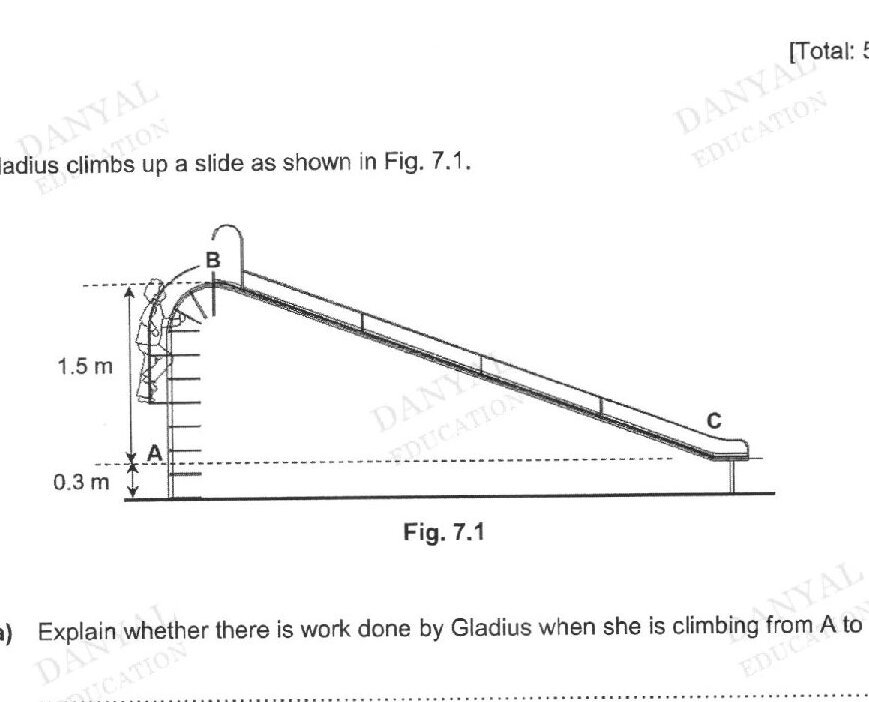
State the type of energy gained by Gladius when she climbs from A to B.
List two forces that are acting on Gladius when she slides down from B to C.
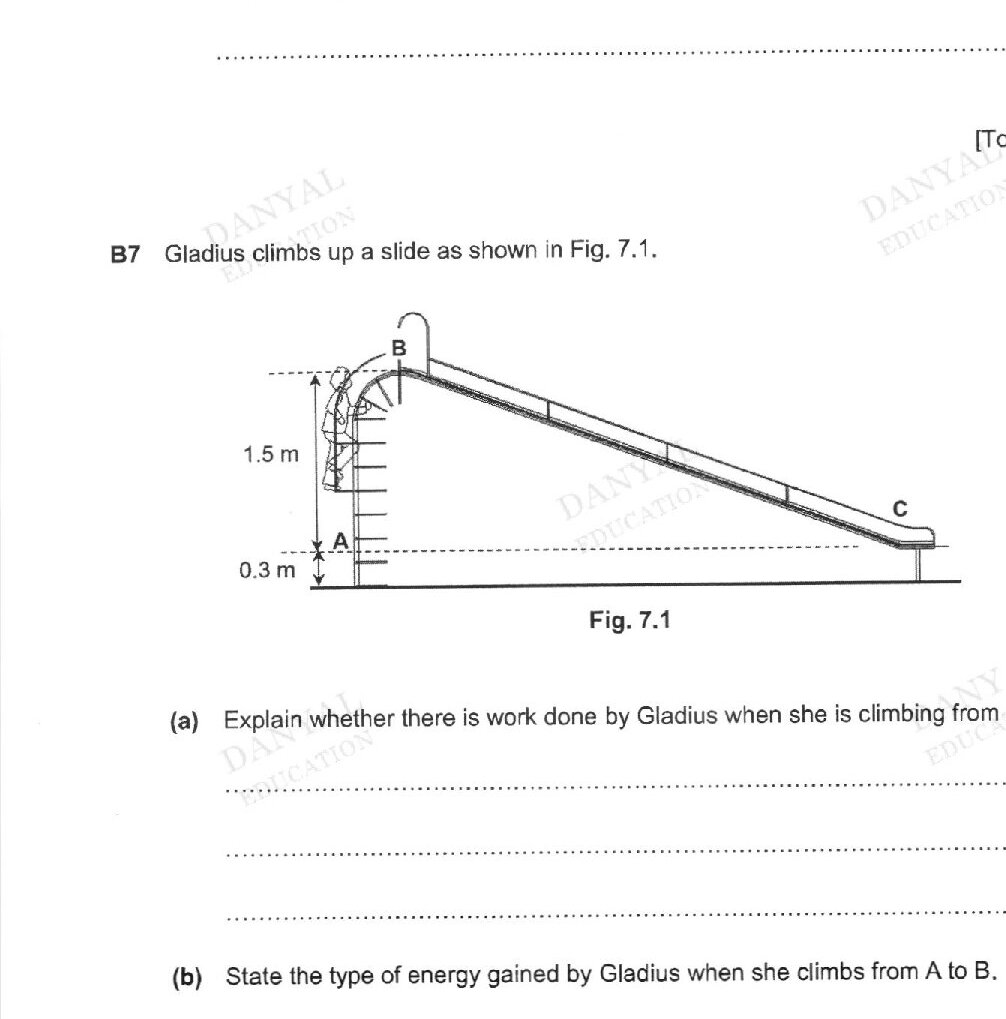
Suggest a method to increase Gladius's speed at C.
The pendulum bob is gently released from rest at position Y. Explain why in real life, the bob reaches position R and not position Q or P.
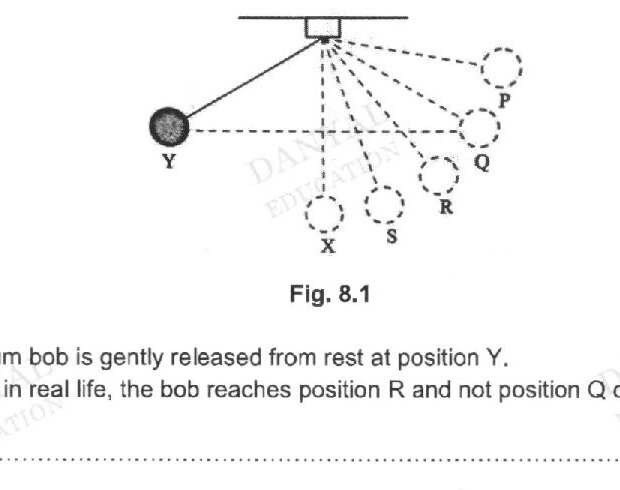
Fig. 6.1 shows an electrical circuit, made up of dry cells, copper wires and an iron nail. A pile of paper clips, which are made of iron, are placed near the iron nail. In an experiment, a student gradually increases the number of turns in the coil on the nail and records the number of paper clips the nail is able to attract. He records the data from his experiment in the Table 6.2.
A construction worker wants to lay this piece of concrete block on a soft ground. On which surface, A, B or C, should he lay the concrete block on so that it is least likely to sink into the soft ground? Explain your answer.

Calculate the pressure exerted on the ground by the surface stated in 3(a) if the mass of the block is 500 kg. (take g to be 10 N / kg)
An oxygen tank weighing 300 N on Earth is brought to Moon. The gravitational field strength on Earth is 10 N / kg and that of Moon is 1.67 N / kg. Calculate the mass of the oxygen tank on Moon.
Calculate the weight of the oxygen tank on Moon.
State the difference between mass and weight.
By using the principle of conservation of energy, determine the value of X. Give your answer in J.
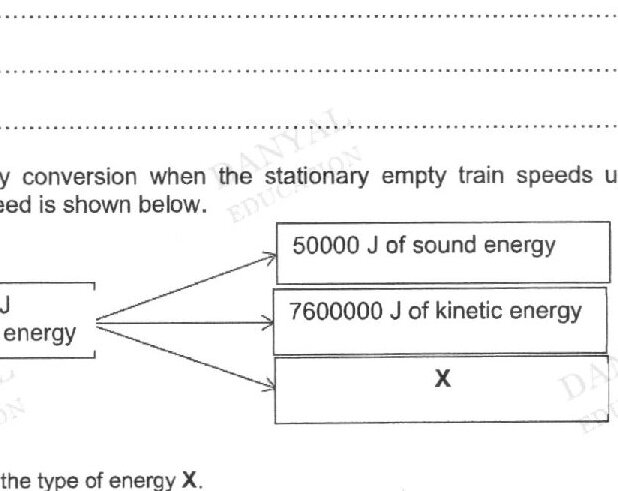
The service speed of the empty train is 20 m / s. Suggest whether more or less electrical energy is required for the train to reach its service speed when it is carrying passengers. Give a reason for your answer.
A man lifts 20 bricks, each weighing 6N. What other piece of information is needed to calculate the work done in lifting the bricks?
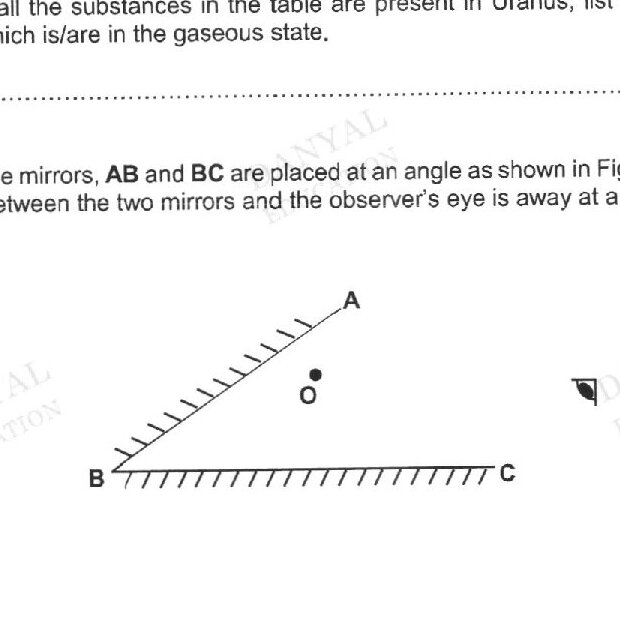
Louis lifts some boxes of identical weight from the ground onto a lorry. In the morning, it takes him 3 s to lift each box. Later in the day, it takes him 2 s. Which statement is correct?
The sum of the gravitational potential energy and kinetic energy of an object falling freely under gravity is called its mechanical energy. Assuming that air resistance is negligible, which of the following best represents the changes in the different energies when the object is falling freely under gravity?
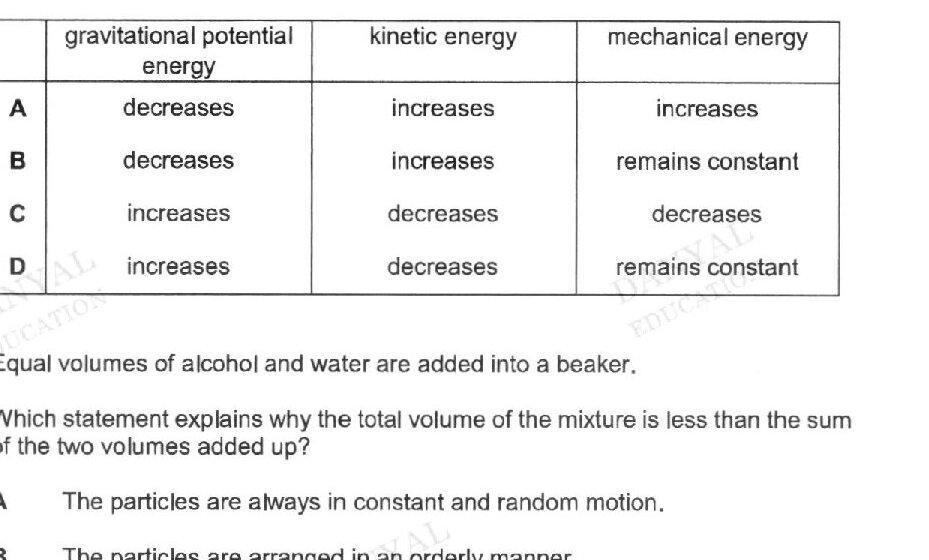
The sum of the gravitational potential energy and kinetic energy of an object falling freely under gravity is called its mechanical energy. Assuming that air resistance is negligible, which of the following best represents the changes in the different energies when the object is falling freely under gravity?
Define pressure.
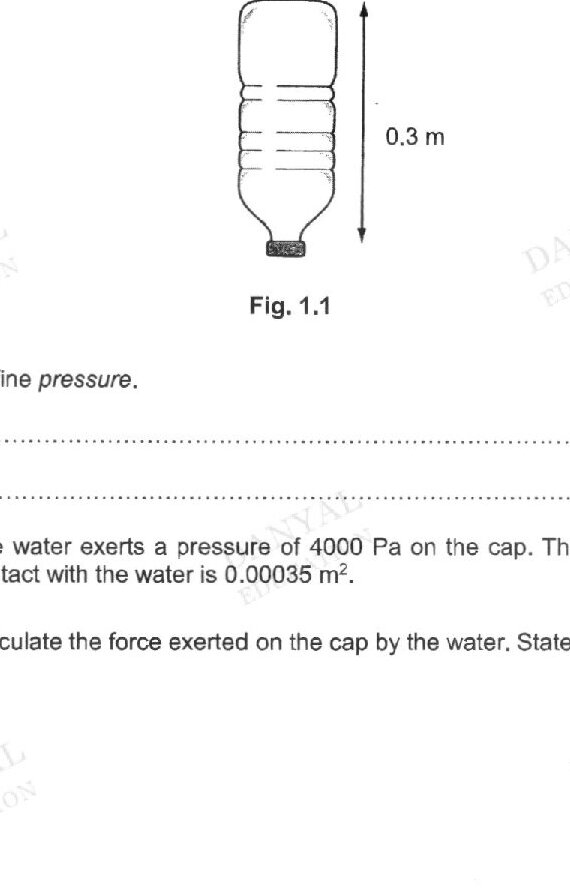
The water exerts a pressure of 4000 Pa on the cap. The area of the cap in contact with the water is 0.00035 m². Calculate the force exerted on the cap by the water. State its unit.
Calculate the work done in pulling back the string of the bow.
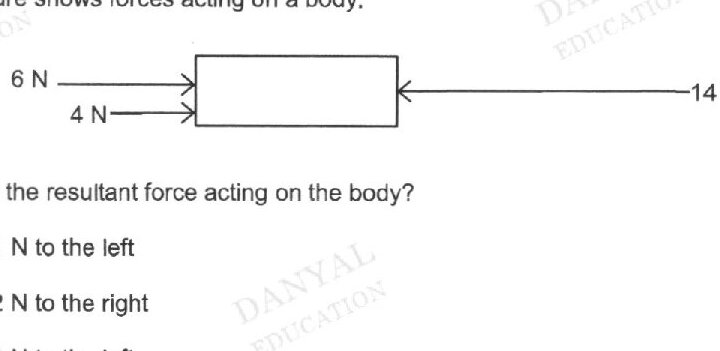
State the kinetic energy gained by the arrow when it is released.
Calculate the speed of the arrow when it leaves the bow.
Sound waves travel through water at a speed of 1500 m/s. Calculate the distance of the shoal of fish below the boat.
Explain your answer to (c).
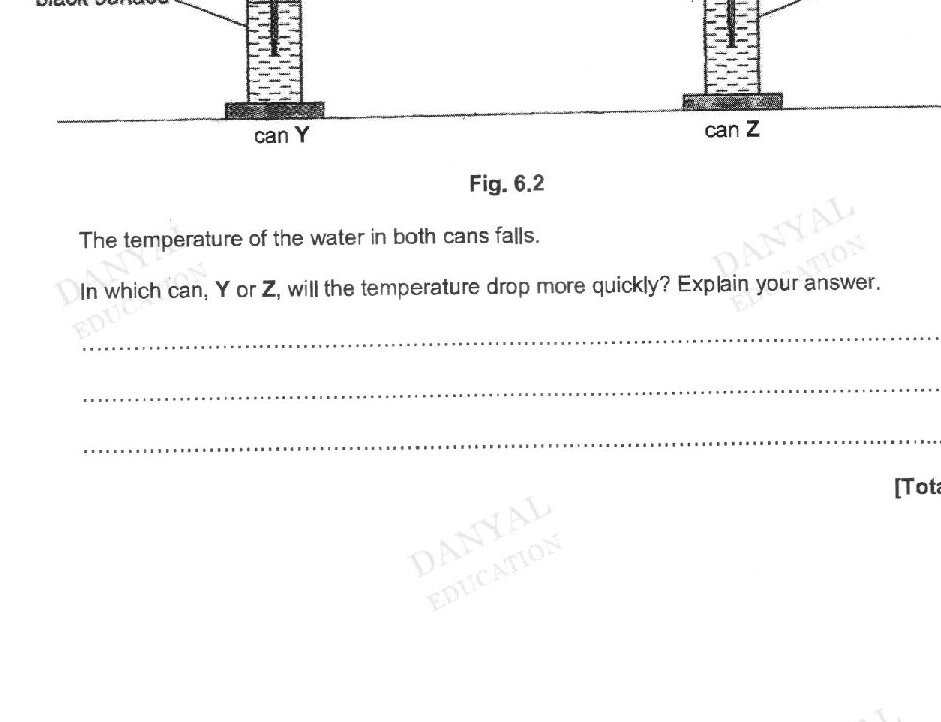
State what is meant by energy.
Past year papers cover the full exam — browse by subject below.
View All Papers ›