Chemical Changes
Chemical Changes - Comprehensive Study Notes
Key Concepts
Characteristics of Chemical Change
- Chemical changes produce new substances with different properties from the original substances
- During a chemical change, chemical bonds are broken and new bonds are formed
- Chemical changes are usually difficult to reverse (unlike physical changes)
Key indicators that a chemical change has occurred:
- Colour change - A new colour appears that wasn’t present before
- Temperature change - Heat is given out (exothermic) or absorbed (endothermic)
- Gas production - Bubbles or fizzing observed (effervescence)
- Precipitate formation - A solid forms in a solution
- Permanent change - Cannot easily reverse to get original substances back
- Light emission - Some reactions produce light
Comparison with Physical Changes:
- Physical changes: No new substance formed (e.g., melting ice, dissolving sugar)
- Chemical changes: New substance(s) formed with different properties
Acids and Bases — pH and Indicators
Acids:
- Sour taste (never taste chemicals in the lab!)
- Turn blue litmus paper red
- React with metals to produce hydrogen gas
- React with carbonates to produce carbon dioxide gas
- Common examples: hydrochloric acid (HCl), sulfuric acid (H₂SO₄), nitric acid (HNO₃), ethanoic acid (vinegar)
Bases:
- Bitter taste and feel slippery (never taste or touch!)
- Turn red litmus paper blue
- React with acids in neutralisation reactions
- Common examples: sodium hydroxide (NaOH), potassium hydroxide (KOH), calcium hydroxide (Ca(OH)₂), ammonia (NH₃)
The pH Scale:
- Measures how acidic or alkaline a solution is
- Scale ranges from 0 to 14
- pH 7 = neutral (pure water)
- pH 0-6 = acidic (lower number = stronger acid)
- pH 8-14 = alkaline (higher number = stronger base)
- Each step represents a 10-fold change in acidity/alkalinity
Common pH Values:
- Stomach acid (gastric juice): pH 1-2
- Lemon juice: pH 2-3
- Vinegar: pH 3
- Pure water: pH 7
- Blood: pH 7.4
- Soap solution: pH 9-10
- Bleach: pH 12-13
Indicators:
-
Substances that change colour depending on pH
-
Litmus paper:
- Red litmus turns blue in alkali
- Blue litmus turns red in acid
- No change in neutral solutions
-
Universal indicator:
- Shows a range of colours for different pH values
- Red/orange = acidic
- Yellow/green = neutral
- Blue/purple = alkaline
- More precise than litmus paper
-
Phenolphthalein:
- Colourless in acid
- Pink in alkali
- Used in titrations
Neutralisation
- Neutralisation is the reaction between an acid and a base to produce a salt and water
- General word equation: Acid + Base → Salt + Water
- The reaction is exothermic (gives out heat)
- At the neutralisation point, pH = 7
Examples of neutralisation reactions:
-
Hydrochloric acid + Sodium hydroxide → Sodium chloride + Water
-
HCl + NaOH → NaCl + H₂O
-
Sulfuric acid + Potassium hydroxide → Potassium sulfate + Water
-
H₂SO₄ + 2KOH → K₂SO₄ + 2H₂O
Types of bases:
- Alkali: A base that dissolves in water (e.g., NaOH, KOH)
- All alkalis are bases, but not all bases are alkalis
Salt naming:
- The first part comes from the base (metal or ammonium)
- The second part comes from the acid:
- Hydrochloric acid → chloride
- Sulfuric acid → sulfate
- Nitric acid → nitrate
Real-life applications:
- Treating acid indigestion with antacids (contain bases)
- Neutralising acidic soil with lime (calcium hydroxide)
- Treating bee stings (acidic) with baking soda (basic)
- Treating wasp stings (alkaline) with vinegar (acidic)
- Neutralising acid spills in laboratories
Reactions of Acids with Metals
General word equation: Acid + Metal → Salt + Hydrogen gas
- Not all metals react with acids
- Reactivity series (most reactive to least):
- Potassium, Sodium, Calcium, Magnesium, Aluminium, Zinc, Iron, Lead, Hydrogen, Copper, Silver, Gold
- Only metals above hydrogen in the reactivity series will react with dilute acids to produce hydrogen gas
- Copper, silver, and gold do NOT react with dilute acids
Observations during reaction:
- Effervescence (fizzing/bubbling)
- Metal dissolves/disappears
- Heat produced (exothermic)
- Gas produced can be tested: “squeaky pop” with lighted splint = hydrogen
Examples:
-
Magnesium + Hydrochloric acid → Magnesium chloride + Hydrogen
-
Mg + 2HCl → MgCl₂ + H₂
-
Zinc + Sulfuric acid → Zinc sulfate + Hydrogen
-
Zn + H₂SO₄ → ZnSO₄ + H₂
Speed of reaction depends on:
- Type of metal (more reactive = faster reaction)
- Concentration of acid (more concentrated = faster)
- Temperature (higher temperature = faster)
- Surface area of metal (powder reacts faster than lumps)
Reactions of Acids with Carbonates
General word equation: Acid + Carbonate → Salt + Water + Carbon dioxide
- All carbonates react with acids
- Common carbonates: calcium carbonate (CaCO₃), sodium carbonate (Na₂CO₃), zinc carbonate (ZnCO₃)
Observations:
- Effervescence (fizzing)
- Carbonate dissolves
- Gas produced is carbon dioxide
Test for carbon dioxide:
- Bubble gas through limewater (calcium hydroxide solution)
- Limewater turns milky/cloudy if CO₂ is present
- This is the confirmatory test for carbon dioxide
Examples:
-
Calcium carbonate + Hydrochloric acid → Calcium chloride + Water + Carbon dioxide
-
CaCO₃ + 2HCl → CaCl₂ + H₂O + CO₂
-
Sodium carbonate + Sulfuric acid → Sodium sulfate + Water + Carbon dioxide
-
Na₂CO₃ + H₂SO₄ → Na₂SO₄ + H₂O + CO₂
Real-life applications:
- Limestone buildings damaged by acid rain
- Using vinegar to remove limescale (calcium carbonate)
- Baking powder (carbonate) reacting with acids in cake mixture to produce CO₂ (makes cakes rise)
Oxidation — Rusting and Burning
Oxidation:
- A chemical reaction where a substance gains oxygen
- Can also be defined as the loss of electrons (at higher levels)
Rusting:
- Rusting is the corrosion of iron in the presence of oxygen and water
- Chemical name: Iron reacts to form hydrated iron(III) oxide (rust)
- Word equation: Iron + Oxygen + Water → Hydrated iron(III) oxide (rust)
Conditions needed for rusting:
- BOTH oxygen (from air) AND water must be present
- Neither alone will cause rusting
- Salt water accelerates rusting (electrolyte effect)
- Acids accelerate rusting
Preventing rust:
-
Barrier methods (prevent contact with oxygen and water):
- Painting
- Greasing/oiling
- Plastic coating
- Plating with another metal (e.g., chromium plating)
-
Sacrificial protection:
- Coating with a more reactive metal (e.g., zinc - called galvanising)
- The more reactive metal corrodes instead of iron
- Zinc blocks, magnesium blocks attached to ship hulls and pipelines
-
Alloying:
- Mixing iron with other metals to make stainless steel
- Stainless steel contains chromium which forms a protective oxide layer
Burning (Combustion):
- Combustion is a chemical reaction where a substance reacts with oxygen and releases energy as heat and light
- A type of oxidation reaction that happens rapidly
Requirements for combustion (Fire Triangle):
- Fuel - substance that burns
- Oxygen - usually from air
- Heat - ignition temperature must be reached
Complete combustion:
- Plenty of oxygen available
- Hydrocarbon + Oxygen → Carbon dioxide + Water
- Clean flame (blue)
- Example: Methane + Oxygen → Carbon dioxide + Water
- CH₄ + 2O₂ → CO₂ + 2H₂O
Incomplete combustion:
- Limited oxygen supply
- Produces carbon monoxide (CO) or carbon (soot)
- Yellow/orange smoky flame
- Carbon monoxide is poisonous (colourless, odourless)
- Example: Methane + Oxygen → Carbon monoxide + Water
- 2CH₄ + 3O₂ → 2CO + 4H₂O
Extinguishing fires:
- Remove one element of the fire triangle:
- Remove fuel (turn off gas supply)
- Remove oxygen (cover with fire blanket, use foam, CO₂ extinguisher)
- Remove heat (water cools below ignition temperature)
Organic chemistry (alkanes, alcohols, carboxylic acids) is a Sec 3/4 topic — not required for Sec 2 NA.
Important Definitions
Chemical change: A change that produces one or more new substances with different properties from the original substances.
Acid: A substance that turns blue litmus paper red, has a pH less than 7, and produces hydrogen ions (H⁺) in water.
Base: A substance that turns red litmus paper blue, has a pH greater than 7, and reacts with acids in neutralisation.
Alkali: A base that dissolves in water to form a solution with pH greater than 7.
pH: A scale from 0 to 14 that measures how acidic or alkaline a solution is, with 7 being neutral.
Indicator: A substance that changes colour depending on whether it is in an acid or alkali.
Neutralisation: The chemical reaction between an acid and a base that produces a salt and water.
Salt: A compound formed when the hydrogen in an acid is replaced by a metal or ammonium ion.
Oxidation: A chemical reaction in which a substance gains oxygen (or loses electrons).
Rusting: The corrosion of iron in the presence of oxygen and water to form hydrated iron(III) oxide.
Combustion: A chemical reaction in which a substance reacts rapidly with oxygen, releasing heat and light energy.
Reactivity series: A list of metals arranged in order of their reactivity, from most reactive to least reactive.
Precipitate: An insoluble solid that forms in a solution during a chemical reaction.
Effervescence: The production of bubbles of gas during a chemical reaction (fizzing).
Worked Examples
Example 1: Identifying Chemical Changes
Question: For each of the following, state whether it is a chemical change or physical change, and give a reason for your answer.
a) Burning a piece of paper b) Boiling water c) Iron rusting d) Dissolving salt in water
Solution:
a) Chemical change
- Reason: New substances formed (ash, carbon dioxide, water vapour)
- Permanent change that cannot be reversed
- Heat and light given out
b) Physical change
- Reason: No new substance formed - water remains water (H₂O)
- Only state changes from liquid to gas
- Can be reversed by condensation
c) Chemical change
- Reason: New substance formed (iron oxide - rust)
- Different properties from original iron
- Cannot easily reverse to get pure iron back
d) Physical change
- Reason: No new substance formed
- Salt (sodium chloride) remains chemically the same
- Can be reversed by evaporation to get salt back
Example 2: Neutralisation and Salt Formation
Question: Complete the following neutralisation reactions and name the salt formed:
a) Hydrochloric acid + Sodium hydroxide → _____ + _____
b) Sulfuric acid + Potassium hydroxide → _____ + _____
c) Nitric acid + Calcium hydroxide → _____ + _____
Solution:
a) Hydrochloric acid + Sodium hydroxide → Sodium chloride + Water
Step-by-step working:
- Metal/base: Sodium → First part of salt name: Sodium
- Acid: Hydrochloric → Second part of salt name: chloride
- All neutralisations produce water
- Salt formed: Sodium chloride (NaCl)
b) Sulfuric acid + Potassium hydroxide → Potassium sulfate + Water
Step-by-step working:
- Metal/base: Potassium → First part: Potassium
- Acid: Sulfuric → Second part: sulfate
- Salt formed: Potassium sulfate (K₂SO₄)
c) Nitric acid + Calcium hydroxide → Calcium nitrate + Water
Step-by-step working:
- Metal/base: Calcium → First part: Calcium
- Acid: Nitric → Second part: nitrate
- Salt formed: Calcium nitrate (Ca(NO₃)₂)
Remember the pattern:
- Hydrochloric acid → chloride salts
- Sulfuric acid → sulfate salts
- Nitric acid → nitrate salts
Example 3: Acid Reactions and Gas Tests
Question: A student adds magnesium ribbon to hydrochloric acid and observes fizzing.
a) Write a word equation for this reaction. b) Name the gas produced. c) Describe how to test for this gas. d) What would be observed in this test?
Solution:
a) Word equation: Magnesium + Hydrochloric acid → Magnesium chloride + Hydrogen
Working:
- Pattern: Metal + Acid → Salt + Hydrogen
- Salt naming: Magnesium (from metal) + chloride (from hydrochloric acid)
b) Gas produced: Hydrogen
Reasoning:
- Metals above hydrogen in reactivity series react with acids
- Always produce hydrogen gas
- Magnesium is quite reactive (above hydrogen in series)
c) Test for hydrogen gas:
- Collect the gas in a test tube
- Bring a lighted/burning splint to the mouth of the test tube
Safety note: Hold test tube at arm’s length pointing away from face
d) Observation in positive test:
- A “squeaky pop” sound is heard
- This confirms the gas is hydrogen
- The pop is caused by hydrogen igniting and reacting rapidly with oxygen
Alternative answer: A small explosion or “pop” sound with a blue flame
Common Mistakes to Avoid
1. Confusing Chemical and Physical Changes
- Mistake: Thinking dissolving is always a chemical change
- Correction: Dissolving is usually physical (like salt in water) unless a reaction occurs (like sodium in water)
- Key: Ask “Has a new substance formed?” If no, it’s physical
2. pH Scale Errors
- Mistake: Saying pH 8 is acidic or pH 6 is alkaline
- Correction: pH 7 is the EXACT neutral point. Below 7 = acid, Above 7 = alkali
- Remember: The further from 7, the stronger the acid/alkali
3. Litmus Paper Confusion
- Mistake: “Blue litmus turns red in alkali” or “Red litmus turns blue in acid”
- Correction:
- Blue litmus turns red in ACID
- Red litmus turns blue in ALKALI
- Memory aid: “RED with RAGE in acid” or “Blue turns red when it’s sad (acid)”
4. Incomplete Neutralisation Equations
- Mistake: Writing “Acid + Base → Salt” (forgetting water)
- Correction: ALWAYS write “Acid + Base → Salt + Water”
- Remember: Neutralisation produces TWO products: salt AND water
5. Wrong Gas Products
- Mistake: Saying acids + metals produce carbon dioxide
- Correction:
- Acid + Metal → Salt + HYDROGEN
- Acid + Carbonate → Salt + Water + CARBON DIOXIDE
- Don’t mix these up!
6. Salt Naming Errors
- Mistake: “Hydrochloric acid + magnesium → magnesium hydrochlorate”
- Correction: Hydrochloric acid makes chloride salts (not “hydrochlorate”)
- Pattern to memorize:
- Hydrochloric → chloride
- Sulfuric → sulfate
- Nitric → nitrate
7. Rusting Conditions
- Mistake: Saying iron rusts in air OR water (listing them separately)
- Correction: Iron needs BOTH oxygen AND water simultaneously
- Key word: Use “AND” not “OR” when describing conditions for rusting
8. Incomplete Combustion Product Confusion
- Mistake: Saying incomplete combustion produces no carbon dioxide at all
- Correction: Incomplete combustion produces carbon monoxide (CO) and/or carbon (soot) in addition to water. Unlike complete combustion, not all the carbon is converted to CO₂ — but CO₂ can still be produced alongside CO.
- Complete combustion → CO₂ + H₂O (all carbon converts to CO₂)
- Incomplete combustion → CO and/or soot © + H₂O (some carbon forms CO or soot instead of CO₂)
9. Fire Triangle Misconceptions
- Mistake: Saying only two factors are needed for fire
- Correction: ALL THREE factors (fuel, oxygen, heat) must be present
- To extinguish: Remove ANY ONE of the three
10. Gas Test Descriptions
- Mistake: Saying “Hydrogen burns” or “It explodes” (not specific enough)
- Correction: Use precise phrases:
- Hydrogen: “Lighted splint produces a squeaky pop sound”
- Carbon dioxide: “Limewater turns milky/cloudy”
11. Oxidation Definition
- Mistake: Saying oxidation only means “reacting with oxygen”
- Correction: At this level, oxidation means “gaining oxygen” (substance combines with oxygen)
- Example: Iron oxidises means iron gains oxygen to form iron oxide
Exam Tips
Keywords and Mark-Earning Phrases
For identifying chemical changes (1-2 marks):
- Always state: “New substance(s) formed”
- Add: “Cannot be easily reversed” or “Permanent change”
- Mention observable signs: “colour change,” “temperature change,” “gas evolved,” “precipitate formed”
For pH and acids/bases questions (1-2 marks):
- Use specific numbers: “pH less than 7” (not just “low pH”)
- State colour changes precisely: “Blue litmus turns red” (specify which colour litmus and the colour change)
- For universal indicator: Give both colour AND pH number
For neutralisation (2-3 marks):
- Always write the complete word equation with all four parts: “Acid + Base → Salt + Water”
- Name the specific salt using the correct pattern
- State that the reaction is “exothermic” (if asked about energy)
- Mention “pH 7 at neutralisation point” or “pH moves toward 7”
For acid + metal reactions (2-3 marks):
- Write complete word equation: “Metal + Acid → Salt + Hydrogen”
- For gas test: “Lighted splint produces a squeaky pop sound with hydrogen”
- Mention observations: “effervescence,” “metal dissolves,” “solution may become warm”
- If asked about rate: Mention reactivity (more reactive metal = faster reaction)
For acid + carbonate reactions (2-3 marks):
- Complete word equation: “Carbonate + Acid → Salt + Water + Carbon dioxide”
- For gas test: “Bubble through limewater, which turns milky/cloudy”
- Remember THREE products (not two!)
For rusting questions (3-4 marks):
- “Both oxygen AND water are required” (use “AND” not “OR”)
- “Neither alone will cause rusting”
- For prevention: State the method AND explain why it works
- Example: “Painting forms a barrier that prevents contact with oxygen and water”
- For galvanising: “Zinc is more reactive than iron, so it corrodes preferentially/instead”
For combustion questions (2-3 marks):
- State the three requirements: “Fuel, oxygen, heat” (fire triangle)
- For complete combustion: “Produces carbon dioxide and water”
- For incomplete: “Produces carbon monoxide (poisonous) or carbon/soot”
- Reason for incomplete: “Insufficient oxygen supply”
Question-Answering Strategies
1. For “Describe and explain” questions (usually 3-4 marks):
- Describe = What happens (observations)
- Explain = Why it happens (science behind it)
- Write 2-3 points for describe, 2-3 points for explain
2. For practical/experimental questions:
- Always include:
- What you would observe (specific colours, sounds, states)
- How you would test for gases (precise procedure)
- Expected result of the test
- Use scientific terminology
3. For word equation questions:
- Check you have the correct number of products:
- Neutralisation = 2 products (salt + water)
- Metal + acid = 2 products (salt + hydrogen)
- Carbonate + acid = 3 products (salt + water + carbon dioxide)
- Check salt name follows the pattern
4. For “suggest” questions about rusting prevention:
- Name the method clearly
- Explain the scientific principle (usually “prevents contact with oxygen and water”)
- Give a specific example if asked
5. When asked to “compare”:
- Make direct comparisons (use words like “whereas,” “while,” “but”)
- Give differences for both items being compared
- Example: “Acid has pH below 7 whereas alkali has pH above 7”
6. For safety questions:
- Mention protective equipment if relevant (goggles, gloves)
- State the hazard clearly (corrosive, flammable, toxic)
- Suggest a precaution that specifically addresses that hazard
Marks Allocation Guide
- 1 mark: A simple fact or definition
- 2 marks: Two separate facts OR one fact with explanation
- 3 marks: Three facts OR two facts with explanation OR complete word equation with salt name
- 4+ marks: Extended answer with multiple points, observations, and explanations
Common Question Types to Prepare For
- Complete the word equation (2-3 marks)
- Describe a test for a gas (2 marks)
- Explain the conditions needed for rusting (2-3 marks)
- Suggest a method to prevent rusting and explain how it works (2-3 marks)
- State what happens to pH during neutralisation (1-2 marks)
- Identify whether changes are chemical or physical with reasons (2-4 marks)
- Name the products of combustion (complete vs incomplete) (2 marks)
- Explain observations during acid-metal/carbonate reactions (3-4 marks)
- Use of indicators to test pH (2-3 marks)
Quick Summary
Essential points to remember for exams:
-
✓ Chemical changes produce new substances with different properties; signs include colour change, temperature change, gas production, and precipitate formation
-
✓ pH scale ranges from 0-14: acids (0-6), neutral (7), alkalis (8-14); universal indicator shows colours (red→orange→yellow→green→blue→purple)
-
✓ Litmus test: Blue litmus turns red in acid; red litmus turns blue in alkali
-
✓ Neutralisation equation: Acid + Base → Salt + Water (produces salt and water, pH becomes 7)
-
✓ Salt naming: First part from base/metal, second part from acid (hydrochloric→chloride, sulfuric→sulfate, nitric→nitrate)
-
✓ Acid + Metal → Salt + Hydrogen; test with lighted splint (squeaky pop sound confirms hydrogen)
-
✓ Acid + Carbonate → Salt + Water + Carbon dioxide; test by bubbling through limewater (turns milky/cloudy)
-
✓ Rusting requires BOTH oxygen AND water; prevention methods include barrier coatings (paint, oil), galvanising (zinc coating),
For this third experiment, arrange the nails in sequence, from the nail with least or no rust to the nail with the most rust observed.
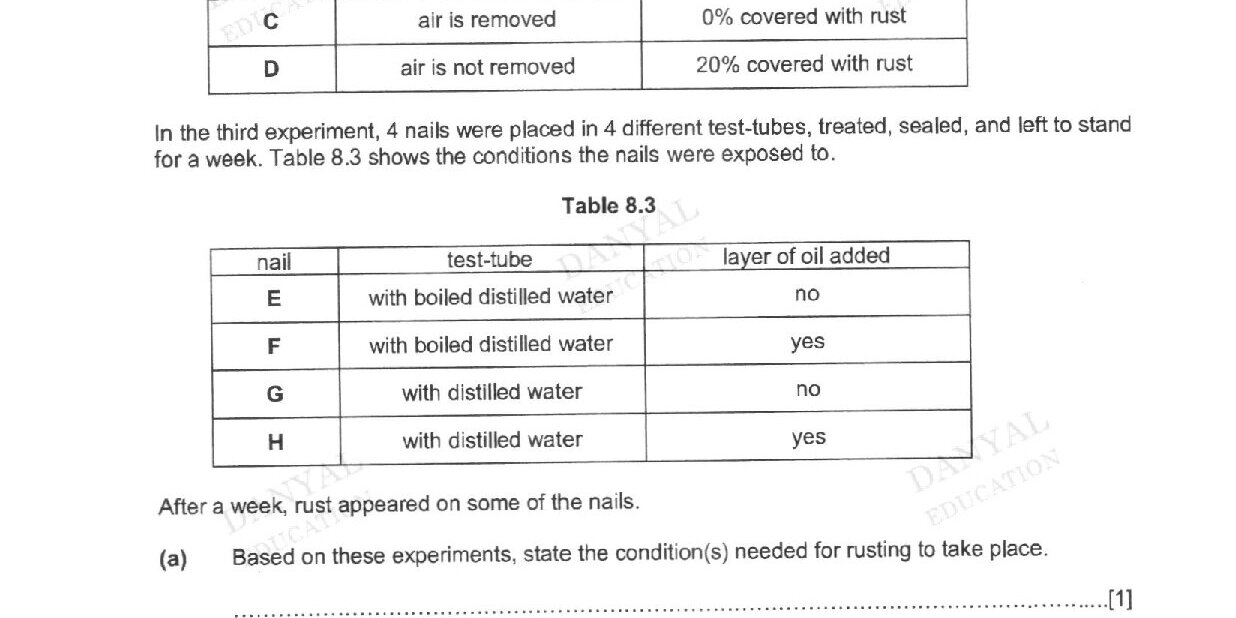
Name one way to prevent an iron nail from rusting.
When heated, copper(II) carbonate undergoes the following reaction. copper(II) carbonate → copper(II) oxide + carbon dioxide Which type of reaction does the word equation represent?
Hydrochloric acid can react with both magnesium metal and magnesium carbonate. In what way are both the reactions similar?
The burning of fossil fuels can release a gas called sulfur dioxide, which is considered to be a pollutant. Which of the following is a harmful effect of sulfur dioxide on the environment?
Write a word equation to represent the combustion of petrol in the car engine.
Which substance is the Universal indicator?
Name the type of reaction if D is sodium hydroxide.
The graph shows how the pH changes in a reaction between an acid and an alkali. Which of the following statement(s) could be deduced from the graph? 1 A gas is produced at part X of the graph. 2 An acid is added to a fixed volume of an alkali. 3 Salt and water are produced at part X of the graph.
The graph shows how the pH changes in a reaction between an acid and an alkali. Which of the following statement(s) could be deduced from the graph?
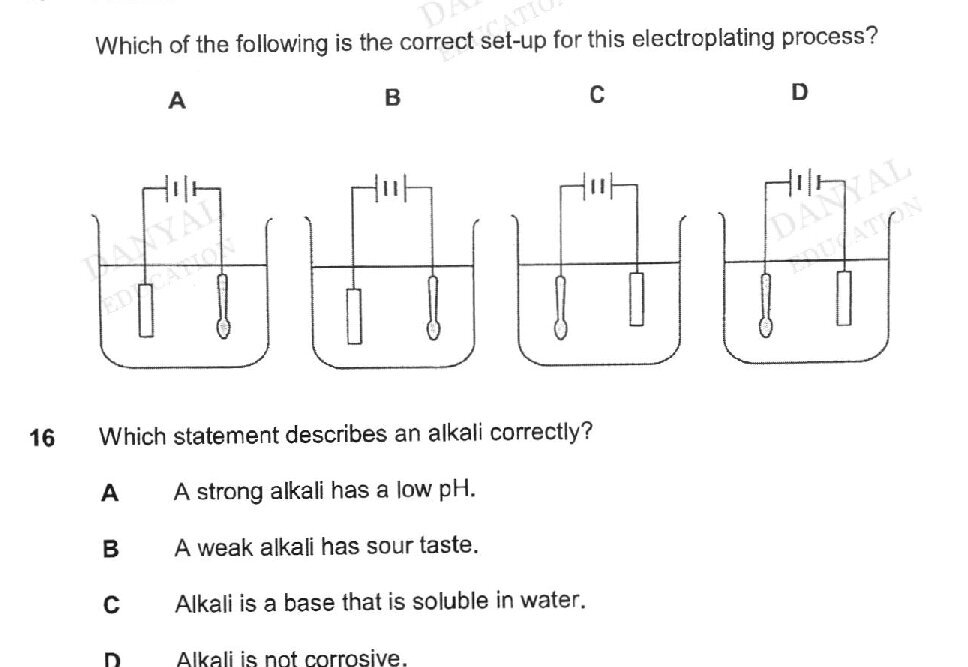
A student would like to coat a spoon with a layer of copper metal. Which of the following is the correct set-up for this electroplating process?
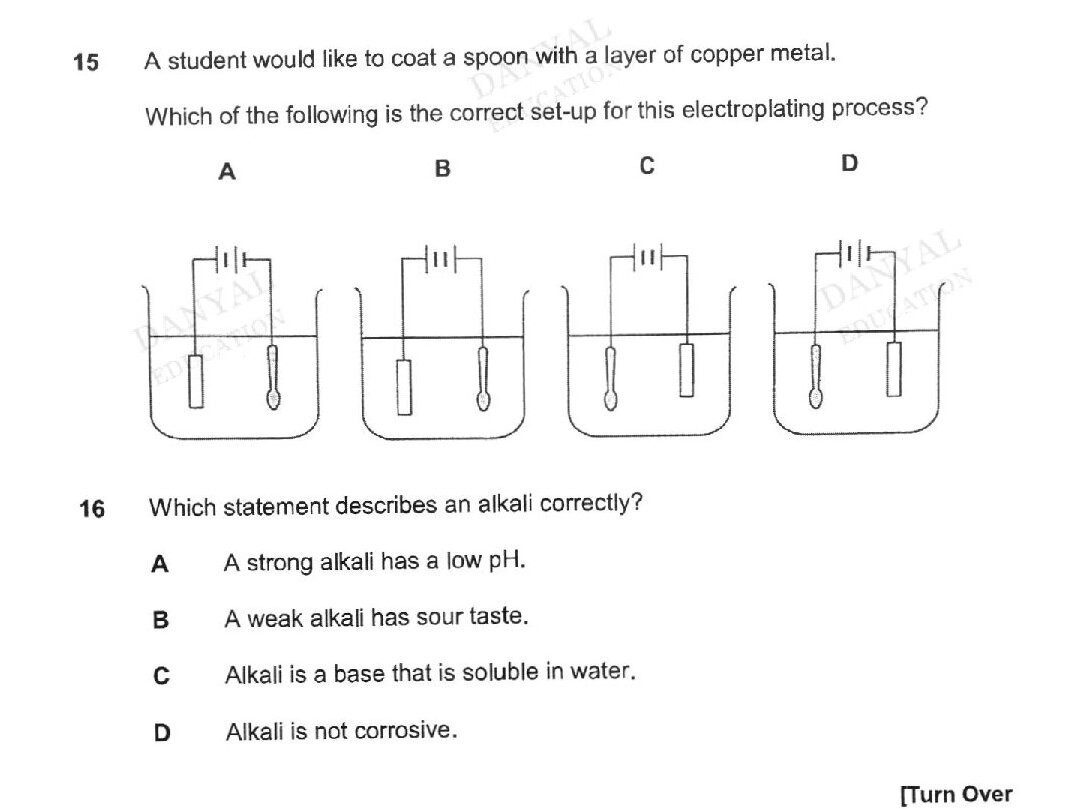
Which statement describes an alkali correctly?
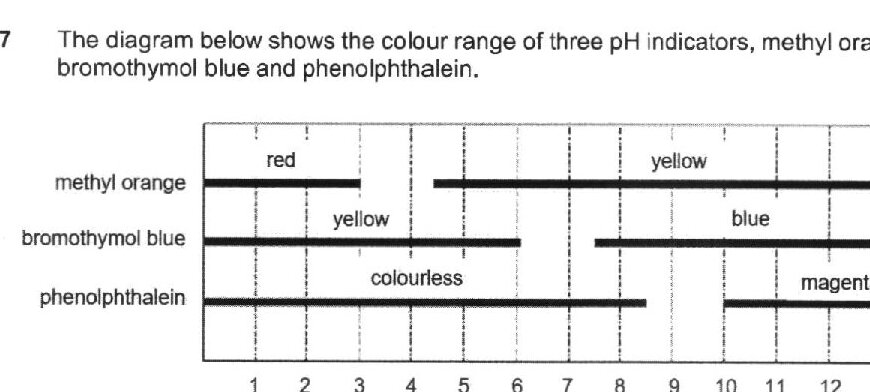
The diagram below shows the colour range of three pH indicators, methyl orange, bromothymol blue and phenolphthalein. When added separately to solution X, methyl orange is yellow, bromothymol blue is blue and phenolphthalein is colourless. What is the pH range of solution X?
Which describes a positive test to show that an acid has reacted with a metal in a test-tube?
State which one of these chemicals has a sour taste.
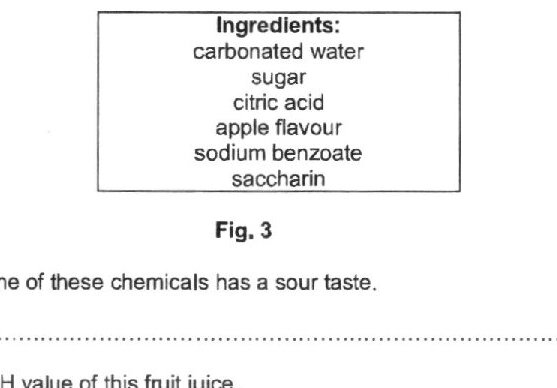
Citric acid can react with other compounds to bring about a chemical change. Describe the term 'chemical change'.
Citric acid can react with carbonates. An example of a common carbonate used in food is sodium carbonate. Complete the word equation in the space below. acid + carbonate →
Describe what is observed when citric acid reacts completely with an exact portion of sodium carbonate in a test-tube.
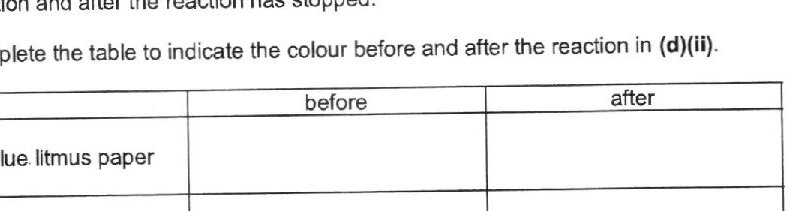
The reaction is tested with both blue litmus paper and red litmus paper before the reaction and after the reaction has stopped. Complete the table to indicate the colour before and after the reaction in (d)(ii).
Describe the mass of the products when compared to the mass of the reactants for the reaction in (d)(ii).
The formation of acid rain is another example of an acid reacting with other compounds to bring about a chemical change. Name a substance that dissolves in rain water to form 'acid rain'.
Name an effect of acid rain.
When the samples are examined under microscope, it is observed that the red blood cells in test tube A remain circular biconcave in shape, but the red blood cells in test tube B become burst. This is caused by a process known as osmosis. Define osmosis.
Complete the word equation to show the reaction between hydrochloric acid and potassium hydroxide.
![Word equation with blanks: hydrochloric acid + potassium hydroxide → [blank] + [blank]](/assets/question-images/sec2_Fuchun-Secondary-SA2-2021-Sec-2-Science_p19_qcii.jpg)
State the pH of the final solution formed at the end of reaction when just enough of acid is added to react exactly with the potassium hydroxide solution.
When excess hydrochloric acid is added to potassium hydroxide, the solution changes from alkaline to acidic. Describe a test that could be carried out to show that the solution is acidic.
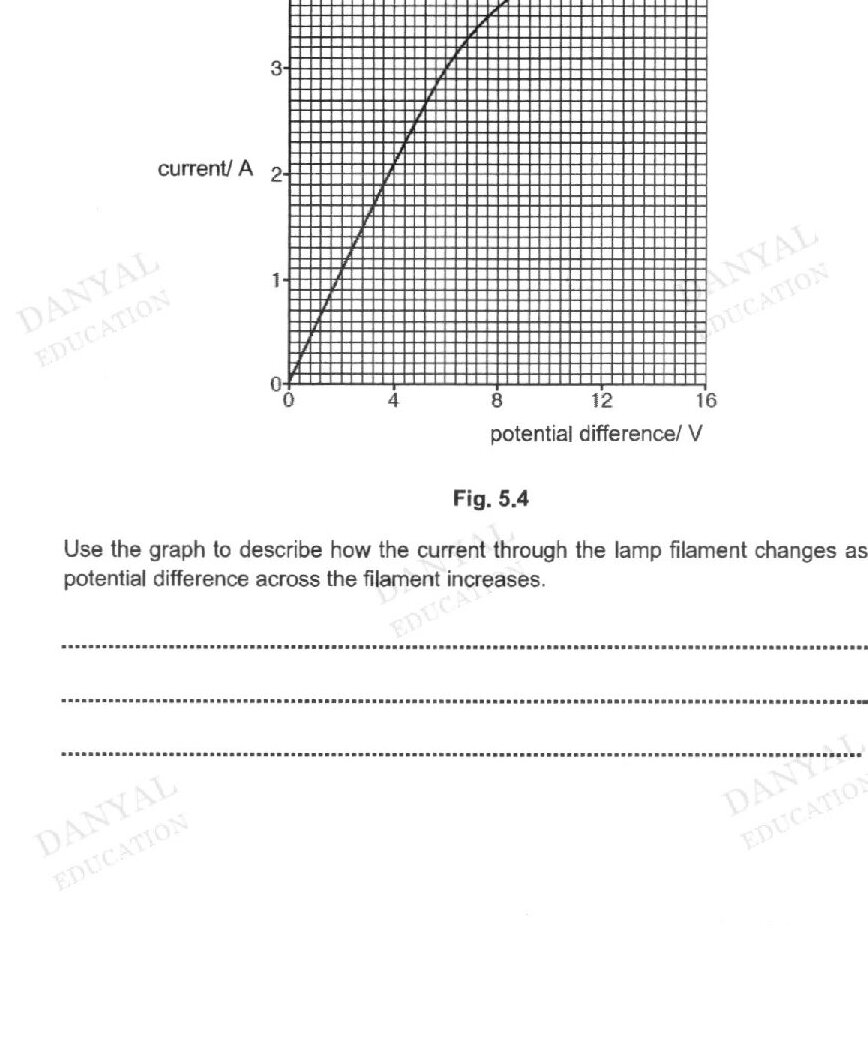
In this reaction, acid reacts with alkali to form products. State another reaction of acids.
Which statement is true of a chemical reaction?
Past year papers cover the full exam — browse by subject below.
View All Papers ›