Atoms and Molecules
Atoms and Molecules: Comprehensive Study Notes
Key Concepts
Structure of the Atom
- Atoms are the smallest particles of an element that can exist and still retain the properties of that element
- Every atom consists of three types of subatomic particles:
- Protons: positively charged particles (+1 charge) located in the nucleus
- Neutrons: neutral particles (no charge) located in the nucleus
- Electrons: negatively charged particles (-1 charge) that occupy shells around the nucleus
- The nucleus is the dense central core of the atom containing protons and neutrons
- The nucleus is extremely small compared to the overall size of the atom
- Most of the atom’s mass is concentrated in the nucleus
- Electrons move in shells (also called energy levels) around the nucleus at different distances
- Atoms are electrically neutral because the number of protons equals the number of electrons
- The positive charges and negative charges balance out to give zero overall charge
Molecules and Compounds
- A molecule is a particle consisting of two or more atoms that are chemically bonded together
- Molecules of the same element contain only one type of atom (e.g. O₃ contains only oxygen atoms)
- A compound is a substance formed when atoms of two or more different elements are chemically bonded together (e.g. H₂O, CH₄)
- Molecules can be classified as:
- Element molecules: all atoms are the same element (e.g. O₃ — ozone, H₂ — hydrogen gas)
- Compound molecules: atoms of two or more different elements bonded together (e.g. CH₄ — methane, C₆H₁₂O₆ — glucose)
- Individual atoms: some substances exist as single atoms, e.g. noble gases such as argon (Ar)
- The atom is mostly empty space — the nucleus is extremely tiny compared to the overall volume of the atom, and electrons orbit in regions (orbitals/shells) far from the nucleus
- Element symbols on the periodic table represent each element (e.g. Mg for magnesium, N for nitrogen, Ag for silver, C for carbon)
Relative Masses and Charges
| Particle | Relative Mass | Relative Charge | Location |
|---|---|---|---|
| Proton | 1 | +1 | Nucleus |
| Neutron | 1 | 0 | Nucleus |
| Electron | 1/1840 (negligible) | -1 | Electron shells |
- Electrons are about 1840 times lighter than protons and neutrons
- For most calculations, we consider the electron mass as negligible
Atomic Number and Mass Number
- Atomic number (Z): the number of protons in an atom
- The atomic number defines what element an atom is
- All atoms of the same element have the same atomic number
- For a neutral atom: atomic number = number of protons = number of electrons
- Mass number (A): the total number of protons and neutrons in an atom
- Mass number = number of protons + number of neutrons
- Number of neutrons = mass number - atomic number
- Atoms are represented using notation:
where X is the element symbol - Example:
represents a sodium atom with mass number 23 and atomic number 11
Isotopes
- Isotopes are atoms of the same element with the same number of protons but different numbers of neutrons
- Isotopes have the same atomic number but different mass numbers
- Isotopes have identical chemical properties because they have the same number of electrons
- Isotopes have slightly different physical properties (like density) due to different masses
- Examples of isotopes:
- Carbon-12 (
): 6 protons, 6 neutrons - Carbon-14 (
): 6 protons, 8 neutrons - Chlorine-35 (
): 17 protons, 18 neutrons - Chlorine-37 (
): 17 protons, 20 neutrons
- Carbon-12 (
Chemical Formulae
- A chemical formula shows which elements are present in a substance and how many atoms of each element
- The subscript number (written small and low) indicates the number of atoms of that element
- If no subscript is written, it means there is only 1 atom of that element
- Examples:
- H₂O: 2 hydrogen atoms, 1 oxygen atom
- CO₂: 1 carbon atom, 2 oxygen atoms
- H₂SO₄: 2 hydrogen atoms, 1 sulfur atom, 4 oxygen atoms
- Ca(OH)₂: 1 calcium atom, 2 oxygen atoms, 2 hydrogen atoms
- Brackets in formulae: the subscript after the bracket multiplies everything inside the bracket
- Ca(OH)₂ means: 1 Ca, 2 × (OH) = 2 O and 2 H
- Mg(NO₃)₂ means: 1 Mg, 2 × (NO₃) = 2 N and 6 O
Chemical Equations
Word Equations
- Word equations show the names of reactants and products in a chemical reaction
- Format: Reactant(s) → Product(s)
- The arrow (→) means “reacts to form” or “produces”
- Reactants are substances that react together (starting materials)
- Products are substances formed in the reaction
- Multiple reactants or products are separated by plus signs (+)
- Example: magnesium + oxygen → magnesium oxide
Symbol Equations
- Symbol equations use chemical symbols and formulae instead of words
- Symbol equations must be balanced — the number of atoms of each element must be the same on both sides
- We balance equations by adding numbers (called coefficients) in front of formulae
- We NEVER change the subscripts in formulae when balancing
- Example: 2Mg + O₂ → 2MgO
- State symbols may be included to show the physical state:
- (s) = solid
- (l) = liquid
- (g) = gas
- (aq) = aqueous solution (dissolved in water)
- Example with state symbols: 2Mg(s) + O₂(g) → 2MgO(s)
Steps to Balance Chemical Equations
- Write the word equation
- Convert to symbol equation using correct formulae
- Count atoms of each element on both sides
- Add coefficients (numbers in front) to balance
- Check that all elements are balanced
- Ensure coefficients are in the simplest whole number ratio
Important Definitions
Atom: The smallest particle of an element that can exist and still retain the properties of that element.
Proton: A positively charged subatomic particle found in the nucleus of an atom, with a relative charge of +1 and relative mass of 1.
Neutron: A neutral subatomic particle (no charge) found in the nucleus of an atom, with a relative mass of 1.
Electron: A negatively charged subatomic particle that orbits the nucleus of an atom in electron shells, with a relative charge of -1 and negligible mass.
Nucleus: The dense central core of an atom containing protons and neutrons, where almost all the atom’s mass is concentrated.
Atomic number (Z): The number of protons in the nucleus of an atom, which defines the element.
Mass number (A): The total number of protons and neutrons in the nucleus of an atom.
Isotopes: Atoms of the same element that have the same number of protons (same atomic number) but different numbers of neutrons (different mass numbers).
Chemical formula: A representation using element symbols and subscript numbers to show which elements are present and how many atoms of each element are in a substance.
Reactants: The starting substances in a chemical reaction that react together (written on the left side of the equation).
Products: The substances formed in a chemical reaction (written on the right side of the equation).
Balanced equation: A symbol equation where the number of atoms of each element is the same on both sides of the equation.
Coefficient: A number placed in front of a chemical formula in an equation to balance it.
Worked Examples
Example 1: Determining Subatomic Particles
Question: An atom of aluminium is represented as
Solution:
Step 1: Identify the atomic number and mass number
- Atomic number (bottom number) = 13
- Mass number (top number) = 27
Step 2: Determine the number of protons
- Number of protons = atomic number = 13 protons
Step 3: Determine the number of electrons
- For a neutral atom, number of electrons = number of protons
- Number of electrons = 13 electrons
Step 4: Determine the number of neutrons
- Number of neutrons = mass number - atomic number
- Number of neutrons = 27 - 13 = 14 neutrons
Answer: The aluminium atom has 13 protons, 14 neutrons, and 13 electrons.
Example 2: Understanding Isotopes
Question: Chlorine has two common isotopes: chlorine-35 and chlorine-37. Complete the table below:
| Isotope | Symbol | Protons | Neutrons | Electrons | Mass Number |
|---|---|---|---|---|---|
| Chlorine-35 | ? | ? | ? | ? | |
| Chlorine-37 | ? | ? | ? | ? |
Solution:
For Chlorine-35:
- Atomic number of chlorine = 17 (this is constant for all chlorine atoms)
- Number of protons = 17
- Mass number = 35 (given in the name)
- Number of neutrons = 35 - 17 = 18
- Number of electrons = 17 (neutral atom)
For Chlorine-37:
- Atomic number of chlorine = 17
- Number of protons = 17
- Mass number = 37
- Number of neutrons = 37 - 17 = 20
- Number of electrons = 17
Completed table:
| Isotope | Symbol | Protons | Neutrons | Electrons | Mass Number |
|---|---|---|---|---|---|
| Chlorine-35 | 17 | 18 | 17 | 35 | |
| Chlorine-37 | 17 | 20 | 17 | 37 |
Key point: Both isotopes have the same number of protons and electrons (same chemical properties) but different numbers of neutrons (different masses).
Example 3: Balancing Chemical Equations
Question: Balance the following equation for the reaction between hydrogen and oxygen to form water: H₂ + O₂ → H₂O
Solution:
Step 1: Count atoms on each side
Left side (reactants):
- H: 2 atoms
- O: 2 atoms
Right side (products):
- H: 2 atoms
- O: 1 atom
Step 2: Identify which elements are unbalanced
- Hydrogen is balanced (2 = 2)
- Oxygen is NOT balanced (2 ≠ 1)
Step 3: Balance oxygen first
- Put a coefficient of 2 in front of H₂O: H₂ + O₂ → 2H₂O
Step 4: Recount all atoms
Left side:
- H: 2 atoms
- O: 2 atoms
Right side:
- H: 2 × 2 = 4 atoms
- O: 2 × 1 = 2 atoms
Step 5: Balance hydrogen
- Hydrogen is now unbalanced (2 ≠ 4)
- Put a coefficient of 2 in front of H₂: 2H₂ + O₂ → 2H₂O
Step 6: Final check
Left side:
- H: 2 × 2 = 4 atoms
- O: 2 atoms
Right side:
- H: 2 × 2 = 4 atoms
- O: 2 × 1 = 2 atoms
Answer: The balanced equation is 2H₂ + O₂ → 2H₂O
Example 4: Writing and Balancing Equations from Word Equations
Question: Write a balanced symbol equation for the following reaction: magnesium + hydrochloric acid → magnesium chloride + hydrogen
Solution:
Step 1: Write the symbol equation with correct formulae
- Magnesium = Mg
- Hydrochloric acid = HCl
- Magnesium chloride = MgCl₂
- Hydrogen = H₂
Unbalanced equation: Mg + HCl → MgCl₂ + H₂
Step 2: Count atoms on each side
Left side:
- Mg: 1 atom
- H: 1 atom
- Cl: 1 atom
Right side:
- Mg: 1 atom
- Cl: 2 atoms
- H: 2 atoms
Step 3: Balance chlorine and hydrogen
- Put a coefficient of 2 in front of HCl: Mg + 2HCl → MgCl₂ + H₂
Step 4: Final check
Left side:
- Mg: 1 atom
- H: 2 × 1 = 2 atoms
- Cl: 2 × 1 = 2 atoms
Right side:
- Mg: 1 atom
- Cl: 2 atoms
- H: 2 atoms
Answer: The balanced equation is Mg + 2HCl → MgCl₂ + H₂
Common Mistakes to Avoid
Atomic Structure Mistakes
- Confusing mass number with atomic number: Remember, atomic number is the number of protons (bottom number), mass number is protons + neutrons (top number)
- Forgetting that neutral atoms have equal protons and electrons: The number of electrons equals the number of protons in a neutral atom
- Thinking electrons have significant mass: Electrons have negligible mass (1/1840 of a proton)
- Placing neutrons outside the nucleus: Both protons AND neutrons are in the nucleus; only electrons orbit outside
- Confusing atomic number with neutron count: atomic number gives the number of protons only — never use it directly as the neutron count; always calculate: neutrons = mass number − atomic number
- Misidentifying a molecule as an atom: O₃ (ozone) is a molecule of three oxygen atoms, not a single atom — check the chemical formula before identifying a particle as an atom
Isotope Mistakes
- Thinking isotopes have different numbers of protons: Isotopes ALWAYS have the same number of protons (same element) but different numbers of neutrons
- Saying isotopes have different chemical properties: Isotopes have the SAME chemical properties because they have the same number of electrons
- Confusing isotope notation: In
, A (top) is mass number, Z (bottom) is atomic number
Chemical Formula Mistakes
- Miscounting atoms in brackets: In Ca(OH)₂, remember to multiply BOTH O and H by 2 to get 2 O atoms and 2 H atoms
- Forgetting to multiply: In Mg(NO₃)₂, there are 2 N atoms and 6 O atoms (not 2 N and 3 O)
- Writing capital letters incorrectly: “Co” is cobalt, “CO” is carbon monoxide — case matters!
Balancing Equations Mistakes
- Changing subscripts in formulae when balancing: NEVER change H₂O to H₂O₂ — only add coefficients in front
- Not checking all elements at the end: Always recount atoms of EVERY element after balancing
- Having coefficients that aren’t in simplest form: 4H₂ + 2O₂ → 4H₂O should be simplified to 2H₂ + O₂ → 2H₂O
- Forgetting to write “1” as nothing: Don’t write “1Mg”, just write “Mg”
- Balancing one element but unbalancing another: Always recount everything after each change
General Mistakes
- Missing units or labels: Always include proper notation like
with both numbers - Incorrect use of state symbols: Remember: (s) solid, (l) liquid, (g) gas, (aq) aqueous — use brackets, not parentheses for atoms
- Confusing the direction of the arrow: Reactants → Products (arrow shows direction of reaction)
Exam Tips
For Atomic Structure Questions
- Always show your working when calculating neutrons: write “neutrons = mass number - atomic number”
- Use the phrase “neutral atom” when explaining why electrons equal protons
- Key phrases to earn marks:
- “The nucleus contains protons and neutrons”
- “Electrons orbit the nucleus in shells”
- “Protons are positively charged, neutrons have no charge, electrons are negatively charged”
- “The atom is electrically neutral because the number of positive charges equals the number of negative charges”
For Isotope Questions
- Always mention both similarities and differences:
- Similarities: same number of protons, same number of electrons, same atomic number, same chemical properties
- Differences: different number of neutrons, different mass number, slightly different physical properties
- Key phrase: “Isotopes are atoms of the same element with the same number of protons but different numbers of neutrons”
- When comparing isotopes, present your answer in a clear table or list
For Chemical Formula Questions
- Count carefully when brackets are involved
- Show your working: For Ca(OH)₂, write “Ca = 1, O = 2 × 1 = 2, H = 2 × 1 = 2”
- Double-check your atom count before finalizing
- Classify the formula type: decide whether the formula represents an element molecule (e.g. O₃), a compound molecule (e.g. CH₄, C₆H₁₂O₆), or an individual atom (e.g. Ar) — questions may ask you to identify the type
- Use precise language: do not write “atom” when you mean “molecule” — examiners will penalise imprecise use of these terms
For Equation Questions
- Word equations: Always use full names, not symbols; use “+” between multiple substances; use “→” not “=”
- Symbol equations:
- Write correct formulae first (don’t invent formulae!)
- Balance by adding coefficients ONLY
- Check your answer by counting atoms on both sides
- Show your final balanced equation clearly
- State symbols: If asked for them, include them in brackets immediately after each formula
- Common equations to memorize:
- Combustion of magnesium: 2Mg + O₂ → 2MgO
- Formation of water: 2H₂ + O₂ → 2H₂O
- Reaction of magnesium with acid: Mg + 2HCl → MgCl₂ + H₂
Mark-Earning Keywords
- For structure: “nucleus”, “electron shells”, “protons and neutrons in nucleus”, “electrons orbit”
- For charge: “electrically neutral”, “equal number of positive and negative charges”
- For isotopes: “same element”, “same protons”, “different neutrons”, “same chemical properties”
- For equations: “balanced”, “same number of atoms on both sides”, “reactants”, “products”
Presentation Tips
- Draw clear diagrams with labels pointing to specific parts
- Use proper notation for isotopes:
format - Write chemical equations on one line with proper spacing: 2Mg + O₂ → 2MgO
- Underline or box your final answers to make them clear to the examiner
- Use a pencil for diagrams so you can correct mistakes
- Number your working (Step 1, Step 2) to show clear logical progression
Quick Summary
Essential points to remember for revision:
- ✓ Atomic structure: Atoms consist of a nucleus (containing protons and neutrons) with electrons orbiting in shells
- ✓ Charges and masses: Protons (+1, mass 1), neutrons (0, mass 1), electrons (-1, negligible mass)
- ✓ Neutral atoms: Number of protons = number of electrons, giving zero overall charge
- ✓ Atomic number (Z): Number of protons in an atom; defines the element
- ✓ Mass number (A): Total number of protons and neutrons; neutrons = A - Z
- ✓ Isotopes: Same element (same protons, same atomic number) but different neutrons (different mass numbers); same chemical properties
- ✓ Chemical formulae: Subscripts show number of atoms; brackets multiply everything inside
- ✓ Counting atoms in formulae: Ca(OH)₂ = 1 Ca, 2 O, 2 H; Mg(NO₃)₂ = 1 Mg, 2 N, 6 O
- ✓ Word equations: Show names of reactants and products: reactants → products
- ✓ Symbol equations: Use chemical formulae and must be balanced
- ✓ Balancing equations: Add coefficients (numbers in front) to make atoms equal on both sides; NEVER change subscripts
- ✓ State symbols: (s) = solid, (l) = liquid, (g) = gas, (aq) = aqueous solution
Diagrams
Bohr Model: Sodium Atom (Na, electron configuration 2,8,1)
Ion formation and ionic bonding are Sec 3/4 Chemistry topics and are not required for Sec 2 NA. This diagram has been removed to avoid confusion during revision.
Fig. 1.1 shows the structure of a nitrogen atom. Complete the table below to show the names and relative masses of the sub-atomic particles represented by the symbols in the nitrogen atom.
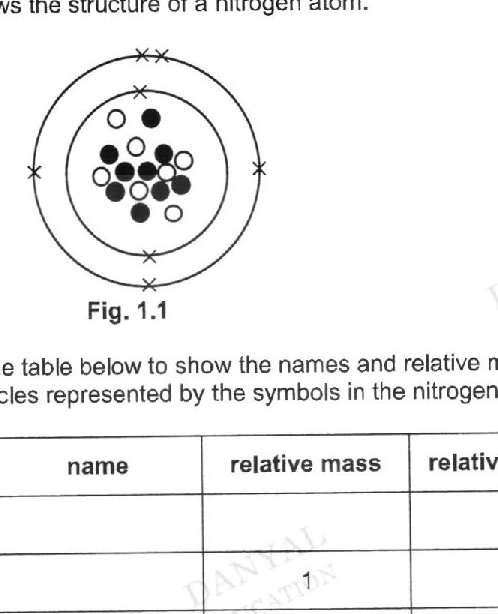
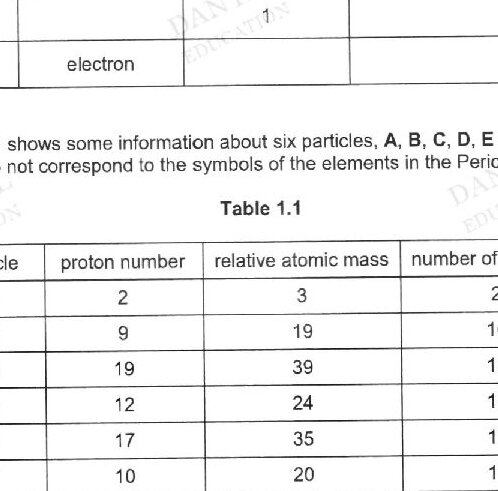
Table 1.1 shows some information about six particles, A, B, C, D, E and F. The letters do not correspond to the symbols of the elements in the Periodic Table. Identify which particles correspond to which elements.
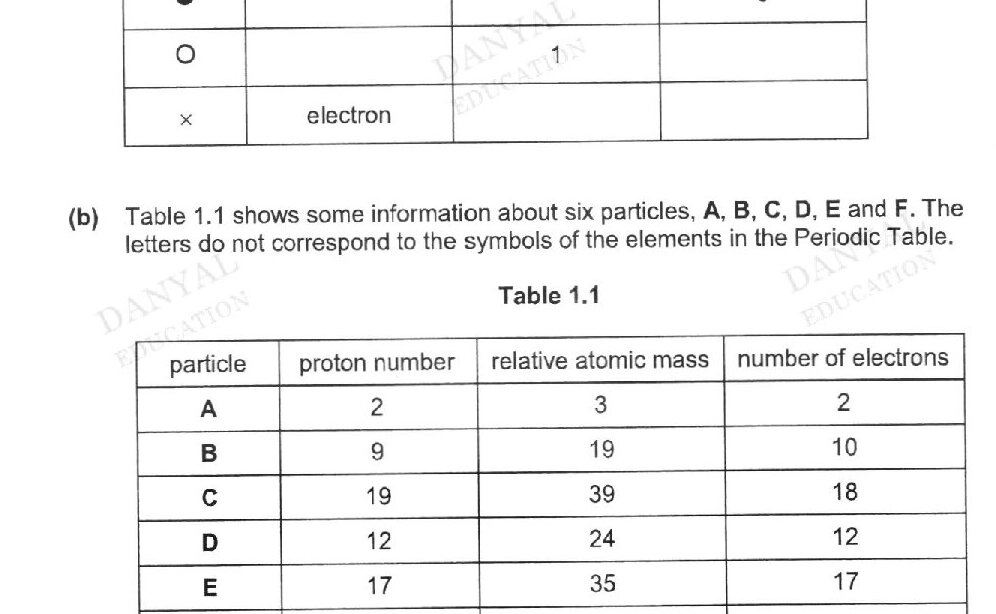
From Table 1.1, choose the particle that is a neutral atom of metal.
From Table 1.1, choose the particle that has a positive charge.
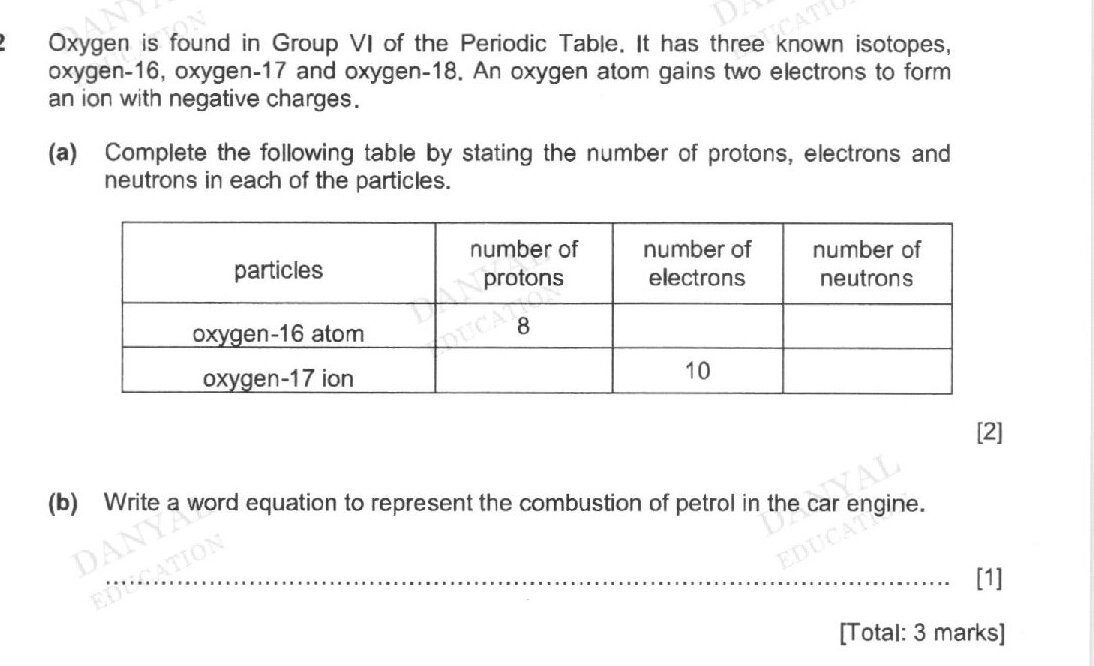
Oxygen is found in Group VI of the Periodic Table. It has three known isotopes, oxygen-16, oxygen-17 and oxygen-18. An oxygen atom gains two electrons to form an ion with negative charges. Complete the following table by stating the number of protons, electrons and neutrons in each of the particles.
A number of students did read the question carefully A Body of student wore electrodes configuration (provided no is covered)
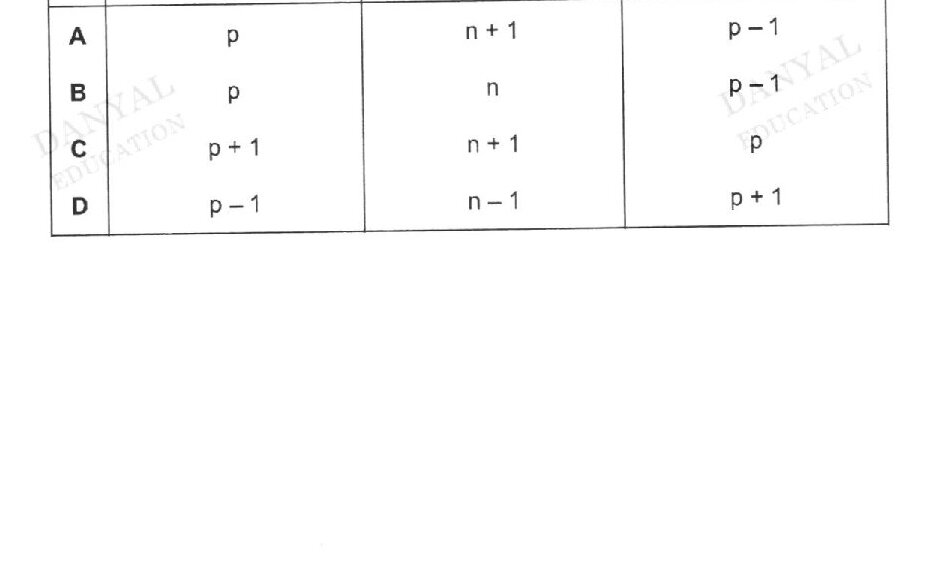
An element, X, has p protons and n neutrons. Which row gives the possible number of subatomic particles in a positive ion of X?
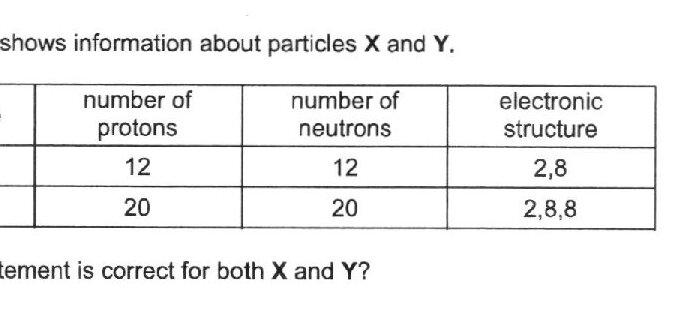
The table shows information about particles X and Y. Which statement is correct for both X and Y?
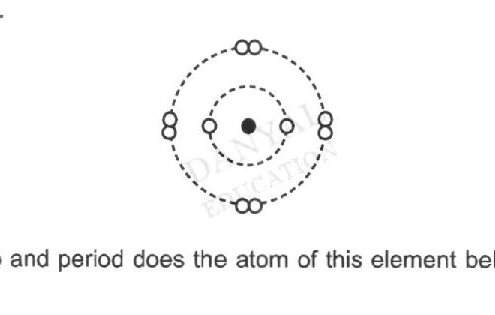
The diagram shows the arrangement of electrons in an ion of an element with a charge of −1. Which group and period does the atom of this element belong to in the Periodic Table?
An element, X, has p protons and n neutrons. Which row gives the possible number of subatomic particles in a positive ion of X?
The table shows information about particles X and Y. Which statement is correct for both X and Y?
The diagram shows the arrangement of electrons in an ion of an element with a charge of −1. Which group and period does the atom of this element belong to in the Periodic Table?
Explain what is meant by the term isotopes.
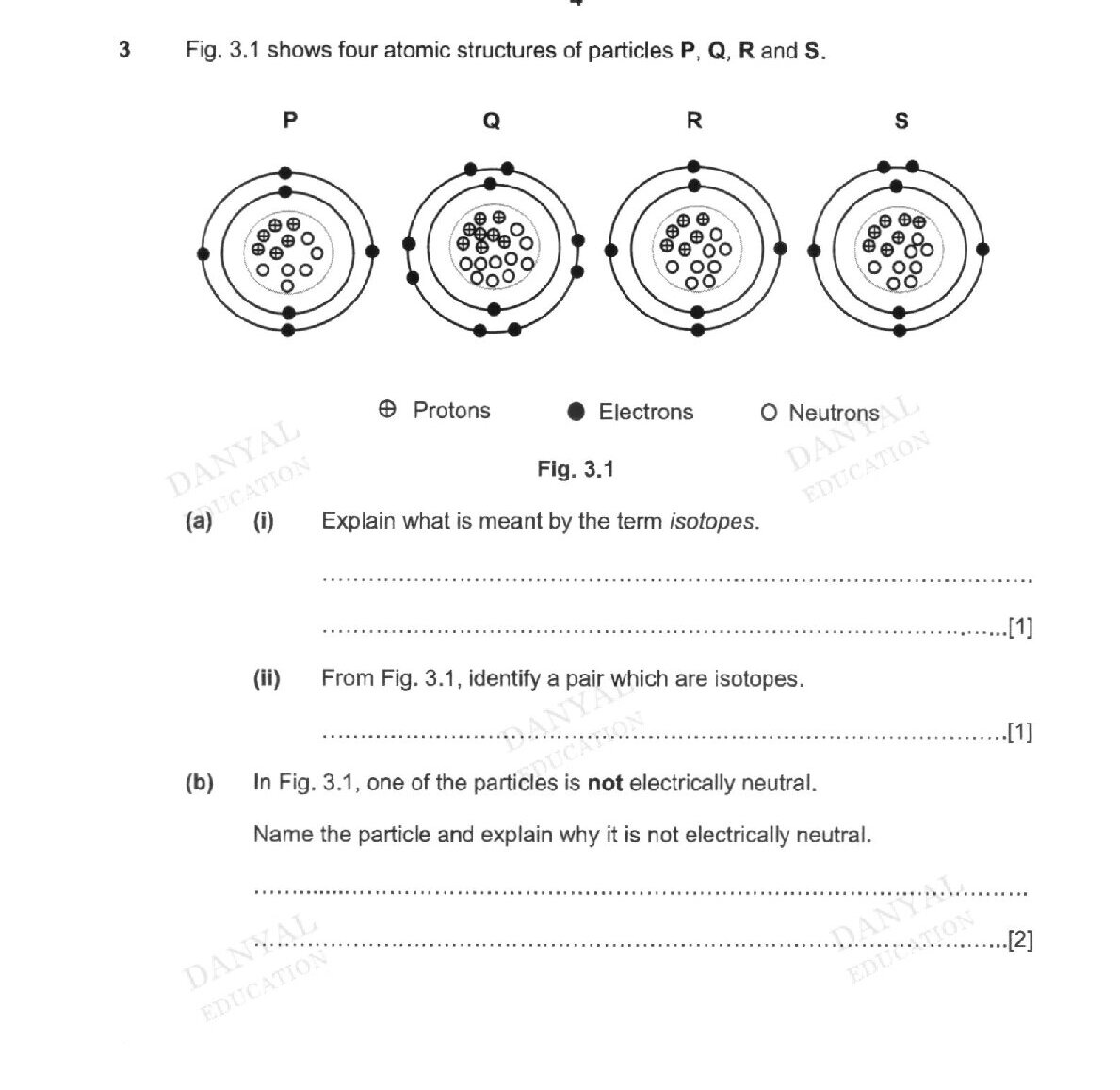
From Fig. 3.1, identify a pair which are isotopes.
In Fig. 3.1, one of the particles is not electrically neutral. Name the particle and explain why it is not electrically neutral.
Which statement about an atom is true?
Which model shows a correct chemical reaction?
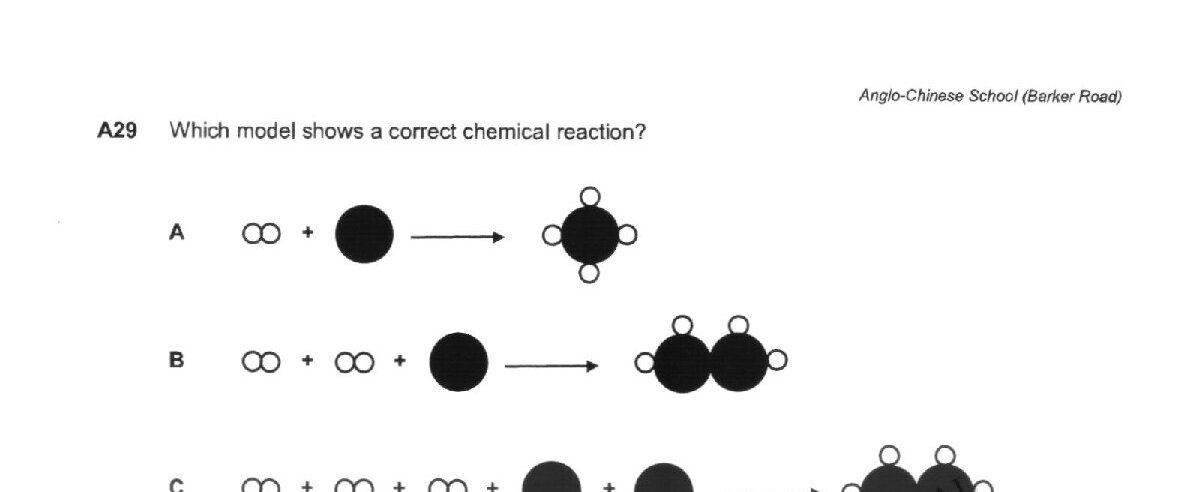
One carbon atom, C, will react with 2 molecules of chlorine, Cl₂, to form one molecule of tetrachloromethane, CCl₄. Thus, 12 g of carbon will react with 142 g of chlorine gas. What will be the mass of tetrachloromethane, CCl₄, obtained after this reaction is completed?
Which statement is true about the Periodic Table?
Which molecule has the greatest number of atoms?
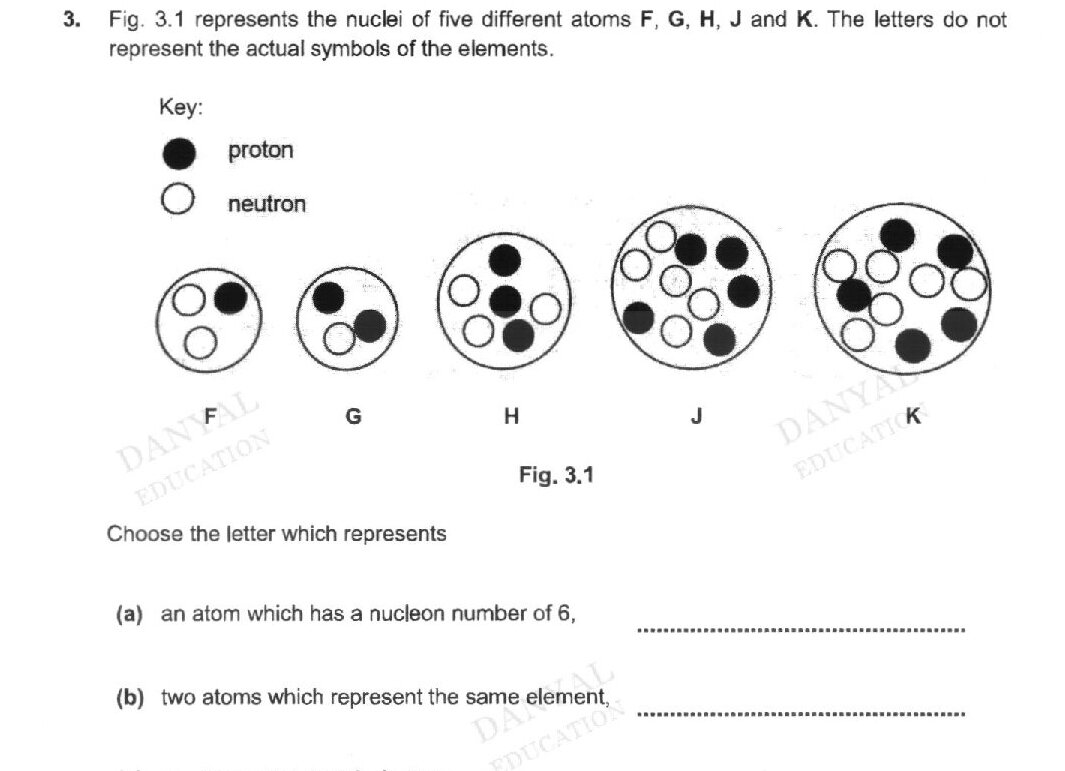
an atom which has a nucleon number of 6,
two atoms which represent the same element,
an atom which has 2 electrons,
Which statement about an atom is correct?
Helium exists as two isotopes He-3 and He-4. Which statement about the two isotopes is true?
Which statement is correct about an atom of an element?
An ion of an element X has 18 electrons, 20 protons and 19 neutrons. Element X has another isotope. An atom of this isotope may have ________.
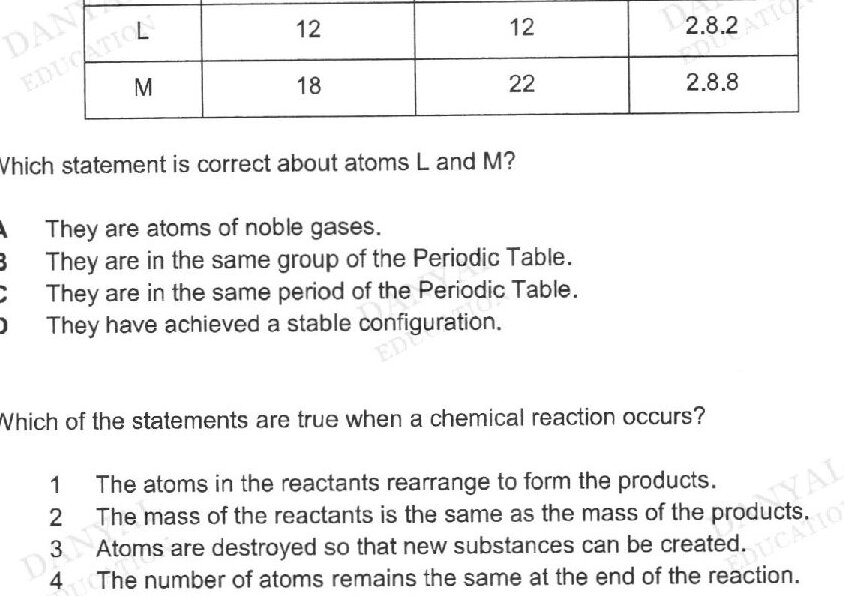
The table shows some information about atoms L and M. Which statement is correct about atoms L and M?
A pairing of both electrons gained by O atom A nucleus represented by BE
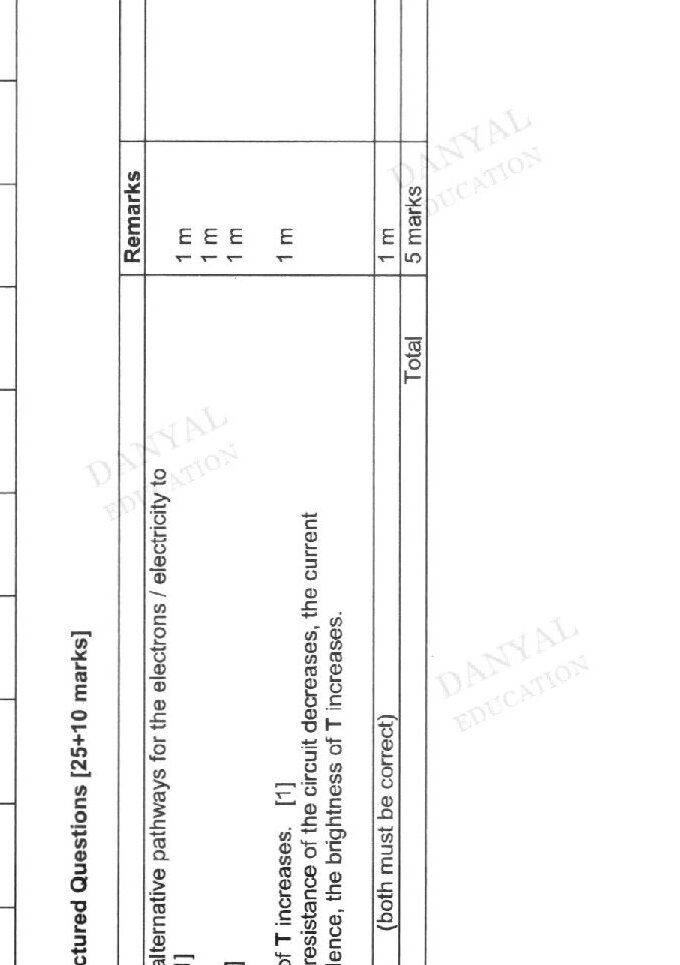
If an additional lamp is added in parallel to lamp S, how will the brightness of lamp T be affected? Explain.
Past year papers cover the full exam — browse by subject below.
View All Papers ›