Cell Model
Cell Model - Comprehensive Study Notes
Key Concepts
Cell Structure — Plant vs Animal
Basic Cell Theory:
- All living things are made up of cells
- Cells are the basic units of life
- All cells come from pre-existing cells
Animal Cells:
- Generally irregular or round in shape
- Smaller in size (10-30 micrometres)
- Do NOT have a cell wall, chloroplasts, or large permanent vacuole
- Have small temporary vacuoles (if present)
- Nucleus is usually centrally located
Plant Cells:
- Regular, rectangular/box-like shape due to rigid cell wall
- Generally larger than animal cells (10-100 micrometres)
- Have THREE additional structures: cell wall, chloroplasts (in green parts), and large permanent vacuole
- Nucleus is pushed to the side by the large vacuole
Common Structures in BOTH Plant and Animal Cells:
- Cell membrane
- Cytoplasm
- Nucleus
- Mitochondria
Cell Organelles and Functions
Cell Membrane:
- Thin, partially permeable outer boundary of the cell
- Controls what enters and leaves the cell
- Allows some substances to pass through but not others
- Found in both plant and animal cells
Cell Wall:
- Thick, rigid outer layer made of cellulose
- Provides shape and support to the plant cell
- Fully permeable (allows all substances to pass through)
- Found ONLY in plant cells
- Located OUTSIDE the cell membrane
Cytoplasm:
- Jelly-like substance that fills the cell
- Site where many chemical reactions occur
- Contains all the cell organelles
- Made mostly of water
Nucleus:
- Large, round organelle (usually the largest visible structure)
- Contains genetic material (DNA/chromosomes)
- Controls all cell activities
- Often called the “control centre” of the cell
Mitochondria (singular: mitochondrion):
- Small, sausage-shaped organelles
- Site of aerobic respiration
- Releases energy from food (glucose) for cell activities
- Often called the “powerhouse” of the cell
- More mitochondria are found in active cells that need more energy
Chloroplasts:
- Disc-shaped, green organelles containing chlorophyll
- Site of photosynthesis (making food using light energy)
- Found ONLY in plant cells, specifically in green parts (leaves, stems)
- NOT found in roots as they don’t receive light
Vacuole:
- In plant cells: Large, permanent, central vacuole filled with cell sap (water, sugars, salts)
- Provides support to keep the cell firm (turgid)
- Stores substances
- In animal cells: Small, temporary vacuoles (if present)
- Store food or waste materials temporarily
Diffusion and Osmosis
Diffusion:
- The net movement of particles from a region of higher concentration to a region of lower concentration
- Continues until particles are evenly distributed (equilibrium reached)
- Does NOT require energy (passive process)
- Happens in gases and liquids
Factors Affecting Rate of Diffusion:
- Concentration gradient — Greater difference in concentration = faster diffusion
- Temperature — Higher temperature = faster particle movement = faster diffusion
- Distance — Shorter distance = faster diffusion
- Size of particles — Smaller particles = faster diffusion
- Surface area — Larger surface area = faster diffusion
Osmosis:
- A special type of diffusion
- The net movement of water molecules from a region of higher water concentration (dilute solution) to a region of lower water concentration (concentrated solution) through a partially permeable membrane
- Does NOT require energy (passive process)
Key Understanding:
- Osmosis is specifically about WATER movement only
- Requires a partially permeable membrane
- Water moves from dilute solution → concentrated solution
- Water moves from high water concentration → low water concentration
Effects of Osmosis on Cells:
Animal Cells:
- Placed in pure water/dilute solution: Water enters by osmosis → cell swells → may burst (lysis)
- Placed in concentrated solution: Water leaves by osmosis → cell shrinks (crenation)
Plant Cells:
- Placed in pure water/dilute solution: Water enters by osmosis → vacuole expands → cell becomes turgid (firm) → does NOT burst (protected by cell wall)
- Placed in concentrated solution: Water leaves by osmosis → vacuole shrinks → cytoplasm pulls away from cell wall → cell becomes plasmolysed (flaccid/limp)
Cell Specialisation
Cell Specialisation (Differentiation):
- Cells develop specific structures to perform particular functions
- Specialised cells have adaptations that make them efficient at their job
Examples of Specialised Animal Cells:
-
Red Blood Cells:
- Function: Transport oxygen around the body
- Adaptations:
- Biconcave disc shape (increases surface area for oxygen diffusion (loading and unloading))
- Contains haemoglobin (protein that binds to oxygen)
- No nucleus (more space for haemoglobin)
- Flexible (can squeeze through narrow blood vessels)
-
Nerve Cells (Neurons):
- Function: Transmit electrical impulses/messages around the body
- Adaptations:
- Long axon/fibre (carries impulses over long distances)
- Many branched endings (connect to many other nerve cells)
- Insulated by fatty sheath (speeds up transmission of impulses)
-
Muscle Cells:
- Function: Contract and relax to produce movement
- Adaptations:
- Long and thin (can contract and relax)
- Many mitochondria (provide energy for contraction)
- Special proteins that can slide over each other (enable contraction)
-
Sperm Cells:
- Function: Fertilise the egg cell
- Adaptations:
- Long tail/flagellum (for swimming)
- Many mitochondria in middle section (provide energy for swimming)
- Streamlined head (reduces resistance when swimming)
- Acrosome in head (contains enzymes to digest egg membrane)
Examples of Specialised Plant Cells:
-
Root Hair Cells:
- Function: Absorb water and mineral salts from soil
- Adaptations:
- Long hair-like projection (increases surface area for absorption)
- Thin cell wall (short diffusion distance)
- Large permanent vacuole (stores absorbed water and minerals)
- No chloroplasts (underground, no light)
-
Palisade Mesophyll Cells:
- Function: Carry out photosynthesis
- Adaptations:
- Many chloroplasts (maximum light absorption for photosynthesis)
- Arranged near top of leaf (receive maximum light)
- Regular, cylindrical shape with large surface area
- Thin cell walls (allow carbon dioxide to diffuse in easily)
-
Xylem Vessels:
- Function: Transport water and mineral salts from roots to leaves
- Adaptations:
- Hollow tube with no end walls (allows continuous water flow)
- No cytoplasm or nucleus (dead cells = no blockage to water flow)
- Thick walls strengthened with lignin (provides support, prevents collapse)
- Walls have pits (allow water to move sideways between vessels)
-
Phloem Cells:
- Function: Transport sugars (food) from leaves to other parts of plant
- Adaptations:
- Sieve tubes with sieve plates (allow dissolved sugars to flow through)
- Companion cells (provide energy for transport)
- Living cells with cytoplasm but no nucleus
Important Definitions
Cell: The basic structural and functional unit of all living organisms.
Cell Membrane: A thin, partially permeable membrane that surrounds the cell and controls the movement of substances in and out of the cell.
Cell Wall: A rigid outer layer made of cellulose found only in plant cells that provides support and shape.
Cytoplasm: The jelly-like substance inside the cell where chemical reactions take place.
Nucleus: The control centre of the cell that contains genetic material (DNA) and controls all cell activities.
Mitochondria: Organelles where aerobic respiration occurs to release energy from glucose.
Chloroplasts: Green organelles found only in plant cells where photosynthesis occurs.
Vacuole: A fluid-filled space; plant cells have a large permanent vacuole containing cell sap, while animal cells may have small temporary vacuoles.
Diffusion: The net movement of particles from a region of higher concentration to a region of lower concentration until evenly distributed.
Osmosis: The net movement of water molecules from a region of higher water concentration to a region of lower water concentration through a partially permeable membrane.
Partially Permeable Membrane: A membrane that allows some molecules (like water) to pass through but not others (like large solute molecules).
Concentration Gradient: The difference in concentration between two regions.
Turgid: A plant cell that is firm and swollen due to water entering by osmosis.
Plasmolysed: A plant cell that has become limp/flaccid because water has left by osmosis and the cytoplasm has pulled away from the cell wall.
Cell Specialisation: The process by which cells develop specific structures and features to perform particular functions efficiently.
Cellulose: The strong material that makes up plant cell walls.
Cell Sap: The solution of water, sugars, and salts found in the permanent vacuole of plant cells.
Worked Examples
Example 1: Identifying Cell Type from Description
Question: A student observes a cell under the microscope with the following features:
- Regular rectangular shape
- Has a cell wall
- Contains many green disc-shaped structures
- Has a large central structure pushing other contents to the sides
Is this a plant or animal cell? Give reasons for your answer.
Solution:
Step 1: Identify the key features mentioned
- Regular rectangular shape ✓
- Cell wall ✓
- Green disc-shaped structures = chloroplasts ✓
- Large central structure = large permanent vacuole ✓
Step 2: Compare with known cell types
- Cell wall is found ONLY in plant cells
- Chloroplasts are found ONLY in plant cells
- Large permanent vacuole is found ONLY in plant cells
- Regular shape is characteristic of plant cells
Step 3: Write complete answer
Answer: This is a plant cell.
Reasons:
- It has a cell wall, which is only present in plant cells
- It contains chloroplasts (green disc-shaped structures), which are only found in plant cells
- It has a large permanent vacuole in the centre, which is characteristic of plant cells
- It has a regular rectangular shape due to the rigid cell wall
(This answer would earn full marks as it correctly identifies the cell type and provides multiple valid reasons with proper terminology.)
Example 2: Explaining Osmosis Effects
Question: A piece of potato is placed in a concentrated salt solution for 30 minutes. Explain what happens to the potato cells and why. Use the term osmosis in your answer.
Solution:
Step 1: Identify the water concentration
- Inside potato cells: high water concentration (cells contain dilute cell sap)
- Outside in salt solution: low water concentration (concentrated solution)
Step 2: Determine direction of water movement
- Water moves from high concentration → low concentration
- Water moves from inside cells → outside into salt solution
Step 3: Identify the process
- This movement is called osmosis (water movement through partially permeable membrane)
Step 4: Explain the effect on cells
- Water leaves the vacuole
- Vacuole shrinks
- Cytoplasm pulls away from cell wall
- Cells become plasmolysed (flaccid/limp)
Step 5: Write complete answer
Answer: The potato cells will become plasmolysed (flaccid/limp).
Explanation:
- Water moves out of the potato cells by osmosis
- This is because water moves from a region of higher water concentration (inside the cells) to a region of lower water concentration (in the concentrated salt solution) through the partially permeable cell membrane
- As water leaves, the vacuole shrinks and the cytoplasm pulls away from the cell wall
- This causes the potato to become soft and limp
(This answer includes the key terms and explains the process step-by-step, earning full marks.)
Example 3: Linking Structure to Function
Question: Explain how two features of a red blood cell are adapted to its function of transporting oxygen.
Solution:
Step 1: Identify the function
- Function: Transport oxygen around the body
Step 2: Identify adaptations
- Feature 1: Biconcave disc shape
- Feature 2: No nucleus
- Feature 3: Contains haemoglobin (Choose any two)
Step 3: Link each feature to how it helps the function
Answer:
Adaptation 1: Biconcave disc shape
- This increases the surface area of the cell
- A larger surface area allows more oxygen to be absorbed quickly and efficiently
Adaptation 2: No nucleus
- The absence of a nucleus means there is more space inside the cell
- This allows the cell to carry more haemoglobin, which can bind to and transport more oxygen
Alternative Adaptation: Contains haemoglobin
- Haemoglobin is a protein that binds to oxygen
- This allows the red blood cell to pick up oxygen in the lungs and release it to body cells that need it
(Any two adaptations with clear explanations linking structure to function would earn full marks. The key is to explain HOW each feature helps the cell perform its function.)
Common Mistakes to Avoid
Mistake 1: Confusing Plant and Animal Cell Features
- ❌ Saying animal cells have chloroplasts or cell walls
- ❌ Saying plant cells don’t have mitochondria
- ✓ Remember: Cell wall, chloroplasts, and large vacuole are ONLY in plant cells
- ✓ Remember: BOTH cell types have cell membrane, cytoplasm, nucleus, and mitochondria
Mistake 2: Incorrect Osmosis Definition
- ❌ Saying “movement of particles” (this is diffusion)
- ❌ Forgetting “partially permeable membrane”
- ❌ Saying water moves from concentrated to dilute solution
- ✓ Correct: “Net movement of water molecules from higher water concentration to lower water concentration through a partially permeable membrane”
Mistake 3: Wrong Direction of Water Movement
- ❌ Thinking concentrated solution has high water concentration
- ✓ Remember: Concentrated solution = LOW water concentration (lots of solute, less water)
- ✓ Remember: Dilute solution = HIGH water concentration (little solute, more water)
Mistake 4: Confusing Turgid and Plasmolysed
- ❌ Mixing up which happens in water vs. salt solution
- ✓ Turgid: Happens when plant cell is in WATER/dilute solution (cell becomes firm)
- ✓ Plasmolysed: Happens when plant cell is in CONCENTRATED solution (cell becomes limp)
Mistake 5: Incomplete Structure-Function Answers
- ❌ Just stating the feature without explaining HOW it helps
- ❌ Example: “Red blood cells have no nucleus” (incomplete)
- ✓ Correct: “Red blood cells have no nucleus, which provides more space to carry haemoglobin, allowing them to transport more oxygen”
Mistake 6: Drawing Errors in Diagrams
- ❌ Drawing chloroplasts in animal cells
- ❌ Drawing plant cells with irregular shapes
- ❌ Not showing the cell wall as separate from cell membrane
- ✓ Always check your diagram matches the cell type required
Mistake 7: Confusing Cell Wall and Cell Membrane
- ❌ Saying cell wall controls what enters/leaves (that’s the cell membrane’s job)
- ❌ Saying cell membrane provides support (that’s the cell wall’s job)
- ✓ Cell wall: Support and shape (fully permeable)
- ✓ Cell membrane: Controls entry/exit of substances (partially permeable)
Mistake 8: Wrong Terminology for Mitochondria
- ❌ Saying “mitochondria produces energy”
- ✓ Correct: “Mitochondria releases energy from glucose during respiration”
- ✓ Energy cannot be produced or destroyed, only converted/released
Mistake 9: Incomplete Osmosis Explanations
- ❌ Not mentioning the partially permeable membrane
- ❌ Not specifying water concentration differences
- ❌ Not explaining what happens to the cell after osmosis
- ✓ Include: water movement direction, concentration gradient, membrane type, effect on cell
Mistake 10: Forgetting About Root Location
- ❌ Drawing chloroplasts in root hair cells
- ✓ Remember: Roots are underground, no light, so NO chloroplasts needed
Mistake 11: Mixing Up Red Blood Cell Adaptations
- ❌ Saying the absence of a nucleus increases the surface area for oxygen diffusion (loading and unloading) — this is WRONG
- ✓ It is the BICONCAVE SHAPE that increases the surface area for oxygen diffusion (loading and unloading) and release
- ✓ The absence of a nucleus creates more space to pack in more haemoglobin, allowing more oxygen to be transported
- These are TWO separate adaptations with TWO different benefits — never swap or merge them
Exam Tips
For Structure/Diagram Questions:
- Use a ruler for plant cells — they have straight edges
- Label lines must be straight and should not cross each other
- Labels must touch the part they’re identifying
- Draw in pencil first, then trace over in pen if allowed
- Always include: cell membrane, cytoplasm, nucleus, mitochondria for both cell types
- Add cell wall, chloroplasts, large vacuole for plant cells ONLY
For Definition Questions:
Key phrases to include for Osmosis:
- “Net movement of water molecules” (not just “water” or “particles”)
- “From region of higher water concentration” (specify “water”)
- “To region of lower water concentration”
- “Through a partially permeable membrane”
- All four components needed for full marks
Key phrases for Diffusion:
- “Net movement of particles/molecules”
- “From higher concentration to lower concentration”
- “Until evenly distributed/equilibrium reached”
For Compare/Contrast Questions:
When comparing plant and animal cells:
- Make a clear table or list
- State what animal cells have AND what plant cells have
- Use “whereas” or “but” to show differences
- Example: “Animal cells have small temporary vacuoles whereas plant cells have large permanent vacuoles”
For Function Questions:
Always link structure to function:
- Feature → How it helps → What the cell does
- Use connecting words: “allows,” “enables,” “helps to,” “so that”
- Example: “Many mitochondria provide energy so that muscle cells can contract”
For Osmosis Effect Questions:
Mark-earning phrases:
- “Water moves by osmosis from…”
- “Through the partially permeable cell membrane”
- “From higher water concentration to lower water concentration”
- Describe what happens to the vacuole
- State whether cell becomes turgid/plasmolysed
- Describe visible effect (firm/limp/burst)
Keywords to Use for Specialised Cells:
Red Blood Cells:
- Surface area, haemoglobin, no nucleus, flexible, transport oxygen
Important distinction for RBC exam answers — always use as two separate points:
- Point 1: Biconcave disc shape → increases surface area → more oxygen absorbed/released quickly
- Point 2: No nucleus → more space inside cell → more haemoglobin packed in → more oxygen transported
- Never state that the absent nucleus increases surface area — the examiner will mark that wrong
Nerve Cells:
- Long axon, transmit impulses, branched endings, fatty sheath, connect
Root Hair Cells:
- Long projection, increases surface area, absorb water and minerals, thin wall
Palisade Cells:
- Many chloroplasts, photosynthesis, maximum light absorption, near top of leaf
General Exam Strategy:
- Read questions carefully — “plant cell” vs “animal cell” makes a big difference
- Use correct scientific terms — not “energy-making things” but “mitochondria”
- Check the marks — 3 marks usually means 3 distinct points needed
- Give reasons/explanations — don’t just state facts
- Use “because,” “so that,” “this allows” to show understanding
- For 4-mark questions, usually need to:
- State the process (e.g., osmosis)
- Explain the direction of movement
- Give the reason (concentration difference)
- Describe the effect on the cell
Command Words:
- State/Name: Just give the answer, no explanation needed
- Describe: Say what happens (no need to explain why)
- Explain: Say what happens AND why it happens
- Compare: Give similarities AND differences
- Suggest: Use your knowledge to work out an answer (not directly taught)
Quick Summary
Essential Revision Checklist:
✓ Cell Structure: Know all organelles in plant cells (cell wall, cell membrane, cytoplasm, nucleus, mitochondria, chloroplasts, large permanent vacuole) vs animal cells (cell membrane, cytoplasm, nucleus, mitochondria, small temporary vacuoles)
✓ Three structures ONLY in plant cells: Cell wall, chloroplasts (in green parts), large permanent vacuole
✓ Function of each organelle: Cell membrane (controls entry/exit), cytoplasm (site of reactions), nucleus (control centre with DNA), mitochondria (releases energy), chloroplasts (photosynthesis), vacuole (storage and support in plants)
✓ Diffusion definition: Net movement of particles from higher to lower concentration until evenly distributed
✓ Osmosis definition: Net movement of water molecules from higher to lower water concentration through partially permeable membrane
✓ Water concentration: Dilute solution = HIGH water concentration; Concentrated solution = LOW water concentration
✓ Effects on plant cells: In water → turgid (firm); In concentrated solution → plasmolysed (limp, cytoplasm pulls away from wall)
✓ Effects on animal cells: In water → swells, may burst; In concentrated solution → shrinks
✓ Cell specialisation: Cells develop specific features for specific functions
✓ Red blood cells: Biconcave shape (increases surface area), no nucleus (more space for haemoglobin), contains haemoglobin (binds oxygen)
✓ Root hair cells: Long projection (increases surface area for absorption), no chloroplasts (underground, no light), thin wall (short diffusion distance)
✓ Palisade mesophyll cells: Many chloroplasts (maximum photosynthesis), located near top of leaf (maximum light exposure)
Remember: Understanding WHY cells have certain features is just as important as knowing WHAT features they have. Always link structure to function in your exam answers!
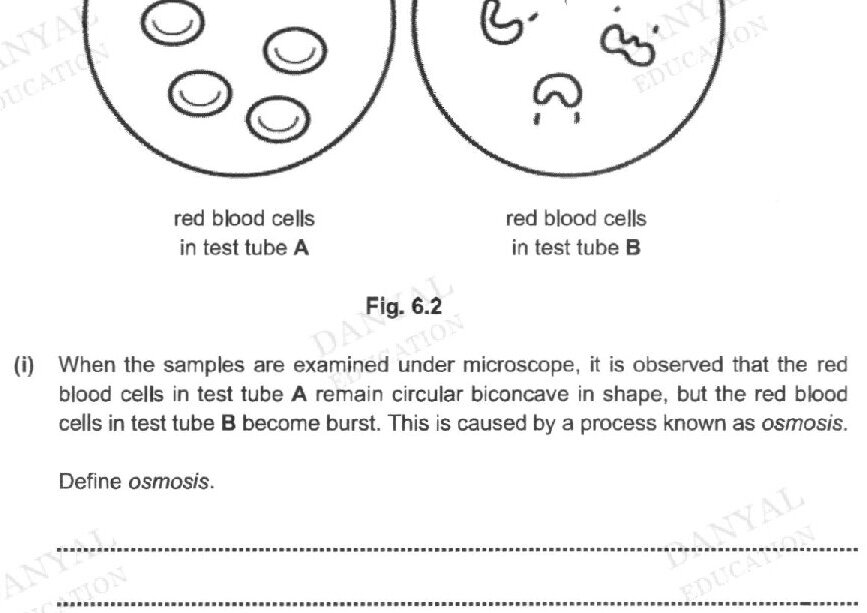
When the samples are examined under microscope, it is observed that the red blood cells in test tube A remain circular biconcave in shape, but the red blood cells in test tube B become burst. This is caused by a process known as osmosis. Define osmosis.
Complete the word equation to show the reaction between hydrochloric acid and potassium hydroxide.
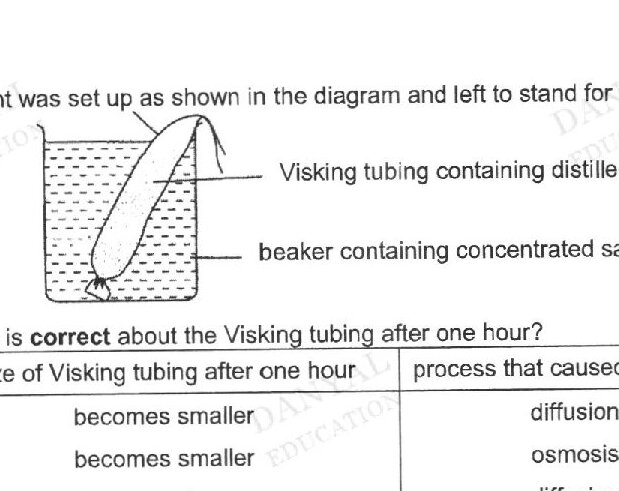
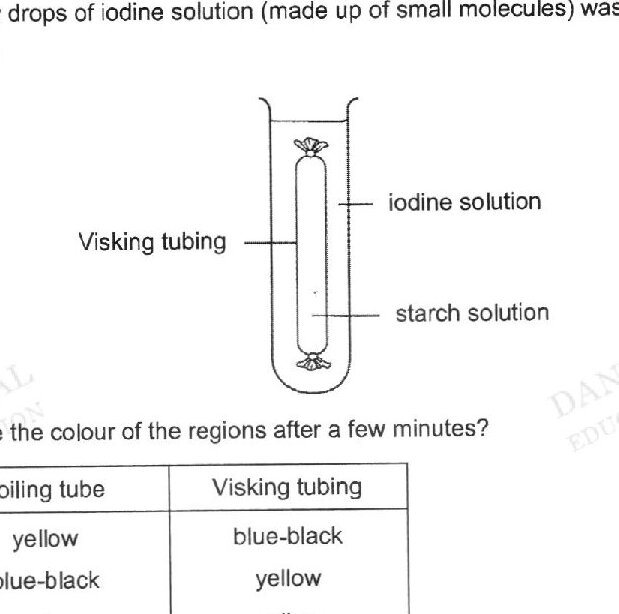
An experiment was set up as shown in the diagram and left to stand for one hour. Which option is correct about the Visking tubing after one hour?
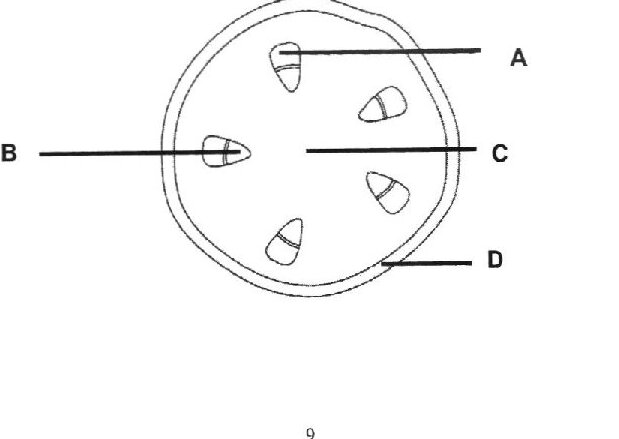
The diagram shows a section through the stem of a dicotyledonous plant. Which tissue transports sugars produced in the leaves during photosynthesis?
Using the knowledge of movement of substances, explain why the starch solution changed colour after 6 hours.
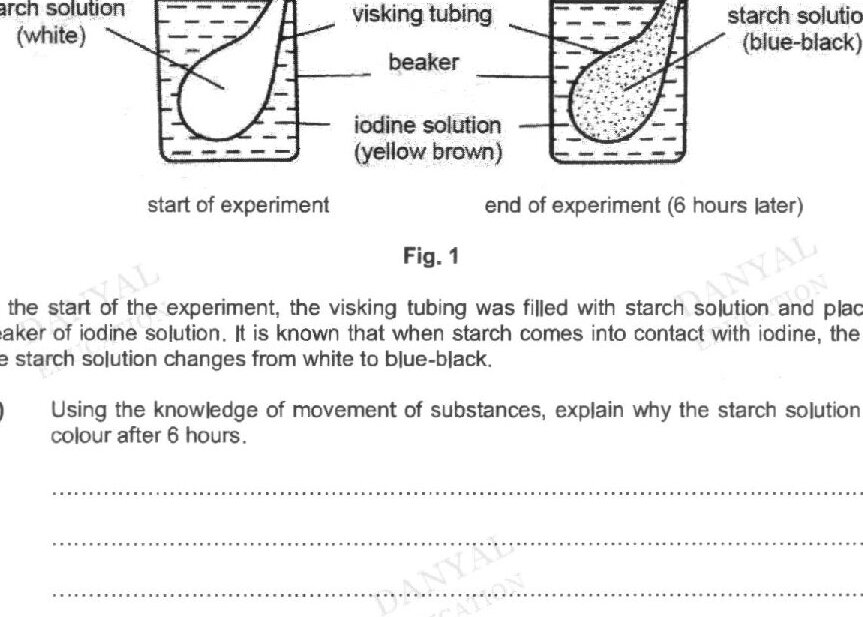
Suggest why the iodine solution in the beaker remains yellowish brown after 6 hours.
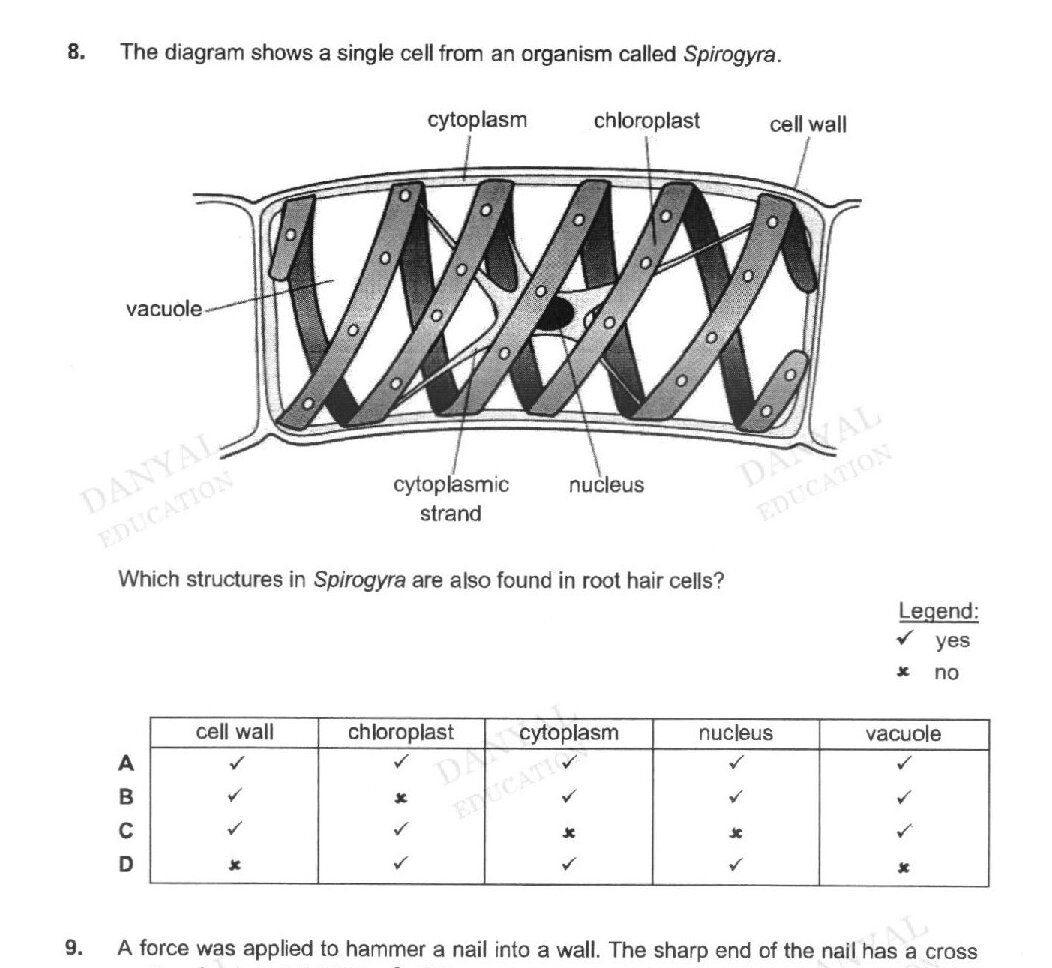
Which structures in Spirogyra are also found in root hair cells?
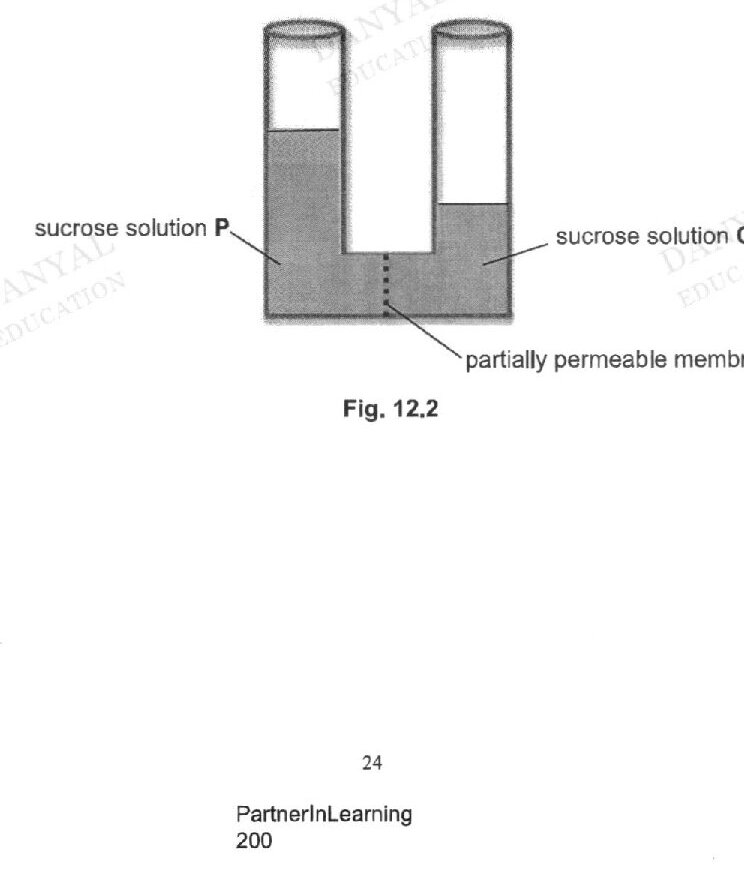
In an experiment, a U-shaped tube was filled with equal volumes of sucrose solutions P and Q. One sucrose solution had a concentration of 5 g/cm³ while the other had a concentration of 25 g/cm³. Fig 12.1 shows this experimental setup. Fig 12.2 shows the heights of solutions P and Q after one hour.
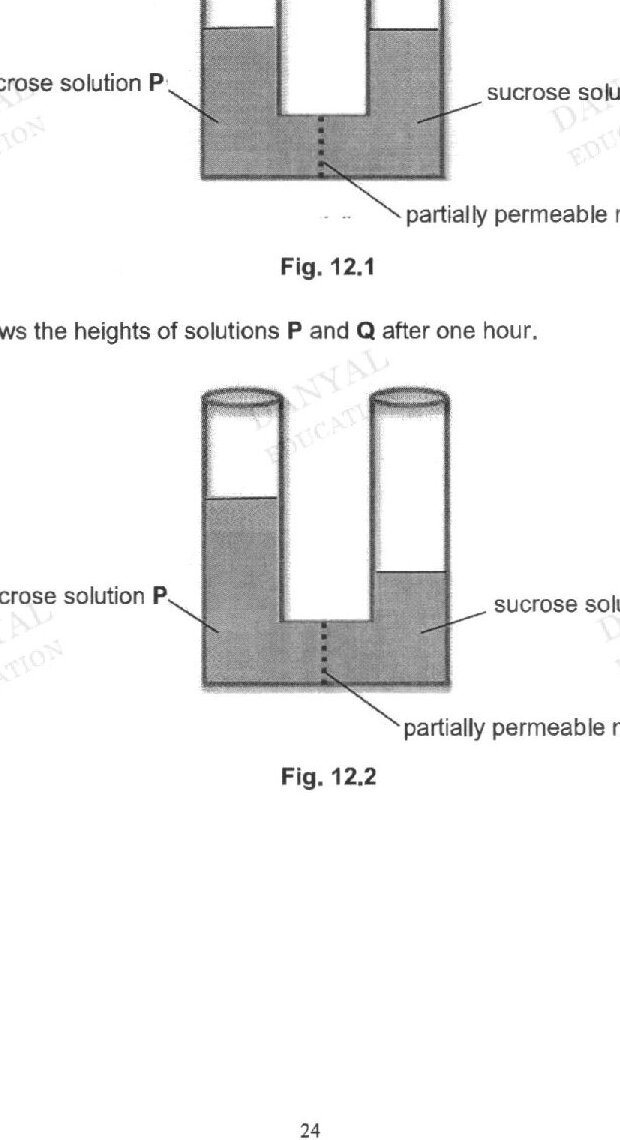
Describe and explain the results of this experiment.
A Viking tubing filled with starch solution was placed in a boiling tube containing water. A few drops of iodine solution (made up of small molecules) was added to the boiling tube. What will be the colour of the regions after a few minutes?
Explain the final position of the rod after two hours, with reference to a process in living things.
When solution X was replaced by 1% sugar solution, the position of the plastic rod did not change after two hours. Suggest a conclusion about the potato cube from this observation.
Past year papers cover the full exam — browse by subject below.
View All Papers ›