Human Digestive System
Human Digestive System - Complete Study Notes
Key Concepts
What is the Digestive System?
- The digestive system is a group of organs working together to break down food into smaller, soluble molecules that can be absorbed into the bloodstream
- Food provides nutrients for energy, growth, and repair
- The digestive system consists of the alimentary canal (a continuous tube from mouth to anus) and accessory organs (organs that help digestion but food doesn’t pass through them)
The Alimentary Canal Organs and Their Functions
1. Mouth
- Mechanical digestion: Teeth physically break down food into smaller pieces (chewing/mastication)
- Chemical digestion: Salivary glands produce saliva containing salivary amylase enzyme
- Salivary amylase breaks down starch into maltose
- Tongue rolls food into a bolus (ball of food) for swallowing
2. Oesophagus (Gullet)
- A muscular tube connecting mouth to stomach (approximately 25 cm long)
- No digestion occurs here
- Uses peristalsis - wave-like muscular contractions that push food downward
- Peristalsis works even if you’re upside down!
3. Stomach
- A muscular bag that churns food (mechanical digestion)
- Stomach wall produces gastric juice containing:
- Hydrochloric acid (HCl): Kills bacteria, provides acidic pH for pepsin to work
- Pepsin enzyme: Breaks down proteins into polypeptides
- Mucus: Protects stomach wall from acid and pepsin
- Food stays in stomach for 2-4 hours, becoming a semi-liquid called chyme
4. Small Intestine
- The longest part of digestive system (approximately 6 meters long)
- Divided into three parts: duodenum (first part), jejunum, and ileum
- Most digestion and absorption happens here
In the Duodenum:
- Receives bile from the gall bladder via bile duct
- Receives pancreatic juice from the pancreas
- Intestinal glands produce intestinal juice
- All three juices complete the digestion of carbohydrates, proteins, and fats
Throughout the Small Intestine:
- Inner wall has millions of tiny finger-like projections called villi (singular: villus)
- Villi increase surface area for maximum absorption of digested food
5. Large Intestine (Colon)
- Approximately 1.5 meters long
- No digestion occurs here
- Main functions:
- Absorbs water from undigested food
- Absorbs minerals and vitamins
- Stores undigested waste (faeces) temporarily
6. Rectum and Anus
- Rectum: Stores faeces before egestion
- Anus: Opening where faeces leaves the body (egestion)
pH and Enzyme Activity
- Pepsin works in acidic conditions (stomach, pH ~2)
- Salivary amylase is inactivated by the stomach acid — it cannot work in acidic conditions
- Pancreatic amylase and lipase work best in slightly alkaline conditions in the small intestine
- Bile (which is alkaline) helps neutralise stomach acid entering the duodenum, providing the correct slightly alkaline pH for enzymes in the small intestine
Accessory Organs
1. Salivary Glands
- Located in the mouth region
- Produce saliva containing salivary amylase
2. Liver
- Largest internal organ in the body
- Produces bile - a greenish-yellow liquid
- Bile is stored in the gall bladder
- Bile is NOT an enzyme; it emulsifies fats (breaks large fat droplets into tiny droplets)
- This increases surface area for lipase enzyme to work on
3. Gall Bladder
- Small sac beneath the liver
- Stores and concentrates bile
- Releases bile into duodenum when needed
4. Pancreas
- Produces pancreatic juice containing three important enzymes:
- Pancreatic amylase: Continues starch digestion
- Trypsin: Continues protein digestion
- Lipase: Digests fats into fatty acids and glycerol
Important Definitions
Digestion: The process by which large, insoluble food molecules are broken down into small, soluble molecules that can be absorbed into the bloodstream.
Mechanical Digestion: The physical breakdown of food into smaller pieces without changing its chemical structure. Examples: chewing, churning in stomach, peristalsis.
Chemical Digestion: The breakdown of large food molecules into smaller molecules using enzymes, changing the chemical structure of food.
Enzyme: A biological catalyst that speeds up chemical reactions in living organisms without being used up in the process.
Peristalsis: Wave-like muscular contractions of the alimentary canal that push food along from the oesophagus to the anus.
Absorption: The process by which small, soluble food molecules pass through the intestinal wall into the bloodstream or lymphatic system.
Egestion: The removal of undigested food waste (faeces) from the body through the anus.
Bolus: A ball of chewed food mixed with saliva, ready to be swallowed.
Chyme: Semi-liquid, partially digested food in the stomach after mixing with gastric juice.
Villi (singular: Villus): Tiny finger-like projections on the inner wall of the small intestine that increase surface area for absorption.
Emulsification: The process of breaking large fat droplets into smaller droplets, increasing surface area for enzyme action (performed by bile).
Alimentary Canal: The continuous muscular tube running from mouth to anus through which food passes during digestion.
Worked Examples
Example 1: Tracing the Digestion of Starch
Question: Describe the complete digestion of starch from the moment it enters the mouth until the final products are absorbed. Include all organs, enzymes, and products.
Step-by-step solution:
Step 1 - Mouth:
- Starch enters in food (e.g., rice, bread)
- Salivary amylase enzyme in saliva breaks down starch
- Chemical equation: Starch → Maltose
- This process begins but is incomplete in the mouth
Step 2 - Oesophagus:
- No digestion of starch occurs
- Food bolus moves down by peristalsis
Step 3 - Stomach:
- No starch digestion occurs (acidic conditions stop salivary amylase from working)
- Food is churned mechanically
Step 4 - Small Intestine (Duodenum):
- Pancreatic amylase from pancreatic juice continues breaking down remaining starch
- Chemical equation: Starch → Maltose
- Maltase enzyme from intestinal juice completes digestion
- Chemical equation: Maltose → Glucose + Glucose
Step 5 - Absorption:
- Glucose molecules are small and soluble
- Glucose is absorbed through villi into blood capillaries
- Blood carries glucose to all body cells for respiration (energy release)
Answer summary: Starch → (salivary amylase) → Maltose → (pancreatic amylase) → Maltose → (maltase) → Glucose → absorbed into blood
Example 2: Explaining Why the Small Intestine is Well-Adapted for Absorption
Question: Explain four structural features of the small intestine that make it efficient for absorption. (4 marks)
Step-by-step solution:
Feature 1: The small intestine is very long (approximately 6 meters)
- Why this helps: Provides more time and space for absorption to occur
Feature 2: The inner wall has millions of villi
- Why this helps: Greatly increases the surface area available for absorption
Feature 3: Each villus has a very thin wall (one cell thick)
- Why this helps: Short diffusion distance allows faster absorption of nutrients
Feature 4: Each villus contains a dense network of blood capillaries
- Why this helps: Maintains a concentration gradient by continuously removing absorbed nutrients, ensuring maximum absorption
Additional feature (bonus): Microvilli on epithelial cells
- Why this helps: Further increases surface area for absorption
Exam answer format:
- Long length provides more time and surface area for absorption. ✓
- Millions of villi increase surface area for absorption. ✓
- Thin wall (one cell thick) provides short diffusion distance. ✓
- Rich blood supply maintains concentration gradient for continuous absorption. ✓
Example 3: Comparing Mechanical and Chemical Digestion
Question: Complete the table below comparing mechanical and chemical digestion. (6 marks)
| Feature | Mechanical Digestion | Chemical Digestion |
|---|---|---|
| Definition | ||
| Where it occurs | ||
| Examples |
Step-by-step solution:
Row 1 - Definition:
- Mechanical digestion: Physical breakdown of food into smaller pieces without changing chemical structure
- Chemical digestion: Breakdown of large molecules into smaller molecules using enzymes, changing chemical structure
Row 2 - Where it occurs:
- Mechanical digestion: Mouth (chewing), stomach (churning), throughout alimentary canal (peristalsis)
- Chemical digestion: Mouth, stomach, small intestine (where enzymes are present)
Row 3 - Examples:
- Mechanical digestion: Chewing by teeth, churning in stomach, peristalsis in oesophagus
- Chemical digestion: Starch broken down by amylase, proteins broken down by pepsin, fats broken down by lipase
Complete answer:
| Feature | Mechanical Digestion | Chemical Digestion |
|---|---|---|
| Definition | Physical breakdown into smaller pieces without chemical change ✓ | Breakdown using enzymes with chemical change ✓ |
| Where it occurs | Mouth, stomach, throughout alimentary canal ✓ | Mouth, stomach, small intestine ✓ |
| Examples | Chewing, churning, peristalsis ✓ | Enzyme action (amylase on starch, pepsin on proteins, lipase on fats) ✓ |
Common Mistakes to Avoid
Mistake 1: Confusing Digestion with Absorption
- Wrong: “Food is digested in the villi”
- Correct: “Food is digested in the lumen (space) of the small intestine, then absorbed through the villi”
- Remember: Digestion = breaking down; Absorption = taking in
Mistake 2: Saying Bile is an Enzyme
- Wrong: “Bile enzyme digests fats”
- Correct: “Bile emulsifies fats; lipase enzyme digests fats”
- Remember: Bile prepares fats but doesn’t break chemical bonds
Mistake 3: Mixing Up Products of Digestion
- Wrong: “Starch is digested into amino acids”
- Correct: “Starch → Maltose → Glucose” / “Proteins → Polypeptides → Amino acids” / “Fats → Fatty acids and glycerol”
- Remember: Learn the specific pathway for each food type
Mistake 4: Wrong Enzyme Locations
- Wrong: “Pepsin works in the small intestine”
- Correct: “Pepsin works in the stomach (needs acidic conditions)”
- Remember: Each enzyme works best in specific locations with specific pH
Mistake 5: Confusing Egestion with Excretion
- Wrong: “Faeces are excreted through the anus”
- Correct: “Faeces are egested through the anus”
- Remember: Egestion = removing undigested food; Excretion = removing metabolic waste
Mistake 6: Not Being Specific About Enzyme Actions
- Wrong: “Amylase breaks down food”
- Correct: “Amylase breaks down starch into maltose”
- Remember: Always state the substrate (what it acts on) and product (what it forms)
Mistake 7: Forgetting Mechanical Digestion
- Wrong: Only mentioning chemical digestion when asked about digestion
- Correct: Include both mechanical (physical) and chemical digestion
- Remember: The question often asks about digestion in general
Mistake 8: Wrong Order of Organs
- Wrong: Mouth → Stomach → Oesophagus → Small intestine
- Correct: Mouth → Oesophagus → Stomach → Small intestine → Large intestine → Rectum → Anus
- Remember: Food always travels in one direction through the alimentary canal
Mistake 9: Incomplete Villus Adaptations
- Wrong: Just saying “villi have large surface area”
- Correct: Mention thin wall, rich blood supply, large surface area, presence of lacteal
- Remember: Explain HOW each feature helps absorption
Mistake 10: Confusing Function of Large Intestine
- Wrong: “The large intestine digests food and absorbs nutrients”
- Correct: “The large intestine absorbs water and minerals; no digestion occurs”
- Remember: By the time food reaches large intestine, digestion is complete
Exam Tips
Keywords to Include for Maximum Marks
When describing digestion:
- “Mechanical digestion” AND “chemical digestion”
- “Large, insoluble molecules” → “small, soluble molecules”
- “Broken down by enzymes”
- Name the specific enzyme and substrate
When describing absorption:
- “Through villi”
- “Into blood capillaries” or “into lacteal”
- “Diffusion” or “active transport”
- “Short diffusion distance”
- “Concentration gradient”
When describing enzyme action:
- Name of enzyme (e.g., “amylase”)
- Substrate (what it acts on, e.g., “starch”)
- Product (what it forms, e.g., “maltose”)
- Location (where it works, e.g., “mouth and small intestine”)
- Use the format: [location] + [enzyme name] + [substrate] → [product]. Example: “In the mouth, salivary amylase breaks down starch into maltose.” Never just write the enzyme name without its substrate and product.
Bile vs Lipase — A Critical Distinction
In any question about fat digestion, always distinguish bile from lipase explicitly:
- Bile emulsifies fats (physical — breaks large droplets into small droplets, increases surface area) but does NOT break chemical bonds
- Lipase is the enzyme that chemically digests fats into fatty acids and glycerol
- Examiners penalise answers that call bile an enzyme or omit this distinction
Mark-Earning Phrases
For 1-mark answers:
- “Increases surface area for absorption”
- “Maintains concentration gradient”
- “Short diffusion distance”
- “Provides acidic conditions” (for stomach/pepsin) or “provides alkaline conditions” (for small intestine/amylase/lipase)
For 2-mark answers:
- “The enzyme [name] breaks down [substrate] into [product]”
- “Villi increase surface area, which allows more absorption to occur”
- “Thin wall means short diffusion distance, so nutrients are absorbed faster”
For longer answers (3-4 marks):
- Give location + process + reason
- Example: “In the mouth, salivary amylase breaks down starch into maltose. This is chemical digestion because enzymes change the chemical structure of food molecules.”
Answering Different Question Types
“Describe the function of…” questions:
- State WHAT it does
- State WHY/HOW this is important
- Example: “The stomach churns food (what), which breaks it into smaller pieces to increase surface area for enzyme action (why).”
“Explain why…” questions:
- Must give a reason/cause-effect relationship
- Use linking words: “because,” “therefore,” “so that,” “which allows”
- Example: “Villi have thin walls because this provides a short diffusion distance, which speeds up absorption.”
“Compare…” questions:
- Make direct comparisons
- Use comparative words: “whereas,” “while,” “but,” “in contrast”
- Structure: Feature A in X, whereas/but Feature A in Y
Diagram questions:
- Always use a ruler for labels
- Label lines should touch the structure
- Don’t cross label lines
- Use the exact terms from your notes
How to Structure Long Answers
For process descriptions (e.g., “Describe the digestion of starch”):
- Start with the organ where it begins
- Go in chronological/spatial order
- Include enzyme names, substrates, and products
- End with absorption
- Use connecting words: “first,” “then,” “next,” “finally”
For explanation questions (e.g., “Explain how the small intestine is adapted for absorption”):
- State the feature/structure
- Explain how this feature works
- Link to the function (absorption)
- Repeat for each feature
Quick Summary
Essential Points for Revision
✓ Digestion: Breaking down large, insoluble food molecules into small, soluble molecules using mechanical and chemical means
✓ Alimentary canal organs in order: Mouth → Oesophagus → Stomach → Small intestine → Large intestine → Rectum → Anus
✓ Accessory organs: Salivary glands, liver, gall bladder, pancreas (food doesn’t pass through these)
✓ Three types of food and their digestion products:
- Carbohydrates (starch) → maltose → glucose
- Proteins → polypeptides → amino acids
- Fats → fatty acids and glycerol
✓ Key enzymes to memorize:
- Salivary amylase (mouth): starch → maltose
- Pepsin (stomach): proteins → polypeptides
- Pancreatic amylase (small intestine): starch → maltose
- Trypsin (small intestine): proteins/polypeptides → shorter polypeptides
- Lipase (small intestine): fats → fatty acids and glycerol
- Maltase (small intestine): maltose → glucose
✓ Bile is NOT an enzyme: It emulsifies fats (makes large droplets smaller) to increase surface area for lipase
✓ Stomach produces: Gastric juice containing hydrochloric acid, pepsin, and mucus
✓ Small intestine is the main site of digestion and absorption: Has villi with thin walls, rich blood supply, and large surface area
✓ Villi adaptations: Thin wall (one cell thick), numerous microvilli, rich blood capillary network, lacteal present
✓ Large intestine function: Absorbs water and minerals; stores faeces (NO digestion occurs here)
✓ Peristalsis: Wave-like muscle contractions that push food through the alimentary canal
✓ Egestion vs Excretion: Egestion = removal of undigested food (faeces); Excretion = removal of metabolic waste
Final Tip: When revising, draw and label the digestive system diagram from memory, then check against your notes. Also practice writing out the enzyme pathways for carbohydrates, proteins, and fats until you can do it perfectly every time!
The diagram illustrates the chemical digestion of fats into substances W and X by enzyme T. Which row correctly represents T, W and X?
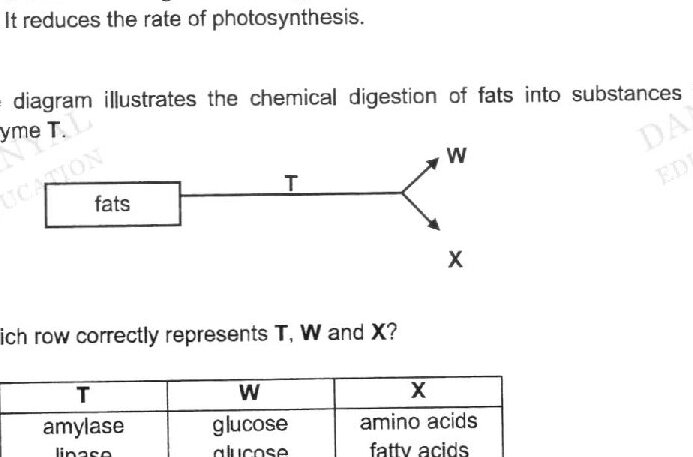
Cystic fibrosis is a genetic disorder that is passed down from one generation to the next. It causes persistent lung infections and limits a person's ability to breathe over time. Which structure is responsible for the inheritance of this disorder from the person's parents to the child?
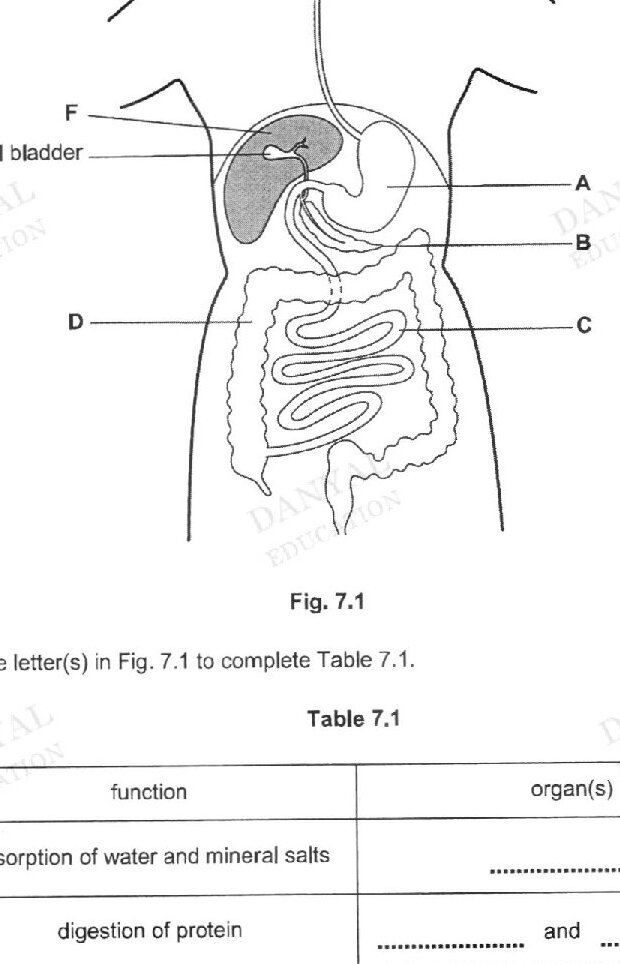
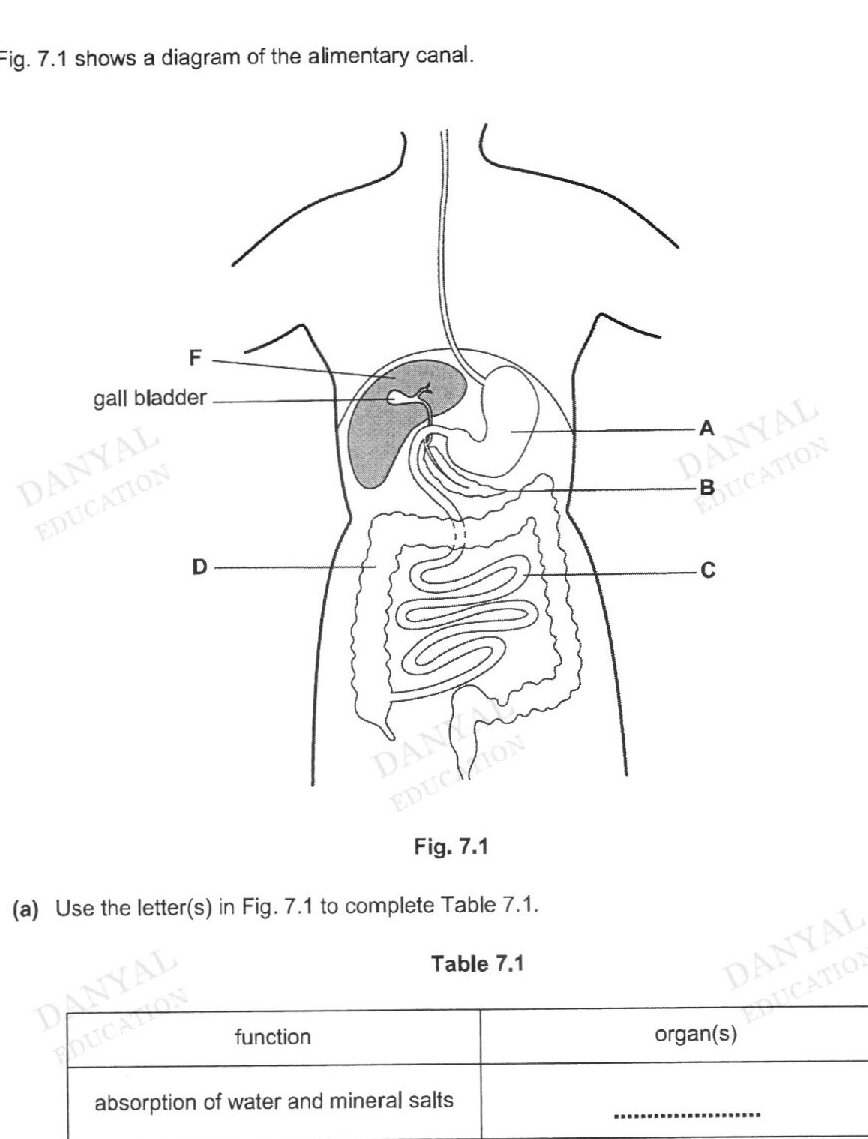
Use the letter(s) in Fig. 7.1 to complete Table 7.1.
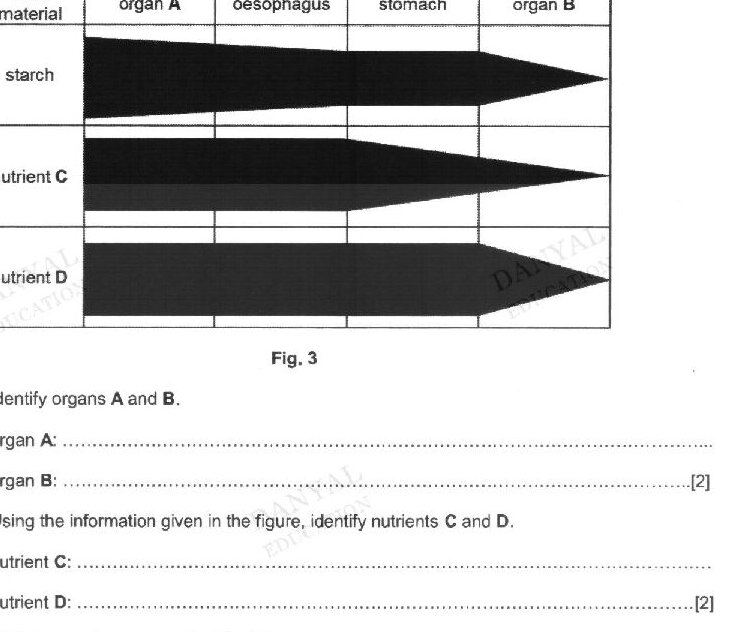
Identify organs A and B.
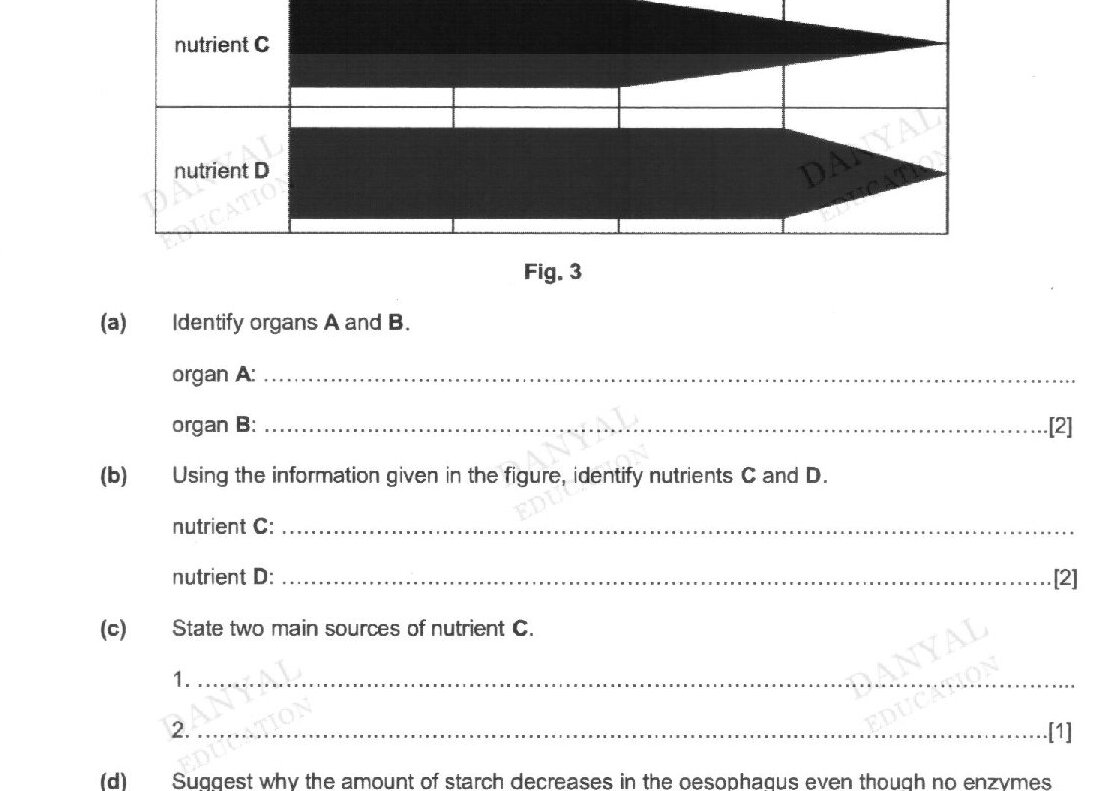
Using the information given in the figure, identify nutrients C and D.
On the space provided in Fig. 5.2, use the correct circuit symbols to complete the circuit diagram for the circuit arrangement shown in Fig. 5.1.
Gallstones are hard crystals which can sometimes form abnormally in gall bladder which is shown in Fig. 7.1. They can cause severe pain and blockage. As a result, surgeons often remove gall bladder to reduce the risk of infections. Explain how the removal of gall bladder will affect the digestion of fats.
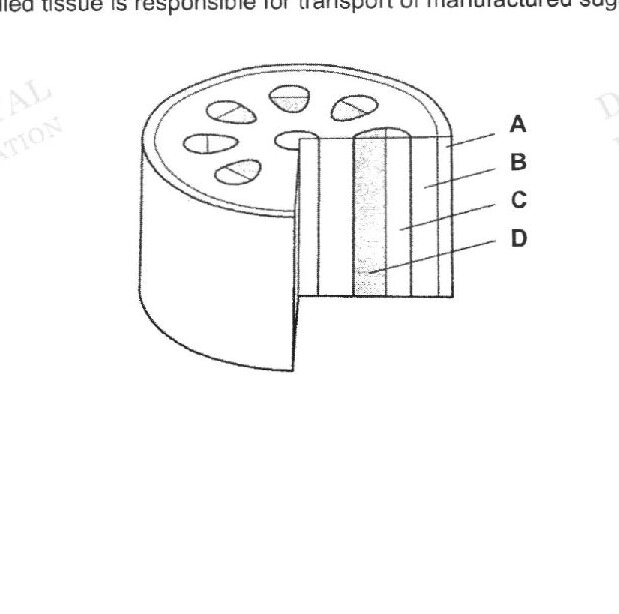
The diagram shows a section of a stem. Which labelled tissue is responsible for transport of manufactured sugars?
On Fig. 4.1, draw label lines with letters to show: A where bile is stored B where egestion occurs.
Mechanically digested food travels from the mouth to the stomach. The gastric juice in the stomach contains hydrochloric acid, providing a low pH environment. Explain why it is important to have a low pH in the stomach.
A student investigated the digestion of fats by an enzyme from the small intestine. He found that as the fats were digested, the pH of the solution changed from pH 8 to pH 6. Explain why the digestion of fats changed the pH of the solution.
Patients with diabetes are unable to produce a protein, insulin, to regulate their blood glucose concentration. Explain why it is recommended that insulin be injected directly into the bloodstream of the patient instead of being taken in tablet form orally.
Past year papers cover the full exam — browse by subject below.
View All Papers ›